Combined effects of deficit irrigation and fresh-cut
processing on quality and bioactive compounds
of nectarines
N. Falagán
1,2, F. Artés
1,2, P.A. Gómez
2, F. Artés-Hernández
1,2,
A. Pérez-Pastor
3, J.M. de la Rosa
3, E. Aguayo
1,21
Postharvest and Refrigeration Group, Department of Food Engineering, Technical Universtiy
of Cartagena, Cartagena, Spain
2
Institute of Plant Biotechnology, Technical University of Cartagena, Cartagena, Spain
3Soil-Water-Plant Group, Department of Plant Production, Technical University
of Cartagena, Cartagena, Spain
Abstract
Falagán N., Artés F., Gómez P.A., Artés-Hernández F., Pérez-Pastor A., de la Rosa J.M., Aguayo E. (2015): Combined effects of deficit irrigation and fresh-cut processing on quality and bioactive compounds of nectar-ines. Hort. Sci. (Prague): 42: 125–131.
Water scarcity makes necessary the use of tools for increasing water productivity such as regulated deficit irrigation strategies (RDI). The effect of RDI on fresh-cut white flesh extra-early nectarine was studied. Initially, the soluble solids content of nectarines from RDI was higher than in control and over-irrigated fruits (9.72 ± 0.20 vs. 8.57 ± 0.05°Brix, re-spectively) but after shelf-life storage no differences were found. During storage, RDI fruits had a more stable antioxidant capacity and soluble phenolic content. This treatment showed 10% more vitamin C than the other irrigation treatments, due to an increase in dehydroascorbic acid content. No pathogenic bacteria growth was found and all microbial counts were below the European legal limits. For all the irrigation treatments, the final sensorial scores were above the limit of marketability. Overall, RDI enabled savings of about 1,260 m3 of water/ha and year, without negatively affecting the quality of the fruit, allowing for their use as a fresh-cut product with a shelf-life of 8 days at 5°C.
Keywords: Prunus persica; minimally processed; microbial and sensory quality
Presently, an increasing commitment for optimiz-ing water productivity is beoptimiz-ing developed, especial-ly in dry areas (Paço et al. 2013). For example, in the Mediterranean basin, agriculture is limited by water scarcity and often by the poor quality of this resource. Besides a structural water deficit, com-petition from other uses (tourist and residential development) adds to the problem (Abrisqueta et al. 2010). In addition, irrigation management is set to shift from emphasizing production per unit
area towards maximizing the production per unit of water consumed, namely, water productivity (Fereres, Soriano 2007). Within stone fruit cul-tivars, peaches and nectarines (Prunus persica (L.) Batsch) are the fourth more important fruit crop in the world and the second one in Europe, with Spain being the fourth largest world producing country (FAOSTAT 2015). Growing stone fruit requires large amount of water, which is not always available in these areas, as they sometimes suffer emergency
drought situations (Vera et al. 2012). Therefore, it is necessary to search for new strategies for a more efficient management of irrigation water to obtain max. water productivity and min. environ-mental impact(Fereres, Soriano 2007). One of these strategies is the application of water below the total crop evapotranspiration requirements (ETc) during certain phenological periods, known as regulated deficit irrigation (RDI) (Chalmers et al. 1981). Previous studies have shown that in whole stone fruits, such as peach, nectarine or apricot, quality attributes are maintained using RDI strategies (Gelly et al. 2004; Pérez-Pastor et al. 2007). It has also been reported that water deficit promotes and allows for the concentration of bioactive compounds in whole (Barbagallo et al. 2013; Laribi et al. 2013; Navarro et al. 2015) and cut products (Peña et al. 2013). Bioactive com-pounds, such as ascorbic acid (AsA), phenols, an-thocyanins, flavonoids and carotenoids are part of the plant’s defence system, and many of them have human health-promoting effects that are linked to the prevention of cancer and cardiovascular dis-eases (Boeing et al. 2012; Haminiuk et al. 2012; Barbagallo et al. 2013). Moreover, RDI is more interesting in extra-early varieties, as their maxi-mum irrigation requirements occur in periods of relatively low evaporative demand. In recent years there has been also an increasing demand for fresh-cut (FC) fruits and vegetables all over the world due to the changes in lifestyle as well as the health ben-efits associated with their consumption, which is attributed to their content in phytochemical com-pounds, which scavenge free radicals (Rico et al. 2007). In fact, the fresh-cut industry has become a multi-billion dollar international industry (Santos et al. 2014). For all these reasons, the main aim of
the present work was to study how RDI affects the overall quality and content of bioactive compounds of FC extra-early nectarines which were stored for 8 days at 5°C.
MATERIAL AND METHODS
The study was conducted in the 2010–2011 grow-ing season in a commercial orchard located in Mur-cia (38°8'N, 1°13'W). The experimental plot had an area of 2 ha and consisted of 11-year-old extra-early nectarine trees cv. VioWhite 5 grafted onto plum cv. Puebla de Soto 101 rootstock at a spacing of 6 × 3.5 m. This cultivar was chosen because of its high commercial value due to its early picking date, which commands a high market price, and its suit-able size for European sales. The electrical conduc-tivity of the irrigation water varied between 1.5 and 2.5 dS/m, depending on the water source used (rigation canal, well or a mix of both). The drip ir-rigation system had two lines per tree row and nine pressure-compensated emitters (1.6 l/h) per tree placed every 75 cm. Irrigation was scheduled weekly and applied daily at night throughout the study pe-riod. During the experiment, three different irriga-tion treatments were applied: (i) Control (CTL), ir-rigated at 110% of ETc during the whole season in order to avoid limiting soil water conditions, deter-mined from the crop reference evapotranspiration (ET0 Penman-Monteith method, Allen et al. 1998); (ii) regulated deficit irrigation (RDI), irrigated at 110% ETc during the critical periods (second rapid fruit growth period and two months after harvest) and at 80 and 60% CTL during the second fruit growth stage in March and late postharvest (from July until the end of the previous growing season),
respective-Table 1. Precipitation and irrigation applied to control (CTL) regulated deficit irrigation (RDI) and over-irrigation (OI) treatments in each phenological period
Phenological period Period (days) Precipitation (m3/ha) Irrigation applied (m3/ha)
CTL RDI OI
Early postharvest 134–182 (2010) 440 1,320 1,320 1,210
Late postharvest 183–304 (2010) 720 2,940 1,720 2,760
Winter dormancy 305 (2010)–31 (2011) 810 350 390 440
Bloom and fruit set 32–59 (2011) 125 180 180 240
Fruit growth I and II 60–94 (2011) 422 480 390 550
Fruit growth III 95–126 (2011) 95 750 740 850
[image:2.595.65.532.622.756.2]ly, and (iii) over-irrigated treatment (OI), irrigated according to the criteria followed by the farmer, at 135% CTL and 115% CTL during the first and the last two fruit growth stages, respectively. In total, the amount of water applied in the CTL treatment dur-ing the season was 6,010 m3/ha and year, 4,750 m3/ha and year for RDI and 6,050 m3/ha and year in OI treatment. The water saving in RDI was 1,260 m3/ha and year. Precipitation and irrigation for each treat-ment and phenological period are shown in Table 1. The experimental design consisted of three repli-cates per treatment, following a randomized block design distributed within the orchard. Each replicate had three adjacent tree rows and contained 15 trees per row. Measurements were taken in trees from the central row, the other trees serving as borders. Nec-tarines (mean fruit calibre – 62 mm, mean fruit mass – 92.7 g) were picked at the beginning of ripening (21st April) taking into account their maturity index averaged to 6.11. The fruit was immediately trans-ported to the Pilot Plant in the Technical University of Cartagena in a ventilated vehicle. Nectarines were refrigerated in a cold room at 0–1°C and 90–95% of the relative humidity (RH). Individual pieces of fruit were selected by eliminating those with defects or bruises. Sound fruit was cut vertically into 6 to 8 wedges with a sharp stainless steel knife. Then, the nectarine wedges were dipped into a water solution at 5°C with 150 ppm NaClO (pH 6.0) for 2 min and rinsed out for 1 min in tap water at 5°C. The pieces (250 g) were then gently dried with filter paper and packaged in 2-l rigid polypropylene (PP) trays. All trays were heat-sealed (Barket, Befor Model, Chas-sieu, France) on top with a 35 µm-thick oriented PP film (Plásticos del Segura S.L., Murcia, Spain). Each 250 g tray was considered a replicate and all data are means of three replicates. To maintain near-ambient oxygen concentration in the trays, a 0.45-mm hole was punched through the film of each tray. All the trays were stored in a cold room at 5°C for 8 days to simulate shelf-life. The quality parameters of the FC nectarines were monitored on days 0, 5 and 8. For the analysis of bioactive compounds, nectarines were cut into small cubes, frozen in N2, ground to a fine powder with a mincer (IKA, A 11 basic, Berlin, Germany) and kept at –80°C until analysed.
Soluble solids content (SSC) measurements. Five of the nectarine wedges from each tray were homogenized in a commercial blender (Moulinex, Barcelona, Spain), with the juice used to measure the SSC, as described in Falagán et al. (2014).
Microbial analysis. To determine microbial growth (psychrophilic bacteria, mold and yeast), 10 g of FC nectarine tissue were collected from trays and homogenized for 1 min in 90 ml of sterile pep-tone-buffered water (Scharlau, Barcelona, Spain) in a sterile stomacher bag with a Colorworth Stomach-er 400 (Steward Laboratory, London, UK). SStomach-erial di-lutions were prepared in the same peptone solution. The presence of pathogenic bacteria (Escherichia coli, Listeria monocytogenes and Salmonella spp.) was also determined and evaluated according to the European legislation for FC plant commodities (EC Regulation 1441:2007 on microbiological crite-ria for food stuffs).The agar medium and incubation conditions were as described in Tomás-Callejas et al. (2011). All samples were carried out in tripli-cate. Microbial counts were reported as log10 colony forming units per g of sample (log CFU/g).
Sensory evaluation. A trained seven-person panel (aged 24–67) carried out the sensory evalu-ation in a room at 20°C. Before the evaluevalu-ation session, the panelists agreed on those attributes that better described sensory changes. Dehydra-tion, off-flavours and browning were scored on a nine-point scale of damage incidence and severity (1 – extreme, 3 – severe, 5 – moderate, limit of marketability, 7 – slight, 9 – none). Flavour, texture and overall quality were evaluated by using a nine-point scale (1 – extremely poor, 5 – fair, limit of usability, and 9 – excellent).
Analysis of bioactive compounds. Materials, ex-tractions and quantification for soluble phenolic con-tent (SPC), antioxidant capacity (AC) using the Ferric Reducing Ability of Plasma reagent, and vitamin C were as described by Falagán et al. (2014). SPC was expressed as mg gallic acid equivalents (GAE)/100 g fresh weight (f.w.). AC results were expressed as mg ascorbic acid equivalent (AsAE)/100 g f.w. Total vi-tamin C was expressed as the sum of both mg of ascorbic acid (AsA) and mg of dehydroascorbic acid (DHA) in 100 g f.w. All quality measurements were evaluated using three trays per treatment.
Statistical analysis. A randomized design with three replicates per treatment was used where each tray constituted a replicate. To determine the effect of RDI and storage time on each dependent variable, a two-way analysis of variance (ANOVA, P < 0.05) was carried out (Statgraphic Plus, version 5.1, Manugis-tic Inc, Rockville, USA). Mean values were compared by Fisher’s LSD test to identify significant differences and interactions among treatments and factors.
RESULTS AND DISCUSSION
SSC measurements
Simple factors such as irrigation treatment and time of storage and their interaction affected the SSC (data not shown). On initial evaluation, sam-ples under RDI had a higher SSC (9.8 ± 0.05°Brix) than CTL (8.6 ± 0.24°Brix) and OI samples (8.2 ± 0.20°Brix). At the end of storage period, all treat-ments showed similar SSC values (8.2 to 8.4°Brix). Previous researchers have reported that the reduc-tion of water supply leads to a higher initial SSC in whole apricot (Pérez-Pastor et al. 2007) or pome-granate (Laribi et al. 2013). The changes observed during storage were due to the consumption of sug-ars and organic acids as respiratory substrates in the fruit pieces. This is generally observed during climacteric fruit ripening and senescence (Crisos-to, Kader 2000), such as nectarines and peaches.
Microbial analysis
The presence of pathogenic bacteria was not de-tected in any irrigation treatment or evaluation day. Throughout the storage period, mold and yeast counts were lower than 2 log CFU/g. Similar counts were obtained for psychrophilic bacteria at days 0 and 5. However, at the end of the shelf-life pe-riod, the psychrophilic bacterial counts were 2.61 ± 0.14 log CFU/g for CTL pieces, 2.36 ± 0.17 log CFU/g for OI treatment and < 2 log CFU/g in RDI wedges. The counts obtained were under the
Euro-pean Union legal limits (EC Regulation 1441:2007) in all cases. These low counts and little growing of the colonies could be due to hygienic management during the minimal processing stage, and the prop-er storage tempprop-erature. Moreovprop-er, cv. VioWhite 5 is an acidic variety (pH 3.3) which complicates bacte-rial growth (Devlieghere et al. 2004).
Sensory evaluation
[image:4.595.71.510.544.690.2]For all treatments and sampling days, no off-fla-vours or dehydration were found. With respect to flavour, a decreasing trend with time of storage was registered, with scores falling from 7.6 to 5.8, with no significant differences among treatments (data not shown). A similar trend was found in texture; a loss of firmness in all treatments was found with scores ranging from 7.8 to 6.8 (≈10 to 12 N) although they were still high enough for the consumer’s ac-ceptance (Crisosto, Kader 2000). Browning was the most important factor that affected the appear-ance of the FC fruit (Fig. 1) increasing at day 5 in all treatments and obtaining similar scores among ir-rigation treatments by the end of the storage period. Enzymatic browning tends to be more noticeable in white flesh nectarines as in this case, and it appears on the cut-edge due to the breakdown of cells and the subsequent interaction of polyphenols and oxy-gen with polyphenol oxidase enzymes(Mishra et al. 2012). The overall quality of the nectarine wedges on the initial day showed no significant differences among the different types of irrigation (7.6 to 7.8). At day 8, a decreasing trend in overall quality was
Fig. 1.Sensory scores for (a) browning and (b) overall quality changes of cv. VioWhite 5 nectarines subjected to three irrigation treatments, freshly-cut and stored up to 8 days at 5°C
CTL – control; RDI – regulated deficit irrigation; OI – over-irrigated; bars with the same letters indicate no significant differ-ence at95% using LSD test; capital letters refer to time of storage, lowercase letters refer to irrigation treatment; data represent means of seven replicates (n = 7 ± SE)
12 3 4 5 6 7 8 9
Br
ow
ning
1 2 3 4 5 6 7 8 9
0 5 8
O
verall quality
CTL OI RDI
12 3 4 5 6 7 8 9
Br
ow
ning
1 2 3 4 5 6 7 8 9
0 5 8
O
verall quality
CTL OI RDI
Days at 5°C Days at 5°C
0 5 8 Aa Aa Aa
Bb Ba
Ba
BaCaBa
Aa Aa Aa
Bb BaBa
Ca Ca Ca
(a) (b)
found, but was still above the limit of marketability in all irrigation treatments (Fig. 1).
Analysis of bioactive compounds
On harvesting day, nectarine pieces from CTL and OI wedges contained more phenolic compounds than RDI fruits (Fig. 2). At day 5, OI samples had a lower level than CTL and RDI sample pieces. At the end of the storage period, the CTL and RDI treat-ment pieces reached the highest values vs. the OI treatment. As observed, the results obtained for SPC showed a decreasing trend during shelf-life storage, mainly in CTL and OI fruit pieces, while in wedges from RDI the values registered were much more sta-ble (Fig. 2). According to Romero et al. (2002), this fact can be due to the activation of the phenolic biosynthesis pathway. As observed in Tovar et al. (2002), this could have been provoked by the stress suffered under RDI, which leads to an increase in l-phenylalanine ammonia lyase activity, which is the main enzyme in this metabolic pathway.
Nectarines are nutritionally important because of their high acceptance by consumers (Cantín et al. 2009), although they usually have lower antioxi-dant content than other fruits such as strawberry, apple or orange (Rupasinghe, Clegg 2007). In this work, the initial AC levels ranged from 32 to 34 mg AsAE/100 g f.w. for all treatments. This range was stable during the shelf-life period, with no significant differences as regards to storage time
or type of irrigation (Fig. 3). These levels are in agreement with those reported on different white flesh nectarine cultivars (14 to 104 mg AsAE/100 g f.w.) when evaluated with the FRAP method (Gil et al. 2002). The AC was well maintained in all treat-ments without decreasing. This was probably due to membrane damage (cuts), which leads to an in-crease in the biosynthesis of antioxidant metabo-lites as cell try to compensate for the effects of such damage (Vinã, Chaves 2006). The AC highly cor-related with SPC (R2 = 0.87, data not shown).
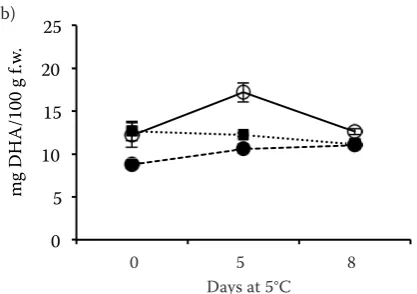
[image:5.595.69.284.96.240.2]Vitamin C was reported as the combination of mg AsA and mg of DHA, its oxidized form. It is impor-tant to measure both molecules because DHA shows the equivalent biological activity to AsA (Spínola et al. 2014). On the initial day and after 5 days of stor-age, CTL had a higher AsA content than the other irrigation treatments (Fig. 4a). In spite of this, at the end of storage, a difference among irrigation treat-ments was not found. DHA content had an opposite behavior as compared to AsA content. CTL nectar-ine wedges had lower levels than OI and RDI sam-ples during the experiment (Fig. 4b). At the end of the storage period, the wedges from the nectarines under RDI showed the highest DHA content than the other irrigation treatments. The results show that water stress affected the oxidation of AsA into DHA, by activating the ascorbate peroxidase en-zyme (Falagán et al. 2015). The trend of total vi-tamin C followed the behaviour observed for DHA, being higher for nectarine wedges under RDI treat-ment during the entire period of storage (Fig. 4c). Fig. 2. Changes on soluble phenolic content of cv. VioWhite
5 nectarines subjected to three irrigation treatments freshly cut and stored up to 8 days at 5°C
CTL – control; RDI – regulated deficit irrigation; OI – over-irrigated; vertical bars indicate the standard error of the means (n = 3 ± SE); LSD (5%)irrigation treatment × time= 6.70
Fig. 3. Total antioxidant capacity changes of cv. VioWhite 5 nectarines subjected to three irrigation treatments, then freshly cut and stored up to 8 days at 5°C
CTL – control; RDI – regulated deficit irrigation; OI – over-irrigated; vertical bars indicate the standard error of the means (n = 3 ± SE); changes were not statistically significant between storage time and type of irrigation at 95%
0 10 20 30 40 50 60
0 5 8
mg GAE/100 g f.w
.
Days at 5°C
CTL OI RDI
0 5 10 15 20 25 30 35 40 45
0 5 8
mg A
A
E/100 g f.w
.
Days at 5°C
CTL OI RDI
0 10 20 30 40 50 60
0 5 8
mg GAE/100 g f.w
.
Days at 5°C
CTL OI RDI
0 5 10 15 20 25 30 35 40 45
0 5 8
mg A
s
A
E/100 g f.w
.
Days at 5°C
CTL OI RDI
Days at 5°C Days at 5°C
[image:5.595.311.521.521.657.2]CONCLUSION
Fresh cut VioWhite 5 nectarines from RDI had the initial SSC higher than CTL samples. Furthermore, during storage, RDI fruits had a more stable anti-oxidant capacity and soluble phenolic content than those from CTL and OI treatments. This treatment had 10% more vitamin C than the other irrigation treatments, due to an increased dehydroascorbic acid content. The use of RDI achieved an important saving of 1,260 m3/ha and year of water. The results lead us to conclude that RDI did not negatively af-fect the suitability of cv. VioWhite 5 nectarines for FC processing obtaining a healthy and fresh, ready-to-eat fruit and produced by a sustainable system.
References
Abrisqueta I., Tapia L.M., Conejero W., Sánchez-Toribio M.I., Abrisqueta J.M., Vera J., Ruiz-Sánchez M.C. (2010): Re-sponse of early-peach (Prunus persica L.) trees to deficit ir-rigation. Spanish Journal of Agricultural Research,8: 30–39. Allen R., Pereira L., Raes D., Smith M. (1998): Crop evapo-transpiration. Guidelines for computing crop water re-quirements. FAO Irrigation and Drainage. Paper No. 56. Rome, Italy.
Barbagallo R.N., Di Silvestro I., Patanè C. (2013): Yield, physico-chemical traits, antioxidant pattern, polyphenol oxidase activ-ity and total visual qualactiv-ity of field-grown processing tomato cv. Brigade as affected by water stress in Mediterranean climate. Journal of the Science of Food and Agriculture, 93: 1449–1457. Boeing H., Bechthold A., Bub A., Ellinger S., Haller D., Kroke A., Leschik-Bonnet E., Müller M.J., Oberritter H., Schulze M., Stehle P., Watzl B. (2012): Critical review: Vegetables and fruit in the prevention of chronic diseases. European Journal of Nutrition, 51: 637–663.
Cantín C.M., Moreno M.A., Gogorcena Y. (2009): Evalu-ation of the antioxidant capacity, phenolic compounds, and vitamin C content of different peach and nectarine (Prunus persica (L.) Batsch) breeding progenies. Journal of Agricultural and Food Chemistry, 57: 4586–4592. Chalmers D.J., Mitchell P.D., Van Heek L. (1981): Control
of peach tree growth and productivity by regulated water supply, tree density and summer pruning. Journal of the American Society for Horticultural Science, 106: 307–312. Crisosto C.H., Kader A.A. (2000): Nectarines. Postharvest
quality maintenance guidelines. Department of Pomol-ogy, Davis, University of California. Available at http:// postharvest.ucdavis.edu
[image:6.595.312.521.94.241.2]Devlieghere F., Vermeulen A., Debevere J. (2004): Chitosan: antimicrobial activity, interactions with food components and applicability as a coating on fruit and vegetables. Food Microbiology, 21: 703–714.
Fig. 4.Vitamin C content (c) as the sum of both mg of ascor-bic acid (AsA) (a) and mg of dehydroascorascor-bic acid (DHA) (b) of cv. VioWhite 5 nectarines subjected to three irriga-tion treatments, freshly cut and stored up to 8 days at 5°C CTL – control; RDI – regulated deficit irrigation; OI – over-irrigated; vertical bars indicate standard error of the the means (n = 3 ± SE); for AsA content changes: LSD (5%)irrigation treatment
× time = 0.50; for DHA LSD (5%)irrigation treatment × time = 2.89; for
total vitamin C: LSD (5%)irrigation treatment × time = 2.87
0 5 10 15 20 25 mg AsA/100 g f.w
. 0 5 10 15 20 25 mg DH
A/100 g f.w
. 0 5 10 15 20 25
0 5 8
Tot
al v
itamin C/100 g f.w
.
CTL OI RDI
0 5 8 Days at 5°C
0 5 10 15 20 25 mg AsA/100 g f.w
. 0 5 10 15 20 25 mg DH
A/100 g f.w
. 0 5 10 15 20 25
0 5 8
Tot
al v
itamin C/100 g f.w
.
CTL OI RDI
0 5 8 Days at 5°C
0 5 10 15 mg AsA/100 g f.w
0 5 10 15 20 25 mg DH
A/100 g f.w
. 0 5 10 15 20 25
0 5 8
Tot
al v
itamin C/100 g f.w
.
CTL OI RDI
Days at 5°C
(a) (b)
(c)
Vol. 42, 2015 (3): 125–131 Hort. Sci. (Prague)
Falagán N., Artés F., Gómez P.A., Artés-Hernández F., Cone-jero W., Aguayo E. (2014): Deficit irrigation strategies combined with controlled atmosphere preserve quality in early peaches.Food Science and Technology International, doi: 10.1177/1082013214553997.
Falagán N., Artés F., Gómez P.A., Artés-Hernández F., Pérez-Pastor A., Conejero W., Aguayo E. (2015): Deficit irrigation strategies enhance health-promoting compounds through the intensification of specific enzymes in early peaches. Journal of the Science of Food and Agriculture, doi: 10.1002/jsfa.7290.
FAOSTAT (2015): Agriculture Data, Food and Agriculture Organsiation of the United Nations. Available at http:// faostat.fao.org/ (accessed March 2015).
Fereres E., Soriano M.A. (2007): Deficit irrigation for reduc-ing agricultural water use. Journal of Experimental Botany, 58: 147–159.
Gelly M., Recasens I., Mata M., Arbones A., Rufat J., Girona J., Marsal J. (2004): Effects of stage II and postharvest deficit irrigation on peach during maturation and after cold storage. Journal of the Science of Food and Agriculture, 84: 561–568. Gil M.I., Tomás-Barberán F.A., Hess-Pierce B., Kader A.A.
(2002): Antioxidant capacities, phenolic compounds, ca-rotenoids, and vitamin C contents of nectarine, peach, and plum cultivars from California. Journal of Agricultural and Food Chemistry, 50: 4976–4982.
Haminiuk C.W.I., Maciel G.M., Plata-Oviedo M.S.V., Peralta R.M. (2012): Phenolic compounds in fruits – an overview. International Journal of Food Science and Technology, 47: 2023–2044.
Laribi A.I., Palou L., IntriglioloD.S., Nortes P.A., Rojas-Argudo C., Taberner V., Bartuald J., Pérez-Gago M.B. (2013): Effect of sustained and regulated deficit irrigation on fruit quality of pomegranate cv. ‘Mollar de Elche’ at harvest and during cold storage. Agricultural Water Management, 125: 61–70. Mishra B.B., Gautam S., Sharma A. (2012): Browning of fresh-cut eggplant: Impact of fresh-cutting and storage. Postharvest Biology and Technology, 67: 44–51.
Navarro J.M., Botía P., Pérez-Pérez J.G. (2015): Influence of deficit irrigation timing on the fruit quality of grapefruit (Citrus paradisi Mac.). Food Chemistry, 175: 329–336. Paço T.A.D., Ferreira M.I., Pacheco C.A. (2013): Scheduling
peach orchard irrigation in water stress conditions: use of relative transpiration and predawn leaf water potential. Fruits, 68: 147–158.
Peña M.E., Artés-Hernández F., Aguayo E., Martínez-Hernández G.B., Galindo A., Artés F., Gómez P.A. (2013):
Effect of sustained deficit irrigation on physicochemical properties, bioactive compounds and postharvest life of pomegranate fruit (cv. ‘Mollar de Elche’). Postharvest Biology and Technology, 86: 171–180.
Pérez-Pastor A., Ruiz-Sánchez M.C., Martínez J.A., Nortes P.A., Artés F., Domingo R. (2007): Effect of deficit irrigation on apricot fruit quality at harvest and during storage. Jour-nal of the Science of Food and Agriculture, 87: 2409–2415. Rico D., Martín-Diana A.B., Barat J.M., Barry-Ryan C. (2007):
Extending and measuring the quality of fresh-cut fruit and vegetables: a review. Trends in Food Science and Technol-ogy, 18: 373–386.
Romero M.P., Tovar M.J., Girona J., Motilva M.J. (2002): Changes in the HPLC phenolicprofile of virgin olive oil from young trees (Olea europaea L. cv. Arberquina) grown under different deficit irrigation strategies. Journal of the Science of Food and Agriculture, 50: 5349–5354.
Rupasinghe H.P.V., Clegg S. (2007): Total antioxidant capacity, total phenolic content,mineral elements, and histamine concentrations in wines of different fruit sources. Journal of Food Composition and Analysis, 20: 133–137.
Santos J., Oliveira M.B.P.P., Ibáñez E., Herrero M. (2014): Phe-nolic profile evolution of different ready-to-eat baby-leaf vegetables during storage. Journal of Chromatography A, 1327: 118–131.
Spínola V., Llorent-Martínez E.J., Castilho P.C. (2014): Deter-mination of vitamin C in foods: Current state of method validation. Journal of Chromatography A, 1369: 2–17. Tomás-Callejas A., Boluda M., Robles P.A., Artés F.,
Artés-Hernández F. (2011): Innovative active modified atmosphere packaging improves overall quality of fresh-cut red chard baby leaves. LWT- Food Science and Technology, 44: 1422–1428. Tovar M.J., Romero M.P., Girona J., Motilva M.J.L. (2002):
Phenylalanine ammonia lyase activity and concentration of phenolics in developing olive (Olea europaea L. cv. Arbe-quina) fruit grown under different irrigation regimes. Jour-nal of the Science of Food and Agriculture, 82: 892–898. Vera J., Abrisqueta I., Abrisqueta J.M., Ruiz-Sánchez M.C.
(2012): Effect of deficit irrigation on early-maturing peach tree performance. Irrigation Science, 31: 747–757. Vinã S.Z., Chaves A.R. (2006): Antioxidant responses in
minimally processed celery during refrigerated storage. Food Chemistry, 94: 68–74.
Received for publication January 2, 2015 Accepted after corrections April 23, 2015
Corresponding author:
Dr. Encarna Aguayo, Technical University of Cartagena, Postharvest and Refrigeration Group, Paseo Alfonso XIII, 48. 30203 Cartagena, Murcia, Spain
phone: + 34 968 325 750, e-mail: [email protected]