24
Mechanical behaviour of several layers of selected
plant seeds under compression loading
D. Herák
1, A. Kabutey
1, A. Sedláček
1, G. GŰrdil
21
Department of Mechanical Engineering, Faculty of Engineering, Czech University
of Life Sciences Prague, Prague, Czech Republic
2
Department of Agricultural Machinery, Faculty of Agriculture, Ondokuz Mayis University
Samsun, Samsun, Turkey
Abstract
Herák D., Kabutey A., Sedláček A., GŰrdil G., 2012.Mechanical behaviour of several layers of selected plant seeds under compression loading. Res. Agr. Eng., 58: 24–29.
This article is focused on the determination of the mechanical behaviour of several layers of plant seeds namely; garden pea (Pisum sativum L.), common bean (Phaseolus vulgaris L.), common sunflower (Helianthus annuus L.) and jatropha (Jatropha curcas L.) seeds under compression loading. The results from the experiment showed that during compres-sion plant seeds may change their mechanical behaviour that is deformation characteristic ceases to be a function of growing and beginning to resemble that of trigonometric functions and this behaviour is called the “wave effect”. Also the strain value at which there is no further change of the mechanical behaviour is actually a local maximum of defor-mation characteristic and this is called the limit defordefor-mation. Exceeding this value can cause vibration of the presser including other negative factors which influences the process of pressing. The amounts of the limit deformation, strain energy and volume energy for jatropha, common bean, common sunflower and garden pea were determined in this experiment. From the calculated amounts of the volume energy, garden pea had the best resistance to change in the mechanical behaviour due to the fact that its change in the mechanical behaviour was not discovered. The other plant seeds; common beans, common sunflower and jatropha with respect to resistance to change in the mechanical behaviour followed in that order of magnitude.
Keywords: jatropha; common bean; garden pea; common sunflower; pressing; wave effect
In oil extrusion with usual extruders used in in-dustrial practice, there is non-linear compression of pressed mixture incurred during the processing. This means that the compression is combination of translational movement moving and rotational movement. For better understanding of mechani-cal behaviour of plant seeds under compression loading, it is necessary first to understand me-chanical behaviour of one free placed seed and one layer of seeds with limited deformation and also mechanical behaviour of more layers of the seeds. Earlier experiments conducted with plant seeds,
creased the volume strain energy decreases. High pressure gradients also occur on the edges of holes when the input material is forced through (Da-nilov 1976). Pressure gradient is provided by the movement of fluid from inside the material on its surface. Liquid and solid phases are mixture of dif-ferent phases which are not strongly bound to each other. The pressed material is viscoelastic and its mechanical properties generate greater stresses for dynamic loading than for static loading at the same energy consumption (Blahovec, Řezníček 1980).
During mechanical loading, the cells behave like thin-walled shell structures (Koegel et al. 1973). For the desired deformation, it is therefore neces-sary to produce the frictional force acting on the tangential stress. When the layer of cells is pressed, the pressure of fluid in the cells increases and the cells expand in width. The pressure fluid is not the same in all cells. The largest pressure is in the mid-dle layer and it decreases gradually toward the edges (Fomin 1978). A breach wall cell occurs at the edge of the layer which again is the largest pressure gra-dient. In compression of more layers of materials, cumulating deformation energy occurred in the compressed material during the process of com-pression. In rupturing some of the cells, the stress of this cell is transmitted to other cells with only small losses of energy consumed to displace liquid from broken cells. There is a stress gradient not only in the radial direction but also in the axial direction (Blahovec, Řezníček 1980). The pressure gradi-ent thus causes a change in the mechanical behav-iour of plant seeds during pressing. To some extent, however, the pressing force or volume energy and the deformation characteristics are globally (strictly) monotonic increasing functions (Faborode, Favier 1996; Očenášek, Voldřich 2009; Tavakoli et al. 2009; Herák et al. 2010; Herák et al. 2011); thus, if the pressing force is increased the deformation increases. In the same way, with some value of the pressing force, volume energy and the deformation characteristics are the local monotonic functions, and thus if the deformation is increased, the press-ing force remains constant or decreases. This effect is denoted as “wave effect” in this article. In fact, the mechanical properties of pressed plant seeds as well as temperature of pressed mixture of plant seeds can also be changed (Resende et al. 2007; Kabutey et al. 2011). In some cases, the initial temperature of the pressing mixture is higher than ambient tem-perature and it occurs when there is a heat trans-fer between the mixture, the pressing device and
the environment. The aim of this experiment was to determine deformation characteristics for several layers of selected plant seeds, namely common sflower, common bean, garden pea and jatropha, un-der compression loading, and also to determine the amount of volume energy at which there is no occur-rence of “wave effect” characteristic (Kabutey et al. 2011). From previous experiments (Fomin 1978) it is known that the change in mechanical behaviour of plant seeds under compression loading is generally affected by moisture content. The moisture contents of the plant seeds were determined by artificially soaking the seeds in water and the values obtained were higher than the natural conditions.
MATERIAL AND METHODS
Sample
Materials used were intact and undamaged seeds of common bean (Phaseolus vulgaris L.), garden pea (Pisum sativum L.), common sunflower ( Heli-anthus annuus L.), and jatropha (Jatropha curcas
L.). Ten samples from each compressed plant seeds were laid-out and their physical properties are pre-sented in the Table 1. The cleaned plant seeds were soaked in water for 3 days in a refrigerator at 5°C and their moisture contents before soaking Mcb (% d.b.) and after soaking Mca (% d.b.) were deter-mined using the ASTA 1985 method (Olaniyan, Oje 2002), the weight of the samples ms (g) was de-termined using equipment Kern 440–35N (Kern & Sohn GmbH, Stuttgart, Germany) and the poros-ity Pf (%) for the soaked seeds was calculated from bulk and true densities using the relationship given by porosity Eq. (1) (Sirisomboon et al. 2007).
(1)
where:
Pf – porosity (%)
rb – bulk density (kg/m3) it was determined as the weight of the sample divided by volume of press-ing vessel 3.627 × 10⁻⁴ m3
rt – true density (kg/m3) it was determined for average moisture content of each sample from the previ-ously experiments as jatropha 971 kg/m3 (Sirisom-boon et al. 2007), common sunflower 885 kg/m3 (Isik, Izli 2007), garden pea 1,150 kg/m3 (Yal-cin et al. 2007), common bean 1,370 kg/m3 (Ozturk et al. 2009)
100
ρ ρ
1 ×
− =
s b f
26
Pressing force
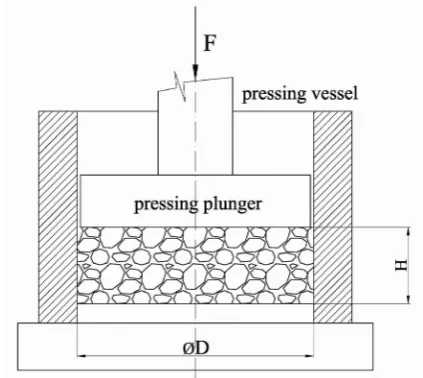
To determine the development of the relationship of the pressing force and linear deformation, the ZDM 50 – 2313/56/18 (VEB, Dresden, Germany) pressing device was used to record the course of de-formation function in an exact and analogical man-ner. A pressing plunger and pressing vessel with in-ner diameter D = 76 mm (Fig. 1) were also used. The pressed seeds were placed into pressing vessel and height of the seeds layers was H = 80 mm. The seeds were pressed under the temperature of 20°C. The pressing speed was v = 1 mm/s. The experiment was repeated for each mixture of plant seeds 10 times. The measuring range of force was from the value 0 N up to 250 kN, in which the test was stopped. Individ-ual points of measurement were digitally recorded and analysed with each new addition of deforma-tion of 0.5 mm. The amount of the limit deformadeforma-tion
d (mm) was determined by the measured value of
the first local maximum deformation characteristic. This limit deformation is a coordinate of the origin of the “wave effect”. Generally, it can be described as the relationshipbetween pressing force F (N) and
deformation x (mm) using Eq. (2), where the press-ing force is a function of deformation
) ( ) (x f x
F = (2)
Strain energy
If the relationship between the pressing force and deformation in Eq. (2) is integrated on the in-terval from zero deformation to limit deformation the amount of the limit deformation energy using Eq. (3) can be determined. This energy will not change the mechanical behavior of the seeds when the “wave effect” characteristic has not displayed.
(3)
Volume energy
Volume energy is the amount of the strain en-ergy Eq. (3) divided by deformed volume Eq. (4) (V, mm3) which is the cross-section of pressing
ves-sel multiplied by limit deformation;
(4)
then the amount of the limit unit volume energy in Eq. (5) (e, 10–3 × J/mm3) can also be calculated.
(5)
RESULTS AND DISCUSSION
Pressing force
[image:3.595.62.536.102.197.2]Results from the experiment showed that there are different dependencies between compressive force and deformation for each pressed mixture of plant seeds. The average values from the data measured Table 1. Determined physical properties of selected pressed samples (mean ± SD)
Plant seeds Weight of the sample m
s (g)
Porosity of the sample
Pf (%) Moisture content before soaking Mcb (% d.b.) Moisture content after soaking Mca (% d.b.)
Jatropha 132.6 ± 5.2 62.18 ± 0.32 5.39 ± 0.65 26.22 ± 0.77
Common sunflower 146.7 ± 6.6 51.46 ± 1.23 8.45 ± 0.56 28.49 ± 0.87
Common bean 262.8 ± 3.2 48.38 ± 1.62 9.15 ± 0.23 31.34 ± 0.93
Garden pea 278.6 ± 6.5 36.83 ± 0.73 10.3 ± 0.45 32.60 ± 0.38
Fig. 1. Scheme of the pressing equipment
dx x F
E=
∫
δ0
) (
δ 4
π 2
× ×
= D
V
V E
e =
[image:3.595.70.282.550.739.2]27 during the experiment are graphically displayed in
the graph (Fig. 2). The figure of the general shape of deformation characteristic (Fig. 3) shows that the characteristics of pressed plantseed appeared from zero deformation into the first limit deformation as the dependencies that can be replaced by function similar to tangent curve (Herák et al. 2010, 2011). From the Fig. 3 it is clear that this region is essen-tially the increasing function area and from this first limit deformation to the second limit deformations the characteristics can be replaced by functions sim-ilar to trigonometric functions and this region is the “wave effect” area.
From the results of the deformation characteristic and with the measured value of the first local maxi-mum deformation characteristic, the amounts of the limit deformation δ (mm) for all measured seeds were determined and are presented in Table 2.
Strain energy
The amounts of limit strain energy using Eq. (6) were determined by both Eq. (3) and pressing force
Eq. (2). These values were calculated from zero de-formation to the limit dede-formation for each plant seeds. In actual sense, strain energy is the size of the area under the deformation curve, which can be set as the sum of the squares Eq. (6).
(6)
where:
i – number of sections in which the axis deformation was divided (step measurement was 0.5 mm) Fn – compressive force for deformation xn (mm) (N) E – strain energy (J × 10–3)
The calculated amounts of the limit strain ener-gies are presented in Table 2.
Volume energy
[image:4.595.70.335.86.247.2]The limit deformation volumes for each crop were determined using Eq. (4) and are displayed in Ta-ble 2. Also the amounts of limit volume energy are calculated by Eq. (4) using the values of limit strain
Fig. 3. General shape of mechanical charac-teristics 0 5,000 10,000 15,000 20,000
0 5 10 15 20 25 30 35 40 45 50 55 60 65 70 75
Pr es sing f or ce (N ) Deformation (mm) Increasing function
Wave effect area
δ – limit deformation
0 5,000 10,000 15,000 20,000 25,000 30,000
0 5 10 15 20 25 30 35 40 45 50 55 60 65 70 75
[image:4.595.66.334.594.743.2]Pr es sing f or ce (N ) Deformation (mm) common bean garden pea common sunflower jatropha
Fig. 2. Measured mechanical characteristics of selected seeds 0 5,000 10,000 15,000 20,000 25,000
0 5 10 15 20 25 30 35 40 45 50 55 60 65 70 75
Pr es sing f or ce (N ) Deformation (mm) Increasing function
Wave effect area
δ – limit deformation
0 5,000 10,000 15,000 20,000 25,000 30,000
0 5 10 15 20 25 30 35 40 45 50 55 60 65 70 75
Pr es sing f or ce (N ) common bean garden pea common sunflower jatropha
(
)
∑
=− = + + × − + = 1 0 1 1 2 i nn n n
n
n F x x
F E
28
energy. The calculated values are presented in Table 2. It was found from the calculated values that the seeds of garden peas had the largest value of strain energy that is the energy in which the “wave effect” characteristic did not occur. The rest, namely the common beans, common sunflowers and jatropha obtained the minimum strain energy. These strain energy values correspond to the maximum energy that can be inserted to the pressing process. Ex-ceeding this value can causevibration of the presser including other negative factors, which also influ-ences the process of pressing (Yao et al. 1997; Zhu et al. 2005). Considering the resistance to change of mechanical behaviour of the plant seeds, it was necessary to compare the values of volume energy to that of the amount of deformed volume for all the plant seeds during compression. The calculated amount of the volume energy for garden pea showed the best resistance to change in the mechanical behaviour. Common beans, common sunflowers and jatropha followed in that order of magnitude to change in mechanical behaviour. These results also correspond to the visual analysis of measured amounts displayed in Fig. 2. From the calculated amounts of porosity, moisture content (Table 1) and the determined volume energy (Table 2) it was found that the resistance to change in mechanical behaviour of the plant seeds depends on porosity. Higher amount of porosity means less resistance to change in mechanical behaviour of the plant seeds and lower amount of limit volume energy. It was also evident that the moisture content of the plant seeds has an influence on volume energy. Higher amounts of moisture content means higher resistance to change in mechanical behaviour of the plant seeds and higher amount of limit volume energy with respect to moisture content before and after soak-ing. Some factors such as moisture content, tem-perature and variety of the seeds (Murthy, Bhat- tacharya et al. 1998; Braga et al. 1999; Herák et al. 2010; Raji, Favier 2004) may change the shape of the curve and strain or even hasten the change in mechanical behaviour, the so-called “wave effect”.
CONCLUSION
The experiment on the mechanical behaviour of several layers of selected plant seeds in which limit volume energy was determined including other pa-rameters. It is evident that the garden pea has the best resistance to change in mechanical behaviour while the other plants, common bean, common sunflower and jatropha, followed in that order of magnitude of change in the mechanical behaviours. The porosity and moisture content of the pressed seed samples influenced the amount of limit vol-ume energy. Higher amounts of porosity and mois-ture content showed lower and higher resistance to change in mechanical behaviour of the plant seeds, respectively. It was also noticed that a change in mechanical behaviour is influenced by physical properties of the pressed seeds as seed dimensions, seed density, porosity, moisture content and me-chanical properties such as ultimate strength and yield strength of the pressed seeds.
References
Addy T.O., Whitney L.F., Chen C.S., 1975. Mechanical parameters in leaf cell Membrane rupture for protein production. St. Joseph, ASAE Paper No. 75-1057. Blahovec J., Řezníček R., 1980. Frakcionace píce
(Frac-tionation of the Forage). Prague, Czech University of Life Sciences Prague: 370.
Braga G.C., Couto S.M., Hara T., Neto J.T.P.A., 1999. Mechanical behaviour of macadamia nut under compres-sion loading. Journal of Agriculture Engineering Research, 72: 239–245.
Danilov V.I., 1976. Energojomkost I KPD processa ekstruzi-onnij dězintegraciji zeljonych kormov (Energy performance and efficiency of the extrusion disintegration process of green forage). In: Proceeding Institute of Agriculture Machine. Rostov-on-Don, Izdatelstvo Rostovskovo uni-versiteta: 35.
[image:5.595.64.532.102.192.2]Faborode M.O., Favier J.F., 1996. Identification and sig-nificance of the oil-point in seed-oil expression. Journal of Agriculture Engineering Research, 65: 335–345.
Table 2. Measured and calculated amounts of selected seeds (mean ± SD)
Plant seeds Limit deformation δ (mm) Strain energy (J) E Deformed volume (10–4 × m3) V Volume energy (105 × J/m3) e
Jatropha 35.1 ± 0.8 63.25 ± 2.76 1.592 ± 0.036 3.97 ± 0.81
Common sunflower 53.2 ± 1.2 149.57 ± 3.65 2.413 ± 0.054 6.12 ± 0.29
Common bean 38.4 ± 1.5 192.43 ± 1.87 1.742 ± 0.068 11.05 ± 0.56
Garden pea 32.8 ± 0.7 198.10 ± 3.25 1.488 ± 0.032 13.31 ± 0.52
Fomin V.I., 1978. Vlažnoje frakcionirovanije zeljonych kor-mov (Wet Fractionation of Green Forage). Rostov-on-Don, Izdatelstvo Rostovskovo universiteta: 160.
Herák D., Karanský J., Sedláček A., Dajbych O., 2007. Basic theory of vegetable oils’ pressing. Naukovij Visnik, 117: 276– 285.
Herák D., Gurdil G., Sedláček A., Dajbych O., Siman-juntak S., 2010. Energy demands for pressing Jatropha curcas L. seeds. Biosystems Engineering, 106: 527–534. Herák D., Kabutey A., Sedláček A., GŰrdil G., 2011.
Tangent curve utilization for description of mechanical behaviour of pressed mixture. Research in Agricultural Engineering, 57: 13–18.
Isik E., Izli N., 2007. Physical properties of sunflower seeds (Helianthus annuus L.). International Journal of Agricul-tural Research, 2: 677–686.
Kabutey A., Herák D., Sedláček A., 2011. Behaviour of different moisture contents of Jatropha curcas L. seeds under compression loading. Research in Agricultural Engineering, 57: 72–77.
Koegel R.G., Fomin V.I., Bruhn H.D., 1973. Roller macera-tion and fracmacera-tionamacera-tion of forage. Transacmacera-tions of the ASAE, 16: 236–240.
Murthy C.T., Bhattacharya S., 1998. Moisture depend-ent physical and uniaxial compression properties of black pepper. Journal of Food Engineering, 37: 193–205. Očenášek J., Voldřich J., 2009. Mathematical modeling of
a biogenous filter cake and identification of oilseed mate-rial parameters. Applied and Computational Mechanics, 3: 1–12.
Olaniyan A.M., Oje K., 2002. Some aspects of the me-chanical properties of shea nut. Biosystems Engineering, 81: 413–420.
Ozturk I., Kara M., Elkoca E., Ercisli S., 2009. Phys-ico-chemical grain properties of new common bean cv. ‘Elkoca-05’. Scientific Research and Essay, 4: 88–93. Raji A.O., Favier J.F., 2004. Model for the deformation in
agricultural and food particulate materials under bulk compressive loading using discrete element method II: Theory, compression of oilseeds. Journal of Food Engineer-ing, 64: 373–380.
Resende O., Correa P.C., Jarén C., Moure A.J., 2007. Bean moisture diffusivity and drying kinetics: a comparison of the liquid diffusion model when taking into account and neglecting grain shrinkage. Spanish Journal of Agricultural Research, 5: 51–58.
Sirisomboon P., Kitchaiya P., Pholpo T., Romphophak T., 2007. Physical and mechanical properties of Jatropha curcas L. fruits, nuts and kernels. Biosystems Engineering, 97: 201–207.
Tavakoli H., Mohtasebi S.S., Rajabipour A., Tavakoli M., 2009. Effects of moisture content, loading rate, and grain orientation on fracture resistance of barley grain. Research in Agricultural Engineering, 55: 85–93.
Yalcin I., Ozarslan C., Zkvas T., 2007. Physical properties of pea (Pisum sativum) seed. Journal of Food Engineering, 79: 731–735.
Yao W.G., Takahashi K., Koyama K., Dai G.C., 1997. Design of a new type of pin mixing section for a screw extruder based on analysis of flow and distributive mixing performance. Chemical Engineering Science, 52: 13–21. Zhu L., Narh K.A., Hyun K.S., 2005. Investigation of mixing
mechanisms and energy balance in reactive extrusion using three-dimensional numerical simulation Method. Interna-tional Journal of Heat and Mass Transfer, 48: 3411–3422.
Received for publication April 4, 2010 Accepted after corrections October 10, 2010
Corresponding author:
Assoc. Prof. Ing. David Herák, Ph.D., Czech University of Life Sciences Prague, Faculty of Engineering, Department of Mechanical Engineering, Kamýcká 129, 165 21 Prague, Czech Republic