INTRODUCTION AND OBJECTIVE
After political and economic changes in the czech republic in 1989, tourism achieved progressive changes and it became a significant part of czech economy.
opening the borders, freedom of enterprise and mak-ing the foreign exchange market accessible became multipliers of fast changes in the o far strictly regu-lated tourism market. The czech republic became a sought-after destination for tourists from the whole
Destination management
Destinační management
K. Ryglová
Department of Marketing and Trade, Faculty of Business and Economics,
Mendel University of Agriculture and Forestry, Brno, Czech Republic
Abstract: This paper deals with the problems of destination management. it focuses on describing the crucial principles of destination management and consecutively on proving the functionality of these principles in practice in an area with a high potential for tourism development. in the selected South-Moravian region (JMK), we have explored whether an existing organization of destination management can be found in this region (DMc Destination Management company) and to which extent it participates in the management and efficient development of tourism. To reach the set targets, we have used a secondary analysis of current data, a depth interview with a destination agency manager and an orientation questionnaire survey among business subjects. The results have shown that the level of cooperation between the destination agency in the JMK and the subjects of tourism is not on such a level and not as intensive as proclaimed by the South-Moravian Tourist Authority (ccrJM – the organization established with the aim of destination management in the JMK). For example, 50% of the addressed subjects have not been aware of the existence of this organization and only 10% of the companies have been addressed to cooperate with the ccrJM. The insufficient cooperation of public and private sectors appears to be the weakest segment. This causes an inconsistent presentation and isolation in preparing projects for the region development. it is the task for destination management, a new organization of tourism, to find the way how to cope with these difficulties and how to make the JMK a unified and quality destinations that would be attractive for tourists.
Key words: destination management, tourism, partnership, destination management company
Abstrakt: Příspěvek se zabývá problematikou destinačního managementu. Práce je zaměřena na popis stěžejních principů destinačního managementu a následně na ověření fungování těchto principů v praxi v kraji s vysokým potenciálem pro rozvoj cestovního ruchu. Ve vybraném Jihomoravském kraji (JMK) jsme zkoumali, zda v kraji existuje funkční organizace destinačního managementu (DMc Destination Management company) a do jaké míry se podílí na řízení a efektivním rozvoji cestovního ruchu. K dosažení stanovených cílů byla využita sekundární analýza stávajících dat, hloubkový rozho-vor s manažerem destinační agentury a orientační dotazníkové šetření mezi podnikatelskými subjekty. Výsledky ukázaly, že úroveň spolupráce destinační agentury v JMK se subjekty cestovního ruchu není na takové úrovni a tak intenzivní, jak proklamuje centrála cestovního ruchu – Jižní Morava (ccrJM, organizace zřízená za účelem destinačního managementu v JMK), tj. např. 50 % z oslovených subjektů o existenci organizace nevědělo a pouze 10 % firem ccrJM vyzvala ke spolu-práci. nejslabším článkem je nedostatečná spolupráce veřejného a soukromého sektoru. Ta pak způsobuje nejednotnou pre-zentaci a izolaci přípravy projektů na rozvoj regionu. Je na destinačním managementu, nové organizaci cestovního ruchu, jak se s těmito problémy vypořádá a jakým způsobem vytvoří z JMK jednotnou a kvalitní destinaci, lákavou pro turisty.
Klíčová slova: destinační management, cestovní ruch, partnerství, organizace destinačního managementu
world – it was something new, non-tiring and at the same time not very expensive. however, this trend has already ended and the czech republic has become a common tourist destination that cannot benefit from such a specific competitive advantage any longer.
Making a certain place a tourism destination is not easy at all. it does not only do to print colour promotion materials on art paper, but it represents a complicated long-lasting work that involves a lot of effort, team-work abilities, cooperation and coordi-nation. A tourism destination needs to be managed in a corresponding way, which means that it needs a management to direct it. With respect to market economy and its close connection to marketing, this should be realized by marketing management.
The instability of external business environment is according to Vajčnerová and ryglová (2008) a typical feature of the present times. The dynamic develop-ment and globalization changes cannot dispense with the continual analysis of the current as well as future situation and also with the timely anticipation of changes with the goal to establish a harmony be-tween company or destination resources and chang-ing external environment – especially market and customers. Strategic management appears to be a suitable tool for ensuring such needs of a company or destination.
Destination management in the czech republic is still in the initial stage of its development and it is not yet as developed as in some countries of West Europe. Although there is a common opinion that tourism represents a significant contribution to the life of regions, towns or villages, it was left to its fate in most cases even in the recent past and it was de-pendant solely on business activities of the individual providers of tourism facilities.
Tourism is a significant tool of prosperity in not only well-known tourist destinations, but it is also an important potential development element in the not so well developed rural regions. in the czech republic, the field of region development and man-aging destinations started developing in the second half of the 1990s. organizing tourism is in the phase of building and it passes through its natural devel-opment. Strong competition between the individual destinations imposes natural pressures on creating marketing managements of these destinations and such offer of products that perfectly come up to tour-ists´ expectations. Together with increasing require-ments, the demands on quality and well-prepared destinations within home tourism revive. in the final consequence, the level of destination management influences the increase in marketability and attend-ance of the region.
The potential of tourism development in the JMK and the basis on which a modern and competitive European destination can be created lies in the rus-tical character of a large part of the region, existing folk traditions, ecclesiastical sights, the traditional rural and modern urban architecture, as well as in the natural and country resources.
The objective of this paper is to describe the main theoretical basis and tools of destination manage-ment. Their concrete practical application is then analysed in one of the most frequented regions in the czech republic – the South-Moravian region (JMK). The paper also includes the suggestion for a model of destination management organizational structure in the JMK. The set targets were reached by not only analysing the secondary available data but also using the techniques of a depth interview with experts and an orientation questionnaire survey among travel agencies and offices, the principal goal of which was to prove functioning of the basic principle of desti-nation management, i.e. the effective cooperation between the public and business sectors.
in the monolingual dictionary of tourism, the term of destination is explained in the narrow sense of word as a target area in a given region for which a significant offer of activities and tourism infrastruc-ture are typical. in the broader sense, a destination is understood as a country, region, human settlements and other areas that are typical with a high concentra-tion of tourism attracconcentra-tions, developed services and other tourism infrastructure, the result of which is a long-term high concentration of visitors.
on the other hand, Királová (2004) defines a tour-ism destination as a natural whole which has unique features from the point of view of tourism develop-ment; these are different from other destinations. Then, she refers to the WTo statement according to which a destination represents a place with certain attractions and tourism facilities and services con-nected; they are chosen by a participant or a group of tourists for their visit and they are brought to the market by their providers. in her book, she refers to the work by Buhalis (2000) who defines six char-acteristic components marked as “six As” of each destination:
– Attractions – a primary offer of tourism that thanks to its amount, quality and attractiveness activates attendance (natural, cultural-historical potential) – Accessibility and ancillary services – a general
– Amenities – superstructure and infrastructure of tourism that enable the stay in the destination and utilizing its attractions (accommodation, hostelry, sports-recreational, cultural-social facilities and others)
– Available packages – prepared products and prod-uct packages
– Activities – various activities
in comparison, Palatková (2006) sees a destination as a set of various services concentrated in a certain place or area and these are provided in connection with the potential of tourism in the given place or area. According to this author the attractions of a destination represents its basis and the main motiva-tion stimulus for visiting it.
The size of a destination and its spatial determina-tion can sometimes collide with administrative borders on the basis of which destinations are defined and sold. Due to this fact, destinations are sometimes categorized into international, national, regional and local ones.
For instance, the agency czech Tourism determines marketing tourist regions within the czech republic and their division does not correspond with the for-mal borders of the regions: Prague, Prague and its surroundings, the South Bohemia, the Šumava, the Plzeň (Pilsen) region, the West-Bohemian thermal spas, the north-West Bohemia, the czech north, the czech Paradise, the East Bohemia, the highlands, the South Moravia, the central Moravia, the north Moravia and Silesia, the Krkonoše Mountains.
For the purposes of tourism and for simplifying processes, a destination is then divided into the so- called natural tourist regions which ought to respect the basic unifying principles:
– To be established with respect to the pragmatic unifying elements – many of the existing districts have a similar or even the same tourist offer – To be geographically, spatially united
– To be administratively identified – it appears inevi-table to define a tourist region by the enumeration of a total number of component elements, in this case municipalities. it makes allocating sources easier
For example, the JMK is for tourism purposes divided into five natural tourist regions that have different tourist potentials: Brno and its surroundings, the Moravian Kras and its surroundings, the Lednicko-Valtický area, the Podyjí and its surroundings and the Slovácko area (its part stretches into the zlínský district).
The development of destination management is outlined by Palatková (2006) in her book. She claims
that the trend of managing destinations in last dec-ades has been heading from the so-called political management of destinations across the manage-ment of a destination being understood as a mere background for business organizations towards the management of a destination set up as a factor for creating and realizing business. The fast development of information technologies in the last decade has meant a new opportunity for developing destination management.
Bartl and Schmidt (1998) understand destination management as “the strategy and the way for strong regions which have the courage to concentrate their powers for collective development, organization and active sale of their key competitive advantages. in this way, destinations emerge that can offer their client a perfectly organized chain of services corresponding with his choice, and it includes the whole process from obtaining the information and comfortable reservation across the flawless duration of his stay up to his coming back home.”
hesková (2006) uses a different approach to the definition. She considers destination management to be the process of creating and managing strong, market oriented and system directed units – des-tinations. Thus destination management is a set of controlling measures and tools that are used in the area of planning, organizing and promoting as well as in decision-making processes leading to the development of a destination. She also determines the basic spheres of activities solved by destination management:
– Development in compliance with permanent sus-tainability of the environment
– Setting economic targets – Social-cultural sphere
– internal and external communication
For complexity, she adds that the management of destinations is a strategy of development that reacts to requirements of international global market, heads towards powerful units, strategically directed and competitive. The author emphasizes the fact that a high level of cooperation among individual subjects participating in directing a destination is a consider-able element in destination management.
in connection with this, we can often come across the term of “local self-government” that can be an unusual expression for many people. however, it is nothing but – as stated by Bernátová and Vaňová (2000) – “attracting investors into the area, attracting tourists, communicating with the public or promoting the region.” These are the main targets of the major-ity of public administration representatives. The marketing of an area (a place) is thus the marketing of local self-governments.
Destination management focused on tourists and tourism is realized by towns and regions that have the preconditions and internal sources for developing a certain sort of tourism. According to the profile of the town or the region and their of-fer, the strategy of a tourism destination is created. Towns with a compact attractive offer of tourism products and services concentrate on the external communication policy, while towns with good pre-conditions for tourism development but without a developed or sufficient offer support running business in tourism or create specific products or product packages.
With respect to the highly competitive environment of tourism, individual destinations have to be man-aged and organized in a professional way. To ensure this function as well as many other ones, there exist the so-called destination agencies or destination management companies which are supported and financed by the strongest partners in the destination. According to Palatková (2006), the principal role of destination agencies lies in connecting relatively in-dependent and legally autonomous service providers into one whole which acts cohesively as one and is directed at selling the key products of the destina-tion. The goal of such a whole is then coordinating and cooperating, creating suitable chains of services and also creating “experiences” for target groups of clients while gaining the influence and control over individual partial services.
Destination management companies (DMc) should act in five main areas, as stated by Bartl, Schmidt (1998):
(1) the organization and coordination of vertical and horizontal connection of subjects with the aim to reach a unified, flexible and market-directed dynamic competitive unit
(2) the critical comparison of the destination level with the best of other destinations with the aim to reach a bigger benefit for a client and at the same time slimming necessary processes (3) the responsibility for fulfilling the basic
func-tions of managing tourism in the destination; influencing service providers not as an “interest”
organization but as a joint enterprise of service providers who finance it
(4) fulfilling the function of offering (5) fulfilling the function of marketing
Destination management companies are irreplace-able in their position of promoting the identity and image of the destination as a whole. The reason is that mostly none of private subjects can represent the country or region. The inability of market to create resources needed for the marketing of the destination spontaneously is usually termed as a market failure for the solution of which three approaches are used: (1) creating an own agency using the financial means
of private subjects selling the destination (2) the intervention of the public sector, the result of
which are publicly financed organizations, busi-ness subjects, local offices or other organizations taking responsibility for the marketing manage-ment of the destination
(3) combining private and public ways of financing with the unambiguous trend of heading towards financing from private sources
Bartl and Schmidt (1998) mention the differences be-tween the DMc (Destination Management company) and the traditional tourist organizations.
– DMcs concentrate on the development and or-ganization of key products and their enforcement on the tourism market.
– DMcs are flexible, “slim” organizations. They can pass the whole range of activities onto their external partners without being divested of their responsi-bility for these activities.
– DMcs ensure enforcing a product on the market, coordinate its placement and sale and they also sell themselves or mediate the sale. They concentrate on their clients´ and partners´ wishes.
– DMcs can act in a market way and with the possi-bility of sanctions as they have the right to enforce and place a product on he market.
– DMcs are established and financed by the strongest partners in the region. The most important control-ling and managing functions are filled according to evaluating the professional skills and importance of selected persons.
– DMcs offer their management such working con-ditions that are comparable to other economic branches.
– DMcs work in a decentralized way if the strongest regional partners are involved in strategic deci-sions.
– DMcs act as administrators of a destination and they take care of optimal relationships among part-ners in the region.
MATERIALS AND METHODS
Destination management companies (state, half-state or with a prevailing private share) can be effec-tive on several possible levels. illustraeffec-tive examples within the czech republic as well as foreign countries are mentioned below:
– Local tourist organization – e.g. Destinační manage-ment města Český Krumlov (Destination Manage-ment of the Town of Český Krumlov), Visit London, Tourismusregionalverband Süd-Weststeiermark, – regional tourist organization – e.g. Jihočeská
centrála cestovního ruchu (The South-Bohemian central office of Tourism), centrála cestovního ruchu – Jižní Morava (The South-Moravian Tourist Authority), Balaton Tourism, VisitScotland, – national tourist organization – e.g.
czechTour-ism, hungaryTourczechTour-ism, British Tourist Authority, Österreich Werbung,
– continental tourist organization
The marketing conception of a tourism destination means the process of coordinating the variety of busi-ness subject that are active in the destination, and at the same time the existence of competition with a complementary offer. Királová (2004) emphasizes the fact that processing, accepting and applying a practicable marketing conception is the basic precon-dition for the success of a destination in the market. Setting mutually dependant targets organized in a pyramidal way is an inseparable part of creating a marketing conception:
– The mission of a destination – a compact idea that gives reasons for offering the destination in the tourism market from the visitor’s point of view. – The marketing target of a destination – it comes
out of the mission of the destination and it is aimed at all those who are interested in the offer of the destination (a clear, unifying philosophy of associa-tion), then it become the basis for formulating the marketing strategy.
– Another degree in the hierarchy of targets are spe-cific marketing targets referring to the position of the destination on the market and its profitability, then financial and social targets, the targets con-nected with market prestige and the social position of the destination.
The practical verification of the functioning of des-tination management principles in the czech republic
has been conducted in the South-Moravian region (JMK) which is one of the most often visited regions in the country. The set targets have been reached not only by analysing the available secondary data but the techniques of depth interviews with experts in a destination management company have also been used, as well as the techniques of an orientation question-naire survey among travel agencies and offices that should be one of the partners for a well-functioning destination management company.
RESULTS AND DISCUSSION
The development of tourism in the JMK is coordi-nated by the regional council, the section for tourism of the Department of regional Development. in 2007 the office for the regional council of the cohesion region South-East was established and it took over the part of the district competences. The South-Moravian Tourist Authority (ccrJM) is an executive and par-tially also marketing organization. it was founded in 2006 just for the purpose of performing destination management in the district. The founder members of this association are the South-Moravian region, the statutory city of Brno and the czech confederation of commerce and Tourism (Socr).
Furthermore, local tourism organizations are active on the lower hierarchy level in the JMK, for instance in the area of Slovácko or the Moravian Kras. For the city of Brno and its surroundings, this destination management function is carried out by the Brno city Municipality and the Brno Tourist information centre. The JMK is divided into five natural tourist regions but not even in the half of them there are organizations of destination management working actively and their activities are insufficiently replaced by tourist information centres in many cases.
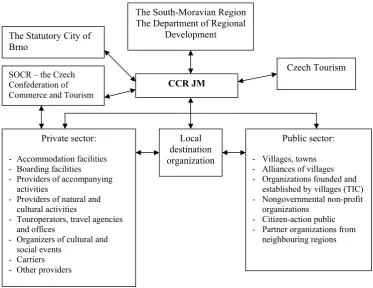
The scheme (Figure 1) shows the suggestion of the destination management model in the JMK, where the role of a coordinator and a mediator for the com-munication among individual subjects should be carried out namely by the ccrJM.
in tourism. The picture lacks the illustration of the connection that would represent the communica-tion and cooperacommunica-tion with neighbouring and partner destinations at home as well as abroad.
The partnership in the JMK
A survey among travel agencies and offices dealing with home and incoming tourism has been conducted for the purpose of finding out the level of functioning partnerships in the JMK. The survey was conducted in the form of a combination of internet and telephone investigations. The final number of subjects that
participated in the survey is 29. The database of the Association of Travel Agencies was used when look-ing for suitable subjects that would fulfil the survey criteria. The size of travel agencies and offices did not play any part in the selection, what was crucial was the orientation of their activities.
50% of the addressed companies were aware of the existence of the ccrJM. in some cases the question concerning the existence of the ccrJM was com-pletely new information for the subjects. More than half of the addressed companies are not planning to start cooperating with the ccrJM (Figure 3), which gives the evidence about their very weak positions and images in the JMK so far.
The South-Moravian Region The Department of Regional
Development
CCR JM
Czech Tourism
Private sector:
- Accommodation facilities - Boarding facilities - Providers of accompanying
activities
- Providers of natural and cultural activities
- Touroperators, travel agencies and offices
- Organizers of cultural and social events
- Carriers - Other providers
Public sector:
- Villages, towns - Alliances of villages - Organizations founded and
established by villages (TIC) - Nongovernmental non-profit
organizations - Citizen-action public - Partner organizations from
neighbouring regions
Local destination organization The Statutory City of
Brno
[image:6.595.106.480.67.355.2]SOCR – the Czech Confederation of Commerce and Tourism
Figure 1. The suggestion of a destination management model for the JMK The source: own survey
10%
90%
yes no
12%
61% 27%
yes no do not know
[image:6.595.122.262.640.748.2]regarding the fact that the ccrJM has only been active on the tourism market for a year and a half, we cannot expect it to be generally well-known among all other interested subjects or even in the general public.
The depth interview with the project manager of the central office shows that the ccrJM contacts their potential partners by itself and directly offers them to cooperate. however, the conducted survey did not prove this fact very much as only 10% sub-jects mentioned that the centre office had addressed them and asked them for cooperation (Figure 2). The survey did not confirm any link between the size of the addressed subjects and their cooperation with the ccrJM.
The partner travel agencies’ statements say that their cooperation with the ccrJM lies in taking part in workshops, opportunities to present their materi-als at fair-trades or including products in promotion materials or websites of the central office.
other points at issue that were a part of the survey concerned using the logo of the ccrJM and the unity of the destination image. none of the addressed agen-cies or offices uses the logo of the ccrJM either in their printed materials or on their web pages. only one travel agency stated that they use the references of the JMK official tourist web portal for their pres-entations. The subjects only use their own marks and labels supplemented with the logo of the AcK if they are members of this association. So in this area, there is also a challenge for the ccrJM and the JMK concerning finding a suitable marketing logo that could be used by all key partners.
We can state that in the area of the JMK, there has not been a unified organization structure of tourism so far as it can be seen for example in Austria or croatia, where a pyramid system has been created, starting from the central marketing organization down to even the smallest units.
Based on the literature available, the conception documents and the conducted surveys, the main prob-lems in the JMK seem to be lying in the following: – insufficient cooperation of the public, business and
non-profit sectors: the absence of the function-ing cooperation is a brake for the development of tourism and prosperity. There can be more reasons for this fact. Entrepreneurs are not interested in cooperation; they believe that their individual ac-tivities will bring them enough profit. on the other hand, the public sector is not able to motivate them enough and to persuade them to cooperate, it can-not explain the benefits of this from the point of view of higher profits emerging from such partner-ship, creating a good name and reputation, and it
is not able to convince them about the necessity of a further development. The rate of the mutual organization and coordination of activities in the frame of public-private partnership can be labelled as low. The mutual trust of individual subjects seems to be a large drawback. it seems necessary to create links of trust so that one businessman could rely on another in the framework of their activity. nevertheless, it will not be that easy in the czech environment at all.
– Superiority of tourism regional authorities: tour-ism regional authorities as well as the destination management companies in the individual areas of the JMK cooperate with entrepreneurs only very little or they do not do so at all. This has fatal consequences especially for creating conceptions. These then create a chaotic mosaic with no unifying element. Such an isolated preparation of projects on both sides is a proof of how especially private subjects do not cooperate sufficiently and are not aware of the necessity of a further development in the branch of tourism.
– inconsistent presentation: the JMK has its own web portal of tourism with markers of the individual natural tourist regions in the district. The drawback lies in the absence of references to these regions´ websites where tourist can be offered more pos-sibilities and up-to-date information. At the same time, these individual areas are presented on other tourism servers in a different way, with different in-formation and different aging. Such non-systematic approach can give tourists a misleading impression of an inconsistent region that has a fragmented and non-complex offer of services. And what is more, they can be rather confused by different informa-tion from different sources and so they might not orient themselves well in the region.
– insufficient qualifications: tourism services of a good quality cannot be ensured on the required level if they are provided by non-qualified workers without the ability to speak foreign languages. The unwillingness to learn more and improve oneself is much stronger than the awareness of such benefits for the development of tourism. Well-qualified and educated people often leave the region. The JMK and the ccrJM try to organize many train-ings and seminars. however, the above mentioned problem seems to appear here again – the organ-izers of these programmes are not able to persuade small entrepreneurs and service providers about the importance of education for the development of tourism.
con-nected with the quality of tourist infrastructure and the complementary services. The consequence of the imperfect structure of tourism management, insufficient political preferences and so the lacks of financial means for the development of tourism appear in this area as well. The JMK as a tourist destination is competitive only in Brno when com-pared with the EU standards and foreign tourists´ requirements. other areas in the region are rather backward and it is inevitable to invest in the tourist infrastructure considerably.
– Little knowledge about the possibilities of financ-ing from the EU sources: regardfinanc-ing the low level of cooperation, businessmen – especially those of smaller subjects in the more outlying areas of the district and in the country – have a rather little knowledge about the possibility to use financial means from the European sources.
CONCLUSION
The paper outlines the main theoretical basis, prin-ciples and tools of destination management and sub-sequently it summarizes the results of the analysis and the conducted survey the objective of which was to prove the functioning of these principles in practice, namely in the JMK.
Accomplishing the mission of destination manage-ment is conditioned by applying specific principles and procedures in managing tourism. Destination management as a process and activity ought to be the result of a joint effort of all main service pro-viders, organizations interested in tourism in the given destination and governing autonomous and administrative institutions. During forming tourism organizations, it is necessary to realize that respect-ing the principle of “3 Ps” is a precondition for the success – in other words, Public-Private-Partnership. The whole conception and gradual realization of tour-ism development is very time-consuming as well as financially and administratively demanding and so it requires the cooperation of all participants of the tourism market. The experience and outcomes from the developed European countries, where destination management is the most complex form of tourism management, give the evidence that the long-term development of tourism cannot be ensured without partnership and cooperation. A well-functioning cooperation and communication are the basis for a good promotion and image of the region on one hand and economic profits on the other hand. Then, this results in satisfied visitors who will come back to the destination.
To utilize all opportunities of tourism and the potential of the given region on a maximum level, there has to be a certain directing unit – a tourism organization that will conduct and streamline the development of tourism in the desirable direction so that all positive impacts in the area are utilized and benefited in the optimal way. The task of such a unit is also to sell the destination actively and to enforce it on the tourism market. With this goal in mind, the South-Moravian Tourist Authority was founded in the JMK in 2006 which should fulfil the function of a destination management organization. The goal and at the same time the vision of this central office is to ensure and support such activities that will bring economic development and make South Moravia an attractive and competitive tourist destination. nowadays, there is a possibility to support tourism development in the JMK also with the help of means from the EU structural funds and the ccrJM can be just the suitable applicant. The strategy of tour-ism development that the ccrJM wants to apply should not only be a one-shot static document but it should adapt to the current development, build on the reached partial results and it should also react to the changing environment. As it was mentioned above, the ccrJM is rather a new organization and so it is not yet possible to evaluate its benefit for the South-Moravian tourism market objectively. The ex-isting steps and successes that the central office has achieved in their activities so far cannot be evaluated in any other but the positive way. Despite the fact that many drawbacks could be mentioned, we have to consider the fact that after one and a half year of its existence the central office is still “learning” how to be a modern European organization of destination management.
The results mentioned above are a part of the re-search project, id. code Vz: 62156 48904 “czech economy in the process of integration and globali-zation and the development of agrarian sector and service sector in new conditions of the European integrated market”.
REFERENCES:
Bartl h., Schmidt F. (1998): Destination Management. institut für regionale innovationen, Wien. Bernátová M., Vaňová A. (2000): Marketing pre
sa-mosprávy (Marketing for Authorities). UMB, Ban-ská Bystrica; iSBn80-8055-337-8.
hesková M. a kol. (2006): cestovní ruch (Tourism). 1st
Edition, Fortuna, Praha; iSBn 80-7168-948-3. Kiráľová A. (2004): Marketing destinace cestovního
ruchu (Marketing of Tourism Destination). Ex-press, Praha; iSBn: 80-86119-56-4.
Palatková M. (2006): Marketingová strategie des-tinace cestovního ruchu (Marketing Strategy of Tourism Destination). grada Publishing, Praha; iSBn 80-247-1014-5.
Štětková r. (2006): Analýza destinačního managemen-tu v JMK (The Analysis of Destination Management in JMK). [Diploma thesis.] MzLU, Brno.
Vajčnerová i., ryglová K. (2008): coordinated change within the Branch with the help of Strategic Al-liances. Agricultural Economics – czech, 54 (2): 85–92.
Arrived on 15th May 2008
Contact address:
Kateřina ryglová, Mendel University of Agriculture and Forestry in Brno, zemědělská 1, 613 00 Brno, czech republic