Economic growth mainly determines the material well-being of billions of people. In economically advanced countries, economic growth since the in-dustrial revolution has allowed almost the entire population to live in a style that only a privileged handful could have afforded a hundred years ago, when the per capita GDP was a small fraction of what it is today. Indeed, growth in some sectors of the economy, especially the medical and pharmaceutical sectors, has allowed almost everyone to live a longer and healthier life that could have been expected by anyone in the 19th century, no matter what position a person held on the economic ladder. In contrast, the lack of economic growth in the poorest countries of the world has meant that living conditions for hundreds of millions of people are appalling by the standards of rich countries; the per capita income levels in many 21st century countries are much lower than they were in the 19th century Europe.
The least developed countries (LDCs) represent the poorest and weakest segment of the interna-tional community. Their low level of socio-economic development is characterized by weak human and institutional capacities, a low and unequally dis-tributed income and scarcity of domestic financial resources. They often suffer from the governance crisis and political instability. Their largely agrarian economies are affected by a vicious cycle of low pro-ductivity and low investment. They rely on the export of few primary commodities as the major source of export and fiscal earnings, which makes them highly vulnerable to the external terms-of-trade shocks. Only a handful has been able to diversify into the
manufacturing sector, though with a limited range of products in labour-intensive industries, i.e. textiles and clothing. These constraints are responsible for the insufficient domestic resource mobilization, the low economic management capacity, the weaknesses in programme design and implementation, chronic external deficits, high debt burdens and a heavy dependence on external financing that have kept the LDCs in a poverty trap.
LEAST DEVELOPED COUNTRIES
The Least Developed Countries comprise more than 880 million people, but they account for less than 2% of the world GDP and about 1% of the global trade in goods (UN-OHRLLS 2013).
Since 1971, the United Nations has recognized the Least Developed Countries (LDCs) as the “poorest and weakest segment” of the international commu-nity. Extreme poverty, the structural weaknesses of their economies and the lack of capacities related to growth, often compounded by structural handicaps, hamper the efforts of these countries to improve the quality of life of their people. These countries are also characterized by their acute susceptibility to external economic shocks, natural and man-made disasters and communicable diseases (UN 2012).
The overall progress is very slow. The main feature of poverty in the LDCs remains in its all-pervasive and persistent nature: in 2007, 53% of the popula-tion was living on less than $1.25 a day, and 78% on less than $2 a day. This implies that 421 million
Least developed countries – characteristics
Vladimír JENÍČEK, Šárka GRÓFOVÁ
Faculty of International Relations, University of Economics, Prague, Czech Republic
Abstract: Despite some progresses in the political situation, the eff ects of the economic crisis and widespread food inse-curity are expected to persist. Humanitarian assistance is now needed to support the needs of the most vulnerable. In the longer term, countries have the signifi cant goal of consolidating peace and security and strengthening the overall govern-ance, while at the same time, reconstructing and rehabilitating their economy.
Key words: agriculture, confl ict, economic growth, food security, poverty
people were living in extreme poverty in the LDCs that year. The incidence of extreme poverty was sig-nificantly higher in the African LDCs, at 59%, than in the Asian LDCs, at 41%. For the $2-a-day poverty line, however, the difference was less marked: 80% in the African LDCs and 72% in the Asian LDCs. It is estimated that the number of extreme poor living in the LDCs by 2015 will be 439 million, while if the MDG target were achieved, it would be only 255 mil-lion (UNCTAD 2011).
Food insecurity. More than 300 million Africans, where 33 out of the 48 LDCs are located, are food insecure.
Economic vulnerability. The LDCs are highly de-pendent on the external sources of funding, includ-ing the official development assistance, workers’ remittances and the foreign direct investment. This overly exposes them to external shocks such as the global financial crisis, which has had a severe impact on their economies.
Environmental vulnerability. While they contribute least to the climate change, the LDCs are among the groups of countries most affected by the climate change. Poor housing, over-dependence on natural resources and the lack of adaptive capacity all people in the LDCs at a greater risk to the impact of the climate change than people in other countries. Many LDCs are also small islands whose very survival is threatened by the rising sea levels (UN DESA 2008).
HISTORICAL BACKGROUND
The development of the LDC category has a his-tory dating back to 1964, when its establishment was advocated by developed countries at the first session of the United Nations Conference on Trade and Development (UNCTAD I), held in Geneva. It was presented as an alternative to the idea of a single system of trade preferences for all developing coun-tries. The UNCTAD member States agreed to pay a “special attention” to what at the time were called the less developed among the developing countries (General Principle Fifteen1).
It was not until the second session of the UNCTAD (UNCTAD II), held in New Delhi in 1968, that the question of the LDC category was examined in de-tail. The Member States accepted by consensus the idea of an LDC category that would focus on special measures for the most disadvantaged economies. The UNCTAD II requested the secretariat of the UNCTAD to conceptualize such special measures with regard to all issues within its purview, to pursue its work in identifying the LDCs and to examine various possible approaches to the question of identification.
In 1969, the General Assembly, following up several pertinent resolutions of the Trade and Development Board (TDB) – the governing body of the UNCTAD – acknowledged the need to alleviate the problems of underdevelopment of the LDCs so as to enable them to draw full benefits from the Second United Nations Development Decade.In this context, the Assembly requested the Secretary – General, in consultation with, among others, the Committee for Development Planning, to carry out a comprehensive examination of the special problems of the LDCs and to recommend special measures for dealing with those problems. At its sixth session in January 1970, the Committee formed a working group to define the methodology for identifying the LDCs and reflecting upon special measures for the countries so classified. Subsequently, in December 1970, the General Assembly took the view that the formal identification of the LDCs was an urgent matter and invited the Economic and Social Council, the TDB and other relevant bodies to deal with the issue on a priority basis.
In its analysis of the matter, the Committee em-phasized that, while developing countries as a group were facing similar problems of underdevelopment, the difference between the poorest and the relatively more advanced among them was quite substantial. The LDCs could not always be expected to benefit fully or automatically from the measures adopted in favour of all developing countries.
The LDCs were understood to be those low-income countries facing severe structural handicaps to growth. Thus, the initial criteria for designating a country as the least developed were a low per capita gross
do-1UNCTAD I recommended 15 “General Principles” (and 13 “Special Principles”) for governing international trade
mestic product (GDP) and the presence of structural impediments to growth.
The presence of such impediments was at the time perceived to be reflected in a small share of manufac-turing in the total GDP (inasmuch as a high degree of industrialization was seen to be the structural characteristic of developed or “advanced” countries), as well as in a low literacy rate (which would be an indication of a country’s low level of human capital development) (UN DESA 2008).
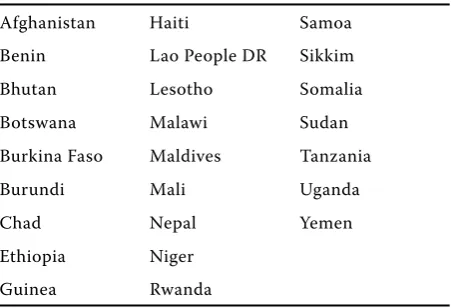
The CDP suggested in 1971 an initial method of identifying the LDCs and proposed the first list of 25 countries (Table 1), of which 16 were located in the Sub-Saharan Africa, 8 in Asia and Oceania and one in Latin America. The criteria used by the CDP were the following:
– per capita GDP less than or equal to $100
– GDP share of manufacturing less than or equal to 10%
– literacy rate of the population above 25 years old less than or equal to 20% (Bjerkholt 2012).
These results of the UNCTAD work that originally led to the creation of the list of the least developed countries, has subsequently led to an increasing awareness of the special needs of these countries. This awareness has changed the policies of countries and multilateral agencies in several important ways. There has been a shift in the share of the official assistance going to this group of countries; several donor countries have not only provided an
increas-ing share of their assistance but have also under the Board resolution 165 (S-IX) “Debt and Development problems of developing countries” (1978) cancelled the debt of, or taken other debt relief measures in favour of, these countries. The shift has been particularly noticeable for the major multilateral organizations, which are now providing a major share of their as-sistance to the least developed countries.
This awareness has also led to a few innovations in the commercial policy measures on behalf of these countries. The creation of a special sub-committee for least developed countries within the GATT pre-viously and now within the WTO should be noted, as the WTO Plan of Action for the Least Developed Countries. Trade preferences, including the provisions in the Lomé Conventions and within the generalized system of preferences (GSP), have also resulted. The international community›s growing awareness has also resulted in the creation of special focal points for activities on behalf of the least developed countries within many organizations of the United Nations system, which in turn have led to an increasing em-phasis on them in both the regular work programmes as well as in the technical co-operation activities.
The efforts of the 1960s, 1970s and 1980s have thus led to the identification of a relatively small category of the very poorest and structurally weakest countries and to the acceptance by the international community that these least developed countries are deserving a special and specific attention (UN 2011).
Despite three successive Programmes of Action2 and notwithstanding the positive developments re-corded by the LDCs in the recent past, most of these countries are far from meeting the internationally agreed goals, including the MDGs, and they still face massive development challenges. Progress in economic growth has made a little dent on the pov-erty and social disparities in the LDCs. Hunger and malnutrition are widespread with dire consequences for the large vulnerable populations.
[image:3.595.64.290.100.254.2]With a view to exactly tackle that emergency and to reinvigorate the pledge in support of the LDCs development and transformation, the international community met in Istanbul, Turkey, for the Fourth United Nations Conference on the Least Developed Countries (LDC-IV). LDC-IV, which took place from 9 to 13 May 2011, provided a major opportunity to deepen the global partnership in support of the LDCs Table 1. The 25 original LDCs from 1971
Afghanistan Haiti Samoa Benin Lao People DR Sikkim Bhutan Lesotho Somalia Botswana Malawi Sudan Burkina Faso Maldives Tanzania Burundi Mali Uganda Chad Nepal Yemen Ethiopia Niger
Guinea Rwanda
Source: http://www.uio.no/studier/emner/sv/sv/UTV3090/ v05/undervisningsmateriale/LDC-lecture.pdf
2First United Nations Conference on the Least Developed Countries: Paris, 1–14 September 1981, Second United
and set the framework for the development coopera-tion for the next decade.
The Conference adopted the Istanbul Programme of Action (IPoA) as its principal document. It represents the international community’s main document in rela-tion to the LDCs for the 2011–2020 period. In effect, it is a mutually agreed compact between the LDCs and their development partners (UN-OHRLLS 2013).
DESIGNATION OF LOW INCOME
COUNTRIES AS THE LEAST DEVELOPED
The Committee for Development Policy (CDP) defines the category of the least developed countries (LDCs) as comprising those low-income countries suffering from structural handicaps to economic development. These handicaps are manifested in a low level of the human resource development and a high level of the structural economic vulnerability. Currently, the identification of the LDCs depends on the predetermined threshold values of three main criteria that identify the structural handicaps: (a) Gross National Income (GNI) per capita; (b) Human Assets Index (HAI);
(c) Economic Vulnerability Index (EVI) (UN DESA 2008).
Criteria for the inclusion and graduation. To be included in the list of the LDCs, a country must fulfil all three criteria. At its twenty-seventh session in 1991, the Committee for Development Planning decided that, in addition to these three criteria, low-income countries with a population of more than 75 million were not eligible to be considered for the inclusion in the list of the LDCs.3In the Committee’s view, countries with larger populations often have an advantage in terms of the potential supply of human capital, besides offering potentially larger domestic markets. The population cap, however, is not a con-sideration applied to countries that were included in the list prior to 1991 or to those whose population exceeded 75 million after joining the category4 (UN DESA 2008).
To become eligible for the graduation, a country must reach the threshold levels for the graduation for at least two of the aforementioned three criteria,
or its GNI per capita must exceed at least twice the threshold level, and the likelihood that the level of the GNI per capita is sustainable must be deemed high. To be recommended for the graduation, a country must be found eligible at two successive triennial re-views by the CDP. (The Committee for Development Policy (CDP), a subsidiary body of the UN Economic and Social Council, is – inter alia – mandated to review the category of the LDCs every 3 years and to monitor their progress after the graduation from the category.)
At the 2012 triennial review of the list of LDCs, the CDP identified the Republic of South Sudan for the inclusion in the list of least developed countries, subject to the country’s agreement. Vanuatu and Tuvalu were found eligible for the graduation for the third consecutive time and recommended for the graduation from the list. The Committee also found Kiribati eligible for the graduation for the first time as it met the GNI per capita and HAI criteria. Angola was also found eligible for the graduation for the first time, as it met the ‘income only’ criterion.
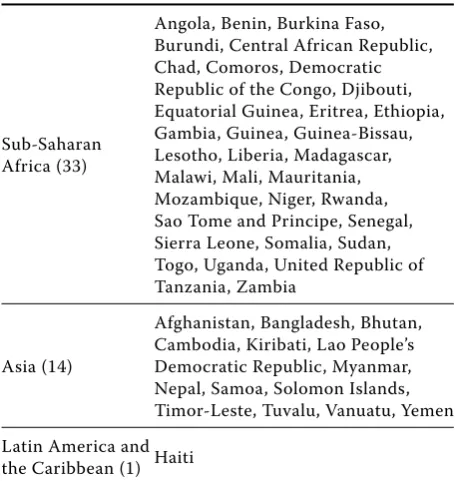
Samoa was scheduled for the graduation in De-cember 2010; however, due to the devastating tsunami that hit the island in 2009, it was decided to postpone Samoa’s graduation to 1 January 2014. Equatorial Guinea was recommended for the graduation in 2009 in accordance with the ‘income only” rule, as its GNI per capita level was several times above the income graduation threshold. Its GNI per capita is now twelve times the graduation threshold. (UN-OHRLLS 2012) For the complete list of the least developed countries in 2012 (Table 2).
There is an intentional asymmetry between the inclusion and graduation criteria:
– Thresholds for the graduation have been established at a higher level than those for the inclusion; – In order to be eligible for the graduation, a country
must cease to meet not just one, but two out of the three criteria (except in cases where the GNI per capita is at least twice the graduation threshold levels);
– The eligibility for the inclusion is ascertained once, whereas the eligibility for the graduation has to be observed over two consecutive triennial reviews; – The inclusion is immediate, while the graduation
takes place only after three years, in order to give
3See Report of the Committee for Development Planning on the Twenty-Seventh Session (22–26 April 1991),Official
Records of the Economic and Social Council, 1991, Supplement No. 11 (E/1991/32).
4In addition to being a condition that determines a country’s eligibility for least developed status, the population size
the country time to prepare for a smooth transi-tion from the list;
– The inclusion requires an approval from the coun-try concerned, whereas the graduation does not (UN 2010).
Gross National Income per capita can provide an indication of the income position of a country
vis-a-vis other developing countries (since the LDCs are understood to be low-income countries suffering from structural impediments to development). It also gives a rough idea of the productive capacity of an economy and its ability to provide the requisite services.
The low-income criterion, based on a three-year average estimate of the GNI per capita, is based on the World Bank Atlas method (under $905 for inclu-sion, above $1086 for graduation as applied in the 2009 triennial review) (UN 2012).
The CDP uses the GNI per capita expressed in the current United States dollars, calculated according to the World Bank Atlas method, which is defined in such a way as to reduce the effects of short-term fluctuations in the inflation and real exchange rates on the GNI. The Committee does not adopt a dollar valued measure of the GNI based on the purchasing power parity (PPP) estimates, as for many low-income countries the published PPP estimates are not based on any direct statistical observations, and for countries with direct estimates, these often are not adequately updated (UN DESA 2008).
Human Assets Index (HAI) is based on indica-tors of: (a) nutrition: the percentage of population undernourished; (b) health: the mortality rate for children aged five years or under; (c) education: the gross secondary school enrolment ratio; and (d) the adult literacy rate (UN 2012).
[image:5.595.63.291.100.341.2]This index has remained unchanged since 2006. The HAI threshold for the inclusion is determined by the Table 2. List of the least developed countries (2012)
Sub-Saharan Africa (33)
Angola, Benin, Burkina Faso, Burundi, Central African Republic, Chad, Comoros, Democratic Republic of the Congo, Djibouti, Equatorial Guinea, Eritrea, Ethiopia, Gambia, Guinea, Guinea-Bissau, Lesotho, Liberia, Madagascar, Malawi, Mali, Mauritania, Mozambique, Niger, Rwanda, Sao Tome and Principe, Senegal, Sierra Leone, Somalia, Sudan, Togo, Uganda, United Republic of Tanzania, Zambia
Asia (14)
Afghanistan, Bangladesh, Bhutan, Cambodia, Kiribati, Lao People’s Democratic Republic, Myanmar, Nepal, Samoa, Solomon Islands, Timor-Leste, Tuvalu, Vanuatu, Yemen Latin America and
the Caribbean (1) Haiti
Source: http://www.unohrlls.org/en/ldc/25/
Size
Location
Economic structure sub-index (1/8)
Environment sub-index (1/8)
Trade shock sub-index (1/4)
Natural shock sub-index (1/4)
Remoteness (1/8) Population
Merchandise export concentration (1/16)
Share of agriculture, forestry and fisheries (1/16)
Share of population in low elevated coastal zones (1/16)
Instability of exports of goods and services (1/8)
Victims of natural disasters (1/8)
Instability of agricultural production (1/8)
Exposure Index (1/2)
Shock index (1/2) Economic
Vulnerability Index
Figure 1. Economic Vulner-ability Index
[image:5.595.65.533.490.759.2]index number corresponding to the third quartile in the distribution of the HAI results for the reference group of all least developed and other developing countries under review. Countries with the HAI values lower than the threshold meet the HAI criterion for the inclusion in the list of the least developed coun-tries. For example, if the reference group consists of 60 countries, there will be 45 countries whose HAI scores are below the threshold and meet the HAI inclusion criterion. The threshold for the gradua-tion has been established at 10% above the inclusion threshold (UN 2010).
Economic Vulnerability (Figure 1) to exogenous shocks is a major structural obstacle to develop-ment. The EVI is designed to reflect the risk posed to a country’s development by exogenous shocks, the impact of which depends on the magnitude of the shocks and on the structural characteristics that determine the extent to which the country would be affected by such shocks (resilience). In this regard, the EVI does not take into account vulnerabilities that result from the economic policy choices made in the recent past and which are of a conjectural nature (UN 2010).
The EVI threshold for the inclusion is the value of the index at the first quartile of the values for the reference group. Countries with the EVI values higher than this threshold meet the EVI criterion for the inclusion in the list of the least developed countries. If the reference group consists of 60 countries, there will be 45 countries whose EVI scores are above the threshold and meet the EVI inclusion criterion. As in the case of the HAI, the Committee applies a dif-ference of 10% between the thresholds for inclusion and graduation (UN 2010).
SPECIAL SUPPORT MEASURES FOR THE LEAST DEVELOPED COUNTRIES
The least developed countries (LDCs) derive special support measures both from the donor community, including bilateral donors and multilateral organiza-tions, as well as from the special treatment accorded to them by certain multilateral and regional trade agreements. Currently, the major support measures extended to countries with the LDC status vary among the development partners and relate primarily to the trade preferences and the volume of the official development assistance (ODA). These measures fall into three main areas: (a) international trade; (b) of-ficial development assistance, including development
financing and technical cooperation; and (c) other forms of assistance.
Support measures and special treatment related to the trade with LDCs
The main categories of special support measures related to the international trade available for the LDCs are (a) preferential market access, (b) special treatment regarding the World Trade Organization (WTO) obligations and (c) trade-related capacity building.
Market access preferences entitle exporters from developing countries to pay lower tariffs or to have a duty- and quota-free access to the third-country markets.These trade preferences are granted under two general preferential schemes: the Generalized System of Preferences (GSP), which is non-reciprocal, and the Global System of Trade Preferences (GSTP) among developing countries, a reciprocal scheme available for signatories.
Market access concessions to the LDCs are also of-fered through regional or bilateral trade agreements and/or non-reciprocal market access schemes. For example, India, Pakistan and Sri Lanka grant mar-ket access preferences under the South Asian Free Trade Agreement (SAFTA) to four least developed country members (Bangladesh, Bhutan, the Maldives and Nepal).
Market access preferences often contain criti-cal exceptions. For example, in 2001, the European Union (EU) adopted the “Everything but Arms” (EBA) initiative, granting the duty-free access to imports of all products from the LDCs – except arms and munitions – without any quantitative restrictions. The EBA initiative, however, also includes tem-porary exceptions on tariff lines of the potential importance to the LDCs (rice and sugar). Duties on these products will be gradually reduced until the duty-free access is granted (for sugar in July 2009 and for rice in September 2009). Original restrictions included bananas, which have been liberalized since 1 January 2006.
The LDCs that are members of the WTO may ben-efit from special considerations resulting from the implementation of that organization’s agreements. Such special provisions fall into five main categories: (a) increased market access, (b) safeguarding of the interests of the LDCs, (c) increased flexibility for the LDCs in rules and disciplines governing trade measures, (d) extension of longer transitional pe-riods to the LDCs, and (e) provision of technical assistance.
Some of these provisions, however, have already expired or are no longer applicable: for example, the longer period extended to the LDCs for
imple-menting certain WTO agreements has expired; in other cases, such as the Agreement on Textiles and Clothing (ATC), special provisions for the LDCs are no longer applicable. The ATC itself expired on 1 January 2005, and the textiles and clothing – sectors subject to quotas under a special regime outside the normal GATT/WTO rules – became fully integrated into the multilateral trading system.
[image:7.595.62.534.295.743.2]An important initiative in support of the LDCs is the Integrated Framework for Trade-related Technical Assistance to Least Developed Countries (IF). The IF was first mandated by the WTO at its first Ministerial Conference, held in Singapore from 9 to 13 December
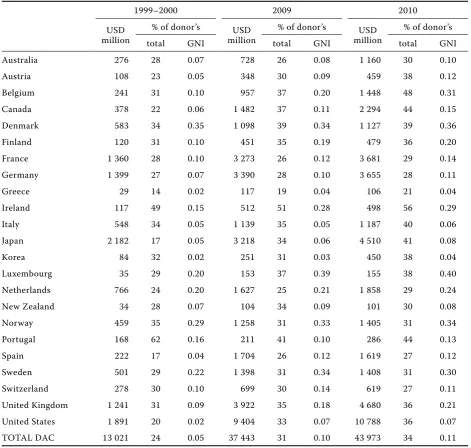
Table 3. Aid from the DAC Countries to the Least Developed Countries
1999–2000 2009 2010
USD million
% of donor’s USD million
% of donor’s USD million
1996, as a multi-agency, multi-donor programme to assist the LDCs in developing the necessary capaci-ties in the area of trade, including improving upon their supply response to trade opportunities and better integrating them into the multilateral trad-ing system. The IF was endorsed at the High-Level Meeting for LDCs in October 1997, and six multi-lateral agencies – the United Nations Development Programme (UNDP), UNCTAD, the World Bank, the International Monetary Fund (IMF), the WTO and the International Trade Centre UNCTAD/WTO (ITC) – have combined their efforts to assist the LDCs in their trade activities.
Following the endorsement of an enhanced IF by the Development Committee of the World Bank and the IMF in 2005, and the detailed recommendations of a task force – which were welcome and approved by the Ministerial Declaration of the WTO meeting in Hong Kong, China – the Enhanced Integrated Framework (EIF) was adopted by the IF govern-ing bodies on 1 May 2007. The EIF strengthens the original Integrated Framework, by focusing on three elements in particular: (a) increased, predictable fi-nancial resources to implement the Action Matrices; (b) strengthened in-country capacities to manage, implement and monitor the IF process; and (c) en-hanced the IF governance.
Official development assistance
Support measures in the area of the bilateral de-velopment financing, the technical cooperation and other forms of assistance usually involve voluntary commitments made by the donor countries. In the Brussels Declaration and the Programme of Action for the Least Developed Countries for the Decade 2001–2010, the donor countries that had previously
pledged to reach the target of 0.15% of the GNP as the ODA to the LDCs as a group, restated their com-mitment to meeting the target expeditiously (there are no targets for the individual LDCs). Meanwhile, the donor countries that had already met the 0.15% target undertook to reach the 0.20% target promptly (UN DESA 2008) – Table 3.
In 2010, the total net disbursements to the LDCs by the member countries of the Development Assis-tance Committee of the Organization for Economic Cooperation and Development (OECD/DAC) amount-ed to about $44.7 billion, as illustrate by Figure 2.
CONCLUSION
Agricultural productivity gains must be the basis for the national economic growth, the instrument for the mass poverty reduction and food security. Faster growth and poverty reduction are now achievable, but they will require commitments, skills, and resources. This poses a huge challenge to the governments and the international community. The agriculture produc-tive capacity is largely determined by four elements: the natural endowment of resources; the public and private investment in infrastructure; research and technology; and the public policy towards agricul-tural producers (De La Torre Ugarte and Dellachiesa 2007). Since the natural resources – land, climate, topography, water – are largely fixed, the level of public investment in infrastructure, research and development, and the support to farmers are all in-dicators of how the productive capacity of the sector is likely to evolve.
Armed conflicts constitute a significant cause of deteriorating the food security in these countries. Reciprocally, the food security can help to prevent conflicts and it is essential for the sustained and
peace-44 699
14 569 25 158
7 406 39 255
least developed countries
other low income
lower middle income
upper middle income
unspecified Figure 2. ODA by income group (USD million, 2010, net disbursements)
[image:8.595.67.383.608.767.2]ful recovery after the wars have ended. A principal source of conflicts lies in the lack of food security, as experienced by different households and communi-ties; religious, ethnic, and political groups; and states. Yet both peace and food security remain elusive for many war-ravaged countries where the decimation or flight of material and human resources make the return to a normal food and livelihood security dif-ficult to achieve. Sources of discontent include the skewed land distribution, the excessive tax burdens, and the wage and price policies that preclude decent standards of living. An unequal access to education and nutrition services, an unequal treatment before the law, the perceptions of unfairness, which in turn leads often to the violent expression of the desire for change.
REFERENCES
Bjerkholt O. (2012): Least Developed Countries: An In-troduction. Available at http://www.uio.no/studier/ emner/sv/sv/UTV3090/v05/undervisningsmateriale/ LDC-lecture.pdf (accessed 2012-08-05).
De La Torre Ugarte D.G., Dellachiesa A. (2007): Advancing the agricultural trade agenda: beyond subsidies. The Georgetown International Environmental Law Review,
19: 775–796.
Development Aid at a Glance (2012). Available at http:// www.oecd.org/dataoecd/59/5/42139479.pdf
UN (1991): Report of the Twenty-Seventh Session, 22–26 April 1991. Committee for Development Planning,
Economic and Social Council Official Records, 1991, Supplement No. 11. United Nations Publications, New York, E/1991/32.
UN (2010): LDC Information: The Criteria for Identify-ing LDCs. Available at http://www.un.org/en/develop-ment/desa/policy/cdp/ldc/ldc_criteria.shtml (accessed 2013-01-0).
UN (2011): The Least Developed Countries: Historical Background. Available at http://www.un.org/events/ ldc3/prepcom/history.htm (accessed 2012-06-05). UN (2012): Fourth UN Conference on LDCs. Istanbul,
Turkey, 9–13 May 2011. Available at https://www. un.org/wcm/content/site/ldc/home/Background/quick_ facts#11127 (accessed 2012-07-05).
UNCTAD (2011): LDC Report 2011. Available at http://unc-tad.org/en/Docs/ldc2011_en.pdf (accessed 2012-04-04). UN DESA (2008): Handbook on the Least Developed Coun-try Category: Inclusion, Graduation and Special Support Measures. Available at http://www.un.org/esa/policy/ devplan/cdppublications/2008cdphandbook.pdf (ac-cessed 2012-07-05).
UN-OHRLLS (2012): Criteria for Identification and Gradu-ation of LDCs. Available at http://www.unohrlls.org/en/ ldc/164/ (accessed 2012-07-08).
UN-OHRLLS (2013): About Least Developed Countries. Available at http://www.unohrlls.org/en/ldc/25/ (ac-cessed 2013-01-05).
http://www.oecd.org/document/9/0,3746, en_2649_34447_1893129_1_1_1_1,00.html
http://www.un.org/en/development/desa/policy/cdp/ldc/ ldc_criteria.shtml
http://www.unohrlls.org/en/ldc/25/
Received: 14th May 2013
Accepted: 15th June 2013
Contact address: