The area of tourism has been significantly expand-ing in the recent years, which is beneficial for the economic and political as well as social spheres of every country. Tourism employs more and more people and becomes an inseparable part of social and modern lives for most inhabitants. Due to the increasing level of tourism, the competition between the individual cities, regions and mainly countries is raising as well, so for sustaining competitiveness, it is inevitable to pay a close attention to the offered quality. Lee (2012) ranks the quality among the six critical factors having an influence on the competi-tive advantages development in tourism. With regard to the specific character of services (especially their tangibility, transience and variability), and since most tourism services contain a high percentage of experi-ence and credexperi-ence properties (Nelson’s classifications, Nelson 1970, 1974), it is rather difficult to measure
this quality and in practice, we can meet with differ-ent approaches and understanding of the destination quality. It is also convenient to approach quality in a complex way, so to understand quality not only as a reflection of localization or realization factors (for instance, the number of natural or cultural attractions or according to the cleanness of the air). Quality is closely connected with customer satisfaction; it is an immediate reflection of a customer’s satisfaction, so it can be successfully evaluated just according to the level of his or her satisfaction.
The World Tourism Organization UNWTO (2003) defines quality as a result of a process that leads to meeting all legitimate needs, requirements and expec-tations of a customer concerning a service product, all this for an acceptable price in compliance with the mutually accepted contract conditions and de-termining qualitative determinants, such as security,
Possible complex approaches towards evaluating
the quality of a destination in the context of tourism
management
Kateina RYGLOVÁ
1, Ida VAJČNEROVÁ
21Department of Marketing and Trade, Faculty of Business and Economics, Mendel University
in Brno, Czech Republic
2Department of Management, Faculty of Business and Economics, Mendel University in Brno,
Czech Republic
Abstract: Th epaper deals with the issues concerning evaluating the quality of a destination in the context of tourism. A
destination has to be looked on as a complex product of tourism consisting of products, services, natural resources, artifi -cially created attractions and information being connected. Th e satisfaction of visitors to a destination is dependent on the quality of their overall experience that is created on the basis of the cooperation of all participants working in tourism in the given area – these are local inhabitants, service providers, public administration workers and destination management workers. Th e paper shows possible approaches towards the complex evaluation of the destination quality. Th e fi rst of the models is based on the European Consumer Satisfaction Index methodology and modifi es it for evaluating the satisfaction of a visitor to a destination (in the researched destination, the values of the total ECSI indexes were calculated at 70% level in the case of home as well as foreign visitors). Th e second model – so-called Four-dimensional model of the destination quality – is based on the integrated approach to quality management when – with the support of the principal component analysis – a new methodology for evaluating the quality of a destination was suggested; it is based on four topically defi ned quality dimensions: attractions, services, marketing management, cooperation and sustainability. In the case of the suggest-ed models, we also see their potential for increasing the quality of services in rural areas, which is the subject of the authors’ further research.
hygiene, availability of tourist services, transpar-ency, authenticity and harmony of tourist activities with human and natural environment. According to Grönroos (2007), there are two basic components of quality: technical quality (which concerns measurable elements that are results of the provided services, for instance physical state, appearance, the cleanness of clothes and so on) and functional quality (which concerns the way of providing the service). Perceiving this component is more subjective, it can for example be influenced by the environment of the provided services, staff behaviour, length of the waiting time and so on. From what was mentioned above, it fol-lows that the quality of a service is a feature of an operation that can be performed on a certain level. However, the requirements for this level are set by customers, so it is inevitable to define the term of quality relatively, also from the point of the subjec-tive view according to the customer satisfaction. Zeithaml et al. (2006) claim that service quality is a component of customer satisfaction, however, mutual relations between satisfaction and perceived quality induce more controversies. Admittedly, Petrick et al. (2004) verified models of the relations between the perceived quality, customer value, satisfaction, and market behaviour of customers, but they do not assume such a possibility that satisfaction has an influence on quality, in all the analysed variants assuming the opposite relation. However, Lee et al. (2004), on the basis of broad studies on the litera-ture, have noticed that the research cannot agree on which of the two terms has a wider scope and which of them is the prerequisite of the other. Getz et al. (2001) notice that properly defining relations between quality and satisfaction depend mainly on the way quality is defined. The problem might be even more complicated if additionally the customer value is taken into consideration as another term strictly connected with the customer satisfaction and product quality (Chen and Chen 2010; Yuskel et al. 2010; Zemła 2012).
Satisfaction is generally perceived as a broad con-cept while service quality focuses mainly on service dimensions. Many experts have dealt with setting the relevant service quality dimensions (e.g. Parasuraman et al. 1985; Berry and Parasuraman 1991; Bruhn 1996) and on the basis of the empiric data, five main dimensions were defined: the influence of environ-ment on a customer (tangibles), the reliability of services, the sensitiveness of the approach towards a customer (responsiveness), the staff qualifications (assurance) and empathy.
Tourist destination is defined as “a target area in a given region for which a significant offer of at-tractions and infrastructure of tourism are typical. in a broader sense, these are the countries, regions, human settlements and other areas that are typical with their high concentration of tourists, developed services and other tourist infrastructure, the result of which is a great long-term concentration of visitors” (Pasková and Zelenka 2002); it is a place with suitable attractions in connection with tourist facilities and services which a tourism participant has chosen to visit” (The World Tourism Organization UNWT). The development of a destination is directed by a tourist organization that realizes the marketing management. According to Buhalis and Costa (2006), a tourist des-tination is characterized by six components marked as “6 As”. It is the primary offer of tourist attrac-tions – the natural and cultural-historical potential (Attraction); the secondary offer – accommodation, hostelry, sports-recreational, cultural-social and other facilities (Amenities), the general infrastructure pri-marily created for local inhabitants’ needs (Ancillary services), Accessibility, product packets (Available packets) and the possibility of using sports, cultural and other experience activities (Activities). Middleton and Clarke (2001) claim that a destination as a prod-uct of tourism is created by five components, three of which agree with Buhalis (Attraction, Amenities, Accessibility), and the other two are the image and perception of the destination and price.
According to Palatková and Tittelbachová (2011), it is not easy to define the term of the destination quality. The first reason is a high subjectivity of the destination visitors’ perception and the complexity of a destination as a social-economic system. The second reason is the respect towards residents whose quality perception does not have to be in compliance with the way how visitors or the management of a destination perceive it.
which is based on the model of exceptionality EFQM. Its creation was initiated by the European Commission on the basis of the published studies that provided the results of the best quality management practice in the selected European destinations (Vajčnerová 2011). The integrated quality management joins four key elements of a destination in its approach – these are the visitors’ satisfaction, the service providers’ satisfaction, the quality of local inhabitants’ lives and the quality of the environment.
The paper aims to shows possible approaches to-wards the complex evaluation of the destination quality in the context of tourism management. The suggestion of models concerning a possible evaluation of the destination quality is also a part of the paper. The first model is based on the ECSI methodology (European Consumer Satisfaction Index) and modi-fies it for evaluating the satisfaction of a visitor to a destination; the second model is based on the inte-grated approach towards the quality management.
MATERIAL AND METHODS
The tool for measuring the qualitative performance of a destination grounded in the European system of integrated quality management (IQM) and based on the model of exceptionality EFQM is called the Qualitest. (The document was published by the European Commission in 2003 as the “Qualitest – a Manual for Evaluating the Quality Performance of Tourist Destinations and Services.”) It is formed by a complex of 16 themes divided into two groups. The first group provides information on basic fac-tors of a destination, the second one on the quality of a tourism product itself. Each theme is evalu-ated by three indicators (QPCI – Quality Perception Condition Indicators, the so-called state indicators; QMI –Quality Management Indicators; QPI – Quality Performance Indicators) that are connected and reflect the integrated approach of quality management that is crucial for a tourist destination (Vajčnerová 2009).
On the basis of measuring, recording and comparing the values of the three indicators (QPCI, QMI, QPI) for each quality index (16 quality indexes altogether, e.g. the vitality of tourist industry in a destination, marketing and promotion, accessibility, transporta-tion etc.), it enables to compare the ways of reaching similar partial objectives in various destinations in the process of benchmarking, to use the good experience and to reveal weaknesses. By keeping the records and comparing the results from previous years, a
destina-tion can follow a positive or negative development of the individual indicators. The practical application of the Qualitest is rather demanding as to the extent of the required information which the management of a destination does not always have to have at its disposal. Regarding the present level of the destina-tion management in the Czech Republic, when in some areas, there are yet no functional destination management organizations, the Qualitest can only be used in the selected destinations provided that it is modified according to the potentials of the individual destinations (Vajčnerová 2009).
In the tourism practice, we can often meet various attempts to find out about a customer’s or a client’s – or possibly a visitor’s – satisfaction that are usu-ally not very systematic, of a low level of complexity and with no following feedback. In the world, we can notice attempts to quantify the level of customer satisfaction when the models enabling the quantifica-tion of satisfacquantifica-tion by indexes are usually used. These approaches can be understood as complex as they try to detect various factors having an influence on the overall satisfaction of a customer. One of them is also the European Model of Customer Satisfaction (ECSI – European Customer Satisfaction Index; Fornell 1992) that is perceived as a set of hypothetical variables: customer’s expectations, the perceived quality, the perceived value, satisfaction, image, loyalty and the customer’s complaints (Mateides and Ďaďo 2002). Each hypothetical variable is determined by a certain number of measurable variables. The number and the exact determination of measurable variables to the individual hypothetical variables are not constant. Measurable variables of the customer satisfaction index are selected and compiled for every branch, area or business sphere independently. The ECSI model is based on the presumption that for gaining the primary input data (point evaluation); we use a questionnaire survey among the clients of the observed companies, institutions or destinations, where the questions are constructed according to the type of the multistage Likert scale. 3–7 questions are usu-ally used for modelling each hypothetical variable (Ryglová and Vajčnerová 2005). It is also inevitable to determine the importance of the individual satisfac-tion features. The hypothetical variables of the ECSI model are calculated as a weighted arithmetic mean. Casel and Eklof (2001) researched the prerequisites for developing a common model structure useful for devising the aggregate CSI results throughout Europe.
satisfaction are either the so-called Gap model or the model of customer satisfaction created by Kano. The Gap model relies on the methods that are based on the formulation of “a perfect service” attributes; it understands quality as the reflection of a customer’s satisfaction and it is grounded in the presumption that the satisfaction of a customer reflects the difference between his or her expectations and the perception of the obtained service level. The model created by Kano offers an outlook on the attributes (features) of products that are perceived as important by the customer, it focuses on various features of the product that the customer primarily turns his or her attention to. It also utilizes questionnaire surveys to obtain the topical data. Kano (2001) differs six categories of quality features the first three of which (basic, satisfying, efficient) affect the customer’s satisfaction. Meeting basic factors is also the minimum for enter-ing the market. The other three attributes mentioned by Kano do not have any influence on satisfaction.
The problems of analysing the customer satisfac-tion also by using quantificasatisfac-tion with the help of indexes are rather extensively solved by Hill et al. (2003). During the analysis of the satisfaction PFI (Priorities for Improvement), the authors based on the identification of the customer requirements and wishes, the analysis of their importance from the point of the customer’s view (importance score), the analysis of his or her satisfaction (satisfaction score) and the following GAP analysis (importance score vs. satisfaction score – the larger is the gap, the bigger problem occurs). Eklof a Westlund (1998) analyze
the topic of the Customer Satisfaction Index in the context of its role in quality management.
RESULTS, DISCUSSION AND CONCLUSIONS
Four-dimensional model of destination quality
The quality of a destination is dependent on many different factors grounded in the basic definition of a tourist destination and its key attributes. The main dimensions of the service quality (the influence of the environment, reliability, responsiveness, staff qualification and empathy) were modified for the needs of a destination where the criteria are slightly different; they come out of the basis of a destination as a product and of the principles of the integrated quality management that respects the satisfaction of tourists, tourist services providers, the quality of local inhabitants’ lives and the responsible approach to the environment. The quality of a destination is measured by the satisfaction of customers with the complete experience; the complete experience depends on the cooperation of all participating components and sustainable development. For the evaluation of the destination quality, twenty factors (measurable variables) were set which were formulated on the basis of the previous researches and they were assigned importance. These factors are mentioned below.
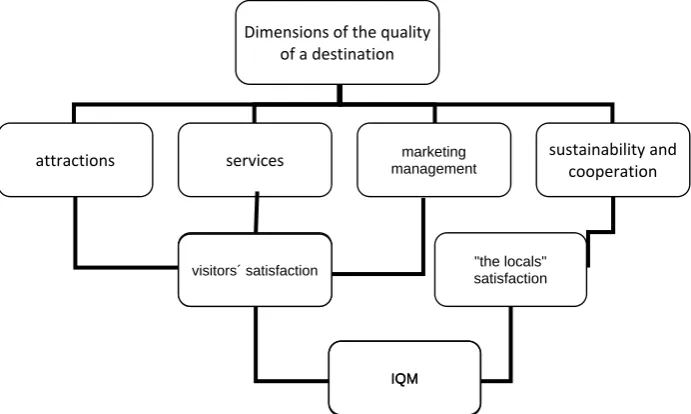
The suggested model (Figure 1) for evaluating the destination quality is based on analysing the im-portance of the individual factors (variables) of the
Dimensionsofthequality
ofadestination
attractions services managementmarketing sustainabilityand
cooperation
Spokojenost návštČvníka
IQM
"the locals" satisfaction
[image:4.595.127.473.514.721.2]IQM Nárovisitors´ satisfactionþnost zákazníka
Figure 1. The model of evaluating the quality of a tourist destination
destination quality; the importance of the factors was set by the relevant respondents in the questionnaire survey. The multidimensional statistic method of the principal components analysis was used to reduce the original number of twenty dependent variables on the basis of similarities in evaluations. This method supported clusters of factors – relative dimensions of the destination quality. Then the methodology for evaluating the destination quality was formulated according to the four newly-defined dimensions of quality: Attractions, Services, Marketing Management, Cooperation and Sustainability.
The principal components of the analysis supported dividing the variables according to the evaluation of their importance into 4 clusters that are the bases for formulating the relative dimension of the desti-nation quality.
– Attractions (the influence of the environment on a customer – primary offer): Natural attractions; Cultural-social attractions.
– Services (the comfort and security – secondary of-fer): Accommodation; Boarding; Experience Activi-ties; Transport Accessibility; Local Transportation; Sense of Security.
– Marketing Management: the availability and quality of information; pre-coming communication; the quality of welcoming; the image of a destination; the uniqueness of a destination; innovations. – The sustainability and Cooperation: Products,
packets; active destination management;
Private-Public-Partnership; strategic alliances development1;
respecting sustainability; entrepreneurs’ satisfaction with activities; local inhabitants’ satisfaction with activities; the value of money.
The original 20 factors of the destination quality were replaced by four dimensions of quality. With the minimal loss of information, on the basis of these di-mensions the quality of a destination can be evaluated. The elements of the integrated quality management (visitors’ satisfaction, service providers’ satisfaction, the quality of local inhabitants’ lives and the quality of the environment) are applied by evaluating the satisfaction in the case of the relevant groups of respondents (visitors and so-called locals).
The analysis of the principal components supported the creation of clusters that laid the foundations for the dimensions of quality. The expert evaluation shows that the dimensions of Attractions, Services and Marketing Management are created by the sets
of factors that can be evaluated by the visitors to the destination on the basis of their experience. The dimension of Sustainability and Cooperation consists of seven factors, five of which (16–20) are impos-sible to be evaluated by a visitor. Only the so-called “locals” can express the experiences and so the level of satisfaction with them. Therefore, the visitors evaluate the first three dimensions, “the locals” the fourth one. On this level, a qualitative research will come into question, the mentioned dimension can also by evaluated on the basis of a depth interview.
For the practical usage, a simplified questionnaire can also be formulated where the respondents will evaluate only 4 dimensions of quality instead of twenty factors – Attractions, Services, Marketing manage-ment, Sustainability and Cooperation. Within the frame of benchmarking, the competitive destinations can be compared when at the same time the evalua-tion is based on the principle of the integrated quality management. This universal method is applicable to all types of destinations, it will primarily help to identify the strengths and weaknesses of the desti-nation quality and at the same time, by quantifying the original variables, it enables the analysis of the necessary dimensions into concrete factors that have to be improved. For the comparison or the possible benchmarking of the quality of random destinations, it is inevitable to define the evaluated destination and to conduct a primary research of visitors’ as well as the so-called “locals’” satisfaction.
The verification of the above mentioned method-ology concerning the evaluation of the quality of a destination for concrete destinations is an issue of the further author’s research.
ECSI modification for evaluating destination quality
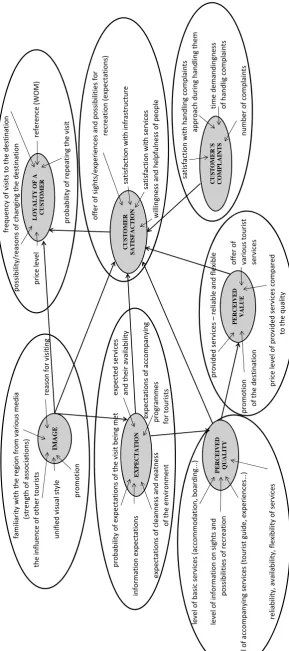
The original ECSI methodology was modified for the specific environment of a destination visitor (Figure 2), the individual measurable variables were determined for the hypothetical variables of the ECSI model. Weight evaluation of their importance was set by the statistical method of covariance; the tested destination was the city of Brno, which is the second largest city in the Czech Republic after Prague. The primary input data in the form of point evaluation enabling the quantification of the Brno visitor’s sat-isfaction by the means of the suggested ECSI model
frequency of visits to the destination familiarity with the region from various media possibility/reasons of changing the destination (strength of associations) the influence of other tourists price level reference (WOM) reason for visiting unified visual style probability of repeating the visit promotion offer of sights/experiences and possibilities for recreation (expectations) probability of expectations of the visit being met expected services and their availability satisfaction with infrastructure information expectations expectations of accompanying satisfaction with services expectations of cleanness and neatness programmes willingness and helpfulness of people of the environment for tourists satisfaction with handling complaints level of basic services (accommodation, boarding...) approach during handling them level of information on sights and provided services – reliable and flexible time demandingness possibilities of recreation of handlig complaints offer of level of accompanying services (tourist guide, experiences…) promotion various tourist number of complaints of the destination services reliability, availability, flexibility of services price level of provided services compared to the quality IMAGE EXPECTATI O N PERCEI V ED Q UALI T Y LO YALTY O F A CUSTO M E R CUSTO M ER SATISFACTIO N PERCEI V ED VALUE CUSTO M ER´ S CO M P LAI N TS F ig u re 2. Mo dif ic
ation of t
[image:6.595.121.411.84.737.2]were obtained by the field research with the help of face to face questioning in the case of domestic (140 responders) as well as foreign visitors (140 re-spondents) of the selected destination of Brno using random sampling. For this purpose, the measurable variables of the relevant hypothetical variables of the ECSI model were transformed into the form of the scale questionnaire questions. Consequently, the indexes of the customer/visitor satisfaction for the Czech as well as foreign visitors to the destination of Brno were calculated.
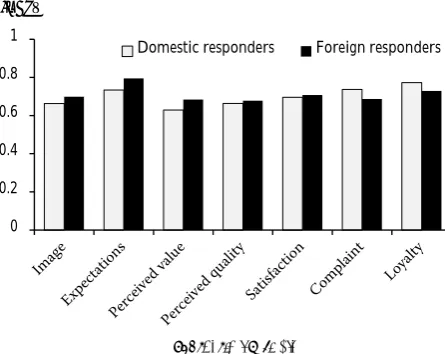
The Figure 3 shows the obtained values of indexes concerning the satisfaction of a visitor to the des-tination in the case of Czech and foreign tourists that participated in tourism in Brno in the spring season 2007.
with the quality of the provided services in this des-tination. Czech tourists are generally less satisfied, which can possibly be ascribed to the typical Czech “always dissatisfied” character. This statement can also be confirmed by the fact that despite the general dissatisfaction of Czech tourists, their expectations before visiting Brno are not by far as high as in the case of foreign respondents. The lowest value of the index was reached by the hypothetical variable of perceived value (62.9%), which points out the fact that domestic tourists are the least satisfied with the offer of services, the accessibility of information and the promotion of this tourist region.
As it has already been mentioned, the obtained results can be analysed in more details, the specific partial values of the individual measurable variables can be examined. For instance, in the case of the hy-pothetical variable of loyalty, the total values of which counted among the highest for both sets (foreign visitors 73%, domestic visitors 77.3%), it is important to know the values of the individual measurable vari-ables, when for example the lower index of the variable expressing the probability of repeating the visit does not necessarily have to mean the dissatisfaction with the destination, but only different preferences of the visitor, who for example is not in the habit of visit-ing the same place repeatedly, despite the fact that he or she was satisfied in the destination. Similarly, the total result of the variable of complaints can be misleading, if we are not aware of the results of the partial variables, as the Czech client is not yet used to making complaints of services to such an extent as it is usual for example in the case of German or Austrian clients. We ought to consider the fact that a customer, even in the case of a very high satisfaction, does not give the highest possible 100% evaluation.
If this ECSI methodology is used for a broader re-search, it would be possible to gain interesting results with a higher revelatory value, which might become an important basis for the strategic decision-making in the area of tourism development in the observed area. However, the objective of the authors was not to analyse the obtained indexes of the customer sat-isfaction in detail and then to evaluate the impacts, but to test and to present the possibility of the prac-tical application of the ECSI and the utilization of this tool within the destination management also in rural areas, as the concrete ECSI application related to the area of the destination management has not been conducted yet.
The studies focused on the prediction of satisfaction and loyalty by the means of the ECSI for hostels in 0
0.2 0.4 0.6 0.8 1
Domestic responders Foreign responders
[image:7.595.66.289.302.479.2]Hypothetical variable
Figure 3. The comparison of the ECSI indexes for do-mestic and foreign visitors
Source: Ryglová (2009)
Index
Australia (Chitty et al. 2007) can be considered to be topically close areas of our research, as well as using the Customer Satisfaction Index Model for analysing the citizens’ satisfaction in the New York City (van Ryzin et al. 2004). So far, in the area of services, we have often met the ECSI application in the area of the financial (Martensen and Grønholdt 2010) and telecommunication (Türkyilmaz and Özkan 2007) services.
The relative exactingness of the practical ECSI application is connected with the complexity of the methodology, especially with regard to the primary data collecting. The existence of seven hypothetical variables and the consequently demanding and exact definition of the concrete measurable variables often results in a questionnaire that is too long and difficult for the end customer, the client or tourist, in conse-quence of which the primary data can be distorted or obtained in a complicated way. The mentioned complexity of the ECSI methodology calculation might be overcome by the approach of Hill et al. (2003), i.e. by using the GAP analysis and calculating a simpli-fied index of the customer satisfaction based only on evaluating no more than twenty most significant characteristics of satisfaction from the position of a customer. This methodology enables quite a fast and not very complex analysis of the customer satisfaction, it reveals the present weaknesses in satisfaction and it provides instructions and advices which problems have to be solved in priority within managing the customer satisfaction. Unfortunately, it does not give answers (unlike the ECSI) for example to the questions of loyalty or complaints that are directly connected with satisfaction.
The subject of the authors’ further research is to reveal the potential of the tested models in rural areas in the context of increasing the competitiveness of the provided agri-tourism services.
REFERENCES
Berry L.L., Parasuraman A. (1991): Marketing Services: Competing Through Quality. Free Press, New York; ISBN 978-0-0290-3079-0.
Bruhn M. (1996): Qualitätsmanagement für Dienstleistun-gen: Grundlagen, Konzepte, Methoden (Quality Services Management: Principles, Concepts, Methods.) Gabler Verlag, Berlin; ISBN 978-3-540-20292-9.
Buhalis D., Costa C. (2006): Tourism Business Frontiers: Consumers, Products and Industry. Elsevier, Oxford; ISBN 978-0-7506-6377-9.
Cassel C., Eklof J.A. (2001): Modelling customer satisfac-tion and loyalty on aggregate levels: Experience from the ECSI pilot study. Total Quality Management, 12: 834–841.
Chen C.-F., Chen F.-S. (2010): Experience quality, perceived value, satisfaction and behavioral intentions for heritage tourists. Tourism Management, 31: 29–35.
Chitty B., Ward S., Chua C. (2007): Application of the ECSI model as a predictor of satisfaction and loyalty for backpacker hostels. Marketing Intelligence & Plan-ning, 25: 563–580.
Eklof J., Westlund A. (1998): Customer Satisfaction Index and its Role in Quality Management. Total Quality Management, 9: 80–85.
Fornell C.A. (1992): National Customer Satisfaction Ba-rometer: the Swedish experience. Journal of Marketing,
56: 6–21.
Getz D., O’Neill M., Carlsen J. (2001): Service quality evaluation at events through service mapping. Tourism Management, 39: 380–390.
Grönroos C. (2007): Service Management and Marketing: Customer Management in Service Competition. John Wiley & Sons, New York; ISBN 978-0-470-02862-9 Hill N., Brierley J., Macdougall R. (2003): How to Measure
Customer Satisfaction. Gower, Burlington; ISBN 05-660-8595-X.
Kano N. (2001): Guide to TQM in Service Industries. Asian Productivity, Tokio; ISBN 92-833-1129-9.
Lee J., Graefe A.R., Burns R.C. (2004): Service quality, sat-isfaction and behavioral intention among forest visitors. Journal of Travel and Tourism Marketing, 17: 73–82. Lee M. (2012): an analysis of the critical factors that affect
the competitive advantages and developmental strategies of leisure farms in Taiwan. Agricultural Economics – Czech, 58: 467–481.
Manual for Evaluating the Quality Performance of Tourist Destinations and Services (2003). Enterprise DG Pub-lication. Available at http://ec.europa.eu/enterprise/ tourism/docs/studies/evaluating_quality_performance/ qualitest_manual_en.pdf (accessed February 2010). Martensen A., Grønholdt L. (2010): Measuring and
man-aging brand equity: a study with focus on product and service quality in banking. International Journal of Quality and Service Sciences, 2: 300–316.
Mateides A., Ďaďo J. (2002): Služby: teória služieb, market-ing služieb (Services: Theory and Marketmarket-ing of Services.) Epos, Bratislava; ISBN 80-805-7452-9.
Middleton V.T.C., Clarke J.R. (2001): Marketing in Travel and Tourism. Butterworth Heinemann, Oxford; ISBN 0-7506-4471-0.
resorts). In: Kasper C.: Jahrbuch der Schweizerischen Tourismuswirtschaft (Yearbook of the Swiss Tourism Industry.) Institut für Tourismus und Verkehrwirtschaft an der Hochschule, St. Gallen.
Nelson P. (1970): Information and consumer behavior. Journal of Political Economy, 78: 311– 329.
Palatková M., Tittelbachová Š. (2011): Analýza systému řízení kvality v sektoru turistických informačních center v České republice (Analysis of the quality management system in the sector of tourism information centers in the Czech Republic.) Collection of reviewed contri-butions from the International Scientific Conference Hospitality, Tourism and Education, 12: 205–217. Parasuraman A., Zeithaml V., Berry L. (1985): A conceptual
model of service quality and its implications for future research. Journal of Marketing, 49: 41–50.
Pásková M., Zelenka J. (2002): Výkladový slovník cesto-vního ruchu (Explanation Dictionary of Tourism.) MMR, Prague; ISBN 80-239-0152-4.
Petrick J.F., Snaith T., Bilim Y. (2004): The roles of quality, value and satisfaction in predicting cruise passengers’ behavioral intentions: holiday satisfaction in Varadero, Cuba. Journal of Travel Research, 42: 397–407. Ryglová K. (2009): Specifické možnosti aplikace
market-ingových nástrojů při podnikání v cestovním ruchu (Specific Possibilities of Applying Marketing Tools in Tourism Business.) [Habilitation thesis.] MZLU, Brno. Ryglová K., Vajčnerová I. (2005): Potential for utilization of european customer satisfaction index in agro-business. Agricultural Economics – Czech, 51: 164–168. Tomšík P., Prokeš M. (2011): New strategic alliances of wine
producers in the Czech Republic. Agricultural Econom-ics – Czech, 57: 573–579.
Türkyilmaz A., Özkan C. (2007): Development of a cus-tomer satisfaction index model: an application to the
Turkish mobile phone sector. Industrial Management & Data Systems, 107: 672–687.
UNWTO (2003). UNWTO Quality Support Committee, sixth meeting, Varadero. Available at http://sdt.unwto. org/en/content/quality-tourism
Vajčnerová I. (2009): Kvalita destinace cestovního ruchu – integrovaný management kvality. (The quality of tour-ism destination – integrated quality management.) Acta Universitatis Agriculturae et Silviculturae Mendelianae Brunensis, 6: 361–367.
Vajčnerová I. (2011): IQM of a tourism destination as a tool of competitiveness. Acta Universitatis Agriculturae et Silviculturae Mendelianae Brunensis, 2: 407–412. Vajčnerová I., Šácha J., Ryglová K. (2012): Using the
prin-cipal component analysis for evaluating the quality of a tourist destination. Acta Universitatis Agriculturae et Silviculturae Mendelianae Brunensis, 2: 449–458. van Ryzin G.G., Muzzio D., Immerwahr S., Gulick L.,
Mar-tinez E. (2004): Drivers and consequences of citizen satisfaction: An application of the American customer satisfaction index model to New York City. Public Ad-ministration Review, 64: 331–341.
Yuskel A., Yuskel F., Bilim Y. (2010): Destination attach-ment: Effects on customer satisfaction and cognitive, affective and conative loyalty. Tourism Management,
2: 274–284.
Zeithaml V.A., Bitner M.J., Gremler D. (2006): Services Marketing: Integrating Customer Focus Across the Firm. McGraw-Hill, Boston; ISBN 00-724-7142-5.
Żemła M. (2012): Evaluation of tourism destination prod-ucts by consumers. Theoretical model. International Journal of Hospitality and Tourism, 1: 57–68.
Received: 30th August 2013 Accepted: 6th January 2014
Contact address:
Ida Vajčnerová, Mendel University in Brno, Faculty of Business and Economics, Zemědělská 1, 613 00 Brno, Czech Republic