• No results found

TAENIATHERUM CAPUT-MEDUSAE

N/A
N/A
Protected

Academic year: 2020

Share "TAENIATHERUM CAPUT-MEDUSAE"

Copied!
142
0
0

Loading.... (view fulltext now)

Full text

(1)

MEDUSAE (MEDUSAHEAD): TAXOMONIC DIVERSITY, GEOGRAPHIC ORIGINS, MULTIPLE INTRODUCTIONS AND FOUNDER EFFECTS

by

Morgan Lindsey Peters

A thesis

submitted in partial fulfillment of the requirements for the degree of

Master of Science in Biology Boise State University

August 2013

(2)

© 2013

Morgan Lindsey Peters

ALL RIGHTS RESERVED

(3)

DEFENSE COMMITTEE AND FINAL READING APPROVALS

of the thesis submitted by

Morgan Lindsey Peters

Thesis Title: Genetic and morphological variation in Taeniatherum caput-medusae (Medusahead): taxonomic diversity, geographic origins, multiple introductions and founder effects

Date of Final Oral Examination: 19 May 2011

The following individuals read and discussed the thesis submitted by student Morgan Lindsey Peters, and they evaluated her presentation and response to questions during the final oral examination. They found that the student passed the final oral examination.

Stephen J. Novak, Ph.D. Chair, Supervisory Committee

James F. Smith, Ph.D. Member, Supervisory Committee

Marcelo Serpe, Ph.D. Member, Supervisory Committee

René Sforza, Ph.D. Member, Supervisory Committee

The final reading approval of the thesis was granted by Steven J. Novak, Ph.D., Chair of

the Supervisory Committee. The thesis was approved for the Graduate College by John

R. Pelton, Ph.D., Dean of the Graduate College.

(4)

iv DEDICATION

This thesis is dedicated with love to Jeannette Irene Turman (1926-2011) and Paul

Onil Frechette (1923-2011).

(5)

v

ACKNOWLEDGEMENTS

This thesis would not have been possible without the endless patience, guidance, and enthusiasm of my major advisor Dr. Stephen J. Novak. I am grateful to have had such an intelligent and passionate mentor and could not have asked for better. I would also like to express my deepest gratitude to Dr. James F. Smith for his unwavering support and encouragement and Dr. Marcelo Serpe for his helpful comments.

I am also indebted to Dr. René Sforza for his many hours in the field collecting samples for this project and his insightful comments. This collaborative project would not have been possible without him. I also want to thank Yves Tindón and Vivian Zapata for their enthusiasm and help in the lab while working on this thesis.

It is also a sincere pleasure to acknowledge those individuals who made my time at Boise State a memorable experience. In particular, the love and support of my friends and colleagues: Lacie Schulte, Emma Wilson, Allison Korte, Kevin (Gus) Gluckert, and Michael Davis(.com). I would also like to extend a special thank you to my loving family and my partner, Erik Hinkle, for their continuous support during my graduate career.

This acknowledgement section would not be complete without a thank you to the Bar Gernika Evolution Group for many a Friday night spent in engaging conversations over tasty adult beverages.

Finally, thanks to all of the organizations that contributed funding to this research:

the United States Department of Agriculture, National Institute of Food and Agriculture

(6)

vi

(USDA NIFA), Project Number IDAR-2008-03063

;

Boise State University and the

United States Department of Agriculture European Biological Control Laboratory.

(7)

vii ABSTRACT

Invasive species are novel to a region, thus their timely and accurate identification is a critical first step in recognizing and managing the threats that they may present in their new habitats. Accurate identification of an introduced species in its new range can prove difficult however for a species that displays taxonomic complexity in its native range, i.e. consists of multiple, morphologically similar subspecies.

Across its native range, Taeniatherum caput-medusae (medusahead) exhibits taxonomic complexity. Three subspecies have been recognized: T. caput-

medusae ssp. caput-medusae, T. caput-medusae ssp.asperum, and T. caput- medusae ssp. crinitum. While subspecies caput-medusae is found in the western Mediterranean and subspecies crinitum occurs from eastern Europe to Central Asia, subspecies asperum is distributed across the geographic distribution of the species. Only subspecies asperum is believe to occur in the United States, where it is now invasive in portions of California, Idaho, Nevada, Oregon, Utah, and Washington. As part of ongoing research to better understand and manage this invasion, genetic analyses of both native and invasive populations of medusahead were conducted. An important prerequisite to these analyses is the proper identification of the three subspecies. In the current study, plants from each native population were grown in a greenhouse common garden, harvested at maturity, and measured using previously described morphological

characters. After Bonferroni correction, three characters, glume length, glume angle, and

(8)

viii

palea length, were found to be statistically significant. Thus, these three characters were quite useful in assigning plants to each of the three subspecies. I found that two other characters, lemma hairs and conical cells, were less informative. Differentiation among native populations of medusahead was further assessed using a molecular genetic marker.

The results of a UPGMA cluster diagram based on allozyme data indicates that

subspecies crinitum is genetically differentiated from the other two, some populations of subspecies caput-medusae and asperum co-occur within different clusters, and

subspecies asperum is the most variable. Results of the analysis of multilocus genotypes are generally consistent with the UPGMA diagram (e.g., subspecies caput-

medusae and asperum share six multilocus genotypes). This research confirms the need of such studies to disentangle the taxonomic complexity that can be found in the native range of invasive species.

The results of an earlier allozyme analysis were consistent with the genetic signature associated with multiple introductions, although this finding can only be confirmed with the analysis of native populations. In the current study, I compared allozyme diversity in native and invasive populations of medusahead to: identify the geographic origin(s) for the U.S. invasion, test the multiple introduction hypothesis, and determine the genetic consequences of these events. Five of the seven homozygous multilocus genotypes previously observed in the western U.S. have been detected in native populations. The geographic origins for these introductions appear to have been drawn from France, Sardinia, Greece, and Turkey, although additional analyses are ongoing. These findings provide support for the multiple introduction

hypothesis. Results of this study have implications for the biological control of

(9)

ix

medusahead: i) the search for effective and specific biological control agents will have to

occur broadly across the species’ native range, ii) multiple agents may be required to

control invasive populations that are admixtures, and iii) because invasive population are

genetically depauperate, highly adapted biocontrol agents are likely to be quite effective.

(10)

x

TABLE OF CONTENTS

DEDICATION ... iv

ACKNOWLEDGEMENTS ... v

ABSTRACT ... vii

LIST OF TABLES ... xiii

LIST OF FIGURES ... xv

CHAPTER 1: MORPHOLOGICAL AND GENETIC DIFFERENTIATION AMONG SUBSPECIES OF TAENIATHERUM CAPUT-MEDUSAE (MEDUSAHEAD; POACEAE): DISENTANGLING TAXONOMIC COMPLEXITY IN THE NATIVE RANGE ... 1

Abstract ... 1

Introduction ... 3

Materials and Methods ... 7

Plant Collection ... 7

Greenhouse Common Garden ... 9

Morphological Measurements ... 9

Enzyme Electrophoresis... 10

Data Analysis ... 11

Results ... 13

Morphological Traits and Variation Among Subspecies ... 13

Genetic Diversity ... 14

Multilocus Genotypes ... 15

(11)

xi

Genetic Relationships Among Subspecies of Taeniatherum caput-medusae. 16

Discussion ... 17

Morphological Trait Variation Among Subspecies ... 17

Genetic Diversity and Differentiation ... 21

Literature Cited ... 27

Figures and Tables ... 36

CHAPTER 2: COMPARISON OF NATIVE AND INVASIVE POPULATIONS OF TAENIATHERUM CAPUT-MEDUSAE SSP. ASPERUM (MEDUSAHEAD): GEOGRAPHIC ORGINS, EVIDENCE FOR MULTIPLE INTRODUCTIONS, AND FOUNDER EFFECTS ... 62

Abstract ... 62

Introduction ... 64

Materials and Methods ... 69

Plant Collections ... 69

Morphological Measurements ... 70

Enzyme Electrophoresis... 71

Data Analysis ... 72

Geographic Origins ... 75

Results ... 75

Morphological Characters and Subspecies Comparisons ... 75

Genetic Diversity of Medusahead in the Native Range ... 76

Population Differentiation of Medusahead in the Native Range ... 77

Geographic Origins ... 79

Comparison of Genetic Diversity in Native and Invasive Populations of

Medusahead ... 80

(12)

xii

Discussion ... 81

Geographic Origins (Source Populations) ... 81

Genetic Diversity of Medusahead in the Native Range ... 82

Population Differentiation ... 84

Propagule Pressure and Founder Effects ... 85

Implications for Biological Control ... 88

Literature Cited ... 90

Figures and Tables ... 101

APPENDIX ... 115

Allele Frequencies for All Polymorphic Loci Found in Native Populations of

Taeniatherum caput-medusae ... 115

(13)

xiii

LIST OF TABLES

Table 1.1 Coordinates, date of collection, and analysis information for all

populations analyzed in this study. Type of data collected: G indicates population included in the genetic analysis, M for those included in the morphological analysis, and B for populations included in both analyses.

*Provided by Signe Frederiksen ... 36 Table 1.2 Character traits measured to assess the morphological variation among

among subspecies of Taeniatherum caput-medusae as described in

Frederiksen 1986. ... 44 Table 1.3 Summary statistics for the significant morphological variables for each

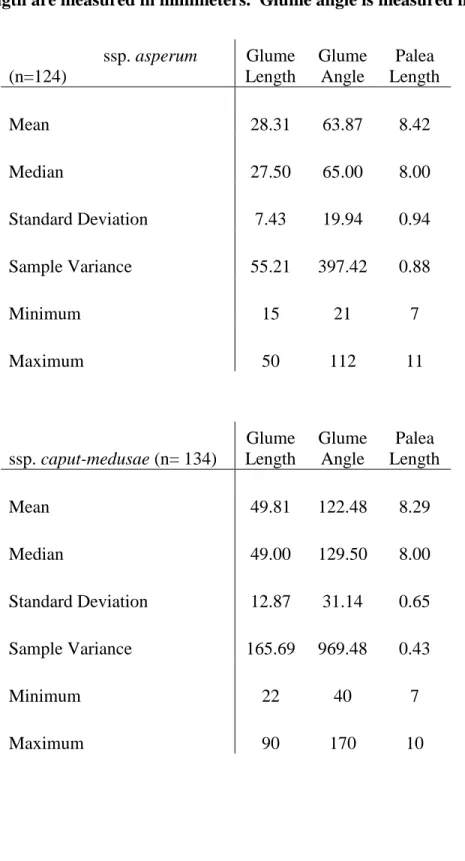
subspecies of Taeniatherum caput-medusae. n is the sample size. Glume length and palea length are measured in millimeters. Glume angle is measured in degrees. ... 45 Table 1.4 Genetic diversity within and among the three subspecies of Taeniatherum

caput-medusae ... 52 Table 1.5 Multilocus genotypes detected in each of the three subspecies of

Taeniatherum caput-medusae. See text for the order of loci used to generate multilocus genotypes. Letters represent different alleles at each of these loci. ... 55 Table 1.6 Analysis of Molecular Variance (AMOVA) using the pairwise differences

distance method for the 82 native “populations” of Taeniatherum caput- medusae... 61 Table 2.1 Within population genetic diversity for all populations of Taeniatherum

caput-medusae ssp. asperum and for all putative source populations (indicated with *) of the invasion of the western United States. Samples obtained from the Plant Introduction Laboratory indicated by

PI

... 102 Table 2.2 Across population genetic diversity for Taeniatherum caput-medusae . 110 Table 2.3 Nei’s Gene Diversity statistics for native populations of Taeniatherum

caput-medusae ... 111 Table 2.4 Analysis of Molecular Variance using the F-Statistics method. Only

Taeniatherum caput-medusae ssp. asperum populations were included in

(14)

xiv

this analysis. Populations were assigned to four geographic regions.

Northwestern Africa (Morocco n= 5), Western Europe (all Spanish and French populations, n=7). Central Europe (all Greek and Italian

populations, n=11), and Eastern Europe (all Turkish and Iranian

populations, n=11). ... 112

(15)

xv

LIST OF FIGURES

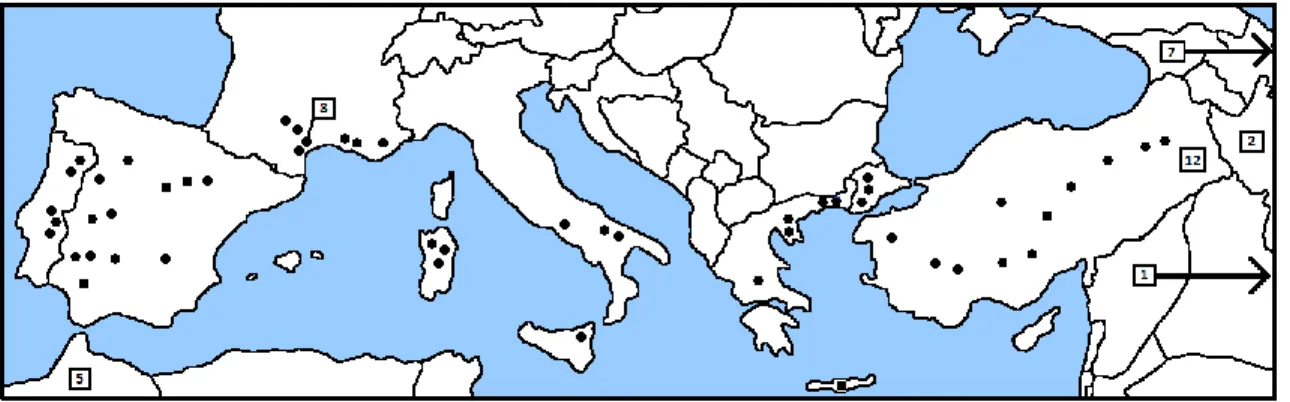
Figure 1.1 Map of 80 Taeniatherum caput-medusae native populations analyzed in genetic portion of this study ... 43 Figure 1.2a Histograms showing means and significant differences among subspecies

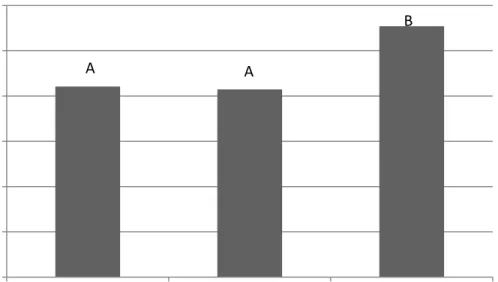
of Taeniatherum caput-medusae. Letters above bars denote SKN groupings for significantly different means. All lengths are measured in millimeters, angles are measure in degrees... 47 Figure 1.2b Histograms showing means and significant differences among subspecies

of Taeniatherum caput-medusae. Letters above bars denote SKN groupings for significantly different means. All lengths are measured in millimeters, angles are measure in degrees... 48 Figure 1.2c Histograms showing means and significant differences among subspecies

of Taeniatherum caput-medusae. Letters above bars denote SKN groupings for significantly different means. All lengths are measured in millimeters, angles are measure in degrees... 49 Figure 1.3a Three dimensional scatter plot of the mean values for the significant

morphological traits measure for 81 populations of Taeniatherum caput- medusae... 50 Figure 1.3b Three dimensional scatter plot of the significant morphological traits

measured for 384 individuals of Taeniatherum caput-medusae ... 51 Figure 1.4a UPGMA cluster diagram of 80 native populations of Taeniatherum caput-

medusae. Note: population samples from Villaviciosa de Cordoba, Spain and Guzelkonak, Turkey were each divided into 2 subspecies represented by an ‘A’ for subspecies asperum and a ‘C’ for subspecies crinitum thus the genetic relationships among 82 “populations” are shown. ... 53 Figure 1.4b (continued) UPGMA cluster diagram of 80 native populations of

Taeniatherum caput-medusae. Note: population samples from Villaviciosa de Cordoba, Spain and Guzelkonak, Turkey were each divided into 2 subspecies represented by an ‘A’ for subspecies asperum and a ‘C’ for subspecies crinitum thus the genetic relationships among 82

“populations” are shown. ... 54

(16)

xvi

Figure 2.1 Distribution of the 34 native range populations of Taeniatherum caput- medusae used in the genetic analysis ... 101 Figure 2.2a Histograms showing means and significant differences among subspecies

of Taeniatherum caput-medusae and populations from the invasive range.

Letters above bars denote SKN groupings for significantly different means. All lengths measured in millimeters, angles measured in degrees.

... 105 Figure 2.2b Histograms showing means and significant differences among subspecies

of Taeniatherum caput-medusae and populations from the invasive range.

Letters above bars denote SKN groupings for significantly different means. All lengths measured in millimeters, angles measured in degrees.

... 106 Figure 2.2c Histograms showing means and significant differences among subspecies

of Taeniatherum caput-medusae and populations from the invasive range.

Letters above bars denote SKN groupings for significantly different means. All lengths measured in millimeters, angles measured in degrees.

... 107 Figure 2.3a Three dimensional scatter plot of the mean values for the significant

morphological traits measured for 82 native range and 43 invasive range populations of Taeniatherum caput-medusae ... 108 Figure 2.3b Three dimensional scatter plot of the significant morphological traits

measured for all native and invasive individuals of Taeniatherum caput- medusae... 109 Figure 2.4 UPGMA cluster diagram of the genetic relationships of native range

populations of Taeniatherum caput- medusae ssp. asperum and the 7 invasive range multilocus genotypes (indicated by boxes)... 113 Figure 2.5 Native range map showing the distribution of invasive range multilocus

genotypes found in native populations of Taeniatherum caput-medusae 114

(17)

CHAPTER 1: MORPHOLOGICAL AND GENETIC DIFFERENTIATION AMONG SUBSPECIES OF TAENIATHERUM CAPUT-MEDUSAE (MEDUSAHEAD;

POACEAE): DISENTANGLING TAXONOMIC COMPLEXITY IN THE NATIVE RANGE

Abstract

Invasive species are novel to a region, thus their timely and accurate identification is a critical first step in recognizing and managing the threats that they may present in their new habitats. However, accurate identification of an introduced species in its new range can prove difficult for a species that displays taxonomic complexity in its native range, i.e. consists of multiple, morphologically similar subspecies. Across its native range, Taeniatherum caput-medusae (medusahead) exhibits taxonomic complexity. Three subspecies have been recognized: T. caput-medusae subspecies caput-medusae, T. caput- medusae subspecies asperum, and T. caput-medusae subspecies crinitum. Only

subspecies asperum is believe to occur in the United States, where it is now invasive in portions of California, Idaho, Nevada, Oregon, Utah, and Washington. As part of ongoing research to better understand and manage this invasion, the accurate

identification of these three subspecies is a requisite first step. In the current study, plants

from each native population were grown in a greenhouse common garden, harvested at

maturity, and measured using previously described morphological characters. After

Bonferroni correction, three characters, glume length, glume angle, and palea length,

were found to be statistically significant. Thus, these three characters proved quite useful

(18)

in differentiating the three subspecies. I found that two other characters, conical cell prominence on the lemma and lemma surface hair location, were less informative.

Differentiation among native populations of medusahead was further assessed using a molecular genetic marker. The results of a UPGMA cluster diagram based on allozyme data indicates that subspecies crinitum is genetically differentiated from the other two, some populations of subspecies caput-medusae and asperum co-occur within a cluster, and subspecies asperum is the most variable. Results of the analysis of multilocus genotypes are generally consistent with the UPGMA diagram (e.g., subspecies caput- medusae and asperum share six multilocus genotypes). Our findings confirm the need of such studies to disentangle the taxonomic complexity that can be found in the native range of invasive species.

Keywords: allozymes, invasive grass, multilocus genotype, taxonomic

complexity, morphological characters, multiple subspecies, genetic relationships

(19)

Introduction

Human activities such as international trade and commerce have greatly increased the number and rate of biological invasions worldwide (Mack et al. 2000; Bossdorf et al.

2005; Ward et al. 2008). Invasive species often have negative ecological consequences such as loss of native biodiversity and community structure; modification of ecosystem processes such as nutrient cycling and trophic level interactions; and alteration of disturbance regimes, especially the frequency and intensity of wildfires (D’Antonio and Vitousek 1992; Wilcove et al. 1998; Mack et al. 2000, Sala et al. 2000; Allendorf and Lundquist 2003). Such events also have enormous economic costs (Pimentel et al. 2005).

Thus, invasions are now considered one of the main drivers of global change (Vitousek et al. 1996; Sala et al. 2000).

Biological invasions occur when organisms are taken from their native range and transported to a new territory where they become established, proliferate and spread beyond their original point of introduction (Mack et al. 2000; Colautti and MacIsaac 2004; Lockwood et al. 2005). In fact, many invasions can be described as large-scale (intercontinental) biogeographical events (Groves and di Castri 1991; Mack et al. 2000;

Hierro et al. 2005). Thus, in order to gain a better understanding of the invasion process, comprehensive analyses of invasive species must, by this characterization, adopt an equally large geographical scope. Two recent reviews (Bossdorf et al. 2005; Hierro et al.

2005) have emphasized the importance of studying invasive species in both their native

and introduced ranges, and this approach has yielded considerable insights into the

ecological, genetic, and evolutionary aspects of invasive species (for a review see Sax et

(20)

al. 2005).

Because introduced species are novel to a region, their timely and accurate identification is a critical first step in recognizing and managing the threats that they may present in their new habitats (Wittenberg and Cock 2005). Quick and reliable taxonomic identification of introduced/invasive species requires recognition of them by field

personnel, sufficient diagnostic information, and accessible databases (Ricciardi et al.

2000; D’Antonio et al. 2004). Accurate identification of an alien can assist in predicting whether it will become invasive in its new range, based on its performance and impacts elsewhere (Reichard and Hamilton 1997; D’Antonio et al. 2004). However, accurate identification of an introduced species in its new range can prove difficult for a species that displays taxonomic complexity in its native range, i.e. consists of multiple,

morphologically similar subspecies. Knowledge and recognition of the taxonomic complexity of an invasive species can be used to: i) differentiate between invasive and non-invasive subspecies in their native range (e.g., Acacia nilotica, Ali and Qaiser 1980;

Kriticos et al. 2003, Wardill et al. 2005; Khatoon and Ali 2006, Centaurea stoebe, Hufbauer and Sforza 2008; Marrs et al. 2008 and Codium fragile, Trowbridge 1998, 2001; Provan et al. 2005), ii) identify native and non-native subspecies within the same region (e.g., Phragmites australis in North America, Saltonstall 2002; Saltonstall et al.

2004; Meyerson et al. 2009), iii) identify different invasive subspecies of the same

species (Lepidium draba, Mulligan and Frankton 1962; Mummenhoff et al. 2001; Al-

Shehbaz et al. 2002, Gaskin et al. 2005), iv) determine whether subspecies exhibit

ecological differentiation, as described by Clausen and Hiesey (1958), in either their

native and/or introduced ranges, and v) allows for the detection of a cryptic invasion

(21)

through the identification of a previously unrecognized invasive subspecies (Bickford et al. 2006). The accurate identification of invasive subspecies also aids in the search for the most specific and effective biological control agents in the native range of a species (Kriticos et al. 1999; Wardill et al. 2005; Bickford et al. 2006; Palmer et al. 2007).

Taeniatherum caput-medusae (L.) Nevski (medusahead, Poaceae), is a self- pollinating, diploid, annual, Eurasian grass that is invasive in the western United States (U.S.). In previous taxonomic treatments Taeniatherum had been included in Elymus, Hordelymus or Hordeum (for a review of the taxonomic history of Taeniatherum see Frederiksen 1986). Linnaeus (1753) originally recognized a single species placed in Elymus (E. caput-medusae L.), while Schreber (1772) named two species (E. caput- medusae and E. crinitus Schreb.), and Link (1827) named three species (E. caput-

medusae, E. crinitus and E. platyatherus Link). Nevski (1934) established Taeniatherum and recognized three species: T. caput-medusae (L.) Nevski, T. crinitum (Schreber) Nevski, and T. asperum (Simonk.) Nevski. Although other taxonomic treatments have been proposed (e.g., Humphries 1978), probably the most widely accepted taxonomic revision of Taeniatherum recognizes three subspecies (Frederiksen 1986): T. caput- medusae (L.) Nevski subspecies caput-medusae, T. caput-medusae subspecies crinitum (Schreb.) Melderis and T. caput-medusae subspecies asperum (Simk.) Melderis. These three subspecies were differentiated by Frederiksen (1986) based on morphological characters associated with the spikes: glume length and spreading of glumes (glume angle) in seed stage, and several traits associated with the lemma and palea (e.g., palea length). Intermediate morphological forms were reported in regions where the

geographic distributions of subspecies overlap (Frederiksen 1986).

(22)

All three subspecies have a diploid chromosome number (2n = 14), and exhibit the same karyotype (Frederiksen 1986; Frederiksen and von Bothmer 1986). Crossing experiments among the subspecies produced hybrids of low fertility, although a high amount of bivalent formation was observed during meiosis. The low fertility of these crosses, combined with observations concerning chromosome pairing behavior, led Frederiksen and von Bothmer (1986) to conclude that all three subspecies have similar genomes and that differences among them appeared to be genetically determined. The subspecies do exhibit different geographic distributions, although some overlap does occur. In general, subspecies caput-medusae is found in the western Mediterranean (Morocco, Portugal, Spain and France), subspecies crinitum occurs from eastern Europe and the eastern Mediterranean to central Asia (Kyrgyzstan, Tajikistan and Afghanistan) and subspecies asperum is found across almost the entire Eurasian native range of Taeniatherum [see Frederiksen (1986) for a map of the geographic distribution of Taeniatherum].

In the western U.S., T. caput-medusae occurs in disturbed sites in the 25-100 cm mean annual precipitation zones, and it can dominate sites with high clay content or well- developed soils (Dahl and Tisdale 1975; Hironaka 1994). The grass has invaded millions of hectares of semi-arid woodlands and shrub-steppe habitats in California, Idaho,

Nevada, Oregon, Utah, and Washington (McKell et al. 1962; Young and Evans 1970;

Young 1992, Pellant and Hall 1994, Miller et al. 1999, Blank and Sforza 2007). Based on the examination of plants in the native and invasive ranges, it is believed that the taxon introduced into the U.S. was T. caput-medusae subspecies asperum (Major et al.

1960; Young 1992; Kostivkovsky and Young 2000).

(23)

The ultimate goal of this thesis research is to determine the genetic and

evolutionary consequences of the introduction of Taeniatherum caput-medusae into the western U.S. (see Chapter 2). However, given that, across its extensive Eurasian native range, T. caput-medusae occurs as three subspecies, gaining a better understanding of this taxonomic complexity is the requisite first step for achieving this goal. Thus, the specific objectives of the current study are to: 1) determine the utility of the morphological

characters described by Frederiksen (1986) in distinguishing the three subspecies of T.

caput-medusae, 2) assess morphological variation within and among native populations of the three subspecies of T. caput-medusae, and 3) determine the level of genetic differentiation among the three subspecies using a neutral molecular marker, enzyme electrophoresis.

Materials and Methods

Plant Collection

For this study, population samples were obtained from a total of 87 native range populations of Taeniatherum caput-medusa and these samples were collected over multiple years: 2002, 2004, 2005, 2007, 2009 and 2010 by Dr. René Sforza and Dr.

Stephen J. Novak (Table 1.1, Figure 1.1). Field collected populations were assigned to a subspecies based upon the morphological characters described by Frederiksen (1986).

Within each population, 30-35 intact spikes were sampled haphazardly 1 -3 m apart. In

populations with fewer than 30 individuals, all individuals were harvested. Intact spikes

were stored in individually labeled paper envelopes at room temperature. Many of the

collections sites were along roadsides, adjacent to agricultural fields or in disturbed areas.

(24)

A total of 87 populations were collected from the native range. Two populations,

Villaviciosa de Cordoba, Spain and Guzelkonak, Turkey consisted of two subspecies and were each separated into two “populations” for analysis, bringing the total to 89

“populations.” Seventy-four populations were used in both the morphological and genetic analysis, seven populations in only the morphological analysis and eight populations in only the genetic analysis (Table 1). Thus, the total number of populations used in the morphological analysis is 81 and the total number used in the genetic analysis is 82.

Samples from native populations were collected over multiple years by Dr. René Sforza and Dr. Stephen J. Novak (Table 1.1, Figure 1.1). The seven populations from Greece and Turkey collected in 2010 were analyzed only for genetic diversity and were not included in the morphological analysis. One population (Kars, Turkey) was not included in the morphological analysis because it did not successfully set seed. Seven populations were not used in the genetic analysis because of their geographic proximity to other populations that were included (see Table 1).

Samples for 22 of the populations included in this research were obtained as accessions from the USDA Western Region Plant Introduction Laboratory, Pullman, WA (USA); 13 from Turkey, seven from Afghanistan, two from Iran, and one from

Kazahkstan (Table 1.1). Unfortunately, in some cases, the geographic location and

collection date for these accessions are not provided. In addition, these accessions are the

product of an unknown number of grow-outs in Pullman, WA, since they were first

collected in their country of origin. Seeds from the Sterea Hellas, Greece population

were kindly provided by Dr. Signe Frederiksen, Institute of Systematic Botany,

University of Copenhagen, Denmark.

(25)

Greenhouse Common Garden

To determine which morphological characters are most useful for distinguishing the three subspecies, a greenhouse common garden was established at Boise State University in mid-winter 2009. For each population, two seeds from six randomly chosen individuals (maternal plants) were grown in a pot (V = 2000 mL) containing standard potting soil supplemented with ¼ cup granulated fertilizer. If both seedlings from each individual emerged, one of the two was randomly selected and discarded, leaving a maximum of six plants per pot. Plants were maintained under ambient growing conditions (e.g., no supplemental lighting), although the temperature within the

greenhouse was not allowed to drop below 2 C or rise above 32 C. Plants were watered three times a week and additionally if needed. During the following summer (2010), mature plants were harvested and spikes from each population were placed in separate envelopes.

Morphological Measurements

Based on the species key developed by Frederiksen (1986), five morphological

characters were selected to be used to distinguish between the three subspecies (Table

1.2). The five traits measured were: glume length, glume angle, palea length, conical cell

prominence on the lemma, and lemma surface hair location. After harvest, measurements

of the five traits were obtained for each individual in each population. The traits glume

length and palea length were measured using a standard metric ruler and scored as

continuous variables. Glume angle was measured with a True Angle ® protractor, and

(26)

was also scored as a continuous variable. Conical cell characteristics and the location of hairs on the lemma surface were determined using a Leica EZ4 Dissecting scope at various magnifications and scored categorically: conical cells not prominent = 1 and conical cells prominent = 2; hairs only at the margins of the lemma surface = 1; and hairs throughout the entire lemma surface = 2.

Enzyme Electrophoresis

Seeds were germinated in petri dishes on moistened filter paper and harvested 7 – 10 days following germination. Entire seedlings (shoot and root tissue) were macerated in a tris-HCl grinding buffer-PVP solution (pH 7.5). The starch concentration of each gel was approximately 12.5% (w/v). Enzyme electrophoresis protocols followed that of Soltis et al. (1983) with modifications described by Novak et al. (1991). A suite of 15 enzymes were stained and visualized using the following buffer systems : isocitrate dehydrogenase (IDH), glucose-6-phosphate dehydrogenase (G6PDH), and shikimate dehydrogenase (SKDH) using system 1 of Soltis et al. (1983); alcohol dehydrogenase (ADH), aldolase (ALD), glutamate dehydrogenase (GDH), and phosphoglucoisomerase (PGI) using system 6; glutamate oxalacetate transaminase (GOT), colorimetric esterase (CE), malic enzyme (ME), superoxide dismutase (SOD), and triosephosphate isomerase (TPI) using system 8; and malate dehydrogenase (MDH), phosphoglucomutase (PGM), and 6-phosphogluconate dehydrogenase (6PGD) using system 9.

Because medusahead is a diploid, the genetic basis of all allozyme variation observed was easily inferred based on the known subunit structure and

compartmentalization of these enzymes (Gottlieb 1982, Weeden and Wendel 1989).

Nomenclature for loci and alleles generally followed that of Novak et al. (unpublished

(27)

data), but also included modification based on the diversity detected in the current study.

Across the 45 invasive populations of medusahead, Novak et al. (unpublished data) determined allelic diversity at 29 loci; but due to low gene expression and banding intensity, the genetic diversity of native populations of T. caput-medusae was assessed using 23 allozyme loci. For example, Novak et al. (unpublished data) scored six CE loci across invasive populations, but only two of these loci could be reliably scored among native populations: Ce-2 and Ce-4. As new alleles were detected in native populations, the nomenclature for alleles had to be updated, with the most anodally migrating allele designated a, the next b, and so on.

Data Analysis

All continuous variables (glume angle, glume length, and palea length) were log transformed prior to statistical analysis because they were not normally distributed. I used the program SAS™ (SAS Institute 2002) to analyze the morphological data.

Contingency tables were generated for the categorical variables (conical cell prominence and lemma surface hair location) and analysis of variance (ANOVA) was conducted on the log transformed continuous variables. To test for significant differences among subspecies morphology, Student-Newman–Keuls tests were run on each significant variable to determine which traits were significantly different for the three subspecies.

Subsequently, a Bonferroni correction was performed to mitigate false positives when

testing multiple hypotheses on the same data set (Rice 1989). Using only those

morphological characters found to be significant, PROC GPLOT in SAS™ (SAS

Institute 2002) was used to generate a three-dimensional (3D) scatter plot. The 3D

scatter plot provides a visual representation of the data’s ability to discriminate between

(28)

the three subspecies.

Because T. caput-medusae is broadly distributed across Eurasia and includes areas where the distribution of subspecies overlaps, populations with two subspecies and/or intermediate forms have been reported (Frederiksen 1986). For population instances in which populations were suspected of being composed of two subspecies, all individuals from the population were assigned to their respective subspecies and analyzed as two separate “populations.” In cases of intermediacy, populations were classified as a certain subspecies based on the consensus derived when considering all available

evidence (including the traits not found to be significantly different).

Allozyme data for 82 populations of T. caput-medusae were analyzed using POPGENE 1.32 (Yeh and Boyle 1997). The data were entered as individual multilocus genotypes and the populations were hierarchically arranged based on subspecies. Genetic diversity within subspecies of T. caput-medusae were expressed as the total number of alleles, the mean number of alleles per locus, the total number of polymorphic loci, the percentage polymorphic loci per subspecies, percentage of polymorphic populations, Nei’s expected mean heterozygosity (H

exp

), and the mean observed heterozygosity (H

obs

).

The expected mean heterozygosity was computed using the unbiased estimate method of Nei (1978), and the observed mean heterozygosity was determined using the Direct Count Method. F

ST

and N

M

were calculated using POPGENE 1.32 (Yeh and Boyle 1997).

The number and identity of multilocus genotypes (MLGs) for all three subspecies

were determined using ARLEQUIN v.3.5.1.2 (Excoffier et al. 2005). The allozyme data

were entered as psuedohaplotype frequencies for each population and structured

(29)

hierarchically according to subspecies. In addition, I used an analysis of molecular variance (AMOVA) to estimate the amount of genetic variation partitioned among and within subspecies. Individuals with missing data were deleted from the data file prior to analysis with ARLEQUIN.

The unweighted pair-group method with arithmetic averaging (UPGMA)

algorithm (POPGENE 1.32) was used to generate a phenogram that displays the genetic relationship among populations of the three subspecies. Nei’s 1978 unbiased genetic identity method (modified from the NEIGHBOR procedure of PHYLIP version 3.5c) was used to generate the UPGMA phenogram because it is best suited for use with data sets containing small sample sizes. The threshold for missing data was set at 0.05%.

Results

Morphological Traits and Variation Among Subspecies

After sequential Bonferonni correction (Rice 1989): three of the five

morphological characters were found to be significantly different among the three

subspecies: glume length (F

2,381

= 369.41, p = 0.0003), glume angle (F

2,381

= 389.67, p =

0.0003), and palea length (F

2,381

= 339.28, p = 0.0003). Conical cell prominence (Χ

2

=

7.2527,d.f. = 2, p = 0.0532) and lemma surface hair locations (Χ

2

= 1.2403, d.f. = 2, p =

0.5379) were found to be non-significant among the three subspecies. Values for the

statistically significant morphological characters for each of the three subspecies are

given in Table 1.3. In general, subspecies asperum has moderately short glumes (mean =

28.3 mm), a mean glume angle of 63.8° and a palea length of 8.4 mm. Subspecies caput-

medusae has the longest glumes (mean = 49.8 mm), an obtuse glume angle (mean =

(30)

122.5°) and a palea length of 8.3 mm. Subspecies crinitum has the shortest glumes (mean = 21.5 mm), an acute glume angle (mean = 36.8°) and the longest palea length (mean 11.1 mm) (Table 1.3). Results of the Student-Neuman-Keuls test reveal that the means for glume length and glume angle are significantly different among all three subspecies (Figures 1.2a and 1.2b); whereas only subspecies crinitum is significantly different for palea length (Figure 1.2c).

Three dimensional scatter plots were created with SAS™ (SAS Institute 2002) as graphical representations of the morphological variation found among the 81 populations and 385 individuals measured in this study (Figures 1.3a and 1.3b, respectively). At the population level, three distinct clouds of data points are apparent and clearly differentiate each of the three subspecies (Figure 1.3a). Conversely, some overlap among individuals associated with the three subspecies can be observed in Figure 1.3b. For instance, subspecies asperum and subspecies caput-medusae show overlap with regard to palea and glume length while subspecies asperum and subspecies crinitum show overlap for glume angle. No overlap in morphological characters can be seen between subspecies caput-medusae and subspecies crinitum.

Genetic Diversity

Estimates of genetic diversity and structure of native range T. caput-medusae are

based on the analysis of 80 populations, two of these populations contained two different

subspecies: Villaviciosa de Cordoba, Spain (subspecies asperum and caput-medusae) and

Guzelkonak, Turkey (subspecies asperum and crinitum). Thus, individuals from each of

these two populations were separated and assigned to the appropriate subspecies, for a

total of 82 “populations” in the genetic analysis (~ 29 individuals per populations) (see

(31)

Figure 1.4 and Table 1.4). The 15 enzymes were coded for by 23 putative loci and across all three subspecies 16 of the 23 (70%) loci were polymorphic: 6Pgd-2, Adh, Ce-2, Ce-4, G3pdh-2, Gdh, Got-1, Got-2, Idh, Mdh-1, Mdh-2, Mdh-3, Pgi-2, Pgm-2, Skdh, Tpi-2.

Across the 82 “populations” analyzed, a total of 50 alleles were detected (2.17

alleles/locus) for all 23 loci. Each polymorphic locus has between 2 and 5 alleles. Three loci, Ce-2, Mdh-3 and Pgi-2, had five alleles. Among all individuals analyzed, only two (one each in the Iran 1 population and Afghanistan 5 population) were found to be heterozygous at any of the 23 loci examined. Just over half (44 of 82, 53.7%) of the populations examined were genetically polymorphic with the remaining 37 populations being monomorphic across all loci (Table 1.4).

Subspecies asperum showed the highest amount of genetic diversity with 48 of the 50 alleles detected (2.09 alleles per locus) and 15 polymorphic loci (65.2%

polymorphic loci) (Table 1.4). Subspecies asperum also had the highest expected mean heterozygosity values of any of the three subspecies (H

exp

= 0.1408), and 23 of 34 (67.6%) subspecies asperum populations were polymorphic. Subspecies caput-medusae generally had intermediate values for genetic diversity parameters; whereas subspecies crinitum had the lowest values. For subspecies caput-medusae, 36 alleles (1.57 alleles per locus) and 10 polymorphic loci (43.5%) were detected. Half of the subspecies caput- medusae populations were polymorphic. Subspecies crinitum had 33 alleles (1.43 alleles per locus), nine polymorphic loci (39.3 %), and 11 of 28 (39.3%) populations were polymorphic.

Multilocus Genotypes

The program ARLEQUIN was used to identify all multilocus genotypes (MLGs)

(32)

across and within the three subspecies of medusahead. A total of 93 MLGs were detected across the three subspecies, with subspecies asperum having over two-thirds of these genotypes (66 out of 93) (Table 1.5). Subspecies caput-medusae had 22 MLGs and subspecies crinitum had 11 MLGs. Six MLGs were shared between subspecies asperum and subspecies caput-medusae, and neither subspecies shared MLGs with subspecies crinitum.

Genetic Relationships Among Subspecies of Taeniatherum caput-medusae

The UPGMA cluster diagram based on Nei's (1978) unbiased genetic identity values provides a graphic representation of the genetic relationships found among the three subspecies (Figure 1.4). Four distinct clusters of populations are apparent in the phenogram. Clusters 1 and 4 include 24 of the 34 (70.6%) populations of subspecies asperum included in this analysis. Cluster 2 includes all 20 populations of subspecies caput-medusae and eight populations of subspecies asperum, with these eight populations of subspecies asperum sampled from either Spain or Morocco. Cluster 3 contains all populations of subspecies crinitum and two populations of subspecies asperum (Orosei, Sardinia, Italy and Iran 1). Cluster 4 is composed of the three populations from the Italian mainland and three populations from Morocco.

Analysis of molecular variance (AMOVA, Table 1.6) reveals that 92.6% of the total genetic diversity for T. caput-medusae is partitioned among subspecies (48.38%) and among populations within subspecies (44.22%). The high level of genetic diversity partitioned among populations within subspecies is due to the high level of genetic differentiation among populations of all three subspecies especially subspecies asperum.

Only 7.39 % of the total genetic diversity is partitioned within-populations and within-

(33)

individuals, indicating that populations possess little genetic diversity and individuals exhibit very low levels of heterozygosity.

Discussion

Taeniatherum caput-medusae exhibits taxonomic complexity in its native range.

This study utilizes morphological characters and genetic data to gain a better understanding of this complexity and determine the level of differentiation among populations of the three subspecies of medusahead. These analyses will allow precise and valid comparisons of native and invasive populations. The morphological characters used to differentiate the three subspecies show overlap among traits for the subspecies but appear robust. The assessment of genetic differentiation among the subspecies shows some intermixing between subspecies, but generally reflects the relationships observed in the morphological analysis.

Morphological Trait Variation Among Subspecies

This study reveals that three morphological traits may be used to differentiate

between the three subspecies of medusahead. The traits glume angle and glume length are

significantly different among all three subspecies (Figure 1.2 b-c). Thus, these two

characters are useful for subspecies differentiation. Palea length shows overlap between

subspecies asperum and subspecies caput-medusae and was unable to differentiate

between the two, but this trait clearly distinguishes these two subspecies from subspecies

crinitum (Figure 1.2c). Variability among the three subspecies for palea length reflects

the larger overall seed size associated with subspecies crinitum (Frederiksen 1986),

(34)

compared with the other two subspecies. While all three morphological traits, in combination, are effective in distinguishing the three subspecies of medusahead, some morphological overlap between individuals of subspecies asperum and caput-medusae and between individuals of subspecies asperum and subspecies crinitum does occur (see below).

Frederiksen (1986) found the prominence of conical cells and the density and location of lemma surface hairs to be diagnostic between the three subspecies. In my study, I did not find these characters to be diagnostic for distinguishing the three subspecies. When comparing my findings with that of Frederiksen (1986), some

methodological differences may explain this discrepancy. First, Frederiksen (1986) used a scanning electron microscope (SEM) to analyze the prominence of conical cells and density and location of hairs found on the lemma surface, whereas I used a standard light microscope. Perhaps differences in magnification contributed to this discrepancy.

Second, differences in sample preparations may also explain these different outcomes.

Frederiksen (1986) conducted her study with herbarium specimens, while the

measurements reported in the current study were made on plants grown in a greenhouse common garden. Finally, Frederiksen (1986) appears to have made her observations on a single individual per locality; whereas, I measured an average of 4.75 individuals per population (range = 2-6 individuals per population). Perhaps, my larger sample size per population increased the population-level variability detected for these traits.

The three dimensional scatter plots reveal different patterns at the population and individual levels. At the population level, three distinct groups of symbols, each

associated with one of the three subspecies, can clearly be seen (Figure 1.3a). Because it

(35)

is based on the mean values of these three traits for individuals in each population (thus ignoring trait variation among individuals), this scatter plot better illustrates the

morphological differentiation among the subspecies. The distinctiveness of these three groups, further demonstrates the usefulness of the morphological traits described by Frederiksen (1986). This result is not surprising, as characters associated with the spike or spikelet have repeatedly been shown to be diagnostic for members of the Triticeae (Dewey 1979; Baum and Bailey 1990; Murphy 2003; Frederiksen and Peterson 1997;

Cabi and Dogan 2010. For example, Barkworth et al. (2009) evaluated 61 characters for their ability to assign herbarium specimens to one of 13 genera in the Triticeae. They found that specimens could almost always be identified to one of the genera using a single spike. At the species level, Kharazian and Rahiminejad (2005) showed that species within Triticum (Triticaeae) could be differentiated using two characters: the awns of the uppermost spikelet and the form of the glume.

The use of morphological characters, particularly those associated with spikes, panicles and/or caryopses (seeds) have widespread utility and are often diagnostic for species and subspecies identification within the Poaceae. For example, Saltonstall et al.

(2004) used a combination of morphological traits (ligule length, lower glume length, upper glume length, and lemma length) and chloroplast DNA haplotype data to identify a new subspecies of Phragmites (Poaceae) that is native throughout much of North

America.

Morphological overlap among some individuals belonging to these subspecies can

be seen (Figure 1.3b), although this overlap occurs only among some individuals of

subspecies asperum and subspecies crinitum and between subspecies asperum and

(36)

subspecies caput-medusae. Morphological overlap among certain individuals is not surprising considering that these three subspecies have been shown to be quite variable and intermediate morphological forms have been reported (Frederiksen 1986;

Frederiksen and von Bothmer 1986). In addition, overlap occurs among individuals from populations in localities where the geographic distribution of subspecies also overlaps (e.g., Morocco, Spain, and France for subspecies asperum and caput-medusae and Sardinia and Sicily for subspecies asperum and crinitum). These morphological data suggest that hybridization may be taking place in areas where the distribution of the subspecies overlaps. Hybridization among the subspecies has previously been reported, although crossing experiments among subspecies produced hybrids of low fertility

(Frederiksen 1986; Frederiksen and von Bothmer 1986). Depicting trait measurements at the individual level clearly blurs the morphological boundaries among some individuals of the three subspecies, however these results may signal important events (e.g.,

hybridization) that have occurred in the evolutionary history of populations of medusahead in regions where they co-occur.

The goal of this phase of my research was to better understand the taxonomic complexity of medusahead in its native range through an assessment of the

morphological variation of the three subspecies. This work was not designed as a

quantitative genetic study. Plants grown in the greenhouse common garden were derived from field-collected seeds, and I did not perform a preliminary grow-out in the

greenhouse environment to purge maternal (environment) effects (Schaal 1984, Roach

and Wulff 1987, Falconer and Mackay 1996). Maternal effects may contribute to some

of the morphological trait variation and overlap observed among individuals of the three

(37)

subspecies included in this analysis. For example, seed size has been shown to be influenced by maternal effects, and seed size differences have an effect on germination characteristics, seedling size, and adult plant size (Roach and Wulff 1987). Thus, some of the morphological traits measured in this experiment may have been influenced by maternal carryover effect, which is possible even for plants grown in a greenhouse common garden. The influence of maternal effects on morphological trait variation in medusahead can only be resolved by future studies that utilize a quantitative genetic approach.

Genetic Diversity and Differentiation

Across all three subspecies (Table 4), allozyme diversity in medusahead (69.6%

polymorphic loci and 2.17 alleles per locus) is higher than the mean values (50.5%

polymorphic loci and 1.96 alleles per locus) reported for 473 plant species (Hamrick and Godt 1989). The level of allozyme diversity in subspecies asperum (65.2% polymorphic loci and 2.09 alleles per locus) is also higher than the mean values for all plant species reported by Hamrick and Godt (1989), whereas allozyme diversity across populations of subspecies caput-medusae and subspecies crinitum is lower than the mean values

reported for all plants. In addition, allozyme diversity across all populations of subspecies asperum is generally higher or similar to the range of values (41.8 - 59.2 percent polymorphic loci and 1.69 – 2.38 alleles per locus) reported for selfing, early successional, annual, and monocot plant species (Hamrick and Godt 1989), while the same does not hold for subspecies caput-medusae or subspecies crinitum.

Genetic diversity and genetic differentiation vary among the three subspecies of

medusahead. Subspecies asperum exhibits the greatest amount of allozyme diversity,

(38)

while subspecies crinitum possesses the least. The high diversity found within subspecies asperum may be related to its large geographic range (Frederiksen 1986).

Species exhibiting large geographic distributions typically exhibit higher levels of genetic diversity, compared to congeners with smaller distributions (Karron 1989). The lower level of genetic diversity detected for subspecies crinitum, compared with the other two subspecies, may be explained, in part, by the type of plant collections mostly used to assess the diversity of this subspecies. Twenty-two (68.8%) of all subspecies crinitum population samples were obtained as accessions from the Western Regional Plant Introduction (PI) Station, Pullman, Washington (Table 1.1), and the use of this type of plant material may contribute to an underestimation of genetic diversity in subspecies crinitum. This underestimate of genetic diversity may occur because: 1) information about these accession is sparse and the original field collections may only have included a limited number of individuals and thus may not reflect the overall diversity of the

sampled populations, 2) each accession has been through an unknown number of grow- outs since they were stored at the PI Station and this may further reduce diversity through genetic drift, and 3) grow-outs were carried out in Pullman, WA and selection for or against certain genotypes in a novel (non-native) environment may further reduce genetic diversity. However, some field-collected populations of subspecies crinitum (e.g.,

Avcilar, Dendril and Seydisehir, Turkey) also exhibit similarly low diversity, and some

PI accessions (Uzumluk, Tukey, Afghanistan 4 and Karagali, Kazahkstan) do exhibit

higher amounts of genetic diversity (data not shown). Thus, the low genetic diversity

detected for subspecies crinitum, especially for some populations from eastern Turkey,

Iran, and Afghanistan, may reflect a regional pattern, and not be due to factors associated

(39)

with how these populations were sampled. Resolving this issue can only be

accomplished through the analysis of more populations of subspecies crinitum from this region.

Genetic differentiation among the three subspecies is illustrated by the UPGMA cluster diagram (Figure 1.4). Populations of subspecies asperum exhibit the highest amount of genetic differentiation as indicated by the occurrence of subspecies asperum populations throughout the cluster diagram. For example, Clusters 1 and 4 are exclusively composed of only populations of subspecies asperum, and these two clusters are highly diverged. Cluster 4 includes populations from Italy and Morocco, with populations from these two countries exhibiting relatively long branch lengths, suggesting that these populations are relatively well differentiated. Cluster 1 includes populations of subspecies asperum that possess genotypes that either match or are very similar to the genotypes detected in populations of medusahead (subspecies asperum) from western U.S. A comparison of genetic diversity in these native populations with that of western U.S. populations will provide insights into the geographic origins and genetic

consequences (e.g., founder effects) of this invasion (Chapter 2).

Cluster 2 includes all 20 populations of subspecies caput-medusae included in this

study as well as eight populations of subspecies asperum form either Spain or Morocco

(Figure 1.4). Several of the populations of subspecies caput-medusae and subspecies

asperum that co-occur in Cluster 2 share six multilocus genotypes (Table 1.5). Thus,

genetic results are in agreement with morphological data, and suggest that certain

subspecies asperum and subspecies caput-medusae populations (especially from Spain

and Morocco) are morphologically and genetically similar. Taken together, these data

(40)

further support the possibility of hybridization occurring between these two subspecies in regions where their distributions overlap.

Cluster 3 primarily consists of populations of subspecies crinitum (Figure 1.4).

The short branch lengths observed for 21 of the 28 populations of subspecies crinitum included in this analysis indicate a low level of genetic differentiation among these populations (Figure 1.4). Two populations of subspecies asperum (Orosei, Sardinia, Italy, and Iran 1) also occur in Cluster 3, indicating that both of these populations are genetically more similar to populations of subspecies crinitum than they are to other populations of subspecies asperum. This is true even though these two populations of subspecies asperum do not share any MLGs with populations of subspecies crinitum (Table 1.5). The population from Orosei, Sardinia, Italy is located in the UPGMA cluster diagram with the population of subspecies crinitum from Lunguaglossa/Mt. Etna, Sicily, Italy. Individuals from Orosei and Lunguaglossa/Mt. Etna exhibit morphological overlap (Figure 1.3b); and Orosei shares more alleles with populations of crinitum than it does with other populations of subspecies asperum (including other populations from Sardinia). As observed for populations of subspecies asperum and subspecies caput- medusae from Spain and Morocco, these data suggest that hybridization may be

occurring between subspecies asperum and subspecies crinitum (or at least intermediate forms are present) in regions where their geographic distributions overlap.

The level of genetic differentiation among the three subspecies can be quantified

through AMOVA (Table 1.6). Most of the total genetic diversity detected in this analysis

is partitioned among the subspecies (48.4%) and among populations within subspecies

(44.2%), indicating high genetic structure associated with the three subspecies. This

(41)

result is supported by data on the distribution of multilocus genotypes (Table 1.5): only six multilocus genotypes are shared between subspecies asperum and caput-medusae and the remaining 93 genotypes are found exclusively in one subspecies, or another.

Additionally, very little diversity is partitioned within populations (7.2%) and within individuals (0.25%) (Table 1.6). The pattern by which genetic diversity is distributed among and within native subspecies and populations is typical with that reported for highly self-pollinating plant species (Hamrick and Godt 1989, 1996). Indeed, values for mean observed heterozygosity (H

obs

) reported for the three subspecies (Table 1.4) suggest exceedingly high rates of self-pollination. Moreover, in an analysis of progeny arrays using allozyme genetic markers, Rausch (2004) found that 10 invasive populations of medusahead were 99.8% self-pollinating.

Taxonomic Complexity and Invasions

The timely and accurate identification of introduced species is critical in their management (Wittenberg and Cock 2005). Taxonomic complexity arises when multiple, morphologically similar subspecies have been recognized within a species’ native range, and this complexity is accentuated by the presence of intermediate morphological forms among these subspecies. These intermediate forms are likely to occur as a result of hybridization events.

Relationships among the three taxa of Taeniatherum were described and revised

by Frederiksen (1986). Her analysis of morphological characters and crossing studies

(Frederiksen 1986, Frederiksen and von Bothmer 1986) showed an indistinct boundary

between the species and thus she recognized three subspecies, rather than the three

species originally described by Nevski (1934). The combined analysis of morphological

(42)

traits and genetic diversity and differentiation among the three subspecies described here supports the taxonomic revision of Frederiksen (1986). Although crossing experiments among the three subspecies of medusahead produced hybrids with low fertility

(Frederiksen 1986, Frederiksen and von Bothmer 1986), results of this study suggest that hybridization among these subspecies occurs in areas where their geographic distribution overlap in the native range.

In conclusion, results of this study indicate that i) the morphological traits

associated with spikes and seeds are robust and useful to differentiate subspecies of

medusahead, ii) the three subspecies of medusahead show genetic differentiation with a

small amount of overlap, and iii) subspecies asperum, the subspecies with the broadest

geographic distribution in the native range, is the most genetically diverse of the three

subspecies. Through this understanding of the taxonomic complexity associated with the

three subspecies of medusahead, further analyses comparing native and introduced

populations of this species will likely lead to a better understanding of this invasion and

how it may be managed.

(43)

Literature Cited

Ali SI, Qaiser M (1980) Hybridization in Acacia nilotica complex. Bot J Linn Soc 80:

69-77

Al-Shehbaz IA, Mummenhoff K, Appel O (2002) Cardaria, Coronopus, and Stroganowia are united with Lepidium (Brassicaceae). Novon, 12, 5–11.

Allendorf FW, Lundquist LL (2003) Introduction: population biology, evolution, and control of invasive species. Conserv Biol 17: 24 – 30.

Barkworth ME, Culter DR, Rollo JS, Jacobs SWL, Rashid A (2009) Morphological identification of genomic genera in the Triticeae. Breed Sci 59: 561-570 Baum BR, Bailey LG (1990) Key and synopsis of North American Hordeum species.

Canad J Bot 68:2433-2442

Bickford D, et al. (2006) Cryptic species as a window on diversity and conservation.

TREE 22: 148- 155

Blank RR, Sforza R (2007) Plant–soil relationships of the invasive annual grass

Taeniatherum caput-medusae: a reciprocal transplant experiment. Plant Soil 298:

7-19

Bossdorf O, Auge H, Lafuma L, Rogers WE, Siemann E, Prati D (2005) Phenotypic and genetic differentiation between native and introduced plant populations.

Oecologia 144:1-11.

Cabi E, Dogan M (2010) Taxonomic study of the genus Eremophyrum (Ledeb.) Jaub. et

(44)

Spach (Poaceae) in Turkey. Plant Syst Evol 287:129-140

Clausen J, Hiesey WM (1958) Experimental studies on the nature of species. IV. Genetic structure of ecological races. Carnegie Inst of Washington Publ, Washington, DC.

Colautti RI, MacIsaac HJ (2004) A neutral terminology to define ‘invasive’ species. Div Distrib 10:135-141

Dahl BE, Tisdale EW (1975) Environmental factors related to medusahead distributrion.

J Range Manag. 28(6)

D’Antonio CM, Jackson NE, Horvitz CC, Hedberg R (2004) Invasive plants in wildland ecosystems: merging the study of invasion processes with management needs.

Front Ecol Env

D’Antonio CM, Vitousek PM (1992) Biological invasion by exotic grasses, the grass/fire cycle and global change. Annu Rev Ecol Syst 23:63-87

Dewey DR (1979) The Hordeum Violaceum complex of Iran. Amer J Bot 66: 166-172 Excoffier L, Laval G, Schneider S (2005) Arlequin (version 3.0): an integrated software

package for population genetics data analysis. Evol Bioinform 1:47-50

Falconer DS, Mackay TFC (1996) Introduction to Quantitative Genetics (Fourth Edition).

Longmans Green, Harlow, Essex, UK

Frederiksen S (1986) Revision of Taeniatherum (Poaceae). Nord J Bot 6: 389-397 Frederiksen S, Peterson G (1997) Morphometric analyses of Secale L. (Triticeae,

Poaceae). Nord J Bot 17: 185-198

(45)

Frederiksen S, von Bothmer R (1986) Relationships in Taeniatherum (Poaceae). Canad J Bot 10: 2343-2347

Gaskin JF, Zhang D-Y, Bon M-C (2005) Invasion of Lepidium draba (Brassicaceae) in the western United States: distributions and origins of chloroplast DNA

haplotypes. Mol Ecol 14: 2331-2341

Groves RH, di Castri F (1991). Biogeography of Mediterranean Invasions, 485.

Cambridge University Press, Cambridge, Massachusetts, USA

Gottlieb LD (1982) Conservation and duplication of isozymes in plants. Sci 4544:373- 380

Hamrick JL, Godt MJW (1989) Allozyme diversity in plant species. In: Brown AHD, Clegg MT, Kahler Al, Weir BS (eds), Plant Population Genetics, Breeding and Genetic Resources, 43-63. Sinauer, Sunderland, Massachusetts, USA

Hamrick JL, Godt MJW (1996) Effects of life history traits on genetic diversity in plants.

Phil Trans R S Lond B 351: 1291-198.

Hierro JL, Maron JL, Callaway RM (2005). A biogeographical approach to plant invasions: The importance of studying exotics in their introduced and native range. J Ecol 93: 5–15.

Hironaka M (1994) Medusahead: natural successor to the cheatgrass type in the northern Great Basin. In: Symposium on Ecology, Management, and Restoration of

Intermountain Annual Rangelands, Boise, ID, May 18-22,1992

Hufbauer RA, Sforza R (2008) Multiple introductions of two invasive Centaurea taxa

inferred from cpDNA haplotypes. Div Distrib14:252–261

(46)

Humphries C (1978) Variation in Taeniatherum caput-medusae (L.) Nevski. Bot J Lineean Soc 76: 340-344.

Karron JD (1989) A comparison of levels of genetic polymorphism and self-

compatibility in geographically restricted and widespread plant congeners. Evol Ecol 1:47-58

Kharazian N, Rahiminejad MR (2005) Evaluation of diagnostic reproductive and

vegetative characters among tetraploid Triticum L. species (Poaceae; Triticeae) in Iran. Turk J Bot 29:283-289

Khatoon S, Ali SI (2006) Hybridization in Acacia nilotica complex in Indo-Pakistan subcontinent: cytological evidence. Pak J Bot 38: 63-66

Kostivkovsky V, Young J (2000) Invasive exotic rangeland weeds: a glimpse at some of their native habitats. Rangelands 22(6)

Kriticos DJ, Brown JR, Radford I, Nicholas M (1999) Plant population ecology and biological control: Acacia nilotica as a case study. Biol Cont 16: 230-239 Kriticos DJ, Sutherst RW, Brown JR, Adkins SW, Maywald GF (2003) Climate change

and the potential distribution of an invasive alien plant: Acacia nilotica ssp.

indica in Australia. J App Ecol 40: 111-124

Link HF (1827) Hortus Regius Botanicus Berolinensis. I.- Berolini.

Linnaeus C (1753) Species Plantarum. I. Ed. 1. – Stockholm.

Lockwood JL, Cassey P, Blackburn T (2005) The role of propagule pressure in

explaining species invasions. TREE 20(5)

Figure

Figure 1.1  Map of  80 Taeniatherum caput-medusae native populations analyzed  in genetic portion of this study
Table 1.2  Character traits measured to assess the morphological variation   among among subspecies of Taeniatherum caput-medusae as described in  Frederiksen 1986
Table 1.3  Summary statistics for the significant morphological variables for  each subspecies of Taeniatherum caput-medusae
Figure 1.2a  Histograms showing means and significant differences among  subspecies of Taeniatherum caput-medusae
+7

References

Related documents

amarus leaves aqueous extract to castor oil induced diarrhea rats, Charcoal meal test and.. PGE 2 induced enteropooling gastric motility could decrees in activity via

Additionally, our results performed that down- regulation of CXCR3A and up-regulation of CXCR3B brought about the increased expres- sions of PLCβ, MMP-1, and MMP-3 except

One of the important contributing factors in severe or refractory asthma is the increase in the airway smooth muscle mass. Bronchial thermoplasty is a procedure were thermal

Erin Davis, Parker Trudeau, Geneva Wandahsega, Marilyn Shawano, Crystal Lea, Jackie Kang, Charlotte Harris (in at 3:40), Mary

Dynamic analysis of nitrate, nitrite content and nitrosodimethylamine (NDMA) and nitrosodiethylamine (NDEA) formation were performed on meat samples (chicken ham,

According to other research, veterans had worse health if they were deployed to a combat zone than if they were not, but only within the first five years after they

Haematological parameters evaluated include packed cell volume (PCV), Haemoglobin (Hb) and white blood cell (WBC), while some biochemical parameters studied were liver

ефективна допрофесійна підготовка учнівської молоді може здійснюватися тільки за умови створення цілісної системи функціонування закладу середньої освіти – ліцею,