171
Effect of Temperature on the Antioxidant Activity
of Phenolic Acids
Zuzana Réblová
Department of Food Chemistry and Analysis, Faculty of Food and biochemical Technology, Institute of Chemical Technology Prague, Prague, Czech Republic
Abstract
Réblová Z. (2012): Effect of temperature on the antioxidant activity of phenolic acids. Czech J. Food Sci., 30: 171–177.
The effect of temperature on the antioxidant activity of phenolic acids (gallic, gentisic, protocatechuic, syringic, vanillic, ferulic, caffeic, and sinapic; 0.5 mmol/kg) was studied in pork lard, using an Oxipres apparatus, at a temperature range of 90°C to 150°C. The antioxidant activity of all studied compounds decreased with increasing working temperature, whereas a linear relationship (P < 0.01) existed between temperature and the antioxidant activity in all cases. However, the relative rate of the antioxidant activity decrease with increasing temperature (i.e. in comparison with the activity at 90°C) was not the same for all studied phenolic acids. Easily oxidisable phenolic acids (i.e. gallic, gentisic, proto-catechuic, and caffeic) showed a slower decrease in antioxidant activity with increasing temperature (in comparison with their activity at 90°C) than the less oxidisable ones (i.e. syringic, ferulic and sinapic acids, and especially vanillic acid). Consequently, only gallic, gentisic, protocatechuic, and caffeic acids showed a significant antioxidant activity at 150°C and vanillic acid was active only at 90°C.
Keywords: antioxidants; pork lard; oxidasability; Oxipres
Temperature is one of the most important factors affecting antioxidant activity. Generally, heating causes an acceleration of the initiation reactions, and hence a decrease in the activity of the present or added antioxidants (Pokorný 1986). However, variations in temperature may change the mecha-nism of action of some antioxidants (Yanishlieva 2001) or affect them in another way. Temperature can affect particular reactions in which antioxidants participate (mainly the reactions with lipid radicals compared to side reactions, in which the tested compounds do not act as antioxidants or act as pro-oxidants) (Marinova & Yanishlieva 1992, 2003; Armando et al. 1998), or the antioxidants can evaporate (Zandi & Ahmadi 2000; Zhang et al. 2004). For example, the α-tocopherol activity
increased with increasing working temperature in the temperature range of 20°C to 100°C in all the stabilised substrates (Marinova & Yanishlieva 1992, 1996, 1998).
Although the effect of temperature on the activity of different antioxidants in bulk fats and oils has been systematically studied (in the temperature range of 20°C to 100°C) by Marinova and Yanish-lieva (1992, 1996, 1998, 2003), YanishYanish-lieva and Marinova (1996), and also partly by other authors (Reynhout 1991; Cho 1997; Armando et al. 1998; Nakatani et al. 2001; Wagner et al. 2001; Evans
et al. 2002; Kolb et al. 2002; Zhang et al. 2004), there is not a sufficient amount of reliable details about the effect of temperature on the antioxidant activity of different compounds in the available
172
literature. Therefore, a systematic study of the effect of temperature on the antioxidant activity of individual antioxidants was undertaken.
In the first stage (Réblová 2006), the effect of temperature (in the range of 80°C to 150°C) on the antioxidant activity of α- and δ-tocopherol
was studied in pork lard using an Oxipres ap-paratus. This study indicated that a general re-lationship could exist between the decrease in antioxidant activity with increasing temperature and the oxidisability of antioxidants. Therefore, the effect of temperature on the antioxidant ac-tivity of phenolic acids (which form a large group of structure-related compounds with different antioxidant activities) was studied in the present part of this project (under similar conditions like in the first stage (Réblová 2006)) and compared with their oxidisability.
MATEriAl And METhods
Materials and sample preparation. The same pork lard was used in all experiments; it was a com-mercial product, purchased in an ordinary shop. Its fatty acid composition was as follows: palmitic acid 26.8%, stearic acid 16.6%, other saturated acids 2.7%, oleic acid 37.6%, linoleic acid 7.6%, linolenic acid 0.7%, and other unsaturated acids 8.0%. The peroxide value was lower than 1 meq/kg, the natural α-tocopherol content was lower than 10 mg/kg and synthetic antioxidants were not present.
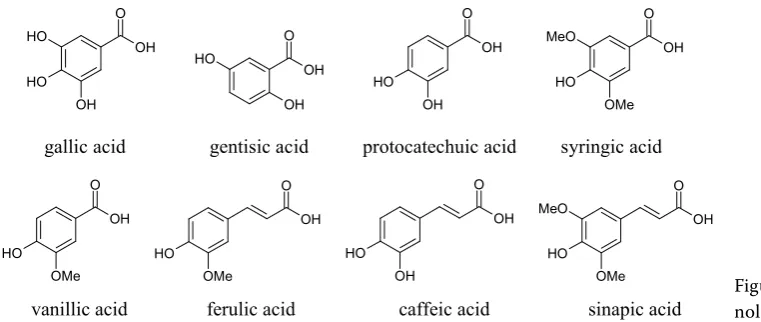
The tested phenolic acids (Figure 1) were pur-chased from Sigma-Aldrich (St. Louis, USA) with the following purities: gentisic acid (Aldrich, Buchs, Switzerland; purity 98%), gallic acid (purity higher than 98%) protocatechuic acid (purity higher than
97%), syringic acid (purity higher than 97%), va-nillic acid (purity higher than 97%), ferulic acid (purity higher than 98%), sinapic acid (purity higher than 97%) – all from Fluka (Buchs, Switzerland), caffeic acid (Sigma, St. Louis, USA; purity higher than 98%).
The phenolic acids were added to the pork lard separately (each at 0.5 mmol/kg) using the following procedure: 5 ml of a solution of the studied acid in acetone (0.5 mmol/l ± 1%) was pipetted into 5 g (± 0.1 g) of liquid pork lard in the test bottle. The pork lard and the acetone solution were mixed and the bottles were placed in a fume hood, in which acetone evaporated at room temperature overnight. Pork lard with acetone was prepared for the control samples.
Antioxidant activity determination. The induc-tion periods of all tested materials (i.e. pork lard and pork lard with the studied phenolic acids) were determined at temperatures of 90, 100, 110, 120, 130, 140, and 150°C, using an Oxipres apparatus (Mikrolab Aarhus, Højbjerg, Denmark) (Tro-jáková et al. 1999) with an initial overpressure (adjusted at room temperature while filling the test vessel with oxygen and measured against the ambient environment) of 0.50 MPa. Four determi-nations were performed in all cases. [The relative standard deviations characterising the uncertainty of the gained induction periods were generally lower than 10%, excepting very low induction periods (lower than one hour), where the relative standard deviations were lower than 15%.]
The antioxidant activity of the phenolic acids was expressed as a percentage and calculated as 100 × (IPA – IP0)/IP0, where IPA is the average induction period of pork lard with an antioxidant and IP0 is the average induction period of pork lard without an antioxidant, measured at the same temperature.
OH O
O H
O H
OH
OH O O
H
OH
OH O
OH O H
OH O
O H
OMe MeO
gallic acid gentisic acid protocatechuic acid syringic acid
OH O
O H
OMe
O H
OMe
OH O
O H
OH
OH O
O H
OH O
OMe MeO
[image:2.595.64.445.598.759.2]
173
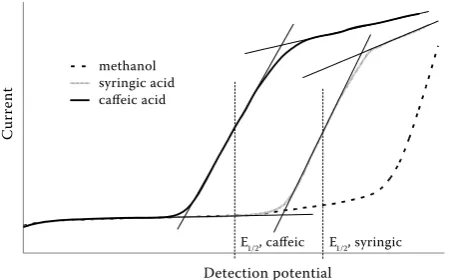
Oxidation potential assessment. The oxidisability of the studied phenolic acids was investigated at room temperature in a flow system consisting of an LCP 4020.31 non-steel pump (Ecom, Prague, Czech Republic) and an HP 1049A amperometric detector (equipped with a glassy carbon working electrode and solid-state Ag/AgCl reference elec-trode; Hewlett-Packard, Palo Alto, USA) under the following conditions: base electrolyte 0.2% (m/m) H3PO4/acetonitrile (1:4, v/v) mixture with NaCl (0.005 mol/l) (for the measurement containing 0.2 ml of methanol (baseline) per 50 ml or 0.2 ml of a solution of the studied phenolic acid in metha-nol (2.5 mmol/l) per 50 ml); flow rate 0.2 ml/min; detection potential from 0 V to 1.2 V (rising speed 5 mV/s). The oxidation half-wave potentials were determined as shown in Figure 2.
Observation of phenolic acid degradation. The content of the selected phenolic acids (gallic, sy-ringic, vanillic, and ferulic) was determined in the enriched pork lard oxidized at 100°C and/or 150°C at the end of the respective induction period (and compared with the initial content), using a reverse-phase HPLC with amperometric detection under the following conditions: mobile phase 0.2% (m/m) H3PO4/methanol (90:10, 80:20, 85:15, and 70:30, v/v for gallic, syringic, vanillic and ferulic acid, respectively) mixtures with NaCl (0.005 mol/l); flow rate 1 ml/min (LCP 4020.31 non-steel pump; Ecom, Prague, Czech Republic); injected volume: 20 μl; sample preparation: extraction of melted pork lard (1 g) by the respective mobile phase (25 ml) at room temperature (shaking for 1 min); column Hypersil ODS, 200 × 4.6 mm, particle size 5 μm (Hewlett-Packard, Palo Alto, USA); detection potential +0.80, +0.90, +1.10 and +0.90 V for gal-lic, syringic, vanilgal-lic, and ferulic acid, respectively (HP 1049A amperometric detector equipped with
a glassy carbon working electrode and solid-state Ag/AgCl reference electrode; Hewlett-Packard, Palo Alto, USA).
Statistical analysis. Differences between sam-ples (i.e. between their average induction periods) were tested using Student’s t-test (on the 0.05 level of probability).
rEsulTs And discussion
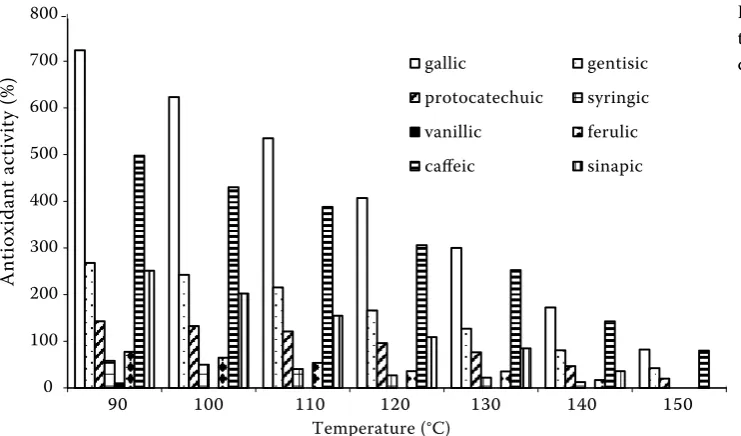
The stability of pork lard without antioxidants decreased with increasing working temperature. Its average induction period was 9.4, 4.4, 2.2, 1.2, 0.7, 0.6, and 0.5 h for 90, 100, 110, 120, 130, 140, and 150°C, respectively. The antioxidant activity of the studied phenolic acids at different temperatures is shown in Figure 3. The activity of all phenolic acids decreased with increasing temperature. Therefore, syringic, ferulic and sinapic acids were not active at the temperature of 150°C (P < 0.05; calculated as the coincidence between the average induction period of pork lard with phenolic acid and that of pork lard with acetone only) and vanillic acid was significantly active only at 90°C (P < 0.05).
A decrease in antioxidant activity with increasing temperature is typical (Pokorný 1986) although it does not have universal validity. For example, the antioxidant activity of ferulic acid in purified lard triacylglycerols (0.2–2.0 g/kg) was constant in the temperature range of 25°C to 100°C (Mari-nova & Yanishlieva 1992) and the antioxidant activity of caffeic and sinapic acids determined in triacylglycerols of sunflower oil (0.02–0.2 g/kg) was higher at 90°C than at 22°C (Marinova & Yanishlieva 2003).
A linear relationship (|r| ≥ 0.986; P << 0.01) was found to exist between temperature and the antioxidant activity of all studied phenolic acids. However, the relative rate of the decrease in anti-oxidant activity with increasing temperature (i.e. in comparison with the activity at 90°C) was not the same for all studied phenolic acids. Gallic, gentisic, protocatechuic and caffeic acids showed a slower decrease in antioxidant activity with increasing temperature (in comparison with their activity at 90°C) than syringic, ferulic, and sinapic acids, and vanillic acid. Therefore, sinapic acid was more active than protocatechuic acid in the temperature range of 90°C to 130°C (P < 0.05; calculated as the coincidence between the average induction period of pork lard with sinapic acid and that of pork lard
Detection potential
Current
methanol syringic acid caffeic acid
[image:3.595.65.292.585.725.2]E1/2, caffeic E1/2, syringic
174
with protocatechuic acid at the same temperature), but protocatechuic acid was more active at 140°C and 150°C (P < 0.05). Similarly, gentisic acid was only slightly more active than sinapic acid at 90°C (P < 0.05), but it was more than twice as active as sinapic acid at 140°C. Hence, it is generally very difficult to extrapolate antioxidant activities to other temperatures and to make a comparison of particular antioxidants.
However, the author’s previous paper (Réblová 2006) indicated that a general relationship could exist between the decrease in antioxidant activity with increasing temperature and the oxidisability of antioxidants. Thus, the knowledge of oxidisability of antioxidants could help to predict antioxidant activity at different temperatures or to extrapolate the known antioxidant activities to other
tempera-tures. Therefore, the oxidisability of the studied phenolic acids was compared with their decrease in antioxidant activity with increasing temperature. To this purpose, the relative rates of the decrease in antioxidant activity with increasing temperature (i.e. in comparison with the activity at 90°C) were replaced by the temperature at which the antioxi-dant activity of each phenolic acid was half of its activity at 90°C. The reactivity of antioxidants (i.e. phenolic acids in this case) against free radicals is characterised by bond dissociation energy (BDE) of the O-H bonds in the phenolic groups of these antioxidants (phenolic acids) (Becker et al. 2004; Karadag et al. 2009). However, this parameter can be (and often is) replaced by the standard reduction potential (Becker et al. 2004; Choe & Min 2009; Karadag et al. 2009) or, even better, 0
100 200 300 400 500 600 700 800
90 100 110 120 130 140 150
Temperature (°C)
Antioxidant activity (%)
[image:4.595.64.435.83.301.2]gallic gentisic protocatechuic syringic vanillic ferulic caffeic sinapic
Figure 3. Antioxidant ac-tivity of phenolic acids at different temperatures
Figure 4. The relationship between the relative decrease in antioxidant activity with increasing temperature (expressed as the temperature at which the antioxidant activity of each phenolic acid is half of its activity at 90°C – T1/2) and the oxidisability of the studied phenolic acids (determined as oxidation half-wave potentials – E1/2)
gallic
protocatechuic
sinapic ferulic
gentisic caffeic
vanillic syringic
80 90 100 110 120 130 140 150
0.4 0.5 0.6 0.7 0.8 0.9 1.0 1.1
E1/2 (V)
T1/2
(°C)
[image:4.595.162.447.545.716.2]175 the formal reduction (oxidation) potential, which
characterises reactivity (oxidisability) under con-crete conditions (Becker et al. 2004). In this study, oxidation half-wave potentials were measured in an acidic medium to suppress the dissociation of phenols, similar to that which occurs in bulk fats and oils, because this dissociation (which increases at higher pH levels) affects antioxidant activity (Amorati et al. 2006).
As it is evident from Figure 4, there was a sig-nificant inverse linear correlation (r = –0.816;
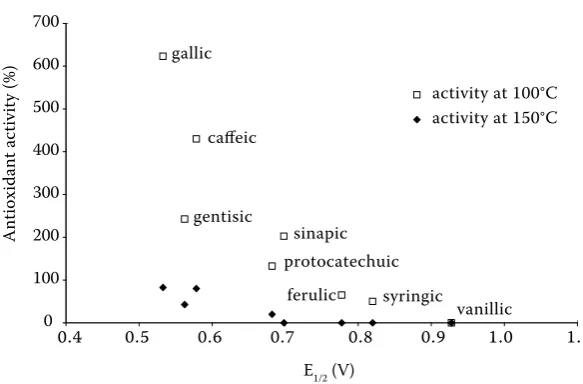
P < 0.01) between these two parameters, i.e. be-tween the relative decrease in antioxidant activity with increasing temperature (expressed as the temperature at which the antioxidant activity of each phenolic acid was half of its antioxidant ac-tivity at 90°C) and the oxidisability of the studied phenolic acids (determined as oxidation half-wave potentials in an acidic medium). The eas-ily oxidisable phenolic acids (i.e. gallic, gentisic, protocatechuic and caffeic) showed a decrease in antioxidant activity with increasing temperature (in comparison with activity at 90°C) at a slower rate than the less oxidisable ones (i.e. syringic, ferulic and sinapic acids, and especially vanillic acid) and they maintain their antioxidant activity at higher temperatures (Figure 5). This agrees with the author’s previous study, where easily oxidisable α-tocopherol decreased its antioxidant activity with increasing temperature relatively more slowly than less oxidisable δ-tocopherol. In that study, α-tocopherol had half the antioxidant activity of δ-tocopherol at 80°C but their activity was the same (P < 0.05) at 130°C (Réblová 2006).
As mentioned in the introduction, a decrease in antioxidant activity with increasing temperature is generally explained by the acceleration of
[image:5.595.64.356.79.271.2]initia-tion reacinitia-tions associated with faster utilisainitia-tion of antioxidants (Pokorný 1986). However, the relationship found in this study (i.e. a significant inverse linear correlation between the relative decrease in antioxidant activity with increasing temperature and the oxidisability of the studied phenolic acids; Figure 4) implies that a decrease in antioxidant activity with increasing temperature (faster for antioxidants with higher oxidation potential, i.e. antioxidants with lower reactivity against free radicals) is caused by a decrease in the ability of antioxidants to react with free radi-cals (particularly with peroxyl radiradi-cals of fatty acids) at higher temperatures. Consequently, it is logical that the less oxidisable antioxidants lose their antioxidant activity sooner (i.e. at lower temperatures) than the easily oxidisable ones (Figure 5). In this case, the antioxidants would not be decomposed quickly at high temperatures but, on the contrary, slowly (in relation to fatty acid oxidation). Therefore, the losses of selected phenolic acids during the oxidation of pork lard enriched with these phenolic acids were studied at 100°C and 150°C.
At 100°C, the losses of phenolic acids corre-sponded to their antioxidant activity. The loss of vanillic acid (without significant antioxidant activity) during the respective induction period was smaller than the losses of gallic and ferulic acids, which had significant antioxidant activity. Therefore, the absence of the antioxidant activ-ity of vanillic acid at this temperature was more likely caused by its inability to react with peroxyl radicals of fatty acids than its fast utilisation. However, at 150°C, the losses of gallic, syringic and ferulic acids during the respective induction periods were approximately the same
(approxi-Figure 5. The relationship between the oxidisability of the studied phenolic acids (determined as oxidation half-wave poten-tials – E1/2) and their antioxidant activity at different temperatures
1 gallic
protocatechuic sinapic
ferulic gentisic
caffeic
vanillic syringic
0 100 200 300 400 500 600 700
0.4 0.5 0.6 0.7 0.8 0.9 1.0 1.1
E1/2 (V)
Antioxidant activity (%)
mately 90%), regardless of their antioxidant activ-ity. This phenomenon can be explained by higher decomposition of hydroperoxides before the end of the induction period at higher temperatures (Lomanno & Navar 1982), forming highly reac-tive alkoxyl and hydroxyl radicals (Frankel 1980) (more reactive than peroxyl radicals (Becker
et al. 2004; Choe & Min 2009) which can react
with phenolic acids without an impact on the length of the induction periods (Frankel 1996). Further increases in temperature would prob-ably also restrain the reactivity of phenolic acids against alkoxyl and hydroxyl radicals (or increase the relative reactivity of fatty acids) to favour the reactions of fatty acids with all present free radicals, resulting in the protection of phenolic acids by unsaturated fatty acids, as was observed for tocopherols (Verleyen et al. 2002). However, a detailed clarification of the respective reaction mechanisms was not the aim of this study. To this purpose, the reactions of the present antioxidants will be studied in greater detail.
conclusions
On the basis of experiments performed with phenolic acids, the existence of a relationship be-tween the relative decrease in antioxidant activity with increasing temperature and the oxidisability of the antioxidants was found. According to this relationship, the easily oxidisable antioxidants show a decrease in antioxidant activity with increasing temperature (in comparison with their activity at a low temperature) at a slower rate than the less oxidisable ones, and maintain their antioxidant activity also at higher temperatures (in contrast to less oxidisable antioxidants). Although other factors would also have to be taken into account in the real systems (such as oxidisability of the stabilized substrate, given by the composition of the present fatty acids, and the volatility of anti-oxidants, which did not affect the results obtained by a closed Oxipres apparatus), the antioxidant activities can be extrapolated to other tempera-tures using the oxidisability of the antioxidants (determined as oxidation half-wave potentials, for example). Furthermore, the presented results indicate that the total deletion of the antioxidants does not generally correspond with the end of the induction period, as some authors have assumed (Marinova & Yanishlieva 1992, 2003).
rEfErEncEs
Amorati R., Pedulli G.F., Cabrini L., Zambonin L., Landi L. (2006): Solvent and pH effects on the antioxi-dant activity of caffeic and other phenolic acids. Journal of Agricultural and Food Chemistry, 54: 2932–2937. Armando C., Maythe S., Beatriz N.P. (1998):
Anti-oxidant activity of grapefruit seed extract on vegetable oils. Journal of the Science of Food and Agriculture, 77: 463–467.
Becker E.M., Nissen L.R., Skibsted L.H. (2004): Anti-oxidant evaluation protocols: food quality or health ef-fects. European Food Research and Technology, 219: 561–571.
Cho H.-Y. (1997): Reaction mechanisms and kinetics of antioxidant using Arrhenius equation in soybean oil oxi-dation. Journal of Food Science and Nutrition, 2: 6–10. Choe E., Min D.B. (2009): Mechanisms of antioxidants in
the oxidation of foods. Comprehensive Reviews in Food Science and Food Safety, 8: 345–358.
Evans J.C., Kodali D.R., Addis P.B. (2002): Optimal to-copherol concentrations to inhibit soybean oil oxida-tion. Journal of the American Oil Chemists’ Society, 79: 47–51.
Frankel E.N. (1980): Lipid oxidation. Progress in Lipid Research, 19: 1–22.
Frankel E.N. (1996): Antioxidants in lipid foods and their impact on food quality. Food Chemistry, 57: 51–55. Karadag A., Ozcelik B., Saner S. (2009): Review of
meth-ods to determine antioxidant capacities. Food Analytical Methods, 2: 41–60.
Kolb T., Loyall U., Schäfer J. (2002): Antioxidants. determination and interpretation of the temperature correlation of oxidative stabilities. Food Marketing & Technology, 16: 27–32.
Lomanno S.S., Navar W.W. (1982): Effect of heating tem-perature and time on the volatile oxidative decomposition of linolenate. Journal of Food Science, 47: 744–746. Marinova E.M., Yanishlieva N.V. (1992): Effect of
tem-perature on the antioxidative action of inhibitors in lipid autoxidation. Journal of the Science of Food and Agri-culture, 60: 313–318.
Marinova E.M., Yanishlieva N.V. (1996): Antioxida-tive action of some flavonoids at ambient and high tem-peratures. Rivista Italiana delle Sostanze Grasse, 73: 445–449.
Marinova E.M., Yanishlieva N.V. (1998): Antioxidative action of quercetin and morin in triacylglycerols of sun-flower oil at ambient and high temperatures. Seifen Öle Fette Wachse, 124: 10–16.
177 at ambient and high temperatures. Food Chemistry, 81:
189–197.
Nakatani N., Tachibana Y., Kikuzaki H. (2001): Estab-lishment of a model substrate oil for antioxidant activity assessment by oil stability index method. Journal of the American Oil Chemists’ Society, 78: 19–23.
Pokorný J. (1986): Addition of antioxidants for food sta-bilization to control oxidative rancidity. Czech Journal of Food Sciences, 4: 299–307.
Réblová Z. (2006): The effect of temperature on the anti-oxidant activity of tocopherols. European Journal of Lipid Science and Technology, 108: 858–863.
Reynhout G. (1991): The effect of temperature on the induction time of a stabilized oil. Journal of the American Oil Chemists’ Society, 68: 983–984.
Trojáková L., Réblová Z., Pokorný J. (1999): Deter-mination of the oxidative stability of fats and oils using the Oxipres apparatus. Czech Journal of Food Sciences, 17: 68–72.
Verleyen T., Kamal-Eldin A., Mozuraityte R., Verhé R., Dewettinck K., Huyghebaert A., de Grey W. (2002): Oxidation at elevated temperatures: competition between
Corresponding author:
Doc. Ing. Zuzana Réblová, Ph.D., Vysoká škola chemicko-technologická v Praze, Fakulta potravinářské a biochemické technologie, Ústav chemie a analýzy potravin, Technická 5, 166 28 Praha 6, Česká Republika tel. + 420 220 443 181, e-mail: [email protected]
α-tocopherol and unsaturated triacylglycerols. European Journal of Lipid Science and Technology, 104: 228–233. Wagner K.-H., Wotruba F., Elmadfa I. (2001):
Antioxida-tive potential of tocotrienols and tocopherols in coconut fat at different oxidation temperatures. European Journal of Lipid Science and Technology, 103: 746–751. Yanishlieva N.V. (2001): Inhibiting oxidation. In:
Poko-rný J., Yanishlieva N.V., Gordon H. (eds): Antioxidants in Food – Practical Applications. Woodhead Publishing, Cambridge: 22–70.
Yanishlieva N.V., Marinova E.M. (1996): Antioxidative effectiveness of some natural antioxidants in sunflower oil. Zeitschrift für LebensmittelUntersuchung und -Forschung, 203: 220–223.
Zandi P., Ahmadi L. (2000): Antioxidant effect of plant extracts of labiatae family. Journal of Lipid Science and Technology, 37: 436–439.
Zhang C.X., Wu H., Weng X.C. (2004): Two novel syn-thetic antioxidants for deep frying oils. Food Chemistry, 84: 219–222.