Root system of a plant is the site of water and nu-trients uptake, a sensor of biotic and abiotic stress, a structural anchor to support the whole plant, and the storage organ in some species (Nibau et al. 2008). In the development of plant root system ar-chitecture (RSA), the initiation and development of LRs is one of the most important. Indole-3-butyric acid (IBA), a naturally occurring auxin besides the major indole-3-acetic acid (IAA), is effective in inducing new roots when applied exogenously. It was reported that the signal transduction pathway for IBA is at least partially different from that for IAA, suggesting that IBA is per se an auxin and does not act simply via the conversion to IAA (Chhun et al. 2004). However, in contrast to IAA, the crosstalk between IBA and nitric oxide (NO) in the initiation and development of LR was less understood (Lanteri et al. 2006).
Quercetin is a flavonoid widely distributed in plants that has multiple functions both in animal and plant cells. In animals, quercetin has been found to have anti-inflammatory and antioxidant
properties. In plants, quercetin is widely accepted as an auxin transport inhibitor and a signaling molecule in the formation of nodules, root knot nematode galls, LRs, and shoots branching (Peer and Murphy 2007, Wasson et al. 2009).
NO is a versatile signaling molecule that func-tions in numerous physiological and biological processes during plant development and stress response. The role of NO in root initiation and development was widely investigated, which evi-denced that NO play central roles in auxin-induced LR development (Correa-Aragunde et al. 2004, Pagnussat et al. 2004). NO is mainly located in actively growing tissues, especially new roots (Gao et al. 2010). However, in auxin-induced rooting process, the upstream events concerning how NO is generated was little known. Exogenous NO affects the development of root architecture in many ways.
In this research, we investigated the effects of IBA and quercetin on the development of LR in M. hupehensis Rehd. seedlings, with special
em-Nitric oxide effect on root architecture development
in
Malus
seedlings
H.J. Gao
1, H.Q. Yang
21
Shandong Institute of Pomology, Taian, P.R. China
2
College of Horticultural Science and Engineering, Shandong Agricultural University,
Taian, P.R. China
ABSTRACT
The time-dependent production of nitric oxide (NO) in roots induced by indole-3-butyric acid (IBA) and the effect
of sodium nitroprusside (SNP) on root architecture development were investigated, using Malus hupehensis Rehd.
seedlings. Following IBA application, a very rapid increase in NO formation and a subsequent second wave of NO burst was observed, which was related to the induction of lateral roots (LRs) and the organogenesis of lateral root primordia (LRP), respectively. The first NO burst was correlated with the second and the two peaks of NO burst induced by IBA were totally abolished by 3,3’,4’,5,7-pentahydroxyflavone (quercetin). Exogenous NO promoted the emergence and elongation of LR and inhibited the elongation of primary root (PR) in a dose-dependent manner: low concentrations of SNP promoted both the amounts and the elongation of LR but inhibited the elongation of LR and PR at higher concentrations. It was concluded that (i) the rapid production of NO induced by IBA was cor-related with the IBA-induced initiation of LR; (ii) quercetin inhibition of IBA-induced LR formation was corcor-related with the quercetin inhibition of IBA-induced NO biosynthesis, and (iii) exogenous NO affects the development of root system architecture in a dose-dependent manner.
phasis on the time-dependent production of NO following IBA application. In addition, the effect of exogenous NO on root architecture development was also investigated. The results will contribute to a better understanding of the multiple roles of NO, IBA and quercetin as well as their crosstalk in root architecture development.
MATERIAL AND METHODS
Plant material and growth conditions. Seeds of M. hupehensis Rehd. var. pinyiensis Jiang were surface-sterilized in 50% (v/v) NaClO (5% active Cl2) for 10 min, rinsed extensively and were lami-nated by sand under 4°C for 35–40 days. Then, the seeds were sowed in plastic pots filled with perlite under room conditions (natural light, 15–25°C). After germination, seedlings with radicles about 2.0 cm long were selected and pre-cultured in Hoagland solution for 48 h, then were used im-mediately in the following treatments.
Treatments. The pre-cultured seedlings were transferred to glass beakers containing 30 mL of various treatment solutions and were incubated under room conditions (natural light, 18–25°C). To investigate the effect of IBA, NO and querce-tin on lateral root development, the treatment solutions are (i) Hoagland solution (control); (ii) 100 μmol indole-3-butyric acid (IBA), and (iii) 100 μmol IBA plus 100 μmol 3,3’,4’,5,7-pentahy-droxyflavone (quercetin), based on the results of preliminary experiment. The roots of the seed-lings were sampled at 0.25, 0.5, 1, 3, 8, 24, 48, and 96 h after treatment, respectively, and were frozen with liquid nitrogen for the determination of NO. In addition, roots were additionally sampled at 8 h and 96 h after treatment for the determination of lateral root primordia (LRP). To investigate the effect of exogenous NO on the development of RSA, the treatment solutions are Hoagland solution (control), 10, 50, 100, and 500 μmol SNP, respec-tively, and the development of root system (the number of LR per seedling, the length of LR and PR) was investigated after 14 days of incubation. The above two experiments were both performed in triplicate (10–12 seedlings per replicate).
Assay of NO generation. NO production was estimated by the luminol-H2O2 chemiluminescence (CL) method according to our previous studies (Gao et al. 2010). Samples were ground in an ice bath at a ratio of 200 mg fresh mass per cm3 of cold deoxygenated water (freshly prepared by boiling distilled deionized water for 1 h). The extracts
were centrifuged at 12 000 × g for 20 min and the supernatant was immediately used for CL detection using a BPCL ultra-weak CL analyzer (Institute of Biophysics, Academia Sinica, P.R. China) by quickly injecting four volumes of ‘illumination buffer’ containing 50 mmol sodium carbonate-sodium bicarbonate, pH 9.72, 10 μmol luminol, 20 mmol H2O2, 2 mmol ethylenediamine tetraacetic acid (EDTA) at 30°C. Relative NO production was expressed as CL counts per microgram of protein [CL counts/μg (protein)].
Lateral root primordia (LRP) determination. The PR was cut and fixed with Carnoy’s Fluid (3 alcohol + 1 acetic acid) at 4°C for 24 h, then was stained using Feulgen staining method (Vuylsteker et al. 1998). The LRP was counted by light micros-copy at 50 amplifications.
Protein content was determined according to Bradford (1976), using bovine serum albumen (BSA) as standard.
Statistical analysis. The statistical analysis was done by the Duncan’s multiple rage test (P ≤ 0.05) using the SPSS software (SPSS 16.0for Windows).
Reagents.The reagents used were manufactured by Sigma (St. Louis, USA).
RESULTS AND DISCUSSION
Time-dependent production of NO induced by IBA in roots of M. hupehensis Rehd. seedlings and the participation of quercetin in the NO generation. Figure 1 shows that in comparison with control seedlings, treatment with 100 µmol IBA alone triggered a transient increase in NO production very rapidly (as early as 0.25 h after treatment) in roots. This transient increase in NO accumulation culminated at 0.5 h after treatment and quickly attenuated from 1 h to 24 h after treat-ment to even below control level; then, a second wave of NO burst can be detected at 48 h and 96 h after IBA treatment. However, this two-peak burst of NO induced by IBA was totally abolished by quercetin.
quercetin treated seedlings, consistent with the first and the second wave of NO burst induced by IBA treatment alone (Figures 1 and 2).
From Figures 1 and 2 we can see that the first wave of NO burst was correlated with the second burst, and that quercetin was involved in at least the first wave of NO formation induced by IBA. In Pisum sativum, Kolbert et al. (2008) also investigated the time-dependent generation of NO following IBA application during root growth. However, the very rapid NO burst (NO burst at 0.25 h and 0.5 h after IAB application in this research) induced by IBA was not observed, possibly due to the different IBA concentration that was used. The development of LRs consists of three stages: (i) LR initiation; (ii) LRP organogenesis, and (iii) LR emergence. In this research, it should be concluded that the first and second wave of NO burst following IBA applica-tion was correlated with the initiaapplica-tion of LR and the organogenesis of LRP, respectively, and that
the first burst of NO (initiation of LR) was cor-related with the second NO burst (organogenesis of LRP). That is to say, the very rapid increase in NO formation induced by IBA might trigger the signal transduction pathway(s) that was required for the initiation of LR.
In Medicago truncatula, Imin et al. (2007) also observed that exogenous quercetin inhibited the auxin-induced rooting process. As quercetin is an auxin transport inhibitor, the authors argued that inhibition of auxin transport may prevent specific cell populations from reaching a localized auxin maximum which is required for the establishment of root primordia. However, Wasson et al. (2009) proved that flavonoid was necessary for nodulation but not necessary for LRs formation. In animals, quercetin can act as phosphatase and kinase inhibi-tors, as well as mitochondrial ATPase inhibiinhibi-tors, particularly inhibiting NO formation through inhibition of nitric oxide synthase (NOS) (Peer
0 100 200 300 400 500 600 700
0.25 0.5 1 3 8 24 48 96
Nitr
ic
ox
ide
pro
duction
[C
L c
oun
ts
/μg
(prot
ein)]
Duration of treatment (h)
Control IBA IBA+Quercetin
a
b b
a
a a
abab
a
a
b b
b b b
b abab a aba a a a
0 5 10 15 20 25
8 96
LRP/number seedling
Duration of treatment (h) Control
IBA
IBA+Quercetin
a a a
a
b
[image:3.595.113.432.65.249.2]b
Figure 1. Indole-3-butyric acid (IBA) induced a transient increase in nitric oxide (NO) formation
[chemilumi-nescence (CL) counts/μg (protein)] in roots of Malus hupehensis Rehd. seedlings, followed by a second wave of
NO burst starting at 48 h after treatment. Results are means ± SD (n = 3). Different lower-case letters indicate
significant differences on each sampling date at P ≤ 0.05 (Duncan’s multiple range test). Quercetin –
3',4',5,7-pen-tahydroxyflavone
Figure 2. The formation of lateral root primordia (LRP) induced by indole-3-butyric acid (IBA) at 96 h after treatment was totally abolished by quercetin in
roots of Malus hupehensis Rehd. seedlings. Results
are means ± SD (n = 3). Different lower-case letters
indicate significant differences on each sampling date
at P ≤ 0.05 (Duncan’s multiple range test). Quercetin
[image:3.595.67.283.614.748.2]and Murphy 2007). In plants, there are emerging evidences showing that quercetin most likely play similar roles as in animals. In this research, we found that quercetin inhibition of IBA-induced LRs was related to inhibition of IBA-induced NO formation. Therefore, quercetin in plants may act as a protein kinase inhibitor (Pan et al. 2005), an ATPase inhibitor (Takahashi et al. 1998), and/or an electron transport inhibitor (Moreland and Novitzky 1987), thus inhibiting IBA-induced NO formation and subsequently the LRs initiation.
The roles that NO play in auxin-mediated root-ing process was well documented (Lanteri et al. 2006). However, the upstream event concerning IBA-induced NO biosynthesis is not fully under-stood. NO can be produced either enzymatically through NO-generating enzymes, or nonenzy-matically through nitrite at acidic conditions. To date, there are at least seven enzymatic pathways of NO biosynthesis that were reported in plants, with nitrate reductase being the best characterized (Gupta et al. 2011). Most recently, it was reported that protein kinase was involved in the rapid pro-duction of NO induced by multiple stimuli (Wang et al. 2010). In this research, it was found that IBA-triggered rapid NO burst was totally abolished by quercetin (Figure 1), possibly due to quercetin inhibition of protein kinase (Wang et al. 2010) or the mitochondrial electron transport (Moreland and Novitzky 1987, Gupta et al. 2011). It might be supposed that the first NO burst was gener-ated via the phosphorylation of one or more NO-generating enzymes (or related enzymes), which was achieved by the rapid activation of protein kinase following IBA application. However, which enzymatic pathway(s) (or related enzymes) should be involved in this IBA-induced NO burst remains to be elucidated in future research. Recently, Wang et al. (2010) found that phosphorylation of ni-trate reductase was responsible for the rapid NO
production through the activation of MAPK by hydrogen peroxide.
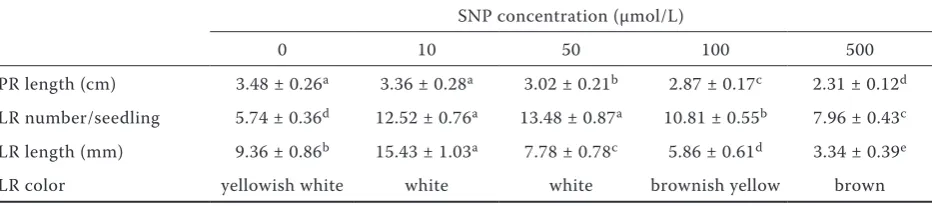
Effect of exogenous NO on the development of root system architecture during post-germina-tion growth of M. hupehensis Rehd. seedlings. From Table 1 we can see that SNP increased the amounts and the length of LR, while decreased the length of PR in a dose-dependent manner. The promotion of LR number was the most effective at 50 µmol SNP, followed by 10 µmol. SNP treatment also affected LR elongation dose-dependently: concentrations between 50–500 µmol SNP sig-nificantly inhibited LR elongation while 10 µmol SNP greatly promoted LR growth (P ≤ 0.05). It could be concluded that exogenous NO affects root architecture development dose-dependently: low concentrations of NO promoted both the number and elongation of LR, while higher concentrations inhibited the elongation of LR and PR. Table 1 also shows that exogenous NO affected the color of LRs dose-dependently. The color of LRs in 10 µmol and 50 µmol SNP treated seedlings was white, while that of 100 µmol and 500 µmol SNP treated seedlings was brownish yellow and brown, respectively. These results indicate that apart from a signaling molecule, exogenous NO may act as a stress factor in controlling LR initiation and development, in agreement with recent findings in soybean seedlings (Böhm et al. 2010).
In soil, nitrate and nitrite can be converted to NO enzymatically or non-enzymatically (Gupta et al. 2011). In low nitrate soils, patches of high nitrate have a localized stimulatory effect on LR development. However, where nitrate levels are globally high (i.e. not growth limiting), LR growth is inhibited (Nibau et al. 2008). Whether or not this effect of nitrate on LR development is due to nitrate-originated NO is an interesting question.
[image:4.595.65.533.88.191.2]In general, we found that IBA induced a very rapid increase in NO accumulation in roots of Table 1. Effect of nitric oxide donor sodium nitroprusside (SNP) on primary root (PR) and lateral root (LR)
development during post-germination growth of Malus hupehensis Rehd. seedlings
SNP concentration (µmol/L)
0 10 50 100 500
PR length (cm) 3.48 ± 0.26a 3.36 ± 0.28a 3.02 ± 0.21b 2.87 ± 0.17c 2.31 ± 0.12d LR number/seedling 5.74 ± 0.36d 12.52 ± 0.76a 13.48 ± 0.87a 10.81 ± 0.55b 7.96 ± 0.43c LR length (mm) 9.36 ± 0.86b 15.43 ± 1.03a 7.78 ± 0.78c 5.86 ± 0.61d 3.34 ± 0.39e
LR color yellowish white white white brownish yellow brown
Data were obtained after 14 days of incubation and were means ± SD, n = 3. Different letters within each row
Malus seedlings that was correlated with the initia-tion of LR and that IBA-triggered rapid NO burst was totally abolished by quercetin. However, the enzymatic pathway(s) involved in IBA-induced NO formation as well as the molecule targets of quercetin regulation in this process remain to be elucidated. Furthermore, apart from the fact that IBA can act as a signal molecule per se, it is also an important source of IAA. In this sense, the mechanisms underlying the rapid production of NO induced by IBA should be further studied.
REFERENCES
Böhm F.M.L.Z., Ferrarese M.L.L., Zanardo D.I.L., Magalhaes J.R., Ferrarese-Filho O. (2010): Nitric oxide affecting root growth, lignification and related enzymes in soybean seedlings. Acta
Physiologiae Plantarum, 32: 1039–1046.
Bradford M.M. (1976): A rapid and sensitive method for the quan-titation of microgram quantities of protein utilizing the principle
of protein-dye binding. Analytical Biochemistry, 72: 248–254.
Chhun T., Taketa S., Tsurumi S., Ichii M. (2004): Different be-haviour of indole-3-acetic acid and indole-3-butyric acid in
stimulating lateral root development in rice (Oryza sativa L.).
Plant Growth Regulation, 43: 135–143.
Correa-Aragunde N., Graziano M., Lamattina L. (2004): Nitric oxide plays a central role in determining lateral root
develop-ment in tomato. Planta, 218: 900–905.
Gao H.J., Yang H.Q., Wang J.Y., Wang J.X. (2010): Two enzymatic sources of nitric oxide in different organs of apple plant.
Bio-logia Plantarum, 54: 789–792.
Gupta K.J., Fernie A.R., Kaiser W.M., van Dongen J.T. (2011): On
the origins of nitric oxide. Trends in Plant Science, 16: 160–168.
Imin N., Nizamidin M., Wu T., Rolfe B.G. (2007): Factors involved
in root formation in Medicago truncatula. Journal of
Experi-mental Botany, 58: 439–451.
Kolbert Z., Bartha B., Erdei L. (2008): Osmotic stress- and indole-3-butyric acid-induced NO generation are partially distinct
processes in root growth and development in Pisum sativum.
Physiologia Plantarum, 133: 406–416.
Lanteri M.L., Graziano M., Correa-Aragunde N., Lamattina L. (2006): From cell division to organ shape: Nitric oxide is involved in auxin-mediated root development. In: Baluška F., Mancuso S., Volkmann D. (eds.): Communication in Plants. Springer-Verlag, Berlin-Heidelberg, 123–136.
Moreland D.E., Novitzky W.P. (1987): Interference by luteolin, quercetin, and taxifolin with chloroplast-mediated electron
transport and phosphorylation. Plant and Soil, 98: 145–159.
Nibau C., Gibbs D.J., Coates J.C. (2008): Branching out in new directions: the control of root architecture by lateral root
formation. New Phytologist, 179: 595–614.
Pagnussat G.C., Lanteri M.L., Lombardo M.C., Lamattina L. (2004): Nitric oxide mediates the indole acetic acid induc-tion activainduc-tion of a mitogen-activated protein kinase cascade involved in adventitious root development. Plant Physiology,
135: 279–286.
Pan Q.H., Li M.J., Peng C.C., Zhang N., Zou X., Zou K.Q., Wang X.L., Yu X.C., Wang X.F., Zhang D.P. (2005): Abscisic acid ac-tivates acid invertases in developing grape berry. Physiologia
Plantarum, 125: 157–170.
Peer W.A., Murphy A.S. (2007): Flavonoids and auxin transport:
modulators or regulators? Trends in Plant Science, 12: 556–563.
Takahashi L., Sert M.A., Kelmer-Bracht A.M., Bracht A., Ishii-Iwamoto E.L. (1998): Effects of rutin and quercetin on mi-tochondrial metabolism and on ATP levels in germinating
tissues of Glycine max. Plant Physiology and Biochemistry,
36: 495–501.
Vuylsteker C., Dewaele E., Rambour S. (1998): Auxin induced
lateral root formation in chicory. Annals of Botany, 81: 449–454.
Wang P., Du Y., Li Y., Ren D., Song C.P. (2010): Hydrogen peroxide-mediated activation of MAP kinase 6 modulates nitric oxide
biosynthesis and signal transduction in Arabidopsis. Plant
Cell, 22: 2981–2998.
Wasson A.P., Ramsay K., Jones M.G.K., Mathesius U. (2009): Differing requirements for flavonoids during the formation of
lateral roots, nodules and root knot nematode galls in Medicago
truncatula. New Phytologist, 183: 167–179.
Received on April 22, 2011
Corresponding authors:
Dr. Hong-Qiang Yang, Shandong Agricultural University, Daizong Street 61, Taian 271018, Shandong, P.R. China e-mail: [email protected]
![Figure 1. Indole-3-butyric acid (IBA) induced a transient increase in nitric oxide (NO) formation [chemilumi-nescence (CL) counts/μg (protein)] in roots of Malus hupehensis Rehd](https://thumb-us.123doks.com/thumbv2/123dok_us/518112.550553/3.595.67.283.614.748/indole-transient-increase-formation-chemilumi-nescence-protein-hupehensis.webp)