
Superhigh Strength Metal Injection Molded Low Alloy Steels by In Process Microstructural Control
5
0
0
Full text
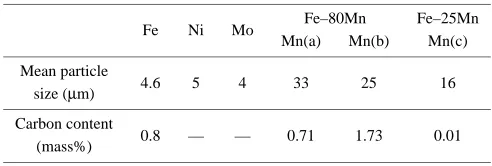
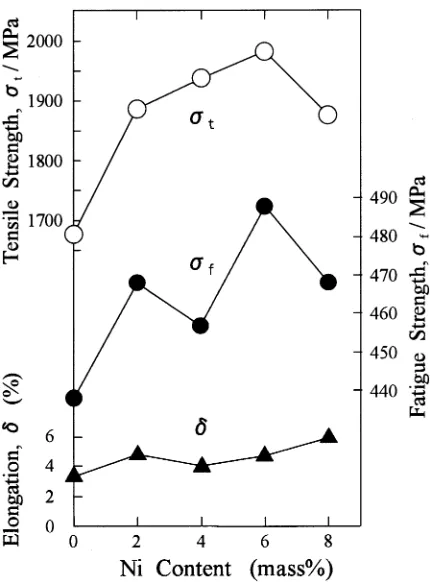
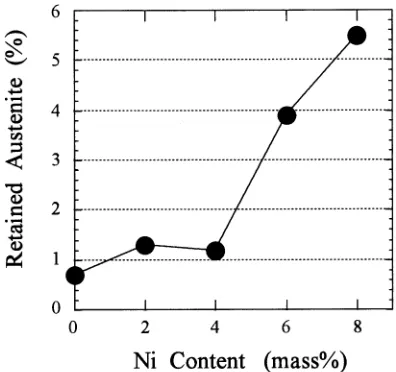
(2) 344. H. Miura and M. Matsuda. Fig. 1 Effect of Ni content on the mechanical properties of MIM Fe–Ni–0.5Mo–0.2Mn steels tempered at 473 K.. to the increase of the retained austenite (6 mass%Ni may be a critical value for the strengthening). Table 2 summarizes the mechanical properties of Fe–Ni–0.5Mo–0.2Mn steels produced by various processes. All the steels were tempered at 473 K for 3.6 Ks in Ar. The properties of injection molded steels with the fine heterogeneous microstructure are significantly higher than those of the conventional P/M steels, and similar to the properties of powder forged steels. The microstructure of high temperature and long time sintered steels (at 1623 K for 18 Ks) become homogeneous. The tensile and fatigue strength of those steels with homogeneous microstructure are lower than those of the steels with the fine heterogeneous microstructure. Consequently, it is confirmed that the fine heterogeneous microstructure is quite useful for superhigh strengthening the sintered low alloy steels. Figure 4 shows the profile of Ni concentration in the white region by EPMA. Since Ni diffuses in the matrix surrounding of white region, Ni concentration of the matrix is approximately 2 mass%. The Ni concentration in the white region increases with increasing Ni content. The size of Ni rich phase (correspond to white region) is about 80 µm in all the steels. When Ni segregates over 12.4 mass%, Mf point become below room temperature, which means to induce the increase of retained austenite. A solute concentration C is described in eq. (2) by the Fick’s second law on a thin film, when a solute diffuse at nonsteady state; C(x, t) = {bC0 /2(π Dt)1/2 } exp(−X 2 /4Dt). (2). the strength is dropped by addition of 8 mass%Ni. Figure 2 shows the microstructures of the injection molded Fe–Ni– 0.5Mo–0.2Mn steels tempered at 473 K. All the matrix are the tempered martensitic structure. There are white regions in the matrix, which consists of a high Ni concentration confirmed by EPMA. These white regions are the martensitic structures which hardness is higher than that of the matrix. Also, white regions having the large pore in the center, are consisted of a high Mo concentration, which were confirmed by EPMA. The formation of large pore is reported to be due to the large difference of the diffusivity between Fe and Mo.3) Anyway, the volume fraction at Ni rich phases increases with increasing Ni content. Accordingly, excellent mechanical properties of the steel added 6 mass%Ni are attributed to the solid solution strengthening of Ni and the fine heterogeneous microstructure which consists of Ni rich martensite surrounded by a network of the tempered martensite. Since some center of the Ni rich phases show the low hardness, the phase was investigated by using X-ray diffraction. It was found to be the retained austenite, because high percentages of Ni depress the transformation (Ms, Mf ) range to considerably below room temperature. The amount of retained austenite for various Ni content steels were investigated as shown in Fig. 3, and which were derived from the eq. (1);. where C 0 is the solute concentration on the thin film, D is the diffusion coefficient, b is the thin film thickness, and x is the distance from the center of thin film. In the debound compacts, Ni powders agglomerate and the size was approximately 15 µm. According to the results, the agglomeration is regarded as the thin film thickness of 15 µm. When the distance from the center of Ni rich phase is 20 µm, the Ni concentration of 8.6% are obtained from the steel containing 4 mass%Ni as shown in Fig. 4 simultaneously, and the diffusion coefficient of Ni is calculated by entering those values to eq. (2). When the Ni concentration is 12.4 mass% (Mf point is below room temperature), the value of about 18 µm is obtained as the initial thin film thickness b. Figure 5 illustrates schematically the structure for Ni rich phase. Upper side figure shows that the Ni rich phase consists of only the martensitic structure if the size of agglomerated Ni powders is below 18 µm, whereas in the bottom side figure the retained austenite is formed in the center of Ni rich phases if the size of agglomerated Ni powders is above 18 µm. If the Ni powders of approximately 20 µm particle size is dispersed uniformly in the matrix, therefore, superior mechanical properties may be obtained by even the same composition of Fe–6Ni–0.5Mo– 0.2Mn steels.. Vγ (%) = {1/(1 + 1/K · Iα /Iγ } × 100. 3.2 Addition of Mn instead of Ni Table 3 shows the tensile properties of the various steels tempered at 473 K, at which Mn (a) and Mn (b) stand for ferromanganese (a) and (b) powders, respectively, as shown in Table 1. The Fe–2Mn ((a) and (b)) steels showed approximately 94% of relative densities, and the fine and spherical pores were distributed individually. Compared to the Fe–2Ni steel, the Fe–2Mn ((a) and (b)) steels show the poor tensile. (1). where Vγ is the amounts of retained austenite, Iα is α (211) integral intensity, Iγ is the average of γ (220) and γ (311) integral intensity, and K is a material constant (1.4). The amount of retained austenite increases with increasing Ni content of 6 or 8 mass%. Therefore, a drop of the tensile and fatigue strength of the steels added 8 mass%Ni may be due.
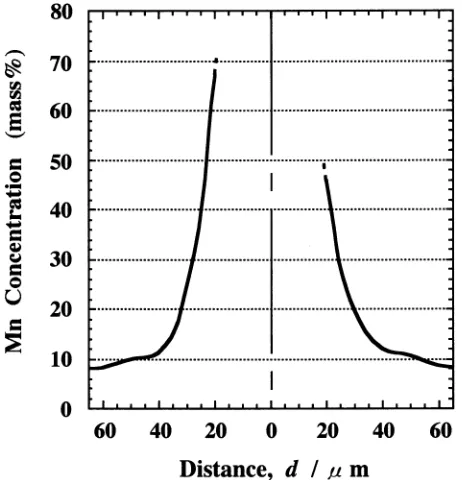
(3) Superhigh Strength Metal Injection Molded Low Alloy Steels by In-Process Microstructural Control. 345. Fig. 2 Microstructures of MIM Fe–Ni–0.5Mo–0.2Mn steels tempered at 473 K.. Table 2 Mechanical properties of the Fe–Ni–0.5Mo–0.2Mn steels produced by various processes. MIM MIM P/M (Forged) P/M (Pressed) (6 mass%Ni) (6 mass%Ni) (2 mass%Ni) (6 mass%Ni) heterogeneity homogeneity Density (%). 99.9. 95∗. 96∗∗. 92.4. Tensile strength (MPa). 2115. 1983 max.2047. 1789 max.1008. 1443 max.1514. Elongation (%). 11. 5. 6. 2. Fatigue strength (MPA). 652. 488. —. 463. Sintering condition: ∗ 1523 K–3.6 ks ∗∗ 1623 K–18 ks. Fig. 3 Fraction of the retained austenite of MIM Fe–Ni–0.5Mo–0.2Mn steels tempered at 473 K.. Fig. 5 Schematic illustrations of the structure for Ni rich phase.. Fig. 4 Profile of Ni concentration at the white region of MIM Fe–Ni–0.5Mo–0.2Mn steels tempered at 473 K.. properties although there is only 1% difference in the relative densities. Figure 6 show the microstructures for the injection molded Fe–2Mn steels tempered at 473 K. All the matrix were tempered martensitic structures (confirmed by EPMA), in which the white regions observed were consisted of Mn. The microhardness of the white regions (228–239 Hv) were considerably lower than that of the matrix (541–595 Hv). Figure 7 shows the profile of the Mn concentration at the. white region. The white regions consist of high Mn concentrations and have large pores in the center. Since the white regions showed low hardness and segregation of high Mn concentrations, the structured phases were investigated by using X-ray diffraction. As a result, it was found to be the retained austenite. The amount of retained austenite is shown in Fig. 8. The amount of retained austenite in the Fe–2Mn ((a) and (b)) steels are somewhat more than that in Fe–2Ni steels. Therefore, a cause of the drop of tensile properties of the Fe–2Mn ((a) and (b)) steels may be due to the increase of the amount of retained austenite. As shown in Fig. 6, there are many voids and large pores in the center of the white regions. At sintering temperature of 1523 K, diffusion coefficient of Mn in γ -Fe is higher than the selfdiffusion coefficient of Fe in γ -Fe. In the Fe–2Mn ((a) and (b)) steels, Mn atoms diffuse faster than.
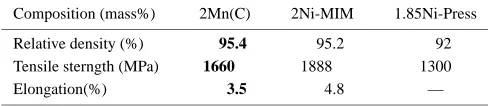
(4) 346. H. Miura and M. Matsuda. Table 3 Tensile properties of MIM low alloy steels tempered at 473 K. Composition (mass%). 2Mn(a). 2Mn(b). 2Ni. Relative density (%) Tensile sterngth (MPa) Elongation(%). 94.1 1570 2.0. 94.5 1450 2.0. 95.2 1888 4.8. Fig. 8 Fraction of the retained austenite of the low alloy steels tempered at 473 K.. Fig. 6 Microstructure of MIM Fe–2Mn(b) steels tempered at 473 K.. Fig. 9 Microstructure of MIM Fe–2Mn(c) steels tempered at 473 K.. Fig. 7 Profile of Mn concentration at the white region of MIM Fe–2Mn(a) steels tempered at 473 K.. Fe atoms at various temperatures and Mn concentrations.4) A. Salak et al.5) have reported that Mn atoms sublimate and evaporate at 1373 K in the sintered Fe–Mn steels. As a result of inductively coupled plasma analysis, the concentration of Mn for the injection molded Fe–2Mn ((a) and (b)) steels tempered at 473 K decreased from 0.1 to 0.3 mass%. Therefore, the voids shown in the white regions are seemed to be Kirkendall voids, according to the different diffusion rates between Fe and Mn. The marks may be caused by the evaporation of Mn atoms or the dislodgement of Fe– 80Mn powders by polishing for microstructure observation. Consequently, the poor tensile properties of the Fe–2Mn ((a) and (b)) steels are mainly due to the voids and large pores on the Mn rich phases.. From these results, the ferromanganese powders which have a low Mn concentration must be used in order to improve the mechanical properties of the sintered Fe–Mn steels. In other words, Mn atoms diffuse fast and homogeneous in the matrix. The occurrence of Kirkendall voids are also inhibited, resulting in the decrease of the retained austenite. Figure 9 shows the microstructure and the hardness of the injection molded Fe–2Mn(C) steels tempered at 473 K. Since Mn atoms almost diffused homogeneously in the matrix, there were little left Mn rich phase in the matrix. Therefore, we hardly observed the Kirkendall voids and large pores. The X-ray diffraction parttern of the injection molded Fe– 2Mn(C) steel tempered at 473 K is shown in Fig. 10. There are little retained austenite. Table 4 shows the relative densities and tensile properties of the various low alloy steels tempered at 473 K. By using the Fe–25Mn(C) powders, tensile strength and elongation increased by 100 MPa and 1.5% more than those of the steel added Fe–80Mn(a) powder. The tensile properties of steel added Fe–25Mn(C) powder are significantly higher than those of the conventional P/M steels (1.85%Ni), and approach to the properties of injection molded Fe–2Ni steel with the fine heterogeneous microstructures..
(5) Superhigh Strength Metal Injection Molded Low Alloy Steels by In-Process Microstructural Control. Fig. 10 X-ray diffraction pattern of Fe–2Mn(c) steel tempered at 473 K. Table 4 Tensile properties of the low alloy steels tempered at 473 K. Composition (mass%). 2Mn(C). 2Ni-MIM. 1.85Ni-Press. Relative density (%) Tensile sterngth (MPa) Elongation(%). 95.4 1660 3.5. 95.2 1888 4.8. 92 1300 —. 347. lution strengthening of Ni and the fine heterogeneous microstructure which consisted of Ni (and Mo) rich martensitic structure surrounded by a network of tempered martensitic structure, resulted in the good balance of strength and ductility. However, the tensile and fatigue strength of the steels added 8 mass%Ni decreased remarkably on account of increasing the amount of retained austenite. According to the model by the Fick’s second law on the thin film, superior mechanical properties may be obtained in the same composition of Fe–2Ni–0.5Mo–0.2Mn steels, when the Ni powders of approximately 15 µm particle size are dispersed uniformly in the matrix. Compared to Fe–2Ni steels, the Fe–2Mn steels using Fe–80 mass%Mn powder show very poor tensile properties. Whereas, by using Fe–25mass%Mn powder, the steels showed high tensile strength of approximately 1660 MPa, and had a ductility of 3.5% elongation due to the decrease in the fraction of retained austenite, and also the disappearance of the voids and large pores. Accordingly, in order to improve the mechanical properties of the injection molded Fe–Mn sintered low alloy steels, the ferromanganese powders which have low Mn concentrations must be used. REFERENCES. 4. Conclusion. 1) R. M. German: Powder Injection Molding, (MPIF, Princeton, NJ, 1990) pp. 3–17.. For the injection molded Fe–Ni–0.5Mo–0.2Mn steels using mixed elemental powders, the tensile and fatigue strength were improved significantly without loss of the ductility, as Ni content increased. Especially the steels added 6 mass%Ni showed an excellent tensile strength of approximately 2000 MPa remaining 5% elongation. The solid so-. 2) K. Baba, T. Honda and H. Miura: J. Japan Soc. Powder and Powder Metal. 44 (1997) 443–447. 3) S. Tanabe and A. Morita: J. Japan Soc. Powder and Powder Metal. 35 (1988) 233–238. 4) S. Tsuji and K. Yamanaka: J. Japan Inst. Metals 34 (1970) 486–490. 5) A. Salak: Powder Metall. Int. 12 (1980) 72–75..
(6)
Figure
+2
Related documents