Testing of Koch method applied for evaluation
of ornamental trees in the Czech Republic
P. Bulíř
Silva Tarouca Research Institute for Landscape and Ornamental Gardening, Průhonice,
Czech Republic
ABSTRACT: Koch method of ornamental trees evaluation is based on interest paid on costs invested in tree-growing
up to their maturity stage minus deductions for age, defects and damage. The aim of this paper is to apply the above mentioned method in the economic conditions of the czech republic. The paper presents essential economic data generated in accordance with the technological model of tree growing at a permanent site. We also describe the mecha-nism of the so-called base tree price calculation as a basis for the subtraction of deductions derived from its current condition. The calculated base tree prices are illustratively compared to prices based on the to-date applied calculating techniques and the relevant regulation. We also refer to the method of base price adjustment based on the criterion of landscape tree value. The mechanism of price calculation applied for Koch method testing included two modifications. The first relates to due consideration of growth qualities when calculating development care costs; the other introduces landscaping value indicator as the only base price adjustment to achieve the resulting price, corresponding with the current tree condition.
Keywords: Koch method; woody species evaluation; ornamental trees; tree-growing costs; development care; base
price; resulting price; landscaping value
Koch method (Koch 1971; Schulz et al. 2002; Breloer 2007a) for calculation of real value (price) of ornamental trees ranks in germany among the universally recognized and so far utilized methods of woody species evaluations in cases of destruc-tion, damage or expropriation. The method is, in principle, based on interest paid on costs invested in woody plants growing up to their maturity stage minus deductions for age, defects and damage in-curred prior to the determining event. instructions for practical application of the methods are to be found in the relevant manuals, elucidating work-ing procedures, containwork-ing indicative economic data as well as calculation examples, in particular related to trees (Hötzel, Hund 2001; Schulz et al. 2002). The methodology is discussed by experts on annual basis, let alone some well-known court verdicts (Breloer 2007a,b). in the cr, the method has not been tested so far. its principles are, howev-er, theoretically accepted by, for instance, Pejchal and Šimek (2003) while its benefits are doubted by Pilař (2003). Both the ambivalent viewing of Koch method and the fact that the current czech woody species evaluation manuals (grulich et al. 1992; Kolařík et al. 2005) and the Decree of the
Minis-try of Finance No. 3/2008 coll. are not sufficiently transparent with regard to prices were instrumen-tal in adopting the decision to test the method (Bulíř 2007). Thus, the aim of our work has been to apply Koch method to determining and adjust-ing base ornamental tree prices in our current eco-nomic conditions and to compare them with prices referred to in the current czech manuals.
MATERIAL AND METHODS
Base tree prices were set using the latest published version of Koch method (Hötzel, Hund 2001).
Both material and labor costs were calculated based on a technological model of permanent site tree-growing, split into the following stages: – young plant planting, including its purchase and
shipping,
– subsequent three-year development care (site establishment period),
prices of identically sized young plants sold by five most prominent czech producers, including 5% val-ue added tax (Vat). Shipping costs of transporta-tion from producer to planting sites were calculated using the flat rate of 18% of the young plant price. all labor operations performed during individual stages of the technological model were assessed in line with the catalogue of Building operations Descriptions & indicative Prices – 823-1 Land ar-eas & Development (2006). Prices of identical labor operations in various terrains (plane, slope 1:5–1:2, slope steeper than 1:2), and prices of operations incorporating alternatives (e.g., hole-digging with-out soil replacement, or with 50% or 100% replace-ment) listed in the said catalogue were averaged. Prices of supplementary material (compost, humus soil, fertilizers, stakes, water, mulch and others) were taken over from current price lists of major producers and distributors (including Vat), being averaged as above. overall development care costs were recalculated to reflect average annual costs. interest on costs was fixed at 7% interest rate, based on banking rates for mid-term and long-term loans, mortgages, bonds, deposits and other products present on the market for the last 40 years (roso-chatecká, tomšík 2007). growth failure rate in the course of establishment stage was set at 10%.
RESULTS AND DISCUSSION
The first cost input in base tree price calculation is represented by the wholesale price of a young plant of a specific cultivar in the shape of a tall-trunk
standard and the selected stem circumference size. it is necessary that the young plant size should be adequate to the envisaged function of the tree at the given site (object of greenery), which may ei-ther increase or decrease its value. initial costs also include transportation of young plants from nurs-eries to the planting site, including planting itself plus necessary support materials (compost, fertil-izers, stakes, etc.).
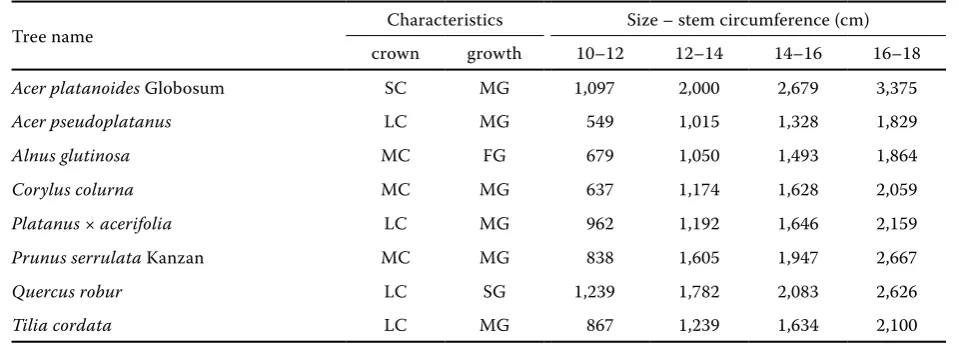
table 1 lists examples of young plant prices for certain woody taxa, including transportation. The table gives the prices of tree sizes most often plant-ed in parks, gardens and housing estates greenery. at the same time, the data given in the table re-flect actual supply on our young tree nursery mar-ket. unlike in germany, larger young plant sizes of deciduous trees are, as a rule, not available in our ornamental tree nurseries. Thus, calculations are determined by these facts. However, in exceptional cases or where prominent landmarks are concerned (trees in the parterres of historical parks, represen-tative buildings, memorials, central squares, etc.) we do allow for the possibility of calculating base tree prices individually bearing in mind the pric-es of bigger young plants which may be imported from abroad.
The table also demonstrates apparent price dif-ferences among individual tree taxa. The differenc-es point out the fact that the objectively calculated base prices of individual taxa cannot be the same; on the contrary, they have to differ.
[image:2.595.58.538.554.727.2]in our instance, the issue of shipping costs was not addressed along the lines of real costs but as an 18% flat rate of the young plant price. our aim was
table 1. Dendrological features of selected taxa and average prices (cZK) of young plants – tall-trunk trees with rootball, including 5% Vat, 18% shipping, grown in the czech republic in 2007
tree name characteristics Size – stem circumference (cm)
crown growth 10–12 12–14 14–16 16–18
Acer platanoides globosum Sc Mg 1,097 2,000 2,679 3,375
Acer pseudoplatanus Lc Mg 549 1,015 1,328 1,829
Alnus glutinosa Mc Fg 679 1,050 1,493 1,864
Corylus colurna Mc Mg 637 1,174 1,628 2,059
Platanus × acerifolia Lc Mg 962 1,192 1,646 2,159
Prunus serrulata Kanzan Mc Mg 838 1,605 1,947 2,667
Quercus robur Lc Sg 1,239 1,782 2,083 2,626
Tilia cordata Lc Mg 867 1,239 1,634 2,100
to develop indicative base prices, not to calculate base tree prices for a known site by a specific day. The used rate is based on former rules applicable to budgeting of landscaping works, i.e., it has its roots in the period when the majority of today’s mature trees had been planted. When assessing a specific case, it is obviously more accurate to make the cal-culation based on actual shipping costs. Fixing of flat transportation rates still remains an open issue and will be subject to further fine-tuning.
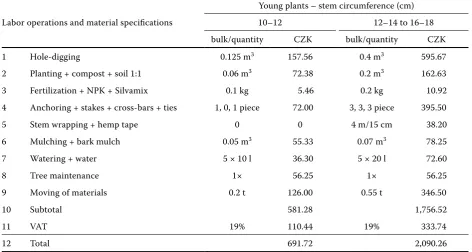
[image:3.595.62.535.96.348.2]table 2 presents a model budget and a cost bal-ance related to young tree planting at a permanent site in parks, gardens, and housing estates. The bud-get includes all essential labor and technological operations and materials associated with planting under standard conditions. Soil preparation opera-tions are however excluded as they are, as a rule, not performed as part of complementary planting at the existing greenery sites. Here, tree planting begins with digging of the hole. in cases of newly
table 2. average prices of labor operations and essential materials for permanent tree planting (parks, gardens, hous-ing estate greenery) in 2007
Labor operations and material specifications
Young plants – stem circumference (cm)
10–12 12–14 to 16–18
bulk/quantity cZK bulk/quantity cZK
1 Hole-digging 0.125 m3 157.56 0.4 m3 595.67
2 Planting + compost + soil 1:1 0.06 m3 72.38 0.2 m3 162.63
3 Fertilization + NPK + Silvamix 0.1 kg 5.46 0.2 kg 10.92
4 anchoring + stakes + cross-bars + ties 1, 0, 1 piece 72.00 3, 3, 3 piece 395.50
5 Stem wrapping + hemp tape 0 0 4 m/15 cm 38.20
6 Mulching + bark mulch 0.05 m3 55.33 0.07 m3 78.25
7 Watering + water 5 × 10 l 36.30 5 × 20 l 72.60
8 tree maintenance 1× 56.25 1× 56.25
9 Moving of materials 0.2 t 126.00 0.55 t 346.50
10 Subtotal 581.28 1,756.52
11 Vat 19% 110.44 19% 333.74
[image:3.595.62.533.561.623.2]12 total 691.72 2,090.26
table 3. average price of yearly tree development care during the establishment period at permanent sites in 2007
Labor operations and specification of materials cumulative price (cZK)
Formative pruning 1×/year, watering, incl. water 5 × 30 l × 3 years, fertilization, including NPK + Silvamix 30 dkg × 3 years, planting basin weeding 2×/year × 3 years,
[image:3.595.72.533.684.758.2]removing of stem wrapper, visual tree checking, moving of materials, Vat 19% 511
table 4. average price related to the continuation of yearly development care from tree establishment to their maturity in 2007
Labor operations and specification of materials cumulative price (cZK)
small crown medium-size crown large crown Maintenance pruning 1×/4–6 years, fertilization incl.
NPK 1.5 kg in 3 years, visual tree control 1×/year,
established sites, as confirmed by our findings, site preparation does not represent any considerable cost-related sum.
tables 3 and 4 present average annual develop-ment care costs for the period of tree establishdevelop-ment and further maturation. The third stage costs (ta-ble 4) are, unlike in Koch method (Hötzel, Hund 2001), calculated for the total of three crown sizes. We have adopted this decision due to distinct dif-ferences in growth and the need of actual care, in particular with respect to trimming of diverse cul-tivars. trimming of trees that naturally develop larger crowns is more demanding both in terms of time and finance in comparison with the trimming of small-crown species. other labor operations as well as material consumption (fertilizers, etc.) as-sociated with these trees also appear to be more ex-pensive. The first modification of Koch method as applied in our economic setting concerns the dif-ferentiation of development care costs associated with tree crown sizes.
The actual calculations of costs related to indi-vidual growing stages presented in tables 1–4 were taken as primary input data for base price calcula-tions of a specific taxon. in addition, the calculation construction was complemented with flat rates for
growth failure risk of 10%. This rate is slightly high-er than the rate published in the Budgeting cata-logue; the reason is that it relates to the whole of the establishment period which spans longer than is considered ordinary. in accordance with both theoretical and practical experience, the envisaged establishment period for a newly planted tree at its permanent location was fixed for all sizes of young plants to last three years. The remaining time of development care – from establishment to full ma-turity – was addressed by using a differentiating ap-proach based on the genetically determined growth speed and crown character of the individual taxa. The fastest-growing species, the species growing at mid-speed, and the slowest-growing species were assigned 10–15 years, 15–30 years and 30–40 years, respectively. The length of this stage was deter-mined by applying information from dendrological publications as well as practical experiences. Data on the growth speed of individual taxa will be fur-ther specified.
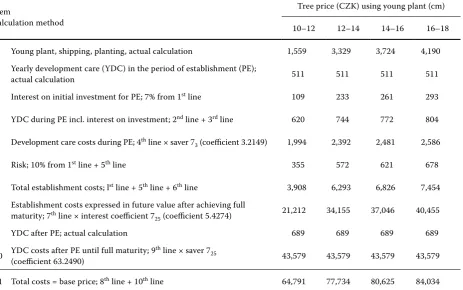
[image:4.595.70.534.463.753.2]table 5 presents the mechanism of calculating a base tree price derived from various young plant sizes. The calculation formula includes compound interest tools; the applied 7% interest rate is a rate specially identified for this work (rosochatecká,
table 5. example of base price calculation of small-leaved lime (Tilia cordata) using various young plant sizes with rootball, establishment period of 3 years, maturation period (development care) of 25 years, 10% risk, and 7% interest
item
calculation method
tree price (cZK) using young plant (cm)
10–12 12–14 14–16 16–18
1 Young plant, shipping, planting, actual calculation 1,559 3,329 3,724 4,190
2 Yearly development care (YDc) in the period of establishment (Pe); actual calculation 511 511 511 511
3 interest on initial investment for Pe; 7% from 1st line 109 233 261 293
4 YDc during Pe incl. interest on investment; 2nd line + 3rd line 620 744 772 804
5 Development care costs during Pe; 4th line × saver 7
3 (coefficient 3.2149) 1,994 2,392 2,481 2,586
6 risk; 10% from 1st line + 5th line 355 572 621 678
7 total establishment costs; lst line + 5th line + 6th line 3,908 6,293 6,826 7,454
8 establishment costs expressed in future value after achieving full maturity; 7th line × interest coefficient 7
25 (coefficient 5.4274) 21,212 34,155 37,046 40,455
9 YDc after Pe; actual calculation 689 689 689 689
10 YDc costs after Pe until full maturity; 9th line × saver 725
(coefficient 63.2490) 43,579 43,579 43,579 43,579
tomšík 2007). its current level can be considered as an initial foundation for Koch method applica-tion in the czech republic as well as for discussions among relevant experts. This rate will be undoubt-edly subject to change in relation to economic de-velopment of this country as was observed in ger-many (e.g., Breloer 2007a).
Base tree prices are defined as total costs spent on woody plants growing up to the time of their complete maturity (see table 5). The quoted base prices are maximum prices applying for optimally developed, sound and undamaged specimens in solitary position, aged 40–45 years and older in case
[image:5.595.67.534.94.276.2]of slowly growing trees or 20–25 years and older in case of fast growing trees. obviously, base prices of younger specimens which have not yet reached the indicated age limits are lower. table 6 gives base prices of other species differing from one another by crown size and growth speed in their maturation stage. test calculations have indicated that, for the determination of objective prices, these factors are indispensable. The reason is that they are essential for determining annual development care costs and its overall duration, which is, in turn, reflected in the level of base prices. to modify Koch method in this particular aspect appears as duly beneficial.
table 6. Base prices of various taxa of young plants with rootball, based on stem circumference sizes, including Vat (5%) and shipping (18%) in 2007
Woody plant characteristics Base price (cZK) by size of stem circumference (cm)
crown growth 10–12 12–14 14–16 16–18
Acer platanoides globosum Sc Mg15 18,373 26,927 29,450 32,038
Acer pseudoplatanus Lc Mg25 62,461 76,094 78,381 82,049
Alnus glutinosa Mc Fg15 22,947 29,527 31,172 32,554
Corylus colurna Mc Mg25 51,913 66,064 69,387 72,537
Platanus × acerifolia Lc Mg25 65,481 77,389 80,711 84,465
Prunus serrulata Kanzan Mc Mg15 23,540 31,589 32,861 35,537
Quercus robur Lc Sg30 98,648 118,556 121,643 127,211
Tilia cordata Lc Mg25 64,791 77,734 80,625 84,034
Lc – large crown, Mc – medium crown, Sc – small crown, Fg – fast growth, Mg – medium growth, Sg – slow growth, index – estimated number of years needed to reach full maturity
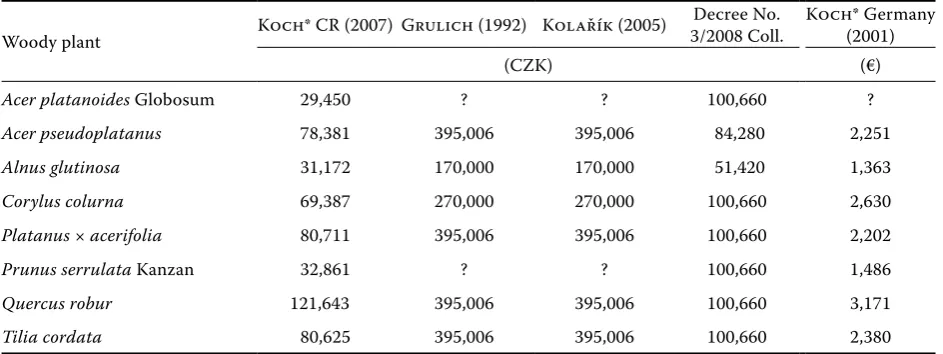
table 7. comparison of maximum base tree prices (cZK) listed in czech manuals & Decrees to those in germany (€), interest 4%, risk 10% (Hötzel, Hund 2001)
Woody plant Koch* cr (2007) grulich (1992) Kolařík (2005) Decree No. 3/2008 coll.
Koch* germany (2001)
(cZK) (€)
Acer platanoides globosum 29,450 ? ? 100,660 ?
Acer pseudoplatanus 78,381 395,006 395,006 84,280 2,251
Alnus glutinosa 31,172 170,000 170,000 51,420 1,363
Corylus colurna 69,387 270,000 270,000 100,660 2,630
Platanus × acerifolia 80,711 395,006 395,006 100,660 2,202
Prunus serrulata Kanzan 32,861 ? ? 100,660 1,486
Quercus robur 121,643 395,006 395,006 100,660 3,171
Tilia cordata 80,625 395,006 395,006 100,660 2,380
[image:5.595.63.535.557.734.2]The calculated indicative base tree prices were subsequently (table 7) compared with base prices utilized by the existing czech guidelines for woody species assessments (grulich et al. 1992; Kolařík et al. 2005; Decree of the Ministry of Finance No. 3/2008 coll.). These were, according to their au-thors, also calculated using the cost-based method, therefore they can be verified by comparison. The table clearly demonstrates that reference prices cal-culated in czech economic environment by using Koch method (Hötzel, Hund 2001) or the refer-ence prices included in the directive for practical use (Schulz et al. 2002) are, in their maximum, alto-gether manifold lower than those calculated by the so far used method for evaluating the extent of woody species damage and the determination of
replace-ment planting price (grulich et al. 1992; Kolařík et al. 2005). The newly fixed prices are closer to those listed in the currently valid regulation (Decree of the Ministry of Finance No. 3/2008 coll.). The examples include only one exception, i.e., taxon Prunus serru-lata Kanzan; its price listed in the Decree is evidently too high. The calculated base prices are comparable with indicative tree prices in germany where, at present, interest rate of 4% applies.
Koch method does not end up by calculating total tree-growing costs up to its maturity (base price). it winds up by calculating the so-called material value, based on the present condition of a woody plant, when the calculated base price is being adjusted to reflect deductions for age, defects and damage. to achieve this, it uses formulas and tables. While test-ing individual age deduction calculattest-ing formulas, we identified quite significant result discrepancies as well as practical problems associated with determin-ing both the sufficiently accurate current age and life expectancy of specific trees. We also found out that deductions on account of defects and damage may not always reflect all deficiencies of a given woody plant. Thus, we abandoned the original method when calculating the resulting evaluation price; instead, in order to adjust base prices in our conditions, we ap-plied an indicator by which we evaluate the overall woody plant quality and potential. This indicator is known among professional public as landscaping
table 8. characteristics of landscaping value degrees (LV)
Landscaping
value degree Description
1 Very high tree with ideally developed habitat, corresponding with the given taxon and age; mostly solitary wit regular branching, fully vital, sound, undamaged, safe; very significant both functionally and compositionally on the site with long-term perspective
2 High
in all quantitative and qualitative markers, tree departs only slightly from relevantly aged ideal (LV 1); the departures, however, are not detrimental to its typical appearance, condition, func-tion, and safety; significant both functionally and compositionally on the given site with long-term perspective
3 average
Showing more conspicuous departures from ideal habitat at relevant age; shows slight or more serious physiological disorders or defects in its architecture; overall condition, damage and stabil-ity, however, do not reduce its relatively favorable functionality and safety, still allowing its mid-term to long-mid-term existence
4 Low
tree with considerably damaged habitat, e.g., due to crown closure, diseases, permanently active pests, age or absence of professional care; insufficiently enfoliated, weakly to very weakly vital, during maturity and senescence considerably unsafe for its immediate vicinity; with very limited functionality, with short-term expectancy, non-perspective
[image:6.595.63.291.646.756.2]5 Very low (zero) Little or no vitality, seriously ill, with little foliation, dying or dry in its entirety; habitat seriously damaged, in maturity and senescence unsafe to dangerous; nonfunctional and without perspective
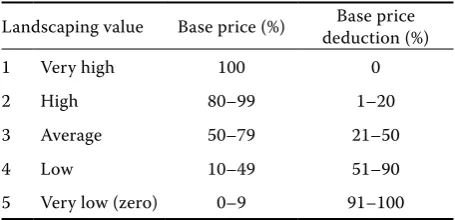
table 9. translation key for base price deductions using the landscaping value criterion
Landscaping value Base price (%) deduction (%)Base price
1 Very high 100 0
2 High 80–99 1–20
3 average 50–79 21–50
4 Low 10–49 51–90
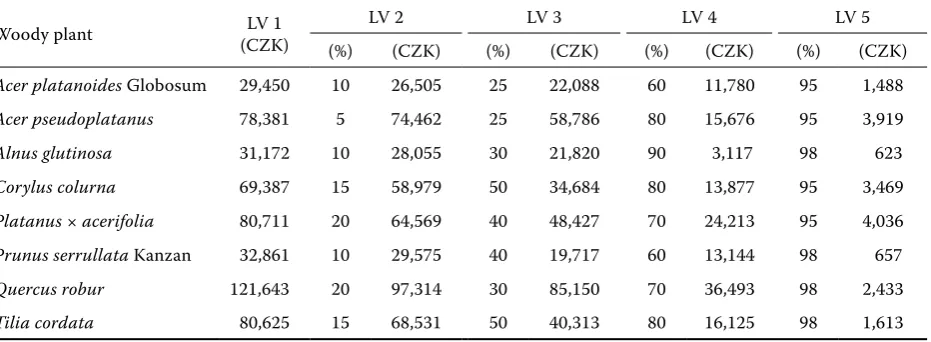
value. The landscaping value scale proposed for the evaluation purposes (see table 8) draws on previ-ous classifications (Machovec 1970; Šimek 2001). unlike those classifications, it ceased to take into account the woody plant age. The appropriate scale modification allows that even young, solitary, vital, still maturing (growing) specimens in their typical habitat can attain the highest scoring degree. Thus, price distortions related to young and maturing trees are being prevented; these trees were, according to the original classification, scored by grade three. Base price deductions are carried out using the proposed translation key (see table 9). Percentage range as-signed to individual scoring degrees make it possible for every assessor to apply his/her expert opinion as regards the quality and, consequently, the resulting price of the woody plant. table 10 presents examples of woody plant prices that were modified using the described indicator. These prices are termed as final, resulting (assessment) woody plant prices; their cal-culation was our initial aim.
The second tree price calculating modification of Koch method introduced in our conditions concerns the application of landscaping value indicator.
By using the described procedure, it is possible to calculate both the base and the resulting (evalua-tion) price of any tree species and/or cultivar.
CONCLUSIONS
Domestic testing of Koch method for ornamental trees evaluation has demonstrated that this meth-od based on interest paid on invested costs is rela-tively simple, professionally transparent and easily checked. By utilizing the procedure, one can set the
price of a given woody plant both in its nominal condition (base price) and in its actual (real, cur-rent) condition. The latter is termed as the resulting (evaluation) price and/or material value of a tree. Koch method can be used to calculate both base and resulting price of any tree species or cultivar, ir-respective of whether one knows or does not know its dimensions (size). The only necessary input data include material and labor costs associated with its growing into completely mature, fully stabilized condition as well as the knowledge of current tree quality. The most important material costs embrace the choice of proper young plant size which should always correspond with the significance of the tree for the given site.
calculations that were conducted indicate that prices of individual taxa may differ considerably. The differences are caused, in particular, by the fol-lowing factors: tree species (cultivar) itself, chosen young plant size, genetic qualities of the evaluated taxon – and above all, speed of maturation growth and crown size. Price levels are also considerably affected by relevant interest rates. The interest rate of 7% is the initial rate specially calculated for Koch method application in czech domestic conditions. at the same time, it represents the opening cue for professional debate on this topic.
comparisons of base prices of selected trees have indicated that the corresponding prices quoted in current czech manuals are manifold higher. Thus, the demand for price change appears to be legiti-mate as Koch method is based on real costs.
[image:7.595.67.533.93.264.2]While Koch method was being tested in this country, two modifications were proposed to be made in the calculation construction. one is related to making provision for tree growth qualities when
table 10. examples of base price deductions (%) set by a degree of landscaping value (LV) and resulting current tree prices (cZK). The prices are based on young tree with the size of stem circumference 14–16 cm
Woody plant (cZK)LV 1 LV 2 LV 3 LV 4 LV 5
(%) (cZK) (%) (cZK) (%) (cZK) (%) (cZK)
Acer platanoides globosum 29,450 10 26,505 25 22,088 60 11,780 95 1,488
Acer pseudoplatanus 78,381 5 74,462 25 58,786 80 15,676 95 3,919
Alnus glutinosa 31,172 10 28,055 30 21,820 90 3,117 98 623
Corylus colurna 69,387 15 58,979 50 34,684 80 13,877 95 3,469
Platanus × acerifolia 80,711 20 64,569 40 48,427 70 24,213 95 4,036
Prunus serrullata Kanzan 32,861 10 29,575 40 19,717 60 13,144 98 657
Quercus robur 121,643 20 97,314 30 85,150 70 36,493 98 2,433
calculating development care costs, the other is as-sociated with landscaping value application when determining the level of deductions linked with the actual condition of the given woody plant.
References
BreLoer H., 2007a. Was ist mein Baum Wert? Braun- schweig, Haymarket Media: 1–172.
BreLoer H., 2007b. 21. trefen zur Methode Koch mit interessanten Themen. ProBaum, 1: 24–25.
BuLíř P., 2007. on tree evaluation and appraisal. in: conference Papers The tree and Flower – Part of Life. Průhonice, riLog: 131–134. (in czech)
gruLicH J. et al., 1992. Methodology for evaluating woody species growing outside forest areas and for calculating substitute trees and shrubs. [Manuscript.] Praha, ČÚoP: 1–11. (in czech)
HötZeL H-J., HuND F., 2001. aktualisierte gehölzwert-tabellen. Bäume und Sträucher als grundstückbestandteile an Strassen, in Parks und gärten sowie in freier Landschaft. einschliesslich obstgehölze. Karlsruhe, VVW: 1–299. KocH W., 1971. Verkehrs- und Schadenersatzwerte von
Bäume, Sträucher, Hecken und obstgehölze nach dem Sachw-ertverfahren. Bonn, Verlag Pflug und Feder, Heft 69: 1–52. KoLaříK J. et al., 2005. caring Woody Species growing
outside Forests – ii. Vlašim, ČSoP: 1–720. (in czech)
MacHoVec J., 1970. inventoring woody species. in: KaVKa B. et al. (eds.), Landscapings. Praha, SZN: 478–480. (in czech)
PeJcHaL M., ŠiMeK P., (2003). towards and Methodology of Woody Species evaluation. in: Woody Species evalua-tion. Plzeň, SZKt a SVSMP: 12–16. (in czech)
PiLař t., 2003. Navigating through a pandenonium of methods woody species evaluation. in: Woody Species evaluation. Plzeň, SZKt a SVSMP: 45–48. (in czech) roSocHatecKá e., toMŠíK K., 2007. Material for
or-namental woody species evaluation using modificed Koch method. [Manuscript.] 1–27 (in czech)
ScHuLZ H-J. et al., 2002. richtlinie für die Wertermittlung von Schutz- und gestaltungsgrün, Baumschulpflanzen und Dauerkulturen. teil a: Schutz- und gestaltungsgrün. Bonn, FFL: 1–127.
ŠiMeK P., 2001. evaluating Woody Species and their cum-munities for gardening and Landscaping. [Ph.D. Thesis.] Brno, MZLu, ZF Lednice: 1–159. (in czech)
catalogue of Building operations Descriptions & indicative Prices – 823-1 Land areas & Development (2006). Praha, ÚrS. (in czech)
Ministry of Finance, 2008. Decree No. 3/2008 coll., imple-menting certain provisions of act No. 151/1997 coll., on property assessment. collection of Law of the czech republic, tMV, Praha.
received for publication May 2, 2008 accepted after corrections July 8, 2009
Testování Kochovy metody oceňování okrasných stromů v České republice
ABSTRAKT: Kochova metoda oceňování okrasných stromů je založena na úročení nákladů vynaložených na jejich
pěstování do stadia plné funkčnosti, od kterých se odečítají srážky za stáří, vady a poškození. cílem práce byla aplikace této metody v ekonomických podmínkách České republiky. Příspěvek uvádí potřebná ekonomická data vytvářená podle technologického modelu pěstování stromu na trvalém stanovišti. Prezentován je i mechanismus výpočtu tzv. základní ceny stromu jako základny pro odpočet srážek podle jeho aktuálního stavu. Vypočítané základní ceny stromů jsou na příkladech porovnávány s úrovní cen v dosud používaných metodikách a právním předpisu. řeší se i způsob úpravy základní ceny, a to podle kritéria sadovnická hodnota stromu. V mechanismu výpočtu cen byly při testování Kochovy metody uplatněny dvě modifikace. První se týká zohlednění růstových vlastností v kalkulaci nákladů rozvojové péče, druhá zavedení ukazatele sadovnická hodnota jako jediného kritéria úpravy základní ceny na cenu výslednou, odpovídající aktuálnímu stavu stromu.
Klíčová slova: Kochova metoda; oceňování dřevin; okrasné stromy; náklady na pěstování; rozvojová péče; základní
cena; výsledná cena; sadovnická hodnota
Corresponding author:
ing. Pavel Bulíř, cSc., Výzkumný ústav Silva taroucy pro krajinu a okrasné zahradnictví, v.v.i., Průhonice, Květnové náměstí 391, 252 43 Průhonice, Česká republika