Abstract—In order to face the ASEAN Economic Community (AEC) in 2015, Sebelas Maret University (UNS) forming an entrepreneurship incubator housed in the Technology Innovation Centre, University of Sebelas Maret (PIT UNS). The entrepreneurship incubator in UNS cannot be said to be optimal. Implement strategy for commercialization is needed to ensure the long term success of the commercialization strategy for university spin-off, the tangible manifestation of the success of an entrepreneurial incubator. Starting from factors in successful entrepreneurship incubator, benchmarking with ICC UTM and HQ Nutraceuticals Sdn Bhd and transferred be SWOT analysis, this paper proposed to provide all services and supports of the PIT UNS to gain the success of the UNS’s university spin-off, so that the
commercialization policies, economic situation and
commercialization culture can be developed, build the university spin-off based on the tropical climate, develop the business networking, develop the HRD aspect and build the special building to develop the business of university spin-off. This paper recommended the strategies in commercialization of UNS.
Index Terms—commercialization, commercialization strategy, entrepreneurship incubator, SWOT analysis, university spin-off.
I. INTRODUCTION
N order to improve the competitiveness, it needs to be fostered new entrepreneurs who are resilient, creative, and professional. Indonesia needs a lot of entrepreneurs to be the leader of other nations, especially in the face of the ASEAN Economic Community (AEC) in 2015 [1]. The entrepreneurship incubator is an effective vehicle to foster the entrepreneurial spirit, ability, networking, and entrepreneurial insight [2]. Entrepreneurship incubator can be organized by universities, science and technology park (STP), the private sector, government and local government [3].
For the entrepreneurship incubator organized by
Manuscript received November 11, 2014; revised December 29, 2014. Aam Hamid Al Ghabid (1) and Nur Atikah (2) are with Sebelas Maret University, Surakarta, 57126, Indonesia (e-mail: (1) [email protected]; (2) [email protected]).
Wahyudi Sutopo is with The Research Group of Logistics System and Business, Industrial Engineering Department, Sebelas Maret University, Surakarta, 57126, Indonesia, (e-mail: [email protected]).
Muhammad Nizam is with Research and Development for Indonesia Electric Vehicle Consortium Team, Sebelas Maret University, Indonesia (email: [email protected]).
Ida Idayu Muhamad is with the Bioprocess Engineering Department, Faculty of Chemical Engineering, Universiti Teknologi Malaysia, 81310 UTM Skudai, Johor, Malaysia, (e-mail: [email protected]).
universities, it would produce the university spin-off. University spin-off is a global phenomenon in which the world is currently interested in the translation of the universities’ research results of technology towards economic development through entrepreneurship [4]. The university spin-offs can be a positive impact on the economic development of a country, among others, generate significant economic value, create jobs, increase the rate of investment in the development of higher education technology and increase local economic development. In addition, university spin-off is also a positive impact on the college, as an effective vehicle for the commercialization of the technology, an effective vehicle to support the inventor's involvement in business development, helping to achieve the mission of universities, increase the number and quality of research activities and provide education for students in entrepreneurship [4].
To foster the entrepreneurial spirit in the academic environment in particular and society in general audiences, the University of Sebelas Maret (UNS) forming an entrepreneurship incubator housed in the Technology Innovation Centre, University of Sebelas Maret (PIT UNS) [5] [6] [7]. An entrepreneurship incubator in UNS cannot be said to be optimal. The target output in 2014, about 100 bank of ideas, intellectual property along with 10 of his IPR and the university spin-offs developed [3], has not yet to be achieved, meanwhile there are some tenants who will be its first university spin-offs.
Universiti Teknologi Malaysia (UTM) as the best number eighth universities in Southeast Asia [8] has an entrepreneurship incubator were quite successful, Innovation and Commercialization Centre, Universiti Teknologi Malaysia (ICC UTM), which has spawned until 2770 IPR and 18 university spin-offs since its establishment in 2010 as a tangible manifestation of the success of an entrepreneurial incubator [9] [10].
As an incubator of entrepreneurs who are quite successful, UTM can be a lesson for the UNS to develop, produce university spin-offs as a tangible success of entrepreneurial incubator. The study and analysis that can be done to take lessons from UTM is the study or analysis of strategies used by university spin-offs that have been developed and also how the ICC UTM commercialize its university spin-offs. This is because the university spin-off is a realization of an entrepreneurial incubator successful.
Among the many UTM university spin-offs, there is a company that is successful, the HQ Nutraceuticals Sdn Bhd [11]. The company is preceded by research on high-fiber foods conducted by researchers of UTM [12]. Meanwhile, HQ Nutraceuticals Sdn Bhd is a company which has not
Commercialization Strategy Formulation for
University Spin-Off: A Case Study
Aam Hamid Al Ghabid, Nur Atikah, Wahyudi Sutopo, Muhammad Nizam and Ida Idayu Muhamad
reached the level of maturity in the commercialization model, so that this is the closest benchmarking with tenants of PIT UNS.
Studies of commercialization strategies have been carried out. Pellikka and Malinen examined the commercialization strategies used in high-tech sectors and their role as part of a new product commercialization strategy and innovation management [13]. Meanwhile, Dmitriev, et al has examined the development of commercialization that has focused on the relationship between the elements of the value of conceptualizing and organizations that have a linear sequence in which the business model first designed and then implemented [14]. Then, Sarma, et al, has been doing research on commercialization strategies result of product innovation through optimization models for collaboration in agricultural research and development agency [15]. Then Rajkovič, et al also conducted research on the commercialization strategy in technology of polymer materials [16]. While Prawitasari and Nuariputri has conducted research on the formulation of corporate strategy by using SWOT analysis [17] [18]. In other research, Erliza, et al has formulated the strategy for promoting investment of Technopolis with the benchmarking and SWOT analysis of the methodology [19].
This paper aims to analyze the commercialization strategy of the UNS by benchmarking with UTM and its HQ Nutraceuticals Sdn Bhd by using the SWOT analysis.
II. METHODOLOGY
To analyze the commercialization strategy of the university spin-off by using SWOT analysis, it needs some steps to formulate the strategy. The first, it needs to be known the success factors of the university spin-off and the entrepreneurship incubator of the university. By doing benchmarking with other university, it would deepen the analysis. The next analyzes the strategies by doing the SWOT analysis based on the aspects [20]. After that, by using the SWOT matrix, it would be known what kind of strategy the UNS and its tenants needs to be focused on the commercialization. Finally, the strategies can be formulated as a list to suggest the UNS and its tenants to be university spin-off. The Fig. 1 shows the methodology to formulate the commercialization strategy.
III. SUCCESS FACTORS IN COMMERCIALIZATION, BENCHMARKING, AND SWOT ANALYSIS
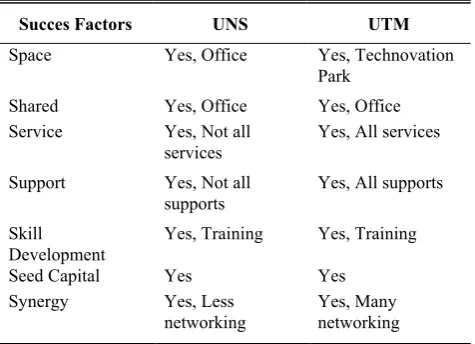
There are seven factors to successful entrepreneurship incubator in commercialization [21] [22]. The factors are space, shared, service, support, skill development, seed capital, and synergy [21] [22]. Space talks about incubator provides a place to develop the business in the early stages. Shared is about incubator provides office facilities that can be used together, for example receptionist, conference room, phone system, fax, computer, and security. Services include management consulting and market issues, financial and legal aspects, trade and information technology. Support: incubator helps access to research, professional networking, technology, international, and investment. Skill development: it can be done through training to prepare a business plan, management, and other capabilities. Seed capital: it can be done through an internal revolving fund or to help small businesses access to funding sources or existing financial institutions. Synergy is about cooperation or competition among tenants and networking (network) with the universities, research institutions, private businesses, professionals and the international community [21] [22]. The seven factors can be the internal aspect of SWOT analysis. The PESTEL analysis, which are politic, economic, social, technology, environment, and legal, can be used as the external aspect for SWOT analysis [24]. There are also seven factors to successfully university spin-off [23]. The seven factors are financial resources, technological resources, knowledge, organizational resources, relational capital, human capital, and motivational factors [23].
Success factors in commercialization are used to generate an internal and external environment that affecting of commercialization. UNS and its tenants is used to be the case study, with the benchmarking with UTM and HQ Nutraceuticals Sdn Bhd. We analyzed existing conditions of the UNS and its tenants to benchmark with UTM and HQ Nutraceuticals Sdn Bhd as shown in Table 1, Table 2, and Table 3, and to generate its strengths, weaknesses, opportunities, and threats as shown in Table 4.
TABLEI
BENCHMARKING BETWEEN UNS AND UTM
Succes Factors UNS UTM
Space Yes, Office Yes, Technovation
Park
Shared Yes, Office Yes, Office
Service Yes, Not all services
Yes, All services
Support Yes, Not all
supports Yes, All supports Skill
Development
Yes, Training Yes, Training
Seed Capital Yes Yes
Synergy Yes, Less
networking
Yes, Many networking
[image:2.595.306.544.565.737.2]IV. RESULT AND DISCUSSION
From Table 4, the strengths, weaknesses, opportunities, and threats that exist in the UNS is already generated. After analyzing, the existing factors mutually forms were a SWOT matrix. The matrix was used to develop support strategies.
S-O strategies formulated by using the power of the UNS and its tenants to take advantage of existing opportunities. W-O strategy formulated by minimizing the weaknesses of the university to take advantage of the opportunities. S-T strategy formulated by using the power of the UNS and its tenants to address the threat. Whereas W-T strategy formulated by minimizing the weaknesses and avoid threats from the external environment as shown as Fig. 2.
A. Push the Commercialization Policies and Develop the Economic Situation by the Success of UNS's University Spin-Off
With the condition of less policies by the government, which concern on commercialization and university spin-off existence, there are opportunities to show off the success of university spin-off. This action can stimulate the growth of the university spin-off in Indonesia, and the government will see this and make a decision to make some policies related to this problem.
Based on the economic condition which is so dynamic, the existence of university spin-off can be an answer for the problem. With the university spin-off, the technology developed by universities can be touch the market or the people itself, so it can help the economic aspect of Indonesian people.
TABLEIV
SWOTANALYSIS:ACASE STUDY
Factors S W O T Explanation of Case Study
Space √ W1-Office uses for all activity Shared √ W1-Office uses for all activity Service √ W2-Not provide all services and
supports
Support √ W2-Not provide all services and supports
Skill Develop-ment
√ S1-Provide training to develop skill
Seed Capital √ S2-Provide funding access
Synergy √ W3-Less networking
Financial √ W4-Weak university spin-off's finance
Knowledge √ S3-Supported by high knowledge
Organiza-tion √ W5-Not structured university spin-off's organization Relation √ W6-Less university spin-off's
relationship Human
Capital
√ S4-Strong human capital
Motivation √ T1-Weak commercialization culture
Politic √ O1-Less commercialization policies
Economy √ O2-Dynamic economic situation Social √ T1-Weak commercialization
culture
Technology √ W7-Develop middle technology
Environ-ment
√ O3-Tropical climate lead some business opportunities
Legal √ T2- Hard to develop company, bureaucracy restriction
TABLEIII
BENCHMARKING BETWEEN UNS AND UTM–PESTELFACTORS
PESTEL Factors UNS UTM
Politic Less
commercializatio n policies
Strong
commercialization policies
Economy Dynamic
economic situation
Competitive economic situation
Social Weak
commercializatio n culture
Strong
commercialization culture
Technology Middle technology support
High technology support
Environment Tropical climate Tropical climate
Legal Hard to develop
company Easy to develop company TABLEII
BENCHMARKING BETWEEN UNS’S TENANTS
AND HQNUTRACEUTICALS SDN BHD
Succes Factors Tenants of UNS HQ Nutraceuticals Sdn Bhd
Financial Weak,
Supported
Strong enough, Supported Technology Middle
technology
High technology
Knowledge High knowledge High knowledge Organization Not structured Structured Relation Less relation Strong relation Human Capital Strong human
capital
Strong human capital
Motivation Weak
commercializati on culture
Strong
B. Build the University Spin-Off and Develop the Technology Based On the Tropical Climate
Develop the university spin-off based on the tropical climate, technology is just right to the countries in this tropical climate area. The technology can be developed as the high technology because of the appropriate environmental condition.
C. Develop the Business Networking to Gain the Financial Resources
To gain the financial resources, the business networking development can be used to do that. The bigger the business network, the more party we have, the more chance to gain the financial resources, because we can do some business or some deals to gain our financial resources.
D. Develop the Commercialization Culture with the Success of UNS's University Spin-Off
With the success of UNS’ university spin-off, the commercialization culture in the university can be developed. The people at the university will see this success, so that they will be following this culture of commercialization.
E. Face the Bureaucracy Restriction with the Strong Human Capital, by Gain the HRD Aspect
With gain the HRD aspect, the human capital will be developed and gain the qualification. By this developed human capital, the restriction of bureaucracy in building new companies (university spin-off) can be faced. This problem can restrict the existence of university spin-off, so that this could be solved by human capital development.
F. Build the Special Building to Develop University Spin-Off Business
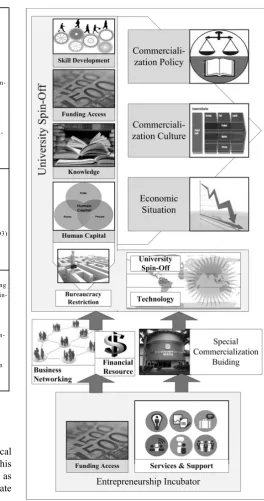
[image:4.595.279.544.55.557.2]The special building like Technovation Park of ICC UTM can be the best place to develop the business in the early stages of the university spin-off. The place can be the factory, the office, or something else can help the university Fig. 3. The proposed scheme of commercialization strategy in UNS.
Internal Factors STRENG TH WEAKNESS
S1-P rovide training to develop skill
W1-Office uses for all activity
S2-P rovide funding access W2-Not provide all services and supports S3-Supported by high
knowledge
W3-Less networking
S4-Strong human capital W4-Weak university
spin-off's finance W5-Not structured university spin-off's organization
W6-Less university spin-off's relationship
External Factors
W7-Develop middle technology
OPPORTUNITY
O1-Less commercialization policies
O2-Dynamic economic situation
O3-Tropical climate lead some business opportunities
THREAT
T1-Weak
commercialization culture
T2- Hard to develop company, bureaucracy restriction
S-O Strategy
P ush the commercialization policies and develop the economic situation by the success of UNS's university spin-off (S1,S2,S3,S4-O1,O2) Build the university spin-off based on the tropical climate (S1,S2,S3,S4-O3)
W-O Strategy
Develop the business networking to gain the financial resources (W3,W4,W6-O2) Develop tropical climate based technology (W7-O3)
S-T Strategy
Develop the
commercialization culture with the success of UNS's university spin-off (S1,S2,S3,S4-T1) Face the bureaucracy restriction with the strong human capital (S4-T2)
W-T Strategy
Build the special buildiing to develop university spin-off business (W1-T1) P rovide all services and supports to gain the success of university spin-off (W2-T1) Gain the HRD aspect, so that the human capital can face the bureaucracy restriction (W5-T2)
spin-off to develop their business. So that, UNS can build the special building, just like Technovation Park in UTM. This special place could help UNS’ tenants to develop to university spin-off and being a successful company in the future.
G. Provide All Services and Supports to Gain the Success of University Spin-Off
The all entrepreneurship incubator services like management consulting and market issues, financial and legal aspects, trade and information technology; and support like helping with access to research, professional networking, technology, international, and investment, could be given. The services and the support of entrepreneurship incubator to its tenant or university spin-off can help them to develop their business and reach the maturity in business.
The all strategies, S-O strategies, S-T strategies, W-O strategies, and W-T strategies united in a scheme. The scheme of commercialization strategy in UNS can be formulated as shown in Fig. 3. The proposed scheme shows that the entrepreneurship incubator and the university spin-off should be cooperating to develop the success of university spin-off.
V. CONCLUSION AND FUTURE RESEARCH
The commercialization strategies suggested to UNS are to provide all services and supports of the PIT UNS to gain the success of the UNS’s university spin-off, so that the commercialization policies, economic situation and commercialization culture can be developed, build the university spin-off based on the tropical climate, develop the business networking, develop the HRD aspect and build the special building to develop the business of university spin-off. The future research suggested for deepening the business area. It can include the business strategy formulation for university spin-off.
ACKNOWLEDGMENTS
This work is supported by program of Electric Vehicle Development, FY 2014 under ‘Program Riset Molina Afirmasi LPDP, Contract No: PRJ-933/LPDP/2014, August 17, 2014).
REFERENCES
[1] Y. Manggala, “The Students Should Be Driven to Be an
Entrepreneur”, Availabe:
http://www.republika.co.id/berita/pendidikan/dunia- kampus/13/11/20/mwk6es-mahasiswa-harus-didorong-jadi-entrepreneur.
[2] Republic of Indonesia, "Regulation of the President of the Republic of Indonesia Number 27 Year 2013 about the Development of Entrepreneurial Incubator", in Gazette of the Republic of Indonesia Year 2013 Number 66. Jakarta: Secretariat of the Cabinet of the Republic of Indonesia.
[3] Sebelas Maret University Technology Innovation Center, "Entrepreneurial Incubators Development Coordination Guidelines
Coordinating Ministry for Economic Affairs", Available:
http://inovasi.uns.ac.id/?page_id=3065.
[4] I. Tritoasmoro, "Academic Entrepreneurship: Create Prosperity
through University Spin-Off”, Available:
http://kemahasiswaan.kopertis4.or.id/assets/source/pmw%202014/Ke wirausahaan%20Akademik_%20Menciptakan%20kesejahteraan%20d engan%20Spinoff%20University.pdf.
[5] Bramantyo, “PIT UNS Being Technopreneur Development Center”, Available:http://kampus.okezone.com/read/2014/03/13/373/954538/pi t-uns-jadi-pusat-pengembangan-technopreneur
[6] T. Suwarto, “Indonesia Has To Develop Energy and Food
Innovation”. Available: http://www.pikiran-rakyat.com/node/273342
[7] Zadmin, “Hatta Rajasa Inaugurated Technology Innovation Center in UNS”. Avalable: http://www.thepresidentpost.com/2014/03/12/hatta-rajasa-inaugurated-technology-innovation-center-in-uns/.
[8] Webometrics. “South East Asia”, Available: http://www.webometrics.info/en/asia_pacifico/south%20east%20asia [9] A. Aziz, “UTM Inventors’ Guide to Spin-offs and Technology
Transfer: For Researchers, Students and Industry”. Johor Bahru:
UTM Innovation and Commercialisation Centre.
[10] Z. Ujang, “Nourish Back the Soul of Academia”. Johor Bahru: UTM Press.
[11] A. Jamil, “2011 UTM-MTDC Symbiosis Products”, in Innovation and Commercialization Centre Bulletin. Issue 6, vol. 1 (December 2013 – January 2014). Johor Bahru, pp. 12.
[12] ICC UTM, “UTM - MTDC Symbiosis Companies”. Available: www.icc.utm.my/other/technologies/utm-mtdc-symbiosis-companies/ [13] J. Pellikka, and P. Malinen, “Business Models in the
Commercialization Processes of Innovation among Small
High-Technology Firms”, in International Journal of Innovation and
Technology Management, Vol. 11, Issue 2, April 2014, Article number 1450007.
[14] V. Dmitriev, G. Simmons, Y. Truong, M. Palmer, D. Schneckenberg,
“An Exploration of Business Model Development in the
Commercialization of Technology Innovations”, In R and D
Management, Vol. 44, Issue 3, June 2014, pp. 306-321.
[15] M. Sarma, K. Irwanto, N. Nugrahan, E. Adriani, “Results Product Commercialization Strategy Optimization Model Innovation through
Partnerships in RnD Agency”, in Proceeding of Research Result of
IPB.
[16] T. Rajkovič, G. Arh, S. Vaupot, “Commercialization Strategies of Innovations in Centre of Excellence, Case of Centre of Excellence
Polymer Materials and Technologies – CoE PoliMaT”, in
Proceedings of the 12th Management International Conference, Portorož, Slovenia, 23–26 November 2011, pp. 909-928.
[17] S. Prawitasari, “SWOT Analysis as Company Competitive Marketing Strategy Formulation (Case Study on Honda Tunggul Sakti Dealer in
Semarang)”. Semarang: University of Diponegoro.
[18] H. Nuariputri, “SWOT Analysis in Determination of Marketing Strategy on PT. Kusumahadi Santosa in Karanganyar (Study Case on
Marketing Division I Local)”. Surakarta: University of Sebelas Maret.
[19] A. Erliza, R. Zakaria, W. Sutopo, A. Widiyanto, E. Supriyanto.
“Formulation Strategy for Promoting Investment of Technopolis: A
Case Study”, in Proceedings of the International MultiConference of
Engineers and Computer Scientists 2014 Vol II, IMECS 2014, March 12 - 14, 2014, Hong Kong.
[20] F. Rangkuti, “Technique Dissecting the Business Case: SWOT Analysis, Weight Calculation Method, Rating, and OCAI”, Jakarta: Gramedia Pustaka Utama.
[21] T. Agustina, “Role of Higher Education in Business Incubator to Minimize The Risk of Failure For New Merchandise At Early Stage
(Start-Up)”, in Majalah Ekonomi, Year XXI, Number 1, April 2011,
pp. 64-74.
[22] M. Sahban, D. Kumar, and S. Sri Ramalu, “Factors Related to Entrepreneurial Incubation Centers Model Verification through
Delphi Technique”. In: 4th International Conference on Education and
Information Management, 21-22 December 2013, Penang, Malaysia. [23] G. Lauto, M. Bau, C. Compagno, “Resources and Motivational
Factors Enabling the Creation of Academic Spin-Off: The Italian Experience”, in ESU Conference 2009 on Entrepreneurship, Benevento, 8-13 September, pp. 1-12.