EUROPEAN REGIONAL DEVELOPMENT FUND
UK REGIONAL DEVELOPMENT PROGRAMME
1986-90
Sections 1 to 6:
United Kingdom — General
V<l>0 DOCUMENT
DOCUMENTO
BCUMENT DDCUMENTO DONO
NT
ΕΓΓΡΑΦΟ
DOCUMENT DO
MENTODOCUMENT DOGUMI
COMMISSION
OF THE EUROPEAN
This document has been prepared for use within the Commission. It does not necessarily represent the Commission's official position.
Cataloguing data can be found at the end of this publication
Luxembourg: Office for Official Publications of the European Communities, 1987 Vol. 1 : ISBN 92-825-7192-0
Vol. 1-7: ISBN 92-825-7199-8
Catalogue number: CB-98-87-001-EN-C
© ECSC-EEC-EAEC, Brussels · Luxembourg, 1987
Reproduction is authorized, except for commercial purposes, provided the source is acknowledged.
Commission of the European Communities
European Regional Development Fund
UK RE6I0NAL DEVELOPMENT PROGRAMME 1986-90
Sections 1 to 6: United Kingdom - General
This document has been prepared for use within the Commission. It does not necessarily represent the Commission's official position.
Copyright ECSC-EEC-EAEC, Brussels - Luxembourg, 1987
European Regional Development Fund
UK REGIONAL DEVELOPMENT
PROGRAMME 1986-90
BDBAAF
UK REGIONAL DEVELOPMENT PROGRAMME 1 9 8 6 - 9 0
CONTENTS
The Programme consists of detailed information on regional or sub-regional areas (Sections 7 to 10) preceded by general information on the United Kingdom (Sections i to 6 ) . This is
Sections. I t o b
SECTIONS 1 TO 6 - UNITED KINGDOM; GENERAL
Section ι Introduction
2 Economic and Social Analysis 3 Development objectives
4 Measures tor Development 5 Financial Resources
6 Co-ordination of Government Activities in the Regions
Annex ι - UK Government Departments with an Interest in the Programme
Annex 2 - Maps of Planning Regions Annex 3 - Central Government Funds Annex 4 - The Assisted Areas
Annex 5 - Assistance for Industry and Tourism
Annex 6 - Infrastructure Authorities and programmes Annex 7 - Declining Industries
Annex 8' - UK Regional Job Deficiency Projections
STATISTICAL TABLES (i TO 40): Index precedes tables
SECTION 7 - ENGLAND
7A 7B 7C
North East Whitby Bradford
7E South Yorkshire 7F Workington
7G Greater Manchester 7H Greater Merseyside 7J West Midlands
7K Corby 7L South West
7M Cinderford and Ross-on-Wye
SECTION 8 - WALES
8A 8B 8C 8D 8E 8F
Overview North East North West South West Industrlal Mid Wales
Wales Wales Wales
South Wales
SECTION 9 - SCOTLAND
9A Overview
9B Scotland-Highlands and Islands 9C Scotland-East Central
9D Scotland-West Central 9E Scotland-South West
Reí:3 7GAAA
Sect i on O n e
INTRODUCTI ON
1.1 The fundamental aim of the G o v e r n m e n t ' s regional development policy - set out in this document - is to stimulate economic activity in the disadvantaged areas of the United K i n g d o m . For this purpose some of the
disadvantaged areas of the UK have been designated by the Secretary of State for Trade and Industry as 'Assisted A r e a s ' . Two categories of Assisted Areas have been
designated Development Areas (areas with high persistent unemployment and structural w e a k n e s s e s ) and Intermediate Areas (where economic p r o b l e m s , although important are less
severe than those in Development A r e a s ) (See Annex k ) . In the selection of the Assisted Areas the G o v e r n m e n t ' s
intention was to c o n c e n t r a t e aid in the areas of greatest need. T o ensure this a wide range of criteria were
c o n s i d e r e d . By far the major factor taken into a c c o u n t , h o w e v e r , was the local unemployment rate. Other factors included the industrial and economic structure of an a r e a , the prospective growth in labour supply and the likely need for employment o p p o r t u n i t i e s .
1.2 E u r o p e a n Regional Development Fund support is currently available in respect of the Assisted A r e a s , for the purpose of the main instruments of regional industrial aid (Regional Selective Assis-tance and Regional Development G r a n t s ) and in respect of areas a d m i n i s t e r e d by the
H i g h l a n d s and Islands Development Board (HIDB) and the Development Board for Rural Wales (DBRW) some of which are not As s i s t ed A r e a s .
1.3 A full description of the e c o n o m i c problems of the Assisted Areas is given b e l o w in section two. G e n e r a l l y , h o w e v e r , they suffer from being distant from major economic centres ('peripheral ity') or from the decline of
traditional industries like c o a l , s t e e l , s h i p b u i l d i n g , textiles and fishing (see Annex 7 ) . T h e s e industries were once prime sources of e m p l o y m e n t ; their decline has led to high rates of unemployment and stagnant local e c o n o m i e s . The aim of regional aid is to assist the difficult but necessary restructuring of local e c o n o m i e s . The UK Regional Development Programme sets out the economic
d i f f i c u l t i e s of the regions and the G o v e r n m e n t ' s policies for a l l e v i a t i n g these d i f f i c u l t i e s .
Organi sat ion
\.k Within the framework of regional policy individual
M i n i s t e r s have r e s p o n s i b i l i t y , in their own social and economic s p h e r e , for selecting m e a s u r e s to bring about the G o v e r n m e n t ' s objectives and allocating funds accordingly
a u t h o r i t i e s , g o v e r n m e n t a g e n c i e s and n a t i o n a l i s e d
i n d u s t r i e s (See A n n e x 3 ) . T h e s e b o d i e s m a k e individual investment d e c i s i o n s in a c c o r d a n c e with agreed p o l i c i e s and under the j u r i s d i c t i o n of the M i n i s t e r c o n c e r n e d a l t h o u g h , of c o u r s e , e l e c t e d local a u t h o r i t i e s may m a k e d e c i s i o n s a f f e c t i n g regional policy o u t s i d e central g o v e r n m e n t ' s
direct control p r o v i d e d that they are a c t i n g w i t h i n the law H o w e v e r , as M i n i s t e r s and p u b l i c a u t h o r i t i e s plan their p r o g r a m m e s on d i f f e r e n t regional b a s e s , it is d i f f i c u l t and s o m e t i m e s i m p o s s i b l e to p r o v i d e an exact c o r r e l a t i o n of forward p r o g r a m m e s for every sector of a c t i v i t y on an A s s i s t e d A r e a b a s i s . A n n e x 2 gives d e s c r i p t i o n s and m a p s
of the v a r i o u s p l a n n i n g r e g i o n s .
1.5 T h e regional arms of G o v e r n m e n t (such as G o v e r n m e n t d e p a r t m e n t ' s regional o r g a n i s a t i o n s , d e v e l o p m e n t a g e n c i e s , u r b a n d e v e l o p m e n t c o r p o r a t i o n s and v a r i o u s other p u b l i c a u t h o r i t i e s ) try to e n s u r e that p o l i c i e s are s e n s i t i v e to
local needs and to e n a b l e the impact of p o l i c i e s to be c l o s e l y m o n i t o r e d . R e g i o n a l B o a r d s (see section 6)
c o - o r d i n a t e d e p a r t m e n t a l a c t i v i t i e s at the regional l e v e l . W h e r e investment p r o p o s a l s affect the use of land, the
Section Two
ECONOMIC AND SOCIAL ANALYSIS
(The Tables and map referred to in this section are to be found on pages
2.1 The EC synthetic index of regional problems
(Tables 1 and 2) shows the United Kingdom's Assisted Areas to be among the most disadvantaged in the nine Member
States covered by the index. Of the poorer regions
identified by the Commission's Second Periodic Report more than a third are in the UK and 10 of the highest ranking 30
level 2 regions on the unemployment indicator are in the UK.
2.2 The principal manifestation of the regional problem in the United Kingdom is the significant and long standing variation in unemployment rates between different regions. Throughout the last two decades unemployment has been above
the national average in Scotland, W a l e s , Northern Ireland, and the North and North West of England . In Yorkshire and Humberside and, particularly, the West Midlands, the period has seen the emergence of unemployment rates above the national average. With rising unemployment nationally during the 1970s and 1980s, regional unemployment
disparities have widened in absolute terms but, in general, they have narrowed when expressed relative to the national average. These points are supported by table 3.
2.3 Whilst regional unemployment rates illustrate the degree of the UK's regional unemployment problem, it is
important to emphasise that most regions contain areas of high and low unemployment. Highest unemployment rates are usually found in the Development Areas, though Intermediate Areas also usually have unemployment rates which exceed the national average. (Tables 4 to 7.) Youth unemployment is also high in the United Kingdom (Tables 41 and 42 refer).
2.4 The increase in total unemployment has been
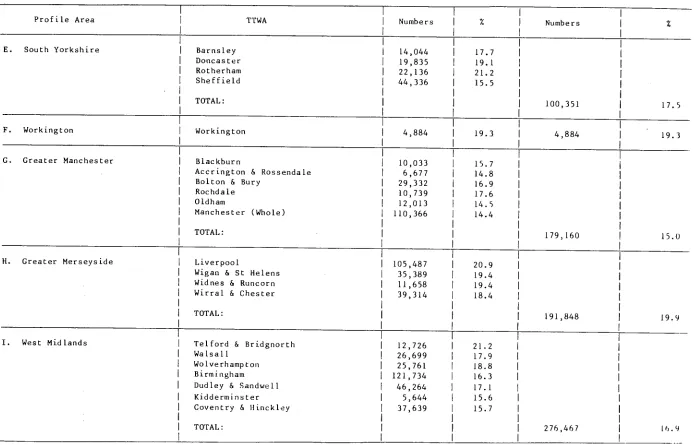
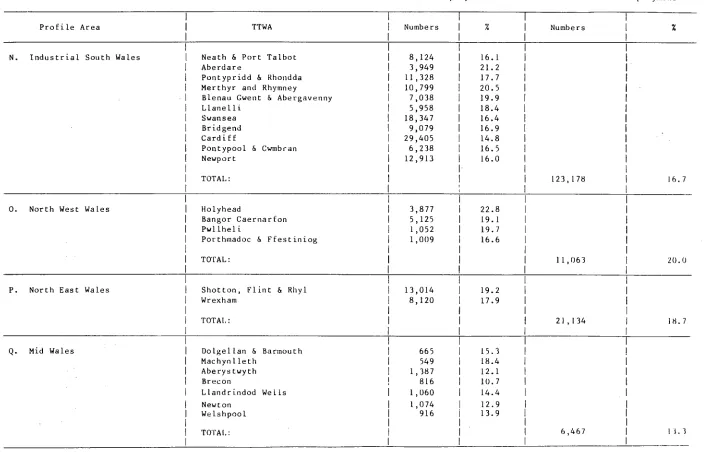
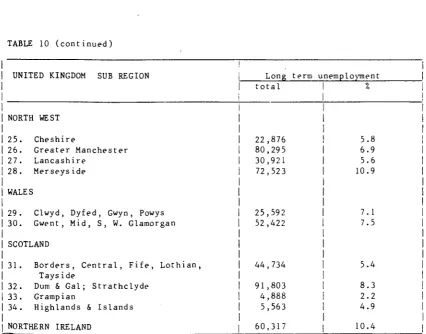
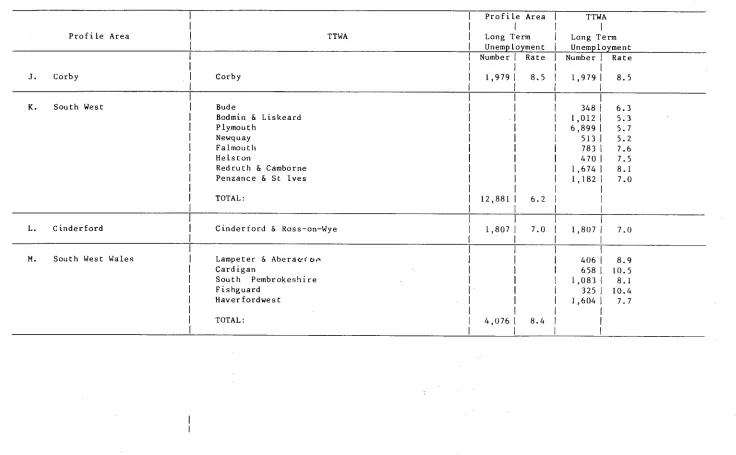
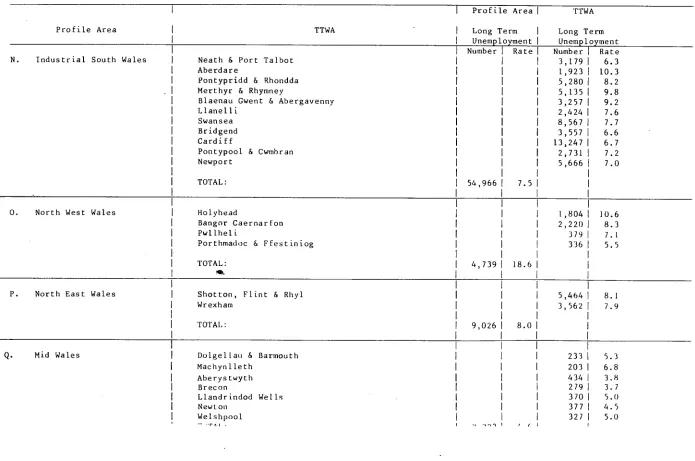
accompanied by an increase in national, regional and local long term unemployment. As tables 8 to 11 show, the
pattern of high rates of long term unemployment is closely related to that for all unemployment.
2.5 A similar picture is shown by the pattern of
regional employment change. Over the period 1965-85 the fall in employment was above the national average in Scotland, Wales, and the North, the North West, Yorkshire and Humberside and the West Midlands regions of England. Since 1979 employment declines in Northern Ireland have also been faster than for the UK as a whole. Of particular
This represents a change from the late 1960s and 1970s when trends in manufacturing employment in most of the
traditional Assisted Areas regions (Scotland, Wales,
Northern Ireland, the North, the North West and Yorkshire and Humberside) were closer to the national experience. (Table 12 refers.)
2.6 Accompanying the changes in regional employment trends that have been taking place in all regions, but most noticeably in the South and Midlands, there has been a
shift of manufacturing employment from the major
contributions and larger cities to the smaller towns and rural areas (Table 1 3 ) . The "urban/rural shift" of
manufacturing employment has been accompanied by a shift of population out of urban areas. This has been the most
significant change in the distribution of population over the last two decades far outweighing net inter-reg iona1 migration flows, though these continue to show net movement
to the outer parts of the South East, the South West and East Anglia (Tables 14 to 1 8 ) .
2.7 Overall since 1971, the female civilian labour force in Great Britain has increased while the male labour force has decreased. The North West, West Midlands, North,
Yorkshire and Humberside and Scotland have fared below the national average in the 1971-84 period. Over the seven years from 1984 to 1991, the national labour force is
projected to rise by around 3%, though below average rises are projected for the North, North West, West Midlands and Scotland. (Table 19.)
2.8 Historically, there have been large differences of activity rates between areas. During the 1971 to 1984 period, regional variations became less marked, although
local differences continue to persist. During this
interval male activity rates declined in each region, with sharpest reductions in the West M i d l a n d s , North and Wales. Female activity rates have grown, though increases have been lowest in the West Midlands and North West.
Differences in overall activity rates partly reflect variations in traditional patterns of economic activity, but are also partly a consequence of regional differences
in the age distribution of the population. No substantial further narrowing of the range of activity rates is
projected between 1984 and 1991. (Tables 2 0 - 2 6 ) .
2.9 Unlike some other Community countries, regional disparities in GDP per head have been relatively minor in the UK and, up to the mid 1970s, were tending to narrow. However, since the mid 1970s, the disparities have widened and in 1984 regional GDP per head ranged from 117% of the UK average in the South East to 78.3% in Northern Ireland.
2.10 H i s t o r i c a l l y , one of the m a j o r c a u s e s of r e g i o n a l d i s p a r i t i e s w i t h i n the U n i t e d K i n g d o m has been the
c o n c e n t r a t i o n in p a r t i c u l a r a r e a s and r e g i o n s of i n d u s t r i e s in secular d e c l i n e . T h u s coal m i n i n g , t e x t i l e s ,
s h i p b u i l d i n g and m a r i n e e n g i n e e r i n g and steel have b e e n c o n c e n t r a t e d in S c o t l a n d , W a l e s , N o r t h e r n Ireland and the N o r t h and West of E n g l a n d . ( T a b l e 2 9 ) H o w e v e r , w h i l s t c l o s u r e s a s s o c i a t e d w i t h the d e c l i n e of these i n d u s t r i e s are largely r e s p o n s i b l e for the high u n e m p l o y m e n t
p r e v a i l i n g in some p a r t i c u l a r a r e a s , the e v i d e n c e s u g g e s t s that the i m p o r t a n c e of i n d u s t r i a l s t r u c t u r e in e x p l a i n i n g v a r i a t i o n s in r e g i o n a l m a n u f a c t u r i n g e m p l o y m e n t p e r f o r m a n c e d e c l i n e d in the late 1 9 7 0 s , a l t h o u g h it has r e - e m e r g e d as a factor e x p l a i n i n g the higher rate of m a n u f a c t u r i n g
e m p l o y m e n t d e c l i n e in some of the t r a d i t i o n a l a s s i s t e d r e g i o n s in the m o s t recent p e r i o d .
2.11 Per i p h e r a 1 i t y - r e m o t e n e s s e i t h e r from u r b a n c e n t r e s or m o r e g e n e r a l l y from the b u l k of p o p u l a t i o n and e c o n o m i c a c t i v i t y - is a n o t h e r factor t r a d i t i o n a l l y seen as c o n t r i b u t i n g to regional e c o n o m i c d i s p a r i t i e s . R e s e a r c h s u g g e s t s that m a n y of the U K A s s i s t e d A r e a r e g i o n s are p e r i p h e r a l in E u r o p e a n terms and that the n a t u r e of the d i s a d v a n t a g e c o n f e r r e d by p e r i p h e r a l i t y is not only higher m o n e t a r y t r a n s p o r t c o s t s but a l s o the less t a n g i b l e c o s t s
a s s o c i a t e d , for e x a m p l e , w i t h o b t a i n i n g m a r k e t
i n t e l l i g e n c e ; g a i n i n g and m a i n t a i n i n g c o n t a c t s ; and l i a i s i n g w i t h s u p p l i e r s . (Map I.)
2.12 W h i l s t industrial s t r u c t u r e and p e r i p h e r a 1 i t y c o n t i n u e to c o n t r i b u t e to the e x p l a n a t i o n of r e g i o n a l e c o n o m i c d i s p a r i t i e s , r e s e a r c h over the last d e c a d e or so has i d e n t i f i e d other c h a r a c t e r i s t i c s a s s o c i a t e d w i t h some or all of the U K ' s a s s i s t e d r e g i o n s w h i c h may help to e x p l a i n c o n t i n u i n g r e g i o n a l e c o n o m i c d i s p a r i t i e s . I n n o v a t i o n p e r f o r m a n c e and the e x t e n t to w h i c h the
e n t r e p r e n e u r i a l c l i m a t e is c o n d u c i v e to n e w f i r m f o r m a t i o n are n o w r e c o g n i s e d to be i m p o r t a n t f a c t o r s in the e c o n o m i c d e v e l o p m e n t of r e g i o n s as well as c o u n t r i e s .
2.13 W i t h i n the U K , the a v a i l a b l e e v i d e n c e s u g g e s t s that r e s e a r c h and d e v e l o p m e n t a c t i v i t y is c o n c e n t r a t e d in the S o u t h East and that that r e g i o n is a l s o d i s p r o p o r t i o n a t e l y
likely to c o n t a i n the first c o m m e r c i a l location of s i g n i f i c a n t i n n o v a t i o n s . R e g i o n a l v a r i a t i o n s in the a d o p t i o n of p r o c e s s i n n o v a t i o n s appear to be s m a l l , but there is e v i d e n c e of g r e a t e r v a r i a t i o n in the a d o p t i o n of p r o d u c t i n n o v a t i o n s . O v e r a l l , the a v a i l a b l e e v i d e n c e
2.14 In a d d i t i o n to v a r i a t i o n s in i n n o v a t i o n
p e r f o r m a n c e , it a p p e a r s that the e c o n o m i e s of some of the a s s i s t e d r e g i o n s may be less c o n d u c i v e to the f o r m a t i o n and g r o w t h of new firms in a c t i v i t i e s which are likely to lead to a net i n c r e a s e in regional income and e m p l o y m e n t . The e v i d e n c e s u g g e s t s , for e x a m p l e , that the b u o y a n c y of the
local e c o n o m y , the a v a i l a b i l i t y of a h e a l t h y small firms sector in w h i c h p o t e n t i a l e n t r e p r e n e u r s can obtain
a p p r o p r i a t e e x p e r i e n c e and a w o r k f o r c e w i t h the n e c e s s a r y skills are important f a c t o r s in d e t e r m i n i n g the rate of new firm f o r m a t i o n . A n a l y s i s of regional v a r i a t i o n s in the f a c t o r s b e l i e v e d to i n f l u e n c e the rate of new firm
f o r m a t i o n s u g g e s t s that the e n v i r o n m e n t is most f a v o u r a b l e in the South East and South west and least f a v o u r a b l e in the N o r t h . T h e a v a i l a b l e s t a t i s t i c s c o n f i r m that there are indeed regional v a r i a t i o n s in the rate of new firm
f o r m a t i o n . (Table 3 6 . )
2.15 T w o well d o c u m e n t e d s t r u c t u r a l c h a r a c t e r i s t i c s of the e c o n o m i e s of the U K ' s a s s i s t e d r e g i o n s may c o n t r i b u t e to t h e s e w e a k n e s s e s . F i r s t , a high level of m a n u f a c t u r i n g e m p l o y m e n t is in p l a n t s w h i c h are owned and c o n t r o l l e d by national or i n t e r n a t i o n a l c o m p a n i e s w i t h h e a d q u a r t e r s o u t s i d e the a s s i s t e d r e g i o n s . W h i l s t it is a c k n o w l e d g e d that the e s t a b l i s h m e n t of b r a n c h p l a n t s and the a c q u i s i t i o n of local firms can bring a d v a n t a g e s , c o n c e r n has been
e x p r e s s e d that the a b s e n c e or removal of r e s e a r c h and d e v e l o p m e n t a c t i v i t i e s and h e a d q u a r t e r s ' f u n c t i o n s may w e a k e n local e c o n o m i e s in the longer r u n . S e c o n d , the low p r o p o r t i o n of m a n a g e r i a l and p r o f e s s i o n a l o c c u p a t i o n s in the M i d l a n d and N o r t h e r n r e g i o n s and in W a l e s and N o r t h e r n Ireland may weaken, these r e g i o n s ' e n t r e p r e n e u r i a l c a p a c i t y . (These low p r o p o r t i o n s are m i r r o r e d by c o m m e n surat e 1 y
higher p r o p o r t i o n s in low skilled o c c u p a t i o n s , T a b l e s 3 7 - 4 0 . )
D e v e l o p m e n t N e e d s and P r o s p e c t s
2.16 Any s u s t a i n e d i m p r o v e m e n t in the p e r f o r m a n c e of the e c o n o m i e s of the U K A s s i s t e d A r e a s over the next few years will be a s s o c i a t e d with i n c r e a s e d c a p a c i t y in e x i s t i n g firms to i n n o v a t e and adapt to c h a n g i n g e c o n o m i c
c i r c u m s t a n c e s , and w i t h an i n c r e a s e in the rate of new firm f o r m a t i o n . E f f o r t s to secure these o b j e c t i v e s are a
n e c e s s a r y c o m p l e m e n t to m o r e t r a d i t i o n a l p o l i c i e s intended to e n c o u r a g e the location and e x p a n s i o n of plants and firms in the A s s i s t e d A r e a s t h r o u g h the p r o v i s i o n of i n c e n t i v e s to i n ve s tmen t.
2.17 The need to i n n o v a t e and adapt to c h a n g i n g e c o n o m i c c i r c u m s t a n c e s a p p l i e s not only in the long d e c l i n i n g
t r a d i t i o n a l i n d u s t r i e s but t h r o u g h o u t the range of
t r a d e a b l e m a n u f a c t u r e r s and in other p r o d u c t s w h i c h enter d i r e c t l y or i n d i r e c t l y into t r a d e . P a r t i c u l a r a t t e n t i o n
processes and products are introduced and old ones are
adapted is at least as great in the areas of need as in the more prosperous areas of the UK. In parallel, attention
needs to be given to ensuring that the labour force in the areas of need is appropriately trained and sufficiently adaptable to allow full benefit to be derived from technological change. The European Social Fund has an
important part to play in providing funds for the various training scheme s.
2.18 To the extent that new and small firms are important sources of new jobs and of innovation,
encouragement of new firm formation and of small firms generally is an important element in assisting the less prosperous regions. Devising means by which new and small
firms can be encouraged in the Assisted Areas is one of the major challenges for regional policies, but some important
initiatives have been undertaken already. The measures introduced under the ERDF regulation in steel, shipbuilding and textile areas and the measures introduced in fishing areas address significant weaknesses in the small firms sector. The new Regional Development Grant Scheme contains special provisions for small firms, and the English
Industrial Estates Corporation, the Scottish and Welsh
Development Agencies and local authorities have been active in providing small factory units.
2.19 The United Kingdom, Italian and Eire Governments have jointly put forward an agreed labour market initiative (Employment Growth into the 1990s) as a means of combating the European Community's major social problem of
unemployment. The initiative concentrates on four main areas where action might be taken to stimulate economic growth and proposes a number of specific measures in the
areas, which are promoting enterprise and se I f -emp1oyment ;
flexible employment patterns and conditions; training; and long-term unemployment.
Sect i on Three
DEVELOPMENT OBJECTIVES
Employment and Industry
3.1 The overall objective of United Kingdom regional policy is to reduce unemployment in the less favoured regions by encouraging in these areas manufacturing
investment and the development of service industries , including the hotel and other tourism - related sectors which create new jobs and safeguard existing employment.
In order to achieve this, it is important not only to
attract industries but also to strengthen the regional and national economy by broadening the industrial base,
improving efficiency and providing more productive and secure jobs. An important contribution to this latter objective is raising of the standard of infrastructure to help make the Assisted Areas more attractive to
industrialists by removing constraints to development. Better infrastructure is also needed to allow existing
industry to prosper and compete on equal terms with firms in other areas. Detailed descriptions of the particular
problems of specific areas of the United Kingdom and the
measures designed to solve them are given in the regional profiles in Sections 7-10 of the Programme.
3.2 All commercially viable projects which create new job opportunities and/or protect· exist ing employment in the manufacturing or service industries are welcome in the
Assisted Areas. Recent experience has shown that changes in the fortunes of the national economy have a more
profound effect on the regions than can be achieved by
regional policy, even with the assistance of the Fund. The UK government does not believe that it is either sensible
or practicable to make forecasts of unemployment for
several years ahead as the many uncertainties surrounding both the national and international economies rule this out. The UK does, however, make some assumptions about future levels of national unemployment for public
expenditure purposes and these are detailed at Annex 8.
3.3 While the aim of regional policy is to reduce regional disparities in employment opportunities on a
stable long-term basis, the UK Government does not attempt to identify particular industries as suitable for
particular areas or seek actively to attract them there. The choice of location for a firm's investment within the Assisted Areas is influenced by the availability of grants under the Regional Selective Assistance and Regional
Development Grants Schemes although ultimately it is a matter for a firm's own commercial judgement, taking
supplies, transport, communications and proximity to the firm's mar ket s.
3.4 More general considerations such as the current and prospective level of demand in the economy, the state of world trade, present and prospective levels of inflation and taxation also affect decisions on investment. In the case of Northern Ireland its peripheral location has been an inhibiting factor in the development of the local
economy and has distorted both the distribution of population and economic activity within the Province.
Moreover, Northern Ireland's economic position is affected by the fact that it shares a common land frontier with the Republic of Ireland, which while it shares many of Northern
Ireland's economic drawbacks, provides an extemely competitive range of tax and other incentives.
Agr i cu 1 tu re
3.5 Agriculture plays an important part in the economic welfare of the Assisted Areas. The industry needs a high standard of infrastructure, particularly good
communications, water and electricity supplies, to promote efficient production and marketing. The great majority of the United Kingdom's "Less Favoured Areas" (LFAs) lie within the Assisted Areas (map 5 at Annex 4 ) . These areas
therefore also benefit from the special help provided to farmers under the Community's LFA Directive and recently agreed structures regulation. These provide direct
assistance through grants to enable farmers in the LFA's, inter alia, to diversify their business into on-farm
tourism and craft industry (See Annex 7 ) .
Fishing
3.6 Fishing is a basic industry in numerous communities of widely varying size. Many of these communities are dependent for their economic survival on fishing and its ancillary occupations, and on fish processing. In addition to the investment required for the necessary restructuring of the industry, a high standard of infrastructure,
particularly communications, is essential for the effective operation of the industry.
Tou r i sm
3.7 It is the Government's policy to promote the development of tourism wherever good prospects for it exist. Its main objectives are to secure the maximum number of job opportunities in the industry and to encourage a wider dispersal of tourists throughout the country, particularly to those areas capable of attracting more visitors and with levels of high unemployment. Its
to improve and e x t e n d the level of t r a i n i n g in the i ndu s t r y.
3.8 T h e r e is a g r o w i n g trend t o w a r d s s h o r t - s t a y and w e e k e n d h o l i d a y s w i t h i n the U K . T h e greater a c c e s s i b i l i t y of tourist a t t r a c t i o n s by p r i v a t e and p u b l i c t r a n s p o r t has a l s o led to an i n c r e a s e in d a y - t r i p v i s i t o r s from both w i t h i n and o u t s i d e the r e g i o n s . R o u n d trips of 2 0 0 - 3 0 0 k i l o m e t r e s in a day can n o w be r e g a r d e d as q u i t e f e a s i b l e since road i m p r o v e m e n t s have reduced t r a v e l l i n g t i m e s .
3.9 T h e r e is a demand for act i v i t y - based f a c i l i t i e s : sports and r e c r e a t i o n , and c u l t u r a l a t t r a c t i o n s such as m u s e u m s , art g a l l e r i e s , t h e a t r e s and c o n c e r t h a l l s . Such
f a c i l i t i e s are o f t e n e s s e n t i a l to d e v e l o p i n g and
e n c o u r a g i n g t o u r i s m , p a r t i c u l a r l y in 'non - trad i t iona1 '
tourist a r e a s . P r o j e c t s w h i c h p r o m o t e industrial h e r i t a g e , t o o , are h a v i n g an i n c r e a s i n g impact on t o u r i s m and a l s o help to e x p a n d the e m p l o y m e n t b a s e of industrial a r e a s . T h e U K ' s w e a t h e r is not as r e l i a b l e as that of some other
parts of the C o m m u n i t y , so a t t r a c t i o n s w h i c h may be e n j o y e d r e g a r d l e s s of the w e a t h e r m u s t be d e v e l o p e d . I n v e s t m e n t in leisure and r e c r e a t i o n p r o j e c t s has a direct b e n e f i t to t o u r i s m , w h i l e also p r o v i d i n g f a c i l i t i e s for local p e o p l e and a t t r a c t i n g inward i n v e s t m e n t by i m p r o v i n g the living and w o r k i n g c o n d i t i o n s of the a r e a .
3.10 In N o r t h e r n I r e l a n d , t o u r i s m has a c o r r e s p o n d i n g role in the s t i m u l a t i o n of e c o n o m i c a c t i v i t y and the p r o v i s i o n of e m p l o y m e n t , e s p e c i a l l y in a r e a s w h e r e the scope for industrial d e v e l o p m e n t is l i m i t e d .
T h e C o n t r i b u t i o n of I n f r a s t r u c t u r e
3.11 T o m a i n t a i n the e f f i c i e n c y of e x i s t i n g i n d u s t r y , p r o v i d e o p p o r t u n i t i e s for g r o w t h , and a t t r a c t n e w
m a n u f a c t u r i n g and s e r v i c e i n d u s t r i e s to an a r e a , there m u s t be an a d e q u a t e supply of sites s u i t a b l e for d e v e l o p m e n t w i t h b a s i c s e r v i c e s such as w a t e r , s e w e r a g e , g a s ,
e l e c t r i c i t y and rail or road a c c e s s e i t h e r a v a i l a b l e or p r o v i d e d soon . Longer d i s t a n c e c o m m u n i c a t i o n s by r o a d , r a i l , a i r , ports and t e l e c o m m u n i c a t i o n s as well as local links to the m a i n s y s t e m s are a l s o i m p o r t a n t . In m a n y
u r b a n a r e a s e s p e c i a l l y , e x i s t i n g i n f r a s t r u c t u r e is not only old and o u t w o r n but i n a d e q u a t e for p r e s e n t needs let alone e x p a n s i o n . In a d d i t i o n to these b a s i c s e r v i c e s the tourist
industry r e q u i r e s a d d i t i o n a l i n f r a s t r u c t u r e s e s s e n t i a l to its d e v e l o p m e n t , namely for c o n f e r e n c e f a c i l i t i e s ,
r e c r e a t i o n a l , cultural and other e n t e r t a i n m e n t a c t i v i t i e s . The p r o v i s i o n of i n f r a s t r u c t u r e by a w i d e range of b o d i e s t h e r e f o r e r e m a i n s of vital i m p o r t a n c e and a high level of
investment in m o d e r n s e r v i c e s and i n f r a s t r u c t u r e is
in Section 5.7 - 5.9 and in the Regional Profiles of Sect i ons 7- 10 . )
Training
3.12 Government policies towards training play a significant role in regional policy through activities
aimed at ensuring that development in the Assisted Areas is not impeded by a lack of manpower with the relevant ski lis. The assistance provided by the Government and its agencies
is described in Section 4.
Changes in Regional Policy
3.13 Since first taking office in May 1979 the
Government has kept its regional policies under constant review in the light of experience gained during the
previous years, and their overall economic policy
objectives. Some interim changes were introduced in 1980 and 1982, and in December 198 3 the Government issued a White Paper on "Regional Industrial Development"
(Cmnd 9111) which proposed more radical changes in the system of regional assistance. As a result of these reviews and wide ranging consultation with industry and
local authorities, the Government concluded that a strong regional policy, based on providing special assistance to
industries in the depressed areas designated by the
Secretary of State for Trade and Industry (assisted a r e a s ) , was still very much needed. However, in order to improve cos t - e f fect i vene s s the policy should concentrate more heavily on assisting industrial investment that directly helped to create and retain employment in the assisted
areas. The new policy and assisted areas designated by the Secretary of State were announced in November 1984.
3.14 The major changes in the revised structure of regional industrial incentives affect the Assisted Areas map and the Regional Development Grant system. The
structure of the assisted areas was reduced from 3 to 2 tiers and they now consist of:
a. Development Areas, eligible for regional development grants at 15% and for selective assistance;
b. Intermediate Areas, eligible for selective assistance only.
The new map covers some 3 5% of Great Britain's 1983 working population - Development Areas 15.5% - with parts of the West Midlands being included for the first time. The
Development Areas are now those areas of highest persistent unemployment. This Regional Development Programme relates
Wales, which although not Assisted Areas for UK Regional Aid purposes do fall within the framework described in
Section 1 of this programme.
3.15 The UK Government revised its regional industrial policy in November 1984. One of the main intentions was to make the policy more cost-effective in meeting the
objectives of reducing regional disparities on a stable long term basis. Although expenditure on regional aid has been reduced in line with the Government's aim of reducing public expenditure, it is still a significant amount
estimated at some L550m in the current UK financial year 1 April 1986 - 31 March 1987. This emphasis on
cos t-ef f eet i veness has been directed at the following savings: a) limiting the amount of grant paid for capital
intensive projects which do not create any additional employment or which may even reduce existing employment
(Regional Development G r a n t s ) ; b) excluding projects which merely result in the transfer of existing jobs from one
part of the country to another (Regional Selective
Assistance) ; c) seeking to exclude projects which would risk the displacement of local competitors (Regional
Development Grants) and d) reducing the Assisted Areas map to two tiers by abolishing Special Development Areas
enabling a simpler, less costly policy (Regional
Development G r a n t s ) . All these factors were taken into account when the UK Regional Aid schemes were revised in November 1984.
Whilst economic analysis suggests that some 3 0,00 0 net
additional jobs were created in the Assisted Areas in the 1960s as a result of the application of regional industrial policies it is unlikely in the 1970s and 1980s that new jobs have been created at much more than half this rate. These estimates are of net additional jobs attributable to
regional industrial policy and as such are quite distinct from estimates of the gross jobs directly associated with projects in receipts of support. Measures of gross jobs need to be adjusted to take account of those jobs which would have been created without support and of jobs
3 7GAAF
4 - MEASURES FOR DEVELOPMENT
4.1 United Kingdom regional policy measures apply to all the Assisted Areas of Great Britain (England, Scotland and Wales) and the whole of Northern Ireland. Northern Ireland,
because of its special problems, has the highest priority for ERDF support in respect of eligible industrial and service projects. Great Britain has two categories of Assisted Areas; Development Areas and Intermediate Areas. Eligible industrial and service projects in Development Areas, where both Regional Development Grants and Regional
Selective Assistance are available, have a higher priority for ERDF support than similar projects in Intermediate Areas where only Regional Selective Assistance is available. In
the case of infrastructure projects in the United Kingdom, all areas eligible for ERDF aid (including areas
administered by the Highland and Islands Development Board in Scotland and the Development Board for Rural Wales) have equal priority for ERDF support.
4.2 There are five broad groups of measures in the United Kingdom designed to help provide new jobs in the regionally a i ded areas:
(a) measures which encourage the re-location and growth of manufacturing and service industries;
(b) measures to encourage the growth of the tourist industry and the development of tourism through both commercial and public sector investments;
(c) provision of infrastructure to support industrial investments including those essential to the growth of tour i sm;
(d) schemes and policies with a specific local impact on both industry and infrastructure provision;
(e) other related sectoral policies and programmes which assist the development of regionally aided areas.
(a) INDUSTRIAL POLICY
4.3 The Government's policy is to create the conditions in which business can prosper. The policy has two main
strands. One is the maintenance of a firm financial
framework, primarily directed at the control of inflation (down sharply from its 1980 peak) to lower costs and improve competitiveness, and the second, is a range of policies to achieve a more flexible and competitive market economy. Examples of the latter policies
b) improvement of competition through removing obstacles to free functioning of markets and reducing the role of the state through privatisation etc;
c) the removal of unnecessary controls and administrative burdens on business.
4.4 In addition the Government gives limited direct
financial assistance to help industry to adapt and compete. Selective support is available to encourage high risk
innovatory projects in companies and collaborative research particularly into new technologies. The Government also supports schemes to encourage awareness and application of new technologies and key skills, the encouragement of best practice and the exploitation of UK technology. Support of this kind is available to companies throughout the United Kingdom and across different industrial sectors.
4.5 A direct stimulus to industry can also be given by the Scottish and Welsh Development Agencies, the Development Board for Rural Wales and the Highlands and Islands Development Board, whose functions include furthering economic development, the provision, maintenance or
safeguarding of employment and the promotion of industrial efficiency and international competitiveness. Since
September 1982 the stimulus for industrial development in Northern Ireland has been provided by the Industrial
Development Board - which operates under the aegis of the Department of Economic Development. The small firms sector remains the responsibility of the Northern Ireland Local Enterprise Development Unit.
Measures for Manufacturing Industry
4.6 The United Kingdom Government offers incentives, some automatic and others discretionary, to encourage industry either to establish new projects or to expand existing operations in the Assisted Areas and Northern Ireland; but there is no machinery to direct industry or commerce to the Assisted Areas or to Northern Ireland.
4.7 The main industrial measures available in the Assisted Areas of Great Britain and Northern Ireland comprise :
Regional Development Grants (Northern Ireland equivalent : Standard Capital Grants and Regional Selective Assistance
(Northern Ireland equivalent : Selective Financial Ass i stance).
a) Regional Development Grants and Standard Capital Grants (NI ) .
higher of either : 15% of eligible capital expenditure towards new assets (subject to a limit of 110,000 for each job created for projects carried out by undertakings
employing over 200 people) or 13000 for each net new job created (subject to a limit of 4 0 % of initial investment for manufcturing projects and certain service projects
undertaken by m a n u f a c t u r e r s ) .
In Northern Ireland, the Standard Capital Grants Scheme, which is a counterpart of the previous Regional Development Grant Scheme in Great Britain, was reviewed in 1984. In
view of the different economic circumstances prevailing in this area, the Scheme's conditions were largely retained, but in March 1985 the rate of grant was reduced in a bid to make it more cost-effective.
b) Regional Selective Assistance and Selective Financial Assis tance ( N I ) .
Regional Selective Assistance is available throughout the Assisted Areas (and equivalent Selective
Financial Assistance in Northern Ireland) for projects by manufacturing and service industries. This normally takes the form of a grant based on the capital expenditure costs of the project, and on the numbers of jobs to be created or maintained, although other form of assistance are also available,
including loans in very exceptional cases. Grant will not normally be available for simple relocation projects except in Northern Ireland. Assistance is also available towards training costs where the training is an essential part of a project which qualifies for selective assistance and which has a new technology element. The amount of assistance is negotiable and represents the minimum necessary for a project to proceed. Regional Selective Assistance can also take the form of a guarantee against
exchange losses for loans from the ECSC, up to a maximum of L500,000 for each supported project.
c) the provision of factories in advance of specific orders from tenants or purchasers, at full market rents;
d) assistance with the transfer of employees and training in general skills.
The measures applicable in Great Britain are described in greater detail in Annex 5 and in Section 10 for Northern
Ireland. Because of its special problems a greater range of assistance is available in Northern Ireland than that
The United K i n g d o m G o v e r n m e n t proposes to submit a National Programme of C o m m u n i t y I n t e r e s t , under A r t i c l e s 10-12 of Council R e g u l a t i o n (EEC) 1 7 8 7 / 8 4 , for c o - f i n a n c i n g of the Regional Aid Schemes (RDG and R S A ) in Great B r i t a i n .
Dispersal and location of G o v e r n m e n t work
4.8 In May 1979 the newly elected G o v e r n m e n t stated its intention of reviewing the programme of d i s p e r s i n g Civil Service posts announced by the previous G o v e r n m e n t in July
1974 from which 25,000 posts remained to be d i s p e r s e d . A modified programme for the dispersal of nearly 6,000 posts from London was announced in 1979. The revised programme involves the dispersal of over 2,000 posts from the M i n i s t r y of D e f e n c e and the O v e r s e a s Development A d m i n i s t r a t i o n to the G l a s g o w area; 1,250 posts (mainly from the Health and Safety E x e c u t i v e ) to Mersey s i d e ; and 1,8 50 Manpower Services C o m m i s s i o n posts to S h e f f i e l d . The balance was m a d e up of ongoing d i s p e r s a l s from the previous p r o g r a m m e . The revised programme is in the G o v e r n m e n t ' s view the most the country can a f f o r d . It recognises the needs of the Development Areas of G l a s g o w and M e r s e y s i d e , and has regard to Civil Service efficiency as a w h o l e . By November 1985, nearly 7 5 % of the posts in the revised programme had been d i s p e r s e d , and it is estimated that the programme should be completed within the following 2/3 y e a r s .
4.9 T h e r e is unlikely to be any major dispersal initiative in the foreseeable f u t u r e , although there may be some
instances where some relocation is d e s i r a b l e . T h e s e will be considered on their m e r i t s in the light of the need to
contain public e x p e n d i t u r e , the needs of the regions and the relevant o p e r a t i o n . The same criteria will apply to the location of any new G o v e r n m e n t w o r k .
P r o v i s i o n of Industrial P r e m i s e s ('Advance F a c t o r i e s ' )
4.10 The G o v e r n m e n t is continuing its long-standing policy of providing industrial and commercial premises in advance of specific orders from potential occupiers in the A s s i s t e d A r e a s . The P r o g r a m m e ' s main purpose remains that of
providing a c c o m m o d a t i o n for industry and commerce of a type and in those localities where the private sector is not prepared to invest in this a c t i v i t y . The A g e n c i e s
u n d e r t a k i n g this development programme on behalf of central government are in England the English Industrial E s t a t e s C o r p o r a t i o n , in Scotland the Scottish Development Agency and
and specialised units for industries engaged in new techno I og i es.
4.11 The UK government sees a need for this programme to continue for the foreseeable future, because of the
continuing reluctance of the private sector to invest in this kind of activity. Without the programme other schemes of assistance aimed at encouraging employers to set-up, re-locate or expand in depressed areas would be less successful because there would be a shortage of modern industrial accommodation for these firms. The level of support for investment, provided by such general schemes of regional assistance as Regional Development Grant and
Regional Selective Assistance, is not in itself high enough to encourage the necessary level of investment in modern industrial and commercial buildings.
4.12 After some initial success when the Agencies
attracted substantial investment from the private sector in joint venture activities, there has been virtually no
further private sector investment in these joint ventures for the past 2 or 3 years. It appears that private sector institutions are no longer prepared to make this sort of investment, even in the least depressed parts of the assisted areas, unless they are heavily subsidised or the Government guarantees that they will earn a commercial rate
of return on their investment.
4.13 Factory provision also forms part of the industrial assistance measures of the New Towns and of the Local
Authorities, and, in rural areas of England, of the
Development Commission (acting through English Estates). Local authorities mainly provide small trading units, often by converting unused existing large factories and
warehouses. These cheaper premises are let at lower rental levels than new units and thereby provide opportunities for small and new enterprises with limited financial resources. The local authority involvement has been usually in very
small units (50-200 m^) to meet local demand.
4.14 In Northern Ireland, factory provision is regarded as an integral part of the industrial development drive.
Advance industrial premises are constructed to varying sizes. The smaller units largely provide premises for clients of the Local Enterprise Development Unit.
Other Factory Building
4.15 During the period 1986-90, the Government will continue to sell existing holdings of land so that
businesses can build their own factories and continue to respond to demand for factory extensions by existing
to build p r e m i s e s to the specific order of p r o s p e c t i v e
o c c u p a n t s , they will also c o n t i n u e to give high priority to b u i l d i n g in a d v a n c e of specific demand in order to p r o v i d e p r e m i s e s that will attract n e w industries to certain
d e p r e s s e d l o c a t i o n s . T h e G o v e r n m e n t foresees a steady
c o m m i t m e n t of public funds to p r o v i d i n g industrial p r e m i s e s over the next 3 or 4 y e a r s , but it is c o n t i n u i n g to e x a m i n e ways of i n t e r e s t i n g the p r i v a t e sector in investing directly
in industrial and commercial d e v e l o p m e n t in the d e p r e s s e d areas or joining with the D e v e l o p m e n t A g e n c i e s in joint v e n t u r e s for this p u r p o s e . T h e U K G o v e r n m e n t is also
e x a m i n i n g w a y s of m a k i n g the p r o g r a m m e s m o r e self financing by increasing income from rents and factory s a l e s .
(b) TOURISM POLICY
4.16 T h e m a i n r e s p o n s i b i l i t y for p r o m o t i n g the d e v e l o p m e n t of t o u r i s m in E n g l a n d , Scotland and W a l e s lies with the three statutory national tourist b o a r d s set up under the D e v e l o p m e n t of T o u r i s m A c t , 1 9 6 9 . Each is required to
e n c o u r a g e the p r o v i s i o n and improvement of t o u r i s m a m e n i t i e s and f a c i l i t i e s w i t h i n its own country in a c c o r d a n c e with the a r r a n g e m e n t s and policy o b j e c t i v e s set by D e p a r t m e n t of E m p l o y m e n t . F i n a n c i a l a s s i s t a n c e is a v a i l a b l e , under
Section 4 of the A c t , in the form of g r a n t s or l o a n s , to e n c o u r a g e capital t o u r i s m p r o j e c t s which meet the B o a r d s ' s e l e c t i v e c r i t e r i a . Since July 1982 this a s s i s t a n c e has been a v a i l a b l e in all parts of Great B r i t a i n and is
a v a i l a b l e to both public and p r i v a t e sector p r o j e c t s . Similar schemes of a s s i s t a n c e are a d m i n i s t e r e d by the
D e p a r t m e n t of E c o n o m i c D e v e l o p m e n t in N o r t h e r n I r e l a n d , by the H i g h l a n d s and Islands D e v e l o p m e n t Board in Scotland and the C o u n c i l for Small Industries in Rural Areas ( C O S I R A ) in E n g l a n d . Further d e t a i l s of these schemes are given in
Annex 5. T o u r i s m and leisure p r o j e c t s in the A s s i s t e d Areas may also qualify for a s s i s t a n c e under S e c t i o n 7 of the
Industrial D e v e l o p m e n t Act 1 9 8 2 .
(c) THE PROVISION OF INFRASTRUCTURE
4.17 T h e r e s p o n s i b i l i t y for p r o v i d i n g i n f r a s t r u c t u r e w i t h i n the U K and its A s s i s t e d A r e a s h a s , in g e n e r a l , been placed upon a series of single purpose sectoral a g e n c i e s , though t e l e c o m m u n i c a t i o n s is of an e x c e p t i o n . Indeed, the 1974 r e f o r m of local g o v e r n m e n t in England and W a l e s
increased this sectoral s p e c i a l i s a t i o n by c r e a t i n g separate regional water and regional health a u t h o r i t i e s . This change also kept the local a u t h o r i t i e s with r e s p o n s i b i l i t i e s
divided b e t w e e n d i s t r i c t s and c o u n t i e s . C o n s e q u e n t l y there are no powerful a l l - p u r p o s e regional or local a u t h o r i t i e s in England and W a l e s . (The d i f f e r e n c e s in Scotland and
N o r t h e r n Ireland are noted in S e c t i o n s 9 and 10.)
m a n a g e m e n t r e s p o n s i b i l i t i e s to their r e s p e c t i v e regional b o a r d s and a u t h o r i t i e s . H o w e v e r , these operational regions vary widely in number and c o n f i g u r a t i o n , as illustrated by the appended m a p s . R é g i o n a l i s a t i o n of these services has also been a c c o m p a n i e d by sectoral r e q u i r e m e n t s to p r o d u c e
fully justified capital investment p r o g r a m m e s , usually c o m p r i s i n g a one year capital plan and a five year m e d i u m term p r o g r a m m e . The central approval of capital p r o g r a m m e s , combined with overall a u t h o r i t y for annual capital
a l l o c a t i o n s , e n s u r e s that individual development schemes are c a r e f u l l y vetted against specific sectoral c r i t e r i a . W i t h i n these sectoral a s s e s s m e n t s regional p r i o r i t i e s are e f f e c t e d through d i f f e r e n t i a l capital a l l o c a t i o n s to the regional a u t h o r i t i e s . T h e r e is also m u c h contact between the various a g e n c i e s at o p e r a t i o n a l level over the p r e p a r a t i o n of
detailed investment p r o g r a m m e s .
4.19 The m a i n general i n f r a s t r u c t u r e services fall into three groups (other types of i n f r a s t r u c t u r e are of course important in specific l o c a t i o n s ) :
(i) C o m m u n i c a t i o n s ( t e l e c o m m u n i c a t i o n s , r o a d s , r a i l w a y s , p o r t s , a i r p o r t s , w a t e r w a y s and f e r r i e s ) ;
(ii) E n e r g y and Water S e r v i c e s ( e l e c t r i c i t y , g a s , water and s e w a g e ) ;
(iii) Local land and b u i l d i n g supplies (industrial s i t e s , a d v a n c e f a c t o r i e s , land c l e a r a n c e ) .
4.20 The a g e n c i e s p r o v i d i n g these s e r v i c e s , their powers and their role in regional d e v e l o p m e n t are d e s c r i b e d in m o r e detail in A n n e x 6. The d e s c r i p t i o n which follows serves to highlight their i m p o r t a n c e in regional d e v e l o p m e n t .
Individual d e v e l o p m e n t m e a s u r e s and sub-regional p r o g r a m m e s and b u d g e t s , w h e r e a v a i l a b l e , are p r e s e n t e d in
S e c t i o n s 7-10.
4.21 Te I e c o m m u n i ca t ions : B r i t i s h T e l e c o m Plc's e x c l u s i v e p r i v i l e g e of running public t e l e c o m m u n i c a t i o n systems has been removed and new a r r a n g e m e n t s for licensing
t e l e c o m m u n i c a t i o n s o p e r a t o r s w e r e introduced as a result of the T e l e c o m m u n i c a t i o n s Act 1984. In its capacity as a
public t e l e c o m m u n i c a t i o n s o p e r a t o r , B r i t i s h T e l e c o m Pic now faces c o m p e t i t i o n from M e r c u r y C o m m u n i c a t i o n s , which has been licensed to p r o v i d e services (as it e x p a n d s ) throughout the c o u n t r y , and from local b r o a d b a n d cable systems as they are e s t a b l i s h e d and from the e s t a b l i s h m e n t of two national cellular radio s y s t e m s . All these systems are d e s i g n a t e d as public t e l e c o m m u n i c a t i o n s y s t e m s . A l s o licensed as a public t e l e c o m m u n i c a t i o n s operator is the K i n g s t o n - u p o n - H u l l City C o u n c i l , which p r o v i d e s t e l e c o m m u n i c a t i o n services w i t h i n
4.22 B r i t i s h T e l e c o m Pic still retains a d o m i n a n t p o s i t i o n in the m a r k e t and is obliged by its licence to p r o v i d e a universal service t h r o u g h o u t the c o u n t r y . In f u l f i l l i n g its
licence o b l i g a t i o n s it is taking major steps to u p g r a d e its n e t w o r k . E x i s t i n g trunk and local e x c h a n g e s and their
t r a n s m i s s i o n links ( j u n c t i o n c a b l e s , coaxial trunk c a b l e s , m i c r o w a v e radio r o u t e s ) will be p r o g r e s s i v e l y c o n v e r t e d to digital w o r k i n g as rapidly as p o s s i b l e . T h i s integrated digital n e t w o r k will be c a p a b l e of p r o v i d i n g public switched t e l e p h o n e s e r v i c e , p a c k e t , m e s s a g e and circuit s e r v i c e s . W i t h i n these overall p r i o r i t i e s of p r o v i d i n g an e f f i c i e n t
national service linking all parts of the country e q u a l l y e f f e c t i v e l y to the t e l e p h o n e s y s t e m , E R D F grants have
enabled locally important schemes in the A s s i s t e d A r e a s to go ahead earlier than internally g e n e r a t e d r e s o u r c e s would n o r m a l l y have a l l o w e d .
4.23 In the early stages of its d e v e l o p m e n t , M e r c u r y has aimed d i r e c t l y at b u s i n e s s users and has e s t a b l i s h e d a trunk n e t w o r k of optical fibre cable loops s e r v i n g L o n d o n and
major c i t i e s , o f f e r i n g high speed c o m m u n i c a t i o n s , both d o m e s t i c a l l y and i n t e r n a t i o n a l l y . S w i t c h e d t e l e p h o n e
s e r v i c e s for large c u s t o m e r s began in M a y 1986. T h e p r o v i s i o n of services to smaller b u s i n e s s u s e r s and
r e s i d e n t i a l s u b s c r i b e r s later in 1986 and e x p a n s i o n of the network are p l a n n e d . The new g e n e r a t i o n of local b r o a d b a n d c a b l e systems will c o n c e n t r a t e initially on t e l e v i s i o n
s e r v i c e s but will have the c a p a b i l i t y of d i v e r s i f i c a t i o n into the p r o v i s i o n of a wider range of t e l e c o m m u n i c a t i o n s e r v i c e s .
4.2 4 Road s : As w i t h t e l e c o m m u n i c a t i o n s , the p r i m a r y o b j e c t i v e of the trunk road p r o g r a m m e (run in E n g l a n d and W a l e s by the D e p a r t m e n t of T r a n s p o r t , in Scotland by the S c o t t i s h D e v e l o p m e n t D e p a r t m e n t , and in N o r t h e r n Ireland by
the D e p a r t m e n t of the E n v i r o n m e n t ) is the e f f e c t i v e linking of all regions to the national trunk road and m o t o r w a y
n e t w o r k . P r i o r i t y is given to roads w h i c h assist e c o n o m i c r e c o v e r y , improve the e n v i r o n m e n t or e n h a n c e road safety. Allied to the trunk roads is the local road network w h i c h is
the r e s p o n s i b i l i t y of local highway a u t h o r i t i e s , with some financial support from C e n t r a l G o v e r n m e n t . In N o r t h e r n
Ireland the D e p a r t m e n t of the E n v i r o n m e n t is r e s p o n s i b l e for local r o a d s . E R D F grant aid has been very important in improving a c c e s s to and w i t h i n industrial e s t a t e s and
industrial areas and in p r o v i d i n g a c c e s s to isolated parts of the A s s i s t e d A r e a s .
4.25 Ra i 1 way s : The B r i t i s h R a i l w a y s Board has d i r e c t e d the m a j o r i t y of its i n f r a s t r u c t u r e investment towards
investment w h i c h b e n e f i t s A s s i s t e d A r e a s takes place beyond those a r e a s . T h e r e w i l l , h o w e v e r , a l s o be a c o n t i n u i n g need for E R D F a s s i s t a n c e for schemes p r o d u c i n g a purely local or reg i ona1 bene fit.
T r a c k r a t i o n a l i z a t i o n and r e s i g n a l l i n g will be important to e n s u r i n g that there c o n t i n u e s to be an e f f i c i e n t rail
s y s t e m . S t a t i o n i m p r o v e m e n t s are important to i m p r o v i n g rail's image for both investment and tourist p u r p o s e s . The N o r t h e r n Ireland R a i l w a y s C o L t d , w h i c h is r e s p o n s i b l e for railway s e r v i c e s in N o r t h e r n I r e l a n d , will c o n t i n u e its p r o g r a m m e to improve t r a c k , s i g n a l l i n g and rolling s t o c k .
4.26 P o r t s : N e a r l y two fifths of the v o l u m e of B r i t a i n ' s s e a b o r n e f o r e i g n trade is now with other E u r o p e a n C o m m u n i t y c o u n t r i e s - almost d o u b l e the p r o p o r t i o n of a d e c a d e a g o . As an island state involved in r e a l i g n i n g our m a i n trading
link with the rest of the C o m m u n i t y , port investment is n e c e s s a r y to e n s u r e the e f f i c i e n t m o v e m e n t of e x p o r t s and
i m p o r t s , w h i c h are still very s u b s t a n t i a l l y s e a b o r n e .
C u r r e n t port investment r e f l e c t s both the need to m o d e r n i s e c a r g o h a n d l i n g m e t h o d s and to meet d e v e l o p i n g c u s t o m e r needs and trading f u n d s . Several of the m a i n ports are located in the A s s i s t e d A r e a s and their d e v e l o p m e n t will d i r e c t l y
c o n t r i b u t e to the d e v e l o p m e n t of these a r e a s .
4.27 A i r p o r t s : T h e G o v e r n m e n t has m a i n t a i n e d a c o n s i s t e n t policy of e n c o u r a g i n g the m a x i m u m use of the a i r p o r t s
o u t s i d e the L o n d o n system to meet demand a r i s i n g in the r e g i o n s . Such d e v e l o p m e n t s benefit p a s s e n g e r s to and from the regions by p r o v i d i n g them with air links at local
a i r p o r t s . T h r i v i n g regional a i r p o r t s a l s o p r o v i d e direct and indirect e m p l o y m e n t in the r e g i o n s and benefit local
industry by p r o v i d i n g c o n v e n i e n t air s e r v i c e s for
b u s i n e s s m e n and local air freight s e r v i c e s . M a n c h e s t e r I n t e r n a t i o n a l A i r p o r t is d e s i g n a t e d as a G a t e w a y
I n t e r n a t i o n a l A i r p o r t for long-haul s e r v i c e s and is e x p e c t e d to d e v e l o p as a regional hub a i r p o r t . In S c o t l a n d , all
s e r v i c e s help to keep open the a c c e s s to island and
p e r i p h e r a l a r e a s and in N o r t h e r n I r e l a n d , air services are of p r i m e i m p o r t a n c e in h e l p i n g to o v e r c o m e the r e g i o n s g e o g r a p h i c a l i s o l a t i o n . E R D F a s s i s t a n c e will be essential
in e n s u r i n g the full p o t e n t i a l is a c h i e v e d of those a i r p o r t s both w i t h i n and n e a r b y , but serving the A s s i s t e d A r e a s .
4 . 2 8 ( a ) Inland Wat erway s : Inland water transport has for many d e c a d e s been the r e c i p i e n t of a lower level of
financial support r e l a t i v e to other forms of t r a n s p o r t . Recent E R D F grant aid has a l r e a d y h e l p e d to improve part of
the inland w a t e r w a y n e t w o r k .
t e r m i n a l s has been incurred in recent years and further investment will be necessary in the period to 1990.
4.29 E l e c t r i c i t y : M u c h of the investment in the
e l e c t r i c i t y industry occurs in large u n i t s , such as for new g e n e r a t i n g s t a t i o n s , and these costs are well in e x c e s s of
the s u p p o r t i v e grants at present a v a i l a b l e from E R D F .
N e v e r t h e l e s s , there are locally important schemes to provide improved power supplies - for e x a m p l e , p r o v i s i o n of new supply to industrial areas and s u b m a r i n e cable links to island areas - w h e r e ERDF a s s i s t a n c e can play a v a l u a b l e par t .
4.30 G a s : The B r i t i s h Gas C o r p o r a t i o n and its successor company will c o n t i n u e to seek new b u s i n e s s o p p o r t u n i t i e s for e x p a n d i n g the gas supply s y s t e m , including the r e i n f o r c e m e n t of e x i s t i n g piped supplies which p r o v i d e s for new loads to be s u p p l i e d , in the A s s i s t e d A r e a s , thus c o m p l i m e n t i n g regional p o l i c y . ERDF a s s i s t a n c e will c o n t i n u e to a d v a n c e timing and improve the v i a b i l i t y of such s c h e m e s .
4.31 Water and s e w a g e : T h e t e r r i t o r i e s of the R e g i o n a l Water A u t h o r i t i e s ( R W A s ) in E n g l a n d and W a l e s have been defined to cover river basin catchment a r e a s . At present they are charged with m a n a g i n g all a s p e c t s of the water c y c l e including flood a l l e v i a t i o n , land d r a i n a g e , water
s u p p l y , sewage disposal and water p o l l u t i o n c o n t r o l . W i t h i n the A s s i s t e d A r e a s these a u t h o r i t i e s have inherited a
b a c k l o g of o b s o l e t e , o v e r - u s e d and n o n - e x i s t e n t sewage f a c i l i t i e s and serious river p o l l u t i o n . In some areas lack of water s u p p l y , flood a l l e v i a t i o n and d r a i n a g e are a l s o major r e s t r a i n t s to industrial d e v e l o p m e n t . ERDF grant aid will c o n t i n u e to be needed to improve the w h o l e range of water a u t h o r i t y services in the A s s i s t e d A r e a s . T h e
G o v e r n m e n t is c o m m i t t e d to the c o n v e r s i o n of the R W A ' s into public limited c o m p a n i e s , and their f l o t a t i o n on the Stock E x c h a n g e . T h e p r i v a t i s e d water a u t h o r i t i e s will retain all
the e x i s t i n g functions of the T W A ' s except that the f i n a n c i n g and c o - o r d i n a t i o n of land d r a i n a g e and flood p r o t e c t i o n will be done through special public b o d i e s . In S c o t l a n d , water and sewage are the r e s p o n s i b i l i t y of the R e g i o n a l and Islands C o u n c i l s , and there are no plans for
this r e s p o n s i b i l i t y to be t r a n s f e r r e d to the p r i v a t e s e c t o r . S i m i l a r l y , in N o r t h e r n Ireland r e s p o n s i b i l i t y for water and sewage will remain with the D e p a r t m e n t of the E n v i r o n m e n t (NI ) .
4.32 Industrial s i t e s : T h e s e play an o b v i o u s part in e n s u r i n g that the areas c o n c e r n e d are ready to take
a d v a n t a g e of any investment o p p o r t u n i t i e s which may a r i s e . C o n s i d e r a b l e ERDF grant aid for industrial site d e v e l o p m e n t
involved in e s t a t e d e v e l o p m e n t . The a g e n c i e s involved are d e s c r i b e d e l s e w h e r e in this c h a p t e r .
4.33 D e r e l i c t Land R e c l a m a t i o n : Central G o v e r n m e n t grants are a v a i l a b l e both to local a u t h o r i t i e s and other public sector b o d i e s for the r e c l a m a t i o n of derelict land for the p u r p o s e of b r i n g i n g it into use or improving its a p p e a r a n c e . The m a j o r i t y of r e c l a m a t i o n schemes are in the A s s i s t e d
A r e a s and D e r e l i c t Land C l e a r a n c e A r e a s w h e r e grants are a v a i l a b l e at the rate of 1 0 0 % of the net loss for local a u t h o r i t i e s and 8 0 % for other public b o d i e s . In Scotland r e c l a m a t i o n of d e r e l i c t land is the r e s p o n s i b l i t y of the r e s p e c t i v e D e v e l o p m e n t A g e n c y and the total cost is borne by the E x c h e q u e r . In W a l e s the r e c l a m a t i o n of derelict land is the r e s p o n s i b i l i t y of the W e l s h D e v e l o p m e n t Agency which p r o v i d e s g r a n t - a i d at a rate of 1 0 0 % for local a u t h o r i t y
schemes and 8 0 % of e l i g i b l e costs for p r i v a t e sector
s c h e m e s . Since 1981 a greater a w a r e n e s s of the role which land r e c l a m a t i o n can play in urban p o l i c y , p a r t i c u l a r l y through e n c o u r a g i n g p r i v a t e sector a c t i v i t y has resulted in current p r i o r i t i e s which e m p h a s i s e the need for r e c l a m a t i o n to b r i n g about the re-use of urban land, e s p e c i a l l y inner city land and its disposal wherever p o s s i b l e for subsequent p r i v a t e sector d e v e l o p m e n t for i n d u s t r y , c o m m e r c e and
h o u s i n g . T h i s not only s t i m u l a t e s p r i v a t e sector investment but by p r o v i d i n g land for d e v e l o p m e n t also relieves p r e s s u r e on the green belt and the c o u n t r y s i d e . A l t h o u g h the current rate of annual r e c l a m a t i o n with the aid of grant is running at 1,300 h e c t a r e s the 1982 Survey of Derelict Land in
E n g l a n d showed that 4 5 , 7 0 0 h e c t a r e s w e r e d e r e l i c t and there is strong e v i d e n c e that the c r e a t i o n of new d e r e l i c t i o n through the d e c l i n e of old industries is at least m a t c h i n g the current rate of r e c l a m a t i o n .
4.3 4 New T o w n D e v e l o p m e n t : Normal town d e v e l o p m e n t is the product of c o - o p e r a t i v e w o r k i n g b e t w e e n the b u i l d i n g
i n d u s t r y , the i n f r a s t r u c t u r e a g e n c i e s and the local a u t h o r i t i e s . In the A s s i s t e d A r e a s New Town D e v e l o p m e n t C o r p o r a t i o n s have frequently been used as growth p o i n t s ,
although current p r i o r i t i e s have changed so that a similar a p p r o a c h is now being used also to r e s u s c i t a t e central urban a r e a s .
(d) L O C A L L Y S P E C I F I C P O L I C I E S
N e w T o w n s
4.35 Since 1 9 4 6 , 28 New T o w n s have been d e s i g n a t e d in G r e a t B r i t a i n and 4 in N o r t h e r n Ireland. In 17 of these a
Assisted A r e a s . R e s p o n s i b i l i t y for planning and development of New T o w n s lies with individual New Town Development
C o r p o r a t i o n s but is subject to M i n i s t e r i a l control and
d i r e c t i o n . In an increasing number of cases the purposes of
New town d e s i g n a t i o n have been achieved and Development
C o r p o r a t i o n s have been wound up w i t h , in most c a s e s , housing and community related assets being conferred to the local a u t h o r i t i e s and residual commercial assets passing to the C o m m i s s i o n for New T o w n s . In England some 11 Development C o r p o r a t i o n s have now been wound up and a further 5 should be dissolved by 1988. The remaining 5 C o r p o r a t i o n s in England and Wales are expected to be wound up by the late
1980s or shortly a f t e r , but in Scotland the 5 Development C o r p o r a t i o n s are likely to continue into the 1990s. In Northern Ireland residual new town m a t t e r s are the
responsibility of the D e p a r t m e n t of the E n v i r o n m e n t ( N I ) .
4.36 Amongst other a c t i v i t i e s the New Towns make sites a v a i l a b l e to incoming firms and also build factories for
immediate o c c u p a t i o n . The ability of New Towns to provide generous o p p o r t u n i t i e s for new and diverse employment together with housing and associated economic and social
infrastructure has helped to make them a t t r a c t i v e growth c e n t r e s . The G o v e r n m e n t ' s policy is to attract the m a x i m u m private investment to the remaining New T o w n s with the public sector providing only the essential investment in
infrastructure and facilities to c o m p l e t e the town and enable it to be a self-sufficient community which can generate its own g r o w t h .
U r b a n areas policy
4.37 Many of the older urban areas face e x c e p t i o n a l l y severe problems of structural economic change and high
u n e m p l o y m e n t . M a n u f a c t u r i n g employment has declined fastest in the c o n u r b a t i o n s and larger cities and towns, adding to the problems of m u l t i p l e d e p r i v a t i o n , physical d e r e l i c t i o n , social stress and poor housing which many such areas have
long e x p e r i e n c e d . The G o v e r n m e n t ' s urban policy has 4 broad ob j ect i ve s :
i. to improve employment prospects in the inner c i t i e s , by increasing both job o p p o r t u n i t i e s and the ability of those who live there to compete for them;
ii. to reduce the number of derelict sites and vacant bui I d i n g s ;
iii. to strengthen the social fabric of the inner city and e n c o u r a g e s e l f - h e l p ;
iv. to reduce the number of people in acute housing s t r e s s .
local a u t h o r i t i e s which face e x c e p t i o n a l problems resulting from structural e c o n o m i c and social changes a f f e c t i n g the inner cities and other areas of urban d e p r i v a t i o n . Its role is to e n c o u r a g e local a u t h o r i t i e s to d e v e l o p a c o - o r d i n a t e d approach and an action p r o g r a m m e to tackle the problems of their inner a r e a s ; to work with the p r i v a t e and voluntary s e c t o r s ; to involve other a g e n c i e s including Cent