Abstract— Building infrastructure for implementing smart city system in Makassar had been begun by building smart operation room. Main function of this smart operation is in order that the mayor can see the whole city activities directly (real time), that monitoring on development program planned by municipal government could better. There are four prominent activities in building this smart operation room; they are building data center, distribution of 69 CCTV to all city angles (stage I), next the development of wall monitoring and the last is building operation room. These four activities should be able to be operated in phases that it would not disrupt financial, human resource, and time target determined by the foreman. Therefore, there is needed election on priority building based on integrity determined. The criteria is good, adequate, and less where the determination is based on sub criteria of planning design, time, financial, and workers. This study resulted 3 recommendations labeled with a, b, c where the best level is B recommendation by value of 0.72, C recommendation by value of 0.66 and the last is A recommendation by value of 0.55.
Keyword : smart-operation-room, development, smarcity, priority
I.INTRODUCTION
Planning is determining purpose for the future by observing and considering matters and conditions in the past and the present as conception on potentially conditions occur, and it is presented in series of measured actions for achieving purpose or target needed[1][2][3].
Building operation room is the origin of Makassar government intention to make it as smart city. Operation Manuscript received January 31, 2017. This work is supported by the SEB Company involving researchers in the development of smart operation room.
Fachrul Kurniawan is a Doctoral Student the Department of Electrical Engineering; Department of Computer Engineering, Institut Teknologi Sepuluh Nopember (ITS) Surabaya; Lecture Department of Informatics Engineering, Islamic State University of Maulana Malik Ibrahim Malang, Indonesia. e-mail:[email protected]; Supeno Mardi Susiki Nugroho is a lecture in Department of Electrical Engineering; Department of Computer Engineering, Institut Teknologi Sepuluh Nopember (ITS) Surabaya, Indonesia (e-mail: [email protected]).
Mochamad Hariadi is a Ass. Professor in Department of Electrical Engineering; Department of Computer Engineering, Institut Teknologi Sepuluh Nopember (ITS) Surabaya, Indonesia (e-mail: [email protected]).
room is infrastructure which has to be built as centered space for 24 hours controlling and monitoring the city[4][5]. Besides, in building operation room, it is also built data center which function to receive and t manage data current from the whole data process of Makassar municipal government[3][6]. As the initial development to realize Makassar as smart city, there are needed stages that it would be executed in maximum based on targeted time, budget and resources needed[7][8][9].
Smart Operation Room is a specific room to place electronic system and related components for placing, storing, and processing data which is equipped by a system to monitor areas or places condition with long-distant equipment placed in real time (real condition). Smart operation room is being a prominent issue in municipal government in Indonesia, especially those that will implement smart city[1][4].
[image:1.595.306.548.513.630.2]Operation room which is equipped with data center,
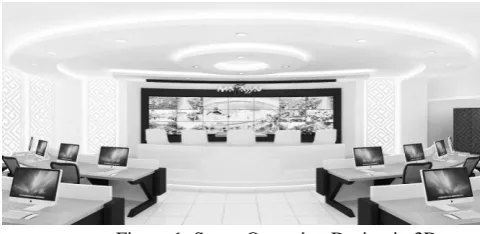
wall monitoring and distribution of CCTV in all over the city is important and the first infrastructure must be realized. And below is a design of smart operation that includes operation room, data center, and distribution of CCTV and wall monitoring that we had been presented in the previous paper[1][10].Figure 1. Smart Operation Design in 3D
Smart operation design above is also equipped with networks configuration picture that should be prepared during its building, and below is network design picture to be used where data center becomes important that the development must according to standards TIER2[11][12].
Prioritizing The Smart Operation Room
Development for Smart City Based on
Analytical Hierarchy Process
Figure 2. Network Communication Data Centre
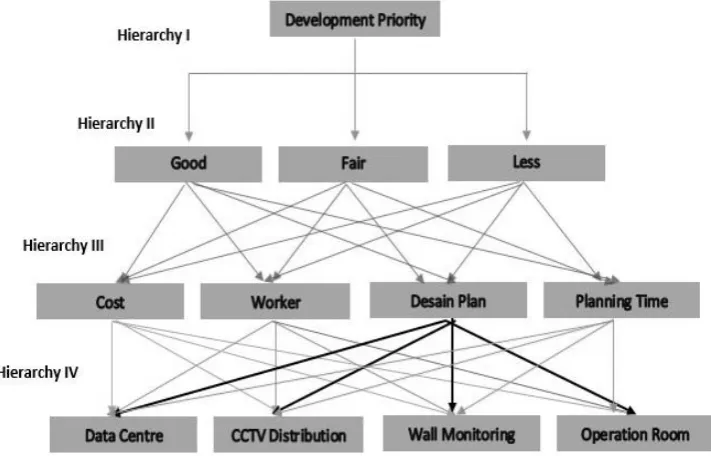
Figure 3. Hierarchy of Criteria Development Priority
Process design for communication network of smart operation room is centered and began from data center. It can be seen in Figure 2 where data center will be communication traffic from CCTV, wall room, and operation room[13][14].
Building process including four main activities will be measured and executed if its execution priority for building is structured and had been considered based on field condition[15]. Therefore, it is used analytical hierarchy process method. It is needed to get priority recommendations of building smart operation room to be more structured and fulfilling contract target of building that there would be no puffy budget and not breaking the design[16][2][17].
II.METHODSDEVELOPMENT A.Building Steps
Building smart operation room is begun from planning building design to the need of used technology. There are four main activities:
1. Building data center based on TIA-942 standard where data center consists of :
a. Entrance Room
It is used as interface between data center wiring system and cross-building wiring. This location is for access supply equipment and demarcation points also interface with wiring. b. Main Distribution Area
Main distribution area is located in center area which locates main cross-connect, core router and switches for LAN (Local Area Network) and SAN (Storage Access Network) infrastructures.
c. Horizontal Distribution Area
Distribution location for wiring to equipment distribution area including LAN/SAN switches, keyboard/video/mouse switches for equipment in equipment distribution area.
[image:2.595.120.476.232.460.2]It is a space which is allocated for final equipment including computer system, and telecommunication equipment.
e. Zone Distribution Area
It is located between horizontal distribution area and equipment distribution area.
2. Building Wall Monitoring Display is a combination of specific television displays to be a series monitoring screen. This screen has 46” width from 21 monitors. Monitoring screen is used to display information from CCTV cameras attached in the whole city and government service offices. Besides, as the center for information update on municipal society issues from social to economy when the mayor has meeting.
3. Operation Room building is in the 10th floor with 30
meter length and 21,6 meter width, where it is used as main place to receive all activities of smart operation room. In the building, there is operational room and chief room, waiting room, receptionist room, musholla, toilet, operating room warehouse, evacuation room.
4. Installation of CCTV cameras in smart operation room and in all city corners. Camera installed including two technical types; they are indoor and outdoor, because it is installed in government office area (inside) and all city areas (primary road, secondary area or sensitive area). Distribution of CCTV installation is used criteria based on road type, kind of place and others (it would be discussed on the other paper)
B.The use of Analytical Hierarchy Process
Finding recommendation to be cause of decision had been part of life, in often times we faced on two choices, or simple choice which make it difficult. On strategic taking decision that it made to be causing a huge change toward a system would need a specific process that the decision or the recommendation resulted is really appropriate to what is expected[18][19]. One of decision support system method is Analytic Hierarchy Process (AHP) that is developed by Thomas L Saaty in 1970s that essentially solve complex problems by arranging a criteria hierarchy; it is appraised in subjective by those who are in charge then having considerations to develop weight or priority (conclusion)[16][17][19].
The use of AHP method in this study is to find the best recommendation to determine smart operation building steps that it would fulfill determined target by municipal government as the owner of occupation and contractor as the executor[9][17]. Building smart operation room is only given by 90 days with determined fund, and it is not allowed to be late and also breaking the design in planning[20]. Fig 3 is hierarchy of criteria development to result recommendation by using AHP. Hierarchy I is decision resulted from the best recommendation based criteria III and criteria IV, where this recommendation is used to begin smart operation room building activities. Hierarchy III is criteria used to determine building activity priority on criteria III[2][18].
C.Result of priority calculation by using AHP
[image:3.595.307.546.115.217.2]To determine recommendation of activity on what should be conducted first in building smart operation, below is calculation by using analytical hierarchy process method:
Table I. Form of Criteria Matrix
On table 1, it is weight based on importance of criteria on hierarchy III adjusted with activity based on hierarchy criteria IV. Weight is based on data analysis consideration in the field and also expert who participated to execute smart operation room project of Makassar municipal government.
Furthermore, to determine priority of each criteria is based on hierarchy IV that it is obtained the result of calculation as shown in table 2 below :
Table II. Priority Matrix of Hierarchy IV
Criteria on hierarchy IV that obtained the highest value is data center it is 0.57, distribution of CCTV is 0.20, Wall monitoring 0.14 and the last is operation room of 0.09. This calculation is the result of table 1 that it is obtained priority value based on hierarchy 4. From the result, it is obtained value of CR (CI/IR) = -0.40, that it can be accepted because there is smaller value of 0.1 which is the requirement of AHP method. Value on hierarchy IV is obtained from criteria given by hierarchy III where the number of criteria is 4.
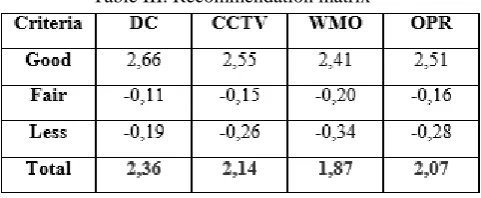
[image:3.595.316.557.662.761.2]After that, each of the four criteria will be calculated and looked for CR value to determine more important recommendation level based on 3 criteria on hierarchy II, and it is obtained result based on table 3.
From table 3 it is obtained recommendation on hierarchy II that consists of good, fair and less criteria. It can be seen that total value of each criteria is based on building activities then the biggest value is obtained on data center, distribution of CCTV, building operation wall and wall monitoring building activities.
[image:4.595.318.555.50.158.2]After calculating each criteria on each hierarchy, it is obtained the result recommendation by the number of 3, and it is initialed by a, b, c. And the following is final result of calculation using AHP methods :
Table IV. Result of recommendation
Based on table 4, it is obtained recommendation conclusion of:
In Recommendation A the first activity that should be done in building smart operation room is building data center, then wall monitoring, and mutually building distribution of municipal CCTV and operation room.
In Recommendation B the first activity that should be conducted in building smart operation room is building data center, and is continued wall monitoring, operation room and the last is building distribution of CCTV.
In Recommendation C the first activities that should be conducted in building smart operation room is data center, building distributions of municipal CCTV, building wall monitoring and the last is building operation room.
Consideration should be used in making decision if it is viewed from total value, it can be concluded that Recommendation B is the best and it is followed by Recommendation C and the last is Recommendation A.
D.Result of Building Smart Operation Room
The following is the result of building smart operation room that is conducted in Makassar as infrastructure prevailed in smart city system.
a.Result of building data centre is based on TIER 2 standard.
[image:4.595.317.537.342.472.2]Figure 4. Data Centre 12 racks
Figure 5. Data Centre TIER 2 standard
On Figure 4 and 5, it is shown the result of building data center where it is conducted firstly because of its prominent characteristics as storage and data communication of smart operation room. By TIER 2 standard for this data center is equipped with 3 kinds of energy sources; they are regular from state electrical company, generator set by capacity of 1,5 KV, and the last is energy source from solar panel by capacity of 150 KW. This data center is equipped with 12 rack server that there would be enough to be used in 10 years forward in storing data activity of Makassar.
b.Result of Building CCTV Distribution in City
Figure 6. Municipal Condition from city CCTV monitoring.
In Figure 6, it is shows monitor which is divided into several parts where the picture is direct recording from CCTV installed in 69 city corners (stage I) from 150 distribution spots in proper (continued to stage II). Monitoring focus used CCTV is path security problem from criminal especially motor gang, also monitoring traffic jam spots.
c.The result of building Wall Monitoring
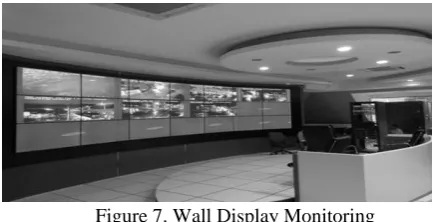
Figure 7. Wall Display Monitoring
[image:4.595.314.531.585.696.2] [image:4.595.58.296.639.751.2]city data. It is strategic step of a city in implementing smart city system.
[image:5.595.55.288.95.212.2]d.Result of Building Operation Room
Figure 8. Operation Room
Operation room is a room that is used to operate wall monitoring where data taken comes from data center beside it. This operation room is equipped with 12 operator officers who serve during 24 hours to monitor data recorded from city CCTV that later would be presented in wall monitoring screen. Each operator is equipped with personal computer to manage incoming data that it can be presented in wall monitoring in maximum. This operation room cannot be entered by anybody because this data is very important obtained by this smart operation that security service could be conducted in 24 hours.
III. CONCLUSION
Infrastructure of smart city is the fundamental that should be prepared well that smart city system will run well. The building of smart operation has significant impact toward the operation of Makassar smart city because it is needed by government as the executor of smart city system and society as object in implementing this system. Building needs good planning and implementation suit to time and budget, therefore, absolute building analysis is needed to achieve good development. Choosing appropriate recommendation that it can be used as decision in beginning a work can be conducted by implementing analytical hierarchy process (AHP) method. The implementation of AHP method gives good effect because it results building activities recommendation that should be begun in the first time. By implementing this recommendation, building smart operation is complex enough to be conducted in proper by not increasing budget to several times. With accuracy level and exactness in recommendation resulted is able to give advantage for executor contractor and helps municipal government fast begin smart city system. Furthermore, AHP system can be implemented in building other smart city infrastructure in the second year.
ACKNOWLEDGMENT
Researcher thanks to Makassar government especially Bureau of Computer Science and Communication also PT. Sumber Energi Barokah as the executor of this job because is being involved in Makassar smart city project. It excites researcher to investigate smart city field especially in Indonesia.
REFERENCES
[1] Fachrul Kurniawan;Supeno Mardi SN and M. Hariadi, “Smart Operation Room for Smart City in Makassar : A Design Perspective,” Journal of Next Generation Information Technology, vol. 7, no. 2, pp. 76–83, 2016.
[2] M. M. A. Chandak, “Review on Optimal Route Guidance using Analytical Hierarchy Process,” pp. 0–3, 2015.
[3] T. Clohessy, T. Acton, and L. Morgan, “Smart city as a service (SCaaS): A future roadmap for e-government smart city cloud computing initiatives,” in Proceedings - 2014 IEEE/ACM 7th International Conference on Utility and Cloud Computing, UCC 2014, 2014, pp. 836–841.
[4] S. Zygiaris, “Smart City Reference Model: Assisting Planners to Conceptualize the Building of Smart City Innovation Ecosystems,” J. Knowl. Econ., vol. 4, no. 2, pp. 217–231, 2013.
[5] S. Chatterjee, H. Khas, A. K. Kar, and H. Khas, “Review and Policy Insights,” pp. 2335–2340, 2015.
[6] T. Nam and T. a. Pardo, “Conceptualizing smart city with dimensions of technology, people, and institutions,” Proc. 12th Annu. Int. Digit. Gov. Res. Conf. Digit. Gov. Innov. Challenging Times - dg.o ’11, p. 282, 2011.
[7] A. Wiig, “IBM‟s smart city as techno-utopian policy mobility,” City, vol. 19, no. 2–3, pp. 258–273, 2015.
[8] L. Hao, X. Lei, Z. Yan, and Y. ChunLi, “The application and implementation research of smart city in China,” 2012 Int. Conf. Syst. Sci. Eng., no. 70172014, pp. 288–292, 2012. [9] C. P. Techniques, “Sustainable Development Contribution
Assessment of Renewable Energy Projects,” 2015.
[10] M. Seufert, T. Griepentrog, V. Burger, and T. Hoßfeld, “A Simple WiFi Hotspot Model for Cities,” vol. 7798, no. c, pp. 3–6, 2015.
[11] V. Javidroozi, H. Shah, A. Cole, and A. Amini, “Towards a City ‟ s Systems Integration Model for Smart City Development : A Conceptualization,” 2015.
[12] H. Chourabi, J. R. Gil-garcia, T. A. Pardo, H. J. Scholl, S. Walker, and K. Nahon, “Understanding Smart Cities : An Integrative Framework,” 2012.
[13] I. S. Mustafa, N. M. Din, and A. Ismail, “Antenna Placement for Landslide Monitoring Using Analytical Hierarchy Process ( AHP ) and Geographical Information System ( GIS ),” pp. 295–300, 2013.
[14] G. Falconer and S. Mitchell, “Smart City Framework: A Systematic Process for Enabling Smart+Connected Communities,” Point View, no. September, p. 11, 2012. [15] S. AlAwadhi and H. J. Scholl, “Aspirations and realizations:
The Smart City of Seattle,” in Proceedings of the Annual Hawaii International Conference on System Sciences, 2013, pp. 1695–1703.
[16] J. Zhang, D. Xue, and X. Han, “Selection of an Instruction Response System with Analytical Hierarchy Process Method,” pp. 758–760, 2012.
[17] W. Yuyang, X. Luyan, H. Yan, and L. Yuqing, “Fuzzy Analytical Hierarchy Process Methods for Evaluating the Comfort of textiles,” pp. 1–4, 2015.
[18] R. Agustiansyah and M. Kom, “Implementation of Analytic Network Process ( ANP ) and Analytic Hierarchy Process ( AHP ) Method to Determine Priorities of Roads to be Repaired at Bogor City Department Of Public Works,” pp. 61–66, 2013.
[19] S. Hatton, “Choosing the „ Right ‟ Prioritisation Method,” pp. 517–526, 2008.