Original Article
Baseline S100B protein as a potential predicator
for postoperative cognitive dysfunction in elderly
patients after hip joint replacement surgery
Xiaoli Ji, Canlin Sun, Xiaojing Li, Hailin Xing, Pengfei Zhao, Lin Jiang
Department of Anesthesiology, Taizhou People’s Hospital, Medical School of Nantong University, Taizhou, Jiangsu Province, China
Received August 12, 2016; Accepted September 27, 2016; Epub November 1, 2016; Published November 15, 2016
Abstract: Background: Postoperative cognitive dysfunction (POCD) is well described as a permanent decline of cog-nition after both cardiac and non-cardiac surgery without a defined etiology. This present study sought to investigate potential predicators for POCD at day 7 after hip joint replacement surgery. Methods: 171 patients who scheduled to undergo elective total hip replacement for osteoarthritis were finally enrolled in this single-center, prospective observational study. The presence status of POCD was assessed before the surgery (baseline) and at day 7 after the surgery with neuropsychological tests. Multiple logistic regression and receiver operating characteristic (ROC) curve analysis were used for the analysis of predicators for POCD. Results: The incidence of POCD at day 7 after the sur -gery was 19.3% (33/171) in this study. Serum S100B protein expression at baseline was an independent risk factor for POCD (OR: 2.21, 95% CI: 1.32-5.43, P=0.013) by multiple logistic regression analysis. The area under the curve (AUC) of S100B protein for POCD was 0.685, with 95% CI of 0.576-0.795, the sensitivity of 62.77% and specificity of 72.73% respectively (P<0.001) by ROC analysis. Conclusions: Our results suggested that baseline S100B protein as a potential predicator for POCD in elderly patients after hip joint replacement surgery.
Keywords: Postoperative cognitive dysfunction, S100B protein, biomarker, elderly patients
Introduction
Postoperative cognitive dysfunction (POCD), distinct from postoperative delirium, is well described as a permanent decline of cognition after both cardiac and non-cardiac surgery [1,
2]. The incidence of POCD in old patients (>60
years) undergoing non-cardiac surgery is re- ported to be as high as 25.8 at 1 week and 9.9% at 3 months by the International Study of Postoperative Cognitive Dysfunction (ISPOCD) [3]. While another study conducted by Monk et al. found an incidence of 41.4% at discharge and 12.7% at 3 months in old patients with non-cardiac surgery [4]. While POCD may prom-inently prolong the length of hospital stay, inter-fere the postoperative recovery [5], affect the quality of life [6] and increase the mortality [7]. Although POCD has been studied for several decades, the mechanisms of POCD still remain abstruse and a key issue about potential predi-cators for POCD requires being resolved. Pre-
vious studies have revealed that several factors (including postoperative pain, hypoperfusion,
thrombosis, inflammatory status and anesthet -ic factors, etc.) might be involved in the mecha-nisms of POCD [8]. Potential predicative factors for POCD will be greatly helpful in the etiology investigation and risk evaluation after the sur-gery. Recent reports have revealed that S100B protein may be closely associated with POCD [9], however whether it can be used as a valid clinical indicator for POCD still remains unclear.
This research was designed to verify whether
S100B protein could predict POCD in patients undergoing hip joint replacement surgery.
Material and methods
Patients
This study protocol was approved by the Medical
Institutional Ethics Committee of Jiangsu
-tional study was conducted in the Department
of anesthesiology, Taizhou People’s Hospital from July 2012 to July 2015. The eligible elderly patients (≥60 years) who scheduled to undergo
elective total hip replacement for osteoarthritis were consecutively enrolled. All the participants were required to offer the written informed
con-sent. The exclusion criteria were described as
follows: patients with preexisting neurological or neurovascular disease; MMSE score <24 or with history of dementia; patients with the his-tory of surgery or cerebrovascular accidents within 6 months; those with low compliance, blindness or deafness; those with subsequent loss to follow-up.
Neuropsychological testing and POCD assess-ment
The enrolled patients were assessed with neu -ropsychological tests which were commonly used and recommended by the consensus statement before the surgery (baseline) and
at day 7 after surgery [10]. The test battery was
comprised with the widely described tests including Mini-mental state examination
(MMSE), Digit span test, Trail making test (part A), Verbal fluency test, Word recognition memo -ry tests and Symbol digit test [5]. By using test results and the baseline levels, a Z score was then individually calculated according to the description by International Study of Posto- perative Cognitive Dysfunction (ISPOCD1 and
ISPOCD2) [3, 11]. POCD was defined while the Z scores on at least two tests ≥1.96 [12].
Biochemical parameters
Fasting blood sample were obtained from all the enrolled patients before the anesthesia as the baseline levels with anticoagulant tubes.
The collected samples were centrifuged (820
rpm, 10 min, 4°C) and then the supernatant
was stored at -80°C for further detections. The
biochemical parameters including C-reactive
protein (CRP), tumor necrosis factor-α (TNF-α),
interleukin-6 (IL-6), S100B protein were all
measured by enzyme-linked immuno sorbent assay (ELISA) according to the manufacturer’s
instructions using ELISA kits (R&D Systems, Minneapolis, MN, USA). An
electrochemilumi-nescent assay was used for the neuron-specific
enolase (NSE) measurement using an anti-NSE antibody (R&D Systems, Minneapolis, MN, USA).
Statistical analysis
Data was analyzed by using GraphPad Prism 5.0 (GraphPad Inc., CA, USA) and SPSS 19.0
(SPSS, Inc., IA, USA). Continuous data was pre-sented as mean and standard error (S.E.M) while categorical data as number (n) and per-centage (%). Continuous variables were com-pared with Mann-Whitney U test or t test,
whereas categorical data analyzed by
Chi-square test or Fisher exact test. Receiver oper-ating characteristic (ROC) curve analysis was performed to assess the accuracy of S100B protein in the discrimination of POCD and non-POCD. Multivariate logistic regression analyses were used for determining independent risk factors for POCD. All statistical tests were bilat-eral probability and P<0.05 was considered
significant. Results Patient cohort
This prospective study has recruited 226
pa-tients according to the inclusion criteria. 55 of them were excluded due to the various reasons (30 data not completed, 7 MMSE <24, 10
refused to cooperate, 8 with financial prob -lems), and consequently, 171 were enrolled
into the final study analysis. A diagnosis of
POCD at day 7 after the surgery was observed
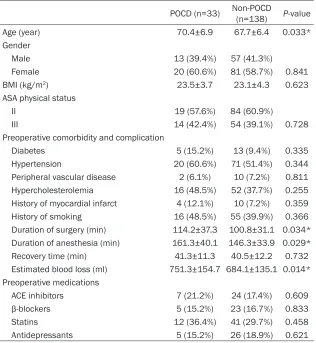
in 33 patients (33/171, 19.3%). The demo -graphics, baseline characteristics and opera-tion-related data of patients with or without POCD were presented in Table 1. Our results exhibited a close correlation between the advancing age and POCD occurrence (P<0.05).
The patients in POCD group showed significant -ly increased blood loss as compared to those in
non-POCD group (P<0.05). Those with longer
duration of anesthesia and surgery were more likely to develop POCD (P<0.05).
Biochemical tests
As listed in Table 2, there were no statistical differences in the serum expressions of IL-6, creatinine, urea and NSE at baseline between
two groups (P>0.05). Compared with non-POCD group, CRP, TNF-α and S100B protein were all
observably elevated among POCD group (P<0.05).
Neuropsychological tests at baseline
Table 3 summarized the neuropsychological
non-POCD groups. Patients in non-POCD group had
sig-nificantly poor preoperative levels of MMSE and verbal fluency test than those in non-POCD
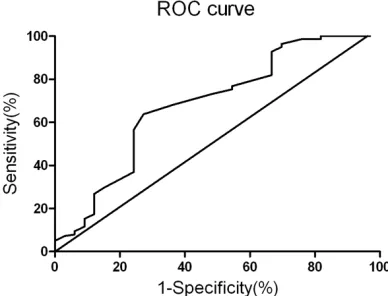
S100B protein for POCD was 0.685, with 95% CI of 0.576-0.795, the sensitivity of 62.77%
and specificity of 72.73% respectively (P<
0.001).
Discussion
Despite the great steps in anesthetic and surgi-cal techniques during the past decades, the brain injury or cognitive decline after the
sur-gery still remains highly prevalent [13]. This pro -spective study revealed that POCD was seen in approximately 19.3% of elderly patients who scheduled to undergo elective total hip replace-ment, which was relatively close to previous reports [3, 11]. POCD has been widely observed in patients at any age with major surgery,
espe-cially in those elderly patients [4]. The age has been repeatedly verified as an important risk
factor for the development of neurological
[image:3.612.90.406.84.427.2]dis-order [14]. The decline in memory and learning Table 1. Characteristics of patients with or without POCD
POCD (n=33) Non-POCD (n=138) P-value
Age (year) 70.4±6.9 67.7±6.4 0.033*
Gender
Male 13 (39.4%) 57 (41.3%)
Female 20 (60.6%) 81 (58.7%) 0.841
BMI (kg/m2) 23.5±3.7 23.1±4.3 0.623
ASA physical status
II 19 (57.6%) 84 (60.9%)
III 14 (42.4%) 54 (39.1%) 0.728
Preoperative comorbidity and complication
Diabetes 5 (15.2%) 13 (9.4%) 0.335
Hypertension 20 (60.6%) 71 (51.4%) 0.344
Peripheral vascular disease 2 (6.1%) 10 (7.2%) 0.811 Hypercholesterolemia 16 (48.5%) 52 (37.7%) 0.255 History of myocardial infarct 4 (12.1%) 10 (7.2%) 0.359 History of smoking 16 (48.5%) 55 (39.9%) 0.366 Duration of surgery (min) 114.2±37.3 100.8±31.1 0.034* Duration of anesthesia (min) 161.3±40.1 146.3±33.9 0.029* Recovery time (min) 41.3±11.3 40.5±12.2 0.732 Estimated blood loss (ml) 751.3±154.7 684.1±135.1 0.014* Preoperative medications
ACE inhibitors 7 (21.2%) 24 (17.4%) 0.609
β-blockers 5 (15.2%) 23 (16.7%) 0.833
Statins 12 (36.4%) 41 (29.7%) 0.458
[image:3.612.91.304.506.624.2]Antidepressants 5 (15.2%) 26 (18.9%) 0.621 ASA, American Society of Anesthesiologists; BMI, Body Mass Index; ACE, angiotensin-converting enzyme; POCD, Postoperative Cognitive Dysfunction. P-values were calculated by Chi-square test, Fisher exact test, Mann-Whitney U-test or t test. *P value <0.05.
Table 2. Baseline biochemical levels of patients with or without POCD
Baseline (n=33)POCD Non-POCD (n=138) P-value CRP (mg/L) 14.1±5.7 12.2±4.5 0.041* IL-6 (pg/mL) 18.3±9.7 17.8±8.8 0.774 TNF-α (nmol/L) 8.3±1.9 7.6±1.5 0.024* Creatinine (mmol/L) 87.2±23.3 84.8±30.2 0.670 Urea (mmol/L) 6.8±2.2 6.5±3.1 0.601 S100B (ng/mL) 0.37±0.11 0.31±0.08 <0.001* NSE (ng/mL) 10.4±1.2 10.7±1.4 0.258 POCD, Postoperative Cognitive Dysfunction; CRP, C-reactive protein; IL-6, interleukin-6; TNF-α, tumor necrosis factor-α; NSE, neuron-specific enolase. P-values were calculated by Mann-Whitney U-test or t test. *P value <0.05.
group (P<0.05). And the other neuropsycho-logical tests results did
not differ significantly
between the two gro-
ups (P>0.05).
Independent risk fac-tors for POCD
All the possible risk fa- ctors for POCD men-tioned above were for- ced into a multivariate logistic regression mo-
del. The results from Table 4 revealed that serum S100B protein expression was an in- dependent risk factor for POCD (OR: 2.21, 95% CI: 1.32-5.43, P= 0.013).
Predicative value of S100B protein for POCD
As displayed in Figure 1, ROC curve analysis
was utilized for the
predicative value analy-sis of S100B protein for
POCD. The area under
Table 4.Multiple logistic regression analysis for POCD
POCD
Parameter OR 95% CI P value
Age 1.56 0.91-3.82 0.128
Duration of surgery 2.21 0.73-7.44 0.153 Duration of anesthesia 3.31 0.82-8.23 0.211 Estimated blood loss 2.03 0.62-5.21 0.198
CRP 2.73 0.81-6.15 0.142
TNF-α 2.01 0.78-5.13 0.138
S100B 2.21 1.32-5.43 0.013*
MMSE 2.01 0.33-14.31 0.453
Verbal fluency test 5.71 2.21-11.33 0.112 POCD, Postoperative Cognitive Dysfunction; CRP, C-reactive protein; TNF-α, tumor necrosis factor-α; MMSE, Mini-Mental State Examination; CI: Confidence Interval; OR, Odds Ratio. *P value <0.05.
Previous studies have shown that the surgical
trauma can influence the magnitude of postop
-erative inflammation [15]. The studies conduct -ed in ag-ed rats reveal that the performing of partial hepatectomy will result in a cognitive decline [16]. Many studies in aged animals suggest that surgery of greater magnitude would potentially induce more remarkable
neu-roinflammation and result in significant cogni
-tive deficiency [17].
NSE has been suggested as a valid biochemi-cal marker for postoperative dysfunction [18], however, no solid association was found in our study between baseline NSE levels and POCD. Our results from the multivariate logistic regres-sion analysis suggested that baseline S100B protein expression was an independent risk factor for POCD. ROC curve analysis also
dem-onstrated the significant predicative value of
serum S100B for POCD at day 7. Although it still remains controversy, several studies have also demonstrated the close correlation between S100B protein and cognitive dysfunction [19,
20], which is in consistence with our findings.
As a member of the S100 protein family, S100B is mainly expressed by astrocytes [15]. It has been reported that enhanced S100B exerts critical actions in learning capabilities and spa-tial memory by previous studies conducted in animal models [21]. Data have reported that elevated S100B can upregulate cyclooxygen-ase-2 expressions through the receptor for
advanced glycation end product (RAGE) path -way in microglia [22, 23]. In addition, cyclooxy-genase-2 inhibitor can ameliorate the cognitive
function in patients with Alzheimer disease by inhibiting neuroinflammation [24]. S100B pro
-Table 3. Neuropsychological test results at baseline of patients with or without POCD
Neuropsychological test (Baseline) (n=33)POCD Non-POCD (n=138) P-value
MMSE 28.6±1.1 29.0±0.9 0.030*
Digit span test
Correct order 8.5±0.8 8.3±0.7 0.154 Reverse order 4.6±1.2 4.3±1.3 0.229 Trail making test A (s) 19.4±10.6 17.7±12.6 0.475 Verbal fluency test 14.6±3.2 16.5±3.7 0.007* Word Recognition memory tests 1.4±1.0 1.4±1.1 1.000 Symbol digit test 31.1±11.8 32.8±12.0 0.464 MMSE, Mini-Mental State Examination; POCD, Postoperative Cognitive Dysfunc-tion; P-values were calculated by Mann-Whitney U-test or t test. *P value <0.05.
ability associated with advanced age is commonly observed in both humans and animal models due to the susceptibility to
neuro-inflammation. Our results also
showed a close relationship bet- ween age and POCD. However, the multivariate logistic
regres-sion analysis didn’t support the
predicative value of age for POCD, which were not quite cor-responding with previous
investi-gations. The pathogenesis of
POCD is considered multifactori-al and it still remains unclear until now.
[image:4.612.90.293.299.442.2] [image:4.612.91.285.507.655.2]tein can also could also promote the activation of nuclear factor-kappa B (NF-κB) pathway by binding to RAGE and up-regulate proinflamma
-tory mediators including IL-1β [25]. In contrast, the IL-1β secretion can also impact the S100B expression through NF-κB pathway modulation [26]. This may be one of the explanations why
serum S100B protein can serve as a predicator for POCD in this present study. Investigations have indicated that overexpressed S100B can
promote Aβ generation from amyloid precursor protein [27]. In addition, the increased Aβ and
amyloid precursor protein after the surgical procedure is closely associated with cognition
decline [28]. This may provide a possible
invo-lved mechanism supporting the critical role of S100B in predicating POCD.
This study has some limitations. First, this is a
relative small single-center cohort with no fol-low-up design. Moreover, the involved mecha-nisms why S100B acts as a predicative role for POCD remains unclear. Furthermore, a larger scale study should be designed to compensate for the inadequacies.
Disclosure of conflict of interest
None.
Address correspondence to: Lin Jiang, Department of Anesthesiology, Taizhou People’s Hospital, Medi-cal School of Nantong University, 210 Yingchun Road, Taizhou 315000, Jiangsu Province, China. E-mail: [email protected]
References
[1] Rappold T, Laflam A, Hori D, Brown C, Brandt J, Mintz CD, Sieber F, Gottschalk A, Yenokyan G, Everett A and Hogue CW. Evidence of an as -sociation between brain cellular injury and cognitive decline after non-cardiac surgery. Br J Anaesth 2016; 116: 83-89.
[2] Shaw PJ, Bates D, Cartlidge NE, French JM, Heaviside D, Julian DG and Shaw DA. Neurologic and neuropsychological morbidity following major surgery: comparison of coro-nary artery bypass and peripheral vascular surgery. Stroke 1987; 18: 700-707.
[3] Moller JT, Cluitmans P, Rasmussen LS, Houx P, Rasmussen H, Canet J, Rabbitt P, Jolles J, Larsen K, Hanning CD, Langeron O, Johnson T, Lauven PM, Kristensen PA, Biedler A, van Beem H, Fraidakis O, Silverstein JH, Beneken JE and Gravenstein JS. Long-term postopera -tive cogni-tive dysfunction in the elderly
ISPOCD1 study. ISPOCD investigators. Inter- national Study of Post-Operative Cognitive Dysfunction. Lancet 1998; 351: 857-861. [4] Monk TG, Weldon BC, Garvan CW, Dede DE,
van der Aa MT, Heilman KM and Gravenstein JS. Predictors of cognitive dysfunction after major noncardiac surgery. Anesthesiology 2008; 108: 18-30.
[5] Silbert BS, Scott DA, Evered LA, Lewis MS, Kalpokas M, Maruff P, Myles PS and Jamrozik K. A comparison of the effect of high- and low-dose fentanyl on the incidence of postopera-tive cognipostopera-tive dysfunction after coronary artery bypass surgery in the elderly. Anesthesiology 2006; 104: 1137-1145.
[6] Newman MF, Grocott HP, Mathew JP, White WD, Landolfo K, Reves JG, Laskowitz DT, Mark DB, Blumenthal JA, Neurologic Outcome Research G and the Cardiothoracic Anesthesia Research Endeavors Investigators of the Duke Heart C. Report of the substudy assessing the impact of neurocognitive function on quality of life 5 years after cardiac surgery. Stroke 2001; 32: 2874-2881.
[7] Phillips-Bute B, Mathew JP, Blumenthal JA, Grocott HP, Laskowitz DT, Jones RH, Mark DB and Newman MF. Association of neurocogni-tive function and quality of life 1 year after coronary artery bypass graft (CABG) surgery. Psychosom Med 2006; 68: 369-375.
[8] Krenk L, Rasmussen LS and Kehlet H. New in-sights into the pathophysiology of postopera-tive cognipostopera-tive dysfunction. Acta Anaesthesiol Scand 2010; 54: 951-956.
[9] Silva FP, Schmidt AP, Valentin LS, Pinto KO, Zeferino SP, Oses JP, Wiener CD, Otsuki DA, Tort AB, Portela LV, Souza DO, Auler JO Jr and Carmona MJ. S100B protein and neuron-spe-cific enolase as predictors of cognitive dys -function after coronary artery bypass graft sur-gery. Eur J Anaesthesiol 2016; 33: 681-9. [10] Murkin JM, Newman SP, Stump DA and
Blumenthal JA. Statement of consensus on as-sessment of neurobehavioral outcomes after cardiac surgery. Ann Thorac Surg 1995; 59: 1289-1295.
[11] Johnson T, Monk T, Rasmussen LS, Abildstrom H, Houx P, Korttila K, Kuipers HM, Hanning CD, Siersma VD, Kristensen D, Canet J, Ibanaz MT, Moller JT and Investigators I. Postoperative cognitive dysfunction in middle-aged patients. Anesthesiology 2002; 96: 1351-1357.
[13] Bruggemans EF. Cognitive dysfunction after cardiac surgery: Pathophysiological mecha-nisms and preventive strategies. Neth Heart J 2013; 21: 70-73.
[14] Wu CL, Hsu W, Richman JM and Raja SN. Postoperative cognitive function as an out-come of regional anesthesia and analgesia. Reg Anesth Pain Med 2004; 29: 257-268. [15] Huang TJ, Hsu RW, Li YY and Cheng CC. Less
systemic cytokine response in patients follow-ing microendoscopic versus open lumbar dis-cectomy. J Orthop Res 2005; 23: 406-411. [16] Cao XZ, Ma H, Wang JK, Liu F, Wu BY, Tian AY,
Wang LL and Tan WF. Postoperative cognitive deficits and neuroinflammation in the hippo -campus triggered by surgical trauma are exac-erbated in aged rats. Prog Neuropsycho- pharmacol Biol Psychiatry 2010; 34: 1426-1432.
[17] Li RL, Zhang ZZ, Peng M, Wu Y, Zhang JJ, Wang CY and Wang YL. Postoperative impairment of cognitive function in old mice: a possible role for neuroinflammation mediated by HMGB1, S100B, and RAGE. J Surg Res 2013; 185: 815-824.
[18] Tamura A, Imamaki M, Shimura H, Niitsuma Y and Miyazaki M. Release of serum S-100beta protein and neuron-specific enolase after off-pump coronary artery bypass grafting with and without intracranial and cervical artery steno-sis. Ann Thorac Cardiovasc Surg 2011; 17: 33-38.
[19] Spinella PC, Dominguez T, Drott HR, Huh J, McCormick L, Rajendra A, Argon J, McIntosh T and Helfaer M. S-100beta protein-serum levels in healthy children and its association with out-come in pediatric traumatic brain injury. Crit Care Med 2003; 31: 939-945.
[20] Kofke WA, Konitzer P, Meng QC, Guo J and Cheung A. The effect of apolipoprotein E geno -type on neuron specific enolase and S-100beta levels after cardiac surgery. Anesth Analg 2004; 99: 1323-1325; table of contents. [21] Bell K, Shokrian D, Potenzieri C and
Whitaker-Azmitia PM. Harm avoidance, anxiety, and re -sponse to novelty in the adolescent S-100beta transgenic mouse: role of serotonin and rele-vance to Down syndrome. Neuropsychophar- macology 2003; 28: 1810-1816.
[22] Bianchi R, Adami C, Giambanco I and Donato R. S100B binding to RAGE in microglia stimu -lates COX-2 expression. J Leukoc Biol 2007; 81: 108-118.
[23] Sorci G, Bianchi R, Riuzzi F, Tubaro C, Arcuri C, Giambanco I and Donato R. S100B Protein, A Damage-Associated Molecular Pattern Protein in the Brain and Heart, and Beyond. Cardiovasc Psychiatry Neurol 2010; 2010.
[24] Peng M, Wang YL, Wang FF, Chen C and Wang CY. The cyclooxygenase-2 inhibitor parecoxib inhibits surgery-induced proinflammatory cyto -kine expression in the hippocampus in aged rats. J Surg Res 2012; 178: e1-8.
[25] Barrientos RM, Hein AM, Frank MG, Watkins LR and Maier SF. Intracisternal interleukin-1 receptor antagonist prevents postoperative cognitive decline and neuroinflammatory re -sponse in aged rats. J Neurosci 2012; 32: 14641-14648.
[26] de Souza DF, Leite MC, Quincozes-Santos A, Nardin P, Tortorelli LS, Rigo MM, Gottfried C, Leal RB and Goncalves CA. S100B secretion is stimulated by IL-1beta in glial cultures and hip-pocampal slices of rats: Likely involvement of MAPK pathway. J Neuroimmunol 2009; 206: 52-57.
[27] Mori T, Koyama N, Arendash GW, Horikoshi-Sakuraba Y, Tan J and Town T. Overexpression of human S100B exacerbates cerebral amyloi-dosis and gliosis in the Tg2576 mouse model of Alzheimer’s disease. Glia 2010; 58: 300-314.