
Construction of a New Cryptographic Method,
Employing Pseudoanalytic Function Theory
A. Bucio R.
IAENG, Member, A. Hernandez-Becerril
IAENG, Member,
C. M. A. Robles G.
IAENG, Member, M. P. Ramirez T.
IAENG, Member, A. Arista-Jalife.
?Abstract—Employing the Pseudoanalytic Function Theory, and based upon the inverse Dirichlet boundary value problem for the two-dimensional Electrical Impedance Equation, an open problem also known as Electrical Impedance Tomography, we propose a new cryptographic method whose main charac-teristics are the Confidentiality and the Data Integrity.
Index Terms—Cryptography, Electrical Impedance Tomog-raphy, Pseudoanalytic Functions, Vekua Equation.
I. INTRODUCTION
[image:1.595.66.271.436.600.2]T
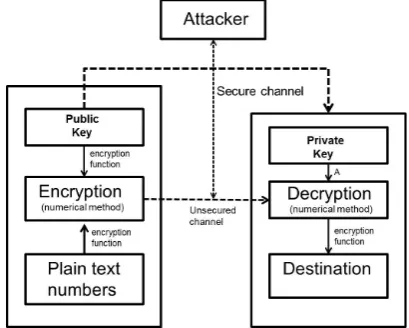
HE study of techniques for secure communication is the main goal of Cryptography [6]. That is why this discipline is strongly related with other branches of Science, as Applied Mathematics and Computation. There are many other disciplines on which the Cryptography can be based on. Yet, the paragraphs shown further will show that, in this particular proposal, both Mathematics and Computes Sci-ences will provide enough material to ensure the successful performance of the novel method. Therefor, the Figure 1 shall be adequate to appoint the basic execution of a ciphering method.Fig. 1: A general description of a cryptographic method.
This work pays particular attention to the Pseudoanalytic Function Theory [3], that has recently proved to be an important tool in Theoretical Physics, and Applied Mathe-matics (seee.g.[4], [11], and [15]). More precisely, since the pseudoanalytic functions have been employed for analyzing the Electrical Impedance Tomography [18] (a mathematical
A. Bucio R. is with the National Polytechnique Institute, UPIITA, Mexico, [email protected]
C. M. A. Robles G. and A. Hernandez-Becerrilare with the National Polytechnique Institute, ESIME C. Mexico, [email protected] M. P. Ramirez T. and A. Arista-Jalifeare with the Communications and Digital Signal Processing Group, Engineering Faculty of La Salle University, Mexico, [email protected].
?Each author equally contributed to the research work.
problem that remains open), it is possible to propose a new cryptographic method that will positively posses characteris-tics as Confidentiality and Data Integrity.
From the scope of these pages, a cryptographic algorithm will be considered a mathematical method whose main pur-pose is to convert information into encrypted data, such that the decryption is available only for those that posses the key. For that, the cryptographic algorithm will arise employing numerical techniques that allowed the approaching of the so-called Taylor Series in Formal Powers.
Starting with a brief study of the Pseudoanalytic Function Theory, and its relation with the two-dimensional Electrical Impedance Equation, we expose the details of the method-ology for constructing a cryptographic method.
Based upon the material previously posed in a variety of works, fully dedicated to the forward Dirichlet boundary value problem for the Electrical Impedance Equation, we explain that this method is effective for ciphering numerical data whose values are significantly bigger than10−12. Thus,
the variety of data classes on which this method could be useful, can be considered wide enough for engineering applications.
II. THECRYPTOGRAPHICPROPOSAL.
The idea of proposing a new cryptographic algorithm arises from the study of the Electrical Impedance Tomog-raphy problem, employing modern elements of the Pseudo-analytic Functions [11]. Nevertheless, we shall appoint that these numerical techniques do not provide yet an adequate solution for the problem.
As a matter of fact, most works (see e.g. [4] and [13]) mainly analyze the forward Dirichlet boundary value prob-lem for the Electrical Impedance Equation (the Electrical Impedance Tomography constitutes the inverse problem, correctly posed in mathematical form by A.P. Calderon in [5]). Thus, even the new techniques do provide additional information for better understanding the field, it is impossible to assert that the Electrical Impedance Tomography problem could be solved for arbitrary cases.
III. ELEMENTS OFPSEUDOANALYTICFUNCTION THEORY AND THEIR RELATION WITH THEELECTRICAL
IMPEDANCEEQUATION.
Let us consider the two-dimensional case of the Electrical Impedance Equation:
∇ ·(σ∇u) = 0, (1) whereuis the electric potential andσis a separable-variables non-vanishing function within a bounded domain Ω, with boundary Γ, such that:
σ=σ1(x)σ2(y). (2)
By introducing the notations:
W =√σ∂xu−i
√
σ∂yu, p=
s σ2(y)
σ1(x)
, (3)
wherei2=−1,∂
x= ∂x∂ and∂y= ∂y∂ ; the equation (1) can
be rewritten into a Vekua equation [17] of the form:
∂zW −
∂zp
p W = 0, (4)
where ∂z = ∂x +i∂y, and W represents the complex
conjugation of W:W =ReW−iImW.
The general solution of this equation can be expressed by means of the Taylor series in formal powers [3]:
W =
∞
X
n=0
Z(n)(an, z0;z). (5)
This is, indeed, a generalization of the classical postulates of Complex Analysis, that was mainly developed by L. Bers [3]. The following paragraphs contain a condensed description of the material that will be needed for our further discussions. The reader can find a complete and detailed explanation of these postulates in [3] and [11].
A. Formal Powers.
The formal power Z0(0)(a0, z0;z) with complex constant
coefficienta0, center atz0, depending uponz, formal
expo-nent0, and corresponding to the generating pair(F0, G0); is
expressed as:
Z0(0)(a0, z0;z) =λ0F0+µ0G0;
whereλ0 andµ0 are real constants such that
λ0F0(z0) +µ0G0(z0) =a0;
and
F0=p, G0=
i p.
whereppossesses the form (3).
The formal powers with higher formal exponents n, are defined by the recursive integral expressions:
Zj(n)
0 (an, z0;z) =n
Z z
z0
Zj(n−1)
1 (a0, z0;z)d(Fj0,Gj0)z. (6)
where j0 = 0,1 and j1 = 1,0. This is, if j0 = 0 then
j1= 1, and if j0= 1thenj1= 0. The integral expressions
in the right-hand side of (6) are what can be considered antiderivartives in the sense of Bers [3]:
Z z
z0
Zj(n−1)
1 (a0, z0;z)d(Fj0,Gj0)z=
=Gj0Re
Z
Λ
Fj∗0Z
(n−1)
j1 (a0, z0;z)dz+
+Fj0Re
Z
Λ
G∗j0Z
(n−1)
j1 (a0, z0;z)dz.
Here,Λis a rectifiable curve going fromz0 uptoz, and:
F1=
√
σ, G1=
i √
σ.
whereas
Fj∗
0 =−iFj0, G
∗
j0=−iGj0,
as well
Fj∗1 =−iFj1, G
∗
j1=−iGj1.
Once more, the detailed description of the construction and characteristics of the formal powers can be found in [3] and [11]. Here we will only enhance two fundamental properties for our discussions.
1)
lim
z→z0
Z(n)(an, z0;z) =an(z−z0)n. (7)
2) Let an = a0n +ian00, where a0n and a00n are both real
constants. Thus
Z(n)(an, z0;z) =
=a0nZ(n)(1, z0;z) +a00nZ (n)(i, z
0;z). (8)
The absence of the subindex j0 and j1 indicates that the
properties are valid for all formal powers.
Notice the last statement establishes that any formal power Z(n)(a
n, z0;z)can be approached by the linear combination
of Z(n)(1, z
0;z) andZ(n)(i, z0;z), thus the numerical
cal-culations shall be exclusively performed to approach these two classes of formal powers.
Moreover, in [8] was provided the proof about the com-pleteness of the set:
n
ReZ(n)(1, z0;z)|Γ,ReZ(n)(i, z0;z)|Γ
o∞
n=0
, (9)
for approaching solutions of the forward Dirichlet boundary value problem corresponding to the equation (1).
This is, given a non-vanishing functionσwithin a bounded domainΩ, with boundaryΓ, any boundary conditionu|Γ can
be approached by the linear combination of the elements belonging to (9), that are the real parts of the formal powers with coefficients1 andi, valued at the points belonging to the boundaryΓ:
u|Γ=
∞
X
n=0
c(1)n ReZ(n)(1, z0;z)|Γ+
+
∞
X
n=0
c(i)n ReZ(n)(i, z0;z)|Γ, (10)
wherec(1)n andc(i)n are all real constant coefficients.
A final statement is in place before studying the numerical method for approaching the elements of (9).
It is a conjecture posed first in [15], and employed to analyze a wider class of conductivity functions and domains in [14]. It establishes that any functionσ, fully defined within a domainΩ, can be considered at every single point, a special separable-variables function for whichj0=j1, thus it can be
B. Numerical approaching of the formal powers.
This Section is dedicated to briefly explain the numerical method for approaching integral expressions corresponding to (6). We will only expose the procedure for calculating the formal powers with coefficient1, since there are not relevant logical variations when taking into account the coefficienti. Since the integral expressions of (6) are path-independent, as proved in [3], let us consider a collection of Q=Q+ 1 points:
{x[q], y[q]}Qq=0;
located in the closed interval [0,1]; corresponding to a parametric radius of magnitude R, traced into a circle with center atz0= 0, and with some angleθ, such that:
x[q] =r[q] cosθ, y[q] =r[q] sinθ, (11)
where r[q] are points located upon the radius R, traced equidistantly among each other.
Then, the elements of the array Z(0)[q], corresponding to the numerical approach of the formal power Z(0)(1,0;z), will be defined as follows:
Z(0)[q] =pσ(x[q], y[q]). (12) Notice that according to (7), fork= 0and everyn >0, we will have that:
Z(n)[0] = 0.
The subsequent elementsqof the arraysZ(n)[q]will be
ap-proached according to the following variation of the classical trapezoidal integration method:
Z(n)[q] =F[q]· ·Re
q
X
h=0
G∗[h]Z(n−1)[h] +G∗[h+ 1]Z(n−1)[h+ 1]· ·(x[h+ 1]−x[h] +i(y[h+ 1]−y[h])) +
+G[q]· ·Re
q
X
h=0
F∗[h]Z(n−1)[h] +F∗[h+ 1]Z(n−1)[h+ 1]· ·(x[h+ 1]−x[h] +i(y[h+ 1]−y[h])). (13) On behalf of briefness, we will denote these calculations in operational form:
Z(n)[q] =BhZ(n−1)[q]i. (14) wheren= 1,2, ..., N.
This process will be performed for every angleθon which the close interval [0,2π)is subdivided. Particularly, we will consider an array ofSangles, such that:
θ[s] =2πs
S S
s=0
. (15)
In other terms, we will consider S angle intervals, over which N formal powers will be numerically approached, consideringQequidistant points on every radius.
After obtainingN formal powers for the coefficient1, and N formal powers for the coefficient i, each one composed by Sarrays of Qelements, we shall collect the real values ofZ(n)[Q;s],s= 0,1,2, ...,S; as posed in the equation (9).
Thus, we will obtain a linear independent system ofN= 2N+ 1 vectors, each one withSelements.
Moreover, we can apply a standard Gram-Schmidt or-thonormalization process to the set:
n
Z(n)[K;s]o
N,S
n=0,s=0,
from which it will upraise a matrix:
U[N,S]; (16)
whose lines will constitute a set orthonormal vectors. This is:
hUn1, Un2i= S
X
s=0
Un1[s]Un2[s] =
0;n16=n2,
1;n1=n2;
whereUn represents a vector of Selements, containing all numbers of the n-line corresponding to the matrix U[N,S];
whereasUn[s],s= 0,1,2, ...,S; represent each element of the vectorUn.
IV. CONSTRUCTION OF THE CRYPTOGRAPHIC ALGORITHM.
We propose aPrivate Key Algorithm, because the encryp-tion key is not publicly known. In other words, not any person can employ the encryption key to cipher a message, and only who has the corresponding decryption key will be able to decipher the information. In these kind of algorithms, the cipher key and the decryption key compose thePrivate Key.
Thus, let us consider a random matrix A[Q,S], whose
elements will be suppose to be the collected values of the function σ, introduced in (2), such that every line q = 0,1,2, ..., Q; contains the conductivity values corresponding to every radius s = 0,1,2, ...,S (notice every value must be positive and bigger than zero). We shall denote the total number of lines asQ=Q+ 1.
Thus, by applying the full procedure described in the Section III, we can obtain the matrixU[N,S] posed in (16).
Suppose there is as set ofM×Nvalues to be encrypted, where M = M + 1. They can be always organized into a matrix B[M,N], thus every element bm,n ∈ B[M,N] will
represent a number to encrypt. Here n= 0,1,2, ...,N−1; andm= 0,1,2, ..., M.
The encryption idea arises as follows. Let us consider the vector Cm, composed by S elements, upcoming from the linear combination:
Cm=
N
X
n=0
bm,nUn. (17)
If this operation is performed consideringm= 0,1,2, ..., M; we will obtain a set ofM vectors with form (17), each one containingSelements.
Thus we can introduce a matrix:
C[M,S] =
C0;C1;C2;. . .;CM
, (18)
that, as a matter of fact, is the encryption of the data contained into the matrixB[M,N].
Fig. 2: Simplified illustration of the encryption process, employing the algorithm based on pseudanalytic approach.
are orthonormal vectors, the encrypted data bm,n can be
recovered by simply considering the inner products:
bm,n=hCm, Uni=
S
X
s=0
Cm[s]Un[s]; (19)
where Cm[s], s = 0,1,2, ...,S; represent each element of
the vectorCm.
On the light of the previous paragraphs, we can propose the elements of thePrivateand the Public Keys.
Private Key
• A random matrixA[Q,S].
• A maximum numberN of formal powers.
• A set of M×N values to be encrypted; all contained
into a matrix B[M,N]. Public Key
• A matrix C[M,S]. A. Encryption Process.
We shall now summarize the encryption and decryption processes. First, in order to perform the encryption process, we follow the next steps:
1) Construct the random matrix A[Q,S], that will be part
of thePrivate Key.
2) Employing the A[Q,S] matrix, and using the number
N (the second part of the Private Key), approach Nformal powers, employing the procedure described in the Section III, taking also into consideration the postulates of the Section IV.
3) Applying a Gram-Schmidt process, obtain an orthonor-mal systemU[N,S], as posed in (16).
4) Introduce a matrix B[M,N], containing the data bm,n
to be encrypted.
5) Construct a matrix C[M,N], containing the encrypted
data, according to ideas exposed in the Section IV. This matrix will be thePublic Key.
B. Decryption Process.
1) Employing the matrixA[Q,S], employed in the
Encryp-tion Process, constructNformal powers. 2) Approach the orthonormal systemU[N,S].
3) Finally, for recovering the encrypted data, calculate the inner products between the vectors Cm belonging to
C[M,N] in (18), and Un belonging toU[N,S] in (16):
bm,n=hCm, Uni.
A brief illustration of the encrypting process is plotted in Figure 2, whereas the Figure 3 illustrates the decoding procedure.
On behalf of clarity, it is also useful to expose the full procedure in the Algorithm 1. We shall remark that the numerical values appearing on it, are purely illustrative.
Fig. 3: Brief illustration of the decryption process.
Algorithm 1Cryptographic Algorithm
functionFORMAL POWER APPROACHER
S←501; (Maximum number of radii)
Q←101; (Maximum number of points per radius) N←250;(Maximum number of Formal Powers)
whilen= 0→N do
whiles= 0→Sdo
whileq= 0→Qdo
Z(n)[q] =B
Z(n−1)[q]
; (see equation (14))
end while end while end while
functionORTHONORMALIZATION
Gram-Schmidt process reachingU[N,S]
end functionORTHONORMALIZATION
end functionFORMAL POWER APPROACHER
functionENCRYPTION PROCESS
M ←501;
whilem= 0→M do
Cm=P2N
n=0bm,nUn; end while
end functionENCRYPTION PROCESS
functionDECRYPTION PROCESS
whilem= 0→M do
whilen= 0→2N do
bm,n=hCm, Uni; end while
end while
end functionDECRYPTION PROCESS
V. CONCLUSIONS: ADVANTAGES OF THE PROPOSED METHOD.
In general, it is required that the cryptographic algo-rithms preserve the security of the encrypted information from several points of view. Among those, we shall remark the Confidentiality and the Data Integrity. Taking this into account, we will describe the performance of this ciphering method.
About Confidentiality, we might appoint that to decipher the encrypted databm,n, employing any different method to
the posed in (19), would be totally equivalent to solve the
Electrical Impedance Tomographyproblem, posed in [5]. It is true that most of the material analyzed in the Section III is part of a new theory dedicated to study, and eventually to solve this problem. Nevertheless this achievement is far to be complete, when considering arbitrary cases. Moreover, the existing computational tools (seee.g.[10] and [18]) provide very low image resolution, when this technique is applied for medical purposes.
Then, if the decryption process of the matrixC[M,N] was
attempted through novel or current algorithms for solving the Electrical Impedance Tomography problem, the random matrix A[Q,S] would play the role of the conductivity σ,
[image:4.595.310.545.51.92.2]be so high, that the probability of recovering the encrypted values from one single lineCmof the matrixC
[M,N], would
numerically vanish.
Beside, the procedure for solving the Electrical Impedance Tomography problem would have to be performed for each vector Cm, thus the necessary computational resources
would provoke any attempt to become profitless.
The reader can verify the veracity of this statements, examining the modern literature dedicated to the Electrical Impedance Tomography problem, contained in e.g. [9] and [16].
Related to the Data Integrity, it is convenient to remark that the numerical tools employed for the construction of the new cryptography method, are a variation of the methods employed in [13] and [14], which have proved to be efficient for solving the forward Dirichlet boundary value problem of (1). Yet, for ciphering purposes, additional considerations may be taken into account when performing the numerical calculations.
Specifically, since the orthonormal vectorsUn, belonging to the matrix U[N,S], are expected to be high-dimensional,
in order to warrant the Confidentiality, a standard Gram-Schmidt orthonormalization method could not be enough to ensure the Data Integrity.
For instance, if performing the full procedure described in the Algorithm 1, considering a random matrixA[Q,S] whose
values are located in the closed interval [1,100], withQ= 101andS= 501, and approachingN= 501base functions, when examining the set of inner products:
UN, U0,UN, U1,UN, U2, ...,UN, UN ; (20)
we will find that:
UN, U0
∼6.878×10⁻¹⁵. Nevertheless for n >90, we obtain
UN, Un ∼1;
which is unacceptable to warrant the Data Integrity. An illustration of the random matrix A[Q,S] is provided in the
[image:5.595.310.547.323.516.2]Figure 4.
Fig. 4: Example of a random matrixA[Q,S].
Still, this numerical inconvenience, emerging when em-ploying basic Gram-Schmidt orthonormalization processes, can be easily overpass by using a variety of well known improved techniques (see e.g. [2]), whose computational requirements do not significantly increase the total cost of applying the ciphering method.
On the other hand, if the valuesaq,s of the matrixA[Q,S]
are produced according to the exact expressions:
aq,s=
q
Qcos
2π
Ss+ 0.5
−1q Qsin
2π
Ss+ 0.5 −1
,
(21) we will find that the elements of the set (20) are all smaller than 1×10⁻¹⁶, when employing the same Gram-Schmidt
[image:5.595.53.291.564.759.2]method of the previous example. It is clear that the values produced with the formulas shown above are not random. Nonetheless the reader can verify in, e.g.[9], that even for this exact case, the Electrical Impedance Tomography prob-lem has not been adequately solved, thus the Confidentiality and the Data Integrity are assured. The Figure 5 plots an example ofA[Q,S] generated by the formula (21).
Fig. 5: Example of a matrix A[Q,S] constructed according to the expression 21.
As a final remark, related to the time-viability of the method, taking into account the explanations posed in the Section III-B, it is possible to verify that the calculation of the formal powers can be performed employing parallel computing tools. This would immediately allow a reduction of the computational time required for the construction the matrixU[N,S].
Moreover, the matrix U[N,S] not necessarily shall be
approached every time we desire to encrypt different data sets, contained into the matrixB[M,N].
Since U[N,S] is part of the Private Key, as explained in
the Section IV, and given the Confidentiality provided by the method, subsequent encryption processes could well employ the same matrixU[N,S], without compromising the security
of the ciphering algorithm. In this sense, the computational cost would be reduced considerably.
enough to clearly illustrate the effectiveness of the new encryption method.
Disclosure: As it was appointed in [14] and [15], the numer-ical methods used for approaching the formal powers in Section III-B, were fully developed in GNU C/C++ Compiler, employing a [email protected], on SLACKWARE 13.37 LINUX operating system. The experimental procedures showed that the numerical results can vary when using different platforms, based on 32 B and 64 B processor architecture, or compilers between other operating systems, including different LINUX distributions or Registered Trade Mark operating systems. If the reader wishes to perform his own numerical trials, please contact the authors to obtain the resource codes.
Acknowledgements: The authors would like to acknowledge the support of CONACYT projects 81599, and 106722; A. Bucio R., A. Hernandez-Becerril, C. M. A. Robles G. would like to thank the support of CONACYT; M. P. Ramirez T. thanks the support of HILMA S.A. de C.V., Mexico.
REFERENCES
[1] K. Astala, L. P¨aiv¨arinta (2006),Calderon’s inverse conductivity problem in the plane, Annals of Mathematics, Vol. 163, pp. 265-299. [2] J. L. Barlow, A. Smoktunowicz, H. Erbay (2005), Improved
Gram-Schmidt Type Downdating Methods, BIT Numerical Mathematics, Vol-ume 45, Issue 2, pp 259-285.
[3] L. Bers (1953),Theory of Pseudoanalytic Functions, IMM, New York University.
[4] A. Bucio R., R. Castillo-Perez, M.P. Ramirez T. (2011), On the Numerical Construction of Formal Powers and their Application to the Electrical Impedance Equation, 8th International Conference on Electrical Engineering, Computing Science and Automatic Control, IEEE Catalog Number: CFP11827-ART, ISBN:978-1-4577-1013-1, pp. 769-774.
[5] A. P. Calderon (1980),On an inverse boundary value problem, Seminar on Numerical Analysis and its Applications to Continuum Physics, Soc. Brasil. Mat., pp 65-73.
[6] Z. Cao (2012),New Directions of Modern Cryptography, CRC Press, Shanghai Jiao Tong University, China.
[7] H. M. Campos, R. Castillo-Perez, V. V. Kravchenko (2011), Construc-tion and applicaConstruc-tion of Bergman-type reproducing kernels for boundary and eigenvalue problems in the plane, Complex Variables and Elliptic Equations, 1-38.
[8] R. Castillo-Perez., V. Kravchenko, R. Resendiz V. (2011),Solution of boundary value and eigenvalue problems for second order elliptic op-erators in the plane using pseudoanalytic formal powers, Mathematical Methods in the Applied Sciences, Vol. 34, Issue 4.
[9] S. Kaufhold (Editor) (2013), Proceedings of the XVth International Conference on Electrical Bio-Impedance (ICEBI) and the XIVth Confer-ence on Electrical Impedance Tomography 2013, Heilbad Heiligenstadt, Germany.
[10] Y. Kim, J. G. Webster, W. J. Tompkins (1983),Electrical impedance imaging of the thorax, J Microw Power.
[11] V. V. Kravchenko (2009),Applied Pseudoanalytic Function Theory, Series: Frontiers in Mathematics, ISBN: 978-3-0346-0003-3. [12] V. V. Kravchenko (2005),On the relation of pseudoanalytic function
theory to the two-dimensional stationary Schr¨odinger equation and Taylor series in formal powers for its solutions, Journal of Physics A: Mathematical and General, Vol. 38, No. 18, pp. 3947-3964. [13] C. M. A Robles G., A. Bucio R., M. P. Ramirez T., (2013), New
Characterization of an Improved Numerical Method for Solving the Electrical Impedance Equation in the Plane: An Approach from the Modern Pseudoanalytic Function Theory, IAENG International Journal of Applied Mathematics, Volume 43, Issue 1.
[14] M. P. Ramirez T., M. C. Robles G., R. A. Hernandez-Becerril (2012),
Study of the forward Dirichlet boundary value problem for the two-dimensional Electrical Impedance Equation, Mathematical Methods in the Applied Sciences (submitted for publication), available in electronic at http://arxiv.org
[15] M. P. Ramirez T., M. C. Robles G., R. A. Hernandez-Becerril, A. Bucio R. (2013),First characterization of a new method for numeri-cally solving the Dirichlet problem of the two-dimensional Electrical Impedance Equation, Journal of Applied Mathematics, Volume 2013, Article ID 493483, 14 pages, Hindawi Publishing Corporation.
[16] M. Soleimani (Editor),Proceedings of the 12th International Confer-ence in Electrical Impedance Tomography, University of Bath, U.K. [17] I. N. Vekua (1962), Generalized Analytic Functions, International
Series of Monographs on Pure and Applied Mathematics, Pergamon Press.

![Fig. 5: Example of a matrix A[Q,S] constructed according to theexpression 21.](https://thumb-us.123doks.com/thumbv2/123dok_us/468585.545020/5.595.53.291.564.759/fig-example-matrix-q-s-constructed-according-theexpression.webp)