Investigation of Waste Management Practices and
Cleaner Production Application in a Tannery: Case
Study
Ignatio Madanhire, and Charles Mbohwa
Abstract— This research study investigated ways of rationalizing chemical water and energy consumption usage and reducing waste discharge in a tannery. The work was motivated by the need to achieve sustainable development through the use of best practices to achieve compliance with environmental regulations through the application of Cleaner Production initiatives. The processes involved stripping of over 70% of animal skin wet mass, to retain a refined product. It is this non-useable material which is contaminated with process chemicals that is a cause for environmental concern. Effort was made to explore areas that consumed the most resources, and had the most emissions, with a view to recover, reuse and recycle or substitute waste material generated in the tannery.
Index Terms— Tannery, waste discharge, cleaner production, resources, waste management
I. INTRODUCTION
HE process of converting hides and skins into leather is
carried out in aqueous medium. The process its self is characterized by a high demand and extensive use of chemicals to treat and soften hides. Over twenty different chemicals are employed to convert hides and skin into commercial leather. The resulting discharge from tanning drums and paddles contain numerous soluble and insoluble materials from hides as well as process chemicals to make up the effluent and waste water [1]. A ton of hides yields about 200kg of finished leather and the rest of the material, blood, manure, hair, proteins, greases and fats make up waste [2].
Municipal authorities have since realized the dangers presented by these chemicals and effluents. They have also realized that tanneries are in fact passing the cost of treating industrial effluent to them, despite their limited effluent treatment capacity. Hence they have imposed stringent regulations with regard to the quality of effluent produced
Manuscript received March 10, 2015
Ignatio Madanhire is with the University of Johannesburg
,
School of Engineering Management, Faculty of Engineering and The Built Environment, Auckland Park 2006, South AfricaOR
University of Zimbabwe, Department of Mechanical Engineering, P O Box MP167, Mount Pleasant, Harare, Zimbabwe (phone: +263 712 453 451; e-mail: imadanhire@ eng.uz.ac.zw).
Charles Mbohwa is with theUniversity of Johannesburg, School of Engineering Management, Faculty of Engineering and The Built
Environment, Auckland Park 2006, South Africa (email: [email protected])
by leather processors as well as levying penalties for any breach.
At tannery level, cleaner production becomes the logical route to reduce the pollution load in effluent discharge while maintaining high quality standards. Thus leather processing industry needs to invest in waste minimizing technologies that emphasize reduction of pollution at source.
II. TANNERY OPERATION OVERVIEW
Operation process stages are curing, soaking, liming, de-liming, bating, degreasing, picklling, tannage, fat-liqouring, dyeing, drying and finishing [5].
Curing – this is to shield freshly flayed hides from attacks by microorganisms for them to be stored for long periods through processes such as: air drying, salting, prinkling and disinfection. With the exception of air-drying all the cure methods mentioned above employ chemicals.
Soaking - it helps to restore the natural swollen condition of the skin and to remove dirt, blood, dung, soluble proteins and curing agents such as salt. Soaking rehydrates the fibres and tries to bring the skins as close as possible back to the state of green hides.
Liming - the purpose of liming is to loosen hair on the hide, remove the epidermis and separate fibres and fibrils. The hair loosening power of lime is enhanced by adding substances to lime such as sodium sulphide, arsenic disulphide, demethyl, sodium hydrosulphite, sodium bisulphite.
De-liming - for adequate tanning the chemically combined lime must be removed and the degree of swelling reduced to levels required for various processes. De-liming tends to lower pH to a range between 8.2 - 8.4.
Bating – this process makes the grain of the leather clean, smooth and fine resulting in final leather soft pliable and stretchy. Bating is achieved by use of enzymes. The longer the operation the softer and more stretch the final product. Pickling - pickling is an acidification process of the de-limed and bated pelts and is considered an essential preparatory operation before tanning especial before chrome tanning.
Tannage - it is the means by which hides are preserved into a substance which does not putrefy, dries soft, swell when wetted, which substance is called leather. The object of converting pelt into leather is to enhance its strength properties.
imparting a certain feel and handle to it. The process improves leather properties such as extensibility, tensile strength, wetting properties, water proofness and permeability to air and vapour.
The processes produce high levels of both liquid and solid waste. The effluent discharge contains materials and residues of process chemicals. Research has shown that out of 1000kgs only 200kgs goes towards finished leather, the rest is waste [7]. The table 1 gives the process stage as well as the waste discharge from it [12].
TABLE I PROCESS EFFLUENT
OPERATION TYPES OF POLLUTIION GENERATED
Soaking Mainly blood, manure, and soluble proteins
salt and emulsifying agents
Unhairing/Liming Mainly sulphides,high alkalinity, suspended solids(hairs and lime)proteins nitrogeneous matter, high COD and BOD
Deliming Ammonium salts ,inorganic acids and enzymes
Pickling Mainly common salts and inorganic acids
Degreasing Mainly fats, degreasing agents and common
salt
Chrome tanning Mainly chromium III salts, sulphates and carbonates
Vegetable tanning
Natural and synthetic tannins, organic acids and phenols
Fat liquoring Natural and synthetic fats and oils
Dyeing Synthetic dye stuffs, inorganic and organic
acids, ammonia
Finishing Organic Solvents, pigments, emulsifying
agents and heavy metals
Raw tannery effluent is unacceptable into any municipal
sewage system as it is too strong in many respects.Prior to disposal the effluent must meet stringent regulatory standards. The impact of tannery effluent includes the presence of ammonia and nitrates in water which is toxic to organisms for quantities greater than 10 Mg/1. The sulphide constituent of effluent is significant as hydrogen sulphide is a highly toxic gas [7]. The absence of oxygen promotes un-aerobic putrefactive fermentation, especially in the presence of protein resulting in foul odours.
The handle the challenge, preliminary treatment is done by removal of materials that threaten collection systems through screening, settling and carbonation. While, primary treatment removes the main pollutants in raw wastewater such as COD, sulphide and chrome [11]. This operation is applied to sulphide liquors to separate them from effluent by air oxidant and catalytic air oxidation. The plain sedimentation technique
is employed to remove non-flocculant particles and floatable low density materials. This results in reduced suspended solids, BOD, chromium and pH levels of tannery waste.
III. CLEANER PRODUCTION (CP)
The gradual progression from ‘ignore’ pollution through to
‘prevent’ pollution has culminated in the realization that it is possible to achieve economic savings for industry and improved environment for society. For production processes, CP entails the conservation of raw materials and energy, the elimination of toxic raw materials, and the reduction in the quantities and toxicity of waste and emissions. The key difference between pollution control and CP is one of timing. Pollution control is an after-the-event, ‘react and treat’ approach, whereas Cleaner Production reflects a proactive, ‘anticipate and prevent’ philosophy [11]. Prevention is always better than cure and is quite often less costly in long run. It is important to stress that Cleaner Production is about attitudes as well as technological change. In many cases, the most significant Cleaner Production benefits can be gained through lateral thinking, without adopting technological solutions. The environmental benefits of Cleaner Production can be translated into market opportunities for greener products. Companies that factor environmental considerations into the design stage of a product will be well placed to benefit from the marketing advantages of any future eco-labeling schemes.It can also be achieved through improved management techniques, different work practices and many other ‘soft’ approaches .Cleaner Production is as much about attitudes, approaches and management as it is about technology. While it is true that Cleaner Production technologies do not yet exist for all industrial processes and products, it is estimated that 70% of all current wastes and emissions from industrial processes can be prevented at source by the use of technically sound and economically profitable procedures (Baas et al1992).
Cleaner Production operates in partnership with quality and safety systems to identify areas for improvement. Economy and environment go hand in hand Cleaner Production [10]. The three measures used to reduce environmental degradation caused by industrial plants are source-oriented measures, process integrated measures and end of pipe measures .Source oriented measures focus on the origin of environmental pollution. The thrust is on choosing the appropriate chemical or avoiding their use entirely. The process-integrated measures apply cleaner production technology, water and energy conservation as well equipment and process modifications.
Source and process oriented measures do not always lead to high technology installations, rather they emphasize making incremental improvements at all points in the process. They reduce the cost of production as well as the need for costly pollution control facilities that characterize most end-of-pipe measures.
from effluent-quality regulation that tend to be more stringent than in many other places including non-African countries, shall compel them to explore this new technology [12].
IV. METHODOLOGY
A material usage investigation was conducted for the case study tannery. Retrospective effluent data was collected in order to establish compliance with municipal standards. Several techniques were employed to collect research information, the object being to collect as much information about the system as possible. Use of retrospective company data helped to reinforce the need for the project by establishing each of the company’s effluent parameters as compliant or non-compliant to municipal regulations. It also helped in benchmarking performance as well as for comparisons with standards elsewhere. A walk through the tannery provided deep insight into the operations, plant layout and the prevailing process conditions. It also helped in drawing of the process flow diagram and the identification of cleaner production opportunities. A checklist was used based on the following: chemicals used, process waste, water use, odor and worker health hazards.
V. FINDINGS AND RESULTS
This facility primarily processes ostrich skins. The tannery
has the capacity to process 6 tons of skins per day at an average wet salted skin weight of 22.3kg per skin. The waste generated by the tannery, originate from the hides as well as residual chemicals used in the tanning process. Cleaner production and pollution prevention are terms known higher up in the management hierarchy, but not at supervisory and shop floor level.A. Manufacturing process
The manufacturing process for hides takes place
predominantly in tanning drums made out of stainless steel. The operator at each station would manually load into the drum, the pre-weighed skins, water and chemicals according to the process guidelines. Then the process is monitored by taking sample of process liquor, testing and making the required adjustments. The main process parameters tested are temperature and pH. The only manual operation is fleshing, other operations are carried out on the machines by skilled operators.B. Types of waste
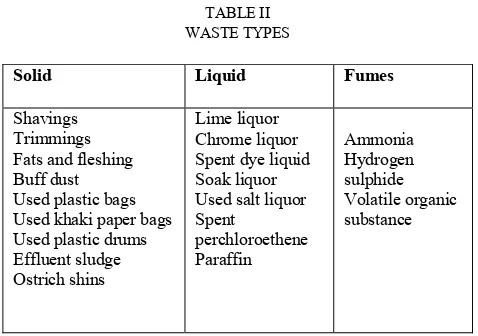
Most waste in the process is treated and discharged into the sewer system, while solids are collected as sludge. All other chemicals are used once and discharged to the treatment plant.
TABLE II WASTE TYPES
Solid Liquid Fumes
Shavings Trimmings Fats and fleshing Buff dust Used plastic bags Used khaki paper bags Used plastic drums Effluent sludge Ostrich shins
Lime liquor Chrome liquor Spent dye liquid Soak liquor Used salt liquor Spent
perchloroethene Paraffin
Ammonia Hydrogen sulphide Volatile organic substance
C. Effluent treatment plant
[image:3.595.309.548.83.251.2]The tannery has a small treatment plant on site for treating process waste.
Tank No.1 in Fig 1 receives waste water from soaking
liming, de-liming and pickling operations section. Tank No.2 receives wastewater from the section where degreasing, pre-tanning, chrome tanning and fat liqouring are done. Tank No. 3 receives wastewater from the dyeing and dry cleaning section. All the waste converge in the storage tank that has a capacity of 3000 cubic metres. From the storage tank the mixed effluent is pumped into a settling tank where treatment chemicals are added. These include flocculants such as aluminium sulphate and an organic coagulant. After settlement a valve is opened to drain sludge from the bottom into sludge beds while the clarified water is released to the municipal drain. The sludge dries by filtration in the sludge beds, while the filtrate flows by gravity back into the storage tank for further treatment. The sludge is loaded into a trailer ready for transportation to the municipal dump. In the absence of effluent treatment chemicals, the mixed effluent is made to circulate from storage tank to the settlement tank and back.D. Effluent quality
Pollution load in treated effluent showed wide swings in values. This was attributed to the batch processes that occur on different days. Effluent flow from the process waste streams was intermittent. The results depended on which operation was in progress within the tannery at the time of sampling. The object of presenting the results however was to establish compliance with effluent quality standards set by the municipal authorities. The results could also be used for identifying areas that require modifications.
Acidity- Effluent from a tannery fluctuates between pHs of 3 to as high as 12. The municipal limit is a range of 6.5-12. Treated effluent within the data review period shown in Fig 2 has complied with the standard once in the month of February 2014, where a pH value of 6.6 was obtained , the lowest value being 4.6. Mixed effluent from the two ends of the pH scale would be expected to come fairly close to the desired range. This is however not the case due to numerous downward adjustments with formic acid that seek to create optimal conditions for chromium and dye uptake.
COD - it is a measure of the chemical reducing power of effluent and hence its ability to destroy potential oxygen content of water. The results indicated that throughout 2013, COD levels were 100 percent non-conforming and only conformed 25 percent of the time in 2014. The highest value within the data review period was 15167mg/1, which fell short of the municipal standard set at 2000mg/1. This value is also unusually high relative to all the other results captured. This pointed to something unusual happening at the time such as a chemicals stock out or shortage. The lowest value achieved is 1721mg/1, which fell well within the stipulated limit. The processes that generate COD were early stages such as soaking (which washes off blood, manure and soluble proteins, liming (which dissolves the skins’ epidermis and material that cements skin fibres together) and the degreasing
and dry cleaning processes that sought to remove fats and greasy material.
Total suspended solids-Tannery treated effluent had improved from complying 33.3 percent in 2013 to complying 50 percent of the time with the standard in 2014, which was pegged at 600mg/1. Solids waste generation is an inherent part of leather processing. The levels of skill in the flaying (skinning) and fleshing operation may have improved during the review period.
Sulphates - Municipal limit for sulphates is considered technically unachievable at 300mg/1. Sulphates are generated by three stages namely the delime stage, the pickle and tannage stages. The delime stage uses ammonium sulphate, the pickle stage uses sulphuric acid and the tannage stage uses chrome sulphate. None of the values attained in 2014 are anywhere near compliance.
Sulphides – this constitute one of the most dangerous pollutants. The major contributor to sulphide pollution is liming operation, which uses sodium sulphide. Processes that generate sulphates in their waste liquors also contribute to sulphide pollution. In oxygen deficient waters, sulphates are reduced to sulphides. Treated waste was compliant 25 percent of the time in 2013 and 42 percent in 2014 with respect to sulphides.
Chromium- chromium discharge was found to be outstanding. It was shown that they were compliant over 75 percent of the time in 2013 and were 100 percent compliant in 2014. Technicians attribute this to their high exhaustion and the rigorous process control, which optimises chromium uptake in the skin. While the results were highly impressive, it is known that when chrome bearing streams are mixed with alkaline effluents at pHs 7.5-9.5, all but 1.0mg/1 is precipitated as hydroxide, and so environmentally, chrome is of more concern in sludge than in treated effluent. Separate treatment of chrome streams is thus necessary for limiting its content in sludge, even in those tanneries achieving high exhaustion.
Chemical usage by process- the largest quantity of chemicals was consumed in the salt washes accounting for 16.1 percent of the total. This was followed by the pre-tan, the chrome tan, the degrease, pickle, re-tan and then dry cleaning each accounting for 15.8, 14.3, 13, 10.4, 9.6, 9.0, and 8.9 percent by mass respectively. The comparison of chemical consumption helps to identify those processes where recycling and reuse alternative can be employed, as well as rationalise consumption levels.
in the hierarchy of usages. They both give off volatile organic fumes and are highly flammable. Perchloroetheneis is recovered and re-used about four time over before disposal. The same can be done for paraffin.
Water-use intensity - Tannery processes invariably take place in water media. At the tannery process water was charged in to tanning drums from a 1000 litre container positioned to facilitate gravity flow. The process of re-tonnage consumed the most water. The consumption is elevated by the fact that the process incorporated some washes that were performed, before during and after re-tanning . It accounts for about 25.9 percent of water consumed .Water consumed by washes before chrome tanning was grouped together and collectively ranks next, accounting for about 20 percent total consumption. Soaking, liming, de-liming and pickling are next. The percentages were per ton of leather from the time it enters the tannery to the time it leaves as finished product.
Comparison of waste generation - fleshing accounted for largest proportion of waste. Two fleshing operations were carried out to remove fat and meat from skin material proper. The quantity of fleshing was affected by the efficiency of the preceeding flaying operation. The total waste generated, 1471 kg was very close to the initial weight of the skins. It was important to note that the skins absorbed chemicals at every stage of operation thus increasing its weight to beyond the initial 1598kg. Fleshing thus accounted for 39.4 percent of the wet salted mass of the skins. Stream dried moisture constituted 23 percent, while dripping the skins of bath liquor rid them of 20 percent of their mass. Chrome shavings and buffing constituted 10 and 6 percent by mass respectively of the waste.
TABLE III
CHEMICAL CLASSIFICATION ACCORDING TO HARZARD
HAZARD CHEMICAL
TOXIC Sodium metabisulphite
Sodium chlorite Perchloroethylene
CORROSIVE Sulphuric acid
Lime Caustic soda Formic acid Sodium sulphide Sodium hydrosulphide
FLAMMABLE Dyes
Paraffin Propanol
Finishing chemical
Hazardous chemical classification - this helps to improve handling and reduce the potential for accidents within the work place. Most suppliers provide guidelines for chemical handling and include safety aspects such as safety clothing. The tannery had chemicals as shown by Table III, which were known to be especially hazardous to warrant special attention so that their quantities in stock, location and movements were traceable at all times.
Odour generation - Odours originating from tannery wastes were difficult to quantity. They were caused by interaction between a variety of compounds. Hydrogen sulphide gas and ammonia from the lining stage constituted the major offenders. The main bad smell sources were found to be; tanning drums, spray booths, mixed effluent tank and sludge beds. For purposes of control and monitoring some sort of quantitative test is required to detect and quantify poisonous gases within the tannery.
Boiler fuel consumption - this relates to fuel consumed by the boiler to provide heat for process work, i.e. hot water or heat for wet work and drying. The boiler emissions were not quantified in this study however it was found that consumption was typically 700kg of coal per days that it takes to conclude a process run, this figure amounts to 14700kg of coal. Steam condensate from the drying plant could be captured and redirected for use as heated process water. This sought to reduce energy consumed in heating process water.
The following pollution problems are evident at the tannery from the data collected: high COD, high total suspension solids(TSS), acidic pH, high sulphate, high sulphide, partially compliant chrome levels, and high salt use-intensity.
VI. CP OPTION RECOMMENDATIONS
The recommendations seek to improve environmental
performance with respect to COD, TSS, Sulphates, sulphide, chromium discharge, pH levels and salt-use intensity. Wet processes require exact quantities and information in order to avoid overdosing and resultant rejection of the product. Documented work procedures are already a key feature in the processing plantNo designated area was marked for preparation of chemicals, and spilled chemicals were observed in the chemicals stores suggesting that sometimes the operation was being performed here. Containers particularly for finishes had residual chemicals on them so that subsequent use made direct exposure to fumes or contact inevitable. A well ventilated and spacious “chemical kitchen” should be designated where all preparations mixing and weighing are done.
The fleshing operation is manual and messy. The dirty floor was washed with running water. The fleshing board can be elevated slightly to allow a plastic bin to be positioned so that fleshing can fall in. At this section adjustments have to be done for the operation to become cleaner and reduce water-use intensity.
It was observed that pH paper was being used for monitoring acidity for chrome tanning and dyeing operation to get qualitative results only. This must be replaced by the pH meter for all operations to enable better process control and reduce potential for mistakes and rejects.
All chemicals used should be recorded in an inventory book to prevent wasting. Material safety data sheet (MSDS) to give toxicity levels and the handling instructions as well as other safety precautions should be readily available in the stores from the suppliers.
Use of pentachlorophenol or arsenic preservatives has to be avoided as the chemicals are carcinogens or cancer causing agents. The impact of removing carcinogenic chemicals is likely to create a hazard free work place with a lower absenteeism rate due to illness.
Alternative tanning method has to be found to replace chrome tanning, possible alternatives include vegetable tanning, aluminium tanning, titanium or zirconium tanning.
Direct processing of raw skins as they come from the abattoir may be considered as the hides do not need curing for preservation and subsequent soaking thereby reducing salt (chloride) consumption and discharge. The uncured hides would only need to be washed and fleshed prior to liming. This process optimization also reduces water use-intensity. Chilling of skins just after flaying is also an option that permits preservation of hides by applying temperatures of 4 degrees Celsius, this allows preservation for up to 3 weeks .This option is high capital intensive in that there are requirements for a large cold room to be built for storage of hides.
Currently the firm uses ammonium sulphate as the main delime chemical. Carbon dioxide can be used in place of ammonium sulphate in the de-liming process. The main advantage of the use of carbon dioxide is the reduction in nitrogen load in the waste water and the reduction in odour nuisance as less ammonia is evolved during the liming operations.
Where the use of chromium is inevitable, measures must be taken to reduce chromium discharge. Chrome tanning is inherently inefficient due low chrome fixation in the tanning bath. Chrome also bleeds out in subsequent wash processes. Wash water from relatively cleaner stages in the process can be recycled particularly where the concentration of residual chemicals is low and has little adverse impact on subsequent stages.
The use of solar energy reduces the frequency of power cut, and products spoiled by power outages. Solar energy can also be used for chilling skins for short-term preservation.
VII. CONCLUSION
This study has shown that the firm has a high use-intensity
of salt. This can be reduced by direct processing of hides after flaying. Direct processing requires careful planning of process runs. The hides cannot be left unprocessed for more than four hours, this period is lower for summer months, after which hide will putrefy and be lost completely. Non-conforming parameters would need to be monitored more closely. Proper plant monitoring not only serves as a tool for evaluating the characteristics of treated effluent in relation to the stipulate standards but also offers deeper control of the step-by-step performance of the tannery and effluenttreatment plant. The major reason for non-compliance is that the effluent treatment plants ( ETP) is too small to cope with the volumes as well as the strength of the waste being discharged. While municipality still carries out snap surveys of discharge into their sewer systems, “the polluter pays” principle is no longer functioning as it should. The cost of polluting is not sufficiently deterrent, to force industrialist to seek alternatives within their production systems to meet the requirements of local governments. The study revealed that the two year period covering 2013 and 2014 effluent quality has only been consistently compliant with chromium discharge.
REFERENCES
[1] Chadra Babu (2004) Salinity Reduction in Tannery Effluents: CLRI Research. LERIG, January 2004. [2] Chandak S.P. (1999). Oral Presentation. Application of
CP & Global Experience. SMED Seminar on How to Increase Profits and Save the Environment through the application of CP. Colombo Sri Lanka, January 1999. [3] Di Iaconi, C., Di Pinto, A.P., Ricco, Tomei, M.C. (2002)
Treatment options for tannery wastewater I: Integrated chemical and biological oxidation, Annali di Chimica, 92, 531-539
[4] Hunt CB, Auster ER (1990). Proactive environmental management: avoiding the toxic trap. MIT Sloan Manage. Rev., 31(2): 7-18.
[5] Meriç, S., De Nicola, E., Iaccarino, M., Gallo, M., Di Gennaro, A., Morrone, G., Warnau, M., Belgiorno, V., Pagano, G. (2005) Toxicity of leather tanning wastewater effluents in sea urchin early development and in marine microalgae, Chemosphere, 61(2), 208-217
[6] Money, Catherine A. Curing of Hides and Skins: Alternative Methods. Australia: CSIRO Leather Research Centre.
http://www.csiro.au/resources/OtherCuringMethods.html. [7] Money C.A. (2003) Utilisation of Total Dissolved Solids by Tannery Effluent Irrigation. Proceedings, Global Benchmarks for Leather Sector, CLRI, Chennai, January 2003.
[8] Money C. A.(2005) Addressing salinity in tannery effluents and uses for land irrigation in Australia and India. World Leather, 2005, 18, 1, 22.
[9] Money C. A. and Chandra Babu N. K. (2006) Salinity reduction in tannery effluent. Leather International, 2006, 208, Jan/Feb 30.
[10] Ramasami T, Chandra Babu N. K, Muralidharan C, Ragava Rao J Saravanan P and Money C. A. (2007) Salinity Reduction in Tannery Effluent. Proceedings, p20-26.
[11] Recommendation on cleaner technology for leather production. http://www.iultcs.org/pdf/IUE1_2008.pdf