
CRITIKAL Consolidated Management Report
18
0
0
Full text
(2) Executive Summary This report analyses the achievements made in the CRITIKAL project against the original objectives and success factors. Most objectives have been achieved. We conclude that the project has been a success in most respects. However, there have been some areas where the envisaged results have not been achieved. These are discussed. The technical results of the project are described and the dissemination activities summarised. The significance of the project is analysed.. This document may be copied and distributed freely in its entirety, provided that due credit is afforded the CRITIKAL Consortium, and all copyright notices remain.. d1.10_public_final1.doc. © CRITIKAL Consortium, 1999. 1 of 16.
(3) Contents Executive Summary ................................................................................................................. 1 Contents .................................................................................................................................... 2 1. Introduction ....................................................................................................................... 3. 1.1. General ........................................................................................................................ 3. 1.2. Structure of the Report .............................................................................................. 3. 1.3. Abbreviations Used in the Report ............................................................................ 3. 2. Management report .......................................................................................................... 4. 2.1. Introduction ................................................................................................................ 4. 2.2. High-level objectives and background..................................................................... 4. 2.3. Changes of context..................................................................................................... 4. 2.4. Achievements and results ......................................................................................... 5. 2.5. Significance of achievements and results............................................................... 12. 2.6. Commercial exploitation ......................................................................................... 13. 2.7. Management............................................................................................................. 14. 2.8. Deliverables .............................................................................................................. 14. 2.9. Publications and dissemination .............................................................................. 14. 3. Exploitation plans ........................................................................................................... 17. 4. Conclusions ..................................................................................................................... 17. d1.10_public_final1.doc. © CRITIKAL Consortium, 1999. 2 of 16.
(4) 1 Introduction 1.1 General This report is the public version of the final report of the CRITIKAL Project (ESPRIT 22700). The project involves the following partners: Attar Software (UK), Gehe (D), Lloyds TSB Group (UK), PAC (UK) and the University of Stuttgart (D).. 1.2 Structure of the Report This document is based on the structure suggested in the EC’s “FINAL REPORT OUTLINE” document (ref. Finrep.doc: final report outline – April 1994 -).. 1.3 Abbreviations Used in the Report The following abbreviations are used throughout the report: SOP:. Start of the project. PM1 etc: Month 1… Month 24 of the project Q1 etc:. First quarter of the project … eighth quarter of the project. Deliverable reference numbers are taken from Table 5.1 in the Technical Annex.. d1.10_public_final1.doc. © CRITIKAL Consortium, 1999. 3 of 16.
(5) 2 Management report 2.1 Introduction Section 2 reports on the main issues of the project and covers • the objectives of the project and the background to it at the time the project commenced; • the major changes in context which have occurred during the project lifetime; • the major achievements and results of the project; • the significance of the achievements and results for the partners, the consortium, and for European industry in general; • a summary of the commercial exploitation opportunities that have resulted from the project; • a summary of the major dissemination activities and publications resulting from the project.. 2.2 High-level objectives and background The basic premise for the CRITIKAL project was that there is a real business need for tools to enable in situ data mining against large databases in a client-server environment. The high level objectives of the CRITIKAL project were to: • demonstrate the potential for adding value to the information assets of organisations in different sectors through effective client-server induction from large corporate data warehouses; • develop and demonstrate an advanced client-server induction system capable of supporting efficient, effective data mining of large databases in business environments; • generate prototypes of a series of enhancements to Attar Software’s XpertRule Profiler product which are enabled by HPC technology and which are commercially exploitable during the lifetime of the CRITIKAL project; and • generate a body of large-scale data mining experiences, from both the financial and pharmaceuticals wholesale sectors, which will form the basis for generic dissemination and specific marketing activities. To meet the CRITIKAL project objectives, a key technical objective was the development of an innovative 3-tier rule induction architecture. It was proposed that such an architecture would flexibly support several client-server processing models, and thus be deployable in a wide range of user situations. The architecture would provide scope for optimising mining performance, particularly where the data to be mined is held on parallel HPC platforms.. 2.3 Changes of context As the project was being set up in 1996 the emerging data mining industry was primarily selling algorithms and essentially standalone tools. At the outset, CRITIKAL. d1.10_public_final1.doc. © CRITIKAL Consortium, 1999. 4 of 16.
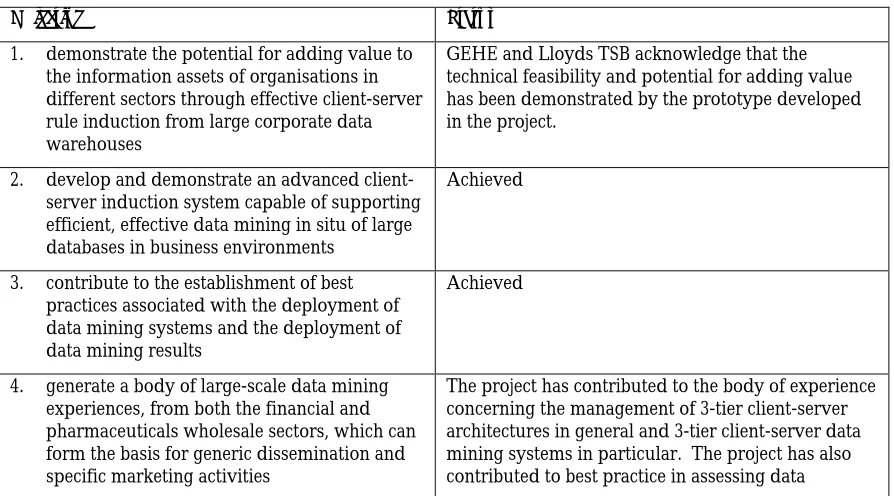
(6) encapsulated the vision of making data mining more deployable in a corporate environment by enabling algorithms and tools to be delivered in a way that fits within, and complements, existing IT infrastructures. Early in the life of the project it became evident that implementing data mining systems in a way that fits with corporate IT infrastructures would not be sufficient to fully address the requirements for corporate adoption of data mining. An additional requirement was identified for a reusable data mining process to enable data mining projects to be planned and executed with confidence. BWI led the task of developing a data mining process. This process was based largely on the accumulated experience of Attar Software and Lloyds TSB and on information sourced from the literature. After this decision was taken and the work was well underway, the CRISP-DM project aimed specifically at developing a tool independent process for data mining was started. At the outset of CRITIKAL only IBM among the mainstream IT industry players had a serious data mining offering. During the lifetime of CRITIKAL, data mining has become a component of the offering from other major suppliers such as Business Objects, NCR, and SAS Institute, but the marketplace currently has no dominant players. There has been a steady growth in the number of small and start-up data mining suppliers and there has been an increasing awareness among potential users of the real potential of data mining. During the lifetime of CRITIKAL, therefore, there has been no step-change in the shape or structure of the marketplace for data mining.. 2.4 Achievements and results 2.4.1 Analysis Table 1 contains a comparison of achievements and results against the detailed objectives, envisaged project results and success measures contained in the Project Programme. In the public version of this report some analysis has been removed for purposes of commercial confidentiality. Objective. Status. 1.. demonstrate the potential for adding value to the information assets of organisations in different sectors through effective client-server rule induction from large corporate data warehouses. GEHE and Lloyds TSB acknowledge that the technical feasibility and potential for adding value has been demonstrated by the prototype developed in the project.. 2.. develop and demonstrate an advanced clientserver induction system capable of supporting efficient, effective data mining in situ of large databases in business environments. Achieved. 3.. contribute to the establishment of best practices associated with the deployment of data mining systems and the deployment of data mining results. Achieved. 4.. generate a body of large-scale data mining experiences, from both the financial and pharmaceuticals wholesale sectors, which can form the basis for generic dissemination and specific marketing activities. The project has contributed to the body of experience concerning the management of 3-tier client-server architectures in general and 3-tier client-server data mining systems in particular. The project has also contributed to best practice in assessing data. d1.10_public_final1.doc. © CRITIKAL Consortium, 1999. 5 of 16.
(7) exploitation systems in data warehousing environments. While the CRITIKAL system has had some exposure to business users, the project has not led to the anticipated volume of experiences from a business perspective. 5.. generate prototypes of a series of enhancements to Attar’s XpertRule Profiler product set which are enabled by HPC technology and which are commercially exploitable starting during the lifetime of the CRITIKAL project. Achieved. 6.. end-users to add value to their investment in corporate data warehousing strategies for decision support. GEHE and Lloyds TSB acknowledge that the technical feasibility and potential for adding value has been demonstrated by the prototype developed in the project.. 7.. be able to understand and quantify the business benefits obtainable from the deployment of data mining in support of specific business functions within their respective companies. Lloyds TSB have established a central Data Exploitation and Data Mining Practice. Projects undertaken by the Practice are supported by a business case. The CRITIKAL data mining process emphasises the need to identify and understand the business benefits of a specific data mining project. GEHE are not yet at the point where they are seeking to implement data mining within the business. This point is likely to occur during 1999. CRITIKAL has given GEHE a good qualitative understanding of what is achievable from data mining, but not the quantitative understanding the would be required for the development of a business case.. 8.. understand the productivity, organisational and strategic implications of different ways of deploying data mining within their respective companies. Both end-users have gained insight into the organisational structures and architectural and systems implications of implementing data mining. It is too early to formulate any substantial analysis of productivity.. Envisaged results 9.. proven prototype of a 3-tier implementation of Attar’s Profiler rule-induction system capable of flexibly addressing the data mining needs of large corporate users. The 3-tier architecture will flexibly support a variety of client-server processing models to enable user organisations to implement the technology in a way which best suits their specific user load profiles and IT infrastructure.. Achieved. 10. query optimisation methodologies and software to improve the response times of queries issued against parallel RDBMSs by the decision tree builder. Methodologies for optimising performance against Oracle and Teradata have been developed, and experiments conducted. The identified optimisations have not all been implemented into the CRITIKAL system.. 11. generic optimisation methodologies and software for decision tree construction against large databases. This will include the development of intelligent software to reduce database accesses by implementing decision tree construction algorithms which use only a limited (sampled) subset of the database for. Methodologies for optimising performance against Oracle and Teradata have been developed, and experiments conducted. The identified optimisations have not all been implemented into the CRITIKAL system.. d1.10_public_final1.doc. © CRITIKAL Consortium, 1999. 6 of 16.
(8) node branching decisions at, and close to, the root node, and which use the whole database in situ in order to maintain decision tree accuracy near to the leaves. 12. example tree-node evaluation server based RDBMS query generation modules (for Teradata and Oracle) enabling the SQL which is generated during decision tree construction to exploit the specific performance features of particular RDBMSs. Methodologies for optimising performance against Oracle and Teradata have been developed, and experiments conducted. The identified optimisations have not all been implemented into the CRITIKAL system.. 13. a software framework enabling the specification of virtual (composite) attributes and their use in the construction of decision trees. DataPrep is a project output that enables composite attributes to be specified and generated. DataPrep demonstrates the functionality and look and feel that is required of a 3-tier client-server tool. However, DataPrep does not work against data in situ or in a 3tier architecture.. 14. a software framework enabling the analysis of time series (transactional) data using ruleinduction data mining and association rules discovery. Support for the analysis of transactional data is provided by the association rules discovery technology. DataPrep also provides a demonstration of the support required for data transformation of time series data.. 15. software enabling the generation of the profiles which result from rule-induction as both SQL (enabling their reuse) and as OLE2 objects (enabling their use by other client desktop packages). Profiles can be deployed as both SQL and Windows Metafile objects.. 16. technological developments will be tested and demonstrated against the specific application requirements of the end users in the CRITIKAL consortium. Achieved. Success measures 17. Subjective measures of value to individual users will be made. Both end-users have held workshops with users that have yielded subjective assessments of value.. 18. show that the resulting technology can be embedded in the decision making processes of the end-users and that it can be effectively used to aid the creation of business solutions. Issues such as tool usability and user acceptance, user perceptions of performance associated directly with operations that specific users wish to carry out, ease of deployment, efficiency of resource consumption, networking demands, reliability, and integrability with existing infrastructures will all figure in the overall judgement as to whether the specific technological results of the project are successful or not.. GEHE and Lloyds TSB acknowledge that the technical feasibility and potential for adding value has been demonstrated.. 19. be able to identify tasks for which the data mining tools are better suited than existing tools, or tasks which are made possible through the use of data mining tools, but are not possible with other tools. Deliverable D2.3 Guidelines for the Data Mining Process contains a suitability checklist.. 20. be able to assess and quantify the costs associated with licensing, installing, maintaining, managing, resourcing and. Achieved for installing, maintaining, managing, resourcing and training via the data mining process.. d1.10_public_final1.doc. Issues associated with usability, performance, efficiency of resource consumption, networking demands, reliability, integrability with existing infrastructures have been addressed with positive results. However, it has not yet been possible to provide convincing evidence of impact in a business context.. © CRITIKAL Consortium, 1999. 7 of 16.
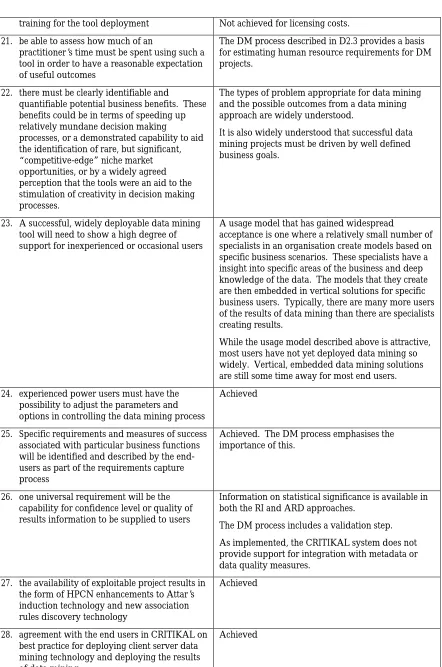
(9) training for the tool deployment. Not achieved for licensing costs.. 21. be able to assess how much of an practitioner’s time must be spent using such a tool in order to have a reasonable expectation of useful outcomes. The DM process described in D2.3 provides a basis for estimating human resource requirements for DM projects.. 22. there must be clearly identifiable and quantifiable potential business benefits. These benefits could be in terms of speeding up relatively mundane decision making processes, or a demonstrated capability to aid the identification of rare, but significant, “competitive-edge” niche market opportunities, or by a widely agreed perception that the tools were an aid to the stimulation of creativity in decision making processes.. The types of problem appropriate for data mining and the possible outcomes from a data mining approach are widely understood.. 23. A successful, widely deployable data mining tool will need to show a high degree of support for inexperienced or occasional users. A usage model that has gained widespread acceptance is one where a relatively small number of specialists in an organisation create models based on specific business scenarios. These specialists have a insight into specific areas of the business and deep knowledge of the data. The models that they create are then embedded in vertical solutions for specific business users. Typically, there are many more users of the results of data mining than there are specialists creating results.. It is also widely understood that successful data mining projects must be driven by well defined business goals.. While the usage model described above is attractive, most users have not yet deployed data mining so widely. Vertical, embedded data mining solutions are still some time away for most end users. 24. experienced power users must have the possibility to adjust the parameters and options in controlling the data mining process. Achieved. 25. Specific requirements and measures of success associated with particular business functions will be identified and described by the endusers as part of the requirements capture process. Achieved. The DM process emphasises the importance of this.. 26. one universal requirement will be the capability for confidence level or quality of results information to be supplied to users. Information on statistical significance is available in both the RI and ARD approaches. The DM process includes a validation step. As implemented, the CRITIKAL system does not provide support for integration with metadata or data quality measures.. 27. the availability of exploitable project results in the form of HPCN enhancements to Attar’s induction technology and new association rules discovery technology. Achieved. 28. agreement with the end users in CRITIKAL on best practice for deploying client server data mining technology and deploying the results of data mining. Achieved. Table 1. Comparison of achievements and results against the detailed objectives, envisaged project results and success measures d1.10_public_final1.doc. © CRITIKAL Consortium, 1999. 8 of 16.
(10) d1.10_public_final1.doc. © CRITIKAL Consortium, 1999. 9 of 16.
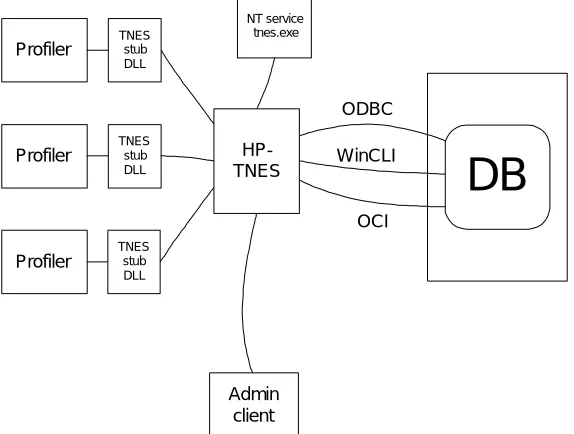
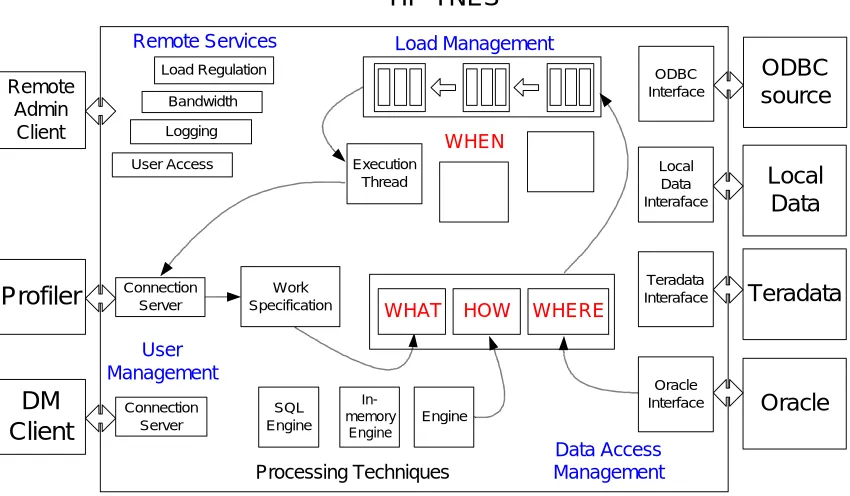
(11) 2.4.2 Software results The CRITIKAL system contains several software components: • Support for association rules discovery DLL in CAF • Association rules discovery DLL • TCP/IP wrapper for CAF: socket.exe • Stub DLLs for HP-TNES and Proxy • NT service .EXEs for Proxy and HP-TNES • HP-TNES • Proxy • Administration client • Results deployment modules Profiler, not as standalone DLLs. n.b. these are implemented as options within. • DataPrep– n.b. as developed in CRITIKAL DataPrep is a standalone 2-tier clientserver tool The role of these components in the CRITIKAL Phase 2 implementation and CRITIKAL Phase 3 implementation is illustrated in Figures 1 and 2 respectively. Figure 3 provides a detailed architectural analysis of the HP-TNES component.. Profiler. TNES stub DLL. NT service tnes.exe. ODBC Profiler. TNES stub DLL. Profiler. TNES stub DLL. HPTNES. WinCLI. DB. OCI. Admin client. Figure 1. CRITIKAL Phase 2 architecture. d1.10_public_final1.doc. © CRITIKAL Consortium, 1999. 10 of 16.
(12) Profiler. NT service proxy.exe. Proxy stub DLL. Proxy Profiler. Proxy stub DLL. Profiler. Proxy stub DLL. OCI. HPTNES. ODBC socket. exe. CAF. socket. exe. CAF. ODBC. DB. ODBC. CAF. Admin client. Support for ARD DLL. ARD DLL. Figure 2. CRITIKAL Phase 3 architecture with expanded association rules discovery (ARD) component. HP-TNES Remote Services. Load Management. Load Regulation. Remote Admin Client. ODBC Interface. Bandwidth Logging. WHEN. User Access. Profiler. Connection Server. Execution Thread. Work Specification. WHAT. HOW. WHERE. User Management. DM Client. Connection Server. ODBC source Data. SQL Engine. Inmemory Engine. Engine. Processing Techniques. Local Data Interaface. Local Data. Teradata Interaface. Teradata. Oracle Interface. Oracle. Data Access Management. Figure 3. Detail architecture of the HP-TNES component showing an example execution path.. d1.10_public_final1.doc. © CRITIKAL Consortium, 1999. 11 of 16.
(13) 2.4.3 Process results A data mining process has been developed in CRITIKAL. This is described in deliverable D2.3, which is a publicly available document downloadable from the CRITIKAL website http://www.pac.soton.ac.uk/critikal.. 2.5 Significance of achievements and results 2.5.1 CRITIKAL partners Attar Software The results of CRITIKAL have played a significant role in shaping the next generation of data mining products from Attar Software. The CRITIKAL architecture is now fundamental to the architecture of Attar’s products, the CAF has already been productised, CRITIKAL user input has shaped the front-end/usability characteristics of the new products, and the performance optimisation results will be reused. BWI CRITIKAL has contributed to BWI’s generic knowledge of process and its analysis approaches for process description. BWI have enhanced their reputation in this area, particularly through the publications they have made that describe their work. CRITIKAL has also contributed to BWI’s specific knowledge of the data mining process. IPVR IPVR has enhanced its reputation for research in data mining through participation in CRITIKAL, particularly through their conference publication. New projects building on the research work carried out in CRITIKAL are being planned (e.g. a German funded data mining project combining data mining and visualisation including VR techniques, the result of this proposal are due Feb. 1999). CRITIKAL has also provided useful knowledge that is being used as a basis for data mining teaching activities. GEHE Prior to the CRITIKAL project, GEHE had no direct experience of data mining. CRITIKAL has enabled GEHE to understand • the potential benefits of data mining, • how to manage the introduction of data mining, • how to assess data mining tools, • the training requirements associated with introducing data mining, • how to implement data mining projects, and • how to exploit the results of mining activities. While CRITIKAL has not led to the immediate uptake of data mining, this is due to where GEHE are in their data warehousing project lifecycle rather than any failing of data mining. In addition to data mining related issues, CRITIKAL has contributed to GEHE’s understanding of the benefits and management issues associated with multi-tier clientserver architectures.. d1.10_public_final1.doc. © CRITIKAL Consortium, 1999. 12 of 16.
(14) Lloyds TSB At the outset of CRITIKAL Lloyds TSB already had substantial expertise in data exploitation processes and data mining. CRITIKAL has reinforced and augmented these processes and the knowledge associated with them. CRITIKAL has provided particularly high added value for Lloyds TSB • by aiding understanding of the benefits and management issues associated with multi-tier architectures, • by providing a data mining project lifecycle, and • by giving Lloyds TSB insight into trends in the data mining industry. In addition, Lloyds TSB have benefited from insight into the software development lifecycle for advanced data exploitation products, they have evolved existing software evaluation frameworks to take account of multi-tier architectures, and they have gained experience of the management issues associated with NT in a corporate network environment. PAC Participating in CRITIKAL has enabled the PAC to augment its systems design and implementation skills. It has enabled the PAC to establish strong credentials in the introduction and implementation of data mining capabilities. CRITIKAL has provided the PAC with access to a data mining process and it has enabled us to work directly with end users as they experiment with the application of data mining. 2.5.2 European industry While the CRITIKAL brand name will not persist beyond the end of the project, the technological advances will live on. CRITIKAL will have a most direct impact on the product range offered by Attar, with this in turn enabling Attar’s end user customers to deploy data mining more effectively than was previously possible. More generally, CRITIKAL has contributed to the increasing maturity of the emerging data mining industry. With its emphasis on the balance between fit with infrastructure, process, and tools, CRITIKAL has been in the vanguard of development activities that have addressed the real needs of large companies in deploying data mining. It was asserted in the proposal to the EC that CRITIKAL was highly innovative in its approach to implementing data mining, and that the consortium was leading the world. The emerging data mining industry has reinforced this positioning, with recent announcements by ISL (with their CHESS product) and Angoss (with their KnowledgeSERVER product and In-Place Mining Drivers) helping to validate the architecture and approach taken in CRITIKAL. The CRITIKAL consortium still believes that it is ahead in terms of the manageability and control (and therefore capability to fit within corporate IT infrastructures).. 2.6 Commercial exploitation The results of the CRITIKAL project have played a significant role in shaping the next generation products from Attar Software. These products have been announced at the Data Warehouse98 Show at London-Olympia in November 1998 and will start shipping in January 1999. The results of CRITIKAL have been exploited in the new products as summarised below:. d1.10_public_final1.doc. © CRITIKAL Consortium, 1999. 13 of 16.
(15) • XpertRule Miner is Attar’s new data mining environment. It supports the data mining process developed in CRITIKAL by supporting all the stages of such a process from data preparation, transformation and exploration to pattern generation, validation, deployment and monitoring. The graphical front end of XpertRule Miner uses the design of DataPrep. • The architecture of XpertRule Miner uses the multi-tier client server design of CRITIKAL. Attar has implemented a middle tier Proxy server and a number of CAF servers. Attar Software also plans to exploit the performance optimisation techniques researched in CRITIKAL. • The new data mining Client ProfilerX has been completely redesigned to incorporate the end user feedback on usability, pattern presentation and deployment. ProfilerX is an ActiveX client which can be seamlessly embedded in other front end applications. Attar Software is also using the Data Mining Process developed within CRITIKAL in its data mining training programmes.. 2.7 Management <<This section removed in public version of report.>>. 2.8 Deliverables <<This section removed in public version of report.>>. 2.9 Publications and dissemination 2.9.1 Conference and seminar presentations and workshop participation Event. Date. Presenter/participant. 7th International Workshop on Research Issues in Data Engineering: High Performance Database Management for large Scale Applications: RIDE’97 Conference, Birmingham. 7-8.4.97. A Al-Attar, Attar P J Allen & M J Addis, PAC. Unicom Data Mining Conference, London. 24.6.97. C Upstill, PAC. IBM SP World, London. 28-29.10.97. C Upstill, PAC. CRISP-DM SIG meeting, Amsterdam. 20.11.97. A Al-Attar, Attar C J Scott, PAC. HPCnet Effective Knowledge Discovery workshop, Milan. 4.7.97. A Al-Attar, Attar B Barham & D Nisbet, Lloyds TSB P J Allen, C J Scott & C Upstill, PAC. UK Industrial IT Forum meeting, Sheffield. 25.2.98. A Al-Attar, Attar. EPCC seminar on Data Mining for Financial Services, Edinburgh. 1.4.98. A Al-Attar, Attar S Hellberg, PAC. Unicom seminar: Data Mining Business Benefits, London. 28.4.98. A Al-Attar, Attar. Operational Research Society Conference, Lancaster. 8.9.98. A Al-Attar, Attar. CRITIKAL seminar: Scalable Client-Server Data Mining: Technologies, Management, London. 9.12.98. A Al-Attar & H Al-Attar, Attar W Schneider & V Wenzel, GEHE. d1.10_public_final1.doc. © CRITIKAL Consortium, 1999. 14 of 16.
(16) B Barham, A Douthwaite & D Nisbet, Lloyds TSB M J Addis, P J Allen, C J Scott & C Upstill, PAC T Barth, BWI Unicom seminar: Data Mining in the Energy & Process Industries, London. 10.12.98. A Al-Attar, Attar. MicroStrategy Congress. 12.98. W Schneider, GEHE. 'A Multi-Tier Architecture for. 1999. H Schwarz & R Rantzau, IPVR. 1999. H Schwarz & R Rantzau, IPVR. Presentation to. Date. Participants. U of Southampton Concurrent Computation Group. 24.2.98. M J Addis, PAC. GEHE business users. various. S Weh, GEHE. Lloyds TSB General Insurance. 10.12.98. H Al-Attar, Attar D Nisbet, B Barham & A Douthwaite, Lloyds TSB M J Addis, PAC. U of Stuttgart BWI. 24.8.98. T Barth, BWI. Internal seminars on data warehousing and data mining. summer 1998. H Schwarz & R Rantzau, IPVR. High-Performance Data Mining' has been accepted for the conference: Fachtagung Datenbanksysteme in Buero, Technik und Wissenschaft (BTW99). Paper on ARD in 3-tier architecture in preparation. 2.9.2 Internal presentations. 2.9.3 Third party briefings <<This section removed in public version of report.>> 2.9.4 Papers and articles Al-Attar, Akeel, CRITIKAL: Client-server Rule Industion Technology for Industrial Knowledge Acquisition from Large Databases, in: Proceedings of the RIDE’97 Workshop Barth, Tilmann; Hertweck, Andreas (1998), Kognition und Information. Data Mining - intelligenter Helfer in der Datenlawine, in: IT-Managment, o.Jg. (1998), Nr. 10, S. 28-34 (German) Barth, Tilmann; Hertweck, Andreas (1999), Das Management von Data Mining Prozessen - strategische und operative Aspekte (provisional title), in: Computerworld Schweiz, to be edited in 1999 (German) Rantzau, Ralf; Schwarz, Holger, A Multi-Tier Architecture for High-Performance Data Mining to appear in: Proceedings of BTW99. d1.10_public_final1.doc. © CRITIKAL Consortium, 1999. 15 of 16.
(17) 2.9.5 Publicly available reports At the time of writing, CRITIKAL report “Guidelines for the Data Mining Process” (D2.3) was available for download from http://www.planung.bwi.uni-stuttgart.de/ and http://www.pac.soton.ac.uk/critikal/. CRITIKAL reports “Data Warehouse Design: the Impact of Data Mining” (D2.4) and “Best Practice” (D8.3) will be available shortly from http://www.pac.soton.ac.uk/critikal/. 2.9.6 Project poster and flier The PAC produced a CRITIKAL poster and flier (see Figure 4) for use at the CRITIKAL seminar.. Figure 4. CRITIKAL poster and flier 2.9.7 Website The PAC has developed a website for CRITIKAL at http://www.pac.soton.ac.uk/critikal/. This will continue to be supported for at least six months after the end of the project. 2.9.8 Demonstrator Attar and the PAC have implemented a Web-accessible demonstration of the CRITIKAL system. This was publicly demonstrated for the first time at the CRITIKAL seminar on 9 December 1998. It can be accessed on http://194.164.24.39/critikal.. d1.10_public_final1.doc. © CRITIKAL Consortium, 1999. 16 of 16.
(18) 3 Exploitation plans <<This section removed in public version of report.>>. 4 Conclusions In CRITIKAL, the partners sought to establish a position of leadership in the data mining industry. They have successfully achieved most of the objectives of the project. In particular, the technical feasibility, manageability and usability of multi-tier clientserver mining against large data warehouses within the IT infrastructures found in large companies have been successfully demonstrated. No one else has yet demonstrated the capabilities that have been demonstrated in CRITIKAL. With recent announcements from vendors like Angoss and ISL, the vision represented in the CRITIKAL project seems to be receiving validation. Attar Software has already announced product technology featuring developments made in CRITIKAL. All partners in CRITIKAL have acquired significant knowledge from participation. This knowledge is being reused in a wide range of activities including research, teaching, process improvement, system engineering and project management. The overall success of the project is, however, moderated slightly by the fact that no substantial, real-world business problem has been undertaken using the CRITIKAL system.. d1.10_public_final1.doc. © CRITIKAL Consortium, 1999. 17 of 16.
(19)
Figure
+2

Related documents