3: GENDER DIFFERENCES IN ONLINE DATING
EXPERIENCES
MILENA R. LOPES AND CARL VOGEL
Online dating applications have emerged in the mobile device industry as a powerful tool to connect people and facilitate relationship formation or casual dates. Tinder is one of these applications, and forms part of a trend among young people, who tend to engage with new technologies and intensively interact with each other in virtual environments. There are some benefits associated with the use of such applications. Compared to offline courtship, using applications may save time, provide a greater level of privacy, anonymity, and safety (within a virtual environment), and allow the user to engage with many users simultaneously.
The advance of hookup culture is intrinsically connected to the rise of online dating. A hookup is defined as a casual sexual interaction (which can include intercourse or not) without the exclusivity and commitment of a romantic relationship.1 In this context of hookup culture, studies have revealed that women have a lower sexual desire and sexual attitudes in comparison to men2 and that men are more likely to benefit from hookups,3 probably due to gender differences in social stigma associated with casual sex.4 A different study, however, attributed the willingness to engage in sexual activity to personality traits rather than gender.5 Armstrong, England, and Fogarty6 suggested that gender inequality affects sexual enjoyment in hookups for women and argued that a lack of concern with women’s pleasure in casual sex was reported by both men and women. Those differences over the willingness to engage in hookups as well as enjoyment during encounters highlight the importance of considering both men's and women's needs in the design of the experience of online dating applications. The experience designed for an application is most readily tangible to users in the interface, which functions partly as an interface for the user to the application itself, and partly as an interface to other users.
1 Armstrong, E. A., England, P., & Fogarty, A. C. K. (2010). Orgasm in college hookups and relationships. In B. Risman (Ed.), Families as they really are (pp. 362–377). W.W. Norton; Bogle, K. A. (2008). Hooking up: Sex, dating, and relationships on campus. NYU Press; Wade, L. (2017). American hookup: The new culture of sex on campus. WW Norton & Company.
2 Petersen, J. L., & Hyde, J. S. (2010). A meta-analytic review of research on gender differences in sexuality, 1993-2007. Psychological Bulletin, 136(1), 21-38. doi:10.1037/a0017504.
3 Bogle, Hooking up.
4 Allison, R., & Risman, B. (2013). A double standard for “hooking up”: How far have we come toward gender equality? Social Science Research, 42, 1191-1206. doi:10.1016/j.ssresearch.2013.04.006. 5 Vrangalova, Z., & Ong, A. D. (2014). Who benefits from casual sex? The moderating
role of sociosexuality. Social Psychological and Personality Science, 5(8), 883-891. doi:10.1177/1948550614537308.
Our past work attempted to assess users' experience of Tinder. Data collected from female users of Tinder revealed that a great number of women felt frustrated (43%) and disrespected (35%) after using Tinder and reported experiencing some kind of offensive behavior towards them (70%), as a direct sexual approach and sexist remarks.7 Moreover, 85% of respondents said they believed that the developer was a man and 60% believed that men and women usually have different motivations to use Tinder.8 These numbers indicate that there is a perception of gender dimension linked to the personal experience of using Tinder.
However, these findings are not indicative of a gender difference in response to Tinder itself, since it is restricted to the perception by female users only. In the study reported here we expand the perspective to male users (through a fresh recruitment of participants including both males and females) and examine their reflections on Tinder in the attempt to map gender differences. In order to assess women’s and men’s experiences, we rely on the graphical user interface (GUI) as the main channel of communication though mobile application, which highlights the design of the interaction through visual outputs. Thus, we analyze the user experience by assessing their impression of the GUI and their impression of another users’ behavior.
The objective of this study is to determine whether there is a genuine difference between female and male user’s experience and perception with regards to the motivations to use the application, to the perception of the interface, to the perception of the benefits and downsides of the application, to their reflection on well-being (feeling respected), to their perception of gender differences, and to the acceptance and adoption of the application. We detail the research methods and exact questions tested and report results noting where gender differences were statistically significant. Following discussion of these results, we conclude with an indication of next steps. We emphasize that we have no personal or corporate connections to Tinder; this research is not funded by that company nor by any of its competitors. Additionally, the study we report here and our prior work that we cite were approved by the Research Ethics Committee of the School of Computer Science and Statistics of Trinity College Dublin, the University of Dublin.
Earlier Explorations
Recently, we carried out a study to explore the perceptions women hold about online dating applications.9 Tinder was selected for that pilot investigation due to its popularity. Tinder makes it easier to connect people, initially in a virtual space. Based on Tinder’s reports,10 the application is in use in more than 190 countries and makes possible one million dates per week. According to the company, the application is focused on bringing people together and promoting connections that would not be possible without the benefit of interaction in
7 Lopes, M. R., & Vogel, C. (2017b). Women's perspective on using Tinder: A user study of gender dynamics in a mobile device application. In Proceedings of the 35th ACM International Conference on the Design of Communication (p. 12). ACM. doi:10.1145/3121113.3121220.
8 Lopes & Vogel, Women’s perspective on using Tinder. 9 Lopes & Vogel, Women’s perspective on using Tinder.
the virtual realm.
The original study employed a non-probability convenience sample (N=40) of Brazilian female Tinder users and adopted a mixed methods approach incorporating both qualitative and quantitative data analysis. The qualitative analysis made it possible to understand female users’ motivations, expectations and experience through the application, and the posterior quantitative analysis allowed us to judge whether the application considered their needs and provided them with a good experience. The study11 revealed that 70% of the respondents experienced offensive behavior during dialogues with male users and that more than 50% uninstalled the application after facing a frustrating experience. Participants characterized their experiences in abstract terms, without necessarily providing examples of episodes that underpin their descriptions. Concepts like ‘frustration’ that emerge from users are not possible in the data collected to disambiguate between, for example, frustration with the interface and the software interactions it requires and frustration with the types of interactions with other users that were experienced through the software. Furthermore, the women, tended to look for friendship and/or a relationship and met these aims using the application. However, the majority also reported that they eventually uninstalled the application due to a negative overall experience. These figures, while taken cautiously due to the small sample size, arguably indicate that Tinder, the most popular dating application, disregards women’s needs and expectations. The findings show that female users are quite likely to face a frustrating experience, even when they get what they want from the application. In other words, the application may meet their expectations regarding the motivation to use it but at a high cost: the large number of reported offensive behaviors (such as unwanted direct sexual approaches and sexist remarks) indicates a sensitive gender dynamic and the presence of sexist behavior among users of the application. The subjective analysis reveals that women used Tinder in the absence or unawareness of better online alternatives for dating.
Our initial study highlights three facts that are important to the development of a wider research plan to investigate gender bias in the interactions enabled by dating applications. First, the high percentage of reported allegedly sexist behavior indicates the possible presence of harmful dynamics among the service users, although the causes are not yet clear. Second, the high percentage of women who believe that the developer is a man sheds light on gender effects in the perception of design – if female users believe the application to be designed by men, they may be inclined to feel it is designed for men, more than for women, and therefore it is interesting to know if both male and female users have the same perception about the design. Third, the rate of overall dissatisfaction reported by women points to a problem regarding the design of the application that can be related to gender biases during the planning stages of the design of the online dating experience. The last two facts are very likely to be caused by gender biases in design, and, the first, although not clear, could be either a consequence of design or worsened by design. It is safe to assume
11 Lopes, M. R., & Vogel, C. (2017a). Gender bias on Tinder: Transforming an exploratory qualitative survey into statistical data for contextualized interpretation. In A. Costa, L. Reis, F. Souza, & A. Moreira (Eds.),
that sexist behaviors exist independently of Tinder and to realize that women interacting with men outside this computer application also have negative (and positive) experiences. However, in presenting Tinder as an application that makes establishing relationships easier, one might imagine that its developers considered that it could provide an environment in which negative experiences are minimized, relative to the alternative of not using such an application. One might imagine that its design attended to the perspective of both males and females in its formulation. We emphasize the design of the application as the visual product of a communication project that is developed to attend user’s needs and expectations and within which the GUI highlights the outcomes of that project. The aesthetics of interactive system carries instructions of how to use it12 and, consequently, is embedded with the designer beliefs and perspectives of the system.13
However, that initial study left open the possibility that men have the same perception women have of the dynamics in online dating applications and may also be largely dissatisfied with their experience on Tinder. Therefore, we repeat the study with subjects from both genders in order to examine differences of motivation, expectations, and perceived experience and to gather evidence that can indicate whether the application appears to prioritize the needs of one gender more than the other.
Method
In order to identify whether significant gender differences in the perception of the experience of Tinder exist, we repeated the same survey we conducted in 2016 with women, but now with both men and women. The method is identical to the one used in the previous study.14 Specifically, we conducted the survey online (the questions are listed below), using Qualtrics, and asked the same questions that were asked in the previous survey. As in the previous study, participants were recruited through online social media. The survey was presented in the format of a structured interview. Even though the interview consisted mainly of open-ended questions, which facilitate the elicitation of different perspectives.15 These responses were then coded as described below. We also handled the coded data quantitatively using a mixed method approach,16 essentially analyzing contingency tables according to gender and response categories.
12 Petersen, M. G., Iversen, O. S., Krogh, P. G., & Ludvigsen, M. (2004). Aesthetic interaction: A pragmatist’s aesthetics of interactive systems. In 5th conference on designing interactive systems: processes, practices, methods, and techniques (dis ’04). doi:10.1145/1013115.1013153; Bannon, L. J., & Bødker, S. (1989). Beyond the interface: Encountering artifacts in use. DAIMI Report Series,18(288). doi:10.7146/dpb.v18i288.6666.
13 Winograd, T. (1986). A language/action perspective on the design of cooperative work. In Proceedings of the 1986 ACM conference on computer-supported cooperative work (pp. 203-220). doi:10.1207/ s15327051hci0301_2.
14 Lopes & Vogel, Women’s perspective on using Tinder.
15 Patton, M. Q. (2002). Qualitative research and evaluation methods. SAGE.
RECRUITMENT AND PARTICIPANTS
Recruitment was conducted through social media. We took advantage of our personal relationships to distribute the survey. The call for participation was posted in one of the researchers’ Facebook and Whatsapp groups with a brief explanation of the study and the link to Qualtrics. Volunteers found the information for participants and the consent to participate in the first page of the survey. In total, 61 participants completed the interview. Of these, we analyzed the data of 29 males and 25 females. Men looking exclusively for men (1 participant) and women looking exclusively for women (7 participants in total) were excluded from the analysis, since we were unable to run tests that analyze whether homosexuality as factor revealed a different gender impact, given the usual assumptions for minimum numbers of expected values (i.e., 5) in each cell of resulting contingency tables. As we analyzed the perception of gender and gender dynamic within the communication through online applications, we focused primarily on heterosexual individuals since heterosexual connections serve as a starting point to understanding gendered expressions in the dating realm and biases in design. All the participants were Brazilian except for 7 males who came from European countries. All in all, the sample is qualified as a non-probability convenience sample composed of 54 heterosexual participants aged 20 to 52 years old who used Tinder at least once to meet possible partners.17 Although our findings cannot be extended to the whole population of Tinder’s users (not least because we do not here report on the data of users seeking same sex matches), it reveals several differences that give a picture of the gender dimension of dating applications.
STRUCTURED INTERVIEW
The structured interview is used in this research because we wanted to learn about the users' experience and to obtain spontaneous answers. To avoid potential bias, we did not reveal the purpose of the study to the participants until they finished the interview which had both English and Portuguese versions. It was composed of 16 questions, plus several more concerning personal information (gender, age, sexual preference and nationality). Below, we provide the questions in English, and add a brief explanation for each. Open-ended questions were incorporated in the hope to that participants would expand on their thoughts. This included adopting questions that we felt open to interpretation as well as creating possibilities for open responses (we hoped that responses would in those cases reveal interpretations of the questions).
Question 1 - 'Why did you install the application? What were you looking for and what were your expectations?’ This question was posed to understand the motivations for using Tinder.
Question 2 - 'Did you have to ponder before installing Tinder? Why?’ We wanted to know if there was any preconceived idea about Tinder related to concerns or fears that could discourage installation.
Question 3 - 'What was your first impression when you started using the app?’ With this question we wanted to find out what users felt about the application, before they had a complete experience of it. First impressions can reveal how the graphical user interface meets users’ expectations.
Question 4 - 'How did you feel about your first matches?’ In this question we invite users to recall the feeling they had when they first matched with someone using the application.
Question 5 - 'How did you feel about the application’s approach and the match-based interaction?’ This question aims to reveal what users thought about the interaction and the interface.
Question 6 - 'What are the positive aspects of your experience? Tell me about some remarkable situations.’ From this question we hope to learn about the perception of a ‘good’ experience.
Question 7 - 'What are the negative aspects of your experience? Did anything unpleasant happen? Tell me about these situations.’ This is a key question that could reveal harmful dynamics in using Tinder.
Question 8 - 'Did you feel respected during your experience on Tinder?’ Through this question we wanted to investigate whether Tinder creates a space for inconvenient patterns of interaction (including sexism).
Question 9 - 'For how long have you been using or have used the application?’ The duration of usage may indicate satisfaction or dissatisfaction.
Question 10 - 'Have you uninstalled Tinder?’ We wanted to measure users’ fidelity to the application as it can also indicate dissatisfaction at a high extent.
Question 11 - 'If you have stopped using the application, what is the reason?’ This is one of the key questions of the interview through which we aimed to understand the reasons for dropout.
Question 12 - 'Do you think the developer was a man or a woman?’ This question could reveal the perception of a gender dimension in the design of the application by users.
Question 14 - 'Do you have friends that are using / have used the application? What is their opinion, in general?’ The idea of this question is to obtain insight into the users' peers with regards to Tinder.
Question 15 - 'How could your experience on Tinder be more pleasant?’ This question provides an opportunity to point out the improvements they would like to see in the interface so they would have a better experience. It can also reveal some of the problems regarding the interface, including those related to gender dynamics.
Question 16 - 'Apart from Tinder, have you used other dating applications? Which app do you prefer?’ This question is asked to place Tinder in the larger context of dating apps.
Question 14 was not analyzed quantitatively (neither in the first study nor in this one) due the nature of the question, which is beyond the scope of this paper. The text of the question is included for completeness of description.
DATA ORGANIZATION
The data resulting from this mixed gender survey was subjected to both quantitative and qualitative analysis. The first stage of this process was to analyze each sentence of participants’ responses, take notes and summarize their comments in keywords. This process entails careful and repeated reading of participants’ responses. For example, one user responded to the first question (motivations for installation) writing ‘I was looking for dates. I didn’t really have expectations. I was looking for casual’. The first sentence still created doubts as to what sort of relationship he was looking for, but the last phrase reveals that he was looking for casual dates. We posited ‘hookup’ as a keyword in this case. Another respondent expressed, ‘to meet new people, go on a few dates and see how it goes’. From this answer we understand that she was primarily interested in getting to know new people (and, consequently, extending her social circle) and in casual dates. Thus, we categorized this answer using two keywords: ‘people’ and ‘hookup’. Sometimes, the respondents provided relevant answers not in the space predefined for the question but in a different place in the survey. For example, when asked about the negative aspects of the application, some participants responded ‘none’ or pointed to a specific concern, but by analyzing the whole interview it was possible to identify different complaints about the application made in response to the first question (when asked about their motivations), the third question (when asked about their first impression) or the eleventh question (when asked about reason for uninstalling it). Those and other misplaced answers were distributed to items related to the topic.
install the application. The raw interview texts were examined twice in order to verify that the answers fit the proposed categories (that summarized the answers) and to certify that information was not lost in the process of reducing paragraphs to words.
Results
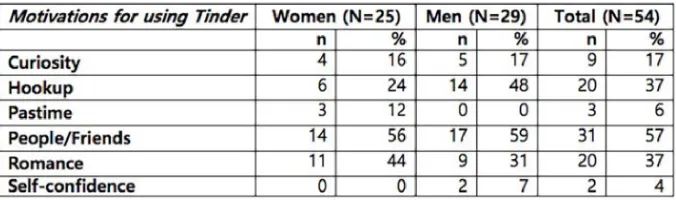
[image:8.442.46.384.329.429.2]In Question 1 men and women were asked to state motivations for installing Tinder and recounted similar reasons (see Table 1) except for hooking up (casual dates and sex). No female users openly said they were looking for sex and four male participants declared this to be the case. In both groups, participants declared they were looking for casual dates, which means they were interested in finding a casual partner either for sex or for a short sexual interaction involving sex or not, both with no emotional ties and no commitment, which characterizes a hookup.18 In total, 48% of male users reported they were looking for hookups (sum of results for ‘sex’ and ‘casual’) while only 24% of female users said so. That is a substantial difference between the two groups, but only approaches statistical significance (χ2=2.43, df = 1, P = 0.1189). Some categories are exclusive to one group or the other. For example, 12% of female users said they were using Tinder as a pastime, while no male users provided this reason. Apart from declaring hookups as a main purpose, male users also said they were using the application to improve self-confidence, but no female users did so. None of the binary response categories yields a significant interaction with gender; exact results are reported in Table 1.
Table 1: Motivations for using Tinder. Note: Every participant responded to the question (N=54). The per-centages in each column refer to the proportion of individuals of each gender that indicated the answer. Participants could indicate more than one answer.
Question 2 was about concerns before installing Tinder. The answers revealed no patter of gender differences. Men were slightly more confident with respect to installation: 76% had no concerns prior to installation vs. 68% of female participants. This putative interaction between gender and reported need to reflect prior to installation of the application is not statistically significant.
In response to Question 3 men and women reported almost the same categories of answers regarding their first impressions of Tinder. Only one man who expressed a neutral impression
said it was addictive, and one woman said the application seemed too sexual at first sight. The majority of women (58% of the 24 participants who responded to that question) had a negative first impression (too sexual, superficial, awkward, disappointing, unfiltered), whereas the majority of men (55%) had a positive first impression (engaging, exciting, fun, great, intuitive, straightforward). The interaction between gender, and the categories of response is not statistically significant.
When asked about their feelings with respect to their first matches (Question 4), men and women showed a subtle, but not statistically significant, difference. The two groups pointed out the same categories of responses (confident, indifferent, not reciprocate, uncomfortable), but several male users also indicated feeling ‘unconfident’ or ‘curious’. However, the categories ‘not reciprocate’ and ‘uncomfortable’ can also be considered as ‘unconfident’, considering that unconfident can either represent the feeling about oneself or towards the application. Most women (68%) felt confident while 24% felt unconfident. 55% of men felt confident and 31% unconfident. The interaction between gender and categorization of first matches is not statistically significant.
When asked about the design of the system (Question 5), the two genders indicated similar categories of responses (effective, inefficient, fun, ok, straight-forward, superficial), except that men also pointed out ‘reciprocal’, ‘easy’, and ‘confusing’, while women added ‘private’ and ‘innovative’. Only 10% of the men and 20% of the women reported to find the system effective, however, in total, 61% of the females liked the system, 30% disliked it and none had mixed feelings. Among male users, 52% like Tinder, 41% disliked it and 7% had a mixed impression. The interaction of gender and characterization of the application is not statistically significant.
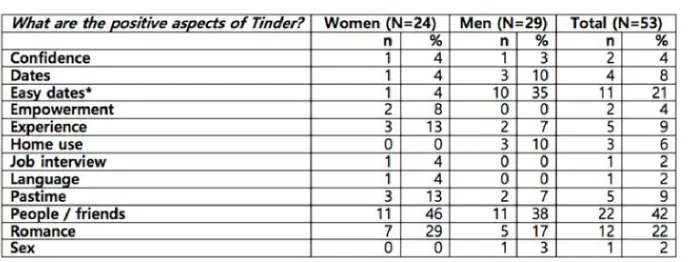
In response to Question 6 regarding the benefits of using Tinder, several gender differences come to light (see Table 2). Getting to know new people (and eventually making friends) was identified as the most rated positive aspect of the application by both groups (38% of male users and 46% of female users); this difference is not statistically significant. For men, finding ‘an easy date’ was also very compelling (35%), but only one female saw it also as a benefit,
and the difference is significant (χ2=5.93, df = 1, P = 0.01491). Some 28% of the female users and 17% of the male users said that starting a romantic relationship was a benefit; the gender difference is not significant. Facilitating a ‘job interview’, practicing a ‘language’,
Table 2: The positive aspects of Tinder. Note: From the original sample (N=54), 24 women and 29 men responded to this question (53 participants in total). The percentages in each column refer to the propor-tion of individuals of each gender that indicated the answer. Participants could indicate more than one answer. Statistical significance using a chi-squared test of interaction between categorical variables is indicated with italic font, and an asterisk (* - p<0.05; ** - p<0.01; *** - p<0.001).
When asked about the negative aspects of Tinder (Question 7), some substantial gender differences emerged (see Table 3). One-third of the women reported experiencing what they regarded offensive behavior toward them, while none of the men did so; this interaction between gender and reports of experiencing offensive behavior is significant (χ2=7.01, df = 1, P = 0.008093). One-fourth of the women said that the application enabled interactions excessively focused on sex (‘too sexual’), while only one man only expressed feeling bad about the ‘objectification’ embedded in the system; the interaction between gender and report of sexualized interactions is significant (χ2= 5.59, df = 1, P= 0.01808). 28% of male users experienced unpleasant situations but only 12% of women said so; this difference is not statistically significant. Some answers like ‘prostitution’, ‘superficial’, ‘being ignored’, ‘few matches’, ‘features’, ‘frustration’ and ‘unwanted sex’ are exclusive to male users, while ‘offensive behavior’, ‘too sexual’, ‘feeling vulnerable’, ‘impersonal’ and ‘rejection’ are exclusive
Table 3: The negative aspects of Tinder. Note: Every participant responded to the question (N=54). The percentages in each column refer to the proportion of individuals of each gender that indicated the answer. Participants could indicate more than one answer. Statistical significance using a chi-squared test of interaction between categorical variables is indicated with italic font, and an asterisk (* - p<0.05; ** - p<0.01; *** - p<0.001).
Regarding the feeling of respect during the experience on Tinder (Question 8), a significant difference emerges (see Table 4). Sixty-five percent of the men said they always felt respected while only 12% of the women reported always feeling respected. One-quarter of the women said they barely felt respected (12% never and 12% rarely) and another quarter felt respected only sometimes. All the male respondents reported always or often feeling respected. The interaction between gender and categories representing extent of experienced respect is significant (χ2= 23.47, df = 4, P < 0.001). Inspecting Pearson residuals, it is evident that instances of females reporting always feeling respected is significantly lower (P < 0.05) and of males, significantly higher (P < 0.05) than one would expect if there were no interaction between gender and the perceptions of respect.
Table 4: Feeling of respect on Tinder. Note: Every participant responded to the question (N=54). The per-centages in each column refer to the proportion of individuals of each gender that indicated the answer. Participants indicated only one answer. Statistical significance using a chi-squared test of interaction between categorical variables is indicated with italic font, and an asterisk (* - p<0.05; ** - p<0.01; *** - p<0.001). Pearson residuals are highlighted similarly.
Another slight difference emerges with respect to the time of use of the application among participants (Question 9). Among women, the majority used for less than 1 year (68%), while among men the majority used for more than 1 year (55%); the mean of months’ usage among women is 9 and among men is 13. These differences are not statistically significant (neither using χ2 on the test of interaction between gender and the binary factor of months’ usage less than 12, nor using a Wilcoxon test on the difference between medians of months’ usage).
When asked about the gender of the developer (Question 12), 72% of the women reported to believe it was a man, 16% said they had no opinion and 12% said it was a woman. Among men, 59% reported to believe it was a man, 17% had no opinion, 10% said it was a woman, 7% said it was a team composed of both genders, and 7% said it did not matter. The interaction between gender and speculation regarding the gender of the developer is not statistically significant.
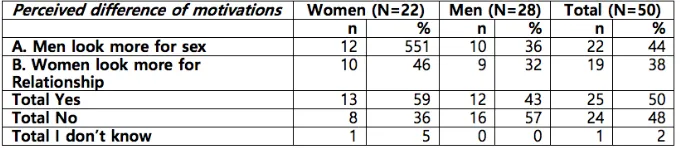
In response to Question 13, participants revealed whether they think there is a difference between what women and men want on Tinder in general (see Table 5). The majority of men said there is no difference (57%), whereas the majority of women perceive a difference (59%). The difference in response between the genders is not statistically significant. Those who think there is a difference between the two groups pointed out (early equally between male and female respondents) that usually men are looking more often for sex than women or that women are looking more often for a relationship than men.
[image:12.442.45.385.341.415.2]When asked what would make their experience better (Question 15), both groups rated ‘accurate matching’ most highly - 36 % of women and 44% of men; certainly, the difference in reply by gender was not statistically significant. Apart from the improvements in common between the two groups, women also pointed out ‘block offensive behavior’. Men pointed out ‘more matches’, ‘more female users’, ‘feedback’, and ‘women were more open’. Other responses were: ‘I don’t care’, ‘no’, ‘not sure’, ‘paid features’, ‘more interaction’, and ‘more respect’.
Table 5: Perception of difference of motivations between male and female users. Note: From the original sample (N=54), 22 women and 28 men responded to this question (50 participants in total). The per-centages in each column refer to the proportion of individuals of each gender that indicated the answer. Participants indicated only one answer between ‘yes’, ‘no’ or ‘I don’t know’. However, participants who answered ‘yes’ could indicate more than one reason (A, B or both).
Discussion
The survey results reveal gender differences with respect to several themes related to online dating. The use of a mixed methods approach was central to identify those differences. Quantitative analysis also made it possible to compare the experience of the two genders. Of the differences explored, statistical significance was noted in the interactions between gender and categorical representations of the propensity to feel respected. While the sample analyzed is small, it is not so small as to prohibit detection of statistically significant effects or trends approaching significance. The purpose of this research was to identify gender differences in response to the use of Tinder and reflect upon the potential existence of bias in the design of the application. Here we discuss the most relevant numbers.
The first difference is regarding the motivation to use Tinder. Almost half of male users said they used it for hooking up, while only a quarter of female users used it for that purpose. Also, there is a slight difference in the desire to find a partner in order to develop a romantic relationship. Almost half of female users said this was their aim in comparison to 31% of men. Thus, there is a revealed difference in the motivations to use Tinder, since men appear to look for hookups more than women. This result reveals that, for women, Tinder is more a tool for social interaction while for men it is also a tool to find easy sexual interaction. Because 4% declared explicitly to be looking for sex, this also possibly indicates that men feel more comfortable to declare they are looking for sex while the lack of such a response within the female group can either indicate a taboo about openly saying to be looking for sex or that women are less likely to have casual sex and one-night stands. If men and women are equally likely to seek casual sex, these results suggest that women are cautious about looking for casual sex using an online dating application.
Despite the implicit gender roles and taboo around female sexuality, results for Question 2 show that women are gaining confidence to date online, since 68% of the participants expressed to have no concerns about using the application. However, 32% of female participants still had concerns prior to the installation of Tinder. Their full comments provided anecdotal evidence that they feared to be recognized by known people, judged, exposed, vulnerable, objectified or to feel ashamed. For the 24% of male users, who expressed a need to ponder possible consequences before installing the application, the main concern prior to installation is about using an online application for flirting, which seemed odd to them. Hence, the answers for this item disclose a subjective difference between female and male groups with regards to concerns with online dating: while male concerns are restricted to the oddity of using an application, female concerns are related to their psychological integrity.
declared looking for a relationship in Question 1 and 67% of those who answered Question 11 uninstalled the application due to a new relationship, but only 17% reported that as a benefit. These numbers possibly indicate that the application was not useful for relationship formation among men. Indeed, in response to Question 7 (negative aspects of Tinder), 31% of users said the application was boring and 28% said they had experienced unpleasant situations. This is possibly the reason why ‘accurate matching’ was by far the most rated improvement suggested by men in response to Question 15. Despite not having ‘good matches’, they still benefitted from casual sex.
Among women, ‘accurate matching’ was also the most frequently desired improvement. Nevertheless, it seems female users either could not benefit from hookups without accurate matching as male users could or they do not really consider it a major benefit, even though 24% said they were looking for casual dates in Question 1. For female users, the most frequently reported negative aspect of their experience is ‘offensive behavior’ towards them: 32% of the women we surveyed reported that experience. The second most rated negative aspect was the perception of a ‘lack of accuracy’ in profile information (28%), followed by the hyper-sexualization of interactions enabled by the application (24%). In total, 12 women (48%) reported unpleasant gender dynamic on the application (the sum of those women who experienced offensive behavior, who felt it too sexual, and/or who felt vulnerable).
In response to Question 8, only 12% of female users said they felt always respected on Tinder, while 65% of male users said so. Because almost half of female participants reported that they never, rarely or only sometimes felt respected, it is possible to assume that there is a gender factor that divides the experience of women and men. The vast majority of men were treated well while half of women were not. In fact, the majority of women uninstalled Tinder due to a negative experience (55%) in the application and the majority of men uninstalled it because they started a new relationship (67%). Otherwise, they would possibly continue to use Tinder to benefit from hookups, even when lacking a ‘good match’ or if its ‘boring’, since they are more likely to feel respected using Tinder and probably not exposed to psychologically harmful situations. Indeed, men are more likely to use Tinder for a longer time than women: the majority of women used it for less than one year (64%) and the majority of men for more than one year (55%).
To conclude the analysis, the perception of the influence of gender in the design of the application seems to be more evident to female users. 72% of women and 59% of men think the developer is a man. Both groups expressed awareness of male domination in technology, which is very likely to influence the application’s design, according to Williams’19 study on gender bias in design. The numbers indicate that men’s needs are favored in the design of Tinder. Moreover, 57% of the men said they don’t think there is any difference from what men and women look for on Tinder, while only 32% of the women think so. However, 41% of men and 52% of women perceived a difference. In fact, there is a difference that approaches statistical difference in the motivations to use it, as indicated in the results for Question 1.
The gender blindness, in this case, is also to consider that both male and female users have the same needs while using an online dating application. As pointed out, female users have concerns about being objectified, and feeling vulnerable, exposed, among others, and have different motivations for using the application than men. Thus, their fears and hopes are part of their needs. If women do not feel fully respected, if they uninstall Tinder due to negative experiences, if they sense unpleasant gender dynamics in the application, among other perceptions already mentioned, then the application quite likely disregards females’ needs.
The application does not seem to fully meet men’s needs as well. Although they are more likely to feel respected and less frustrated than women, they also point out that the application is boring, which can also be addressed as a problem of design. It is interesting that the majority of both genders believed the developer of the app was a man. Perhaps, this has to do with the conception of programming as a primarily male's job.20
Contributions, Limits and Challenges
The results of this survey reveal perceived differences between female and male Tinder users regarding motivations, the feeling of being respected, the benefits of using Tinder and the downsides of the experience, among other components of the experience of an online dating application. Apart from highlighting these differences, a closer analysis brought to light how these differences are related to gender bias in the design of the application. Gender biases are more likely to occur when the design team is mainly composed in a manner in which one gender is in a clear majority, however, the presence of women in the team alone may not ensure that the design will be free from bias and that women’s needs will not be disregarded. A commitment to use design approaches that focus on users’ needs and to develop methodological tools to reduce biases is also important.
The results disclosed here, however, are limited to a small sample of participants and cannot be extended to the whole population of Tinder users. Yet, given that the pattern of response among women in this study corresponds to the patterns identified in our earlier study, it is likely that a similar pattern emerges from additional studies of both sexes, using a larger sample of participants. Further studies are also needed to explore how homosexual males and females feel about using Tinder and how they perceive the app's design. It is an open question with additional categories of response and response distributions will emerge where individuals seeking same-sex matches are more fully represented.
Regardless of the limitations of the sample, the figures presented by the survey draw attention to important issues in the development of mobile applications and important issues in initiating the development of relationships in an online setting. Apart from quantifying the experience of Tinder users, another gain of the study was to find the categories of answers of participants, which was essential to understanding users’ experience. This understanding can be deepened through other quantitative studies, since preferences and the gender dynamic have already been described here. For this analysis we have focused on the quantitative quality of the mixed
method in order to elucidate the transformation of a qualitative interview into quantitative data. Nevertheless, the subjective analysis can also be deepened using the data collected here.
Acknowledgment
This research was supported in part by Brazilian government’s CAPES sponsorship and by Science Foundation Ireland (SFI) through the CNGL Program (Grant 12/CE/I2267 and 13/ RC/2106) in the ADAPT Centre in Dublin Ireland.
References
Allison, R., & Risman, B. (2013). A double standard for “hooking up”: How far have we come toward gender equality? Social Science Research, 42, 1191-1206. doi:10.1016/j.ssresearch.2013.04.006 Armstrong, E. A., England, P., & Fogarty, A. C. K. (2010). Orgasm in college hookups and relationships. In B. Risman (Ed.), Families as they really are (pp. 362–377). W.W. Norton.
Armstrong, E. A., England, P., & Fogarty, A. C. K. (2012). Accounting for women’s orgasm and sexual enjoyment in college hookups and relationships. American Sociological Review, 77(3), 435-462. doi:10.1177/0003122412445802
Bannon, L. J., & Bødker, S. (1989). Beyond the interface: Encountering artifacts in use. DAIMI Report Series,18(288). doi:10.7146/dpb.v18i288.6666
Bogle, K. A. (2008). Hooking up: Sex, dating, and relationships on campus. NYU Press.
Creswell, J. (2014). Research design: Qualitative, quantitative, and mixed methods approach. Thou-sand Oaks, CA: Sage.
Lopes, M. R., & Vogel, C. (2017a). Gender bias on Tinder: Transforming an exploratory qualitative survey into statistical data for contextualized interpretation. In A. Costa, L. Reis, F. Souza, & A. Moreira (Eds.), Computer supported qualitative research (Vol. 71, p. 225-236). London: Springer. doi:10.1007/978-3-319-61121-1_20
Lopes, M. R., & Vogel, C. (2017b). Women's perspective on using Tinder: A user study of gender dynamics in a mobile device application. In Proceedings of the 35th ACM International Conference on the Design of Communication (p. 12). ACM. doi:10.1145/3121113.3121220
Patton, M. Q. (2002). Qualitative research and evaluation methods. SAGE.
Petersen, J. L., & Hyde, J. S. (2010). A meta-analytic review of research on gender differences in sexu-ality, 1993-2007. Psychological Bulletin, 136(1), 21-38. doi:10.1037/a0017504
Petersen, M. G., Iversen, O. S., Krogh, P. G., & Ludvigsen, M. (2004). Aesthetic interaction: A pragma-tist’s aesthetics of interactive systems. In 5th conference on designing interactive systems: processes, practices, methods, and techniques (dis ’04). doi:10.1145/1013115.1013153
Sauro, J., & Lewis, J. R. (2012). Quantifying the user experience: Practical statistics for user research. Morgan Kaufmann.
Williams, G. (2014). Are you sure your software is gender-neutral? Interactions, 21(1), 36-39. doi:10.1145/2524808