Delayed P
Presentation iin L
Leprosy
Acknowledgement
This booklet is part of instead of this research is part of the ILEP Nerve Function Impairment Research
programme (INFIR), addressing issues of prevention of disability in leprosy.
We are grateful to the Raoul Follereau Association of Luxembourg and the Luxembourg Government for their funding of this research. We also acknowledge the support and co-ordination role of the INFIR Steering
Correspondence:
Peter Nicholls, Department of Public Health,
University of Aberdeen, Polwarth Building, Foresterhill,
Aberdeen, AB25 2ZD, Scotland, UK
The procedures described here are drawn from published texts. Every effort has been made to ensure the information presented is accurate.
Identifying the causes of delayed presentation in leprosy
A guide to field work
Purpose
Contents
Chapter One Introduction and Outline Page 1
Chapter Two The help-seeking process that adds to delay Page 3
Chapter Three Preparing for fieldwork Page 7
Chapter Four Learning from patient records Page 11
Chapter Five Learning from patients Page 14
Chapter Six Learning from the community Page 21
Chapter Seven Learning from staff Page 27
Chapter 1 - Introduction and Outline
Q. What is delay in presentation?
•• For each patient, delay is the time from becoming aware of the first symptom through to start of treatment.
Q. How do I know if there is a problem?
•• People who delay are more likely to develop impairments – nerve damage with sensory or motor loss or visible impairments such as ulcers. Do you have people like this in your project?
Q. Why should I get involved?
•• Delay prolongs the time when a person may pass on the disease to others. •• Delay may mean more drugs and a longer course of treatment.
Q. What would be involved?
To understand why people delay you need to understand how people assess their symptoms and the actions they take to seek help. These all contribute to delay. This will involve:
•• Taking time to listen to the experience of individual patients.
•• Learning from significant people within the community, for example, teachers or religious or political leaders.
•• Talking to doctors involved in private or general health services. •• Hearing what your staff have to say.
•• Preparing a summary of the primary factors leading to delay. •• Identifying the actions that may encourage early presentation.
Q. I already have enough work. Is this really important?
• Achieving early presentation is essential to controlling leprosy.
• The local reasons for delay are unique to your situation. No one else can do it for you. • Your patients already know why they delayed. You can learn from them.
• Your staff and community members can contribute.
Chapter 2: The help-seeking process that adds to delay
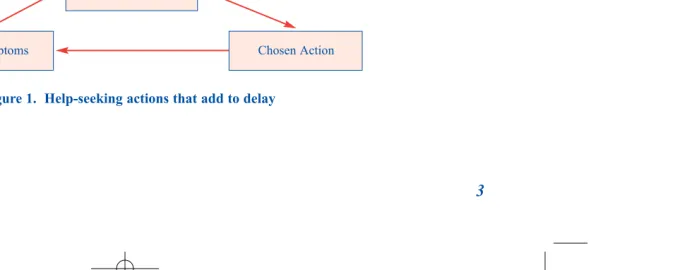
Figure 1 describes how the actions people take add to delay. They assess their symptoms, decide on an action and assess the result. While they rely on ineffective treatments or fail to suspect leprosy a series of such actions adds to delay. Finally, something happens to break the cycle. The symptoms are recognised. They attend the clinic, are diagnosed and start treatment.
First Symptom
What to do?
[image:11.595.169.507.200.335.2]Effect on symptoms Chosen Action
Q. If this is why people delay, what is the problem?
The problem is in the great variety of ways in which people decide to seek help:
Decisions are affected by awareness of leprosy: • People may not recognise the early signs. • They may be unaware of the cure.
Decisions are affected by local culture:
• People may not be able to go for help without the approval of the husband, father or head of family. • People may not recognise the early signs of leprosy as an important disease.
• People may prefer to use traditional medicine and cures.
• People may follow advice from owners of medicine shops or community or religious leaders. • People may believe leprosy is inherited or caused by a curse or judgement, so no medicine can be
Decisions may be affected by questions of cost.
• People cannot afford the loss of earnings during clinic visits.
• People may think the cost involved in going to the clinic and getting treatment is too high. • People may think the consultation fee with a doctor is too high.
Decisions may be affected by fear of the social consequences (Annex 1). • People may fear the consequences for their marriage or family or work. • People may fear the consequences for their position in the community.
Decisions may be affected by experiences within the health services
• People may go to doctors expecting an instant cure. When this doesn’t happen they try a different doctor. They don’t give the doctor time to decide a diagnosis.
• People may reject the diagnosis and treatment they receive and look for a more acceptable diagnosis from another doctor.
• People may ignore the doctor’s referral to a specialist. • The doctor may misdiagnose.
The reasons people present and start treatment are also of interest:
•• They present because they recognise the possibility of leprosy. •• They present because their symptoms can no longer be hidden.
•• They finally decide to follow the advice of family members, friends or doctors. •• They are found through survey.
In any given community some reasons for delay are more common or more important than others:
• It may be that the problem occurs amongst older people who maintain traditional beliefs. • The problem may be among young women who don’t want to spoil their marriage prospects. • The problem may apply in limited geographical areas.
• The problem may be amongst particular occupational groups.
Chapter 3 - Preparing for fieldwork
Methodology
• Rely on interviews, group work and observation. These methods are best for exploring new areas and uncovering new facts and practices. Chapters 5, 6 and 7 each describe one method. See also Annex 4.
• Your findings must not be biased by one point of view. Plan to work with patients, and with at least one other source of information – your staff, health service practitioners or individuals or groups representative of the community. We also recommend you learn from the data stored in your patient records. You can be confident of your findings when two or more sources or methods give matching information.
• If you follow the suggestions in each chapter you should be able to complete the whole project in 8 to 10 weeks. In the outline Action Plan (Annex 3), we propose three phases of work, two weeks of
preparation and training, six weeks for fieldwork and one to two weeks for analysis and report preparation.
Make the most of the people and resources available to you:
People:
• Recognise patients and staff as important sources of information.
• Identify key individuals or groups within the community as additional sources.
Data:
• Make use of data already available to you – specifically, your patient records.
Skills:
• Make full use of existing skills amongst your staff, in particular, their interviewing skills. • Involve local organisations that can offer skills or other forms of assistance.
• Remember that practitioners in traditional medicines have the best insights into local health practices.
Funds:
• To save on travel costs, plan fieldwork in and around regular outpatient clinics.
Keep the work to a manageable minimum:
• Choose to focus on a limited geographical area. • Choose to focus on specific socio-economic groups • Choose to focus on a specific demographic group.
Q. Am I really going to learn anything new?
• Keep focussed, but also keep an open mind.
• Don’t devalue the experiences of your patients. Their stories provide the information you need. Try to understand their thinking and decision-making.
• Respect the point of view of your staff, especially those with long service. They have had contact with many patients, in the clinics and in the homes. They have learned something about delay.
Q. Will anyone take any notice?
• Your manager must be convinced there is a problem and ready to respond to recommendations you make. • Be sure your manager approves of the fieldwork.
Chapter 4 – Learning from patient records
Who are the people that delay?
The first action is to identify and describe the people who delay in presentation or first present with visible impairments. To do this we will collect information from the patient clinic records:
• Work through the most recent registrations, people registered in the last 3 to 9 months. Earlier registrations may not be relevant to the current situation.
• If you are focussing on a limited geographical area or a small patient group, choose your records accordingly.
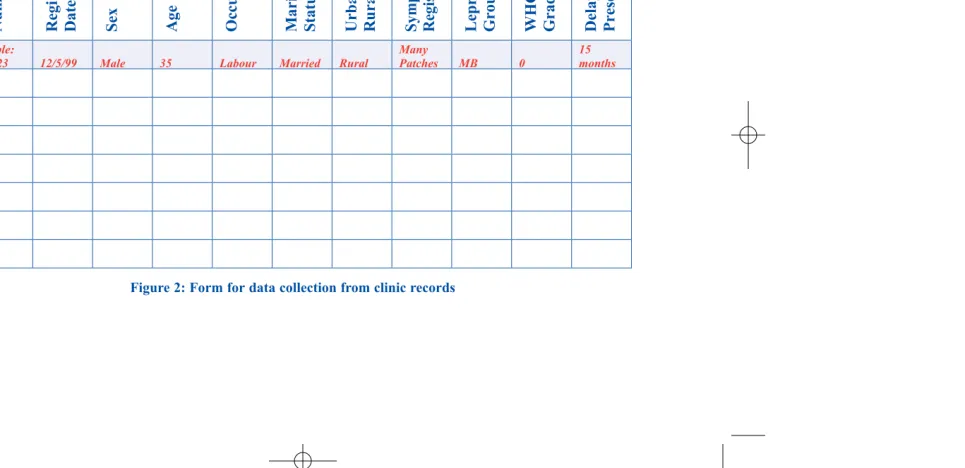
• Record the details of each newly registered patient using a form like that in Figure 2.
Using the data on the completed form you can summarise the situation and identify the individuals who delay or present with Grade 2 disability:
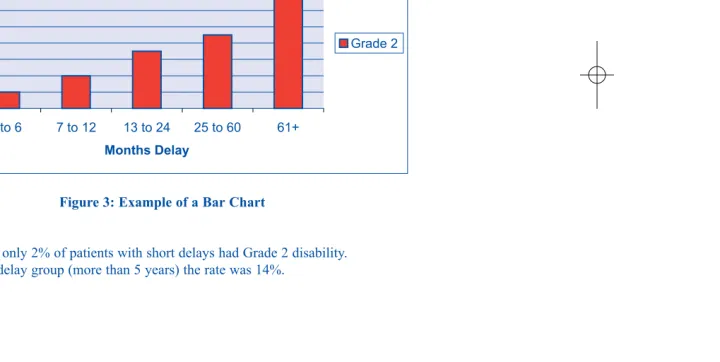
• Use a bar chart to summarise delay and disability grade (Figure 3). • Look for factors such as age or sex associated with delay or disability.
Oc upat ion Mr it a l St tu s Card Nu mb er Registratio n Date Se x Age
c a a
U r ban/ Ru ral S y mp toms at Registratio n
Leprosy Group WHO Grade Delay
in Presen tati o n Example:
ABC123 12/5/99 Male 35 Labour Married Rural
Many
Patches MB 0
[image:20.595.80.563.104.338.2]15 months
Figure 3: Example of a Bar Chart
WHO Grade 2 Disability and Delay in Presentation
0 2 4 6 8 10 12 14 16
0 to 6 7 to 12 13 to 24 25 to 60 61+
Months Delay
P
e
rcentage
Chapter 5 – Learning from patients
If you understand the decisions and decision-making that result in delay then you may find a way to reduce delay. You need to find out who is involved in decision-making, the decisions that are taken, and the time committed to each action. You can then identify the main actions adding to delay and the events that finally caused the person to present and start treatment. The most direct way to do this is to listen to the experiences of individual patients and learn from them.
Q. What method will I use?
• The first method we recommend is patient interviews, using experienced staff as interviewers.
• At a later stage you might use focus groups and work with groups of patients. You might also observe the reaction of new patients to the leprosy diagnosis. (See Annex 4).
Q. How can I be sure to collect all the information I need? .
Q. I can think of other things I would want to ask my patients – can I change the interview outline?
• Yes, you will need to do this! What you already know or what you learn in the first few interviews will help you to develop an outline that meets the needs of your local situation.
• The fieldwork is all about learning something new, so be flexible. Follow-up new ideas or unexpected actions or comments arising in the interviews.
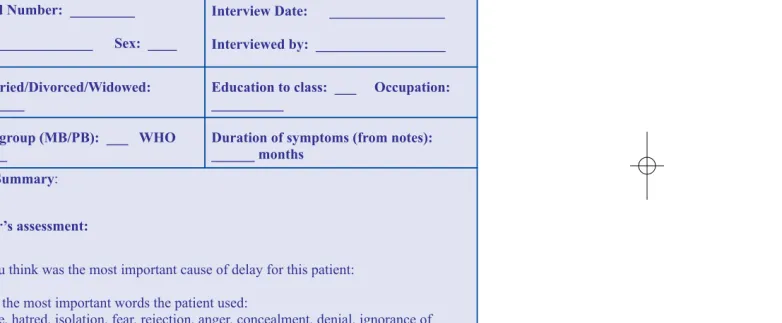
• When you are sure the Interview Outline is correct, print some copies with Figure 5 on the reverse. The interviewers can then use one sheet of paper for each interview and record their notes and comments from the interview on the same paper.
Q. So how do I organise the interviews?
• Make sure each patient is willing to participate. Limit interviews to 30 minutes.
• Build trust and confidence. Be ready to care for anyone who finds telling their story an emotional experience.
• Start each interview by asking the patient to describe his/her experiences. • Ask extra questions to fill in details omitted from the patient’s story.
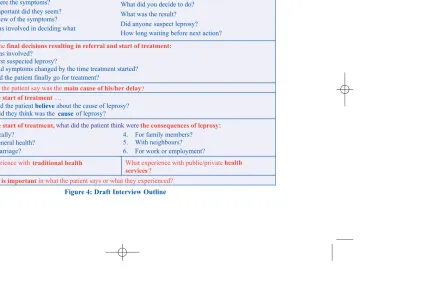
• Ask specific questions from the Interview Outline and other information (Figures 4 and 5).
Q. How should I select and train interviewers?
• Select experienced male and female staff as interviewers. A sympathetic and respectful attitude towards patients is the essential qualification.
• A male interviewer should interview male patients while a female interviewer makes notes. The roles will be reversed with female patients.
• Explain the importance of open questions and the need to learn from patients. • Arrange for practice in interviewing, first in a role-play and later with patients.
• Start formal interviews only when you are convinced the interviewers are producing reliable data. • Use the training interviews to further develop the Interview Outline to cover local issues.
Q. How many people do I interview?
• Plan to interview around 20 patients over a 6 week period.
• Choose patients currently receiving treatment – months 3 to 9. The experience of older patients may no longer be relevant.
• Plan a quota of interviews within age and sex groups (or other appropriate factors). • Maintain a record of progress towards the quotas.
Looking after the data
• Leave enough time each day to complete a written interview summary for each interview. • Don’t limit the summary to simple answers to questions. Include personal information about each
patient - attitude, confidence, understanding and response to their experiences. All these are important. • Record the patient’s experiences and comments using their own words.
• In the interview summary, clearly separate description from personal comments, interpretation and judgements.
• Make sure the interview summaries are safely filed at the end of each day.
• In a separate research diary, record the date of each interview and any comments about how the work is going or new directions that it might take
.
Difficulties to expect
• Patients find it difficult to estimate time spent on individual actions. Comparison with ages of children, marriages, annual festivals etc, can help to improve the estimate.
• Patients may have difficulty in remembering where and when they looked for help. The important point is to identify the most important reason for time lost, whether through taking no action, through traditional medicine or through the health services.
• Look out for reported problems not related to leprosy. For example, there are many reasons for divorce. • Rather than talking in general about stigma patients may describe hatred, rejection, humiliation, or
what did the patient think were :
·
Who was involved?
Who first suspected leprosy?
How had symptoms changed by the time treatment started? Why did the patient finally go for treatment?
·
·
·
·
Ask the patient to tell their story, describing each help -seeking action in detail: What were the symptoms?
How important did they seem? Who knew of the symptoms? Who was involved in deciding what to do?
·
·
·
What did you decide to do?
·
· What was the result?
·
· Did anyone suspect leprosy?How long waiting before next action?
What did they think was the cause of leprosy?
· What did the patientbelieveabout the cause of leprosy?
·
1. Physically? 2. For general health? 3. For marriage?
4. For family members? 5. With neighbours? 6. For work or employment?
INTERVIEW OUTLINE The Patient’s Story:
Describe thefinal decisions resulting in referral and start of treatment:
What does the patient say was themain cause of his/her delay?
Before the start of treatment …
Before the start of treatment, the consequences of leprosy
services
What experience withtraditional health
?
atehealth
What experience with public/priv
services?
[image:26.595.109.543.82.365.2]______________
Clinic Card Number: _________ Interview Date: ________________
Interviewed by: __________________ Name: _______________ Village:
Age: __________________ Sex: ____
Interview Number: ______________
_____________
Single/Married/Divorced/Widowed:
__________
Education to class: ___ Occupation:
Grade: ____
Diagnostic group (MB/PB): ___ WHO
______ months
Duration of symptoms (from notes):
, hatred, isolation, fear, rejection, anger, concealment, denial, ignorance of :
Interview Summary
(for example
Interviewer’s assessment:
What do you think was the most important cause of delay for this patient:
[image:27.595.131.522.89.250.2]An interview summary from Malawi
Profile:
Young boy, aged 10 years, walks 16 km to clinic. PB leprosy. No previous contact. 3 months MDT completed. Anaesthetic patches. No motor or sensory loss. No ulcers.
Details:
His family members know he has leprosy. They did not reject him, neither did the village community. He can still eat with them and share their drinking water. He still contributes to the fishing nets, showing there has been little or no social impact. His first sign was an ordinary patch on his head. After a month his mother noticed and they went for traditional medicine (6 months). The traditional medicine cured the patch, but it reappeared. They did not think about going to hospital. He was identified as having leprosy by a village survey.
The parents think that everyone was affected by “magic”, women more than men, and that everyone goes to the (traditional healer) though women find it difficult because of the long distances. With leprosy they thought women were more likely to be divorced than men, because men will want to marry another woman without leprosy. They say traditional healers do not refer patients to hospital and that they can’t cure leprosy.
Comment of interviewer:
No evidence of fear or actual stigma, though there is a risk of divorce. Opting for traditional medicine caused six months delay. Traditional healers still have a strong hold over some people.
Chapter 6 – Learning from the community
The community’s beliefs and behaviour towards leprosy provide the background for the behaviour of patients. It is important to confirm what you learned from patients by listening to what members of the community have to say. To do this you might choose to interview community representatives or you might choose a different approach, working with selected groups of individuals.
Q. How do I choose who to speak to in the community?
First of all, choose to speak to people that have a good knowledge of how the community functions – political or religious leaders or other respected people in the community. Local teachers might be another source, though those that have moved into the area may have little local knowledge.
If you want to learn more about the importance of traditional medicine you might choose to meet with local practitioners, or with people who seek help from them.
Q. What do I want to learn from the community?
The focus will be on key points relating to leprosy:
•• What do people believe about its cause and the people it affects? •• What do people fear about the disease and the people it affects?
•• Within marriages, how do people behave towards people affected by leprosy? •• Within families, how do people behave towards people affected by leprosy? •• Amongst neighbours, how do people behave towards people affected by leprosy? •• In the community, how do people behave towards people affected by leprosy? •• Are these attitudes and behaviours changing? If so, why?
Q. What method will I use?
• You may choose to use semi-structured interviews – but be ready to make substantial changes to the interview outline in Figure 4.
• You may choose to run Focus Groups. See Chapter 7.
• You may choose to use a method called free-listing described here (Figures 7 and 8).
• Following your free-listing with community representatives you might plan a free-listing exercise with patients or with their family members.
Q. How does free-listing work?
In free-listing you ask people to write down how they respond to one or more carefully chosen questions. For example, you might ask people to write down what they think in response to one of the questions following:
- For me to be diagnosed with leprosy would mean …. - Telling my husband (wife) I had leprosy would mean …. - Telling my neighbours I had leprosy would mean …
Organising a free-listing exercise
•• Get participants seated and provide them with pen and paper.
•• Where literacy is a problem, form groups and ask one person to act as secretary. •• Write the chosen question on a board for all to see.
•• Explain that there will be 10 minutes to think and write down responses to the question.
•• Make it clear that there are no right or wrong answers! People should simply write what they think. Each person may write several different responses.
•• After 10 minutes, go into a group session, asking participants to report their responses. •• Write the responses on the board, counting how many people give each response.
•• Identify any groupings – e.g. positive or negative attitudes, knowledge or ignorance of the disease, fears for physical consequences, fears for social consequences, impact on family, impact on work. •• Identify the most frequent and most important responses.
•• Explore these through group discussion.
Free-listing with nurse trainees in India
The exercise took place in a leprosy hospital situated in a city centre in India. It was the first action at the start of a two-day orientation course for nurse trainees from a local training centre.
• The trainees are asked to write down how they would respond if told they had leprosy. • The trainees wrote down their responses.
• The responses were written onto a blackboard, counted and discussed.
The response in 2001 ranged from complete confidence in the cure and in the response of family members to complete despair – I want to die. The trainees recognised the potential social implications – people may not touch me or love me – but there is also the potential for self-imposed isolation – shall I practice home segregation.
Figure 8: Result of a free-listing exercise in an Indian city in 2001. For me to be diagnosed with leprosy would mean …
Reponses of 39 nurse-trainees at the start of a two-day orientation course in leprosy.
1. I am uncertain how society will treat me (20) 2. I would doubt if my near ones would accept me (16) 3. How will I live in the world? (13)
4. Why did I have to get this disease? (11) 5. I want to leave my home (9)
6. Who will marry me (8)
7. Should I practice segregation at home? (8) 8. I want to die (7)
9. Will I be treated the same was as others in society? (7) 10. How will I attend my college? (4)
11. Will my children get leprosy? (4)
Chapter 7. Learning from staff
The experience of your staff is as important as the knowledge of the community in validating the experiences of your patients. Staff members meet with patients every working day. They listen to patients and try to understand their symptoms and experiences. Creating the opportunity to learn from staff adds value to the staff and provides insights into their understanding of what contributes to delay.
• Many staff have an intimate knowledge of the local culture. • The best staff have good working relationships with patients.
• They know where patients live and may be aware of the home situation.
To collect information from staff you might choose to interview selected staff members, you might choose a free-listing exercise or you might choose to use focus groups, as described here.
Through your group work with staff you might identify further information to collect from patients. You might add to the Interview Outline or plan group work with patients.
Q. How do I organise a focus group?
Arrange for the group to meet together and encourage them to discuss the reasons why patients delay.
• Decide on the focus - no more than one or two questions for discussion – e.g. what contributed to your delay? • Plan the meeting in advance – the time and place. Choose carefully who to invite, covering
appropriate groupings by sex, age or other important variables.
• Write guidelines to ensure that the discussion proceeds in an orderly fashion. Appoint and instruct a facilitator who should:
- Strictly limit their involvement in the discussion.
- Ask only an occasional question that ensures the discussion remains focused. - Try to be just a “fly on the wall”, listening and learning from what is said.
• An observer should take notes, leaving the facilitator free to concentrate on the direction of the discussion. • You might decide to record the discussion, but this can be difficult amongst many people in a large room. • Set a strict limit on the time of the meeting – e.g. 45 to 60 minutes.
• The observer and facilitator need to agree and complete a written summary of each group meeting, including conclusions of those present. These are the basis for analysis using the method described in Chapter 8.
• Note the points of agreement and disagreement.
• Look out for experiences and information that are of most interest.
Practical points for group work:
• Expect the unexpected – unforeseen ideas will arise.
• Try to identify any important differences between group members.
• Interactions between group members will develop. There may be points of special interest or points of strong emotional involvement.
• Contradictory opinions and feelings may be expressed.
• How well the group work is facilitated strongly influences the result. • Encourage everyone in the group to participate.
Q. Need more information?
• Repeat the exercise with patients, discussing issues relating to the impact of the diagnosis or the things people fear about leprosy.
Group work with staff in Paraguay
The exercise took place in the main referral hospital in Paraguay. Many of the staff have been involved in the work for 20 years or more. In addition to in-patient and patient work at the centre there are out-patient clinics linked to government health centres across the country.
Discussions focussed on:
• Local knowledge and awareness of leprosy • The reasons for delay
• Any changes taking place
There was enthusiastic discussion that opened up subjects related to attitude and behaviour towards leprosy and what might be addressed through health education. We also interviewed two senior staff of the project.
We found a high level of agreement between the information provided by staff and the information from patient interviews.
Results of group work with staff in Paraguay
Discussion on “Why people delay in starting treatment”. The staff were organised into two groups of 8.
The groups agreed that the most important reasons for delay were ignorance and failure to recognise the importance of symptoms. Next, female staff identified use of traditional medicine, the male staff identified wrong diagnoses made by doctors in the private and general health services. Male staff also identified a cause of delay relating to culture, which defines or requires serious disease to be accompanied by pain. Since leprosy causes no pain it is not recognised as a serious disease, so people do not seek treatment. The groups also identified other contributors to delay: fear of the diagnosis, the perceived cost of the treatment, fatalism and denial.
Special needs identified included: people living in isolated areas, places where witchdoctors have power and forbid contact with the health services, and people experiencing no pain.
The groups identified necessary actions - improved communication about leprosy, increased awareness of the cure, greater awareness and better diagnostic skills in the health service.
Chapter 8 Analysing your data
Your fieldwork has produced valuable data. You now need to identify the most important findings and write a short report. This is potentially a complicated area, with the risk that you get submerged in detail. The key to success will be to use the simplest possible approach, as described here.
Because the data is in text form the analysis involves reading and rereading and preparing a written summary.
• First check you have all the data, from patient records, from interview and from group work. • Read through all the data 2 or 3 times:
- Identify the main two or three actions that contribute to early or late presentation. - Identify the one or two groups of individuals that are likely to delay.
- Identify the one or two geographical locations from which people are likely to delay. •• Prepare a summary table (Figure 11) to compare what was said by patients, by community
representatives and by staff.
•• If you don’t believe what you read or find information is missing, go back to patients, staff or community to fill the gaps.
•• Read through the data one final time to make sure nothing has been missed
Finally:
Q. What do I write in my report?
In writing your report answer the questions:
• What are the most common reasons for delay? • Who are the people most at risk?
• What is the extent of the problem?
• Make recommendations about what might be done about it.
Remember:
•
Keep the report short, no more than 4 pages.
•
Focus on the main findings.
•
Include a Summary and Conclusions
•
Identify recommended actions to be taken in response to your findings (Chapter 9).
Sources: Clinic records Patients Community Staff Causes of delay:
People at risk of delay:
[image:43.595.120.554.85.335.2]Chapter 9 – Applying your results
• When you review your findings you might ask yourself three questions:
- Is there something new we should be doing?
- Is there something already started that we should be doing better? - Is there something already started that we should do less?
• Remember that your fieldwork is limited, so be cautious in recommending change. After 6 months repeat some of the fieldwork to see what the effect of the changes has been.
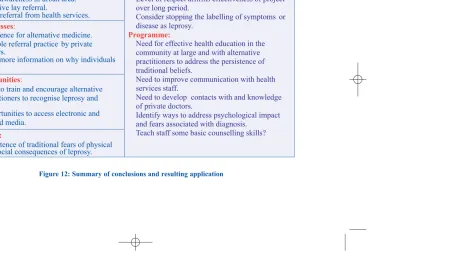
Level of respect affirms effectiveness of project over long period.
Consider stopping the labelling of symptoms or disease as leprosy.
Application: Management:
Programme:
contacts with and knowledge Need for effective health education in the community at large and with alternative practitioners to address the persistence of traditional beliefs.
Need to improve communication with health services staff.
Need to develop of private doctors.
Identify ways to address psychological impact and fears associated with diagnosis.
Teach staff some basic counselling skills?
Threats: Findings: Strengths:
Weaknesses:
Opportunities:
Good awareness in urban area. Effective lay referral.
Good referral from health services.
Preference for alternative medicine. Variable referral practice by private doctors.
Need more information on why individuals delay. · · · · · · · · · · · · · ·
Able to train and encourage alternative practitioners to recognise leprosy and refer?
· Opportunities to access electronic and printed media.
[image:45.595.96.555.92.359.2]Application
Need more information?
If you still need more information on the causes of delay you might add questions to the forms completed with each newly registered patient (Figure 13).
__________ Duration of symptoms (months):
Delay before first action (months):
How much time did the patient spend in seeking help from other sources: Traditional practitioners: _____ (months)
Homeopathic practitioners: _____ (months) Ayurvedic practitioners: _____ (months) Natural practitioners: _____ (months) Other practitioners: _____ (months)
Village doctors: _____ (months) Medicine Shops: _____ (months) Private Doctors: _____ (months)
[image:46.595.105.547.200.342.2]Health Service Doctors: _____ (months)
Annex 1 - Persistent stigma
In 1989 Dennis Mull wrote this about the history of stigma related to leprosy:
Throughout recorded history, whether in Asia, Europe, Africa or the New World, leprosy victims have been shunned and in a very real sense discarded by the societies in which they live. Such behaviours arise from a belief that the disease is a punishment from God, with strong associations that only the most heinous sins would have earned so fearful a punishment. People were caste out of their homes as a threat to society.
(Mull JD et al, Social Science and Medicine, 29(7) 1989, 799-811.)
Annex 2 – Fieldwork Skills
Your interviewers need to be able to encourage people to speak freely and to tell their story. They need analytical skills to understand how patients decided to seek help and the sequence of actions they took. They must be able to identify the most important features of each individual’s experience.
The basic skill requirements include:
• Experience in basic interview technique.
• Experience in organising and leading group discussions. • A sympathetic and caring attitude towards patients.
• Analytical skill, able to organise and record the experiences of each individual from often muddled narrative.
You should consider:
• The special needs of women.
What makes a good interviewer/facilitator?
• Keep to the interview/group work outline and be sure to cover all the questions. • Use open questions, those that encourage the patient to talk freely and confidently:
Openquestions encourage detailed answers Closedquestions invite one word answers
Example: Example:
Tell me about your first symptom Was your first symptom a patch?
• Work to develop good listening skills:
• Repeat words and phrases used by the patient – this encourages them to explain or give more detail. • Provide a private area for the interview, free from interruptions.
Annex 3 - Making an Action Plan
Preparing an Action Plan will require you to consider all the details of how and when you want to undertake fieldwork. Include times to meet with supervisors and time to deal with problems that might arise.
You may need to consider the following:
• Do you need organisational approval? • Do you need ethical approval?
• Are there any special requirements relating to your integrated programmes?
Plan the work in phases - preparation, data collection and reporting, each with definite start and end dates.
Phase I – Preparation – weeks 1 - 2
• Take two weeks to set objectives and complete planning. • Select staff to train for interview and other group work. • Prepare paperwork to record data.
• Plan the selection of patients, staff, community representatives etc to interview. • Schedule interviews, group work and other fieldwork.
• Keep costs to a minimum by working through scheduled clinics. • Complete training.
Phase II – Data collection – weeks 3 – 8
• Extract data from patient records.
• Work at completing a weekly quota of patient interviews plus community and staff interviews or group work. • During the period, plan at least three meetings to review progress and solve problems.
• Monitor the effectiveness of the fieldwork and be ready to change the focus if necessary. • Check records of each interview and group meeting are adequate.
• Check data is stored safely.
Phase III - Analysis and reporting – weeks 8 - 9
• Collate data, checking that all fieldwork is complete. • Summarise the data.
Annex 4 - Choosing Methods
• Semi-structured interviews - allow you to encourage individual patients to share their experiences while you follow an Interview Outline to ensure you collect all the information you need.
The
interviewer may be flexible in using the Interview Outline, but must always be careful to cover
all the listed topics.
• Focus Groups– provide the opportunity for a small number of people to discuss a topic freely and spontaneously under the guidance of a facilitator. They are especially helpful for gaining insight into people’s perceptions, attitudes, opinions, behaviour and experiences. They can also help to assess the acceptance of concepts and how information is being passed on from one person to the next.
• Observation. Recommended as way to assess the effectiveness of the interview process. It might be used to assess the impact of the leprosy diagnosis. As the name suggests, it involves watching behaviour and assessing the changes that occur over time. In Paraguay we observed the traumatic impact of the leprosy diagnosis on two young women. Elsewhere we relied on observation to assess the
emotional
and organisational state of patients.
• Survey.We recommend you don’t rely on this approach. More than likely it will only confirm what you already know. Surveys need comparatively large numbers and a complicated analysis.
Other points about fieldwork
Annex 5 - Evaluation
Evaluation - I
We recommend you evaluate the results of your fieldwork. First you might assess their value by reviewing your findings. How does the value of what you learned compare with the effort put into the fieldwork?
After twelve months you might complete a more detailed evaluation. What has been the impact on the project?
Evaluation - II
As part of our evaluation of the procedures described here, we would be interested to hear you assessment. Please forward comments to the contact address given at the front of the booklet.
We have four main areas of interest:
• Please describe any difficulty you experienced in understanding or implementing fieldwork. • What did you learn from the fieldwork?