Implementation of the Curve Number Method
and the KINFIL Model in the Smeda Catchment
to Mitigate Overland Flow with the Use of Terraces
Pavel KOVÁŘ*, Darya FEDOROVA and Hana BAČINOVÁ
Department of Land Use and Improvement, Faculty of Environmental Sciences,
Czech University of Life Sciences Prague, Prague, Czech Republic
*Corresponding author: [email protected]
Abstract
Kovář P., Fedorova D., Bačinová H. (2018): Implementation of the curve number method and the KINFIL model in the Smeda Catchment to mitigate overland flow with the use of terraces. Soil & Water Res., 13: 98−107.
The Smeda catchment, where the Smeda Brook drains an area of about 26 km2, is located in northern
Bohe-mia in the Jizerské hory Mts. This experimental mountain catchment with the Bily Potok downstream gauge profile was selected as a model area for simulating extreme rainfall-runoff processes, using the KINFIL model supplemented by the Curve Number (CN) method. The combination of methods applied here consists of two parts. The first part is an application of the CN theory, where CN is correlated with hydraulic conductivity Ks of the soil types, and also with storage suction factor Sf at field capacity FC: CN = f(Ks, Sf). The second part of the combined KINFIL/CN method, represented by the KINFIL model, is based on the kinematic wave method which, in combination with infiltration, mitigates the overland flow. This simulation was chosen as an alternative to an enormous amount of field measurements. The combination used here was shown to provide a successful method. However, practical application would require at least four sub-catchments, so that more terraces can be placed. The provision of effective measures will require more investment than is currently envisaged.
Keywords: CN method; infiltration; kinematic KINFIL model; wave
The discharges in the limnigraphic profile at the
outlet of the Bily Potok profile of the Smeda
catch-ment have been measured continuously since 1957.
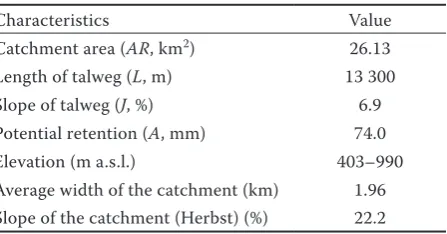
The physical and geometric characteristics of the
catchment are provided in Table 1. The catchment
area is 26.13 km
2.
MATERIAL AND METHODS
Smeda catchment
.
Table 2 presents the
hydro-logical situation and the N-year discharges. Table 3
documents the calculation of the average value of the
Curve Number CN
II= 77.5. This value is relatively
high, and indicates low infiltration capacity through
the hydrologic soil group C (77%). The remainder of
the soils belongs to the hydrologic group B, i.e. soils
with low sorptivity (oligo-mesotrophic soils, podzolic
[image:1.595.308.532.641.758.2]peat-brown soils, and peaty-gley soils). The relative
substitution of the first granulometric category is
20% to 25%, and the coefficient of saturated hydraulic
conductivity
K
s< 10 mm/h. The surface of the
for-ested part of the catchment (88%) can be classified
Table 1. Physical and geometric characteristics of the Bily Potok profile of the Smeda catchmentCharacteristics Value Catchment area (AR, km2) 26.13
under Forest Hydrological Conditions (FHC) = 2, on
the basis of the compactness of “forest litter” when
timber understorey (TU) = 1 (depth < 5 cm).
Since 1957, three rainfall observatories have been
installed: at Hejnice, at Nove Mesto and at Bily Potok.
All weighted rainfall means have also been measured,
together with their direct discharge flows to the
Smeda River at the Bily Potok catchment outlet. The
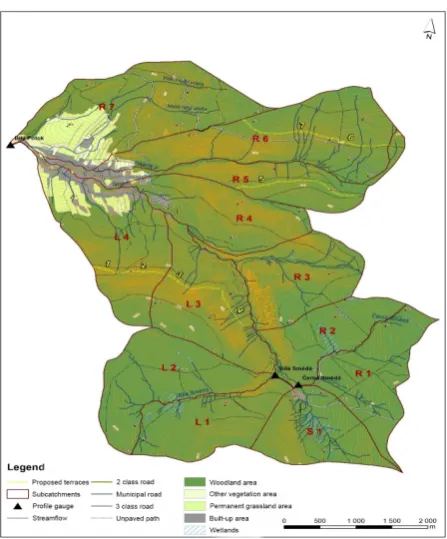
basic characteristics of the catchment were derived
from geographical maps, and are presented in
Fig-ure 1. For modelling rainfall – runoff, it is important
to obtain correct values of the curve numbers (CN)
(NRCS 2004a, b) as the starting values for the
pa-rameters of the model: hydraulic conductivities
K
s,
and the sorptivity values at the field capacities
S
f.
The values of CN are influenced by land use. In the
the Smeda catchment, the land is used mainly for
forestry.
Table 2. N-year discharges from the Bily Potok profile in the Smeda catchment, (source Czech Hydrometeorological Institute, data 2015)
[image:2.595.63.291.213.329.2]Return period (N-years) 1 2 5 10 20 50 100 Discharges QN(m3/s) 21 33 54 74 97 132 162
Table 3. Curve Number (CN) for the Bily Potok profile in the Smeda catchment
Land use Area (%) Hydrol soil group CN Weighted mean CN
Forest 7018 CB 7969 55.312.4
Pastures 7 C 79 5.5 Arable land 3 B 79 2.4 Urbanized area 2 – 98 1.9
[image:2.595.91.500.341.738.2]Total 100 – – 77.5
Figure 1. Selected characteristics of the Smeda catchment
The Smeda catchment Elevation
Geology
Watershed divide Orthogneiss Granodiorite Metagranite granite
Wetlands (peat soils) Slope sediments Loam, Sand, Gravel
Slopes
Soils Land use
Watershed divide Modal Cambisols Cambisols Gleysols Podzols Organosols
Outlet profile Watershed divide Smeda river Tributaries Wetlands Forest Grassland Other green areas Urbanised area max. 1148 m a.s.l.
min. 371 m a.s.l. Sub-catchment Contourline Watershed divide
max. 100%
In addition, we optimized the design of the terraces for
the simplest one-route, or three-routes, or five-routes
in parallel. For this task, just four sub-catchments were
selected. Sub-catchments R5, R6, and L3, L4 were
de-signed. Unfortunately, the water discharges of the four
sub-catchments (R5, R6 and L3, L4) in urbanized areas
of the village of Bily Potok reach high values, despite
the five rows of terraces (Figure 2).
Table 4 provides the parameters of standard flood
control terraces, when they are 10.0 m in width and
the central part is 5.0 to 7.0 m in length, with a slight
slope of 0.01 to 0.03. The total sum of the lengths
of all the terraces is 6488 m. Figure 3 presents the
transversal profile of the terraces. It shows the
com-parability between filling and excavated parts of the
natural soil material.
Computations without the design of biotechnical
measures were applied with short torrential rainfalls
for a return period of
N
= 2, 10, and 100 years, and
40 min and 60 min in duration (Table 4), i.e. the
conditions for which the critical culmination of the
discharges was computed (
N
= 2 years is not printed
here). The time translation of the runoff is dependent
on travelling time
T
L, which can be computed using
the US SCS methodology (US SCS 1986, 1992), or
according to Ferguson (1998), as follows:
T
L= (3.28 ×
L
)0.8/1900 ×
J
00.5(1)
where:
L – hydraulic length of the thalweg (m) J0 – slope of the thalweg (%)
For CN = 77.5 the potential retention of the catchment A is 74.0 mm.
Natural gravel-bed channels are composed of
hetero-geneous sized grains at different spatial scales. Mao
and Surian (2010) investigated sediment mobility
and demonstrated the relationships between shear
stress and sediment transform (Laronne & Shlomi
2007; Chang & Chung 2012). An alternative method
that has been recently developed in image processing
techniques has shown promising as a viable method
for measuring gravel and larger size fluvial sediment
(Beggan & Hamilton 2010). Hallema and Moussa
(2014) used a distributed model for overland flow and
channel flow based on a geomorphologic
instantane-Table 4. Standard flood control terrace parameters in the Smeda catchmentTerrace
(n) Sub-catchment (n)
Length Entire length Width Slope
(–) Roughness – Manning n (–) (m)
5 R5 1794 1794 10.0 0.01 0.150
6 + 7 R6 684 + 1468 2152 10.0 0.01 0.150
3 + 4 L3 821 + 696 1517 10.0 0.01 0.150
1 + 2 L4 391 + 634 1025 10.0 0.01 0.150
[image:3.595.65.289.92.362.2]Sum of lengths = 6488 m
[image:3.595.308.529.93.184.2]Figure 2. Design of the orderlines of each of the terraces in the Smeda catchment, sub-catchments R5, R6, L3 and L4
Figure 3. Transversal profile of the terraces designed for the Smeda catchment
FILLING
EXCAVATED ORIGINA
L TE RRAIN
[image:3.595.62.532.657.743.2]ous unit hydrograph (GIUH) method. Quantification
of the size distribution of fluvial gravels is an
impor-tant issue in the studies of river channel behaviour
in hydraulics, hydrology and geomorphology. For all
the computations, we used our own DES_RAIN
soft-ware (Vaššová & Kovář 2012), which is available on
http://fzp.czu.cz/vyzkum/. Table 5 provides the design
rainfall depths
P
t,N(mm) and the duration in minutes.
Combining the Curve Number method and the
KINFIL model
. A combination of the CN method
and the KINFIL model (Kovar 1989, 2014) provides
a schematic representation of the Smeda catchment
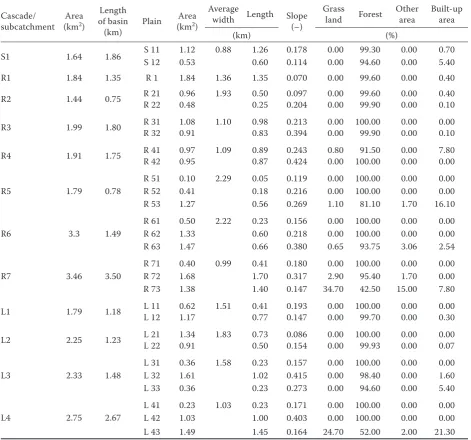
data for the KINFIL model (Tables 6 and 7).
[image:4.595.63.292.127.239.2]The current version of the KINFIL model is based
on the Green-Ampt infiltration theory, with
pond-ing time accordpond-ing to Mein and Larson (1973) and
Morel-Seytoux (Morel-Seytoux & Verdin 1981;
Morel-Seytoux 1982; Ponce & Hawkins 1996):
Table 5. Design rainfall depths Pt,N (mm) and duration (min)for the Bily Potok observatory
N (years) Rainfall duration (t, min)
24 h 20' 40' 60' 120' 2 66.8 27.16 32.74 35.47 40.70 5 95.0 41.37 52.07 56.40 64.65 10 113.1 51.67 65.50 70.94 81.24 20 132.0 64.04 81.90 88.71 101.52 50 155.1 79.82 103.61 112.23 128.82 100 173.2 92.15 120.00 129.98 148.91
Table 6. Scheme of the Smeda catchment for the KINFIL model
Cascade/
subcatchment (kmArea 2)
Length of basin
(km) Plain
Area (km2)
Average
width Length Slope (–)
Grass
land Forest Other area Built-up area
(km) (%)
S1 1.64 1.86 S 12S 11 1.120.53 0.88 1.260.60 0.1780.114 0.000.00 94.6099.30 0.000.00 0.705.40
R1 1.84 1.35 R 1 1.84 1.36 1.35 0.070 0.00 99.60 0.00 0.40
R2 1.44 0.75 R 22R 21 0.960.48 1.93 0.500.25 0.0970.204 0.000.00 99.9099.60 0.000.00 0.400.10
R3 1.99 1.80 R 31R 32 1.080.91 1.10 0.980.83 0.2130.394 0.00 100.000.00 99.90 0.000.00 0.000.10
R4 1.91 1.75 R 41R 42 0.970.95 1.09 0.870.89 0.2430.424 0.800.00 100.0091.50 0.000.00 7.800.00
R5 1.79 0.78
R 51 0.10 2.29 0.05 0.119 0.00 100.00 0.00 0.00 R 52 0.41 0.18 0.216 0.00 100.00 0.00 0.00 R 53 1.27 0.56 0.269 1.10 81.10 1.70 16.10
R6 3.3 1.49
R 61 0.50 2.22 0.23 0.156 0.00 100.00 0.00 0.00 R 62 1.33 0.60 0.218 0.00 100.00 0.00 0.00 R 63 1.47 0.66 0.380 0.65 93.75 3.06 2.54
R7 3.46 3.50
R 71 0.40 0.99 0.41 0.180 0.00 100.00 0.00 0.00 R 72 1.68 1.70 0.317 2.90 95.40 1.70 0.00 R 73 1.38 1.40 0.147 34.70 42.50 15.00 7.80
L1 1.79 1.18 L 11L 12 0.621.17 1.51 0.410.77 0.1930.147 0.00 100.000.00 99.70 0.000.00 0.000.30
L2 2.25 1.23 L 21L 22 1.340.91 1.83 0.730.50 0.0860.154 0.00 100.000.00 99.93 0.000.00 0.000.07
L3 2.33 1.48
L 31 0.36 1.58 0.23 0.157 0.00 100.00 0.00 0.00 L 32 1.61 1.02 0.415 0.00 98.40 0.00 1.60 L 33 0.36 0.23 0.273 0.00 94.60 0.00 5.40
L4 2.75 2.67
[image:4.595.63.535.317.757.2]K
s(
z
f+
H
f/
z
f) = (θ
s– θ
i)
dz
f/
dt
(2)
S
f= (θ
s– θ
i) ×
H
f(3)
t
p=
S
f/
i
× (
i
/
K
s– 1)
(4)
where:Ks – hydraulic conductivity (m/s)
zf – the vertical extent of the saturated zone (m) θs – water content at natural saturation (–) θi – initial water content (–)
Hf – wetting front suction (m) I – rainfall intensity (m/s) Sf – storage suction factor (m) tp – ponding time (s)
t – time (s)
The main task is to assess hydraulic
conductiv-ity
K
s, and the storage suction factor
S
f(at field
ca-pacity,
FC
)
.
These
two parameters can be measured
directly on small experimental catchments. In larger
catchments, the previously derived relationships of
these parameters and the CN, which are widely used
by Soil Conservation Service (SCS) (US SCS 1986),
can also be applied. The CN correspond with the
conceptual values of soil parameters
K
sand
S
f(
FC
):
CN =
f
(
K
s,
S
f)
.
The CN method, developed by the US Soil
Con-servation Service based on soil types (Brakensiek
& Rawls 1981), design rainfall depths and duration,
vegetation cover, land use, and antecedent moisture
conditions, is widely used due to its easy application.
An evident shortcoming of this methodology is that
it disregards both the intensity and the duration of
the rainfall that causes flood runoff. This
imperfec-tion can be dealt with by using the physically-based
infiltration approach of the KINFIL model (Kovář
1992) instead of the usual empirical CN approach.
The relationships between the CN method and the
soil type parameters have been used for the
infiltra-tion process. These relainfiltra-tionships were derived by
correlating the data from 62 gauges located in the
Czech territory (Šamaj
et al
. 1983; Kovář 1992) and
the parameters of the basic soil groups.
RESULTS AND DISCUSSION
The computed CN values for the Smeda catchment
are shown in Table 8.
Table 9 shows the principles for computing the
results from the correlation processes to change the
hydraulic conductivity
K
s(mm/h) and the sorptivity
S
(θ
FC) (mm/h
0.5at field capacity). When this
sorptiv-ity
S
(θ
FC) is amended to the storage suction factor,
its form can be expressed as follows:
S
f= (
S
(θ
FC)
2/2.0 ×
K
s
)
(5)
The second part of the KINFIL model simulates
the propagation and the transformation of the direct
runoff (Beven 2006). The partial differential
equa-tion describes the unsteady flow approximated by
a kinematic wave on a cascade of planes arranged
according to the topography of the catchment:
(6)
Table 7. Correlation relationships CN = f (Ks, Sf), orderlines of the terraced area
Status Number of lines CN (–) Ks (mm/h) Sf (mm) Terraces area (km2) (%)
Without terraces – 77 1.86 22.60 – –
With terraces
1 75 2.02 20.75 0.423 1.61
3 71 3.63 18.34 1.270 4.86
5 67 5.20 16.60 2.120 8.11
[image:5.595.64.533.112.197.2]CN – Curve Number; Ks – hydraulic conductivity; Sf – storage suction factor
Table 8. Curve Number (CN) values derived from the Smeda catchment for the soil types (US classification and Czech Bily Potok major profile)
Soil types
1 2 3 4 5 6 7 8 9 10
CN 95.1 92.1 90.0 86.8 85.8 78.0 64.1 60.7
US soil types (Brakensiek and Rawls (1981), amended by the Czech soil classification according to Novak)
1α m
e
y my y i t
t x
where:
x, y, t – length (m), depth (m) and time (s) α, m – hydraulic parameters
ie(t) – excess rainfall intensity (m/s)
This equation is solved by the finite difference
method, using an explicit numerical scheme.
N
umeri-cal stability of the scheme is ensured if the time and
space step is according to equation (7):
(7)
where: c – celerity c = m × ym–1
y – water depth
Explicit schemes in the software where there is only
one unknown on the left-hand side of the equation
are quick, but they are sensitive to the stability of
the computation, if there is a bigger difference in the
time (Δ
t
) and space step (Δ
x
) (Eq. (7)).
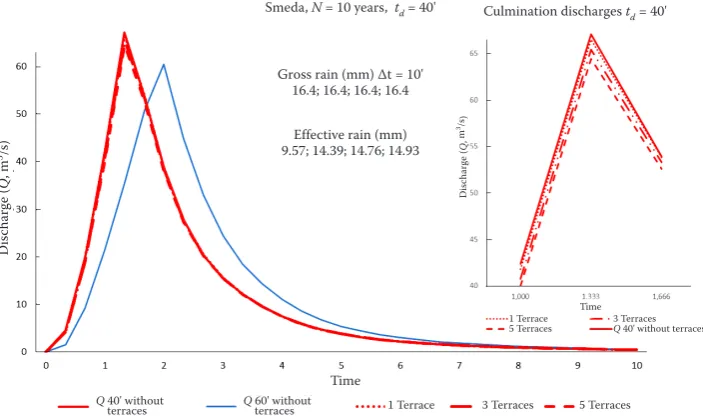
To ensure safe biotechnical measures, it is
neces-sary to construct multiple terraces in a contour line
system. In the Smeda basin, one row 10 m in width
has been built in four sub-catchments R5, R6, and
L3, L4. For a greater level of safety, the Bily Potok
municipality will need at least five rows of terraces to
decrease the water discharges for
N
= 10-year flood
from 67.0 m
3/s (without terraces) to about 64.5 m
3/s.
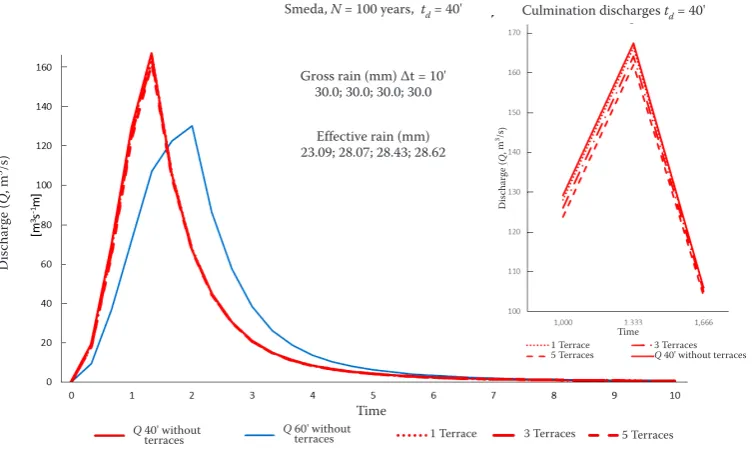
The Tables 10−13 and Figures 4 and 5 provide results
that reduce the cumulation of
N
=100-year discharges
from 167.3 m
3/s (without terraces) to about 162.0 m
3/s.
[image:6.595.62.533.111.250.2]The most dangerous time situation is duration of
40 min. A similar computation was also performed
for a torrential rain of 60 min in duration, but this is
a less dangerous scenario.
Table 9. Instruction from the correlation processes for hydraulic conductivity Ks (mm/h) and storage suction factor Sf (mm)
Conditions for CN Equation Accuracy(σ)
Ks equations (mm/h)
if CN ≥ 75 0.084
if 74 ≥ CN < 36 Ks = 31.4 – (0.39 × CN) 0.136 if CN < 35 Ks = 47.1 – (0.82 × CN)
S(θFC) equations (mm/h0.5)
if CN > 65
if CN < 64 S(θFC) = 30.25 – (0.15 × CN)
CN – Curve Number; Sf = S(θFC)2/2.0 × K
s
100 CN 12 4
S
K
θ 100 CN 2.5FC
S
1
t c
x
Figure 4. Smeda, N = 10 years, time duration td = 40 min; discharges without terraces, 1 terrace, 3 terraces, 5 terraces
Culmination discharges td = 40' Smeda, N = 10 years, td = 40'
Gross rain (mm) Δt = 10' 16.4; 16.4; 16.4; 16.4
Effective rain (mm) 9.57; 14.39; 14.76; 14.93
Di
sc
har
ge (
Q
,
m
3/s)
Time 1 Terrace
5 Terraces 3 TerracesQ 40' without terraces
Time
Di
sc
har
ge (
Q
, m
3/s)
Q 40' without
[image:6.595.123.475.527.736.2]Figure 5. Smeda, N = 100 years, time duration td = 40 min; discharges without terraces, 1 terrace, 3 terraces, 5 terraces Table 10. Maximum N = 10 years and N = 100 years discharges (Q, m3/s) with duration of 40 min, without terraces and
with 5 rows of terraces
Seq. Time (h)
10 years 100 years
Seq. Time (h)
10 years 100 years without
terraces 5 rows of terraces without terraces 5 rows of terraces without terraces 5 rows of terraces terraceswithout 5 rows of terraces 1 0.333 4.461 4.252 19.226 17.906 16 5.333 3.164 3.149 3.368 3.353 2 0.666 20.023 18.913 69.224 64.570 17 5.666 2.643 2.631 2.789 2.776 3 1.000 42.347 40.005 129.138 123.765 18 6.000 2.235 2.225 2.339 2.329 4 1.333 67.069 64.454 167.356 161.927 19 6.333 1.909 1.900 1.983 1.974 5 1.666 53.926 52.618 105.956 103.828 20 6.666 1.644 1.637 1.698 1.690 6 2.000 38.737 38.091 67.480 66.622 21 7.000 1.427 1.421 1.466 1.460 7 2.333 27.635 27.296 44.925 44.524 22 7.333 1.248 1.242 1.275 1.269 8 2.666 20.400 20.205 30.333 30.117 23 7.666 1.097 1.092 1.117 1.112 9 3.000 15.540 15.419 20.845 20.715 24 8.000 0.970 0.966 0.985 0.981 10 3.333 12.181 12.101 14.843 14.759 25 8.333 0.862 0.858 0.874 0.870 11 3.666 9.580 9.524 10.963 10.905 26 8.666 0.769 0.766 0.779 0.776 12 4.000 7.507 7.466 8.332 8.290 27 9.000 0.690 0.687 0.699 0.696 13 4.333 5.920 5.889 6.476 6.444 28 9.333 0.622 0.619 0.629 0.626 14 4.666 4.735 4.711 5.127 5.103 29 9.666 0.563 0.561 0.569 0.567 15 5.000 3.843 3.824 4.125 4.106 30 10.000 0.512 0.510 0.517 0.515 Seq. − sequence
Table 11. Effectiveness of the terraces in the Smeda catchment, N = 10 and 100 years, time duration td = 40 and 60 min (effective rainfall; 5 rows of terraces)
Without terraces With terraces Without terraces With terraces
N = 10, td = 40': RER = 56.7 mm RER_T = 55.9 mm N = 100, td = 40': RER = 112.2 mm RER_T = 110.4 mm
N = 10, td = 60': RER = 59.7 mm RER_T = 58.7 mm N = 100, td = 60': RER = 118.8 mm RER_T = 117.8 mm
RER – effective rainfall without terraces (mm); RER_T – effective rainfall with terraces (mm)
Culmination discharges td = 40' Smeda, N = 100 years, td = 40'
Gross rain (mm) Δt = 10' 30.0; 30.0; 30.0; 30.0
Effective rain (mm) 23.09; 28.07; 28.43; 28.62
Di
sc
har
ge (
Q
,
m
3/s)
Time 1 Terrace
5 Terraces 3 TerracesQ 40' without terraces
Time
Di
sc
har
ge (
Q
, m
3/s)
Q 40' without
[image:7.595.107.484.514.740.2]For a comparison with the
N
-year discharges on
the Smeda catchment, we computed Tables and
Fig-ures with geometric factors for sub-catchments and
their land use. The same procedure was followed,
in principle, for
N
= 2 years and 40 min duration.
However, this computation is not presented here.
CONCLUSION
Slope terraces have hydro-physical
characteris-tics that can be different and they require a lot of
[image:8.595.65.532.112.595.2]finances. Hydrological analyses indicate that the use
of flood control terraces as biotechnical measures
does not provide any effective barriers for the Bily
Potok municipality. For a practical application, more
than four sub-catchments are needed. In addition,
more than five rows of terraces are needed, and also
at least two polders. The provision of effective
meas-ures will require more investment than is currently
envisaged. A comparison of the computational results
(Table 10) shows that correct results are dependent
on regular maintenance.
Table 12. Discharges (Q, m3/s) from individual sub-catchments of the Smeda catchment, N = 10 years, time duration 40 min
Acknowledgements. Supported by Project N TA02020402 of Technological Agency of the Czech Republic and by the In-ternal Grant Agency of the Faculty of Environmental Sciences as a part of the Project IGA2017 20174257 – Modelling of the overland flow to mitigate harmful impact of soil erosion.. The team of authors express their gratitude for this support.
References
Beggan C., Hamilton C.W. (2010): New image processing software for analysing object size-frequency distribution,
geometry, orientation, and spatial distribution. Comput-ers & Geosciences, 36: 539–549.
Beven K.J. (2006): Rainfall-Runoff Modelling. The Primer. Chichester, John Wiley & Sons.
Brakensiek D.L., Rawls W.J. (1981): An infiltration based rainfall-runoff model for a SCS type II distribution. In: Winter Meeting ASAE. Palmer House, Chicago. Chang F.J., Chung C.H. (2012): Estimation of riverbed
grain-size distribution using image-processing techniques. Journal of Hydrology, 440–441: 102–112.
[image:9.595.64.534.125.593.2]Ferguson B.K. (1998): Introduction to Stormwater. New York, J.Wiley & Sons, Inc.
Table 13. Discharges (Q, m3/s) from individual sub-catchments of the Smeda catchment, N = 100 years, time duration
40 min
Hallema D.W., Moussa R. (2014): A model for distributed GIUH-based flow routing on natural and anthropogenic hillslopes. Hydrological Processes, 28: 4877–4895. Kovář P. (1989): Rainfall-runoff Event Model Using Curve
Numbers (KINFIL). Research Report No. 110.92. Wa-geningen, Department of Hydraulics and Catchment Hydrology.
Kovář P. (1992): Possibilities of determining design dis-charges on small catchments using KINFIL model. Vodohospodářsky časopis (Water Resources Journal), 40: 197–220.
Kovář P. (2014): KINFIL Model: Infiltration and Kinematic Wave. User’s Manual. Prague, FZP CZU.
Laronne J.B., Shlomi Y. (2007): Depositional character and preservation potential of course-grained sediments de-posited by flood events in hyper-arid braided channels in the Rift Valley, Arava, Israel. Sedimentary Geology, 195: 21–37.
Mao L., Surian N. (2010): Observations on sediment mo-bility in a large gravel-bed river. Geomorphology, 114: 326–337.
Mein R.G., Larson C.L. (1973): Modelling infiltration dur-ing a steady rain. Water Resources Research, 9: 384–394. Morel-Seytoux H.J. (1982): Analytical results for prediction
of variable rainfall infiltration. Journal of Hydrology, 59: 209–230.
Morel-Seytoux H.J., Verdin J.P. (1981): Extension of the SCS Rainfall Runoff Methodology for Ungaged Watersheds. [Report FHWA/RD-81/060.] Springfield, US National Technical Information Service.
NRCS (2004a): Hydrologic soil-cover complexes. Chapter 9. In: National Engineering Handbook, Part 630 Hydrology. Washington D.C., USDA.
NRCS (2004b): Estimation of direct runoff from storm rainfall. Chapter 10. In: National Engineering Handbook, Part 630 Hydrology. , Washington D.C, USDA.
Ponce V.M., Hawkins R.H. (1996): Runoff Curve Number: Has it reached maturity? Journal of Hydrologic Engineer-ing, 1: 11–19.
Šamaj F., Brázdil R., Valovič J. (1983): Daily depths of ex-treme rainfalls in 1901–1980 in CSSR. In: Study Proceed-ings of SHMU. Bratislava, ALFA: 19–112. (in Czech and Slovak)
US SCS (1986): Urban Hydrology for Small Watersheds. Technical Release 55 (updated). US Soil Conservation Service.
US SCS (1992): Soil Conservation Program Methodology. Chapter 6.12. Runoff Curve Numbers. US Soil Conserva-tion Service.
Vaššová D., Kovář P. (2012): DES_RAIN, Computational Program. Prague, FZP CZU.