120
Sentiment Analysis for Multilingual Corpora
Svitlana Galeshchuk
Governance Analytics, PSL Research University / University Paris Dauphine
Place du Marechal de Lattre de Tassigny,
75016 Paris, France
Julien Jourdan
PSL Research University / University Paris Dauphine
Place du Marechal de Lattre de Tassigny,
75016 Paris, France
Ju Qiu
Governance Analytics, PSL Research University / University Paris Dauphine
Place du Marechal de Lattre de Tassigny,
75016 Paris, France
Abstract
The paper presents a generic approach to the supervised sentiment analysis of social media content in foreign languages. The method pro-poses translating documents from the origi-nal language to English with Google’s Neural Translation Model. The resulted texts are then converted to vectors by averaging the vectorial representation of words derived from a pre-trained Word2Vec English model. Testing the approach with several machine learning meth-ods on Polish, Slovenian and Croatian Twitter corpora returns up to 86 % of classification ac-curacy on the out-of-sample data.
1 Introduction
Sentiment analysis is gaining prominence as a topic of research in different areas of applica-tion (journalism, political science, marketing, fi-nance, etc.). In the last two decades, opinion-rich data sources are widely available because of
web-resources and social networks. While
lexicon-based frameworks have long been investigated for sentiment analysis, deep learning methods with a vectorial representation of words are proving to deliver promising results. The integration of two types of methods is widely investigated as well. Thus, the sentiment analysis approaches usually require either fine-grained lexicon of most fre-quent words along with their polarity scores or the dataset large enough for supervised training of deep learning network, sufficient computational memory, etc.
Moreover, most of the open-source datasets for training sentiment models comprise English-language texts. The lexicons are not always avail-able for other languages, and it remains a time-consuming task to construct them. It motivates us to build on the existing approaches and test a rather general method to run a sentiment analysis
for different languages without polarity dictionar-ies using relatively small datasets.
We address the challenges for sentiment analy-sis in Slavic languages by using the averaged vec-tors for each word in a document translated in English. The vectors derive from the Word2Vec model pre-trained on Google news.
Researchers tend to use the language-specific pre-trained Word2Vec models (e.g., Word2Vec model pre-trained on Wikipedia corpus in Greek,
Swedish, etc.). On the contrary,we propose
ben-efiting from Google’s Neural Translation Model translating the texts from other languages to En-glish. Translated documents are then converted to the fixed-vectorial representation with Google Word2Vec model.1 The supervised machine learn-ing classifiers such as Gradient Boostlearn-ing Trees, Random Forest, Support Vector Machines provide sufficiently high accuracy on the out-of-sample data converted to the aggregate vectors.
The rest of the paper is structured as follows: Section 2 provides a brief review of related liter-ature. Section 3 describes the methodology. Sec-tion 4 expands on data used. SecSec-tion 5 presents the results from our experiments. Section 6 concludes with some observations on our findings and iden-tifies directions of future research.
2 Related Work
This section elaborates on existing methods for sentiments analysis and the adjacent approaches to text data treatment that have helped us formulate the proposed process of sentiment analysis. Fol-lowingDashtipour et al. (2016), we divide senti-ment analysis systems on lexicon-based, corpus-based and hybrid.
1https://drive.google.com/file/d/
2.1 Lexicon-Based Methods
Lexicon-based methods employ the dictionaries of pre-defined words with corresponding polar-ity scores. These scores define how positive the term is. Some approaches (e.g., Vader lexicon in
Hutto and Gilbert(2014)) use the opinion of sev-eral experts and the final polarity measure equals
the mean of the corresponding scores. A
sub-set of the most popular and promising lexicon-based sentiment classifiers for English corpora
has been reported in Levallois (2013).
Con-cerning Slavic languages, Slovak lexicon trans-lated from English and annotated with Bare-bones particle swarm optimization helps achieve 0.865 F1 score in sentiment classification reported in
Krchnavy and Simko (2017). Gombar et al.
(2017) construct Croatian domain-specific lexicon for domain-specific classification;Haniewicz et al.
(2013) run sentiment analysis with polarity lexi-con for reviews in Polish that renders up to 79% of accuracy. We will refer to these papers later in our study to corroborate our results by comparison with the existing methods.
The idea proposed in Wan(2009) shares some
similarities with our method. Authors translate Chinese text in English and then employ lexicon-based ensemble method to classify texts on posi-tive or negaposi-tive. The reported accuracy is 85.3% though it requires Chinese and English lexicon and some additional calculation to create the ensem-ble method. However, word scoring in each con-structed lexicon usually relies on human treatment and perception. The task is also labor-intensive, and it may be challenging to find fine-grained lex-icons for some languages.
Moreover, a well-known drawback of lexicon-based method is the contextual ignorance as some terms may have different meanings in various
doc-uments. Besides, some documents (e.g., short
texts as tweets) sometimes do not include any word from the lexicon. The introduction of word vectorial representation tend to address this disad-vantage.
2.2 Corpus-based and Hybrid Methods with Vectorial Representation
Embedding approaches usually rely on the seman-tic vector spaces derived from the neural networks. Their application in supervised experimental set-ups for polarity analysis often demonstrates su-perior performance to the lexicon-based methods
(Le and Mikolov, 2014; Severyn and Moschitti,
2015). As the reference point in our study we
use the papers of Giatsoglou et al. (2017) and
Garten et al. (2018) where authors meticulously employ Sentence2Vec in their methodological set-tings. Giatsoglou et al.(2017) uses Sentence2Vec based on the Word2Vec model learned from the Wikipedia corpus in Greek. The performance is evaluated with the datasets of mobile phonesâ ˘A ´Z reviews in Greek. The model that exploits the vectors derived from the Wikipedia corpora+the reviews provides the highest accuracy of 70.89-82.40% on test samples. Author further try hy-brid methods (lexicon- and embedding- driven) that deliver slightly better results.Rotim and Šna-jder(2017) use similar approach for Croatian cor-pora obtaining 0.822 as F1 score for game reviews but the results are much worse for the Twitter dataset. In contrast to the authors, we do not train our Word2Vec model for the corpora in Slavic
languages. Instead, we employ the pre-trained
Google News Word2Vec model after translating
texts to English. It makes our approach more
universal and easier to apply to the foreign lan-guage corpora yielding satisfactory accuracy (see
Results).
Garten et al.(2018) compute the cosine similar-ity between the aggregate vectorial representation of documents and the â ˘AIJnegativeâ ˘A˙I and â ˘ AIJ-positiveâ ˘A˙I dictionaries. Precision on the IMBD English reviews data varies between 0.70-0.75. Our findings show that the introduction of the po-larity dictionaries delivers less accurate outputs than using Sentence2Vec. However, our set-up does not foresee unsupervised learning.
Feature-based approach for Czech language sentiment classification renders 0.69 as F1 mea-sure inHabernal et al.(2013). The method has to be adjusted for other languages if used.
3 Methodology
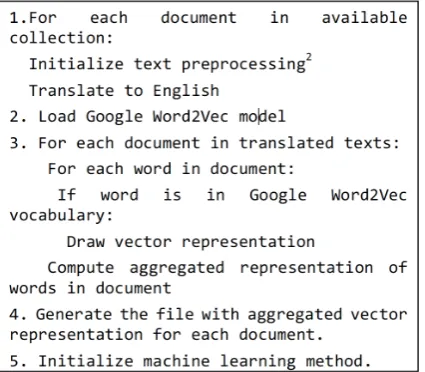
[image:3.595.76.289.138.324.2]Recall from the previous sections that we tend to develop a sentiment analysis approach for multi-language use. Fig.1 depicts the proposed method.2
Figure 1: Generic process of the multilingual sentiment classiffication
Word vectorial representation spurs the inter-est of many researchers in natural language pro-cessing due to its capacity to catch the meaning of terms depending on the context. Researchers and practitioners who use deep learning methods for sentiment analysis tend to learn the embed-ding from the available dataset or pre-trained word embedding models (i.e., Word2Vec, Glove). Each document is then represented as the stack of vec-tors. Document padding unifies the number of vectors that serve as the network input. It means that the network deals with [batchsize*size of vec-torial stack*number of features] input data dimen-sions which may be computationally costly.
Instead, our model exploits vectorial repre-sentation of the words with a transfer learning approach: Google Word2Vec pre-trained model serves as a source of 300-dimensional dense vec-tors for each word in the text. Then the model computes an elementwise sum of the vectors di-vided by the number of terms in the text.
The use of Google Word2Vec model has sev-eral advantages over learning embeddings from the training data: (i) Google model has been pre-trained with the corpora of the news containing circa 100 billion words where each term has been used more than once and in different contexts. It
2We removed urls, emojis, digits and punctuation marks
as text preprocessing
makes the model the state-of-the-art regarding the quality of vectors which plays a crucial role in our study as we use the translated text from Slavic languages to English; (ii) Google model com-prises approximately 3 million words and phrases. This vocabulary covers the lion share of lexicon employed by web-resources and social networks users; (iii) we do not need to construct a large dataset to train our model as the vectors have al-ready been pre-trained with a significant number of terms.
Google Translation. Machine translation does not always provide perfect accuracy from the lin-guistic point of view. However, the resulted trans-lation with recently introduced Googleâ ˘A ´Zs Neu-ral Machine Translation approach tends to deliver English text contextually similar to the input doc-ument (seeWu et al.(2016) for more details).
3.1 Machine Learning Methods Used
This subsection discusses the machine learning classifiers employed in a supervised learning ap-proach to classify texts on positive or nega-tive. The implementation details are stored in the
Github repository.
Support Vector Machines Classification. This approach belongs to the family of versatile ma-chine learning methods with high accuracy on
non-large datasets. It tries to find the
broad-est possible margin between positive and negative classes. As inGiatsoglou et al.(2017) we use lin-ear Support Vector Classifier (SVC) and Gaussian Radial Basis Function (RBF) in our set-up.
Random forest (RF) helps overcome the disad-vantages of a single decision tree by summariz-ing and averagsummariz-ing predictions over the number of trees. It is an ensemble learning approach that uses the outputs of the individual predictors as votes. If the positive class gets more votes, the method will return the corresponding result.
Gradient Boosting Trees. In our set-up Gradient boosting (GBT) method represents an ensemble of classification decision trees. Each tree sequen-tially joins the ensemble correcting the antecedent by fitting its residual errors.
cali-bration in our empirical search for the model with the best possible accuracy. The architecture of our DNN comprises 2 hidden layers with dropout rate of 0.2
3.2 Evaluation
For this classification problem, the quality of a model is measured by the proportion of correctly classified observations (accuracy). The receiver operating characteristic curve plots true positive rate against false positive rate for the test set. The area under the curve (AUC) represents another way to compare the classifiers.
4 Data
Multilanguage Corpora. We use the corpora in Polish, Slovenian and Croatian in our experimen-tal set-up. Polish, Slovenian and Croatian lan-guages belong to the Indo-European family as well as English. However, they are members of the Slavic branch that makes these languages share less close ties with English than, for example, French, Spanish or Italian would have.
We retrieve the dataset with texts and corre-sponding polarity scores for tweets in mentioned languages from the website of the European
re-search infrastructure CLARIN.3Our dataset
com-prises 2794 tweets in Polish (1397 positive and 1397 negative), 4272 tweets in Slovenian (2312 positive and 1950 negative) and 3554 tweets in Croatian (2129 positive and 1425 negative).
Tweets may contain emojis and/or URLs. We removed them together with digits and punctu-ation marks as a part of the data preprocessing
step. Later we employ Google Translator API
via Python Library Google-api-translateto trans-late texts to English language. Google Transla-tion Library is easy to use and it takes approxi-mately 12 min to translate 1000 tweets. The cor-pora for Slovenian and Croatian languages are
im-balanced. Hence, we use stratified split in the
cross-validation settings that returns folds with the corresponding ratio of classes in training and test sets.
5 Results
After mentioned datasets have been translated to English, each tweet is converted to the vector cre-ating the averaged representation of the document words. Data is split into training/testing sets as
3https://www.clarin.si/repository/xmlui/
80/20 respecting the ratio of positive and negative observations.
Table 1 presents the accuracy results for three datasets (Polish, Slovenian, Croatian). The over-all accuracy of the best classifiers is more than 76% which may be seen as satisfactory taking into consideration state-of-the-art findings. The tree-based methods usually deliver marginally better accuracy to the SVC and DNN classifiers. The ac-curacy of more than 78% is higher than the one reported inGarten et al.(2018) where authors use both documents aggregate representation and pre-defined lexicon. Recall measure is lower for the negative class in case of the corpora in Croatian and Slovenian. The issue of the imbalanced data may explain it.
[image:4.595.311.522.291.333.2]Data/cl. RF GBT SVM RBF DNN Polish 76.30 78.46 76.84 73.25 75.58 Slovenian 73.12 76.10 75.70 71.80 75.69 Croatian 86.32 86.26 85.17 86.14 85.58
Table 1: Accuracy with applied machine learning methods
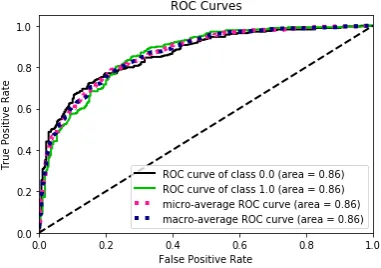
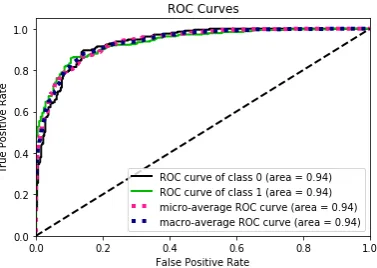
[image:4.595.310.501.463.597.2]Fig. 2, 3, 4. depict the ROC curve with the largest AUC for each datasets (2) RF for Polish, (3) GBR for Slovenian, (4) RF for Croatian. ROC curve detects tree-base methods outperform the rest of approaches for all datasets.
Figure 2: ROC curve with the largest AUC for Polish language
5.1 Comparison of Methods
Figure 3: ROC curve with the largest AUC for Slove-nian language
Figure 4: ROC curve with the largest AUC for Croatian language
scores to evaluate classifiers. Thus we choose the papers with developed methods in Polish, Slove-nian and Croatian tested on social media or prod-uct review corpora to make the quantitative com-parison as unbiased as possible. Table 2 reports the evaluation findings. The analysis proves that despite being generic our approach returns simi-lar or better results for sentiment analysis in Pol-ish, Slovenian and Croatian comparing to the other methods.
Author Measure Reported Results with results developed method POLISH LANGUAGE:
Haniewicz et al.(2013) Accuracy circa 79.00 78.46
Zhang et al.(2017) Accuracy 81.19 78.46
Buczynski and Wawer(2008) Accuracy 77.05 78.46
SLOVENIAN LANGUAGE:
Zhang et al.(2017) Accuracy 78.07 76.10
Kadunc(2016) Accuracy 76,20 76.10
CROATIAN LANGUAGE:
Gombar et al.(2017) F1 Score 0.66 0.86
Rotim and Šnajder(2017) F1 Score 0.57 0.86
Agi´c et al.(2010) F1 Score 0.63 0.86
Table 2: Comparison of Findings
6 Conclusion
The paper introduces and elaborates on the de-veloped generic approach to sentiment analysis of multilingual corpora that encompasses translating texts to English, aggregating vectorial representa-tion of translated words and eventually applying machine learning methods to classify documents on positive or negative. As pointed out earlier, the aim of the study is not to compete with the existing techics in terms of accuracy but to propose method that does not suffer from one-language applicabil-ity and is simple to implement. We build on the state-of-the-art and present a general set-up which may be used in supervised sentiment analysis for different Slavic languages. Testing the accuracy of our approach on a collection of tweets in three Slavic languages delivers comparable accuracy to the reported findings from recent papers on senti-ment analysis for English and non-English corpora (seeRelated Work andComparison of Methods). However, the difference in the classification accu-racy for Polish, Slovenian and Croatian languages motivates us to test the method with other Slavic languages. These discrepancies may arrise from the quality of translation as well as from the im-perfections in labeling the data. We are working on our own pre-labeled balanced dataset to further improve the approach.
Acknowledgments
We are grateful for the received support from the research initiative "Governance Analytics" funded by the PSL University under the program "Investissements Avenir" launched by the French Government and implemented by ANR with
the references ANR-10-IDEX-0001-02 PSL
Paris Sciences et Lettres (PSL). We would also like to thank the anonymous reviewers for their suggestions and comments.
References
Željko Agi´c, Nikola Ljubeši´c, and Marko Tadi´c. 2010. Towards sentiment analysis of financial texts in croa-tian. In Proceedings of the Seventh International Conference on Language Resources and Evaluation.
[image:5.595.73.292.620.728.2]Kia Dashtipour, Soujanya Poria, Amir Hussain, Erik Cambria, Ahmad YA Hawalah, Alexander Gelbukh, and Qiang Zhou. 2016. Multilingual sentiment anal-ysis: state of the art and independent comparison of techniques.Cognitive computation, 8(4):757–771.
Justin Garten, Joe Hoover, Kate M Johnson, Rei-hane Boghrati, Carol Iskiwitch, and Morteza De-hghani. 2018. Dictionaries and distributions: Com-bining expert knowledge and large scale textual data content analysis. Behavior research methods, 50(1):344–361.
Maria Giatsoglou, Manolis G Vozalis, Konstantinos Diamantaras, Athena Vakali, George Sarigiannidis, and Konstantinos Ch Chatzisavvas. 2017. Sentiment analysis leveraging emotions and word embeddings.
Expert Systems with Applications, 69:214–224.
Paula Gombar, Zoran Medi´c, Domagoj Alagi´c, and Jan Šnajder. 2017. Debunking sentiment lexicons: A case of domain-specific sentiment classification for croatian. In Proceedings of the 6th Workshop on Balto-Slavic Natural Language Processing, pages 54–59.
Ivan Habernal, Tomáš Ptáˇcek, and Josef Steinberger. 2013. Sentiment analysis in czech social media us-ing supervised machine learnus-ing. In Proceedings of the 4th workshop on computational approaches to subjectivity, sentiment and social media analysis, pages 65–74.
Konstanty Haniewicz, Wojciech Rutkowski, Mag-dalena Adamczyk, and Monika Kaczmarek. 2013. Towards the lexicon-based sentiment analysis of polish texts: Polarity lexicon. InInternational Con-ference on Computational Collective Intelligence, pages 286–295. Springer.
Clayton J Hutto and Eric Gilbert. 2014. Vader: A par-simonious rule-based model for sentiment analysis of social media text. InEighth international AAAI conference on weblogs and social media.
Klemen Kadunc. 2016. Using machine learning for sentiment analysis of slovene web commentaries.
University of Ljubljana.
Rastislav Krchnavy and Marian Simko. 2017. Senti-ment analysis of social network posts in slovak lan-guage. In2017 12th International Workshop on Se-mantic and Social Media Adaptation and Personal-ization (SMAP), pages 20–25. IEEE.
Quoc Le and Tomas Mikolov. 2014. Distributed repre-sentations of sentences and documents. In Interna-tional conference on machine learning, pages 1188– 1196.
Clement Levallois. 2013. Umigon: sentiment analy-sis for tweets based on terms lists and heuristics. In
Second Joint Conference on Lexical and Computa-tional Semantics (* SEM), Volume 2: Proceedings of the Seventh International Workshop on Semantic Evaluation (SemEval 2013), volume 2, pages 414– 417.
Leon Rotim and Jan Šnajder. 2017. Comparison of short-text sentiment analysis methods for croatian. InProceedings of the 6th Workshop on Balto-Slavic Natural Language Processing, pages 69–75.
Aliaksei Severyn and Alessandro Moschitti. 2015. Twitter sentiment analysis with deep convolutional neural networks. InProceedings of the 38th Inter-national ACM SIGIR Conference on Research and Development in Information Retrieval, pages 959– 962. ACM.
Xiaojun Wan. 2009. Co-training for cross-lingual sen-timent classification. In Proceedings of the Joint Conference of the 47th Annual Meeting of the ACL and the 4th International Joint Conference on Natu-ral Language Processing of the AFNLP: Volume 1-volume 1, pages 235–243. Association for Compu-tational Linguistics.
Yonghui Wu, Mike Schuster, Zhifeng Chen, Quoc V Le, Mohammad Norouzi, Wolfgang Macherey, Maxim Krikun, Yuan Cao, Qin Gao, Klaus Macherey, et al. 2016. Google’s neural ma-chine translation system: Bridging the gap between human and machine translation. arXiv preprint arXiv:1609.08144.