472
Equipping Educational Applications with Domain Knowledge
Tarek Sakakini* Hongyu Gong* Jong Yoon Lee* Robert Schloss† Jinjun Xiong† Suma Bhat*
*University of Illinois at Urbana-Champaign, USA
†T. J. Watson Research Center, IBM, USA
*{sakakini, hgong6, jlee642, spbhat2}@illinois.edu †{rschloss, jinjun}@us.ibm.com
Abstract
One of the challenges of building natural lan-guage processing (NLP) applications for edu-cation is finding a large domain-specific cor-pus for the subject of interest (e.g., history or science). To address this challenge, we pro-pose a tool, Dexter, that extracts a subject-specific corpus from a heterogeneous corpus, such as Wikipedia, by relying on a small seed corpus and distributed document representa-tions. We empirically show the impact of the generated corpus on language modeling, esti-mating word embeddings, and consequently, distractor generation, resulting in a better per-formance than while using a general domain corpus, a heuristically constructed domain-specific corpus, and a corpus generated by a popular system: BootCaT.
1 Introduction
Educational applications tend to target a specific subject, in other words, a specific domain, such as the medical domain in the case of (Jin et al.,
2018). Thus, building these applications with un-derlying NLP algorithms, would typically require a large domain-specific corpus. Example uses of these large corpora are estimating language mod-els (Rosenfeld, 2000), estimating word embed-dings (Mikolov et al.,2013), and estimating docu-ment embeddings (Le and Mikolov,2014). These estimations are central to several downstream ap-plications including automatic speech recognition (Katz, 1987), machine translation (Koehn et al.,
2003), and text categorization (Tang et al.,2015). Previous findings, such as (McClosky, 2010), have shown that training NLP applications on a domain different from the target domain could prove detrimental to the performance of these ap-plications. In order to help educational applica-tions in specific disciplines such as science and history create a large, yet domain-specific corpus,
we propose a domain extraction tool, Dexter1, that extracts a domain-specific corpus from Wikipedia. The algorithm, elaborated in Section2, retrieves a set of documents from Wikipedia that are closest in discipline to a user-supplied small seed corpus. The size of this extracted set is a user-defined hy-perparameter, and thus controls the trade-off be-tween the specificity of the output corpus and its size. We empirically determine the favorable con-figuration of Dexter, demonstrate its benefits to-wards estimating word embeddings, and conse-quently distractor generation, as well as language models. We also show how, on the aformentioned tasks, Dexter outperforms BootCaT, a popular toolkit to automatically create an Internet-derived corpus (Baroni and Bernardini, 2004). Datasets used in this research are released for public use2.
2 Method
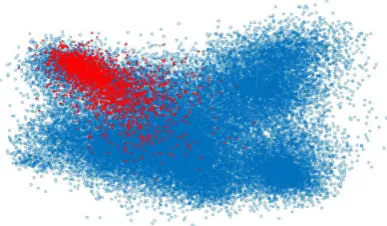
Dexter’s algorithm builds on the assumption that the distributed representation of two documents covering similar topics are closer in the vec-tor space than two documents covering differ-ent topics. To test this assumption qualitatively, we embed all Wikipedia articles in R300 using
Doc2Avg3, and then map them toR2 using t-SNE
(Maaten and Hinton,2008) as shown in Figure1. We see that the subset of science Wikipedia arti-cles form a cluster, thus validating our assump-tion. Details on how science Wikipedia articles were identified are provided in Section3.1. Build-ing on this observation, Dexter takes a seed set of articles representing the target domain (e.g., sci-ence), then sorts Wikipedia articles in increasing order of distance to seed set, then returns the first
kdocuments as the extracted in-domain corpus.
1
Publicly available athttp://bit.ly/dexter-acl
2
http://bit.ly/dexter-dataset-acl
Figure 1: Clustering of science (red) Wikipedia articles among all (blue) Wikipedia articles in 2D.
Multiple design choices need to be considered carefully and are decided empirically in Section
3.2. These decisions are: The document represen-tation method, the distance function to the seed set, and the seed corpus size. For the document representation, we consider: Doc2Vec (Le and Mikolov, 2014), Doc2Avg, Doc2wAvg4, TFIDF (Leskovec et al.,2014), and LSA (Dumais,2004). For the distance function, we consider: Mean, Min, Max, 90th percentile, and 10th percentile (the last two being robust to outliers). For the seed corpus size, we experiment with:10,102, and103.
3 Experiments
We perform three main experiments. The first is an intrinsic evaluation of Dexter, guiding our de-sign choices. Second, we check the effect of the domain-specificity of the resulting word embed-dings on the downstream educational task of dis-tractor generation for science questions. Third, we evaluate the effect of Dexter on language model-ing. Before we delve on the experimental details, we describe the process of labeling Wikipedia ar-ticles as science or not, and describe our competi-tive baseline: BootCaT.
3.1 Experimental Setup
Dataset Preparation:Wikipedia does not clearly partition its articles into different domains, but in-stead assigns a set of categories to each article. Wikipedia also organizes its categories as a di-rected graph, where, if category b is a subcate-gory of catesubcate-gorya, then there exists an edge (a,b) (Sch¨onhofen,2009). Although it might seem nat-ural to consider all descendants of a category (do-main in a broad sense) to belong to that category, upon inspection we found the need for setting a
4The embedding of a document is the average of its words’ embeddings weighted by a word’s TFIDF score
depth limit. For example, “Stalking” is a third de-scendant of “Biology”, although “Stalking” is not considered a “Biology”-related subject. Based on similar observations, we set the depth limit to two. To identify science articles, we consider a list of science root categories, and all their subcategories up to a depth of 2. All articles labeled with any category in this list are considered science articles, amounting to 176,905 articles. This collected sci-ence corpus will be referred to as CD, while the
general Wikipedia corpus will be referred to asC. We note that the corpus CD is created using
heuristics on Wikipedia’s taxonomy. In order to assess the extent to which the articles in CD
be-long to the discipline of science, we do the fol-lowing. Two annotators assess the quality ofCD
by taking a subset of 1000 articles equally spread across depths: 0, 1, 2, and 3. Each article (depth anonymized) was given an integer score between 0 and 5 to reflect how much the content of the article is related to science. The inter-annotator agreement on the scores had a Pearson’s correla-tion coefficient of 0.77 suggesting a reasonably high agreement on the scores. Upon comparing the average scores of articles at different depths, we found the score to be inversely proportional to the depth, with scores 4.35, 3.58, 3.21, and 2.4 for articles at depth 0, 1, 2, and 3 respectively. This further justifies our depth limit of 2, below which the average score suddenly drops below 3.
Also, for the purposes of our experiments, we splitCD (176,905 articles) into three corpora: (1)
Cseed(1,000 articles having a depth of 0), used as
the seed corpus for Dexter and the BootCaT base-lines, (2) Cho (40,000 articles), which is a
held-out dataset to be used for testing language models, and (3) Csilver5 (136,905 articles) =CD −Cho,
our training subset ofCD to be used in language
modeling experiments. CD reflects the quality
of such a corpus heuristically-constructed using Wikipedia’s taxonomy.
Baseline:One popular system used by researchers to extract a domain-specific corpus is BootCaT (Baroni and Bernardini,2004), which operates on the World Wide Web. BootCaT generates queries to a search engine from user-supplied key phrases and parses the first n pages retrieved for each query, wherenis set by the user.
Since Dexter requires seed articles instead of
key phrases, we bridge the gap by a key phrase ex-traction algorithm (Rose et al.,2010) on the set of seed articles, by utilizing a publicly available im-plementation6 with default parameters. We thus take Cseed and extract the top-100 key phrases
with less than 4 words, then feed them to Boot-CaT, leading to a domain-specific corpus (referred to as BootCat-KE). To avoid any possible noise introduced by the keyword extraction algorithm we consider another version of the BootCaT base-line but now with a manual set of 100 key phrases describing the domain of science. We take a list of science key phrases available online7, and then randomly select 100 phrases. The corpus gener-ated by this algorithm is referred to as BootCat-M.
3.2 Intrinsic Evaluation
Before we analyze Dexter’s performance on downstream tasks and compare it to BootCaT, we study the intrinsic performance of Dexter under several design choices and conditions. Our eval-uation of Dexter is based on the precision of the extracted articles averaged over 5 runs. Since we would be manipulating the seed set size, and to ensure Dexter’s robustness under randomness, we artificially construct our seed set by taking a ran-dom subset of CD instead of using Cseed. That
seed set is then used to algorithmically extract the rest ofCD via Dexter. Accordingly, precision is
calculated as the percentage of articles extracted, which belong toCD−Cseed. As for recall, it is not
measured since precision is sufficient as a compar-ison between methods assuming same number of documents extracted.
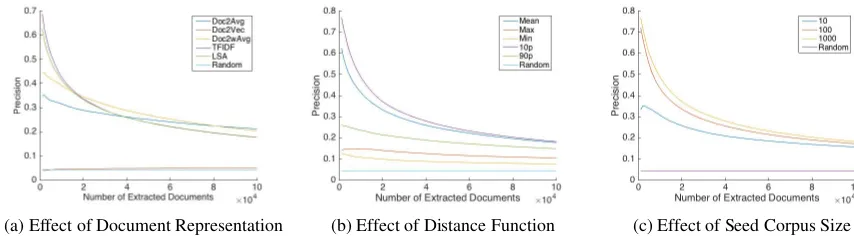
Document representation: We vary the docu-ment representation method while fixing the seed corpus size at 103, and the distance function as Mean (c.f. Figure2a). We observe that LSA and TFIDF are initially superior, but perform compa-rably to Doc2Avg and Doc2wAvg askincreases. LSA is chosen due to its low-dimensionality, and superiority for modestkvalues.
Distance function: We vary the distance function used while fixing the document representation to LSA and the seed corpus size to 1000 (c.f. Figure
2b). We observe that the 10thpercentile distance function leads to the best precision. We hypothe-size that this is due to the 10thpercentile being ro-bust to noise, and requiring closeness to only one
6
https://github.com/csurfer/rake-nltk
7http://sci2.esa.int/glossary/
subdomain of science rather than all at once. Seed corpus size: We vary the seed corpus size while fixing the document representation to LSA and the distance function as 10th percentile (c.f. Figure 2c). We observe that a size of 100 was equally sufficient to 1000. This shows that Dexter does not require an unfeasibly large seed corpus size, which would have defeated the purpose.
3.3 Distractor generation
To better assess the impact of the extracted cor-pus by Dexter, we consider the task of distractor generation for multiple-choice questions (MCQs) (Stasaski and Hearst,2017). Educators spend sig-nificant amount of time choosing suitable distrac-tors for MCQs, where the distracdistrac-tors are the incor-rect choices in an MCQ. Moreover, distractor gen-eration is an essential task for automatic question generation. The choice of distractors is critical to the learning outcomes of students, since a mis-informed selection of easy distractors could ren-der questions non-challenging (Araki et al.,2016). The main aspect of the distractors’ quality is their semantic similarity to the correct answer. The dis-tractor cannot be a synonym of the answer and if too distant, it can be easily eliminated by the learner.
To automate this process, one considered methodology is relying on word embeddings to capture the semantics of the answer, and retrieve the distractors closest semantically to the answer (Araki et al., 2016). An essential component to the quality of these word embeddings is the do-main of the training corpus, as any shift in dodo-main would lead to a decrease in performance as noted in (Bollegala et al.,2015). To illustrate this fur-ther, we take the corpora C (∼2.3B words) and
CD (∼150M words), as described in Section3.1,
(a) Effect of Document Representation (b) Effect of Distance Function (c) Effect of Seed Corpus Size
Figure 2: Effect of design choices on accuracy of extracted domain
Corpus Recall Perplexity
C 17.43% 431.78
Csilver N/A 334.57
CD 20.47% N/A
BootCaT-KE 15.28% 3199.30
BootCaT-M 13.82% 4586.80
Dexter-Downsampled 18.86% 1117.34
[image:4.595.75.287.207.325.2]Dexter 22.71% 294.20
Table 1: Distractor recall@100 for word embeddings (middle) and perplexity of language models (right) trained on corpora of varying domain specificity.
three science questions datasets – 7,787 questions from ARC (Clark et al., 2018), 13,679 questions from SciQ (Johannes Welbl and Gardner, 2017), and 5059 questions from AI2-ScienceQuestions (Allen Institute for AI, 2017) – we check the re-call of the distractors8in the top 100 most similar words to the answer of each question. Results are reported in Table1.
As hypothesized, we notice that science-specific word embeddings trained on CD
(20.47%) perform better than when trained on all of Wikipedia (17.43%). But it was surprising to observe that training on the science corpus generated by Dexter led to an even better per-formance (22.71%) than CD (20.47%). Since
CD was heuristically constructed from human
categorization, it might be the case that Dexter was able to capture the language characteristics of the science seed corpus better than heuristic methods operating on Wikipedia’s taxonomy. The same two annotators mentioned in 3.1 manually labeled the extracted corpus (top 500 articles) using the same scale. The scores of the two annotators had a Perason’s correlation coefficient of 0.66. Indeed the quality of the extracted
8We checked the recall of only one-word distractors since there is no straightforward method to retrieve phrases, as dis-tractors, using distance over word embeddings. This does not affect our comparison study of different word embeddings.
corpus turned out higher than that ofCD, with an
average score of 4.712. A less surprising result was Dexter’s outperformance (22.71%) of both BootCaT baselines (15.28% and 13.82%) even when Dexter was downsampled (18.86%). This is expected as the automatic scraping of webpages by BootCaT introduces noisy artifacts into the corpus.
To qualitatively understand why word embed-dings trained on domain-specific corpora outper-form general ones we take a look at examples of polysemous words, and their word embeddings when trained on different corpora (c.f. Table
2). For example, the closest neighbors to the word “Force” when trained on C are: “Forces”, “Troops”, and “Army”, which reflect the mili-tary sense to the word “Force”. When trained on
CD, the closest neighbors become: “Deflection”,
“Torque”, and “Gravity”, reflecting the scientific sense of the word “Force”. Similarly, the closest neighbors to the word “Field”, when trained on
C, are: “Fields”, “Football”, and “Professional-sized”, reflecting a sports field sense. Whereas, when trained on the extracted corpus by Dexter, neighbors of “Field” become: “Fields”, “Magne-tobiology”, and “Ambipolar”, reflecting a scien-tific sense of the word “Field”.
3.4 Language modeling
Similar to the previous experiment, except for us-ingCsilver instead ofCD, we train 6 different
tri-gram language models (Brown et al., 1992) on each corpus using kenlm (Heafield et al., 2013) and under default parameters9. We then test the perplexity of these language models onCho. The
same pattern of comparative performances (c.f. Table 1) is noticed in language modeling, which reflects the impact of the quality of the domain-specific corpus on the variety of resources (lan-guage models and word embeddings) trained on
Word Neighbors (General) Neighbors (Science)
Force Forces Troops Army Deflection Torque Gravity
Digest Review Guide Supplement Digested Extract Metabolize
Matter Matters Subject Debate Particles Materials Universe
Field Fields Football Professional-sized Fields Magnetobiology Ambipolar
Rock Punk Pop Indie Rocks Shoegazing Screamo
[image:5.595.78.290.229.365.2]Cellular Cell Signalling Apoptosis Cell Organelle Automata
Table 2: Neighbors of polysemous scientific words when trained on the general Wikipedia (left), trained onCD
(top right), and trained on the extracted science corpus by Dexter bottom right).
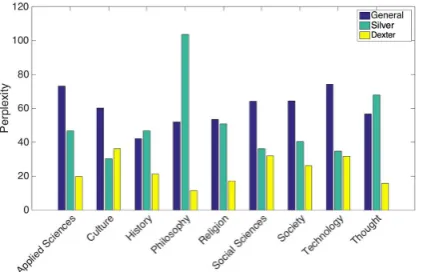
Figure 3: Perplexity scores for language models trained on General, Silver, and Dexter corpora across different domains.
it. We thus conclude that educational NLP appli-cations in science can benefit from Dexter if their algorithm relies on a monolingual corpus. An ex-ample of an educational NLP application utilizing language models would be a machine translator for science webpages.
4 Generalization to other domains
To ensure Dexter’s applicability to other educa-tional domains, we repeated the experiment in Section3.4for educational domains other than sci-ence and show the results in Figure3. We notice that the extracted corpus by Dexter is capable of training a significantly better language model than that trained on either the respective silver corpus or all of Wikipedia. The ineffectiveness of the gen-eral corpus is expected as the extracted corpus of-fers a more domain-specific training data. As for the more surprising outcome of inefficacy of the respective silver corpora, the reason seems to be the size of the silver corpus for most of these do-mains owing to the lack of articles in Wikipedia. The extracted corpus does not suffer from this lim-itation as its size is a hyperparameter set by the
user, 100K in this case. With fewer than 100K in-domain articles, Dexter continues extracting arti-cles that are close to but not in the domain leading to an extrapolated language model combining the benefits of the specificity of the small in-domain corpus and the generality of the large corpus.
5 Conclusion
Relying on off-the-shelf resources reduces the quality of educational NLP applications. To ad-dress this challenge, we offer to the commu-nity an aiding tool, Dexter, to extract a domain-specific corpus from Wikipedia. We show that our simple method outperforms in-domain corpora constructed heuristically using Wikipedia’s taxon-omy, or those constructed using popular systems scraping the World Wide Web.
Acknowledgment
This work is supported by IBM-ILLINOIS Cen-ter for Cognitive Computing Systems Research (C3SR) - a research collaboration as part of the IBM AI Horizons Network.
References
Allen Institute for AI. 2017. AI2 Science Questions v2.1. Accessed: 2019-04-16.
Jun Araki, Dheeraj Rajagopal, Sreecharan Sankara-narayanan, Susan Holm, Yukari Yamakawa, and Teruko Mitamura. 2016. Generating questions and multiple-choice answers using semantic analysis of texts. InProceedings of COLING 2016, the 26th In-ternational Conference on Computational Linguis-tics: Technical Papers, pages 1125–1136, Osaka, Japan. The COLING 2016 Organizing Committee.
Marco Baroni and Silvia Bernardini. 2004. Bootcat: Bootstrapping corpora and terms from the web. In
Piotr Bojanowski, Edouard Grave, Armand Joulin, and Tomas Mikolov. 2017. Enriching word vectors with subword information. Transactions of the Associa-tion for ComputaAssocia-tional Linguistics, 5:135–146.
Danushka Bollegala, Takanori Maehara, and Ken-ichi Kawarabayashi. 2015. Unsupervised cross-domain word representation learning. arXiv preprint arXiv:1505.07184.
Peter F Brown, Peter V Desouza, Robert L Mercer, Vincent J Della Pietra, and Jenifer C Lai. 1992. Class-based n-gram models of natural language.
Computational linguistics, 18(4):467–479.
Peter Clark, Isaac Cowhey, Oren Etzioni, Tushar Khot, Ashish Sabharwal, Carissa Schoenick, and Oyvind Tafjord. 2018. Think you have solved question an-swering? try arc, the ai2 reasoning challenge. arXiv preprint arXiv:1803.05457.
Susan T Dumais. 2004. Latent semantic analysis. An-nual review of information science and technology, 38(1):188–230.
Kenneth Heafield, Ivan Pouzyrevsky, Jonathan H. Clark, and Philipp Koehn. 2013. Scalable modi-fied Kneser-Ney language model estimation. In Pro-ceedings of the 51st Annual Meeting of the Associa-tion for ComputaAssocia-tional Linguistics, pages 690–696, Sofia, Bulgaria.
Lifeng Jin, David King, Amad Hussein, Michael White, and Douglas Danforth. 2018. Using para-phrasing and memory-augmented models to combat data sparsity in question interpretation with a vir-tual patient dialogue system. InProceedings of the Thirteenth Workshop on Innovative Use of NLP for Building Educational Applications, pages 13–23.
Nelson F. Liu Johannes Welbl and Matt Gardner. 2017. Crowdsourcing multiple choice science questions. InWorkshop on Noisy User-generated Text.
Slava Katz. 1987. Estimation of probabilities from sparse data for the language model component of a speech recognizer. IEEE transactions on acoustics, speech, and signal processing, 35(3):400–401.
Philipp Koehn, Franz Josef Och, and Daniel Marcu. 2003. Statistical phrase-based translation. In
Proceedings of the 2003 Conference of the North American Chapter of the Association for Computa-tional Linguistics on Human Language Technology-Volume 1, pages 48–54. Association for Computa-tional Linguistics.
Quoc Le and Tomas Mikolov. 2014. Distributed repre-sentations of sentences and documents. In Proceed-ings of the 31st International Conference on Ma-chine Learning (ICML-14), pages 1188–1196.
Jure Leskovec, Anand Rajaraman, and Jeffrey David Ullman. 2014. Mining of massive datasets. Cam-bridge university press.
Laurens van der Maaten and Geoffrey Hinton. 2008. Visualizing data using t-sne. Journal of Machine Learning Research, 9(Nov):2579–2605.
David McClosky. 2010. Any domain parsing: auto-matic domain adaptation for natural language pars-ing. Ph.D. thesis, Brown University.
Tomas Mikolov, Kai Chen, Greg Corrado, and Jef-frey Dean. 2013. Efficient estimation of word representations in vector space. arXiv preprint arXiv:1301.3781.
Stuart Rose, Dave Engel, Nick Cramer, and Wendy Cowley. 2010. Automatic keyword extraction from individual documents. Text Mining: Applications and Theory, pages 1–20.
Ronald Rosenfeld. 2000. Two decades of statistical language modeling: Where do we go from here?
Proceedings of the IEEE, 88(8):1270–1278.
Peter Sch¨onhofen. 2009. Identifying document topics using the wikipedia category network. Web Intelli-gence and Agent Systems: An International Journal, 7(2):195–207.
Katherine Stasaski and Marti A. Hearst. 2017. Multi-ple choice question generation utilizing an ontology. InProceedings of the 12th Workshop on Innovative Use of NLP for Building Educational Applications, pages 303–312, Copenhagen, Denmark. Association for Computational Linguistics.