77
Energy-Based Modelling for Dialogue State Tracking
Anh Duong Trinh†, Robert J. Ross†, John D. Kelleher‡ †School of Computer Science
‡Information, Communications & Entertainment Institute
Technological University Dublin, Ireland
[email protected], {robert.ross, john.d.kelleher}@dit.ie
Abstract
The uncertainties of language and the com-plexity of dialogue contexts make accurate di-alogue state tracking one of the more chal-lenging aspects of dialogue processing. To improve state tracking quality, we argue that relationships between different aspects of dia-logue state must be taken into account as they can often guide a more accurate interpretation process. To this end, we present an energy-based approach to dialogue state tracking as a structured classification task. The novelty of our approach lies in the use of an energy network on top of a deep learning architec-ture to explore more signal correlations be-tween network variables including input fea-tures and output labels. We demonstrate that the energy-based approach improves the per-formance of a deep learning dialogue state tracker towards state-of-the-art results without the need for many of the other steps required by current state-of-the-art methods.
1 Introduction
Dialogue processing is a challenging task due to the nature of human conversations. Currently most Spoken Dialogue Systems (SDS) have a core com-ponent called the Dialogue Manager that is re-sponsible for: (a) handling dialogue context and understanding user utterances by tracking dia-logue states; and (b) generating useful contribu-tions through the use of an appropriate dialogue policy. The dialogue manager component can be developed independently (Budzianowski et al., 2017;Su et al.,2017;Zhao and Eskenazi,2016) or in an end-to-end dialogue fashion (Williams et al., 2017; Li et al., 2017; Serban et al., 2016). Be-tween the two dialogue manager components, the dialogue state tracker is arguably the more chal-lenging to perfect, as its performance depends on the quality of the speech recognition component, the complexity of natural language used by users,
and even the situational context (Ross and Bate-man,2009).
Generally task-oriented dialogue systems with predefined ontologies represent dialogue states as a set of slot-value pairs, and define dialogue state tracking as a multi-task classification problem. The common deep learning approach to dialogue state tracking therefore is to develop different sub-systems for the tracking of each slot – though early layers in the network will often be shared to vary-ing degrees. While this approach has provided rea-sonable results, we argue that this method does not reflect the natural way that humans process infor-mation; specifically that the inter-relationships be-tween slots are not properly taken into account.
In order to account for such relationships in the dialogue context, it is appropriate to consider the problem not as a multi-task classification prob-lem, as is currently common, but as a structured prediction problem. This insight is not in itself novel, as there have been several attempts in the research community to investigate the variable de-pendencies in dialogue state tracking such as in the multi-task learning model (Trinh et al.,2018), the language modelling tracker (Platek et al., 2016), work building on Conditional Random Fields (Kim and Banchs,2014), work on Attention-based Sequence-to-Sequence models (Hori et al.,2016) and the work byWilliams(2010). Although these architectures are good attempts to engage variable dependencies at different levels of abstraction into the dialogue state tracking process, they have not yet achieved state-of-the-art results and do not pro-vide a clear analysis of the relationships between variables.
struc-tured prediction problems in that that output labels are not assumed to be independent. One efficient approach to structured prediction that has been applied widely in recent years are energy-based methods (LeCun et al., 2006). A key intuition of energy-based structured learning approaches is that it can be easier to learn a function to critique a potential solution Y than to learn to predictY directly from an input signalX. Given this intu-ition, energy-based approaches essentially attempt to learn a function that estimates the goodness of fit between some input feature variableXand an output hypothesis Y. Given such a trained func-tion, a gradient descent-based inference process then searches for an appropriateY at run-time that demonstrates the best fit to a new input vectorX.
To investigate the appropriateness of this method, in this paper we apply a variant of the Structured Prediction Energy Network (SPEN) (Belanger and McCallum,2016) to the Dialogue State Tracking Challenge (DSTC) 2 dataset ( Hen-derson et al.,2014a). To our knowledge, this is the first attempt to apply this formulation of modelling to the DST task. We benchmark our work by com-paring it against a number of other dialogue state trackers including the state-of-the-art hybrid dia-logue state tracker (Vodolan et al.,2015,2017).
2 Analysis of Variable Dependencies
The goal of applying a structured learning ap-proach to dialgoue state tracking is predicated on the assumption that there are indeed dependencies between slots in the dialogue state. In this section we recap some of the features of the dataset that we have applied and investigate whether such de-pendencies exist for this dataset.
2.1 DSTC2 Dataset
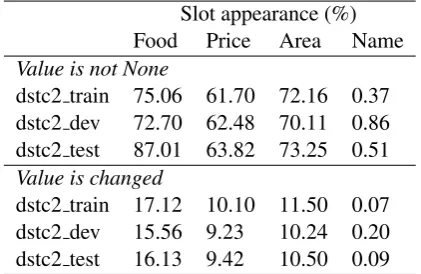
The Dialogue State Tracking Challenge 2 ( Hen-derson et al., 2014a) is a popular dataset for spoken dialogue state tracking in the Cambridge restaurant information domain. The main task of this challenge, calledJoint Goals, requires the models to classify slot-value pairs for four In-formable slots; namely food, price range, area, andname. At every turn of the dialogue, each slot must be assigned a value from its set of possible values detailed in the task ontology. However, the analysis shows that the slotnamerarely appears in the dataset (see AppendixA.1). Therefore follow-ing the approach of a number of other researchers,
we focus on the remaining three slots only. The DSTC2 dataset contains 1612 dialogues in a training set, 506 in a development (validation) set, and 1117 in a test set.
2.2 Data Analysis
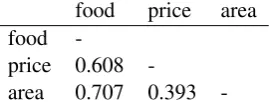
We conducted a data analysis on the DSTC2 data using the chi-square test to examine the de-pendencies between target variables. The chi-square test;is an important statistical test to de-tect associations between variables; however, this test can only give the answer to the question of whether there exist dependencies between vari-ables. Therefore, it is also important to mea-sure the strength of detected dependencies. For this purpose, we perform a chi-square test on the three informable slots in a pairwise fashion and use the chi-square test’s φ coefficient to mea-sure the strength of their dependencies (see Ap-pendixA.2). The chi-square test result confirms the existence of pairwise dependencies among DSTC2 data informable slots with the statistical significancep < 0.05. The dependencies are re-ported in Table1with theφcoefficient.
food price area
food
-price 0.608
-area 0.707 0.393
-Table 1: Data analysis of variable dependencies on DSTC2 data. The result is reported withφcoefficient values.
The statistical test shows that there are associa-tions of different levels among informable slots in the DSTC2 data. We observe that two pairsfood – price rangeandfood – areahave strong depen-dencies, while the relationshipprice range – area
is weaker. We argue that this observation indicates the validity of the motivation for our work in that there are dependencies between target labels and hence the dialogue state tracking task can be cast as a structured prediction problem.
3 Energy-Based Learning
[image:2.595.350.485.403.456.2]to instance segmentation tasks in computer vision (Corso et al., 2004; Li and Zhao, 2009; Ngiam et al., 2011). In all of these tasks the output is not a highly structured object, but is rather a set of labels that are not assumed to be independent of each other.
The main intuition behind energy-based meth-ods is that it is too challenging to learn a structured outputY for a given input vectorX, and that in-stead we should learn a function that essentially assesses the goodness of fit between a given struc-tured outputY and the input vectorX. In practice we often assume that the raw data is pre-processed in a domain appropriate way to give us a more use-ful representation of the data to evaluate against a given target. Thus the energy network actually calculates the goodness of fit between some rep-resentation ofX, referenced from here on out as F(X), and a candidate outputY. While in princi-ple a wide range of methods could be used to gen-erate a feature representation F(X), in this work we assume the feature representation is generated by some form of deep network which we refer to as the feature network. For an image processing task such a network might be based on series of convolutions, while in a language processing task such a network might be based on a recurrent ar-chitecture. Given the above, we define that energy function itself simply as E(F(X), Y) which re-turns some scalar value.
During training, an appropriate objective func-tionL(E, E∗), whereE∗ = E((F)X, Y∗) is the ground truth energy calculated based on input fea-ture representationF(X)and target labelsY∗, is used to guide training such that the energy func-tion is minimised for valid combinafunc-tions ofF(X) andY observed in the training data. During run-time we do not have gold standard values forY, and instead we only have processed inputsF(X). Thus at runtime we begin with an initial hypoth-esis forY – usually that Y = [0]N, and we then perform an inference process to updateY so as to find the best fit according to our learned differen-tiable energy function. This overall approach is illustrated by Figure1.
The specific design of the energy function is important in achieving an appropriate estimator for goodness of fit between input vectors and candidate structured outputs. Belanger and Mc-Callum (2016) propose an energy function based around the combination of a local and global
en-Figure 1: An example of Energy-Based Model, that consists of a feature networkF(X), an energy func-tionE(F(X), Y), and an objective functionL(E, E∗), whereX is input variable,F(X)is a feature represen-tation generated by a feature network,Y is predicted output variable, andY∗is a gold standard label output variable.
ergy where global energy gives a scalar that repre-sents the cross correlations for the target vectorY only, and the local energy considers the relation-ship between the input vectorXand individual el-ements of the total output structure variable, i.e., y ∈ Y. Both the local and global energy func-tions are approximated as layers in a neural net-work such that complex energy functions may be learned from the training data.
As indicated, the energy function beside being used to produce scalar energy values is also used to generate predicted output variables. This pro-cess is called theInference process. Commonly a gradient-based technique is used to generate the output variable in a continuous space (Belanger and McCallum,2016;Belanger et al.,2017). The inference process can be formulated as follow:
yt+1 ←yt−ηt∇y(E(X, Y)) (1)
where ηt is the learning rate at time step t, and ∇y(E(X, Y)) is the gradients of energy value
with respect to the output variable.
The process to train the energy network param-eters is called theLearning process, where an ob-jective function is used to calculate how good the prediction is, and its gradients are used to back-propagate throughout the network. It is important to define a good objective function for the network (LeCun and Huang, 2005). This process is stan-dard for deep learning models. The parameters are updated with the formula:
[image:3.595.308.519.60.209.2]whereθis the network parameters,λis the learn-ing rate, and ∇θ(L(E, E∗)) is the gradients of
the loss between predicted and ground truth en-ergies with respect to trainable parameters of the network.
4 Energy-Based Dialogue State Tracker
Based on the general principles of energy based modelling, we propose a deep learning energy-based architecture for dialogue state tracking. Given the approach outlined in the previous sec-tion, the model consists of three main components:
• Feature networkis a function implemented as a deep learning network to transform dia-logue input into an appropriate representation which can be fed to the energy function.
• Energy function is a function implemented as a feed-forward network that is trained to assign scalar energy values to any given con-figuration of input and output variables.
• Loss functionis a function that provides an measurement of the quality of the network predictions.
In the following we provide details of these components as we specifically designed them for the DSTC2 dataset.
4.1 Feature Network
DSTC2 dialogue data consists of a number of calls (conversations) which in turn are built out of a se-quence of turn pairs. Each turn pair consists of the user utterance itself, and a system response – referred to as the machine act.
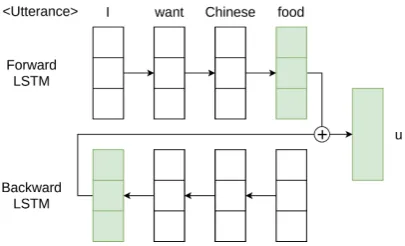
User utterances are sequences of words (to-kens); thus we use a bidirectional LSTM architec-ture (Hochreiter and Schmidhuber,1997) to gen-erate an initial representation of the whole word sequence in a turn (see Figure2). This utterance LSTM is fed using a word embedding layer that is trained directly on our data; empirically we found this to provide us with better results than using a public pre-trained word embedding component.
[image:4.595.307.510.65.188.2]Machine acts are provided in a semantic rep-resentation format, therefore we first parse these into vector representations following the approach outlined in the Word-based Dialogue state tracker (Henderson et al., 2014b). These machine act vectors are high-dimensional one-hot encodings; therefore we find it useful to feed these through an
Figure 2: The bidirectional LSTM architecture to en-code utterances. ⊕denotes the concatenation opera-tion.
[image:4.595.311.512.292.429.2]encoder to produce a reduced distributed represen-tation (see Figure3).
Figure 3: The encoder with two fully connected layers to reduce the dimensionality of machine act vectors.
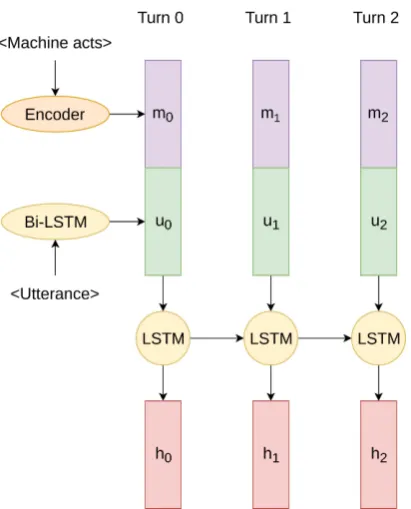
We concatenate the encoded machine act vector with the output vector of the bi-directional utter-ance encoder to form a dialogue turn representa-tion vector.
In order to handle dialogue input and dialogue history, it is necessary to use a second LSTM layer unrolling throughout individual turns to build up a complete representation of the dialogue (see Fig-ure 4). Therefore, we feed the input vector pro-duced for each turn into the second full-dialogue LSTM, and receive a fixed-size output vector – this is thus a representation of the whole dialogue up to the current turn. Hyper-parameters for the two LSTM layers plus the embeddings layers used to produce distributed representations of both user utterances and machine acts are presented later in Table2.
Figure 4: The deep LSTM architecture to transform di-alogue input into fixed-size vector representations.
(2016), the feature network should ideally be pre-trained to improve the quality of features. There-fore we pre-train our feature network by plugging it into a multi-task style learning architecture for dialogue state tracking in the style of that proposed by Trinh et al. (2018). Specifically, to complete pre-training the outputs of the second LSTM are fed to a set of three softmax outputs that affect three independent multinomial targets. Optimisa-tion with backpropagaOptimisa-tion is then used to train the network in the normal way. When used as input to the energy network, the final layer consisting of a set of three softmax operations are discarded and instead the LSTM outputs are taken to be the output of the feature network, i.e.,F(X).
The above approach has the advantage that the feature network’s output vectors F(X), i.e., the outputs of the turn based LSTM, are already well aligned to producing candidate target representa-tions Y – although they are not actual candidate targets.
4.2 Energy Function
The energy function is implemented on top of the feature network to assign the scalar energy values to combinations of dialogue input and output vari-ables. It should be noted though that the energy function in the literature is usually defined in terms ofXandY, but, for the sake of clarity, we will
de-scribe it in terms ofY andF(X), our pre-trained feature representation.
We build our model based around that pro-posed for the Structured Prediction Energy Net-work (SPEN) model (Belanger and McCallum, 2016). In this approach the energy function is the summation of individualLocal energyandGlobal energyterms:
E=Elocal(F(X), Y) +Eglobal(Y) (3)
Local energy is computed between input and output (label) variables.
Elocal(F(X), Y) = L X
i=1
yiWi>F(X) (4)
whereWiis a vector for each label, andyi∈Y is
theithlabel in the label set.
Global energy meanwhile captures the relation-ship between labels in the set of output variables independently of the input features. It is also called Label energy and is given below:
Eglobal(Y) =Wg>2tanh(Wg>1Y) (5)
where all weightsW,Wg1, andWg2 are parame-ters that are learned during the training process.
4.3 Loss Function
There are several options for designing the loss function for use in energy-based modelling. In our architecture, we use a loss function based on that proposed for the end-to-end SPEN model ( Be-langer et al.,2017). This is given as follows:
L= 1 T
T X
t=1 1
T −t+ 1L(yt, y
∗)
(6)
where T is the number of iterations in the in-ference process,tis an iterative variable running through the inference loop, and L(yt, y∗) is the
loss function between the predicted output and the target labels.
The motivation for this loss function is that it measures the quality of every generated prediction L(yt, y∗)in the inference loop, and encourages the
Energy function to produce good quality predic-tion by including the coefficient for each iterapredic-tion
1 T−t+1.
Although the end prediction yT is our desired
generate the output only at the last inference it-eration rather than moving smoothly towards the output in the loop.
Since we define the dialogue state tracking task as a multilabel classification task, we use the cross entropy loss for the formulaL(yt, y∗).
5 Experiments
In this section we provide details of the dataset, hyper-parameter selection, and validation results. Test results are presented in the next section.
We train our models with the training set and use the development set to select the best trained parameters. Following this, we run our models with the test set and report those results.
For the food type, price range, and area slots, we merge all three labels into a single multi-label classification task for the sake of the energy-based calculations. In other words we sacrifice the do-main constraint that one and only variable can be active individually for each of our slots and instead look for complete global configurations. This is necessary to allow a more elegant integration with the energy-based mechanisms we introduced in the previous sections. In practice our model still (mostly) learns that we need one and only one slot for each of thefood,price range, andarearelated subspace of our target variable.
The model performance is evaluated and re-ported with theaccuracymetric, which is one of the feature metrics for the DSTC2.
5.1 Model hyper-parameters
As indicated earlier, we developed a multi-task deep learning state tracker to pre-train the fea-ture network which is subsequently supplied to the energy-based network. This network in practice also serves as a valid benchmark against which we can compare the results of our energy-based model.
This multi-task learning network consists of our feature network (section 4.1) leading into three classifiers for the three informable slots. These three classifiers are implemented with softmax
output activation function as tracking each slot by itself is a multinomial classification task. We train all parameters of this system end-to-end with a cross entropy loss function and use the Adam op-timizer.
The energy-based system is trained with the best set of pre-trained parameters from the
multi-task learning-based system having reviewed its performance on the DSTC2 development set. As we combine the labels of informable slots, the task then becomes a multilabel classification task. Therefore we use asigmoidactivation function for the output of the energy-based system to produce predictions rather than using three softmax func-tions as used in the multi-task network above.
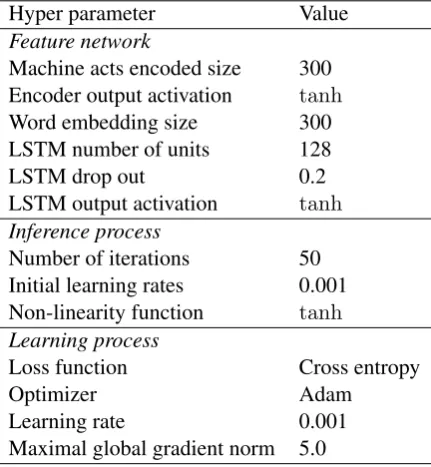
The detail of the selected hyper parameters are presented in the Table 2. All hyper parameters are chosen through a strict selection based on the experiments on DSTC2 training and development sets. We developed our energy-based model in TensorFlow (TF) 1.13 (Abadi et al., 2015). As is the case with the multi-task system, we apply the cross entropy loss function and the Adam opti-mizer (Kingma and Ba,2015) to train the energy-based network.
Hyper parameter Value
Feature network
Machine acts encoded size 300 Encoder output activation tanh
Word embedding size 300
LSTM number of units 128
LSTM drop out 0.2
LSTM output activation tanh
Inference process
Number of iterations 50
Initial learning rates 0.001
Non-linearity function tanh
Learning process
Loss function Cross entropy
Optimizer Adam
Learning rate 0.001
[image:6.595.309.525.318.552.2]Maximal global gradient norm 5.0
Table 2: Basic hyper parameters used in experiments constructing the energy-based dialogue state tracker.
5.2 Validation results
During the development phase we carry the evalu-ation of our multi-task learning-based and energy-based models against the DSTC2 development set in order to find the best set of parameters. We report on both a mean accuracy produced with Tensorflow directly from our data, and the Joint Goals accuracy produced by the toolset provided for the DSTC2 dataset (Henderson et al., 2013). We present the validation results in Table3.
ap-Model TF Acc. DSTC2 Acc.
Multi-task 0.719 0.692
Energy-based 0.759 0.715
[image:7.595.334.499.59.200.2]DSTC2 Baseline 0.623
Table 3: Model performances on the Joint Goals task of DSTC2 development set.
plying the energy network on top of deep learn-ing feature network improves the accuracy on the main tracking task by a margin up to 4%. We also see that there is a big gap between raw accuracy during the training process and external DSTC2 joint goal accuracy results when running evalua-tion on the output track file. This can be explained by a number of factors, including our exclusion of one of the informable slots from the DST task, that brings the accuracy on the DSTC2 develop-ment set down by nearly 1%, and the fact that the raw accuracy metric is carried on mini-batches while the DSTC2 metric evaluates the output of the whole dataset. Despite the differences, it is clear that the overall indicative result indicates a strong improvement with the application of the en-ergy network.
6 Results & Discussions
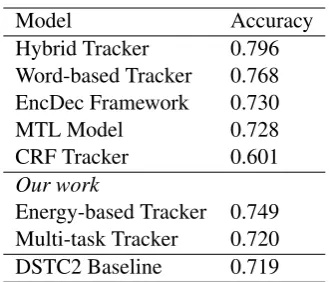
We selected the best fitting set of hyper-parameters and the highest accuracy checkpoint from valida-tion for use on the test set. We report our results against the DSTC2 baseline and other state-of-the-art trackers (see Table4). We choose reference di-alogue state trackers that are related to our work in different aspects such as their investigation of vari-able dependencies or because the network archi-tecture is similar to or inspired that which we use. The evaluation metric used on test results is the accuracy provided by the DSTC2 reference evalu-ation system since this is the same metric used by the published solutions.
Similar to the development set, the energy-based model outperforms the multi-task deep learning tracker by a large margin. The ob-served improvement can only be achieved due to the energy function and inference process of the energy-based learning approach. Our multi-task learning-based tracker is developed with a straight-forward recurrent neural networks (RNN) architecture. The multi-task model is trained to track all three DSTC2 informable slots at the same time, but it does not really tackle the relationships
Model Accuracy
Hybrid Tracker 0.796
Word-based Tracker 0.768
EncDec Framework 0.730
MTL Model 0.728
CRF Tracker 0.601
Our work
Energy-based Tracker 0.749 Multi-task Tracker 0.720
[image:7.595.81.285.62.119.2]DSTC2 Baseline 0.719
Table 4: The performances of Dialogue State Trackers on the Joint Goals task of DSTC2 test set.
between them. On the other hand, the energy-based network includes the possible dependencies of these slots by using an energy function over all slot labels and pre-trained features.
As mentioned above there exist Dialogue State Trackers that also tackle the relationships between variables such as EncDec Framework (Platek et al., 2016), MTL-based model (Trinh et al., 2018), and Conditional Random Field (CRF) tracker (Kim and Banchs,2014). When comparing our energy-based model with those, we observe that our work achieves higher accuracy than those for the DSTC2 test set. Two out of three track-ers, namely the MTL-based model and EncDec Framework, try to track Dialogue States within the incremental dialogue context, that limited their performances in general. Our work does not in-clude the incrementality phenomenon. Kim and Banchs (2014) manually define input features in their work, that do not perform well. In our work we set up the model to learn these features auto-matically, and see improved results.
to extract features from dialogue input.
6.1 Variable Associations Analysis
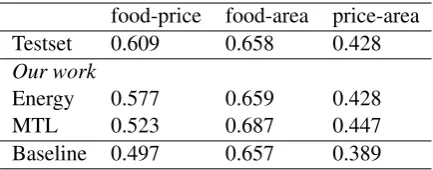
As observed above, the energy-based system per-forms better than the multi-task model in overall score of accuracy. However, the accuracy metric does not provide any extra information in terms of variable associations that the energy-based ap-proach takes advantage of. Therefore, we per-formed further analysis on the results that our trackers produced for DSTC2 test set to compare our predictions to those of the DSTC2 baseline system. The analysis is conducted in a similar fashion to that presented in section2.2, and is pre-sented in Table5.
food-price food-area price-area
Testset 0.609 0.658 0.428
Our work
Energy 0.577 0.659 0.428
MTL 0.523 0.687 0.447
[image:8.595.73.290.273.358.2]Baseline 0.497 0.657 0.389
Table 5: Result analysis of variable dependencies on the DSTC2 test set. The analysis is reported using the
φcoefficient values for each informable slot pair. In the table, the first block is variable dependencies in labels of the test set, while the second block is variable de-pendencies detected by our energy-based (Energy) and multi-task (MTL) trackers, and the last block is the re-sult of the best DSTC2 baseline system.
The analysis result demonstrates that our energy-based system is capable of tackling the presence of variable dependencies in DSTC2 test set. The energy-based method reflects the re-lationships of two informable slot pairs, food – areaandprice range – area, and produces a very close relationship for the other pair, food – price range. On the other hand, the multi-task learning approach manages to capture some dependencies that is shown in the result with bigger margins for all variable pairs.
Overall both the deep learning-based methods outperform the best DSTC2 rule-based baseline system in comparing variable dependencies in the tracking process for at least two out of three in-formable slot pairs of the task.
7 Conclusion
In this paper we presented an energy-based ap-proach to Dialogue State Tracking task that im-proves the overall performance of a basic deep
learning-based model. Energy-based Learning is notably good at structured prediction that we argue applies to the DST task. The results of our work strengthen the hypothesis that dependencies be-tween variables within the dialogue context have an impact on dialogue state tracking performance. To our knowledge this is the first attempt to ap-ply energy-based learning in a dialogue processing task. Though our results do not in themselves im-prove on the state of the art, the difference relative to a multi-task deep learning model is significant enough to indicate that the method could lead to improvements on the state of the art if combined with the state of the art. Beyond that combina-tion with hybrid state-of-the-art models, there is other room for improvement. Our current plans in-cludes the investigation of multivariate dependen-cies in dialogue processing with a larger domain and cross domains. We also believe that it is good to conduct an extensive analysis on variable de-pendencies in data and performances of different architectures.
Acknowledgements
This research was supported by the ADAPT Centre for Digital Content Technology which is funded under the SFI Research Centres Pro-gramme (Grant 13/RC/2106) and is co-funded un-der the European Regional Development Fund.
References
Mart´ın Abadi, Ashish Agarwal, Paul Barham, Eugene Brevdo, Zhifeng Chen, Craig Citro, Greg S. Cor-rado, Andy Davis, Jeffrey Dean, Matthieu Devin, Sanjay Ghemawat, Ian Goodfellow, Andrew Harp, Geoffrey Irving, Michael Isard, Yangqing Jia, Rafal Jozefowicz, Lukasz Kaiser, Manjunath Kudlur, Josh Levenberg, Dan Mane, Rajat Monga, Sherry Moore, Derek Murray, Chris Olah, Mike Schuster, Jonathon Shlens, Benoit Steiner, Ilya Sutskever, Kunal Tal-war, Paul Tucker, Vincent Vanhoucke, Vijay Vasude-van, Fernanda Viegas, Oriol Vinyals, Pete Warden, Martin Wattenberg, Martin Wicke, Yuan Yu, and Xiaoqiang Zheng. 2015. TensorFlow: Large-Scale Machine Learning on Heterogeneous Distributed Systems.
David Belanger and Andrew McCallum. 2016. Struc-tured Prediction Energy Networks. InProceedings of the 33rd International Conference on Machine Learning, volume 48.
Paweł Budzianowski, Stefan Ultes, Pei-Hao Su, Nikola Mrksic, Tsung-Hsien Wen, Inigo Casanueva, Lina Rojas-Barahona, and Milica Gasic. 2017. Sub-domain Modelling for Dialogue Management with Hierarchical Reinforcement Learning. In Proceed-ings of the SIGDIAL 2017 Conference, pages 86–92.
Jason J. Corso, Maneesh Dewan, and Gregory D. Hager. 2004. Image Segmentation Through Energy Minimization Based Subspace Fusion. In Proceed-ings of the 17th International Conference on Pattern Recognition ICPR 2004, volume 2, pages 120–123. IEEE.
Matthew Henderson, Blaise Thomson, and Jason Williams. 2013. Dialog State Tracking Challenge 2 & 3.
Matthew Henderson, Blaise Thomson, and Jason D. Williams. 2014a. The Second Dialog State Track-ing Challenge. InProceedings of the SIGDIAL 2014 Conference, pages 263–272.
Matthew Henderson, Blaise Thomson, and Steve Young. 2014b. Word-Based Dialog State Tracking with Recurrent Neural Networks. InProceedings of the SIGDIAL 2014 Conference, pages 292–299.
Sepp Hochreiter and Jurgen Schmidhuber. 1997.
Long Short-Term Memory. Neural Computation, 9(8):1735–1780.
Takaaki Hori, Hai Wang, Chiori Hori, Shinji Watan-abe, Bret Harsham, Jonathan Le Roux, John R. Hershey, Yusuke Koji, Yi Jing, Zhaocheng Zhu, and Takeyuki Aikawa. 2016. Dialog State Track-ing With Attention-Based Sequence-To-Sequence Learning. In Proceedings of 2016 IEEE Workshop on Spoken Language Technology, pages 552–558.
Seokhwan Kim and Rafael E. Banchs. 2014. Sequen-tial Labeling for Tracking Dynamic Dialog States. In Proceedings of the SIGDIAL 2014 Conference, pages 332–336.
Diederik P. Kingma and Jimmy Ba. 2015. Adam: A Method for Stochastic Optimization. In Proceed-ings of the 3rd International Conference for Learn-ing Representations.
Yann LeCun, Sumit Chopra, Raia Hadsell, Marc’Aurelio Ranzato, and Fu Jie Huang. 2006.
A Tutorial on Energy-Based Learning. Predicting Structured Data.
Yann LeCun and Fu Jie Huang. 2005. Loss Functions for Discriminative Training of Energy-Based Mod-els. InProceedings of the 10th International Work-shop on Artificial Intelligence and Statistics (AIS-tats’05), pages 206 – 213.
Qiuxu Li and Jieyu Zhao. 2009. MRF Energy Mini-mization for Unsupervised Image Segmentation. In
Proceedings of the 5th International Conference on Natural Computation, ICNC 2009, volume 2, pages 67–73. IEEE.
Xiujun Li, Yun-Nung Chen, Lihong Li, Jianfeng Gao, and Asli Celikyilmaz. 2017. End-to-End Task-Completion Neural Dialogue Systems. In Pro-ceedings of the 8th International Joint Conference on Natural Language Processing, pages 733–743. Asian Federation of Natural Language Processing.
Xuezhe Ma and Eduard Hovy. 2016. End-to-end Se-quence Labeling via Bi-directional LSTM-CNNs-CRF. InProceedings of the 54th Annual Meeting of the Association for Computational Linguistics, pages 1064–1074.
Jiquan Ngiam, Zhenghao Chen, Pang Wei Koh, and Andrew Y. Ng. 2011. Learning Deep Energy Mod-els. InProceedings of the 28th International Con-ference on Machine Learning.
Ondrej Platek, Petr Belohlavek, Vojtech Hudecek, and Filip Jurcicek. 2016. Recurrent Neural Networks for Dialogue State Tracking. InProceedings of CEUR Workshop, ITAT 2016 Conference, volume 1649, pages 63–67.
Robert J. Ross and John Bateman. 2009. Daisie: In-formation State Dialogues for Situated Systems. In
Proceedings of International Conference on Text, Speech and Dialogue, TSD 2009, pages 379–386.
Iulian V. Serban, Alessandro Sordoni, Yoshua Bengio, Aaron Courville, and Joelle Pineau. 2016. Build-ing End-To-End Dialogue Systems UsBuild-ing Genera-tive Hierarchical Neural Network Models. In Pro-ceedings of the 30th AAAI Conference on Artificial Intelligence (AAAI-16), pages 3776–3783.
Pei-Hao Su, Pawel Budzianowski, Stefan Ultes, Mil-ica Gasic, and Steve Young. 2017. Sample-efficient Actor-Critic Reinforcement Learning with Super-vised Data for Dialogue Management. In Proceed-ings of the SIGDIAL 2017 Conference, pages 147– 157.
Anh Duong Trinh, Robert J. Ross, and John D. Kelle-her. 2018. A Multi-Task Approach to Incremen-tal Dialogue State Tracking. InProceedings of The 22nd workshop on the Semantics and Pragmatics of Dialogue, SEMDIAL, pages 132–145.
Miroslav Vodolan, Rudolf Kadlec, and Jan Kleindienst. 2015. Hybrid Dialog State Tracker. In Proceed-ings of the Machine Learning for SLU & Interaction NIPS 2015 Workshop.
Miroslav Vodolan, Rudolf Kadlec, and Jan Kleindienst. 2017. Hybrid Dialog State Tracker with ASR Fea-tures. InProceedings of the 15th Conference of the European Chapter of the Association for Computa-tional Linguistics, EACL, volume 2, pages 205–210.
Jason D. Williams. 2010. Incremental Partition Re-combination For Efficient Tracking Of Multiple Di-alog States. InProceedings of the IEEE Interna-tional Conference on Acoustics, Speech and Signal Processing, pages 5382–5385.
Jason D. Williams, Kavosh Asadi, and Geoffrey Zweig. 2017. Hybrid Code Networks: practical and effi-cient end-to-end dialog control with supervised and reinforcement learning. InProceedings of the 55th Annual Meeting of the Association for Computa-tional Linguistics.
Tiancheng Zhao and Maxine Eskenazi. 2016. Towards End-to-End Learning for Dialog State Tracking and Management using Deep Reinforcement Learning. In Proceedings of the SIGDIAL 2016 Conference, pages 1–10.
A Appendices
A.1 Dataset Analysis
We conduct a small analysis on the DSTC2 dataset to reason why we would like to choose only three out of four informable slots to track. In the anal-ysis we count how often the slots appear in labels with a value, i.e. not none, and how often those slots change their values during the conversations.
Slot appearance (%)
Food Price Area Name
Value is not None
dstc2 train 75.06 61.70 72.16 0.37
dstc2 dev 72.70 62.48 70.11 0.86
dstc2 test 87.01 63.82 73.25 0.51
Value is changed
dstc2 train 17.12 10.10 11.50 0.07
dstc2 dev 15.56 9.23 10.24 0.20
[image:10.595.76.287.406.543.2]dstc2 test 16.13 9.42 10.50 0.09
Table 6: The analysis of Informable slot appearances in DSTC2 dataset. The numbers are reported in the per-cent format (%) over the number of turns in the dataset.
Among DSTC2 informable slots, the slotName
rarely appears. That means the datset does not provide enough samples for training Deep Learn-ing models to classify this slot. In the result, this slot does not affect the Joint Goals tracking performance, as in the DSTC2 test set predicting N ame=nonegives 99.5% accuracy.
A.2 Chi-square Test
Chi-square test is a significant test for association between two variables. The task and algorithm are presented as follow.
TaskGiven a contingency table (table of counts) of two variablesAandB. LetP(Ai)andP(Bj)
are probability of appearance in the population of the categoriesAiandBj. Test the relationship
be-tween these two variables (dependent or indepen-dent).
Step 1Define hypotheses of the task.
H0: The two variables are independent
P(Ai∩Bj) =P(Ai)P(Bj) (7)
H1: The two variables are dependent
P(Ai∩Bj)6=P(Ai)P(Bj) (8)
Step 2 Calculate expected frequency of
{Ai, Bj}based on the input
Eij =P(Ai)∗P(Bj)∗N (9)
whereN is the population.
Step 3Calculate the chi-square error
XV2 =X i
X
j
(Oij −Eij)2
Eij
(10)
where V is degree of freedom, Oij and Eij are
observed and expected frequencies subsequently.
Step 4We rejectH0if the computed test statis-tics X2
V is high and the significance coefficient
p <0.05.
There exist several measurements of associa-tion strength between variables directly related to the chi-square test statistics. There measures are scaled between 0 and 1 indicating that 1 is the perfect relationship and 0 is no relationship be-tween variables. We chooseφcoefficient to report the level of dependencies between slots in DSTC2 data as in section2.2.
φ=
s X2
N (11)