2321
Generating Question-Answer Hierarchies
Kalpesh Krishna & Mohit Iyyer
College of Information and Computer Sciences University of Massachusetts Amherst {kalpesh,miyyer}@cs.umass.edu
http://squash.cs.umass.edu/
Abstract
The process of knowledge acquisition can be viewed as a question-answer game between a student and a teacher in which the student typi-cally starts by asking broad, open-ended
ques-tions before drilling down into specifics (
Hin-tikka,1981;Hakkarainen and Sintonen,2002). This pedagogical perspective motivates a new way of representing documents. In this paper,
we present SQUASH (Specificity-controlled
Question-Answer Hierarchies), a novel and
challenging text generation task that con-verts an input document into a hierarchy of
question-answer pairs. Users can click on
high-level questions (e.g., “Why did Frodo leave the Fellowship?”) to reveal related but more specific questions (e.g., “Who did Frodo
leave with?”). Using a question taxonomy
loosely based onLehnert (1978), we classify
questions in existing reading comprehension
datasets as eitherGENERALor SPECIFIC. We
then use these labels as input to a pipelined system centered around a conditional neu-ral language model. We extensively evaluate the quality of the generated QA hierarchies through crowdsourced experiments and report strong empirical results.
1 Introduction
Q:What is this paper about?
A: We present a novel text generation task
which converts an input document into a model-generated hierarchy of question-answer (QA) pairs arranged in a top-down tree structure ( Fig-ure 1). Questions at higher levels of the tree are broad and open-ended while questions at lower levels ask about more specific factoids. An entire document has multiple root nodes (“key ideas”) that unfold into a forest of question trees. While readers are initially shown only the root nodes of the question trees, they can “browse” the document by clicking on root nodes of interest
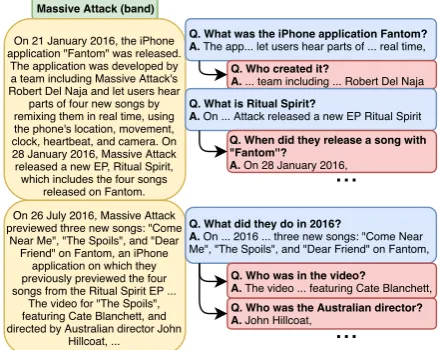
Massive Attack (band)
On 21 January 2016, the iPhone application "Fantom" was released.
The application was developed by a team including Massive Attack's Robert Del Naja and let users hear
parts of four new songs by remixing them in real time, using the phone's location, movement, clock, heartbeat, and camera. On 28 January 2016, Massive Attack released a new EP, Ritual Spirit, which includes the four songs
released on Fantom.
Q. What was the iPhone application Fantom? A. The app... let users hear parts of ... real time,
Q. Who created it?
A. ... team including ... Robert Del Naja
On 26 July 2016, Massive Attack previewed three new songs: "Come
Near Me", "The Spoils", and "Dear Friend" on Fantom, an iPhone
application on which they previously previewed the four songs from the Ritual Spirit EP ...
The video for "The Spoils", featuring Cate Blanchett, and directed by Australian director John
Hillcoat, ...
Q. What is Ritual Spirit?
A. On ... Attack released a new EP Ritual Spirit
Q. What did they do in 2016?
A. On ... 2016 ... three new songs: "Come Near
Me", "The Spoils", and "Dear Friend" on Fantom,
Q. Who was in the video? A. The video ... featuring Cate Blanchett, Q. Who was the Australian director? A. John Hillcoat,
Q. When did they release a song with "Fantom''?
A. On 28 January 2016,
[image:1.595.306.526.224.399.2]...
...
Figure 1: A subset of the QA hierarchy generated by
ourSQUASHsystem that consists of GENERAL and
SPECIFIC questions with extractive answers.
to reveal more fine-grained related information.
We call our task SQUASH(Specificity-controlled
QuestionAnswerHierarchies).
Q:Why represent a document with QA pairs?1
A: Questions and answers (QA) play a critical
role in scientific inquiry, information-seeking dia-logue and knowledge acquisition (Hintikka,1981,
1988;Stede and Schlangen,2004). For example, web users often use QA pairs to manage and share
knowledge (Wagner, 2004;Wagner and Bolloju,
2005;Gruber, 2008). Additionally, unstructured lists of “frequently asked questions” (FAQs) are regularly deployed at scale to present information. Industry studies have demonstrated their effective-ness at cutting costs associated with answering customer calls or hiring technical experts ( Daven-port et al., 1998). Automating the generation of QA pairs can thus be of immense value to compa-nies and web communities.
Q:Why add hierarchical structure to QA pairs?
A: While unstructured FAQs are useful,
ped-agogical applications benefit from additional
hierarchical organization. Hakkarainen and
Sintonen(2002) show that students learn concepts effectively by first asking general, explanation-seeking questions before drilling down into more
specific questions. More generally, hierarchies
break up content into smaller, more digestable
chunks. User studies demonstrate a strong
preference for hierarchies in document summa-rization (Buyukkokten et al., 2001; Christensen et al.,2014) since they help readers easily identify and explore key topics (Zhang et al.,2017).
Q:How do we build systems forSQUASH?
A:We leverage the abundance of reading
compre-hension QA datasets to train a pipelined system for SQUASH. One major challenge is the lack of labeled hierarchical structure within existing
QA datasets; we tackle this issue in Section 2by
using the question taxonomy of Lehnert (1978)
to classify questions in these datasets as either
GENERAL or SPECIFIC. We then condition a
neural question generation system on these two classes, which enables us to generate both types
of questions from a paragraph. We filter and
structure these outputs using the techniques described inSection 3.
Q:How do we evaluate ourSQUASHpipeline?
A: Our crowdsourced evaluation (Section 4)
focuses on fundamental properties of the gener-ated output such as QA quality, relevance, and hierarchical correctness. Our work is a first step towards integrating QA generation into document understanding; as such, we do not directly
evalu-ate howusefulSQUASHoutput is for downstream
pedagogical applications. Instead, a detailed qual-itative analysis (Section 5) identifies challenges
that need to be addressed beforeSQUASHcan be
deployed to real users.
Q:What are our main contributions?
A1: A method to classify questions according to
their specificity based on Lehnert(1978).
A2: A model controlling specificity of generated
questions, unlike prior work on QA generation.
A3: A novel text generation task (SQUASH),
which converts documents into specificity-based hierarchies of QA pairs.
A4: A pipelined system to tackleSQUASHalong
with crowdsourced methods to evaluate it.
Q:How can the community build on this work?
A: We have released our codebase,
crowdsourc-ing templates for evaluation, and a live
demon-stration of our system athttp://squash.cs.
umass.edu/. Additionally, we outline guide-lines for future work inSection 7.
2 Obtaining training data forSQUASH
The proliferation of reading comprehension
datasets like SQuAD (Rajpurkar et al., 2016,
2018) has enabled state-of-the-art neural question generation systems (Du et al., 2017; Kim et al.,
2018). However, these systems are trained for
individual question generation, while the goal of
SQUASHis to produce a general-to-specific hier-archy of QA pairs. Recently-released conversa-tional QA datasets like QuAC (Choi et al.,2018) and CoQA (Reddy et al.,2018) contain a
sequen-tialarrangement of QA pairs, but question
speci-ficity is not explicitly marked.2 Motivated by the lack of hierarchical QA datasets, we automatically classify questions in SQuAD, QuAC and CoQA according to their specificity using a combination of rule-based and automatic approaches.
2.1 Rules for specificity classification
What makes one question more specific than
another? Our scheme for classifying question
specificity maps each of the 13 conceptual ques-tion categories defined byLehnert(1978) to three coarser labels: GENERAL,SPECIFIC, orYES-NO.3
As a result of this mapping, SPECIFIC questions
usually ask for low-level information (e.g.,
en-tities or numerics), while GENERAL questions
ask for broader overviews (e.g., “what happened
in 1999?”) or causal information (e.g, “why
did...”). Many question categories can be reliably identified using simple templates and rules; A complete list is provided inTable 1.4
Classifying questions not covered by templates:
If a question does not satisfy any template or rule, how do we assign it a label? We manage to
clas-2“Teachers” in the QuAC set-up can encourage “students” to ask a follow-up question, but we cannot use these annota-tions to infer a hierarchy because students are not required to actually follow their teachers’ directions.
3We add a third category for
YES-NO questions as they are difficult to classify as eitherGENERALorSPECIFIC.
4
Conceptual class Specificity Question asks for... Sample templates
Causal Antecendent, Goal Oriented, Enablement, Causal Consequent, Expectational
GENERAL the reason for occurrence of an event and the conse-quences of it
Why ...,What happened after / be-fore ...,What was the cause / rea-son / purpose ...,What led to ...
Instrumental GENERAL a procedure / mechanism Howquestion with VERB parent
forHowin dependency tree
Judgemental GENERAL a listener’s opinion Words likeyou,yourpresent
Concept Completion, Feature Speci-fication
GENERALor
SPECIFIC
fill-in-the-blank informa-tion
Where / When / Who ... (“SPECIFIC” templates)
Quantification SPECIFIC an amount How many / long ...
Verification, Disjunctive YES-NO Yes-No answers first word is VERB
[image:3.595.74.521.63.228.2]Request N/A an act to be performed (absent in datasets)
Table 1: The 13 conceptual categories ofLehnert(1978) and some templates to identify them and their specificity.
sify roughly half of all questions with our
tem-plates and rules (Table A1); for the remaining
half, we resort to a data-driven approach. First,
we manually label 1000 questions in QuAC5
us-ing our specificity labels. This annotated data
is then fed to a single-layer CNN binary
classi-fier (Kim,2014) using ELMo contextualized
em-beddings (Peters et al., 2018).6 On a 85%-15%
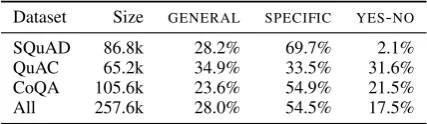
train-validation split, we achieve a high classifica-tion accuracy of 91%. The classifier also trans-fers to other datasets: on 100 manually labeled CoQA questions, we achieve a classification accu-racy of 80%. To obtain our final dataset (Table 2), we run our rule-based approach on all questions in SQuAD 2.0, QuAC, and CoQA and apply our classifier to label questions that were not covered by the rules. We further evaluate the specificity of the questions generated by our final system using a crowdsourced study inSection 4.3.
Dataset Size GENERAL SPECIFIC YES-NO
SQuAD 86.8k 28.2% 69.7% 2.1%
QuAC 65.2k 34.9% 33.5% 31.6%
CoQA 105.6k 23.6% 54.9% 21.5%
All 257.6k 28.0% 54.5% 17.5%
Table 2: Distribution of classes in the final datasets. We
add some analysis on this distribution inAppendix A.
3 A pipeline forSQUASHing documents
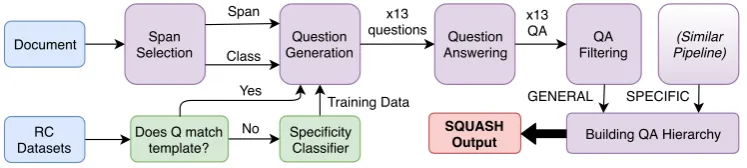
ToSQUASHdocuments, we build a pipelined sys-tem (Figure 2) that takes a single paragraph as in-put and produces a hierarchy of QA pairs as
out-put; for multi-paragraph documents, weSQUASH
5We use QuAC because its design encourages a higher percentage ofGENERALquestions than other datasets, as the question-asker was unable to read the document to formulate more specific questions.
6Implemented in AllenNLP (Gardner et al.,2018).
each paragraph independently of the rest. At
a high level, the pipeline consists of five steps: (1) answer span selection, (2) question genera-tion condigenera-tioned on answer spans and specificity labels, (3)extractivelyanswering generated ques-tions, (4) filtering out bad QA pairs, and (5)
struc-turing the remaining pairs into a GENERAL
-to-SPECIFIChierarchy. The remainder of this section describes each step in more detail.
3.1 Answer span selection
Our pipeline begins by selecting an answer span from which to generate a question. To train the system, we can use ground-truth answer spans from our labeled datasets, but at test time how do we select answer spans? Our solution is to con-sider all individual sentences in the input para-graph as potential answer spans (to generateGEN
-ERALandSPECIFICquestions), along with all
en-tities and numerics (for justSPECIFIC questions). We did not use data-driven sequence tagging ap-proaches like previous work (Du and Cardie,2017,
2018), since our preliminary experiments with
such approaches yielded poor results on QuAC.7
More details are provided inAppendix C.
3.2 Conditional question generation
Given a paragraph, answer span, and desired specificity label, we train a neural encoder-decoder model on all three reading comprehension datasets (SQuAD, QuAC and CoQA) to generate an appropriate question.
Data preprocessing: At training time, we use the ground-truth answer spans from these datasets
[image:3.595.74.288.524.586.2]RC Datasets
Does Q match template?
Specificity Classifier Question Generation
No Span
Selection Document
Span
Class
Question Answering x13
questions QA Filtering
Building QA Hierarchy Yes
(Similar Pipeline)
SQUASH Output
Training Data
x13 QA
[image:4.595.113.487.64.148.2]GENERAL SPECIFIC
Figure 2: An overview of the process by which we generate a pair ofGENERAL-SPECIFICquestions , which
consists of feeding input data (“RC” is Reading Comprehension) through various modules, including a
question classifier and a multi-stage pipeline for question generation, answering, and filtering.
as input to the question generator. To improve
the quality ofSPECIFICquestions generated from
sentence spans, we use the extractive evidence
spans for CoQA instances (Reddy et al., 2018)
instead of the shorter, partially abstractive answer spans (Yatskar,2019). In all datasets, we remove unanswerable questions and questions whose answers span multiple paragraphs. A few very generic questions (e.g. “what happened in this article?”) were manually identified removed from the training dataset. Some other questions (e.g., “where was he born?”) are duplicated many times in the dataset; we downsample such questions to a maximum limit of 10. Finally, we preprocess both paragraphs and questions using byte-pair encoding (Sennrich et al.,2016).
Architecture details: We use a two-layer
biL-STM encoder and a single-layer LbiL-STM (
Hochre-iter and Schmidhuber, 1997) decoder with soft
attention (Bahdanau et al., 2015) to generate
questions, similar to Du et al. (2017). Our
architecture is augmented with a copy mecha-nism (See et al.,2017) over the encoded paragraph representations. Answer spans are marked with
<SOA>and<EOA> tokens in the paragraph, and representations for tokens within the answer span are attended to by a separate attention head. We condition the decoder on the specificity class (GENERAL, SPECIFICand YES-NO)8 by concate-nating an embedding for the ground-truth class to the input of each time step. We implement models
in PyTorch v0.4 (Paszke et al., 2017), and the
best-performing model achieves a perplexity of 11.1 on the validation set. Other hyperparameters details are provided inAppendix B.
Test time usage: At test time, the question gen-eration module is supplied with answer spans and
8While we do not use
YES-NOquestions at test time, we keep this class to avoid losing a significant proportion of training data.
class labels as described in Section 3.1. To pro-mote diversity, we over-generate prospective can-didates (Heilman and Smith, 2010) for every an-swer span and later prune them. Specifically, we use beam search with a beam size of 3 to gener-ate three highly-probable question candidgener-ates. As these candidates are often generic, we additionally
usetop-k random sampling(Fan et al.,2018) with
k = 10, a recently-proposed diversity-promoting
decoding algorithm, to generate ten more ques-tion candidates per answer span. Hence, for every
answer span we generate13question candidates.
We discuss issues with using just standard beam search for question generation inSection 5.1.
3.3 Answering generated questions
While we condition our question generation model on pre-selected answer spans, the generated ques-tions may not always correspond to these input spans. Sometimes, the generated questions are ei-ther unanswerable or answered by a different span in the paragraph. By running a pretrained QA model over the generated questions, we can detect questions whose answers do not match their orig-inal input spans and filter them out. The predicted answer for many questions has partial overlap with the original answer span; in these cases, we dis-play the predicted answer span during evaluation, as a qualitative inspection shows that the predicted answer is more often closer to the correct answer. For all of our experiments, we use the AllenNLP implementation of the BiDAF++ question
answer-ing model ofChoi et al.(2018) trained on QuAC
with no dialog context.
3.4 Question filtering
After over-generating candidate questions from a single answer span, we use simple heuristics
generic and duplicate question candidates9 and pass the remaining QA pairs through the multi-stage question filtering process described below.
Irrelevant or repeated entities: Top-k random
sampling often generates irrelevant questions;
we reduce their incidence by removing any candidates that contain nouns or entities unspec-ified in the passage. As with other neural text
generation systems (Holtzman et al., 2018), we
commonly observe repetition in the generated questions and deal with this phenomenon by re-moving candidates with repeated nouns or entities.
Unanswerable or low answer overlap: We remove all candidates marked as “unanswerable” by the question answering model, which prunes 39.3% of non-duplicate question candidates. These candidates are generally grammatically correct but considered irrelevant to the original paragraph by the question answering model. Next, we compute the overlap between original and predicted answer span by computing word-level precision and recall (Rajpurkar et al.,2016). For
GENERAL questions generated from sentence
spans, we attempt to maximize recall by setting a
minimum recall threshold of 0.3.10 Similarly, we
maximize recall forSPECIFICquestions generated
from named entities with a minimum recall constraint of 0.8. Finally, forSPECIFIC questions generated from sentence spans, we set a minimum
precisionthreshold of 1.0, which filters out
ques-tions whose answers are not completely present in the ground-truth sentence.
Low generation probability: If multiple candi-dates remain after applying the above filtering cri-teria, we select the most probable candidate for
each answer span. SPECIFIC questions generated
from sentences are an exception to this rule: for these questions, we select the ten most probable candidates, as there might be multiple question-worthy bits of information in a single sentence. If
no candidates remain, in some cases11 we use a
fallback mechanism that sequentially ignores fil-ters to retain more candidates.
9
RunningTop-k random samplingmultiple times can pro-duce duplicate candidates, including those already in the top beams.
10
Minimum thresholds were qualitatively chosen based on the specificity type.
11For example, if no valid
GENERALquestions for the en-tire paragraph are generated.
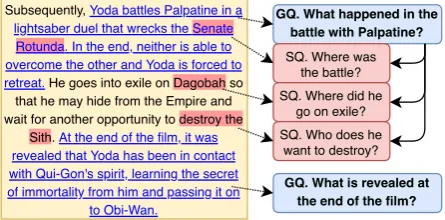
Subsequently, Yoda battles Palpatine in a lightsaber duel that wrecks the Senate Rotunda. In the end, neither is able to overcome the other and Yoda is forced to retreat. He goes into exile on Dagobah so that he may hide from the Empire and wait for another opportunity to destroy the
Sith. At the end of the film, it was revealed that Yoda has been in contact with Qui-Gon's spirit, learning the secret of immortality from him and passing it on
to Obi-Wan.
GQ. What happened in the battle with Palpatine? SQ. Where was
the battle? SQ. Where did he
go on exile?
GQ. What is revealed at the end of the film? SQ. Who does he
[image:5.595.307.530.64.174.2]want to destroy?
Figure 3: Procedure used to form a QA hierarchy. The
predicted answers for GQs (GENERAL questions), are
underlined in blue. The predicted answers for SQs
(SPECIFIC questions) are highlighted in red .
3.5 Forming a QA hierarchy
The output of the filtering module is an
unstruc-tured list of GENERAL and SPECIFIC QA pairs
generated from a single paragraph. Figure 3
shows how we group these questions into a mean-ingful hierarchy. First, we choose a parent for each SPECIFICquestion by maximizing the over-lap (word-level precision) of its predicted
an-swer with the predicted anan-swer for every GEN
-ERAL question. If a SPECIFIC question’s answer
does not overlap with any GENERAL question’s
answer (e.g.,“Dagobah”and“destroy the Sith”)
we map it to the closestGENERALquestion whose
answer occursbeforetheSPECIFICquestion’s
an-swer (“What happened in the battle ...?”).12
4 Evaluation
We evaluate ourSQUASHpipeline on documents
from the QuAC development set using a
vari-ety of crowdsourced13 experiments. Concretely,
we evaluate the quality and relevance of individ-ual questions, the relationship between generated questions and predicted answers, and the struc-tural properties of the QA hierarchy. We empha-size that our experiments examine only thequality of a SQUASHed document, not its actual
useful-nessto downstream users. Evaluating usefulness
(e.g., measuring ifSQUASH is more helpful than
the input document) requires systematic and
tar-geted human studies (Buyukkokten et al., 2001)
that are beyond the scope of this work.
12This heuristic is justified because users read
GEN
-ERALquestionsbeforeSPECIFICones in our interface. 13
Experiment Generated Gold
Score Fleissκ Score Fleissκ
Is this question well-formed? 85.8% 0.65 93.3% 0.54
Is this question relevant? 78.7% 0.36 83.3% 0.41
(amongwell-formed) 81.1% 0.39 83.3% 0.40
Does the spanpartiallycontain the answer? 85.3% 0.45 81.1% 0.43
(amongwell-formed) 87.6% 0.48 82.1% 0.42
(amongwell-formed and relevant) 94.9% 0.41 92.9% 0.44
Does the spancompletelycontain the answer? 74.1% 0.36 70.0% 0.37
(amongwell-formed) 76.9% 0.36 70.2% 0.39
[image:6.595.105.492.63.239.2](amongwell-formed and relevant) 85.4% 0.30 80.0% 0.42
Table 3: Human evaluations demonstrate the high individual QA quality of our pipeline’s outputs. All
interanno-tator agreement scores (Fleissκ) show “fair” to “substantial” agreement (Landis and Koch,1977).
4.1 Individual question quality and relevance
Our first evaluation measures whether questions
generated by our system are well-formed (i.e.,
grammatical and pragmatic). We ask crowd work-ers whether or not a given question is both gram-matical and meaningful.14 For this evaluation, we acquire judgments for 200 generated QA pairs and
100 gold QA pairs15from the QuAC validation set
(with an equal split betweenGENERAL and SPE
-CIFIC questions). The first row ofTable 3 shows that 85.8% of generated questions satisfy this cri-terion with a high agreement across workers.
Question relevance: How many generated ques-tions are actually relevant to the input paragraph?
While the percentage of unanswerable questions
that were generated offers some insight into this question, we removed all of them during the filter-ing pipeline (Section 3.4). Hence, we display an input paragraph and generated question to crowd workers (using the same data as the previous well-formedness evaluation) and ask whether or not the paragraph contains the answer to the question.
The second row of Table 3 shows that 78.7% of
our questions are relevant to the paragraph, com-pared to 83.3% of gold questions.
4.2 Individual answer validity
Is the predicted answer actually a valid answer to the generated question? In our filtering
pro-14As “meaningful” is potentially a confusing term for crowd workers, we ran another experiment asking only for grammatical correctness and achieved very similar results.
15Results on this experiment were computed after remov-ing 3 duplicate generated questions and 10 duplicate gold questions.
cess, we automatically measured answer overlap between the input answer span and the predicted answer span and used the results to remove low-overlap QA pairs. To evaluate answer recall af-ter filaf-tering, we perform a crowdsourced evalua-tion on the same 300 QA pairs as above by asking crowdworkers whether or not a predicted answer
spancontainsthe answer to the question. We also
experiment with a more relaxed variant (partially
contains instead of completely contains) and
re-port results for both task designs in the third and
fourth rows of Table 3. Over 85% of predicted
spans partially contain the answer to the gener-ated question, and this number increases if we con-sider only questions that were previously labeled
aswell-formed andrelevant. The lower gold
per-formance is due to the contextual nature of the gold QA pairs in QuAC, which causes some ques-tions to be meaningless in isolation (e.g.“What did
she do next?”has unresolvable coreferences).
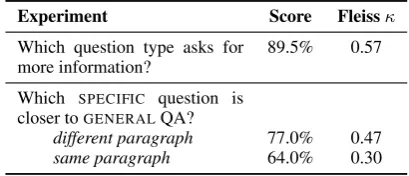
Experiment Score Fleissκ
Which question type asks for more information?
89.5% 0.57
Which SPECIFIC question is closer toGENERALQA?
different paragraph 77.0% 0.47 same paragraph 64.0% 0.30
Table 4: Human evaluation of the structural correctness
of our system. The labels“different / same paragraph”
refer to the location of theintruderquestion. The
re-sults show the accuracy of specificity and hierarchies.
4.3 Structural correctness
To examine the hierachical structure ofSQUASH
[image:6.595.313.518.576.664.2]Cowell formed a new company Syco, which is divided into three units - Syco Music, Syco TV and Syco Film. Cowell returned to music with his latest brainchild
signed to Syco ...
What is Syco?
How many units does Syco have?
Returning home to Brantford after six months abroad, Bell continued experiments with his "harmonic telegraph". The basic concept behind his device was that messages could ...
What was Bell's telegraph?
Where did he take his experiments?
After five years, however, Limon would return to Broadway
to star as a featured dancer in Keep Off the Grass under the
choreographer George Balanchine.
Why did he return to Broadway?
Who did he work with?
Tan Dun earned widespread attention after composing the score for Ang Lee's Crouching Tiger, Hidden Dragon (2000), for
which he won an Academy Award, a Grammy Award ....
How was Tan Dun received?
What award did he win?
From 1969 to 1971, Cash starred in his own television show, The Johnny Cash Show, on the ABC network. The show was performed at the Ryman
Auditorium in Nashville. ...
What did he do in 1969?
[image:7.595.82.520.63.161.2]What network was he in?
Figure 4:SQUASHquestion hierarchies generated by our system with reference snippets . Questions in the
hier-archy are of the correct specificity class (i.e., GENERAL, SPECIFIC).
How faithful are output questions to input specificity? First, we investigate whether our model is actually generating questions with the correct specificity label. We run our specificity classifier (Section 2) over 400 randomly sampled
questions (50% GENERAL, 50% SPECIFIC) and
obtain a high classification accuracy of 91%.16
This automatic evaluation suggests the model is capable of generating different types of questions.
Are GENERAL questions more representative
of a paragraph than SPECIFIC questions?
To see if GENERAL questions really do provide
more high-level information, we sample 200
GENERAL-SPECIFIC question pairs17 grouped
together as described in Section 3.5. For each
pair of questions (without showing answers), we ask crowd workers to choose the question which, if answered, would give them more information
about the paragraph. As shown in Table 4,
in 89.5% instances the GENERAL question is
preferred over the SPECIFICone, which confirms
the strength of our specificity-controlled question generation system.18
How related are SPECIFIC questions to their parent GENERAL question? Finally, we inves-tigate the effectiveness of our question grouping
strategy, which bins multiple SPECIFICQA pairs
under a singleGENERALQA pair. We show crowd
workers a reference GENERAL QA pair and ask
them to choose the most related SPECIFIC
ques-tion given two choices, one of which is the
sys-tem’s output and the other an intruder question.
16
Accuracy computed after removing 19 duplicates. 17We avoid gold-standard control experiments for struc-tural correctness tests since questions in the QuAC dataset were not generated with a hierarchical structure in mind. Pi-lot studies using our question grouping module on gold data led to sparse hierarchical structures which were not favored by our crowd workers.
18We also ran a pilot study asking workers
“Which ques-tion has a longer answer?”and observed a higher preference of 98.6% forGENERALquestions.
Weston was born Paul Wetstein in Springfield, Massachusetts, to Paul Wetstein, a teacher, and
Anna "Annie" Grady. The family moved to Pittsfield when Weston was two, and he spent his formative years in the town. His parents were
both interested in music, and when Paul Sr taught at a private girls' school, he was allowed
to bring the school's gramophone ...
Q. What are his parents like? A. Paul Wetstein, a teacher, and Anna "Annie" Grady.
Q. Who was born in Springfield? A. Weston was born Paul Wetstein in Springfield, Massachusetts, to Paul Wetstein, a teacher, and Anna "Annie" Grady. Q. Where was Weston born? A. Springfield, Massachusetts, Q. Who were his parents? A. Paul Wetstein, a teacher, and Anna "Annie" Grady. Q. Where did he move to? A. The family moved to Pittsfield Q. How old was Weston when he was born?
A. two
Q. How did he get into music? A. His parents were both interested in music, and when Paul Sr taught at a private girls' school,
Q. Where did he go to school? A. Paul Sr taught at a private girls' school,
Paul Weston
...The treaty granted the United States control of Puerto Rico, Guam, Cuba, the Philippines, and parts of the West Indies. Many of Bryan's supporters were opposed to what they perceived
as Republican aspirations of turning the country into an imperial power ... However, when the Bacon Resolution (a proposed supplement to the
Treaty of Paris which would allow the Filipinos a "stable and independent government") failed to pass, Bryan began publicly speaking out against
the Republicans' imperial aspirations.
William Bryan
Q. What was the treaty? A. The treaty granted the United States control of Puerto Rico, Guam, Cuba, the Philippines, and parts of the West Indies.
Q. Where did the Treaty of Paris come from?
A. The treaty granted the United States control of Puerto Rico, Guam, Cuba, the Philippines, and parts of the West Indies. Q. Why was this bad? A. Many of Bryan's supporters were opposed to what they perceived as Republican aspirations of turning the country into an imperial power
Q. What was a result of the resolution? A. failed to pass, Bryan began publicly speaking out against the Republicans' imperial aspirations.
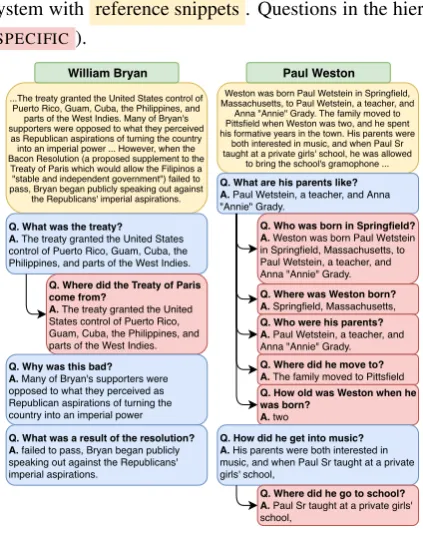
Figure 5: Two SQUASH outputs generated by our
system. The William Bryan example has
interest-ing GENERAL questions. The Paul Weston example
showcases several mistakes our model makes.
We randomly select intruder SPECIFIC questions
from either a different paragraph within the same document or a different group within the same
paragraph. As shown inTable 4, crowd workers
prefer the system’s generated SPECIFIC question
with higher than random chance (50%) regardless of where the intruder comes from. As expected, the preference and agreement is higher when in-truder questions come from different paragraphs, since groups within the same paragraph often con-tain related information (Section 5.2).
5 Qualitative Analysis
[image:7.595.310.522.170.438.2]“In1942, Dodds enlisted in the US army and served as an anti aircraft gunner during World War II.”
B
In what year did the US army take place? In what year did the US army take over?
In what year did the US army take place in the US?
T
What year was he enlisted? When did he go to war?
When did he play as anti aircraft?
Table 5: Beam Search (B) vs Top-ksampling (T)
for SPECIFIC question generation. Top-kcandidates
tend to be more diverse.
5.1 What is our pipeline good at?
Meaningful hierarchies: Our method of group-ing the generated questions (Section 3.5) produces hierarchies that clearly distinguish betweenGEN
-ERAL andSPECIFIC questions; Figure 4 contains
some hierarchies that support the positive results of our crowdsourced evaluation.
Top-k sampling: Similar to prior work (Fan et al., 2018; Holtzman et al., 2019), we notice that beam search often produces generic or
repet-itive beams (Table 5). Even though the top-k
scheme always produces lower-probable questions than beam search, our filtering system prefers a
top-kquestion49.5%of the time.
5.2 What kind of mistakes does it make?
We describe the various types of errors our model makes in this section, using the Paul Weston
SQUASHoutput inFigure 5as a running example. Additionally, we list some modeling approaches we tried that didnotwork inAppendix C.
Reliance on a flawed answering system: Our pipeline’s output is tied to the quality of the pre-trained answering module, which both filters out questions and produces final answers. QuAC has long answer spans (Choi et al., 2018) that cause low-precision predictions with extra information
(e.g., “Who was born in Springfield?”).
Addi-tionally, the answering module occasionally swaps two named entities present in the paragraph.19
Redundant information and lack of discourse:
In our system, each QA pair is generated indepen-dently of all the others. Hence, our outputs lack an inter-question discourse structure. Our system
often produces a pair of redundantSPECIFIC
ques-tions where the text of one question answers the
19For instance in the sentence
“The Carpenter siblings were born in New Haven, to Harold B. and Agnes R.”the modelincorrectlyanswers the question“Who was born in New Haven?”as“Harold B. and Agnes R.”
other (e.g., “Who was born in Springfield?” vs.
“Where was Weston born?”). These errors can
likely be corrected by conditioning the generation module on previously-produced questions (or ad-ditional filtering); we leave this to future work.
Lack of world knowledge: Our models lack
commonsense knowledge (“How old was Weston
when he was born?”) and can misinterpret
polyse-mous words. Integrating pretrained contextualized embeddings (Peters et al.,2018) into our pipeline is one potential solution.
Multiple GENERAL QA per paragraph: Our system often produces more than one tree per paragraph, which is undesirable for short, focused paragraphs with a single topic sentence. To im-prove the user experience, it might be ideal to
re-strict the number ofGENERALquestions we show
per paragraph. While we found it difficult to
generateGENERALquestions representative of
en-tire paragraphs (Appendix C), a potential solution could involve identifying and generating questions from topic sentences.
Coreferences in GENERAL questions: Many
generated GENERAL questions contain
corefer-ences due to contextual nature of the QuAC
and CoQA training data (“How did he get into
music?”). Potential solutions could involve
ei-ther constrained decoding to avoid beams with anaphoric expressions or using the CorefNQG model ofDu and Cardie(2018).
5.3 Which models did not work?
We present modelling approaches which did not
work in Appendix C. This includes, i)
end-to-end modelling to generate sequences of questions using QuAC, ii) span selection NER system, iii)
generation of GENERAL questions representative
of entire paragraphs, iv) answering system trained on the combination of QuAC, CoQA and SQuAD.
6 Related Work
Our work on SQUASH is related to research in
three broad areas: question generation, informa-tion retrieval and summarizainforma-tion.
Question Generation: Our work builds upon
neural question generation systems (Du et al.,
dataset creation (Serban et al., 2016; Du and Cardie,2018). Joint modeling of question genera-tion and answering has improved the performance of individual components (Tang et al.,2017;Wang et al.,2017;Sachan and Xing,2018) and enabled visual dialog generation (Jain et al.,2018).
Information Retrieval: Our hierarchies are re-lated to interactive retrieval setting (Hardtke et al.,
2009;Brandt et al.,2011) where similar webpages
are grouped together. SQUASH is also related
to exploratory (Marchionini, 2006) and faceted
search (Yee et al.,2003).
Summarization: Our work is related to
query-focused summarization (Dang, 2005; Baumel
et al.,2018) which conditions an output summary on an input query. Hierarchies have also been ap-plied to summarization (Christensen et al.,2014;
Zhang et al.,2017;Tauchmann et al.,2018).
7 Future Work
WhileSection 5.2focused on shortcomings in our
modeling process and steps to fix them, this sec-tion focuses on broader guidelines for future work
involving the SQUASH format and its associated
text generation task.
Evaluation of the SQUASH format: As dis-cussed inSection 1, previous research shows sup-port for the usefulness of hierarchies and QA in
pedagogical applications. We did not directly
evaluate this claim in the context ofSQUASH, fo-cusing instead on evaluating the quality of QA pairs and their hierarchies. Moving forward, care-ful user studies are needed to evaluate the efficacy
of the SQUASH format in pedagogical
applica-tions, which might be heavily domain-dependent; for example, a QA hierarchy for a research paper is likely to be more useful to an end user than a QA hierarchy for an online blog. An important caveat is the imperfection of modern text gener-ation systems, which might cause users to pre-fer the original human-written document over a
generated SQUASH output. One possible
solu-tion is a three-way comparison between the
origi-nal document, a human-written SQUASHed
doc-ument, and a system-generated output. For fair comparison, care should be taken to prevent exper-imenter bias while crowdsourcing QA hierarchies (e.g., by maintaining similar text complexity in the two human-written formats).
Collection of aSQUASHdataset: Besides mea-suring the usefulness of the QA hierarchies, a large dedicated dataset can help to facilitate end-to-end modeling. While asking human annotators
to write full SQUASHed documents will be
ex-pensive, a more practical option is to ask them
to pair GENERAL and SPECIFIC questions in our
dataset to form meaningful hierarchies and write extra questions whenever no such pair exists.
QA budget and deeper specificity hierarchies:
In our work, we generate questions for every sen-tence and filter bad questions with fixed thresh-olds. An alternative formulation is an adaptive model dependent on a user-specified QA budget, akin to “target length” in summarization systems, which would allow end users to balance
cover-age and brevity themselves. A related
modifi-cation is increasing the depth of the hierarchies. While two-level QA trees are likely sufficient for documents structured into short and focused para-graphs, deeper hierarchies can be useful for long unstructured chunks of text. Users can control this property via a “maximum children per QA node” hyperparameter, which along with the QA budget will determine the final depth of the hierarchy.
8 Conclusion
We proposeSQUASH, a novel text generation task
which converts a document into a hierarchy of QA pairs. We present and evaluate a system which leverages existing reading comprehension datasets
to attempt solving this task. We believeSQUASH
is a challenging text generation task and we hope the community finds it useful to benchmark sys-tems built for document understanding, question generation and question answering. Additionally, we hope that our specificity-labeled reading com-prehension dataset is useful in other applications such as 1) finer control over question generation systems used in education applications, curiosity-driven chatbots and healthcare (Du et al.,2017). Acknowledgements
References
Dzmitry Bahdanau, Kyunghyun Cho, and Yoshua
Ben-gio. 2015. Neural machine translation by jointly
learning to align and translate. In Proc.
Inter-national Conference on Learning Representations (ICLR).
Tal Baumel, Matan Eyal, and Michael Elhadad. 2018. Query focused abstractive summarization: Incorpo-rating query relevance, multi-document coverage, and summary length constraints into seq2seq mod-els. arXiv preprint arXiv:1801.07704.
Christina Brandt, Thorsten Joachims, Yisong Yue, and Jacob Bank. 2011. Dynamic ranked retrieval. In
Proceedings of the fourth ACM international con-ference on Web search and data mining.
Orkut Buyukkokten, Hector Garcia-Molina, and An-dreas Paepcke. 2001. Seeing the whole in parts: text summarization for web browsing on handheld
de-vices. InProceedings of the 10th international
con-ference on World Wide Web.
Eunsol Choi, He He, Mohit Iyyer, Mark Yatskar, Wen tau Yih, Yejin Choi, Percy Liang, and Luke Zettle-moyer. 2018. Quac: Question answering in context. InProc. Conference on Empirical Methods in Natu-ral Language Processing (EMNLP).
Janara Christensen, Stephen Soderland, Gagan Bansal, et al. 2014. Hierarchical summarization: Scaling up
multi-document summarization. InProc.
Associa-tion for ComputaAssocia-tional Linguistics (ACL).
Hoa Trang Dang. 2005. Overview of duc 2005. In
Document Understanding Conferences.
Thomas H Davenport, David W De Long, and
Michael C Beers. 1998. Successful knowledge
management projects. Sloan management review,
39(2):43–57.
Xinya Du and Claire Cardie. 2017. Identifying where to focus in reading comprehension for neural
ques-tion generaques-tion. In Proc. Conference on
Em-pirical Methods in Natural Language Processing (EMNLP).
Xinya Du and Claire Cardie. 2018.
Harvest-ing paragraph-level question-answer pairs from
wikipedia. InProc. Association for Computational
Linguistics (ACL).
Xinya Du, Junru Shao, and Claire Cardie. 2017. Learn-ing to ask: Neural question generation for readLearn-ing
comprehension. InProc. Association for
Computa-tional Linguistics (ACL).
Angela Fan, Mike Lewis, and Yann Dauphin. 2018.
Hi-erarchical neural story generation. InProc.
Associ-ation for ComputAssoci-ational Linguistics (ACL).
Yifan Gao, Jianan Wang, Lidong Bing, Irwin King, and Michael R Lyu. 2018. Difficulty controllable
ques-tion generaques-tion for reading comprehension. arXiv
preprint arXiv:1807.03586.
Matt Gardner, Joel Grus, Mark Neumann, Oyvind Tafjord, Pradeep Dasigi, Nelson Liu, Matthew Pe-ters, Michael Schmitz, and Luke Zettlemoyer. 2018. Allennlp: A deep semantic natural language
pro-cessing platform. arXiv preprint arXiv:1803.07640.
Tom Gruber. 2008. Collective knowledge systems:
Where the social web meets the semantic web.
Web semantics: science, services and agents on the World Wide Web, 6(1).
Kai Hakkarainen and Matti Sintonen. 2002. The inter-rogative model of inquiry and computer-supported
collaborative learning. Science & Education,
11(1):25–43.
David Hardtke, Mike Wertheim, and Mark Cramer. 2009. Demonstration of improved search result rel-evancy using real-time implicit relevance feedback.
Understanding the User-Logging and Interpreting User Interactions in Information Search and Re-trieval (UIIR-2009).
Michael Heilman and Noah A Smith. 2010. Good
question! statistical ranking for question generation. InProc. Conference of the North American Chapter of the Association for Computational Linguistics – Human Language Technologies (NAACL HLT).
Peter Henderson, Riashat Islam, Philip Bachman, Joelle Pineau, Doina Precup, and David Meger. 2018. Deep reinforcement learning that matters. In
Proc. Association for the Advancement of Artificial Intelligence (AAAI).
Jaakko Hintikka. 1981. The logic of
information-seeking dialogues: A model. Werner Becker and
Wilhelm K. Essler Konzepte der Dialektik, pages 212–231.
Jaakko Hintikka. 1988. What is the logic of
experi-mental inquiry? Synthese, 74(2):173–190.
Sepp Hochreiter and Jürgen Schmidhuber. 1997. Long
short-term memory.Neural computation.
Ari Holtzman, Jan Buys, Maxwell Forbes, Antoine Bosselut, David Golub, and Yejin Choi. 2018. Learning to write with cooperative discriminators. In Proc. Association for Computational Linguistics (ACL).
Ari Holtzman, Jan Buys, Maxwell Forbes, and Yejin Choi. 2019. The curious case of neural text
degen-eration. arXiv preprint arXiv:1904.09751.
Matthew Honnibal and Ines Montani. 2017. spacy 2: Natural language understanding with bloom embed-dings, convolutional neural networks and
incremen-tal parsing. To appear.
Unnat Jain, Svetlana Lazebnik, and Alexander G
Schwing. 2018. Two can play this game: visual
dialog with discriminative question generation and
answering. InProc. IEEE Computer Society Conf.
Yanghoon Kim, Hwanhee Lee, Joongbo Shin, and Ky-omin Jung. 2018. Improving neural question
gen-eration using answer separation. arXiv preprint
arXiv:1809.02393.
Yoon Kim. 2014. Convolutional neural networks for
sentence classification. InProc. Conference on
Em-pirical Methods in Natural Language Processing (EMNLP).
Diederik P. Kingma and Jimmy Ba. 2014. Adam: A
method for stochastic optimization. InProc.
Inter-national Conference on Learning Representations (ICLR).
J Richard Landis and Gary G Koch. 1977. The mea-surement of observer agreement for categorical data.
biometrics, pages 159–174.
Wendy G Lehnert. 1978. The process of question
an-swering: A computer simulation of cognition, vol-ume 978. Lawrence Erlbaum Hillsdale, NJ.
Thang Luong, Hieu Pham, and Christopher D Man-ning. 2015. Effective approaches to attention-based
neural machine translation. InProc. Conference on
Empirical Methods in Natural Language Processing (EMNLP).
Gary Marchionini. 2006. Exploratory search: from
finding to understanding. Communications of the
ACM, 49(4):41–46.
Adam Paszke, Sam Gross, Soumith Chintala, Gre-gory Chanan, Edward Yang, Zachary DeVito, Zem-ing Lin, Alban Desmaison, Luca Antiga, and Adam Lerer. 2017. Automatic differentiation in pytorch. InNIPS 2017 Autodiff Workshop.
Matthew Peters, Mark Neumann, Mohit Iyyer, Matt Gardner, Christopher Clark, Kenton Lee, and Luke Zettlemoyer. 2018. Deep contextualized word
rep-resentations. In Proc. Conference of the North
American Chapter of the Association for Computa-tional Linguistics – Human Language Technologies (NAACL HLT).
Pranav Rajpurkar, Robin Jia, and Percy Liang. 2018. Know what you don’t know: Unanswerable
ques-tions for squad. InProc. Association for
Computa-tional Linguistics (ACL).
Pranav Rajpurkar, Jian Zhang, Konstantin Lopyrev, and Percy Liang. 2016. Squad: 100,000+ questions for
machine comprehension of text. InEmpirical
Meth-ods in Natural Language Processing, pages 2383– 2392.
Siva Reddy, Danqi Chen, and Christopher D. Manning. 2018. Coqa: A conversational question answering
challenge. arXiv preprint arXiv:1808.07042.
Mrinmaya Sachan and Eric Xing. 2018. Self-training for jointly learning to ask and answer questions. In
Proc. Conference of the North American Chapter of the Association for Computational Linguistics – Hu-man Language Technologies (NAACL HLT).
Roger C Schank. 1972. Conceptual dependency: A
theory of natural language understanding.Cognitive
psychology, 3(4):552–631.
Abigail See, Peter J Liu, and Christopher D Manning. 2017. Get to the point: Summarization with
pointer-generator networks. InProc. Association for
Com-putational Linguistics (ACL).
Rico Sennrich, Barry Haddow, and Alexandra Birch. 2016. Neural machine translation of rare words with
subword units. In Proc. Association for
Computa-tional Linguistics (ACL).
Iulian Vlad Serban, Alberto García-Durán, Caglar Gulcehre, Sungjin Ahn, Sarath Chandar, Aaron
Courville, and Yoshua Bengio. 2016.
Generat-ing factoid questions with recurrent neural net-works: The 30m factoid question-answer corpus. In Proc. Association for Computational Linguistics (ACL).
Manfred Stede and David Schlangen. 2004.
Information-seeking chat: Dialogues driven by
topic-structure. In Proceedings of Catalog (the
8th workshop on the semantics and pragmatics of dialogue; SemDial04).
Duyu Tang, Nan Duan, Tao Qin, Zhao Yan, and Ming Zhou. 2017. Question answering and
ques-tion generaques-tion as dual tasks. arXiv preprint
arXiv:1706.02027.
Christopher Tauchmann, Thomas Arnold, Andreas Hanselowski, Christian M Meyer, and Margot Mieskes. 2018. Beyond generic summarization: A multi-faceted hierarchical summarization corpus of
large heterogeneous data. In Proceedings of the
Eleventh International Conference on Language Re-sources and Evaluation (LREC).
Christian Wagner. 2004. Wiki: A technology for con-versational knowledge management and group
col-laboration. Communications of the association for
information systems, 13(1):19.
Christian Wagner and Narasimha Bolloju. 2005. Sup-porting knowledge management in organizations with conversational technologies: Discussion
fo-rums, weblogs, and wikis. Journal of Database
Management, 16(2).
Tong Wang, Xingdi Yuan, and Adam Trischler. 2017. A joint model for question answering and question
generation.arXiv preprint arXiv:1706.01450.
Mark Yatskar. 2019. A qualitative comparison of coqa,
squad 2.0 and quac. Proc. Human Language
Tech-nology/Conference of the North American Chap-ter of the Association for Computational Linguistics (HLT/NAACL).
Ka-Ping Yee, Kirsten Swearingen, Kevin Li, and Marti Hearst. 2003. Faceted metadata for image search
and browsing. InProceedings of the SIGCHI
Amy X. Zhang, Lea Verou, and David Karger. 2017. Wikum: Bridging discussion forums and wikis using
recursive summarization. In Conference on
Appendix
A Question Classification Details
Confirming our intuition, Table 2 shows us
that QuAC has the highest percentage of GEN
-ERAL questions. On the other hand CoQA and
SQuAD, which allowed the question-asker to look
at the passage, are dominated bySPECIFIC
ques-tions. These findings are consistent with a
comparison across the three datasets in Yatskar
(2019). Interestingly, the average answer length for SPECIFIC questions in QuAC is 12 tokens,
compared to 17 tokens forGENERAL questions.
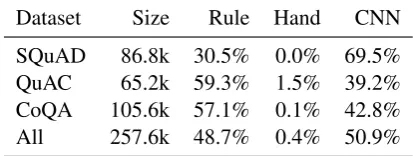
[image:13.595.312.519.402.480.2]We provide the exact distribution of rule-labeled, hand-labeled and classifier-labeled questions in
Table A1.
B Hyperparameters for Question
Generation
Our question generation system consists of a two layer bidirectional LSTM encoder and a
unidirec-tional LSTM decoder respectively. The LSTM
hidden unit size in each direction and token em-bedding size is each set to 512. The class
speci-ficity embeddings size is 16. Embeddings are
shared between the paragraph encoder and
ques-tion decoder. All attention computations use a
bilinear product (Luong et al., 2015). A dropout of 0.5 is used between LSTM layers. Models are
trained using Adam (Kingma and Ba,2014) with
a learning rate of10−3, with a gradient clipping of 5.0 and minibatch size 32. Early stopping on val-idation perplexity is used to choose the best ques-tion generaques-tion model.
C What did not work?
End-to-End Sequential Generation. We ex-perimented with an end-to-end neural model which generated a sequence of questions given a sequence of answer spans. As training data, we leveraged the sequence IDs and follow-up infor-mation in the QuAC dataset,withoutspecificity la-bels. We noticed that during decoding the model rarely attended over the history and often pro-duced questions irrelevant to the context. A poten-tial future direction would involve using the speci-ficity labels for an end-to-end model.
Span Selection NER system. As discussed in
Section 3.1andDu and Cardie (2017), we could
frame answer span selection as a sequence la-belling problem. We experimented with the NER system in AllenNLP (with ELMo embeddings) on the QuAC dataset, after the ground truth answer spans marked with BIO tags, after overlapping an-swers were merged together. We recorded low F1 scores of 33.3 and 15.6 on sentence-level and paragraph-level input respectively.
Paragraph-level question generation. Our
question generation model rarely generated
GENERAL questions representative of the entire paragraph, even when we fed the entire paragraph
as the answer span. We noticed that most GEN
-ERAL questions in our dataset were answered by
one or two sentences in the paragraph.
Answering system trained on all datasets.
Re-cently, Yatskar (2019) reported small
improve-ments on the QuAC validation set by pre-training the BiDAF++ model on SQuAD 2.0 or CoQA. We tried combining the training data in all three datasets but achieved a validation F1 score of just 29.3 (compared to 50.2 after using just QuAC training data).
Dataset Size Rule Hand CNN
SQuAD 86.8k 30.5% 0.0% 69.5%
QuAC 65.2k 59.3% 1.5% 39.2%
CoQA 105.6k 57.1% 0.1% 42.8%
All 257.6k 48.7% 0.4% 50.9%
Table A1: Distribution of scheme adopted to classify questions in different datasets. “CNN” refers to the data-driven classifier. Roughly half the questions were
Before the final of the 100-meter butterfly, US born Serbian swimmer Milorad Cavic caused a minor stir when he said it would be "good" if Phelps lost. "It'd be
good for him if he loses. It would be nice if historians talk about Michael Phelps winning seven gold medals and losing the eighth to 'some guy.' I'd like to be that guy", Cavic said. Phelps responded, "When people say
things like that, it fires me up more than anything." On August 16, Phelps won his seventh gold medal of the Games in the men's 100-meter butterfly, setting an
Olympic record for the event with a time of 50.58 seconds and edging out his nearest competitor Cavic,
by one hundredth (0.01) of a second.
Q. Why was he lost?
A. "It'd be good for him if he loses
Q. What did Phelps do on August 16? A. On August 16, Phelps won his seventh
gold medal of the Games in the men's 100-meter butterfly,
Q.Who did he win against? A. 100-meter butterfly,
Q. Who is the Serbian swimmer? A. US born Serbian swimmer
Milorad Cavic
Q. Who did he lose? A. Milorad Cavic
Q. When did he win a medal? A. On August 16
Q. How many gold medals did he win?
A. Phelps won his seventh gold
medal of the Games in the men's 100-meter butterfly,
Q. Who did he beat? A. edging out his nearest
competitor Cavic, by one hundredth (0.01) of a second.
On February 25, 2003 Converge released their first official DVD, The Long Road Home. The DVD is modeled after band home videos such as Metallica's Cliff Em' All release. Deathwish Inc describes the DVD
as a "two disc collection that is as energetic and exciting as the moments the release captures". The DVD also comes with a bonus disk that included three
full live sets from the band.
Q. What did they do in 2003? A. On February 25, 2003 Converge
released their first official DVD, The Long Road Home.
Q. What was their first DVD? A. On February 25, 2003
Converge released their first official DVD, The Long Road Home.
Q. When did they release this? A. On February 25, 2003
Q. Where were the release? A. The Long Road Home.
Q.What was the DVD about? A. The DVD is modeled after band home
videos such as Metallica's Cliff Em' All release.
Q. What other videos did they have?
A. Metallica's Cliff Em' All release.
Q. How many sets were from the band?
A. three full live sets from the bad
Q. What is Deathwise Inc?
A. Deathwish Inc describes the DVD as a
"two disc collection that is as energetic and exciting as the moments the release captures".
Converge (band) Michael Phelps
Orson Welles
Breaking with the Federal Theatre Project in 1937, Welles and Houseman founded their own repertory company, which they called the Mercury Theatre. The
name was inspired by the title of the iconoclastic magazine, The American Mercury. Welles was executive producer, and the original company included
such actors as Joseph Cotten, George Coulouris, Geraldine Fitzgerald, Arlene Francis, Martin Gabel,
John Hoyt, Norman Lloyd, Vincent Price, Stefan Schnabel and Hiram Sherman.
Q. What is Mercury Theatre? A. Breaking with the Federal Theatre
Project in 1937, Welles and Houseman founded their own repertory company, which they called the Mercury Theatre.
Q. What company did they form?
A. Federal Theatre Project
Q. When was the Federal Theatre Project founded? A. 1937,
Q. Who started it?
A. Welles and Houseman founded
their own repertory company, which they called the Mercury Theatre.
Q. Why was it called the Federal Theatre?
A. The name was inspired by the title of the
iconoclastic magazine, The American Mercury.
Q. What was the name of the iconoclastic magazine? A. The American Mercury Q. Who was the producer? A. Welles was executive producer,
[image:14.595.82.520.205.575.2]and the original company included such actors as Joseph Cotten, George Coulouris, Geraldine Fitzgerald, Arlene Francis, Martin Gabel,
Figure A1: ThreeSQUASHoutputs generated by our system, showcasing the strengths and weaknesses described