Deep Unordered Composition Rivals Syntactic Methods
for Text Classification
Mohit Iyyer,1 Varun Manjunatha,1 Jordan Boyd-Graber,2 Hal Daum´e III1 1University of Maryland, Department of Computer Science andUMIACS
2University of Colorado, Department of Computer Science
{miyyer,varunm,hal}@umiacs.umd.edu,[email protected]
Abstract
Many existing deep learning models for natural language processing tasks focus on learning thecompositionality of their in-puts, which requires many expensive com-putations. We present a simple deep neural network that competes with and, in some cases, outperforms such models on sen-timent analysis and factoid question an-swering tasks while taking only a fraction of the training time. While our model is syntactically-ignorant, we show significant improvements over previous bag-of-words models by deepening our network and ap-plying a novel variant of dropout. More-over, our model performs better than tactic models on datasets with high syn-tactic variance. We show that our model makes similar errors to syntactically-aware models, indicating that for the tasks we con-sider, nonlinearly transforming the input is more important than tailoring a network to incorporate word order and syntax.
1 Introduction
Vector space models for natural language process-ing (NLP) represent words using low dimensional
vectors called embeddings. To apply vector space models to sentences or documents, one must first select an appropriatecomposition function, which is a mathematical process for combining multiple words into a single vector.
Composition functions fall into two classes:
un-orderedandsyntactic. Unordered functions treat
in-put texts as bags of word embeddings, while syntac-tic functions take word order and sentence structure into account. Previously published experimental
results have shown that syntactic functions outper-form unordered functions on many tasks (Socher et al., 2013b; Kalchbrenner and Blunsom, 2013).
However, there is a tradeoff: syntactic functions require more training time than unordered compo-sition functions and are prohibitively expensive in the case of huge datasets or limited computing re-sources. For example, the recursive neural network (Section 2) computes costly matrix/tensor products and nonlinearities at every node of a syntactic parse tree, which limits it to smaller datasets that can be reliably parsed.
We introduce a deep unordered model that ob-tains near state-of-the-art accuracies on a variety of sentence and document-level tasks with just min-utes of training time on an average laptop computer. This model, the deep averaging network (DAN),
works in three simple steps:
1. take the vector average of the embeddings associated with an input sequence of tokens 2. pass that average through one or more
feed-forward layers
3. perform (linear) classification on the final layer’s representation
The model can be improved by applying a novel dropout-inspired regularizer: for each training in-stance, randomly drop some of the tokens’ embed-dings before computing the average.
We evaluateDANs on sentiment analysis and
fac-toid question answering tasks at both the sentence and document level in Section 4. Our model’s suc-cesses demonstrate that for these tasks, the choice of composition function is not as important as ini-tializing with pretrained embeddings and using a deep network. Furthermore, DANs, unlike more
complex composition functions, can be effectively trained on data that have high syntactic variance. A
qualitative analysis of the learned layers suggests that the model works by magnifying tiny but mean-ingful differences in the vector average through multiple hidden layers, and a detailed error analy-sis shows that syntactically-aware models actually make very similar errors to those of the more na¨ıve
DAN.
2 Unordered vs. Syntactic Composition
Our goal is to marry the speed of unordered func-tions with the accuracy of syntactic funcfunc-tions. In this section, we first describe a class of un-ordered composition functions dubbed “neural bag-of-words models” (NBOW). We then explore more
complex syntactic functions designed to avoid many of the pitfalls associated withNBOW
mod-els. Finally, we present the deep averaging network (DAN), which stacks nonlinear layers over the
tradi-tionalNBOWmodel and achieves performance on
par with or better than that of syntactic functions.
2.1 Neural Bag-of-Words Models
For simplicity, consider text classification: map an input sequence of tokensXto one ofklabels. We first apply a composition functiongto the sequence of word embeddingsvwforw∈X. The output of
this composition function is a vectorzthat serves as input to a logistic regression function.
In our instantiation ofNBOW,gaverages word
embeddings1
z=g(w∈X) =|X1|X w∈X
vw. (1)
Feeding z to a softmax layer induces estimated probabilities for each output label
ˆ
y=softmax(Ws·z+b), (2)
where the softmax function is softmax(q) = Pkexpq
j=1expqj (3)
Wsis ak×dmatrix for a dataset with koutput
labels, andbis a bias term.
We train the NBOW model to minimize
cross-entropy error, which for a single training instance with ground-truth labelyis
`(ˆy) =Xk p=1
yplog(ˆyp). (4)
1Preliminary experiments indicate that averaging outper-forms the vector sum used inNBOWfrom Kalchbrenner et al. (2014).
Before we describe our deep extension of the
NBOW model, we take a quick detour to discuss
syntactic composition functions. Connections to other representation frameworks are discussed fur-ther in Section 4.
2.2 Considering Syntax for Composition
Given a sentence like “You’ll be more entertained getting hit by a bus”, an unordered model like
NBOWmight be deceived by the word “entertained”
to return a positive prediction. In contrast, syn-tactic composition functions rely on the order and structure of the input to learn how one word or phrase affects another, sacrificing computational efficiency in the process. In subsequent sections, we argue that this complexity is not matched by a corresponding gain in performance.
Recursive neural networks (RecNNs) are
syntac-tic functions that rely on natural language’s inher-ent structure to achieve state-of-the-art accuracies on sentiment analysis tasks (Tai et al., 2015). As in
NBOW, each word type has an associated
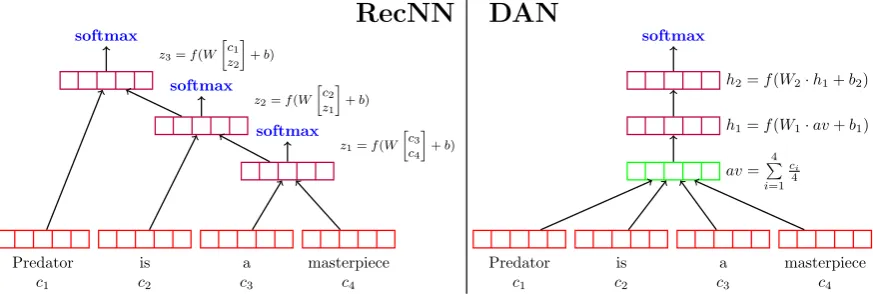
embed-ding. However, the composition functiong now depends on aparse treeof the input sequence. The representation for any internal node in a binary parse tree is computed as a nonlinear function of the representations of its children (Figure 1, left). A more powerful RecNN variant is the recursive
neural tensor network (RecNTN), which modifies gto include a costly tensor product (Socher et al., 2013b).
While RecNNs can model complex linguistic
phenomena like negation (Hermann et al., 2013), they require much more training time thanNBOW
models. The nonlinearities and matrix/tensor prod-ucts at each node of the parse tree are expen-sive, especially as model dimensionality increases.
RecNNs also require an error signal ateverynode.
One root softmax is not strong enough for the model to learn compositional relations and leads to worse accuracies than standard bag-of-words models (Li, 2014). Finally, RecNNs require
rela-tively consistent syntax between training and test data due to their reliance on parse trees and thus cannot effectively incorporate out-of-domain data, as we show in our question-answering experiments. Kim (2014) shows that some of these issues can be avoided by using a convolutional network in-stead of aRecNN, but the computational
complex-ity increases even further (see Section 4 for runtime comparisons).
Predator
c1
is
c2
a
c3
masterpiece
c4
z1=f(W
c3 c4
+b) z2=f(W
c2 z1
+b) z3=f(W
c1 z2
+b) softmax
softmax
softmax
RecNN
Predator
c1
is
c2
a
c3
masterpiece
c4
av=P4
i=1
ci
4
h1=f(W1·av+b1)
h2=f(W2·h1+b2)
[image:3.595.74.511.64.211.2]softmax
DAN
Figure 1: On the left, aRecNNis given an input sentence for sentiment classification. Softmax layers
are placed above every internal node to avoid vanishing gradient issues. On the right is a two-layerDAN
taking the same input. While theRecNNhas to compute a nonlinear representation (purple vectors) for
every node in the parse tree of its input, thisDANonly computes two nonlinear layers for every possible
input.
functions: the compositionality or the nonlineari-ties? Socher et al. (2013b) report that removing the nonlinearities from theirRecNNmodels drops
per-formance on the Stanford Sentiment Treebank by over 5% absolute accuracy. Most unordered func-tions are linear mappings between bag-of-words features and output labels, so might they suffer from the same issue? To isolate the effects of syn-tactic composition from the nonlinear transforma-tions that are crucial toRecNN performance, we
investigate how well a deep version of theNBOW
model performs on tasks that have recently been dominated by syntactically-aware models.
3 Deep Averaging Networks
The intuition behind deep feed-forward neural net-works is that each layer learns a more abstract rep-resentation of the input than the previous one (Ben-gio et al., 2013). We can apply this concept to the
NBOWmodel discussed in Section 2.1 with the
ex-pectation that each layer will increasingly magnify small but meaningful differences in the word em-bedding average. To be more concrete, takes1as
the sentence “I really loved Rosamund Pike’s per-formance in the movie Gone Girl” and generates2
ands3 by replacing “loved” with “liked” and then
again by “despised”. The vector averages of these three sentences are almost identical, but the aver-ages associated with the synonymous sentencess1
ands2 are slightly more similar to each other than
they are tos3’s average.
Could adding depth toNBOWmake small such
distinctions as this one more apparent? In
Equa-tion 1, we computez, the vector representation for input textX, by averaging the word vectorsvw∈X.
Instead of directly passing this representation to an output layer, we can further transformzby adding more layers before applying the softmax. Suppose we havenlayers,z1...n. We compute each layer
zi =g(zi−1) =f(Wi·zi−1+bi) (5)
and feed the final layer’s representation,zn, to a
softmax layer for prediction (Figure 1, right). This model, which we call a deep averaging net-work (DAN), is still unordered, but its depth allows
it to capture subtle variations in the input better than the standardNBOWmodel. Furthermore,
com-puting each layer requires just a single matrix multi-plication, so the complexity scales with the number of layers rather than the number of nodes in a parse tree. In practice, we find no significant difference between the training time of aDANand that of the
shallowNBOWmodel.
3.1 Word Dropout Improves Robustness
Dropout regularizes neural networks by randomly setting hidden and/or input units to zero with some probability p (Hinton et al., 2012; Srivastava et al., 2014). Given a neural network with nunits, dropout prevents overfitting by creating an ensem-ble of2ndifferent networks that share parameters,
where each network consists of some combination of dropped and undropped units. Instead of drop-ping units, a natural extension for theDANmodel is
to randomly drop word tokens’ entireword
which we callword dropout, our network theoreti-cally sees2|X|different token sequences for each
inputX.
We posit a vector r with |X| independent Bernoulli trials, each of which equals 1 with prob-abilityp. The embeddingvw for tokenwinXis
dropped from the average ifrw is 0, which
expo-nentially increases the number of unique examples the network sees during training. This allows us to modify Equation 1:
rw ∼Bernoulli(p) (6) ˆ
X ={w|w∈Xandrw >0} (7)
z=g(w∈X) =
P
w∈Xˆvw
|Xˆ| . (8)
Depending on the choice of p, many of the “dropped” versions of an original training instance will be very similar to each other, but for shorter inputs this is less likely. We might drop a very important token, such as “horrible” in “the crab rangoon was especially horrible”; however, since the number of word types that are predictive of the output labels is low compared to non-predictive ones (e.g., neutral words in sentiment analysis), we always see improvements using this technique.
Theoretically, word dropout can also be applied to other neural network-based approaches. How-ever, we observe no significant performance differ-ences in preliminary experiments when applying word dropout to leaf nodes in RecNNs for
senti-ment analysis (dropped leaf representations are set to zero vectors), and it slightly hurts performance on the question answering task.
4 Experiments
We compare DANs to both the shallow NBOW
model as well as more complicated syntactic mod-els on sentence and document-level sentiment anal-ysis and factoid question answering tasks. TheDAN
architecture we use for each task is almost identi-cal, differing across tasks only in the type of output layer and the choice of activation function. Our results show that DANs outperform other
bag-of-words models and many syntactic models with very little training time.2 On the question-answering
task,DANs effectively train on out-of-domain data,
while RecNNs struggle to reconcile the syntactic
differences between the training and test data.
2Code athttp://github.com/miyyer/dan.
Model RT SST SST IMDB Time
fine bin (s)
DAN-ROOT — 46.9 85.7 — 31
DAN-RAND 77.3 45.4 83.2 88.8 136
DAN 80.3 47.7 86.3 89.4 136
NBOW-RAND 76.2 42.3 81.4 88.9 91
NBOW 79.0 43.6 83.6 89.0 91
BiNB — 41.9 83.1 — —
NBSVM-bi 79.4 — — 91.2 —
RecNN∗ 77.7 43.2 82.4 — —
RecNTN∗ — 45.7 85.4 — —
DRecNN — 49.8 86.6 — 431
TreeLSTM — 50.6 86.9 — —
DCNN∗ — 48.5 86.9 89.4 —
PVEC∗ — 48.7 87.8 92.6 —
CNN-MC 81.1 47.4 88.1 — 2,452
[image:4.595.307.525.63.255.2]WRRBM∗ — — — 89.2 —
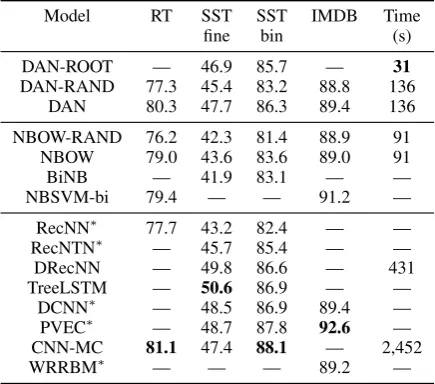
Table 1: DANs achieve comparable sentiment
accu-racies to syntactic functions (bottom third of table) but require much less training time (measured as time of a single epoch on theSSTfine-grained task).
Asterisked models are initialized either with differ-ent pretrained embeddings or randomly.
4.1 Sentiment Analysis
Recently, syntactic composition functions have revolutionized both fine-grained and binary (pos-itive or negative) sentiment analysis. We conduct sentence-level sentiment experiments on the Rot-ten Tomatoes (RT) movie reviews dataset (Pang
and Lee, 2005) and its extension with phrase-level labels, the Stanford Sentiment Treebank (SST)
in-troduced by Socher et al. (2013b). Our model is also effective on the document-levelIMDBmovie
review dataset of Maas et al. (2011).
4.1.1 Neural Baselines
Most neural approaches to sentiment analysis are variants of either recursive or convolutional net-works. Our recursive neural network baselines include standard RecNNs (Socher et al., 2011b), RecNTNs, the deep recursive network (DRecNN)
proposed by ˙Irsoy and Cardie (2014), and the
TREE-LSTM of (Tai et al., 2015).
Convolu-tional network baselines include the dynamic con-volutional network (Kalchbrenner et al., 2014,
DCNN) and the convolutional neural network
multi-channel (Kim, 2014, CNN-MC). Our other
neu-ral baselines are the sliding-window based para-graph vector (Le and Mikolov, 2014,PVEC)3and
the word-representation restricted Boltzmann ma-chine (Dahl et al., 2012, WRRBM), which only
works on the document-levelIMDBtask.4
4.1.2 Non-Neural Baselines
We also compare to non-neural baselines, specif-ically the bigram na¨ıve Bayes (BINB) and na¨ıve
Bayes support vector machine (NBSVM-BI)
mod-els introduced by Wang and Manning (2012), both of which are memory-intensive due to huge feature spaces of size|V|2.
4.1.3 DAN Configurations
In Table 1, we compare a variety ofDANandNBOW
configurations5to the baselines described above. In
particular, we are interested in not only comparing
DANaccuracies to those of the baselines, but also
how initializing with pretrained embeddings and re-stricting the model to only root-level labels affects performance. With this in mind, theNBOW-RAND
and DAN-RAND models are initialized with
ran-dom 300-dimensional word embeddings, while the other models are initialized with publicly-available 300-d GloVevectors trained over the Common Crawl (Pennington et al., 2014). TheDAN-ROOT
model only has access to sentence-level labels for
SSTexperiments, while all other models are trained
on labeled phrases (if they exist) in addition to sen-tences. We train allNBOWandDANmodels using
AdaGrad (Duchi et al., 2011).
We applyDANs to documents by averaging the
embeddings for all of a document’s tokens and then feeding that average through multiple layers as before. Since the representations computed by
DANs are alwaysd-dimensional vectors regardless
of the input size, they are efficient with respect to both memory and computational cost. We find that the hyperparameters selected on theSSTalso work
well for theIMDBtask.
4.1.4 Dataset Details
We evaluate over both fine-grained and binary sentence-level classification tasks on theSST, and
just the binary task onRTand IMDB. In the
fine-grainedSSTsetting, each sentence has a label from
zero to five where two is the neutral class. For the binary task, we ignore all neutral sentences.6
4TheWRRBMis trained using a slow Metropolis-Hastings algorithm.
5Best hyperparameters chosen by cross-validation: three 300-d ReLu layers, word dropout probabilityp = 0.3, L2 regularization weight of 1e-5 applied to all parameters
6Our fine-grainedSSTsplit is{train: 8,544, dev: 1,101, test: 2,210}, while our binary split is{train: 6,920, dev:872,
4.1.5 Results
TheDANachieves the second best reported result
on the RT dataset, behind only the significantly
slowerCNN-MCmodel. It’s also competitive with
more complex models on theSSTand outperforms
the DCNN and WRRBM on the document-level
IMDB task. Interestingly, theDANachieves good
performance on the SSTwhen trained with only
sentence-level labels, indicating that it does not suffer from the vanishing error signal problem that plaguesRecNNs. Since acquiring labelled phrases
is often expensive (Sayeed et al., 2012; Iyyer et al., 2014b), this result is promising for large or messy datasets where fine-grained annotation is infeasible.
4.1.6 Timing Experiments
DANs require less time per epoch and—in general—
require fewer epochs than their syntactic coun-terparts. We compare DAN runtime on the SST
to publicly-available implementations of syntactic baselines in the last column of Table 1; the reported times are for a single epoch to control for hyper-parameter choices such as learning rate, and all models use 300-dword vectors. Training aDAN
on just sentence-level labels on theSSTtakes under
five minutes on a single core of a laptop; when labeled phrases are added as separate training in-stances, training time jumps to twenty minutes.7
All timing experiments were performed on a single core of an Intel I7 processor with 8GB of RAM.
4.2 Factoid Question Answering
DANs work well for sentiment analysis, but how
do they do on other NLP tasks? We shift gears
to a paragraph-length factoid question answering task and find that our model outperforms other unordered functions as well as a more complex syntactic RecNN model. More interestingly, we
find that unlike theRecNN, theDANsignificantly
benefits from out-of-domain Wikipedia training data.
Quiz bowl is a trivia competition in which play-ers are asked four-to-six sentence questions about entities (e.g., authors, battles, or events). It is an ideal task to evaluateDANs because there is prior
test:1,821}. Split sizes increase by an order of magnitude when labeled phrases are added to the training set. ForRT, we do 10-fold CV over a balanced binary dataset of 10,662 sentences. Similarly, for theIMDBexperiments we use the provided balanced binary training set of 25,000 documents.
Model Pos 1 Pos 2 Full Time(s)
BoW-DT 35.4 57.7 60.2 — IR 37.5 65.9 71.4 N/A QANTA 47.1 72.1 73.7 314 DAN 46.4 70.8 71.8 18
[image:6.595.71.292.65.190.2]IR-WIKI 53.7 76.6 77.5 N/A QANTA-WIKI 46.5 72.8 73.9 1,648 DAN-WIKI 54.8 75.5 77.1 119
Table 2: The DAN achieves slightly lower
accu-racies than the more complex QANTA in much
less training time, even at early sentence posi-tions where compositionality plays a bigger role. When Wikipedia is added to the training set (bot-tom half of table), the DANoutperformsQANTA
and achieves comparable accuracy to a state-of-the-art information retrieval baseline, which highlights a benefit of ignoring word order for this task.
● ●
● ●
● ●
69 70 71
0.0 0.1 0.2 0.3 0.4 0.5
Dropout Probability
Histor
y QB Accur
acy
Effect of Word Dropout
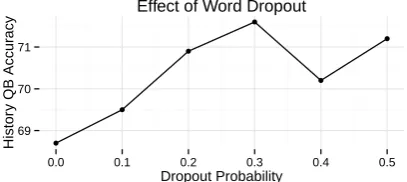
Figure 2: Randomly dropping out 30% of words from the vector average is optimal for the quiz bowl task, yielding a gain in absolute accuracy of almost 3% on the quiz bowl question dataset compared to the same model trained with no word dropout.
work using both syntactic and unordered models for quiz bowl question answering. In Boyd-Graber et al. (2012), na¨ıve Bayes bag-of-words models (BOW-DT) and sequential language models work
well on easy questions but poorly on harder ones. A dependency-treeRecNNcalledQANTAproposed
in Iyyer et al. (2014a) shows substantial improve-ments, leading to the hypothesis that correctly mod-eling compositionality is crucial for answering hard questions.
4.2.1 Dataset and Experimental Setup
To test this, we train aDANover the history
ques-tions from Iyyer et al. (2014a).8 This dataset is aug-8The training set contains 14,219 sentences over 3,761 questions. For more detail about data and baseline systems,
mented with 49,581 sentence/page-title pairs from the Wikipedia articles associated with the answers in the dataset. For fair comparison withQANTA,
we use a normalized tanh activation function at the last layer instead of ReLu, and we also change the output layer from a softmax to the margin rank-ing loss (Weston et al., 2011) used inQANTA. We
initialize the DANwith the same pretrained
100-d wor100-d embe100-d100-dings that were use100-d to initialize
QANTA.
We also evaluate the effectiveness of word dropout on this task in Figure 2. Cross-validation indicates thatp= 0.3works best for question an-swering, although the improvement in accuracy is negligible for sentiment analysis. Finally, continu-ing the trend observed in the sentiment experiments,
DANconverges much faster thanQANTA.
[image:6.595.77.281.348.439.2]4.2.2 DANs Improve with Noisy Data
Table 2 shows that while DAN is slightly worse
thanQANTAwhen trained only on question-answer
pairs, it improves when trained on additional out-of-domain Wikipedia data (DAN-WIKI), reaching
performance comparable to that of a state-of-the-art information retrieval system (IR-WIKI). QANTA,
in contrast, barely improves when Wikipedia data is added (QANTA-WIKI) possibly due to the syntactic
differences between Wikipedia text and quiz bowl question text.
The most common syntactic structures in quiz bowl sentences are imperative constructions such as “Identify this British author who wrote Wuther-ing Heights”, which are almost never seen in Wikipedia. Furthermore, the subject of most quiz bowl sentences is a pronoun or pronomial mention referring to the answer, a property that is not true of Wikipedia sentences (e.g., “Little of Emily’s work from this period survives, except for poems spoken by characters.”). Finally, many Wikipedia sentences do not uniquely identify the title of the page they come from, such as the following sen-tence from Emily Bront¨e’s page: “She does not seem to have made any friends outside her family.” While noisy data affect bothDANandQANTA, the
latter is further hampered by the syntactic diver-gence between quiz bowl questions and Wikipedia, which may explain the lack of improvement in ac-curacy.
0 10 20 30 40 50
0 1 2 3 4 5
Layer
P
er
turbation Response
cool okay the worst underwhelming
[image:7.595.78.280.72.228.2]Perturbation Response vs. Layer
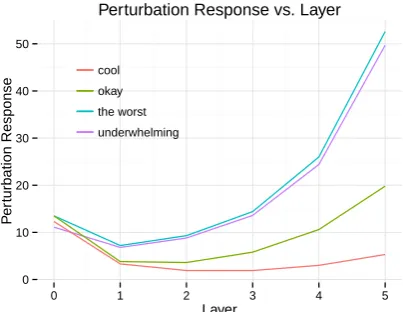
Figure 3: Perturbation response (difference in 1-norm) at each layer of a 5-layerDANafter
replac-ingawesomeinthe film’s performances were
awe-somewith four words of varying sentiment polarity. While the shallowNBOWmodel does not show any
meaningful distinctions, we see that as the network gets deeper, negative sentences are increasingly different from the original positive sentence.
● ●
●
● ● ● ●
● ●
● ●
● ● ●
83 84 85 86 87
0 2 4 6
Number of Layers
Binar
y Classification Accur
acy
● ● ● ●
DAN DAN−ROOT
Effect of Depth on Sentiment Accuracy
Figure 4: Two to three layers is optimal for the
DANon theSSTbinary sentiment analysis task, but
adding any depth at all is an improvement over the shallowNBOWmodel.
5 How Do DANs Work?
In this section we first examine how the deep layers of theDANamplify tiny differences in the vector
av-erage that are predictive of the output labels. Next, we compareDANs to DRecNNs on sentences that
contain negations and contrastive conjunctions and find that both models make similar errors despite the latter’s increased complexity. Finally, we an-alyze the predictive ability of unsupervised word embeddings on a simple sentiment task in an effort to explain why initialization with these embeddings improves theDAN.
5.1 Perturbation Analysis
Following the work of ˙Irsoy and Cardie (2014), we examine our network by measuring the response at each hidden layer to perturbations in an input sen-tence. In particular, we use the templatethe film’s
performances were awesome and replace the
fi-nal word with increasingly negative polarity words
(cool,okay,underwhelming,the worst). For each
perturbed sentence, we observe how much the hid-den layers differ from those associated with the original template in 1-norm.
Figure 3 shows that as aDANgets deeper, the
dif-ferences between negative and positive sentences become increasingly amplified. While nonexistent in the shallowNBOWmodel, these differences are
visible even with just a single hidden layer, thus explaining why deepening theNBOWimproves
sen-timent analysis as shown in Figure 4.
5.2 Handling Negations and “but”: Where Syntax is Still Needed
WhileDANs outperform other bag-of-words
mod-els, how can they model linguistic phenomena such as negation without considering word order? To evaluateDANs over tougher inputs, we collect 92
sentences, each of which contains at least one nega-tion and one contrastive conjuncnega-tion, from the dev and test sets of theSST.9Our fine-grained accuracy
is higher on this subset than on the full dataset,
improving almost five percent absolute accuracy to 53.3%. TheDRecNNmodel of ˙Irsoy and Cardie
(2014) obtains a similar accuracy of 51.1%, con-trary to our intuition that syntactic functions should outperform unordered functions on sentences that clearly require syntax to understand.10
Are these sentences truly difficult to classify? A close inspection reveals that both theDANand the DRecNN have an overwhelming tendency to
pre-dict negative sentiment (60.9% and 55.4% of the time for theDANandDRecNNrespectively) when
they see a negation compared to positive sentiment (35.9% forDANs, 34.8% forDRecNNs). If we
fur-ther restrict our subset of sentences to only those with positive ground truth labels, we find that while both models struggle, theDRecNNobtains 41.7%
accuracy, outperforming theDAN’s 37.5%.
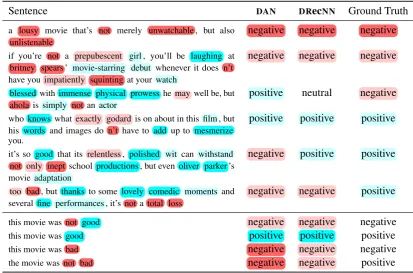
To understand why a negation or contrastive con-junction triggers a negative sentiment prediction,
[image:7.595.77.280.382.500.2]Sentence DAN DRecNN Ground Truth
a lousy movie that’s not merely unwatchable , but also
unlistenable negative negative negative
if you’re not a prepubescent girl , you’ll be laughing at britney spears ’ movie-starring debut whenever it does n’t have you impatiently squinting at your watch
negative negative negative
blessed with immense physical prowess he may well be, but
ahola is simply not an actor positive neutral negative
who knows what exactly godard is on about in this film , but his words and images do n’t have to add up to mesmerize you.
positive positive positive
it’s so good that its relentless , polished wit can withstand not only inept school productions , but even oliver parker ’s movie adaptation
negative positive positive
too bad , but thanks to some lovely comedic moments and
several fine performances , it’s not a total loss negative negative positive
this movie was not good negative negative negative
this movie was good positive positive positive
this movie was bad negative negative negative
[image:8.595.90.504.62.335.2]the movie was not bad negative negative positive
Table 3: Predictions of DANandDRecNN models on real (top) and synthetic (bottom) sentences that
contain negations and contrastive conjunctions. In the first column, words colored red individually predict the negative label when fed to aDAN, while blue words predict positive. TheDANlearns that the negators
notandn’tare strong negative predictors, which means it is unable to capture double negation as in the last real example and the last synthetic example. TheDRecNNdoes slightly better on the synthetic double
negation, predicting a lower negative polarity.
we show six sentences from the negation subset and four synthetic sentences in Table 3, along with both models’ predictions. The token-level predictions in the table (shown as colored boxes) are computed by passing each token through theDANas separate test
instances. The tokensnotandn’tare strongly pre-dictive of negative sentiment. While this simplified “negation” works for many sentences in the datasets we consider, it prevents the DANfrom reasoning
about double negatives, as in “this movie was not bad”. TheDRecNNdoes slightly better in this case
by predicting a lesser negative polarity than the
DAN; however, we theorize that still more powerful
syntactic composition functions (and more labelled instances of negation and related phenomena) are necessary to truly solve this problem.
5.3 Unsupervised Embeddings Capture Sentiment
Our model consistently converges slower to a worse solution (dropping 3% in absolute accuracy on coarse-grainedSST) when we randomly initialize
the word embeddings. This does not apply to just
DANs; both convolutional and recursive networks
do the same (Kim, 2014; ˙Irsoy and Cardie, 2014). Why are initializations with these embeddings so crucial to obtaining good performance? Is it pos-sible that unsupervised training algorithms are al-ready capturing sentiment?
We investigate this theory by conducting a sim-ple experiment: given a sentiment lexicon contain-ing both positive and negative words, we train a logistic regression to discriminate between the asso-ciated word embeddings (without any fine-tuning). We use the lexicon created by Hu and Liu (2004), which consists of 2,006 positive words and 4,783 negative words. We balance and split the dataset into 3,000 training words and 1,000 test words. Using 300-dimensional GloVeembeddings pre-trained over the Common Crawl, we obtain over 95% accuracy on the unseen test set, supporting the hypothesis that unsupervised pretraining over large corpora can capture properties such as sentiment.
Intuitively, after the embeddings are fine-tuned duringDANtraining, we might expect a decrease
norms of sentiment-rich words like “awesome” or “horrible”. However, we find no significant dif-ferences between theL2 norms of stopwords and
words in the sentiment lexicon of Hu and Liu (2004).
6 Related Work
Our DANmodel builds on the successes of both
simple vector operations and neural network-based models for compositionality.
There are a variety of element-wise vector op-erations that could replace the average used in the
DAN. Mitchell and Lapata (2008) experiment with
many of them to model the compositionality of short phrases. Later, their work was extended to take into account the syntactic relation between words (Erk and Pad´o, 2008; Baroni and Zampar-elli, 2010; Kartsaklis and Sadrzadeh, 2013) and grammars (Coecke et al., 2010; Grefenstette and Sadrzadeh, 2011). While the average works best for the tasks that we consider, Banea et al. (2014) find that simply summingword2vecembeddings out-performs all other methods on the SemEval 2014 phrase-to-word and sentence-to-phrase similarity tasks.
Once we compute the embedding average in a
DAN, we feed it to a deep neural network. In
con-trast, most previous work on neural network-based methods forNLP tasks explicitly model word
or-der. Outside of sentiment analysis,RecNN-based
approaches have been successful for tasks such as parsing (Socher et al., 2013a), machine trans-lation (Liu et al., 2014), and paraphrase detec-tion (Socher et al., 2011a). Convoludetec-tional net-works also model word order in local windows and have achieved performance comparable to or bet-ter than that ofRecNNs on many tasks (Collobert
and Weston, 2008; Kim, 2014). Meanwhile, feed-forward architectures like that of the DAN have
been used for language modeling (Bengio et al., 2003), selectional preference acquisition (Van de Cruys, 2014), and dependency parsing (Chen and Manning, 2014).
7 Future Work
In Section 5, we showed that the performance of our DAN model worsens on sentences that
con-tain lingustic phenomena such as double negation. One promising future direction is to cascade clas-sifiers such that syntactic models are used only when aDANis not confident in its prediction. We
can also extend theDAN’s success at incorporating
out-of-domain training data to sentiment analysis: imagine training aDANon labeled tweets for
clas-sification on newspaper reviews. Another poten-tially interesting application is to add gated units to aDAN,as has been done for recurrent and
recur-sive neural networks (Hochreiter and Schmidhuber, 1997; Cho et al., 2014; Sutskever et al., 2014; Tai et al., 2015), to drop useless words rather than randomly-selected ones.
8 Conclusion
In this paper, we introduce the deep averaging net-work, which feeds an unweighted average of word vectors through multiple hidden layers before clas-sification. TheDANperforms competitively with
more complicated neural networks that explicitly model semantic and syntactic compositionality. It is further strengthened by word dropout, a regu-larizer that reduces input redundancy. DANs
ob-tain close to state-of-the-art accuracy on both sen-tence and document-level sentiment analysis and factoid question-answering tasks with much less training time than competing methods; in fact, all experiments were performed in a matter of min-utes on a single laptop core. We find that both
DANs and syntactic functions make similar errors
given syntactically-complex input, which motivates research into more powerful models of composi-tionality.
Acknowledgments
We thank Ozan ˙Irsoy not only for many insight-ful discussions but also for suggesting some of the experiments that we included in the paper. We also thank the anonymous reviewers, Richard Socher, Arafat Sultan, and the members of the UMD “Thinking on Your Feet” research group for their helpful comments. This work was supported byNSFGrant IIS-1320538. Boyd-Graber is also
supported byNSFGrantsCCF-1409287 andNCSE
References
Carmen Banea, Di Chen, Rada Mihalcea, Claire Cardie, and Janyce Wiebe. 2014. Simcompass: Using deep learn-ing word embeddlearn-ings to assess cross-level similarity. In
SemEval.
Marco Baroni and Roberto Zamparelli. 2010. Nouns are vectors, adjectives are matrices: Representing adjective-noun constructions in semantic space. InProceedings of Empirical Methods in Natural Language Processing. Yoshua Bengio, R´ejean Ducharme, Pascal Vincent, and
Chris-tian Jauvin. 2003. A neural probabilistic language model.
Journal of Machine Learning Research.
Yoshua Bengio, Aaron Courville, and Pascal Vincent. 2013. Representation learning: A review and new perspectives.
IEEE Transactions on Pattern Analysis and Machine Intel-ligence, 35(8):1798–1828.
Jordan Boyd-Graber, Brianna Satinoff, He He, and Hal Daum´e III. 2012. Besting the quiz master: Crowdsourcing incre-mental classification games. InProceedings of Empirical Methods in Natural Language Processing.
Danqi Chen and Christopher D Manning. 2014. A fast and accurate dependency parser using neural networks. In
Proceedings of Empirical Methods in Natural Language Processing.
Kyunghyun Cho, Bart van Merrienboer, Caglar Gulcehre, Fethi Bougares, Holger Schwenk, and Yoshua Bengio. 2014. Learning phrase representations using rnn encoder-decoder for statistical machine translation. InProceedings of Empirical Methods in Natural Language Processing. Bob Coecke, Mehrnoosh Sadrzadeh, and Stephen Clark. 2010.
Mathematical foundations for a compositional distribu-tional model of meaning. Linguistic Analysis (Lambek Festschirft).
Ronan Collobert and Jason Weston. 2008. A unified ar-chitecture for natural language processing: Deep neural networks with multitask learning. InProceedings of the International Conference of Machine Learning.
George E Dahl, Ryan P Adams, and Hugo Larochelle. 2012. Training restricted boltzmann machines on word observa-tions. InProceedings of the International Conference of Machine Learning.
John Duchi, Elad Hazan, and Yoram Singer. 2011. Adaptive subgradient methods for online learning and stochastic optimization. Journal of Machine Learning Research. Katrin Erk and Sebastian Pad´o. 2008. A structured vector
space model for word meaning in context. InProceedings of Empirical Methods in Natural Language Processing. Edward Grefenstette and Mehrnoosh Sadrzadeh. 2011.
Ex-perimental support for a categorical compositional distri-butional model of meaning. InProceedings of Empirical Methods in Natural Language Processing.
Karl Moritz Hermann, Edward Grefenstette, and Phil Blun-som. 2013. ”not not bad” is not ”bad”: A distributional account of negation.Proceedings of the ACL Workshop on Continuous Vector Space Models and their Compositional-ity.
Geoffrey E. Hinton, Nitish Srivastava, Alex Krizhevsky, Ilya Sutskever, and Ruslan Salakhutdinov. 2012. Improving neural networks by preventing co-adaptation of feature detectors.CoRR, abs/1207.0580.
Sepp Hochreiter and J¨urgen Schmidhuber. 1997. Long short-term memory.Neural computation.
Minqing Hu and Bing Liu. 2004. Mining and summariz-ing customer reviews. InKnowledge Discovery and Data Mining.
Ozan ˙Irsoy and Claire Cardie. 2014. Deep recursive neural networks for compositionality in language. InProceedings of Advances in Neural Information Processing Systems. Mohit Iyyer, Jordan Boyd-Graber, Leonardo Claudino,
Richard Socher, and Hal Daum´e III. 2014a. A neural network for factoid question answering over paragraphs. InProceedings of Empirical Methods in Natural Language Processing.
Mohit Iyyer, Peter Enns, Jordan Boyd-Graber, and Philip Resnik. 2014b. Political ideology detection using recursive neural networks. InProceedings of the Association for Computational Linguistics.
Nal Kalchbrenner and Phil Blunsom. 2013. Recurrent convo-lutional neural networks for discourse compositionality. In
ACL Workshop on Continuous Vector Space Models and their Compositionality.
Nal Kalchbrenner, Edward Grefenstette, and Phil Blunsom. 2014. A convolutional neural network for modelling sen-tences. InProceedings of the Association for Computa-tional Linguistics.
Dimitri Kartsaklis and Mehrnoosh Sadrzadeh. 2013. Prior disambiguation of word tensors for constructing sentence vectors. InProceedings of Empirical Methods in Natural Language Processing.
Yoon Kim. 2014. Convolutional neural networks for sentence classification. InProceedings of Empirical Methods in Natural Language Processing.
Quoc V Le and Tomas Mikolov. 2014. Distributed represen-tations of sentences and documents. InProceedings of the International Conference of Machine Learning.
Jiwei Li. 2014. Feature weight tuning for recursive neural networks.CoRR, abs/1412.3714.
Shujie Liu, Nan Yang, Mu Li, and Ming Zhou. 2014. A recursive recurrent neural network for statistical machine translation. InProceedings of the Association for Compu-tational Linguistics.
Andrew L. Maas, Raymond E. Daly, Peter T. Pham, Dan Huang, Andrew Y. Ng, and Christopher Potts. 2011. Learn-ing word vectors for sentiment analysis. InProceedings of the Association for Computational Linguistics.
Jeff Mitchell and Mirella Lapata. 2008. Vector-based models of semantic composition. InProceedings of the Association for Computational Linguistics.
Jeffrey Pennington, Richard Socher, and Christopher Manning. 2014. Glove: Global vectors for word representation. In
Proceedings of Empirical Methods in Natural Language Processing.
Asad B. Sayeed, Jordan Boyd-Graber, Bryan Rusk, and Amy Weinberg. 2012. Grammatical structures for word-level sentiment detection. InNorth American Association of Computational Linguistics.
Richard Socher, Eric H. Huang, Jeffrey Pennington, Andrew Y. Ng, and Christopher D. Manning. 2011a. Dynamic Pool-ing and UnfoldPool-ing Recursive Autoencoders for Paraphrase Detection. InProceedings of Advances in Neural Informa-tion Processing Systems.
Richard Socher, Jeffrey Pennington, Eric H. Huang, Andrew Y. Ng, and Christopher D. Manning. 2011b. Semi-Supervised Recursive Autoencoders for Predicting Sentiment Distri-butions. InProceedings of Empirical Methods in Natural Language Processing.
Richard Socher, John Bauer, Christopher D. Manning, and Andrew Y. Ng. 2013a. Parsing With Compositional Vector Grammars. InProceedings of the Association for Compu-tational Linguistics.
Richard Socher, Alex Perelygin, Jean Y Wu, Jason Chuang, Christopher D Manning, Andrew Y Ng, and Christopher Potts. 2013b. Recursive deep models for semantic com-positionality over a sentiment treebank. InProceedings of Empirical Methods in Natural Language Processing. Nitish Srivastava, Geoffrey Hinton, Alex Krizhevsky, Ilya
Sutskever, and Ruslan Salakhutdinov. 2014. Dropout: A simple way to prevent neural networks from overfitting.
Journal of Machine Learning Research, 15(1).
Ilya Sutskever, Oriol Vinyals, and Quoc VV Le. 2014. Se-quence to seSe-quence learning with neural networks. In
Proceedings of Advances in Neural Information Processing Systems.
Kai Sheng Tai, Richard Socher, and Christopher D. Man-ning. 2015. Improved semantic representations from tree-structured long short-term memory networks.
Tim Van de Cruys. 2014. A neural network approach to selec-tional preference acquisition. InProceedings of Empirical Methods in Natural Language Processing.
Sida I. Wang and Christopher D. Manning. 2012. Baselines and bigrams: Simple, good sentiment and topic classifica-tion. InProceedings of the Association for Computational Linguistics.