Context-aware Entity Morph Decoding
Boliang Zhang1, Hongzhao Huang1, Xiaoman Pan1, Sujian Li2, Chin-Yew Lin3
Heng Ji1, Kevin Knight4, Zhen Wen5, Yizhou Sun6, Jiawei Han7, Bulent Yener1 1Rensselaer Polytechnic Institute,2Peking University,3Microsoft Research Asia,4University of Southern California
5IBM T. J. Watson Research Center,6Northeastern University,7Univerisity of Illinois at Urbana-Champaign 1{zhangb8,huangh9,panx2,jih,yener}@rpi.edu,2[email protected],3[email protected]
4[email protected],5[email protected],6[email protected],7[email protected]
Abstract
People create morphs, a special type of fake alternative names, to achieve certain communication goals such as expressing strong sentiment or evading censors. For example, “Black Mamba”, the name for a highly venomous snake, is a morph that
Kobe Bryantcreated for himself due to his agility and aggressiveness in playing bas-ketball games. This paper presents the first end-to-end context-aware entity morph de-coding system that can automatically iden-tify, disambiguate, verify morph mentions based on specific contexts, and resolve them to target entities. Our approach is based on an absolute “cold-start” - it does not require any candidate morph or tar-get entity lists as input, nor any manually constructed morph-target pairs for train-ing. We design a semi-supervised collec-tive inference framework for morph men-tion extracmen-tion, and compare various deep learning based approaches for morph res-olution. Our approach achieved signifi-cant improvement over the state-of-the-art method (Huang et al., 2013), which used a large amount of training data.1
1 Introduction
Morphs (Huang et al., 2013; Zhang et al., 2014) refer to the fake alternative names created by so-cial media users to entertain readers or evade cen-sors. For example, during the World Cup in 2014, 1The data set and programs are publicly
avail-able at: http://nlp.cs.rpi.edu/data/morphdecoding.zip and http://nlp.cs.rpi.edu/software/morphdecoding.tar.gz
a morph “Su-tooth” was created to refer to the Uruguay striker “Luis Suarez” for his habit of bit-ing other players. Automatically decodbit-ing human-generated morphs in text is critical for downstream deep language understanding tasks such as entity linking and event argument extraction.
However, even for human, it is difficult to de-code many morphs without certain historical, cul-tural, or political background knowledge (Zhang et al., 2014). For example, “The Hutt” can be used to refer to a fictional alien entity in theStar Wars
universe (“The Hutt stayed and established himself as ruler of Nam Chorios”), or the governor of New Jersey,Chris Christie(“The Hutt announced a bid for a seat in the New Jersey General Assembly”). Huang et al. (2013) did a pioneering pilot study on morph resolution, but their approach assumed the entity morphs were already extracted and used a large amount of labeled data. In fact, they resolved morphs on corpus-level instead of mention-level and thus their approach was context-independent. A practical morph decoder, as depicted in Fig-ure 1, consists of two problems: (1) Morph Ex-traction: given a corpus, extract morph mentions; and (2). Morph Resolution: For each morph men-tion, figure out the entity that it refers to.
In this paper, we aim to solve the fundamental research problem of end-to-end morph decoding and propose a series of novel solutions to tackle the following challenges.
Challenge 1: Large-scope candidates
Only a very small percentage of terms can be used as morphs, which should be interesting and fun. As we annotate a sample of4,668Chinese weibo tweets, only450out of 19,704unique terms are morphs. To extract morph mentions, we propose a
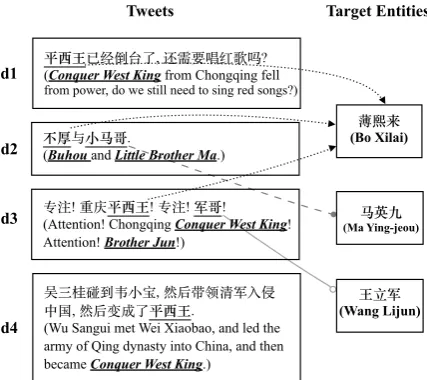
, ? (Conquer West King from Chongqing fell from power, do we still need to sing red songs?)
.
(Buhou and Little Brother Ma.)
! ! ! !
(Attention! Chongqing Conquer West King! Attention! Brother Jun!)
,
, .
(Wu Sangui met Wei Xiaobao, and led the army of Qing dynasty into China, and then became Conquer West King.)
(Bo Xilai)
(Ma Ying-jeou)
(Wang Lijun)
Tweets Target Entities
d1
d2
d3
[image:2.595.74.288.64.254.2]d4
Figure 1: An Illustration of Morph Decoding Task.
two-step approach to first identify individual men-tion candidates to narrow down the search scope, and then verify whether they refer to morphed en-tities instead of their original meanings.
Challenge 2: Ambiguity, Implicitness, Informality
Compared to regular entities, many morphs con-tain informal terms with hidden information. For example, “不厚 (not thick)” is used to refer to “薄熙来 (Bo Xilai)” whose last name “薄 (Bo)”
means “thin”. Therefore we attempt to model the rich contexts with careful considerations for morph characteristics both globally (e.g., language models learned from a large amount of data) and locally (e.g. phonetic anomaly analysis) to extract morph mentions.
For morph resolution, the main challenge lies in that the surface forms of morphs usually ap-pear quite different from their target entity names. Based on the distributional hypothesis (Harris, 1954) which states that words that often occur in similar contexts tend to have similar meanings, we propose to use deep learning techniques to capture and compare the deep semantic representations of a morph and its candidate target entities based on their contextual clues. For example, the morph “平西王(Conquer West King)” and its target entity “薄熙来(Bo Xilai)” share similar implicit
contex-tual representations such as “重庆(Chongqing)” (Bo was the governor of Chongqing) and “倒台
(fall from power)”.
Challenge 3: Lack of labeled data
To the best of our knowledge, no sufficient mention-level morph annotations exist for training an end-to-end decoder. Manual morph annotations require native speakers who have certain cultural background (Zhang et al., 2014). In this paper we focus on exploring novel approaches to save annotation cost in each step. For morph extrac-tion, based on the observation that morphs tend to share similar characteristics and appear together, we propose a semi-supervised collective inference approach to extract morph mentions from multiple tweets simultaneously. Deep learning techniques have been successfully used to model word rep-resentation in an unsupervised fashion. For morph resolution, we make use of a large amount of unla-beled data to learn the semantic representations of morphs and target entities based on the unsuper-vised continuous bag-of-words method (Mikolov et al., 2013b).
2 Problem Formulation
Following the recent work on morphs (Huang et al., 2013; Zhang et al., 2014), we use Chi-nese Weibo tweets for experiments. Our goal is to develop an end-to-end system that auto-matically extract morph mentions and resolve them to their target entities. Given a corpus of tweets D = {d1, d2, ..., d|D|}, we define a
candidate morph mi as a unique term tj in T, where T = {t1, t2, ..., t|T|} is the set of unique
terms in D. To extract T, we first apply sev-eral well-developed Natural Language Process-ing tools, includProcess-ing Stanford Chinese word seg-menter (Chang et al., 2008), Stanford part-of-speech tagger (Toutanova et al., 2003) and Chinese lexical analyzer ICTCLAS (Zhang et al., 2003), to process the tweets and identify noun phrases. Then we define amorph mentionmpi ofmias the
p-th occurrence of mi in a specific document dj. Note that a mention with the same surface form as
mibut referring to its original entity is not consid-ered as a morph mention. For instance, the “平西 王(Conquer West King)” ind1 andd3in Figure 1 are morph mentions since they refer to the modern politician “薄熙来(Bo Xilai)”, while the one ind4
is not a morph mention since it refers to the origi-nal entity, who was king “吴三桂(Wu Sangui)”.
For each morph mention, we discover a list of target candidatesE ={e1, e2, ..., e|E|}from
design an end-to-end morph decoder which con-sists of the following procedure:
• Morph Mention Extraction
– Potential Morph Discovery: This first step aims to obtain a set of potential entity-level morphsM ={m1, m2, ...}(M ⊆T). Then, we only verify and resolve the mentions of these potential morphs, instead of all the terms inT in a large corpus.
– Morph Mention Verification: In this step, we aim to verify whether each mentionmpi of the potential morphmi(mi∈M)from a specific contextdj is a morph mention or not.
• Morph Mention Resolution: The final step is to resolve each morph mentionmpi to its target entity (e.g., “薄熙来(Bo Xilai)” for the morph
mention “平西王 (Conquer West King)” ind1 in Figure 1).
3 Morph Mention Extraction
3.1 Why Traditional Entity Mention Extraction doesn’t Work
In order to automatically extract morph mentions from any given documents, our first reflection is to formulate the task as a sequence labeling prob-lem, just like labeling regular entity mentions. We adopted the commonly used conditional random fields (CRFs) (Lafferty et al., 2001) and got only 6% F-score. Many morphs are not presented as regular entity mentions. For example, the morph “天线 (Antenna)” refers to “温家 宝 (Wen Ji-abao)” because it shares one character “宝(baby)” with the famous children’s television series “天 线宝宝 (Teletubbies)”. Even when they are pre-sented as regular entity mentions, they must refer to new target entities which are different from the regular ones. So we propose the following novel two-step solution.
3.2 Potential Morph Discovery
We first introduce the first step of our approach – potential morph discovery, which aims to nar-row down the scope of morph candidates with-out losing recall. This step takes advantage of the common characteristics shared among morphs and identifies the potential morphs using a super-vised method, since it is relatively easy to collect a certain number of corpus-level morphs as train-ing data compared to labeltrain-ing morph mentions. Through formulating this task as a binary
classifi-cation problem, we adopt the Support Vector Ma-chines (SVMs) (Cortes and Vapnik, 1995) as the learning model. We propose the following four categories of features.
Basic: (i) character unigram, bigram, trigram, and surface form; (ii) part-of-speech tags; (iii) the number of characters; (iv) whether some charac-ters are identical. These basic features will help identify several common characteristics of morph candidates (e.g., they are very likely to be nouns, and very unlikely to contain single characters).
Dictionary: Many morphs are non-regular names derived from proper names while retain-ing some characteristics. For example, the morphs
“薄督 (Governor Bo)” and “吃省 (Gourmand
Province)” are derived from their target entity names “薄熙来 (Bo Xilai)” and “广东省 (Guan-dong Province)”, respectively. Therefore, we adopt a dictionary of proper names (Li et al., 2012) and propose the following features: (i) Whether a term occurs in the dictionary. (ii) Whether a term starts with a commonly used last name, and includes uncommonly used characters as its first name. (iii) Whether a term ends with a geo-political entity or organization suffix word, but it’s not in the dictionary.
Phonetic: Many morphs are created based on phonetic (Chinese pinyin in our case) modifica-tions. For instance, the morph “饭 饼 饼 (Rice Cake)” has the same phonetic transcription as its target entity name “范冰冰 (Fan Bingbing)”. To extract phonetic-based features, we compile a dictionary composed ofhphonetic transcription, termipairs from the Chinese Gigaword corpus 2.
Then for each term, we check whether it has the same phonetic transcription as any entry in the dic-tionary but they include different characters.
Language Modeling: Many morphs rarely ap-pear in a general news corpus (e.g., “六步郎
(Six Step Man)” refers to the NBA baseketball player “勒布朗·詹姆斯(Lebron James)”.).
There-fore, we use the character-based language models trained from Gigaword to calculate the occurrence probabilities of each term, and use n-gram proba-bilities (n∈[1 : 5]) as features.
3.3 Morph Mention Verification
The second step is to verify whether a mention of the discovered potential morphs is indeed used as a morph in a specific context. Based on the
servation that closely related morph mentions of-ten occur together, we propose a semi-supervised graph-based method to leverage a small set of la-beled seeds, coreference and correlation relations, and a large amount of unlabeled data to perform collective inference and thus save annotation cost. According to our observation of morph mentions, we propose the following two hypotheses:
Hypothesis 1: If two mentions are coreferen-tial, then they both should either be morph men-tions or non-morph menmen-tions. For instance, the morph mentions “平西王 (Conquer West King)” ind1andd3in Figure 1 are coreferential, they both refer to the modern politician “薄熙来(Bo Xilai)”.
Hypothesis 2: Those highly correlated men-tions tend to either be morph menmen-tions or non-morph mentions.From our annotated dataset, 49% morph mentions co-occur on tweet level. For ex-ample, “平西王(Conquer West King)” and “军 哥(Brother Jun)” are used together in d3 in Fig-ure 1.
Based on these hypotheses, we aim to design an effective approach to compensate for the lim-ited annotated data. Graph-based semi-supervised learning approaches (Zhu et al., 2003; Smola and Kondor, 2003; Zhou et al., 2004) have been suc-cessfully applied many NLP tasks (Niu et al., 2005; Chen et al., 2006; Huang et al., 2014). Therefore we build a mention graph to capture the semantic relatedness (weighted arcs) between potential morph mentions (nodes) and propose a semi-supervised graph-based algorithm to collec-tively verify a set of relevant mentions using a small amount of labeled data. We now describe the detailed algorithm as follows.
Mention Graph Construction
First, we construct a mention graph that can reflect the association between all the mentions of poten-tial morphs. According to the above two hypothe-ses,mention coreferenceandcorrelationrelations are the basis to build our mention graph, which is represented by a matrix.
In Chinese Weibo, their exist rich and clean social relations including authorship, replying,
retweeting, oruser mentioningrelations. We make use of these social relations to judge the possibility of two mentions of the same potential morph be-ing coreferential. If there exists one social relation between two mentions mpi and mqi of the morph
mi, they are usually coreferential and assigned an association score 1. We also detect coreferential
relations by performing content similarity analy-sis. The cosine similarity is adopted with the tf-idf representation for the contexts of two mentions. Then we get a coreference matrixW1:
W1 mp
i,mqi =
1.0 ifmpi andmqi are linked with certain social relation
cos(mpi, mqi) else ifq∈kNN(p)
0 Otherwise
where mpi and mqi are two mentions from the same potential morph mi, and kNN means that each mention is connected to itsknearest neigh-boring mentions.
Users tend to use morph mentions together to achieve their communication goals. To incorpo-rate such evidence, we measure the correlation be-tween two mentions mpi andmqj of two different potential morphs mi andmj ascorr(mpi, mqj) =
1.0if there exists a certain social relation between them. Otherwise, corr(mpi, mqj) = 0. Then we can obtain the correlation matrix: W2
mpi,mqj =
corr(mpi, mqj).
To tune the balance of coreferential relation and correlation relation during learning, we first get two matricesWˆ1andWˆ2by row-normalizingW1 and W2, respectively. Then we obtain the final mention matrix W with a linear combination of
ˆ
W1andWˆ2:W =αWˆ1+ (1−α) ˆW2, whereα is the coefficient between 0 and 13.
Graph-based Semi-supervised Learning Intuitively, if two mentions are strongly con-nected, they tend to hold the same label. The label of 1 indicates a mention is a morph men-tion, and 0 means a non-morph mention. We use
Y = Yl YuT to denote the label vector of all mentions, where the firstlnodes are verified men-tions labeled as 1 or 0, and the remainingunodes need to be verified and initialized with the label 0.5. Our final goal is to obtain the final label vec-tor Yu by incorporating evidence from initial la-bels and the mention graph.
Following the graph-based semi-supervised learning algorithm (Zhu et al., 2003), the mention verification problem is formulated to optimize the objective functionQ(Y) = µPli=1(yi −yi0)2 +
1 2
P
i,jWij(yi−yj)2 whereyi0denotes the initial
3αis set to 0.8 in this paper, optimized from the
label, andµis a regularization parameter that con-trols the trade-off between initial labels and the consistency of labels on the mention graph. Zhu et al. (2003) has proven that this formula has both closed-form and iterative solutions.
4 Morph Mention Resolution
The final step is to resolve the extracted morph mentions to their target entities.
4.1 Candidate Target Identification
We start from identifying a list of target candidates for each morph mention from the comparable cor-pora including Sina Weibo, Chinese News and English Twitter. After preprocessing the corpora using word segmentation, noun phrase chunking and name tagging, the name entity list is still too large and too noisy for candidate ranking. To clean the name entity list, we adopt the tempo-ral Distribution Assumption proposed in our re-cent work (Huang et al., 2013). It assumes that a morphm and its real targeteshould have sim-ilar temporal distributions in terms of their occur-rences. Following the same heuristic we assume that an entity is a valid candidate for a morph if and only if the candidate appears fewer than seven days after the morph’s appearance.
4.2 Candidate Target Ranking Motivations of Using Deep Learning
Compared to regular entity linking tasks (Ji et al., 2010; Ji et al., 2011; Ji et al., 2014), the major challenge of ranking a morph’s candidate target entities lies in that the surface features such as the orthographic similarity between morph and target candidates have been proven inadequate (Huang et al., 2013). Therefore, it is crucial to capture the semantics of both mentions and target candi-dates. For instance, in order to correctly resolve “平西王 (Conquer West King)” from d1 and d3 in Figure 1 to the modern politician “薄熙来(Bo Xilai)” instead of the ancient king “吴三桂 (Wu Sangui)”, it is important to model the surround-ing contextual information effectively to capture important information (e.g., “重庆(Chongqing)”, “倒台 (fall from power)”, and “唱红歌(sing red
songs)”) to represent the mentions and target en-tity candidates. Inspired by the recent success achieved by deep learning based techniques on learning semantic representations for various NLP tasks (e.g., (Bengio et al., 2003; Collobert et al., 2011; Mikolov et al., 2013b; He et al., 2013)), we
design and compare the following two approaches to employ hierarchical architectures with multiple hidden layers to extract useful features and map morphs and target entities into a latent semantic space.
Pairwise Cross-genre Supervised Learning Ideally, we hope to obtain a large amount of coref-erential entity mention pairs for training. A nat-ural knowledge resource is Wikipedia which in-cludes anchor links. We compose an anchor’s sur-face string and the title of the entity it’s linked to as a positive training pair. Then we randomly sample negative training instances from those pairs that don’t share any links.
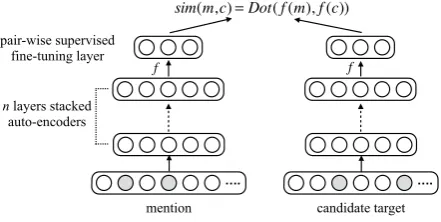
[image:5.595.310.531.401.512.2]Our approach consists of the following steps: (1) generating high quality embedding for each training instance; (2) pre-training with the stacked denoising auto-encoder (Bengio et al., 2003) for feature dimension reduction; and (3) supervised fine-tuning to optimize the neural networks to-wards a similarity measure (e.g., dot product). Figure 2 depicts the overall architecture of this ap-proach.
n layers stacked auto-encoders pair-wise supervised
fine-tuning layer
…. ….
sim(m,c)=Dot(f(m),f(c))
f f
mention candidate target
Figure 2: Overall Architecture of Pairwise Cross-genre Supervised Learning
However, morph resolution is significantly dif-ferent from the traditional entity linking task since the latter mainly focuses on formal and explicit entities (e.g., “薄熙来 (Bo Xilai)”) which tend
to have stable referents in Wikipedia. In con-trast, morphs tend to be informal, implicit and have newly emergent meanings which evolve over time. In fact, these morph mentions rarely appear in Wikipedia. For example, almost all “平西王 (Conquer West King)” mentions in Wikipedia re-fer to the ancient king instead of the modern politi-cian “薄熙来(Bo Xilai)”. In addition, the
usu-ally uses a formal expression “去世(pass away)” while an informal expression “挂了(hang up)” is used more often in tweets. Therefore this approach suffers from the knowledge discrepancy between these two genres.
Within-genre Unsupervised Learning
context( [already])
Input Layer
context( [fell from power])
context( [sing])
context( [red song])
Projection Layer
Xw
summation
Output Layer
[image:6.595.307.526.62.116.2]σ(Xw Tθ)
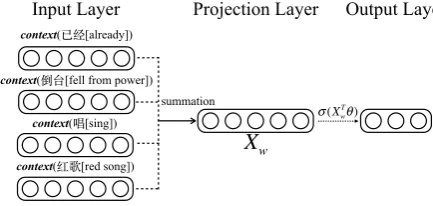
Figure 3: Continuous Bag-of-Words Architecture
To address the above challenge, we propose the second approach to learn semantic embed-dings of both morph mentions and entities di-rectly from tweets. Also we prefer unsuper-vised learning methods due to the lack of train-ing data. Followtrain-ing (Mikolov et al., 2013a), we develop a continuous bag-of-words (CBOW) model that can effectively model the surround-ing contextual information. CBOW is discrimina-tively trained by maximizing the conditional prob-ability of a term wi given its contexts c(wi) =
{wi−n, ..., wi−1, wi+1, ..., wi+n}, where n is the contextual window size, andwi is a term obtained using the preprocessing step introduced in Sec-tion 24. The architecture of CBOW is depicted in
Figure 3. We obtain a vectorXwi through the pro-jection layer by summing up the embedding vec-tors of all terms inc(wi), and then use the sigmoid activation function to obtain the final embedding ofwi inc(wi)in the output layer.
Formally, the objective function of CBOW can be formulated as L(θ) =
P
wi∈WPwj∈Wlogp(wj|c(wi)), where W is the set of unique terms obtained from the whole training corpus. p(wj|c(wi)) is the conditional likelihood ofwj given the contextc(wi) and it is formulated as follows:
p(wj|c(wi)) = [σ(XwiT θwj)]Lwi(wj)×
[1−σ(XT
wiθwj)]1−Lwi(wj),
4Eachwiis not limited to noun phrases we consider as
candidate morphs.
Data Training Development Testing
# Tweets 1,500 500 2,688
# Unique Terms 10,098 4, 848 15,108
# Morphs 250 110 341
# Morph Mentions 1,342 487 2,469 Table 1: Data Statistics
where Lwi(w j) =
1, wi =wj
0, Otherwise , σ is the
sigmoid activation function, andθwiis the embed-dings of wi to be learned with back-propagation during training.
5 Experiments
5.1 Data
We retrieved 1,553,347 tweets from Chinese Sina Weibo from May 1 to June 30, 2013 and 66, 559 web documents from the embedded URLs in tweets for experiments. We then randomly sampled 4,688 non-redundant tweets and asked two Chinese native speakers to manually tate morph mentions in these tweets. The anno-tated dataset is randomly split into training, de-velopment, and testing sets, with detailed statistics shown in Table 15. We used225positive instances
and225negative instances to train the model in the first step of potential morph discovery.
We collected a Chinese Wikipedia dump of Oc-tober 9th, 2014, which contains 2,539,355 pages. We pulled out person, organization and geo-political pages based on entity type matching with DBpedia6. We also filter out the pages with fewer
than 300 words. For training the model, we use 60,000 mention-target pairs along with one neg-ative sample randomly generated for each pair, among which, 20% pairs are reserved for parame-ter tuning.
5.2 Overall: End-to-End Decoding
In this subsection, we first study the end-to-end decoding performance of our best system, and compare it with the state-of-the-art supervised learning-to-rank approach proposed by (Huang et al., 2013) based on information networks con-struction and traverse with meta-paths. We use the 225 extracted morphs as input to feed (Huang et al., 2013) system. The experiment setting, im-plementation and evaluation process are similar to (Huang et al., 2013).
5We will make all of these annotations and other resources
available for research purposes if this paper gets accepted.
[image:6.595.74.291.174.277.2]The overall performance of our approach us-ing within-genre learnus-ing for resolution is shown in Table 2. We can see that our system achieves significantly better performance (95.0%
confidence level by the Wilcoxon Matched-Pairs Signed-Ranks Test) than the approach proposed by (Huang et al., 2013). We found that (Huang et al., 2013) failed to resolve many unpopular morphs (e.g., “小马 (Little Ma)” is a morph
re-ferring to Ma Yingjiu, and it only appeared once in the data), because it heavily relies on aggre-gating contextual and temporal information from multiple instances of each morph. In contrast, our unsupervised resolution approach only leverages the pre-trained word embeddings to capture the se-mantics of morph mentions and entities.
Model Precision Recall F1
Huang et al., 2013 40.2 33.3 36.4 Our Approach 41.1 35.9 38.3
Table 2: End-to-End Morph Decoding (%)
5.3 Diagnosis: Morph Mention Extraction The first step discovered 888 potential morphs (80.1% of all morphs, 5.9% of all terms), which indicates that this step successfully narrowed down the scope of candidate morphs.
Method Precision Recall F1
Naive 58.0 83.1 68.3
SVMs 61.3 80.7 69.7
[image:7.595.92.268.445.491.2]Our Approach 88.2 77.2 82.3
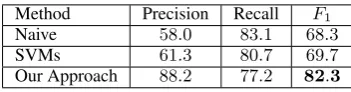
Table 3: Morph Mention Verification (%)
Now we evaluate the performance of morph mention verification. We compare our approach with two baseline methods: (i)Naive, which con-siders all mentions as morph mentions; (ii)SVMs, a fully supervised model using Support Vector Machines (Cortes and Vapnik, 1995) based on un-igrams and bun-igrams features. Table 3 shows the results. We can see that our approach achieves sig-nificantly better performance than the baseline ap-proaches. In particular it can verify the mentions of newly emergent morphs. For instance, “棒棒 棒(Good Good Good)” is mistakenly identified by the first step as a potential morph, but the second step correctly filters it out.
5.4 Diagnosis: Morph Mention Resolution The target candidate identification step success-fully filters86%irrelevant entities with high
preci-sion (98.5% of morphs retain their target entitis). For candidate ranking, we compare with several baseline approaches as follows:
• BOW: We compute cosine similarity over bag-of-words vectors with tf-idf values to measure the context similarity between a mention and its candidates.
• Pair-wise Cross-genre Supervised Learning: We first construct a vocabulary by choosing the top 100,000 frequent terms. Then we randomly sample 48,000 instances for training and 12,000 instances for development. At the pre-training step, we set the number of hidden layers as 3, the size of each hidden layer as 1000, the mask-ing noise probability for the first layer as 0.7, and a Gaussian noise with standard deviation of 0.1 for higher layers. The learning rate is set to be 0.01. At the fine-tuning stage, we add a 200 units layer on top of auto-encoders and optimize the neural network models based on the training data.
• Within-genre Unsupervised Learning: We di-rectly train morph mention and entity embed-dings from the large-scale tweets and web doc-uments that we collect. We set the window size as 10 and the vector dimension as 800 based on the development set.
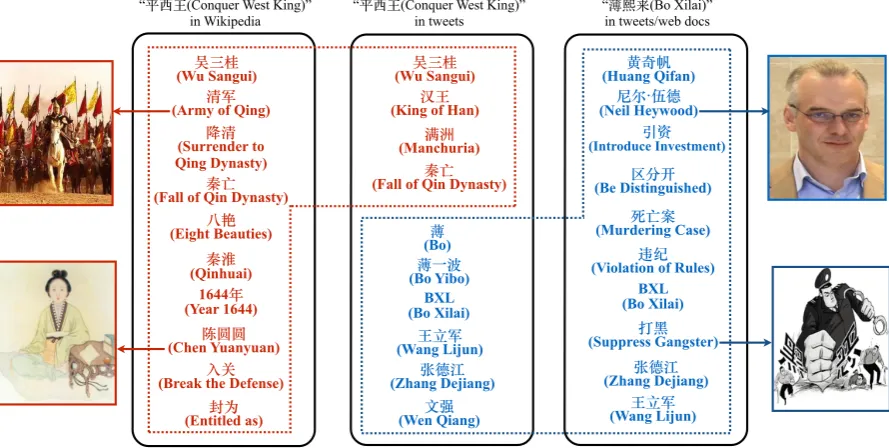
The overall performance of various resolu-tion approaches using perfect morph menresolu-tions is shown in Figure 4. We can clearly see that our second within-genre learning approach achieves the best performance. Figure 5 demonstrates the differences between our two deep learning based methods. When learning semantic embeddings di-rectly from Wikipedia, we can see that the top 10 closest entities of the mention “平西王(Conquer West King)” are all related to the ancient king “吴 三桂(Wu Sangui)”. Therefore this method is only able to capture the original meanings of morphs. In contrast, when we learn embeddings directly from tweets, most of the closest entities are rel-evant to its target entity “薄熙来(Bo Xilai)”.
6 Related Work
The first morph decoding work (Huang et al., 2013) assumed morph mentions are already dis-covered and didn’t take contexts into account. To the best of our knowledge, this is the first work on context-aware end-to-end morph decoding.
(Eight Beauties) (Surrender to Qing Dynasty)
(Qinhuai) (Army of Qing)
1644 (Year 1644)
(Break the Defense) (Fall of Qin Dynasty)
(Chen Yuanyuan) (Wu Sangui)
(Entitled as)
(Bo Yibo) (Manchuria)
BXL (Bo Xilai)
(Wang Lijun)
(Wen Qiang) (Fall of Qin Dynasty)
(Zhang Dejiang) (King of Han)
(Bo) (Wu Sangui)
(Violation of Rules) (Be Distinguished)
BXL (Bo Xilai)
(Suppress Gangster)
(Wang Lijun) (Murdering Case)
(Zhang Dejiang) · (Neil Heywood)
(Huang Qifan)
(Introduce Investment) “ (Conquer West King)”
[image:8.595.77.522.66.290.2]in Wikipedia “ (Conquer West King)” in tweets “in tweets/web docs (Bo Xilai)”
Figure 5: Top 10 closest entities to morph and target in different genres
Figure 4: Resolution Acc@K for Perfect Morph Mentions
NLP tasks: entity mention extraction (e.g., (Zi-touni and Florian, 2008; Ohta et al., 2012; Li and Ji, 2014)), metaphor detection (e.g., (Wang et al., 2006; Tsvetkov, 2013; Heintz et al., 2013)), word sense disambiguation (WSD) (e.g., (Yarowsky, 1995; Mihalcea, 2007; Navigli, 2009)), and entity linking (EL) (e.g., (Mihalcea and Csomai, 2007; Ji et al., 2010; Ji et al., 2011; Ji et al., 2014). However, none of these previous techniques can be applied directly to tackle this problem. As mentioned in section 3.1, entity morphs are fun-damentally different from regular entity mentions. Our task is also different from metaphor detec-tion because morphs cover a much wider range of semantic categories and can include either ab-stractive or concrete information. Some common features for detecting metaphors (e.g. (Tsvetkov,
2013)) are not effective for morph extraction: (1). Semantic categories. Metaphors usually fall into certain semantic categories such as noun.animal and noun.cognition. (2). Degree of abstractness. If the subject or an object of a concrete verb is abstract then the verb is likely to be a metaphor. In contrast, morphs can be very abstract (e.g., “函 数 (Function)” refers to “杨幂 (Yang Mi)” be-cause her first name “幂 (Mi)” means the Power Function) or very concrete (e.g., “薄督(Governor Bo)” refers to “薄熙来 (Bo Xilai)”). In contrast
to traditional WSD where the senses of a word are usually quite stable, the “sense” (target entity) of a morph may be newly emergent or evolve over time rapidly. The same morph can also have mul-tiple senses. The EL task focuses more on explicit and formal entities (e.g., named entities), while morphs tend to be informal and convey implicit information.
Morph mention detection is also related to mal-ware detection (e.g., (Firdausi et al., 2010; Chan-dola et al., 2009; Firdausi et al., 2010; Christodor-escu and Jha, 2003)) which discovers abnormal behavior in code and malicious software. In con-trast our task tackles anomaly texts in semantic context.
[image:8.595.87.273.315.477.2]cru-cial to keep the genres consistent between learning embeddings and applying embeddings.
7 Conclusions and Future Work
This paper describes the first work of context-aware end-to-end morph decoding. By conduct-ing deep analysis to identity the common charac-teristics of morphs and the unique challenges of this task, we leverage a large amount of unlabeled data and the coreferential and correlation relations to perform collective inference to extract morph mentions. Then we explore deep learning-based techniques to capture the semantics of morph men-tions and entities and resolve morph menmen-tions on the fly. Our future work includes exploiting the profiles of target entities as feedback to refine the results of morph mention extraction. We will also extend the framework for event morph decoding.
Acknowledgments
This work was supported by the US ARL NS-CTA No. W911NF-09-2-0053, DARPA DEFT No. FA8750-13-2-0041, NSF Awards 1523198, 1017362, 1320617, IIS-1354329 and HDTRA1-10-1-0120, gift awards from IBM, Google, Disney and Bosch. The views and conclusions contained in this document are those of the authors and should not be inter-preted as representing the official policies, either expressed or implied, of the U.S. Government. The U.S. Government is authorized to reproduce and distribute reprints for Government purposes notwithstanding any copyright notation here on.
References
Y. Bengio, R. Ducharme, P. Vincent, and C. Janvin. 2003. A neural probabilistic language model. Jour-nal of Machine Learning Research, 3:1137–1155, March.
A. Bordes, X. Glorot, J. Weston, and Y. Bengio. 2012. Joint learning of words and meaning representations for open-text semantic parsing. InProc. of the 15th International Conference on Artificial Intelligence and Statistics (AISTATS2012).
A. Bordes, S. Chopra, and J. Weston. 2014. Question answering with subgraph embeddings. InProc. of the 2014 Conference on Empirical Methods in Nat-ural Language Processing (EMNLP2014).
V. Chandola, A. Banerjee, and V. Kumar. 2009.
Anomaly detection: A survey. ACM Computing
Surveys (CSUR), 41(3):15.
P. Chang, M. Galley, and D. Manning. 2008. Optimiz-ing chinese word segmentation for machine transla-tion performance. InProc. of the Third Workshop on Statistical Machine Translation (StatMT 2008). J. Chen, D. Ji, C Tan, and Z. Niu. 2006.
Rela-tion extracRela-tion using label propagaRela-tion based semi-supervised learning. In Proc. of the 21st Interna-tional Conference on ComputaInterna-tional Linguistics and 44th Annual Meeting of the Association for Compu-tational Linguistics (ACL2006).
M. Christodorescu and S. Jha. 2003. Static analysis of executables to detect malicious patterns. InProc. of the 12th Conference on USENIX Security Sympo-sium (SSYM2003).
R. Collobert, J. Weston, L. Bottou, M. Karlen, K. Kavukcuoglu, and P. Kuksa. 2011. Natural language processing (almost) from scratch. Jour-nal of Machine Learning Research, 12:2493–2537, November.
C. Cortes and V. Vapnik. 1995. Support-vector net-works. Machine Learning, 20:273–297, September. I. Firdausi, C. Lim, A. Erwin, and A. Nugroho. 2010. Analysis of machine learning techniques used in behavior-based malware detection. In Proc. of the 2010 Second International Conference on Ad-vances in Computing, Control, and Telecommunica-tion Technologies (ACT2010).
Z. Harris. 1954. Distributional structure. Word, 10:146–162.
Z. He, S. Liu, M. Li, M. Zhou, L. Zhang, and H. Wang. 2013. Learning entity representation for entity dis-ambiguation. In Proc. of the 51st Annual Meet-ing of the Association for Computational LMeet-inguistics (ACL2013).
I. Heintz, R. Gabbard, M. Srivastava, D. Barner, D. Black, M. Friedman, and R. Weischedel. 2013. Automatic extraction of linguistic metaphors with lda topic modeling. InProc. of the ACl2013 Work-shop on Metaphor in NLP.
H. Huang, Z. Wen, D. Yu, H. Ji, Y. Sun, J. Han, and H. Li. 2013. Resolving entity morphs in censored data. InProc. of the 51st Annual Meeting of the As-sociation for Computational Linguistics (ACL2013). H. Huang, Y. Cao, X. Huang, H. Ji, and C. Lin. 2014. Collective tweet wikification based on semi-supervised graph regularization. In Proc. of the 52nd Annual Meeting of the Association for Com-putational Linguistics (ACL2014).
H. Ji, R. Grishman, H.T. Dang, K. Griffitt, and J. El-lis. 2010. Overview of the tac 2010 knowledge base population track. InProc. of the Text Analysis Con-ference (TAC2010).
H. Ji, R. Grishman, and H.T. Dang. 2011. Overview of the tac 2011 knowledge base population track. In
H. Ji, J. Nothman, and H. Ben. 2014. Overview of tac-kbp2014 entity discovery and linking tasks. InProc. of the Text Analysis Conference (TAC2014). J. Lafferty, A. McCallum, and F. Pereira. 2001.
Con-ditional random fields: Probabilistic models for seg-menting and labeling sequence data. InProc. of the Eighteenth International Conference on Machine Learning (ICML2001).
Q. Li and H. Ji. 2014. Incremental joint extraction of entity mentions and relations. In Proc. of the 52nd Annual Meeting of the Association for Com-putational Linguistics (ACL2014).
Q. Li, H. Li, H. Ji, W. Wang, J. Zheng, and F. Huang. 2012. Joint bilingual name tagging for parallel cor-pora. InProc. of the 21st ACM International Con-ference on Information and Knowledge Manage-ment (CIKM2012).
R. Mihalcea and A. Csomai. 2007. Wikify!: link-ing documents to encyclopedic knowledge. In
Proc. of the sixteenth ACM conference on Confer-ence on information and knowledge management (CIKM2007).
R. Mihalcea. 2007. Using wikipedia for
auto-matic word sense disambiguation. In Proc. of the Conference of the North American Chapter of the Association for Computational Linguistics (HLT-NAACL2007).
T. Mikolov, K. Chen, G. Corrado, and J. Dean. 2013a. Efficient estimation of word representations in vec-tor space. CoRR, abs/1301.3781.
T. Mikolov, I. Sutskever, K. Chen, S.G. Corrado, and J. Dean. 2013b. Distributed representations of words and phrases and their compositionality. In
Advances in Neural Information Processing Systems 26.
R. Navigli. 2009. Word sense disambiguation: A survey. ACM Computing Surveys, 41:10:1–10:69, February.
Z. Niu, D. Ji, and C. Tan. 2005. Word sense dis-ambiguation using label propagation based semi-supervised learning. In Proc. of the 43rd Annual Meeting of the Association for Computational Lin-guistics (ACL2005).
T. Ohta, S. Pyysalo, J. Tsujii, and S. Ananiadou. 2012. Open-domain anatomical entity mention detection. In Proc. of the ACL2012 Workshop on Detecting Structure in Scholarly Discourse.
A. Smola and R. Kondor. 2003. Kernels and regu-larization on graphs. InProc. of the Annual Confer-ence on Computational Learning Theory and Kernel Workshop (COLT2003).
K. Toutanova, D. Klein, C. D. Manning, and Y. Singer. 2003. Feature-rich part-of-speech tagging with a cyclic dependency network. In Proc. of the 2003
Conference of the North American Chapter of the Association for Computational Linguistics on Hu-man Language Technology (NAACL2003).
Y. Tsvetkov. 2013. Cross-lingual metaphor detection using common semantic features. In Proc. of the ACL2013 Workshop on Metaphor in NLP.
Z. Wang, H. Wang, H. Duan, S. Han, and S. Yu. 2006. Chinese noun phrase metaphor recogni-tion with maximum entropy approach. InProc. of the Seventh International Conference on Intelligent Text Processing and Computational Linguistics (CI-CLing2006).
M. Yang, N. Duan, M. Zhou, and H. Rim. 2014. Joint relational embeddings for knowledge-based ques-tion answering. InProc. of the 2014 Conference on Empirical Methods in Natural Language Processing (EMNLP2014).
D. Yarowsky. 1995. Unsupervised word sense disam-biguation rivaling supervised methods. In Proc. of the 33rd Annual Meeting on Association for Com-putational Linguistics (ACL1995).
W. Yih, X. He, and C. Meek. 2014. Semantic pars-ing for spars-ingle-relation question answerpars-ing. InProc. of the 52nd Annual Meeting of the Association for Computational Linguistics (ACL2014).
H. Zhang, H. Yu, D. Xiong, and Q. Liu. 2003. Hhmm-based chinese lexical analyzer ictclas. In Proc. of the second SIGHAN workshop on Chinese language processing (SIGHAN2003).
B. Zhang, H. Huang, X. Pan, H. Ji, K. Knight, Z. Wen, Y. Sun, J. Han, and B. Yener. 2014. Be appropriate and funny: Automatic entity morph encoding. In
Proc. of the 52nd Annual Meeting of the Association for Computational Linguistics (ACL2014).
D. Zhou, O. Bousquet, T. Lal, J. Weston, and B. Sch¨olkopf. 2004. Learning with local and global consistency. In Advances in Neural Information Processing Systems 16, pages 321–328.
X. Zhu, Z. Ghahramani, and J. Lafferty. 2003. Semi-supervised learning using gaussian fields and har-monic functions. InProc. of the International Con-ference on Machine Learning (ICML2003).