Munich Personal RePEc Archive
Solving the Grid-Connected Microgrid
Operation by Teaching Learning Based
Optimization Algorithm
Jamaledini, Ashkan and Khazaei, Ehsan and Bitaraf,
Mohammad
Sazeh Sazan Power Company
2 June 2019
Online at
https://mpra.ub.uni-muenchen.de/94276/
Solving the Grid-Connected Microgrid
Operation by Teaching Learning Based
Optimization Algorithm
Ashkan Jamaledini, Ehsan Khazaei, Mohammad Hassan Bitaraf
Electrical and Computer Engineering Department, Sazeh Sazan Power Company, Iran
Abstract: In this paper, the grid-connected operation of microgrid is investigated where
the microgrid can exchange power with the main grid. The proposed problem is
modeled as the mixed-integer linear programming (MILP) and is solved by an
evolutionary algorithm known as the teaching learning-based optimization (TLBO).
Finally, the proposed model is tested on a modified IEEE 33 bus test system to show
the performance of the method.
Keywords: Microgrid, TLBO, Optimization, Grid-connected operation
I. INTRODUCTION
GGREATION of loads and distributed energy systems in a small network which is
close to the consumers, known as the microgrid [1-5]. Such a network has some
significant benefits from two main perspectives: i) technical, ii) economic. This is due to
closeness to the consumers, less transmission line, higher reliability, higher resiliency, and
higher power quality [6-7].
Although there exist lots of benefits, the challenges in protection and operation are not
addressed completely yet. This paper addressed one of them, which is the optimal
operation of the grid-connected operation of the microgrid. Islanded and grid-connected
operation of microgrid are investigated in [6]. Same authors designed a DC/DC boost
converter for the grid-connected operation of the microgrid in [7]. In [8-11] microgrid in the
grid-connected mode is solved by several heuristic methods such as CDOA, GA, and
PSO. The control of grid-connected and islanded microgrid is widely investigated in
[12-15]. Adding the electric vehicles, as well as the security of the microgrid is investigated in
[16- 19]. Despite the above works, this research studied the effective operation of the
grid-connected microgrid, utilizing a new evolutionary technique known as the teaching
learning-based optimization algorithm [20].
II. MATHEMATICAL FORMULATIONS
This optimization problem contains an objective as (1).
A. Objective function
The objective is
𝑚𝑖𝑛 ∑ [𝐶∀𝑖 𝑖𝑃𝑖𝑡𝐼𝑖𝑡+ 𝑆𝑈𝑖𝑡 + 𝑆𝐷𝑖𝑡] (1)
In which I is a binary variable (0 or 1) that control the status of unit i at time t. Moreover,
SU and SD are the startup and shutdown costs. In the rest of the paper, 𝑈𝑇 and 𝐷𝑇 are
minimum up and down, 𝑇(𝑜𝑛) and 𝑇(𝑜𝑓𝑓) are the number of successive on and off hours,
and RU and RD are the ramp up and down of the generators.
B. Constraints
The constraints of the problem are defined as
1. The capacity of the generators
𝑃𝑖𝑡,𝑚𝑖𝑛 ≤ 𝑃𝑖𝑡 ≤ 𝑃𝑖𝑡,𝑚𝑎𝑥 (2)
𝑃𝑖𝑡 − 𝑃𝑖(𝑡−1) ≤ 𝑅𝑈𝑖 (3)
𝑃𝑖(𝑡−1)− 𝑃𝑖𝑡 ≤ 𝑅𝐷𝑖 (4)
3. Minimum up and down of the generators
𝑇(𝑜𝑛)𝑖𝑡 ≥ 𝑈𝑇𝑖(𝐼𝑖𝑡− 𝐼𝑖(𝑡−1) (5)
𝑇(𝑜𝑓𝑓)𝑖𝑡 ≥ 𝐷𝑇𝑖(𝐼𝑖(𝑡−1)− 𝐼𝑖𝑡 (6)
III. TEACHING LEARNING BASED OPTIMIZATION ALGORITHM
As mentioned, microgrid in the grid-connected mode is a MILP problem. This paper
suggested teaching learning-based optimization (TLBO) algorithm to solve the problem.
This method inspires the students who are in a class and try to learn the course by
difference methods. More explanation is in [20]. The flowchart of TLBO is shown in Fig.
1. Overall, heuristic methods are attracted to many considerations because of the fast
Fig. 1. Flowchart of the proposed method [20].
IV. RESULTS
To shows, the perfect performance of the mode, a modified IEEE 30 bus test network
is tested which includes three generation units. Fig. 2 shows the single line diagram of the
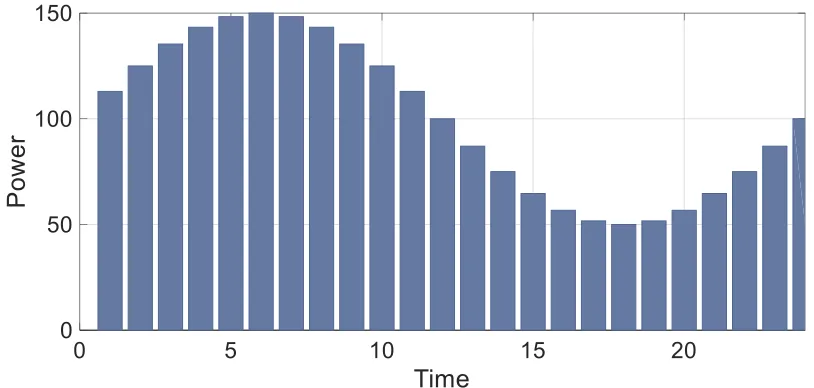
proposed network. Also, the features of the dispatchable units are shown in Table I. The
Fig. 2. Single line model
Table I
Dispatchable unit’s features
Minimum output power Maximum output power
Unit 1 at bus 25 20 100
Unit 2 at bus 33 40 50
Unit 3 at bus 18 1 25
Fig. 3. Load demand for the next 24 hours
DG1
DG2
DG3
Main
The output power of dispatchable units is shown in Fig. 4. According to the figure, the
cheapest unit (unit 1) is more participated than other units; that the decision only is based
on the economic.
Fig. 4. Generation units output power
The comparison of the cost between the proposed method and other well-known methods
such as the particle swarm optimization (PSO) and genetic algorithm (GA) methods is
investigated in Table II.
Table II
Cost of operation for several methods
Operation cost ($) Computational Time (second)
PSO 4942.1 17.1
GA 4839.5 14.9
V. CONCLUSION
In this paper, the TLBO is developed for optimal operation of grid-connected microgrid.
The microgrid could exchange power in the grid-connected mode. The results show that
the proposed method has a very fast response and also lower operation cost, comparing
to the well-known methods such as PSO and GA.
Reference
[1] Dabbaghjamanesh, M., A. Moeini, M. Ashkaboosi, P. Khazaei, and K. Mirzapalangi.
"High Performance Control of Grid Connected Cascaded H-Bridge Active Rectifier Based on Type II-Fuzzy Logic Controller with Low Frequency Modulation
Technique." International Journal of Electrical & Computer Engineering
(2088-8708) 6, no. 2 (2016).
[2] Ashkaboosi, Maryam, Seyed Mehdi Nourani, Peyman Khazaei, Morteza Dabbaghjamanesh, and Amirhossein Moeini. "An optimization technique based on
profit of investment and market clearing in wind power systems." American Journal of
Electrical and Electronic Engineering 4, no. 3 (2016): 85-91.
[3] A. Azarang, H. E. Manoochehri, and N. Kehtarnavaz, "Convolutional autoencoder-based multispectral image fusion," in IEEE Access, vol. 7, pp.35673-35683, Apr. 2019.
[4] A. Azarang, S. Kamaei, M. Miri, and M.H. Asemani, "A new fractional-order chaotic system and its synchronization via Lyapunov and improved Laplacian-based method," in Optik, vol. 127, no. 24, pp.11717-11731, Dec. 2016.
[5] Pourbehzadi, Motahareh, Taher Niknam, Jamshid Aghaei, Geev Mokryani, Miadreza Shafie-khah, and João PS Catalão. "Optimal operation of hybrid AC/DC microgrids
under uncertainty of renewable energy resources: A comprehensive
review." International Journal of Electrical Power & Energy Systems 109 (2019): 139-159.
[6] Rakhshan, Mohsen, Navid Vafamand, Mokhtar Shasadeghi, Morteza
[7] Khazaei, P., S. M. Modares, M. Dabbaghjamanesh, M. Almousa, and A. Moeini. "A high efficiency DC/DC boost converter for photovoltaic applications." International Journal of Soft Computing and Engineering (IJSCE) 6, no. 2 (2016): 2231-2307.
[8] Khazaei, Peyman, Morteza Dabbaghjamanesh, Ali Kalantarzadeh, and Hasan Mousavi. "Applying the modified TLBO algorithm to solve the unit commitment problem." In 2016 World Automation Congress (WAC), pp. 1-6. IEEE, 2016.
[9] Dabbaghjamanesh, Morteza, Abdollah Kavousi-Fard, and Shahab Mehraeen. "Effective scheduling of reconfigurable microgrids with dynamic thermal line rating." IEEE Transactions on Industrial Electronics 66, no. 2 (2019): 1552-1564.
[10] Dabbaghjamanesh, Morteza, Shahab Mehraeen, Abdollah Kavousifard, and Mosayeb Afshari Igder. "Effective scheduling operation of coordinated and uncoordinated wind-hydro and pumped-storage in generation units with modified JAYA algorithm." In 2017 IEEE Industry Applications Society Annual Meeting, pp. 1-8. IEEE, 2017.
[11] Dabbaghjamanesh, Morteza, Shahab Mehraeen, Abdollah Kavousi-Fard, and Farzad Ferdowsi. "A New Efficient Stochastic Energy Management Technique for Interconnected AC Microgrids." In 2018 IEEE Power & Energy Society General Meeting (PESGM), pp. 1-5. IEEE, 2018.
[12] Jiang, Quanyuan, Meidong Xue, and Guangchao Geng. "Energy management of
microgrid in grid-connected and stand-alone modes." IEEE transactions on power systems 28, no. 3 (2013): 3380-3389.
[13] Najy, Waleed KA, Hatem H. Zeineldin, and Wei Lee Woon. "Optimal protection coordination for microgrids with grid-connected and islanded capability." IEEE Transactions on industrial electronics 60, no. 4 (2012): 1668-1677.
[14] Al-Saedi, Waleed, Stefan W. Lachowicz, Daryoush Habibi, and Octavian Bass. "Power flow control in grid-connected microgrid operation using Particle Swarm Optimization under variable load conditions." International Journal of Electrical Power & Energy Systems 49 (2013): 76-85.
[15] Savaghebi, Mehdi, Juan C. Vasquez, Alireza Jalilian, Josep M. Guerrero, and Tzung-Lin Lee. "Selective compensation of voltage harmonics in grid-connected microgrids." Mathematics and Computers in Simulation 91 (2013): 211-228.
[16] Taherzadeh, Erfan, Morteza Dabbaghjamanesh, Mohsen Gitizadeh, and Akbar Rahideh. "A new efficient fuel optimization in blended charge depletion/charge sustenance control strategy for plug-in hybrid electric vehicles." IEEE Transactions on Intelligent Vehicles 3, no. 3 (2018): 374-383.
Cloud-Fog Based Framework for Economic Operation of Microgrids." In 2019 IEEE Texas Power and Energy Conference (TPEC), pp. 1-6. IEEE, 2019.
[18] Dabbaghjamanesh, Morteza. "Stochastic Energy Management of Reconfigurable Power Grids in the Presence of Renewable Energy by Considering Practical Limitations." (2019).
[19] Taherzadeh, Erfan, Shahram Javadi, and Morteza Dabbaghjamanesh. "New Optimal
Power Management Strategy for Series Plug-In Hybrid Electric
Vehicles." International Journal of Automotive Technology 19, no. 6 (2018): 1061-1069.
[20] Rao, Ravipudi V., Vimal J. Savsani, and D. P. Vakharia. "Teaching–learning-based
optimization: a novel method for constrained mechanical design optimization problems." Computer-Aided Design 43, no. 3 (2011): 303-315.
[21] Razavi Arab, Azadeh, S. Abbas Haghshenas, and Farzin Samsami. "Sediment transport and morphodynamic changes in Ziarat Estuary and Mond River Delta, the Persian Gulf." In EGU General Assembly Conference Abstracts, vol. 16. 2014.
[22] HAGHSHENAS, SEYED ABBAS, and ARAB AZADEH RAZAVI. "APPLICATION OF SEDIMENT CONSTITUENT ANALYSIS FOR CHARACTERIZING LONGSHORE SEDIMENT TRANSPORT, CASE STUDY OF RAMIN PORT-IRANIAN COASTLINE OF THE OMAN SEA." (2014).
[23] Arab, Azadeh Razavi, Afshin Danehkar, S. Abbas Haghshenas, and Gita B. Ebrahimi. "ASSESSMENT OF COASTAL DEVELOPMENT IMPACTS ON CORAL ECOSYSTEMS IN NAIBAND BAY, THE PERSIAN GULF." Coastal Engineering Proceedings 1, no. 33 (2012): 31.
[24] Haghshenas, S. Abbas, Azadeh Razavi Arab, Arash Bakhtiari, Morteza Jedari Attari, and Michael John Risk. "Decadal Evolution of Mond River Delta, the Persian Gulf." Journal of Coastal Research 75, no. sp1 (2016): 805-810.
[25] Zhang, Yan, Fanlin Meng, Rui Wang, Behzad Kazemtabrizi, and Jianmai Shi. "Uncertainty-resistant Stochastic MPC Approach for Optimal Operation of CHP Microgrid." Energy(2019).
[26] Chen, Yahong, Changhong Deng, Weiwei Yao, Ning Liang, Pei Xia, Peng Cao, Yiwang Dong et al. "Impacts of stochastic forecast errors of renewable energy generation and load demands on microgrid operation." Renewable Energy 133 (2019): 442-461.
[28] Azadeh, Razavi Arab, S. Abbas Haghshenas, Farzin Samsami, and Michael John Risk. "Traces of sediment origin in rheological behaviour of mud samples taken from the North-Western Persian Gulf." In BOOK OF ABSTRACTS. 2015.
[29] Razavi Arab, Azadeh, S. Abbas Haghshenas, and Homayoun Zaker. "Deep water current velocity data in the Persian Gulf." In EGU General Assembly Conference Abstracts, vol. 17. 2015.
[30] Ghaffari, Saeed, and Maryam Ashkaboosi. "Applying Hidden Markov Model Baby Cry Signal Recognition Based on Cybernetic Theory." IJEIR 5: 243-247.
[31] Ashkaboosi, Maryam, Farnoosh Ashkaboosi, and Seyed Mehdi Nourani. "The Interaction of Cybernetics and Contemporary Economic Graphic Art as" Interactive Graphics"." (2016).
![Fig. 1. Flowchart of the proposed method [20].](https://thumb-us.123doks.com/thumbv2/123dok_us/69648.507552/5.612.174.454.69.440/fig-flowchart-proposed-method.webp)