Proceedings of the 56th Annual Meeting of the Association for Computational Linguistics (Short Papers), pages 126–131 126
A dataset for identifying actionable feedback
in collaborative software development
Benjamin S. Meyers†, Nuthan Munaiah†, Emily Prud’hommeaux‡§, Andrew Meneely†, Cecilia Ovesdotter Alm‡, Josephine Wolff‡, and Pradeep K. Murukannaiah† †
Golisano College of Computing and Information Sciences, Rochester Institute of Technology ‡
College of Liberal Arts, Rochester Institute of Technology §
Morrissey College of Arts and Sciences, Boston College
bsm9339,nm6061,emilypx,axmvse,coagla,jcwgpt,pkmvse}@rit.edu
Abstract
Software developers and testers have long struggled with how to elicit proactive sponses from their coworkers when re-viewing code for security vulnerabilities and errors. For a code review to be suc-cessful, it must not only identify potential problems but also elicit an active response from the colleague responsible for modi-fying the code. To understand the factors that contribute to this outcome, we analyze a novel dataset of more than one million code reviews for the Google Chromium project, from which we extract linguis-tic features of feedback that elicited re-sponsive actions from coworkers. Using a manually-labeled subset of reviewer com-ments, we trained a highly accurate clas-sifier to identify “acted-upon” comments (AUC = 0.85). Our results demonstrate the utility of our dataset, the feasibility of using NLP for this new task, and the po-tential of NLP to improve our understand-ing of how communications between col-leagues can be authored to elicit positive, proactive responses.
1 Introduction
As in many other work environments, such as hos-pitals and law firms, employees in software devel-opment must communicate through written feed-back and comments to develop functional and se-cure code. Developers elicit feedback from their collaborators on the code that they write through the code review process, which is an integral part of the mature software development lifecy-cle. Most large software development organi-zations, including Microsoft (Lipner, 2004) and Google (Chromium, 2017), mandate the review of
all changes to the code base. Code reviews iden-tify potential bugs or errors in software, but not all of the comments made by reviewers are acted upon by developers.
Some code reviews are taken seriously by de-velopers and prompt significant fixes, while many others are overlooked or dismissed. In some cases, such as when code reviewers misunderstand the purpose of a proposed change or identify an unim-portant issue, it may be appropriate to ignore their comments. At other times, however, the presenta-tion and language of the reviewer’s feedback may cause the problems it identifies to be overlooked. Understanding which linguistic characteristics of code reviews influence whether reviews are taken seriously can aid developers in providing effective feedback that is acted upon by their peers. In turn, this can contribute to our general understanding of how to provide meaningful written feedback in a collaborative workplace setting.
With this in mind, we present a dataset of over one million code review comments from the Chromium project (Chromium, 2017), designed with the goal of discovering the linguistic fea-tures associated with actionable developer feed-back. We describe the dataset, along with an ar-ray of linguistic features capturing characteristics of complexity, content, and style, extracted from that dataset. Using a labeled subset of this large dataset, we develop a highly accurate classifier for identifying examples of actionable feedback that performs better than the keyword and sentiment features previously explored for similar tasks.
test-ing1; and (4) a demonstration of the feasibility of using NLP for this task in the form of a high-accuracy classifier of actionable feedback.
2 Background
A typical code review is initiated by a developer (change-author) who wishes to have a collection (patchset) of local changes (patches) to the source code merged into the software product. The patch-set is reviewed by other developers (reviewers) who provide feedback to ensure that the change does not negatively impact the overall quality of the product. In response to this feedback, the change-author can submit one or more additional patchsets for further review. The process repeats until the owner of the source code approves the change. The Chromium project, which underlies Google’s Chrome browser and Chrome OS, fol-lows this typical code review process, requiring all changes to the source code to be reviewed before being accepted into the repository. Rietveld (The Chromium Project, 2017), an open-source tool, fa-cilitates the code review process in Chromium.
The process of providing direct assessment of an individual’s actions or performance, known as feedback intervention, has been widely studied in a number of domains (Judd, 1905; Kluger and DeNisi, 1996, 1998; Xiong et al., 2010; Xiong and Litman, 2010), but previous work applying NLP to the specific task of evaluating code review feed-back is somewhat limited. Rahman et al. (2017) examined a small set of text features (e.g., reading ease, stop word ratio) in a small set of code review comments but found associations between those features and comment usefulness to be mostly in-significant. Pletea et al. (2014) examined senti-ment as an indicator of comsenti-ment usefulness, while Bosu et al. (2015) considered both sentiment and the presence of pre-defined keywords in feedback. While these studies offer insights into the lan-guage used by developers, they are limited to sen-timent and basic lexical attributes. In contrast, we explore more subtle linguistic features that more accurately characterize actionable feedback.
3 Data
Our dataset consists of written natural language conversations among developers working to find
1
[image:2.595.307.527.63.278.2]https://meyersbs.github.io/chromium-conversations/
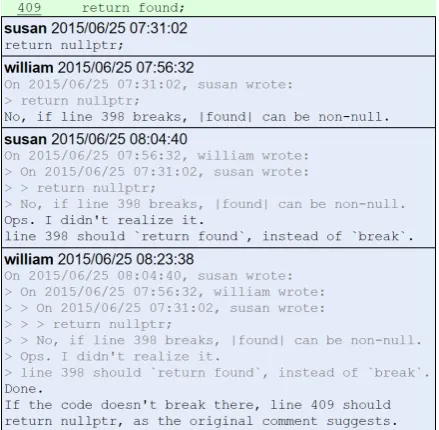
Figure 1: Example code review comment thread.
flaws in proposed changes to software. An ex-ample is shown in Figure 1. We used Rietveld’s RESTful API to retrieve, in JSON formatted doc-uments, publicly-accessible code reviews in the Chromium project spanning eight years (2008-16). We processed the JSON documents and ex-tracted reviews with their associated patchsets, patches, and comments, saving them to a Post-greSQL database. Of the 2,855,018 comments, 1,591,431 were posted by reviewers. We refer to this set of comments, for which we provide val-ues for the 9 linguistic features (described in Sec-tion 4), as thefull dataset.
devel-oper posted a comment with ‘Done.’, there was an associated code change implemented.
To identify comments that were not acted upon, we manually inspected code review comments that did not terminate in a ‘Done.’ comment. We ran-domly sampled a set of 2,047 such comments and inspected the line of code associated with a ment across all patchsets and the source code com-mit associated with the code review. Comments for which the authors could not find evidence that the developer acted upon the feedback were la-beled asnot (known-to-be) acted-upon. Within the sample, 800 (39.08%) were manually identified as
not (known-to-be) acted-upon.
4 Feature Extraction
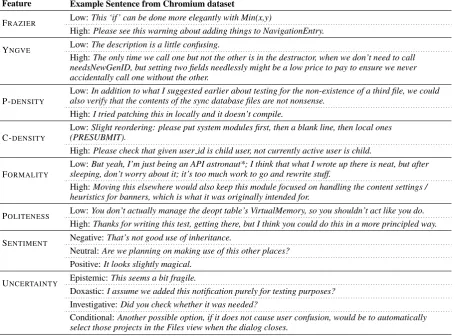
We extract nine linguistic features from the re-viewer comments (examples in Table 1) that cap-ture struccap-ture, information content, style, and tone. Before extracting features, we automatically re-place all sequences of source code tokens with a single custom token. Since comments can span multiple sentences, we aggregate sentence-level features at the comment level as described below for each feature.
Syntactic complexity: Previous work (Rah-man et al., 2017) attempted to measure struc-tural complexity using readability metrics, such as Flesch reading ease (Flesch, 1948), which approx-imate complexity using word and sentence length. We instead evaluate the structure of comments by calculating YNGVE (Yngve, 1960) and FRA
-ZIER (Frazier, 1987) scores, two complimentary approaches derived from constituent parses (as in Roark et al. (2011); Pakhomov et al. (2011)) that approximate the cognitive load of sentence pro-cessing (Baddeley, 2003; Sweller and Chandler, 1991). We take the maximum over all sentences in a comment for each of these scores.
Information content: We calculate both con-tent density (C-DENSITY), which measures the content of text using the ratio of open-class to closed-class words, and propositional density (P
-DENSITY), which is the ratio of propositions to the number of words in a text (Roark et al., 2011). We use an approach similar to that used by Brown et al. (2008) to detect propositions, and we aggre-gate both scores over the sentences in a comment. Style and tone: We explore several features characterizing style and tone to learn whether the way reviewers choose to communicate their
feed-back has an influence on how their colleagues re-spond to that feedback.
SENTIMENT: We extract the sentiment of a
code review comments using Stanford CoreNLP (Manning et al., 2014). In contrast to previous work (Bosu et al., 2015; Agarwal et al., 2011), we use only three values, merging the twopositive
classes and the twonegativeclasses, and introduce a fourth class,non-neutral, which ignores the sen-timent polarity. The sensen-timent at a comment level is the ratio of negative/neutral/positive/non-neutral tokens to all tokens.
FORMALITY: We use the dataset provided by Lahiri (2015) to train a logistic regression model for estimating the formality of a sentence, with precision and recall of 83%. We reduce the 7-point rating scale to a binary (formal vs. infor-mal) scale. The features used to train the model in-cluded parts-of-speech, character n-grams, chunk-ing tags, and other features used in predictchunk-ing un-certainty Vincze (2014). For this feature and PO -LITENESS, we find the maximum and minimum values over all sentences in a comment.
POLITENESS: To measure politeness, we use
a corpus of Wikipedia editor and Stack Ex-change user conversations annotated for politeness (Danescu-Niculescu-Mizil et al., 2013). We re-implemented their logistic regression model with newer programming languages and frameworks, yielding 94% precision and 95% recall.
UNCERTAINTY: Uncertainty in natural lan-guage has been studied by Vincze (2014) and Farkas et al. (2010), who worked with Szarvas et al. (2012) to compile the Szeged Uncertainty Corpus. While Vincze (2014) trained a binary (certain vs. uncertain) model on the corpus, we trained a multi-label logistic regression model us-ing the same features to predict the type of uncer-tainty exhibited by each word in a comment.
5 Results
Feature Example Sentence from Chromium dataset
FRAZIER Low:This ‘if ’ can be done more elegantly with Min(x,y)
High:Please see this warning about adding things to NavigationEntry.
YNGVE Low:The description is a little confusing.
High:The only time we call one but not the other is in the destructor, when we don’t need to call needsNewGenID, but setting two fields needlessly might be a low price to pay to ensure we never accidentally call one without the other.
P-DENSITY
Low:In addition to what I suggested earlier about testing for the non-existence of a third file, we could also verify that the contents of the sync database files are not nonsense.
High:I tried patching this in locally and it doesn’t compile.
C-DENSITY
Low:Slight reordering: please put system modules first, then a blank line, then local ones (PRESUBMIT).
High:Please check that given user id is child user, not currently active user is child.
FORMALITY
Low:But yeah, I’m just being an API astronaut*; I think that what I wrote up there is neat, but after sleeping, don’t worry about it; it’s too much work to go and rewrite stuff.
High:Moving this elsewhere would also keep this module focused on handling the content settings / heuristics for banners, which is what it was originally intended for.
POLITENESS Low:You don’t actually manage the deopt table’s VirtualMemory, so you shouldn’t act like you do.
High:Thanks for writing this test, getting there, but I think you could do this in a more principled way.
SENTIMENT Negative:That’s not good use of inheritance.
Neutral:Are we planning on making use of this other places?
Positive:It looks slightly magical.
UNCERTAINTY Epistemic:This seems a bit fragile.
Doxastic:I assume we added this notification purely for testing purposes?
Investigative:Did you check whether it was needed?
[image:4.595.76.532.66.402.2]Conditional:Another possible option, if it does not cause user confusion, would be to automatically select those projects in the Files view when the dialog closes.
Table 1: Example code review comments for a subset of the linguistic features.
Feature Set Precision Recall F1 AUC
# Tokens 0.793 0.996 0.883 0.610
# Sentences 0.792 0.999 0.884 0.584
All 0.829 0.926 0.872 0.849
Significant 0.805 0.953 0.871 0.805
Relevant 0.802 0.963 0.874 0.819
Table 2: Results of10×10−fold cross-validation.
less uncertain, and had a lower density of proposi-tions than those that werenot acted-upon.
We then trained a classifier to identify code re-view comments that are likely to be acted upon. In training the classifier, we considered three sets of linguistic features: (1) all features, (2) sig-nificant features from association analysis, and (3)relevant features from recursive feature elim-ination. Through recursive feature elimination, we found MAX POLITENESS, P-DENSITY, MIN
FORMALITY, and MAX FORMALITY to be the four most relevant features for discriminating be-tweenacted-uponandnot acted-uponcomments.
We trained logistic regression classifiers with these three sets of linguistic features, evaluating
performance using 10x10-fold cross validation. We compare these with two baseline classifiers us-ing only token count and sentence count. Table 2 shows the average precision, recall, F1-measure, and AUC. The classifiers trained on the linguistic features, while performing near the baselines on the first three measures, substantially outperform the baselines on AUC, with all three yielding val-ues over 0.8. Given these results and the imbal-anced nature of the dataset, it seems that the clas-sifiers trained on the linguistic features are able to identify both classes of comments with high ac-curacy, while the baseline classifiers perform only marginally better than a majority class baseline.
6 Discussion & Future work
[image:4.595.79.285.442.522.2]deliv-ered has more impact on the actions of developers than might be expected given the practical and im-personal nature of written code reviews. These re-sults point to the critical importance of how feed-back is phrased and delivered in workplace set-tings, beyond just the content of the feedback it-self.
In our future work, we plan to explore whether these and other features can be incorporated into a code review tool like Rietveld to automatically flag feedback that is less likely to be acted upon and to encourage more effective communication strategies. We also plan to use our methods to an-alyze the linguistic patterns of individual review-ers to identify those with particularly effective or weak communication styles.
Our work demonstrates the potential of apply-ing NLP to the task of identifyapply-ing actionable feed-back in collaborative work scenarios and the util-ity of our two datasets for this task. More broadly, these results speak to the importance of training code reviewers–and indeed all employees work-ing in highly collaborative environments–not just in how to do their jobs effectively but also how to communicate their findings and feedback to their coworkers in a way that will elicit proactive re-sponses.
References
A. Agarwal, B. Xie, I. Vovsha, O. Rambow, and R. Pas-sonneau. 2011. Sentiment analysis of twitter data.
InProceedings of the Workshop on Languages in
So-cial Media, pages 30–38.
A. Baddeley. 2003. Working memory and language:
An overview. Journal of Communication Disorders,
36(3):189–208.
A Bosu, M Greiler, and C Bird. 2015. Characteristics of Useful Code Reviews: An Empirical Study at
Mi-crosoft. In2015 IEEE/ACM 12th Working
Confer-ence on Mining Software Repositories, pages 146– 156.
C. Brown, T. Snodgrass, S.J. Kemper, R. Herman, and M.A. Covington. 2008. Automatic measurement of propositional idea density from part-of-speech
tag-ging. Behavior Research Methods, 40(2):540–545.
Chromium. 2017. Chromium OS Developer’s Guide.
https://www.chromium.org/chromium-os/developer-guide. [Online; accessed
25-Aug-2017].
C. Danescu-Niculescu-Mizil, M. Sudhof, D. Jurafsky, J. Leskovec, and C. Potts. 2013. A computational
approach to politeness with application to social
fac-tors. InProceedings of the Association for
Compu-tational Linguistics (ACL), pages 250–259.
R. Farkas, V. Vincze, G. M´ora, J. Csirik, and G. Szarvas. 2010. The CoNLL-2010 shared task: Learning to detect hedges and their scope in
nat-ural language text. In Proceedings of the
Four-teenth Conference on Computational Natural Lan-guage Learning—Shared Task, pages 1–12.
R. Flesch. 1948. A new readability yardstick. Journal of Applied Psychology, 32(3):221.
L. Frazier. 1987. Syntactic Processing: Evidence from
Dutch. Natural Language & Linguistic Theory,
5(4):519–559.
C.H. Judd. 1905. Practice without knowledge of
re-sults. The Psychological Review: Monograph
Sup-plements.
A.N. Kluger and A. DeNisi. 1996. The effects of feed-back interventions on performance: a historical re-view, a meta-analysis and a preliminary feedback in-tervention theory. Psychological Bulletin, 119:254– 284.
A.N. Kluger and A. DeNisi. 1998. Feedback interven-tions: Toward the understanding of a double-edged
sword. Current Directions in Psychological
Sci-ence, 7(3):67–72.
S. Lahiri. 2015. SQUINKY! A Corpus of Sentence-level Formality, Informativeness, and Implicature. CoRR, abs/1506.02306.
S. Lipner. 2004. The Trustworthy Computing Security
Development Lifecycle. In20th Annual Computer
Security Applications Conference, pages 2–13.
C.D. Manning, M. Surdeanu, J. Bauer, J. Finkel, S.J.
Bethard, and D. McClosky. 2014. The Stanford
CoreNLP Natural Language Processing Toolkit. In Association for Computational Linguistics (ACL) System Demonstrations, pages 55–60.
S. Pakhomov, S. Chacon, M. Wicklund, and J.
Gun-del. 2011. Computerized assessment of syntactic
complexity in Alzheimer’s disease: A case study of
Iris Murdoch’s writing. Behavior Research
Meth-ods, 43(1):136–144.
D. Pletea, B. Vasilescu, and A. Serebrenik. 2014. Se-curity and Emotion: Sentiment Analysis of SeSe-curity
Discussions on GitHub. InProceedings of the 11th
Working Conference on Mining Software Reposito-ries, pages 348–351.
B. Roark, M. Mitchell, J. Hosom, K. Hollingshead, and J. Kaye. 2011. Spoken Language Derived Measures
for Detecting Mild Cognitive Impairment.
Transac-tions on Audio, Speech, and Language Processing, 19(7):2081–2090.
J. Sweller and P. Chandler. 1991. Evidence for
cognitive load theory. Cognition and Instruction,
8(4):351–362.
G. Szarvas, V. Vincze, R. Farkas, G. M´ora, and I. Gurevych. 2012. Cross-genre and cross-domain
detection of semantic uncertainty. Computational
Linguistics, 38(2):335–367.
The Chromium Project. 2017. Code Review
— Chromium. https://codereview.
chromium.org/. [Online; accessed 25-Aug-2017].
V. Vincze. 2014. Uncertainty Detection in Natural
Language Texts. Ph.D. thesis, University of Szeged.
W. Xiong and D. Litman. 2010. Identifying problem localization in peer-review feedback. InIntelligent Tutoring Systems, pages 429–431. Springer.
W. Xiong, D.J. Litman, and C.D. Schunn. 2010. As-sessing reviewers performance based on mining
problem localization in peer-review data. In Third
International Conference on Educational Data Min-ing, pages 211–220.
V.H. Yngve. 1960. A model and an Hypothesis for
Language Structure. InProceedings of the