2332
Neural Sparse Topical Coding
Min Peng1,Qianqian Xie1,Yanchun Zhang2,Hua Wang2,Xiuzheng Zhang3,Jimin Huang1andGang Tian1
1School of Computer Science, WuHan University, WuHan, China 2Centre for Applied Informatics, Victoria University, Melbourne, Australia
3School of Science, RMIT University, Melbourne, Australia
{pengm, xieq, huangjimin, tiang2008}@whu.edu.cn
{yanchun.zhang, hua.wang}@vu.edu.au,[email protected]
Abstract
Topic models with sparsity enhancement have been proven to be effective at learn-ing discriminative and coherent latent top-ics of short texts, which is critical to many scientific and engineering applica-tions. However, the extensions of these models require carefully tailored graphi-cal models and re-deduced inference al-gorithms, limiting their variations and ap-plications. We propose a novel sparsity-enhanced topic model, Neural Sparse Top-ical Coding (NSTC) base on a sparsity-enhanced topic model called Sparse Top-ical Coding (STC). It focuses on replac-ing the complex inference process with the back propagation, which makes the model easy to explore extensions. Moreover, the external semantic information of words in word embeddings is incorporated to im-prove the representation of short texts. To illustrate the flexibility offered by the neu-ral network based framework, we present three extensions base on NSTC without re-deduced inference algorithms. Experi-ments on Web Snippet and 20Newsgroups datasets demonstrate that our models out-perform existing methods.
1 Introduction
Topic models with sparsity enhancement have proven to be effective tools for exploratory analy-sis of the overload of short text content. The latent representations learned by these models are cen-tral to many applications. However, these mod-els have trouble to rapidly explore variations for the approximate inference methods of them. Even subtle variations on models can increase the com-plexity of the inference methods, which is
espe-cially apparent for non-conjugate models.
With the development of deep learning, many works combine topic models with neural language model to overcome the computation complexity of topic models (Larochelle and Lauly, 2012a; Cao et al.,2015;Tian et al.,2016). Most of these meth-ods adopt multiple neural network layers to model the generation process of each document. Nev-ertheless, these methods yield the same poor per-formance in short texts as traditional topic mod-els. There are also many works introducing new techniques such as word embeddings to traditional topic models. Word embeddings has proven to be effective at capturing syntactic and semantic infor-mation of words. Many works (Das et al., 2015; Hu and Tsujii,2016;Li et al., 2016) have shown that the additional semantics in word embeddings can enhance the performance of traditional topic models. Yet these models have the same trouble in making extensions as traditional topic models.
ac-celerates the training process and increases the flexibility. To evaluate the effectiveness of our models by conducting experiments on 20 News-groups and Web Snippet datasets.
2 Related Work
Topic models with sparsity enhancement: The
performance of traditional topic models are com-promised by the sparse word co-occurrence in-formation when applied in short texts. To over-come the bottleneck, there have been many ef-forts to address the problem of sparsity in short texts. Based on traditional LDA, (Williamson et al.,2010) introduced aSpike and Slab prior to model the sparsity in finite and infinite latent topic structures of text. To consider the dual-sparsity of topics per document and terms per topic, (Lin et al., 2014) proposed a dual-sparse topic model that addresses the sparsity in both the topic mix-tures and the word usage. There are also some non-probabilistic sparse topic models, which can directly control the sparsity by imposing regular-izers. For example, the non-negative matrix fac-torization (NMF) (Heiler and Schn¨orr,2006) for-malized topic modeling as a problem of mini-mizing loss function regularized by lasso. Simi-larly, (Zhu and Xing,2011) presented sparse top-ical coding (STC) by utilizing the Laplacian prior to directly control the sparsity of inferred repre-sentations. Additionally, (Peng et al.,2016) pre-sented sparse topical coding with sparse groups (STCSG) to find sparse word and document rep-resentations of texts. However, over complicated inference procedure of these sparse topic models make them difficult to rapidly explore variations.
Topic models with word embeddings: There
are many works tried to incorporate word embed-dings with topic models to improve the perfor-mance. (Das et al., 2015) proposed a new tech-nique for topic modeling by treating the document as a collection of word embeddings and topics it-self as multivariate Gaussian distributions in the embedding space. However, the assumption that topics are unimodal in the embedding space is not appropriate, since topically related words can oc-cur distantly from each other in the embedding space. Therefore, (Hu and Tsujii,2016) proposed latent concept topic model (LCTM), which mod-eled a topic as a distribution of concepts, where each concept defined another distribution of word vectors. (Nguyen et al., 2015) proposed Latent
Feature Topic Modeling (LFTM), which extended LDA to incorporate word embeddings as latent features. (Li et al., 2016) focused on combing the local information of word embeddings and the global information of LDA, thus proposed a model TopicVec yielded by the variational infer-ence method. However, these models also have trouble to rapidly explore variations.
Neural Topic Models: There are also some
ef-forts trying to combine topic models with neural networks to represent words and documents si-multaneously. (Larochelle and Lauly,2012a) pro-posed a neural network topic model that is sim-ilarly inspired by the Replicated Softmax. (Cao et al.,2015) proposed a novel neural topic model (NTM) where the representation of words and documents are efficiently and naturally combined into a uniform framework. (Das et al.,2015) pro-posed a new technique for topic modeling by treat-ing the document as a collection of word embed-dings and topics itself as multivariate Gaussian distributions in the embedding space. To address the limitations of the bag-of-words assumption, (Tian et al., 2016) proposed Sentence Level Re-current Topic Model (SLRTM) by using a Recur-rent Neural Networks (RNN) based framework to model long range dependencies between words. Nevertheless, most of aforementioned works yield poor performance in short texts.
3 Neural Sparse Topical Coding
Firstly, we define that D = {1, ..., M} is a doc-ument set with size M, T = {1, ..., K} is a topic collection with K topics, V = {1, .., N} is a vocabulary with N words, and wd = {wd,1, ..., wd,|I|}is a vector of terms representing a document d, where I is the index of words in document d, and wd,n(n ∈ I) is the frequency of wordn in documentd. Moreover, we denote β ∈ RN×K as a global topic dictionary for the whole document set with K bases, θd ∈ RK is the document code of each document d and sd,n ∈ RK is the word code of each word n in each documentd. To yield interpretable patterns,
(θ, s, β)are constrained to be non-negative.
3.1 Sparse Topical Coding
code in topic space, which can be employed in many tasks. Based on the global topic dictionary β of all documents with K topic bases sampled from a uniform distribution, the generative process of each documentdis described as follows:
1. Sample the document code θd from a prior p(θd)∼Laplace(λ−1).
2. For each observed wordnin documentd:
(a) Sample the word code sd,n from a conditional distribution p(sd,n|θd) ∼ supergaussian(θd, γ−1, ρ−1).
(b) Sample the observed word count wd,n from a distributionp(wd,n|sd,n∗βn)∼ P oisson(sd,n∗βn)
To achieve sparse word codes, STC defines p(sd,n|θd) as a product of two component dis-tributions p(sd,n|θd) ∼ p(sd,n|θd, γ)p(sd,n|ρ), where p(sd,n|θd, γ) is an isotropic Gaussian dis-tribution, andp(sd,n|ρ) is a Laplace distribution. The composite distribution is super-Gaussian: p(sd,n|θd)∝exp(γ||sd,nθd||22ρ||sd,n||1). With the Laplace term, the composite distribution tends to yield sparse word codes. For the same purpose, the prior distribution p(θd) of document codes is a Laplace prior. Although STC has closed form coordinate descent equations for parameters
(θ, s, β), it is inflexible for its complex inference process.
3.2 Neural Network View of Sparse Topical
Coding
We devote to rebuild STC with a neural network to simplify it’s inference process via BackPropoga-tion. After generating the topic dictionary from neural network, our model follows the generative story below for each documentd:
1. For each wordnin documentd:
(a) Sample a latent variable word code sd,n∼fg(d, n).
(b) Sample the observed word count wd,n from p(wd,n|sd,n, βn) ∼ P oisson(sd,n∗βn)
In our model, we have several assumptions: 1) To simplify our model and acclerate the infer-ence process, we collapse the document code from our model. As illuatrated in (Bai et al.,2013) and STC paper (Zhu and Xing,2011), we can naturally
generate each document code via a aggregation of all sampled word codes among all topics, after in-ferring the global topic dictionary and the word codes of words belong to each document:
θd= D
d=1 Nd
n=1
sd,nkβkn/ D
d=1 Nd
n=1 K
k=1
sd,nkβkn;
2) We replace the composite super-Gaussian prior of the word codes and the uniform distri-bution of the topic dictionary with the neural net-work. In the topic dictionary neural network, we introduce the word semantic information via word embeddings to enrich the feature space for short texts;
3) Similar to STC, the observed word count is sampled from Poisson distribution, which is more appropriate for the discrete count data than other exponential family distributions.
3.3 Neural Sparse Topical Coding
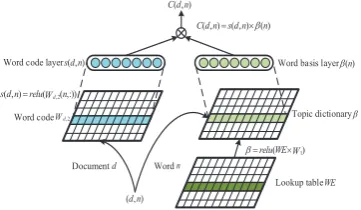
In this section, we introduce the detailed layer structures of NSTC in Figure1. We explicitly
ex-( , )
C d n
( , ) ( , ) ( )
C d n s d nuEn
Word basis layer ( )En
Word code layer ( , )s d n
Topic dictionaryE
Word codeWd,2
Lookup tableWE
1
( )
relu WE W
E u
,2
( , ) ( d( ,:))
s d n reluW n
( , )d n
[image:3.595.326.507.384.489.2]Documentd Wordn
Figure 1: Schematic overview ofNSTC.
plain each layer of NSTC below:
Input layer(n, d): A wordnof documentd∈ D, whereDis a document set.
Word embedding layer(W E∈RN×300): Sup-posing the word number of the vocabulary isN, this layer devotes to transform each word to a distributed embedding representation. Here, we adopt the pre-trained embeddings by GloVe based on a large Wikipedia dataset1.
Word code layers (sd ∈ RN×K): These lay-ers generate theK-dimensional word code of in-put wordnin documentd.
s(d, n) =fs(d, n) (1)
where fs is a multilayer perceptron. In order to achieve interpretable word codes as in STC,
1
we constrain s to be non-negative, therefore we apply the relu activation function on the output of the neural network. Although imposing non-negativity constraints could potentially result in sparser and more interpretable patterns, we exert l1 norm regularization on s to further keep the sparse assumption.
Topic dictionary layers (β ∈ RN×K): These layers aim at convertingW Eto a topic dictionary similar to the one in STC.
β(n) =fβ(W E) (2)
wherefβ is a multilayer perceptron. We make a simplex projection among the output of topic dic-tionary neural network.We normalize each column of the dictionary via the simplex projection as fol-low:
β.k =project(β.k),∀k (3)
The simplex projection is the same as the sparse-max activation function in (Martins and Astudillo, 2016), providing the theoretical base of its em-ployment in a neural network trained with back-propagation. After the simplex projection, each column of the topic dictionary is promised to be sparse, non-negative and united.
Score layer(Cd,n ∈ R1×1): NSTC outputs the matching score of a wordnand a documentdwith the dot product ofs(d, n)andβ(n)in this layer. The output score is utilized to approximate the ob-served word countwd,n.
C(d, n) =s(d, n)∗β(n) (4)
Given the count wd,n of word n in document d, we can directly use it to supervise the training pro-cess. According to the architecture of our model, for each word n and each document d, the cost function is:
L=l(wd,n, C(d, n)) +λ||sd,n||1 (5)
wherelis the log-Poisson loss,λis the regulariza-tion factors.
3.4 Extensions of NSTC
To future illustrate the benefits of a black box in-ference method, which allows rapidly explore new models, we present three variants of NSTC.
Deep l1 Approximation. STC is based on the
idea of sparse coding, in which the sparse code s of the input w can be obtained by solving the
loss function for a given dictionary β. In (Gre-gor and LeCun,2010), the parameterized encoder, named learned ISTA (LISTA) was proposed to ef-ficiently approximate the l1 based sparse code. Based on the consideration, we present a enhanced NSTC via employing the deepl1 regularized en-coder similar to LISTA, named NSTCE. We de-vise a feed-forward neural network as illustrated in Figure2, to efficiently approximate thel1based sparse codesof the inputw.
F(wd;Wd, bd) =relu(wd∗Wd+bd) (6)
The goal is to make the prediction of neural net-work predictor F after the fixed depth as close as possible to the optimal set of coefficientss∗ in Eq.4. To jointly optimizing all parameters with the dictionaryβ together, we add another term to the loss function in Eq.4, and enforce the representa-tionsto be as close as possible to the feed forward prediction (Kavukcuoglu et al.,2010):
L=l(wd,n, C(d, n)) +λ||sd,n||1
+α
n
||sd−F(wd;Wd, bd)||22 (7)
Minimizing the loss with respect tosproduces a sparse representation that simultaneously recon-structs the word count and is not too different from the predicted representation.
w W
b
s
relu
Figure 2: Deepl1encoder.
Group Sparse Regularization. Based on STC,
(Bai et al., 2013) presented GSTC to discover document-level sparse or admixture proportion for short texts, in which the group sparse is employed to achieve sparse code at document level by taking into account the structure of bag of words. Here, we just need to add the group sparse regularization on the weight matrix, to make a neural network extension of GSTC, called NGSTC. We consider each column ofsdas a group.
L=l(wd,n, C(d, n)) +λ K
k=1
||sd,.k||2 (8)
Sparse Group Lasso. Similar to GSTC,
sparse word and document codes, which relaxes the normalization constraint of the inferred rep-resentations with sparse group lasso. Base on STCSG, we propose a novel neural topic model called NSTCSG. We imposse the sparse group lasso on the word code, and have the following cost function:
L=l(wd,n, C(d, n))+λ1||sd,n||1+λ2 K
k=1
||sd,.k||2
(9) These three models have the same neural network structures as NSTC, and can be trained end to end with out re-deduced mathematical inference. Moreover, group and sparse group sparsity can help reduce the intrinsic complexity of the model by eliminating neurons as shown in Figure3, and thus can help obtain practical speed ups in deep neural networks.
3.5 Optimization
For the first two models with the lasso regular-izer, we can directly ulitize the end to end stochas-tic gradient descent (SGD) to perform optimiz-ing. The last two optimizing objectives of NGSTC and NSTCSG are formed as a combination of both smooth and non-smooth terms, they can be solved via proximal stochastic gradient descent. The proximal gradient algorithm first obtains the intermediate solution via SGD on the loss only, and then optimize for the regularization term via performing Euclidean projection of it to the solu-tion space, as in the following formulasolu-tion:
min
st+1 d,n
R(std,n+1) +1
2||s
t+1 d,n −s
t+12
d,n ||22 (10)
whereRis the regularization,st+12
d,n the intermedi-ate solution obtained by SGD,std,n+1 is the variable to obtain after the current iteration. For the group lasso, the above problem has the closed-form so-lution. The proximal operator for the group lasso regularizer in Eq.8is given as follow:
proxGL(sd,nk) = (1− λ
||sd,.k||2)+sd,nk (11) The proximal operator for the sparse group lasso regularizer in Eq.9is given as follow:
proxSGL(sd,nk) =(1−
λ2
||sign(sd,.k, λ1)||2)+ sign(sd,nk, λ1)
(12)
The detailed algorithm framework of NGSTC and NSTCSG is shown in Algorithm1.
Algorithm 1Training Algorithm for our models
Require: a documentd∈D
1: t=t+ 1
2: repeat
3: Compute the partial derivatives of weight matrices,s, and β with a non-regularized objective;
4: Update weight matrices, s, and β using
SGD.
5: Updatesusing proximal operator
6: Updateβusing simplex projection.
7: untilconvergence
4 Experiments
4.1 Data and Setting
We perform our experiments on two benchmark datasets:
• 20Newsgroups: is comprised of 18775
newsgroup articles with 20 categories, and contains 60698 unique words2.
• Web Snippet: includes 12340 Web search
snippets with 8 categories, we remove the words with fewer than 3 characters and with document frequency less than 3 in the dataset3.
We compare the performance of the NSTC with the following baselines:
• LDA (Blei et al., 2001). A classical proba-bilistic topic model. We use the LDA pack-age4 for its implementation. We use the
set-tings with iteration number n = 2000, the Dirichlet parameter for distribution over top-ics α = 0.1and the Dirichlet parameter for distribution over wordsη= 0.01.
• STC(Zhu and Xing,2011). It is a sparsity-enhanced non-probabilistic topic model. We use the code released by the authors5. We set
the regularization constants asλ = 0.3, ρ =
0.0001 and the maximum number of itera-tions of hierarchical sparse coding, dictionary learning as100.
2
http://www.qwone.com/ jason/20Newsgroups/ 3http://jwebpro.sourceforge.net/data-web-snippets.tar.gz
4https://pypi.python.org/pypi/lda
5
(a) (b) (c)
Figure 3: (a) Lasso: the Lasso penalty removes elements without optimizing neuron-level considerations (highlighted in red). (b) Group lasso: when grouping weights from the the same input neuron into each group, the group sparsity has an effect of completely removing some neurons (highlighted in red). (c) Sparse group lasso: it combines the advantages of the former two formulations, which can remove some neurons and elements (highlighted in red).
• DocNADE (Larochelle and Lauly, 2012b).
An unsupervised neural network topic model of documents and has shown that it is a com-petitive model both as a generative model and as a document representation learning algo-rithm6. In DocNADE, the hidden size is50, the learning rate is0.0004, the bath size is64 and the max training number is50000.
• GaussianLDA (Das et al., 2015). A new
technique for topic modeling by treating the document as a collection of word embed-dings and topics itself as multivariate Gaus-sian distributions in the embedding space7. We use default values for the parameters.
• TopicVec(Li et al.,2016). A model
incorpo-rates generative word embedding model with LDA8. We also use default values for the pa-rameters.
Our three models are implemented in Python using TensorFlow9. For both datasets, we use the pre-trained 300-dimensional word embeddings from Wikipedia by GloVe, and it is fixed during train-ing. For each out-of-vocab word, we sample a random vector from a normal distribution. In practice, we use a regular learning rate 0.00001 for both dataset. We set the regularization factor λ = 1, α = 1, λ1 = 0.6, λ2 = 0.4. In ization, all weight matrices are randomly initial-ized with the uniformed distribution in the inter-val[0,0.001]for web snippet, and[0,0.0001]for 20Newsgroups.
6
https://github.com/huashiyiqike/TMBP/tree/master/DocN ADE
7https://github.com/rajarshd/Gaussian LDA
8https://github.com/askerlee/topicvec
9
https://www.tensorflow.org/
4.2 Classification Accuracy
[image:6.595.94.504.60.136.2]dis-tribution with many indistinct non-zeros due to the data sparsity caused by the increasing number of topics. Notice that LDA has the same performance on the web snippet dataset.
0 20 40 60 80 100 0.00 0.17 0.34 0.51 0.68 0.85 Accuracy K k=200 k=150 k=100 k=50
0 20 40 60 80 100 0 15 30 45 60 75 Avg L oss iterations k=200 k=150 k=100 k=50
(a) web snippet
0 10 20 30 40 50 0.0 0.2 0.4 0.6 0.8 1.0 Accuracy K k=50 k=100 k=150 k=200
[image:7.595.75.287.128.332.2]0 10 20 30 40 50 0 30 60 90 120 Avg L oss iterations k=50 k=100 k=150 k=200 (b) 20Newsgroup
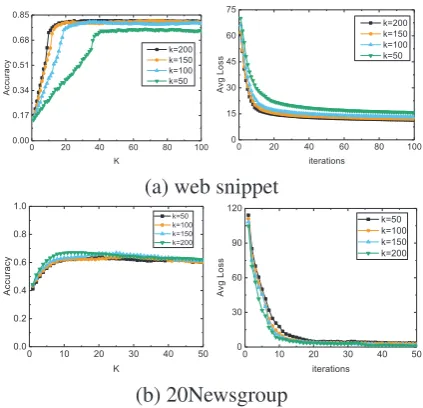
Figure 4: The loss and accuracy curves with the iterations on two datasets,on different number of topicKsettings.
50 100 150 200 250 0 20 40 60 80 100 Sparsi ty K NSTCSG NSTC LDA NTM STC
(a) word codes
50 100 150 200 250 0 20 40 60 80 100 Sparsi ty K NSTCSG NGSTC LDA NTM STC
[image:7.595.75.285.407.513.2](b) document codes
Figure 5: The average sparsity ratio of word and document codes.
4.3 Sparse Ratio
We further compare the sparsity of the learned la-tent representations of words and documents from different models on Web Snippet.
Word code: For each word n, we compute
the average word code and average sparsity ra-tio of them as in (Zhu and Xing, 2011). Fig-ure 5a presents the average word sparse ratio of word codes discovered by different models for Web Snippet. Note that the NGSTC can not yield sparse word codes but sparse document codes. We can see that 1) The NSTCSG learns the sparsest word codes, followed by NSTC and STC, which
perform much better than NTM and LDA. 2) The word codes discovered by LDA and NTM are very dense for lacking the mechanism to learn the focused topics. The sparsity in both models is mainly caused by the data scarcity. 3)The rep-resentations learned by sparse models (NSTCSG, NSTC and STC) are much sparser, which indi-cates each word concentrates on only a small num-ber of topics in these models, and therefore the word codes are more clear and semantically con-centrated. 4) Meanwhile, the sparse ratio of STC and NSTC are lower than NSTCSG. It proves the sparse group lasso penalty can easily allow to pro-vide networks with a high level of sparsity.
Document code: We further quantitatively
evaluate the average sparse ratio on latent repre-sentations of documents from different models, as shown in Figure 5b. We can see that 1) The NSTCSG yields the highest sparsity ratio, fol-lowed by NGSTC and STC, which outperform NTM and LDA by a large margin. 2) The docu-ment codes discovered by LDA and NTM are still very dense, while the representations learned by sparse models (NSTC and STC) are much sparser. It indicates the sparse models can discover focused topics and obtain discriminative representations of documents. 3) Similar to the word code, NGSTC outperforms NGSTC and STC. It demonstrates that the sparse group lasso penalty can achieve bet-ter sparsity than group lasso and lasso. 4) The sparsity ratios of sparse models increase with the topic numbers. The possible reason is that the sparse models tend to learn the focused topic num-ber which approaches to the real topic numnum-ber, and an increasing number of redundant topics can be discarded. 5) The NSTCSG inherits the advan-tages of NSTC and NGSTC, which can achieve the sparse topic representations of words and doc-uments.
4.4 Generative Model Evaluation
probabili-Table 1: Classification accuracy of different models on Web snippet and 20NG, with different number of topic K settings.
Dataset Snippet 20NG
k 50 100 150 200 250 50 100 150 200 250
LDA 0.682 0.592 0.573 0.615 0.583 0.545 0.615 0.607 0.613 0.623
STC 0.678 0.699 0.724 0.731 0.723 0.602 0.631 0.647 0.652 0.654
DocNADE 0.656 0.656 0.645 0.646 0.647 0.682 0.670 0.646 0.583 0.573
GLDA 0.669 0.689 0.675 0.670 0.623 0.367 0.438 0.465 0.496 0.526
NSTC 0.734 0.756 0.791 0.793 0.789 0.634 0.671 0.682 0.690 0.72
NSTCE 0.739 0.778 0.801 0.803 0.810 0.631 0.681 0.682 0.701 0.721
NGSTC 0.773 0.792 0.813 0.811 0.821 0.670 0.681 0.701 0.712 0.737
[image:8.595.83.516.97.244.2]NSTCSG 0.788 0.813 0.821 0.823 0.829 0.665 0.687 0.691 0.717 0.735
Table 2: Perplexity on test dataset.
Model 20NG
LDA 1091
STC 611
DocNADE 896 TopicVec 650
NSTC 517
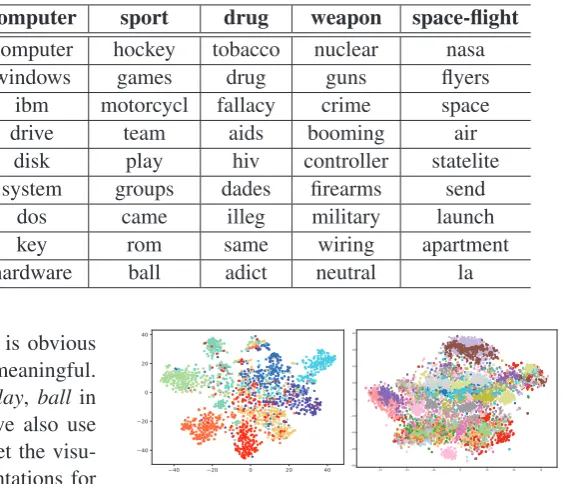
Table 3: Top Words of Learned Topics for 20Newsgroups.
computer sport drug weapon space-flight
computer hockey tobacco nuclear nasa
windows games drug guns flyers
ibm motorcycl fallacy crime space
drive team aids booming air
disk play hiv controller statelite system groups dades firearms send
dos came illeg military launch
key rom same wiring apartment
hardware ball adict neutral la
ties under the corresponding topic. It is obvious that the learned topics are clear and meaningful. Such as economics, hockey, games, play, ball in the topic about sport. In Figure 6, we also use the 2-dimensional t-SNE method to get the visu-alization of the learned latent representations for Web Snippet and 20Newsgroups Dataset with 200 topics. For Web Snippet, we sample 10% of the whole dataset. For 20newsgroups, we sample 30% of the dataset. It is obvious to see that all doc-uments are clustered into 8 and 20 distinct cate-gories. It proves the semantic effectiveness of the documents codes learned by our model.
5 Conclusion
In this paper, we propose a novel neural sparsity-enhanced topic model NSTC, which improves STC by incorporating the neural network and word embeddings. Compared with other word embedding based and neural network based topic models, it overcomes the computation complex-ity of topic models, and improve the generation of representation over short documents. We present
Figure 6: T-SNE embeddings of learned document representations for Web Snippet and 20News-Groups. Different colors mean different cate-gories.
three variants of NSTC to illustrate the great flex-ibility of our framework. Experimental results demonstrate the effectiveness and efficiency of our models. For future work, we are interested in vari-ous extensions, including combining STC with au-toencoding variational Bayes (AVB).
Acknowledgments
[image:8.595.242.526.275.517.2]References
Lu Bai, Jiafeng Guo, Yanyan Lan, and Xueqi Cheng. 2013. Group sparse topical coding: from code to topic. InProceedings of the sixth ACM international conference on Web search and data mining. ACM, pages 315–324.
David M. Blei, Andrew Y. Ng, and Michael I. Jordan. 2001. Latent dirichlet allocation. Journal of Ma-chine Learning Research3:993–1022.
Ziqiang Cao, Sujian Li, Yang Liu, Wenjie Li, and Heng Ji. 2015. A novel neural topic model and its super-vised extension. InAAAI.
Rajarshi Das, Manzil Zaheer, and Chris Dyer. 2015. Gaussian lda for topic models with word embed-dings. InACL.
Karol Gregor and Yann LeCun. 2010. Learning fast approximations of sparse coding. In Proceedings of the 27th International Conference on Machine Learning (ICML-10). pages 399–406.
Matthias Heiler and Christoph Schn¨orr. 2006. Learn-ing sparse representations by non-negative ma-trix factorization and sequential cone programming.
Journal of Machine Learning Research7(Jul):1385– 1407.
Weihua Hu and Junichi Tsujii. 2016. A latent concept topic model for robust topic inference using word embeddings. InThe 54th Annual Meeting of the As-sociation for Computational Linguistics. page 380.
Koray Kavukcuoglu, Marc’Aurelio Ranzato, and Yann LeCun. 2010. Fast inference in sparse coding algo-rithms with applications to object recognition. arXiv preprint arXiv:1010.3467.
Hugo Larochelle and Stanislas Lauly. 2012a. A neural autoregressive topic model. InNIPS.
Hugo Larochelle and Stanislas Lauly. 2012b. A neural autoregressive topic model. InAdvances in Neural Information Processing Systems. pages 2708–2716.
Shaohua Li, Tat-Seng Chua, Jun Zhu, and Chunyan Miao. 2016. Generative topic embedding: a con-tinuous representation of documents. In Proceed-ings of the 54th Annual Meeting of the Association for Computational Linguistics (Volume 1: Long Pa-pers). volume 1, pages 666–675.
Tianyi Lin, Wentao Tian, Qiaozhu Mei, and Hong Cheng. 2014. The dual-sparse topic model: min-ing focused topics and focused terms in short text. InWWW.
Andre Martins and Ramon Astudillo. 2016. From soft-max to sparsesoft-max: A sparse model of attention and multi-label classification. In International Confer-ence on Machine Learning. pages 1614–1623.
Dat Quoc Nguyen, Richard Billingsley, Lan Du, and Mark Johnson. 2015. Improving topic models with latent feature word representations. Transactions of the Association for Computational Linguistics
3:299–313.
Min Peng, Qianqian Xie, Jiajia Huang, Jiahui Zhu, Shuang Ouyang, Jimin Huang, and Gang Tian. 2016. Sparse topical coding with sparse groups. In
WAIM.
Fei Tian, Bin Gao, Di He, and Tie-Yan Liu. 2016. Sentence level recurrent topic model: Letting topics speak for themselves.CoRRabs/1604.02038.
Sinead Williamson, Chong Wang, Katherine A. Heller, and David M. Blei. 2010. The ibp compound dirich-let process and its application to focused topic mod-eling. InICML.
Jun Zhu and Eric P. Xing. 2011. Sparse topical coding.