25
Compositional Language Modeling for Icon-Based Augmentative and
Alternative Communication
Shiran Dudy Steven Bedrick Center for Spoken Language Understanding
Oregon Health & Science University 3181 S.W. Sam Jackson Park Rd.
Portland, Oregon, USA {dudy,bedricks}@ohsu.edu
Abstract
Icon-based communication systems are widely used in the field of Augmentative and Alternative Communication. Typi-cally, icon-based systems have lagged be-hind word- and character-based systems in terms of predictive typing functionality, due to the challenges inherent to training icon-based language models. We propose a method for synthesizing training data for use in icon-based language models, and explore two different modeling strategies.
1 Introduction
Individuals who experience speech and language impairments often are helped by Augmenta-tive and AlternaAugmenta-tive Communication (AAC) tech-niques that facilitate the expression or compre-hension of spoken or written language (Beukel-man and Mirenda, 2005; American Speech Lan-guage Hearing Association et al., 2004; Fossett and Mirenda,2007). Impairments may result from developmental disorders affecting speech and lan-guage (Cerebral Palsy, Down Syndrome, some forms of Autism Spectrum Disorder, etc.), or they may be caused by injury (stroke, traumatic brain injury, neurodegenerative diseases such as ALS, etc.). AAC interventions can take many forms, but a common goal is to provide users with a way to select symbols (words, phrases, etc.) for pur-poses of communication. The field of AAC groups interventions into "low-technology" (i.e., printed) or "high-technology" (i.e., computerized) devices; both are commonly used, and there are a number of factors that go in to the decision of which de-vice to use (Iacono et al.,2011;Light and Drager, 2007). In some cases, devices produce speech (or written language) based on those selections, whereas in other cases, the goal of the device is
to support a user in producing their own speech. In some cases, the unit of selection may be icon-based rather than word- or character-based. This is particularly common in devices used by children or individuals with impaired literacy, but is also common in adult use. Icon-based sys-tems can have higher selection speeds, and can be easier for individuals with neuromuscular impair-ments to operate; there are a wide variety of sym-bol sets and symsym-bol-based communication sys-tems used (Patel,2011).
Computerized text-based AAC devices often include some form of word prediction using a language model (see (Vertanen and Kristens-son, 2011; Garay-Vitoria and Abascal, 2006) for overviews of this area). Icon-based systems often do not employ predictive features.1 In part, this is because they typically rely on direct-selection or other input modalities; another barrier, is a lack of relevant linguistic training data. To our knowl-edge, there are no corpora of language produced using icon-based AAC systems.
In the present work, we apply modern lan-guage modeling techniques to a large-vocabulary icon set commonly used in AAC applications, but for which we have no domain (or even in-vocabulary) training data. We are building our model as support for a brain-computer interface (Orhan et al., 2012). In this input modality, the user has very limited control over item selection, making accurate language modeling critical.
We propose a method to generate language models and evaluate their performance by experi-menting with a process to generate a trainable lan-guage modeling corpus. We also share an
experi-1
mental setup for a new language modeling archi-tecture. Our contributions in this paper are:
• A proposed approach to synthesize a pseudo-corpus with which to learn language models from a corpus-less symbol set
• An experimental evaluation of the impact of various pieces of our corpus synthesis methodology on icon prediction accuracy
• A preliminary attempt to apply a novel lan-guage model architecture suitable for icon-based, open-vocabulary AAC applications
2 Symbolstix dataset
The Symbolstix (Clark,1997) icon set is used in several commercial AAC applications. Each icon includes an image, and is associated with metadata information that textually describes the meaning assigned to the icon at hand. An image in this set can represent a single word, a phrase, or a syntac-tic modifier (such as “plural”). The images cover 48 major topics such as actions, technology, nature etc. They vary in meaning, demonstrating abstract concepts and tangible ones; they also present dif-ferent levels of complexity and details. The meta-data primarily describe the associated term the im-age corresponds to, its synonyms, and its transla-tion to different languages.
[image:2.595.106.259.602.659.2]The Symbolstix icon set was designed for use by communities who are in need of icon-based communication, such as children with communi-cation disabilities, TBI patients, etc. One commer-cial application of the current icon-set is a news-cast aimed at adult consumers; another is a com-munications platform for children with Cerebral Palsy. The set of 34k icons is in practice broad enough to reflect those needs. However, the cre-ators of the system often do add new icons when requested by their user population.
Figure 1: Example icons:afraidandbite leg
On the left side of Figure 1 is an exam-ple of a single-word icon representing the term afraid. This icon’s human-assigned topic category is “descriptives-feelings”. Note that many icons are mapped to multiple synonyms. Synonyms of
this icon are: eerie, fear, feared, fearful, fears, frightened,Halloween,scary,terrified,upset, and nervous. As such, an icon’s meaning is highly context-dependent.
The right-hand side icon in Figure1is an exam-ple of a two-word icon representing the concept bite leg. This icon’s topic is of “actions”. Syn-onyms of this icon are: “bad day” and “dog bite”. As observed in Figure1, the nature of the Symbol-stix leans toward conversational concepts of spo-ken language, due to their intended use in AAC.
Symbolstix contains 34,837icons. 13,951 of these icons are of a single word; several of these are duplicates2, only 12,434 of the single word icons are unique terms. In our experiment, to avoid redundancy, we used this set of unique terms. We chose the unique term-icon pair (from its non-unique group) that had the richest metadata and the highest overlap (within its group) to rep-resent a concept. This step was essential to reduce complexity; however, it did introduce a limitation to our approach, which we discuss in section5.
Notably, the Symbolstix corpus comes with no dataset that demonstrates the intended usage of icons to construct a proper sentence. Ideally, we would use a dataset of icon sentences for language modeling, as it would enable learning icon se-quences and by that to infer the language rules from its patterns. In the next section, we describe how we were able to overcome that obstacle.
3 Experimental Setup
As mentioned in Section2, the Symbolstix data set of icons has no sentence-like corpus from which icon sequences can be readily learned to form a language model of icons. We attempted to syn-thesize an icon corpus by beginning with a textual corpus, and “projecting” our icons into the text space using pre-trained word embeddings using the methodology described below. Since each icon is accompanied by metadata containing human-edited synonym lists, it was natural to represent icons as some composition of their synonyms in a vector space.
In this manner, we embedded our icons in text, and created pseudo-sequences (“icon sentences”). This solution is not without problems, first among them the issue is that our icon sentences may not
2A single lexical item may be represented several times;
represent realistic examples of how the Symbol-stix icons are meant to be used. Rather, they might instead represent the icons as subjected to the guage conventions found in oral or written lan-guage. For example comparing a possible icon se-quence to the English language might look like: Icon: <I> <go> <here> <past>
English:<I> <went> <here>, or
English:<the> <dogs> <are> <at> <home> Icon: <the> <dog> <plural> [<be> optional] <at> <home>
Some of the terms may disappear in translation, while others are added.
Another question is whether it is possible to fully represent an icon as the sum of its synonyms; or, put another way, whether the ways in which an icon’s synonyms are used in written language can capture the totality of an icon’s meaning. For ex-ample, the icon in figure1does not precisely mean “afraid”, but rather refers to a more general con-cept. This is why we chose to explore a composi-tional approach to representing icon meaning in a continuous space. Finally, how should we handle sentences in our textual data set that are not fully representable using icons from Symbolstix?
Data Preprocessing
Icon Representation: In order to construct an icon language model, we needed to find a way to rep-resent our icon vocabulary in a continuous em-bedding space (following the lead ofKiros et al. (2015)). Lacking a corpus that included icons, we were unable to directly train “icon embeddings” from data. Instead, we attempted to “project” our icons into a word embedding space.
We experimented with two different approaches of word embedding (see section4), and, for each icon, generated icon embeddings by averaging3 the word embeddings of the icon’s synonyms (as specified by the Symbolstix metadata). Note that a different choice of icon set would have resulted in a different embedding space and language model. However, this basic approach describes a generic process to produce models form a corpus-less symbol-set, and should translate to other situtions. Textual Datasets: We next took a textual cor-pus (see section4), and identified terms that could be replaced with icon embeddings. In this work, we relied on a relatively simple strategy of me-chanically substituting icons for words based on
3We also experimented with summation, and observed no
meaningful difference.
their Symbolstix metadata. In other words, in-stances of the word “wetland” in the corpus would be replaced by the icon with “wetland” in its list of synonyms or descriptor terms. Note that this icon’s embedding would contain information about other words associated with that icon (e.g. “swamp”). We discuss some practical considera-tions around polysemous words and icons in sec-tion 4. This step forms a dataset of embedding sequences, which we then used as a corpus for learning a language model. The resulting corpus was then fully representable by embeddings (both of the words and icons).
Training
For our language model, we used a standard RNN architecture with two hidden LSTM layers, a lin-ear, and a final softmax layer that predicts the term’s index, trained with cross entropy loss func-tion (seen in Equafunc-tion1). The model’s input is of the generated embeddings and as such contained no explicit embedding layer.
Li = X
jJ
T(i, j) log(P(i, j)). (1)
The icons in this project are aimed at patients who would use them as a means to communicate. It is very likely that the icon language that would be formed by these patients would share similar characteristics with spontaneous speech or infor-mal language since this is the type of commu-nication we have with a caregiver, family mem-ber, or a friend. Knowing this, we used the Sub-tlexUS (Brysbaert and New, 2009) corpus (made up of subtitles from movies and television) as a proxy for a corpus of spontaneous speech that con-tained6,043,188sentences.4
Model Evaluation
We evaluated our language model using three dif-ferent metrics:
• Mean Reciprocal Rank (MRR) of the “cor-rect” predicted icon as seen in Equation2
M RR= 1
|Q|
X
iQ 1
ranki, (2)
Q represents the token events of the target. The choice of MRR metric was to internally
4See (Vertanen and Kristensson,2011) for an extensive
look at the rank of the target, rather than to bi-nary classify it for whether it was accurately predicted in the first rank.
• Accuracy@k: The percentage of predictions in which the “correct” icon was within the topkpredictions. The choice in ACC@k was to inform about the quality of the prediction generated by the models. We have chosen ACC@1 to crudely understand whether the first choice was correct, and ACC@10 to get a sense of the prediction quality given that a user may be able to choose from a limited list (depending on the user interface), and also to model the notion that different users may choose different words in a simialr context (and so there is not a single correct word in reality).
4 Experiments
We performed three sets of experiments. The first explored the effect of different approaches to word embedding, the second explored the effects of either including or excluding non-icon terms in model training, and the third looked at the effects of other (non-Subtlex) text corpora. For both ap-proaches to word embedding, we used pre-trained word vectors. The pretrained set is the source for generating the icon embeddings.
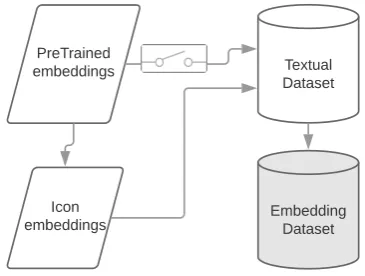
Both the icon and the pretrained embeddings re-place the terms in the textual data with their responding vectors to generate an embedding cor-pus. All our experiments contained the same num-ber of pretrained vectors as well as icon vectors. If both vector sets contained the same term, the icon embedding was used. The textual dataset was to-kenized and punctuation was removed. Each of these experiments was held in a 5 fold cross val-idation fashion. The process to generate the cor-pus from which language models are learned is described in Figure2.
This process shows also the three different mod-ules we experimented with: the pretrained corpus, which forms the icon embeddings; the icon set that forms (with or with out the pretrained set (there-fore the ‘switch’ between pretrained embeddings to textual dataset)) the textual embedding; and the textual dataset that provides the sequences of sym-bols to generate the textual embedding.
Experiment 1: Pretrained Vectors
The Pretrained embeddings in our experiment are used both to construct the icon representations and
BPMN 2.0
shiran | February 20, 2018Textual Dataset PreTrained
embeddings
Icon
[image:4.595.325.508.67.205.2]embeddings Embedding Dataset
Figure 2: Block diagram to generate training set for language modeling
to represent the textual corpus. In our setting we have explored the Global Vectors for Word Representation (Glove) (Pennington et al., 2014) set consisting of 400,000 uncased entries and trained on Wikipedia 2014 and Gigaword version 5 (≈6B tokens) with 50 embedding dimensions, and compared it to Context2Vec (c2v) (Melamud et al.,2016) trained on ukWaC corpus and MSCC (≈2B +≈50M tokens) consisting of 160,563 un-cased entries, with 600 embedding dimensions. To maintain a controlled environment the textual dataset remained fixed, the vocabulary of pre-trained token types was identical (n=69,840) as well as the icon list (n=6,934 term types) irrespec-tive of the dataset used. A term in the dataset was prioritized to be replaced with an icon term first, then if not found, with an icon synonym, with a pretrained representation, and finally, provided no alternative, a term was replaced with an <unk> vector representation.
metric c2v Glove
MRR 0.85 (0.00) 0.85 (0.00) ACC@1 (%) 50.99 (0.03) 49.29 (0.04) ACC@10 (%) 90.51 (0.01) 90.29 (0.01)
Table 1: Effect of word embedding method
Table 1 contains the experimental results of evaluations run on models trained with Glove and c2v vectors, averaged across five folds of cross-validation on the SubtlexUS dataset.
well as the method by which the vectors were gen-erated had no observable impact on the language model performance.
While Experiment 1 covers one aspect of com-paring differences between different word embed-dings, when choosing a pretrained set of vectors to use and generate icons from, there may be ad-ditional considerations. The coverage of the pre-trained set is essential to produce icon represen-tations, but also is important for terms in the tex-tual dataset that cannot be represented with icons (which are then replaced with a pretrained vector if found) as described in Experiment 1. The pre-trained set coverage with regards to the icon set is measured not only by the total number of icon representations that were generated from the pre-trained set, but also by how well each icon cap-tures the broad meaning it stands for. Since each icon is likely to have its name and synonyms com-posed together to represent it (as described in3in Data Preprocessing part), an optimal pretrained set would contain representations for all these terms. As for the textual dataset, an optimal coverage of the text with the pretrained list ideally would con-sist of a large number of term types, but also term events that appear in the dataset.
Experiment 2: Icon Symbols Constraint
Ideally, the corpus to learn language models from would consist of the icon vocabulary solely since the goal is to construct an Icon language model. We therefore, experimented with transforming our synthetic corpus to only include terms rep-resentable using icon vectors (“pure”) and com-pared LM and prediction accuracy with the orig-inal, “non-pure” results. We used Glove and c2v vectors in our experiment presented in Table2.
Table2describe an averaged five fold cross val-idation experiment of SubtlexUS with icon only embeddings referred by the “pure” experiment.
metric c2v Glove
MRR 0.33 (0.00) 0.33 (0.00) ACC@1 (%) 46.79 (0.06) 45.72 (0.06) ACC@10 (%) 54.92 (0.01) 54.29 (0.04)
Table 2: Effect of Icon embedding representation on SubtlexUS mean(standard deviation)
Table2describes a similar pattern to Table1as there was no meaningful change in the final icon language models’ performances due to the “pure”
condition. We do note that there was a slight ad-vantage to c2v embeddings which seemed to be predicting more correctly the target.
The “pure” condition resulted in a relatively smaller prediction accuracy. On the one hand, this may be surprising evidence, as it is reasonable to think that a smaller and more focused vocabulary set would result in an improved language model performance. We assume that the reduction in vo-cabulary size caused as a result of employing icons solely created short, sparse, and uncommon pat-terns of sequences, which limited the models’ abil-ity to learn and predict accurately.
Under the “pure” condition, the model vocabu-lary consists solely of the icon set itself, whereas in the “non-pure” condition, the model vocabu-lary consists of the icon set as well as the pre-trained embeddings together with <unk> terms. While we can not directly compare the two ex-periments (1 and 2) we can share our considera-tions when choosing to generate language models purely based on icons.
To support our explanation for Table2 interpre-tation, we conducted a qualitative test and looked into to the actual sentences produced by the icons in isolation, asking whether these sentences cre-ated “meaningful” (or at least useful) messages for LM training.. This might be helpful to get a deeper perspective on the corpus created and assist in making design choices. Here is an example: “non-pure”: <your> <warning> <did> <not> <work>
“pure”:<your> <warning> <not> <work> Arguably, the main message was conveyed in this sentence, while in the following:
“non-pure”: <they> <did> <n’t> <use> <mud> <they> <used> <sod>
“pure”:<they> <use> <they>
the essence is gone. While it is not feasible to qualitatively look at every sentence, one may con-sider comparing the amount of tokens prior to elimination and post, under the assumption that the greater the loss, the more likely that the quality of solely using the icon-set becomes a concern.
we did not have such a useful resource, it is impor-tant to observe this as a limitation of the current experiment.
Experiment 3: Textual Corpus
In our system, the role of the textual corpus is to provide the language model with training data regarding patterns of word (“icon”) use. Ideally, we would use a corpus made of symbols that rep-resent the type of content and structure an AAC user would produce. Finding an AAC-oriented corpus that would be big enough to train was a hurdle, and so for our previously-described exper-iments, we relied on SubtlexUS. While not ideal, this corpus was closer to spontaneous speech than, say, a newswire corpus would have been, and featured smaller and more manageable sentences that we hoped would withstand being converted to pseudo-icon representations.
That said, we did wish to investigate the util-ity of using an existing corpus that was designed to be closer to AAC-style speech. Vertanen and Kristensson(2011) produced such a corpus, con-sisting of 6,142 sentences produced by Amazon Mechanical Turk users who were paid to generate plausible sentences and to evaluate the plausibility of other sentences generated by other workers.
This corpus, while valuable, was too small for use with our language modeling approach. Fol-lowing Vertanen and Kristensson’s insight that “short text” such as that seen in online media such as Twitter, etc. might be a good proxy for true style speech, we therefore mixed the AAC-style corpus with second corpus, this one con-sisting of modified SMS messages. The second corpus was from Chen and Kan(2013) and con-sisted of 18,042 SMS messages, and was origi-nally constructed for experiments in text normal-ization. As such, it includes messages written in heavily-abbreviated forms as well as “cleaned up” versions of each message, written in some-thing approximating “standard” English orthogra-phy. We used this subset of the corpus in the hopes that its short, informal, and speech-like sentences would complement the AAC-style corpus. Our goal was to assemble a corpus containing language that is as close as possible to what would be pro-duced by actual users of an AAC system. We then repeated the language modeling experiments con-ducted earlier on this hybrid corpus, using identi-cal procedures and evaluation metrics.
Table 3 and 4 tell a similar story to one
an-metric c2v Glove
MRR 0.38 (0.00) 0.33 (0.01) ACC@1 (%) 56.41 (0.52) 47.13 (2.81) ACC@10 (%) 60.44 (0.42) 54.51 (2.37)
Table 3: Textual corpus (AAC-SMS) mean(standard deviation)
metric c2v Glove
MRR 0.37 (0.01) 0.34 (0.00) ACC@1 (%) 53.25 (2.11) 47.73 (1.46) ACC@10 (%) 59.06 (1.29) 56.00 (1.40)
Table 4: Textual corpus (AAC-SMS/pure) mean(standard deviation)
other: the models trained using c2v embeddings outperformed the models that used Glove embed-dings, which is different from what we observed in the previous experiments— though with this cor-pus, the overall performance numbers were much lower than with the original, larger corpora. The reason for overall low performance was probably due to the very small size of the AAC-SMS cor-pus, and possible overfitting as a result. Digging more deeply into our data, we examined the in-dividual cross-validation results at the fold level, thinking that perhaps the results were unstable due to the relatively small data set which indeed seem to be the case.
Nevertheless, in an attempt to indirectly evalu-ate different models, while the AAC experiments had substantially higher variance across folds than did the SubtlexUS experiments, the differences between the two approaches do appear to be real. Ultimately, we note that the substantial difference in corpus size between SubtlexUS and our AAC-SMS corpus make it difficult to draw any firm con-clusions, and investigating this issue further will be a component of our future work in this area.
5 Conclusions
closer to actual AAC-style language, though at a substantial cost in terms of corpus size. This is a common problem in AAC research in general, and our immediate next steps will focus on develop-ing more naturalistic traindevelop-ing corpora (followdevelop-ing the lead ofVertanen and Kristensson(2011), who faced similar challenges).
Another important limitation is that we have not solved the problem of icons that represent multi-word expressions or phrases. This will be a ma-jor area our future work, for two reasons. First, many important icons fall into this category. Sec-ond, one of the advantages of icon-based AAC is increased speed of communication, and collapsing multi-word expressions to a single icon would en-able substantial improvements.
A second area of future work will look at ways to capture and express morphology. Our icon set includes icons that can be used to indicate tense, plurality, etc., but our current approach to cor-pus processing and term substitution/composition does not take advantage of such information. We intend to explore ways to directly represent mor-phological/inflectional information in the input side of our models, and in doing so make better use of our icon system.
A final limitation of this work is that our ap-proach to selecting icons had the unfortunate side effect of ignoring polysemy: the set of icons that we worked with here was restricted to a single sense of polysemous words. This means that some possibly-useful icons were excluded, which could have consequences for anybody actually using our system for communication. Consider the word “cheer”, which can be either a verb or a noun, and in both cases has multiple meanings. There are several icons in Symbolstix that capture different usages of the word, but our current approach only uses one. This will be another active area of future work, and we expect our solution to this problem to tie in with our solution to the issue of multi-word expressions.
Our evaluations thus far have been system-oriented, and have tried to measure the model’s performance. Our MRR and accuracy results have provided us with an internal view for where our models were performing as desired as well as identified areas where they fall short. The next step will be to integrate our language model with the rest of our AAC platform and begin working with real end-users. We anticipate that this will
guide much of our future work on this problem.
Acknowledgments
We thank the anonymous DeepLo workshop re-viewers for their valuable feedback and com-ments. We also thank our clinical collaborators in OHSU’s Institute on Development & Disabil-ity: Betts Peters, Brandon Eddy, and Dr. Melanie Fried-Oken, as well as our collaborators at North-eastern University, in the laboratories of Drs. David Smith and Deniz Erdogmus. Research re-ported in this paper was supre-ported by the National Institute on Deafness and Other Communication Disorders of the NIH under awards R01DC009834 and R56DC015999.
References
American Speech Language Hearing Association et al. 2004. Roles and Responsibilities of Speech-Language Pathologists with Respect to Augmenta-tive and AlternaAugmenta-tive Communication: Technical Re-port .
David R. Beukelman and Pat Mirenda. 2005. Aug-mentative & Alternative Communication: Support-ing Children & Adults with Complex Communica-tion Needs. Paul H. Brookes Publishing Co., 3rd edition.
Marc Brysbaert and Boris New. 2009. Moving Beyond Kuˇcera and Francis: A Critical Evaluation of Cur-rent Word Frequency Norms and the Introduction of a New and Improved Word Frequency Measure for American English. Behavior Research Methods
41(4):977–990.
Tao Chen and Min-Yen Kan. 2013. Creating a live, public short message service corpus: the nus sms corpus. Language Resources and Evaluation
47(2):299–335.
Jacquie Clark. 1997. Symbolstix. News 2 You. https://www.n2y.com/symbolstix-prime.
Brenda Fossett and Pat Mirenda. 2007. Augmentative and Alternative Communication. Handbook of De-velopmental Disabilitiespages 330–348.
Nestor Garay-Vitoria and Julio Abascal. 2006. Text prediction systems: a survey. Universal Access in the Information Society4(3):188–203.
Teresa Iacono, Katie Lyon, and Denise West. 2011. Non-Electronic Communication Aids for People with Complex Communication Needs. Inter-national Journal of Speech-Language Pathology
Ryan Kiros, Yukun Zhu, Ruslan R Salakhutdinov, Richard Zemel, Raquel Urtasun, Antonio Torralba, and Sanja Fidler. 2015. Skip-Thought Vectors. In
Advances in Neural Information Processing Sys-tems. pages 3294–3302.
Janice Light and Kathryn Drager. 2007. AAC Tech-nologies for Young Children with Complex Com-munication Needs: State of the Science and Future Research Directions. Augmentative and Alternative Communication23(3):204–216.
Oren Melamud, Jacob Goldberger, and Ido Dagan. 2016. context2vec: Learning Generic Context Em-bedding with Bidirectional LSTM. InProceedings of The 20th SIGNLL Conference on Computational Natural Language Learning. pages 51–61.
U. Orhan, K. E. Hild, D. Erdogmus, B. Roark, B. Oken, and M. Fried-Oken. 2012. Rsvp Keyboard: An EEG Based Typing Interface. In2012 IEEE International Conference on Acoustics, Speech and Signal Pro-cessing (ICASSP). pages 645–648.
R. Patel. 2011. Message Formulation, Organization, and Navigation Schemes for Icon-Based Communi-cation Aids. In2011 Annual International Confer-ence of the IEEE Engineering in Medicine and Biol-ogy Society. pages 5364–5367.
Jeffrey Pennington, Richard Socher, and Christopher Manning. 2014. Glove: Global Vectors for Word Representation. In Proceedings of the 2014 Con-ference on Empirical Methods in Natural Language Processing (EMNLP). pages 1532–1543.
Keith Vertanen and Per Ola Kristensson. 2011. The imagination of crowds: Conversational aac lan-guage modeling using crowdsourcing and large data sources. InProceedings of the Conference on Em-pirical Methods in Natural Language Processing. Association for Computational Linguistics, Strouds-burg, PA, USA, EMNLP ’11, pages 700–711. http://dl.acm.org/citation.cfm?id=2145432.2145514.
Karl Wiegand and Rupal Patel. 2012a. Non-syntactic word prediction for aac. In Proceed-ings of the Third Workshop on Speech and Language Processing for Assistive Technolo-gies. Association for Computational Linguistics, Stroudsburg, PA, USA, SLPAT ’12, pages 28–36. http://dl.acm.org/citation.cfm?id=2392855.2392860.