Proceedings of the 55th Annual Meeting of the Association for Computational Linguistics, pages 409–419 Vancouver, Canada, July 30 - August 4, 2017. c2017 Association for Computational Linguistics Proceedings of the 55th Annual Meeting of the Association for Computational Linguistics, pages 409–419
Vancouver, Canada, July 30 - August 4, 2017. c2017 Association for Computational Linguistics
Automatically Labeled Data Generation for Large Scale Event Extraction
Yubo Chen1,2, Shulin Liu1,2, Xiang Zhang1, Kang Liu1 and Jun Zhao1,2
1 National Laboratory of Pattern Recognition, Institute of Automation, Chinese Academy of Sciences, Beijing, 100190, China
2 University of Chinese Academy of Sciences, Beijing, 100049, China {yubo.chen, shulin.liu, xiang.zhang, kliu, jzhao}@nlpr.ia.ac.cn
Abstract
Modern models of event extraction for tasks like ACE are based on supervised learning of events from small hand-labeled data. However, hand-labeled training da-ta is expensive to produce, in low cov-erage of event types, and limited in size, which makes supervised methods hard to extract large scale of events for knowledge base population. To solve the data label-ing problem, we propose to automatically label training data for event extraction vi-a world knowledge vi-and linguistic knowl-edge, which can detect key arguments and trigger words for each event type and em-ploy them to label events in texts auto-matically. The experimental results show that the quality of our large scale automat-ically labeled data is competitive with e-laborately human-labeled data. And our automatically labeled data can incorporate with human-labeled data, then improve the performance of models learned from these data.
1 Introduction
Event Extraction (EE), a challenging task in In-formation Extraction, aims at detecting and typ-ing events (Event Detection), and extracttyp-ing ar-guments with different roles (Argument Identifi-cation) from natural-language texts. For
exam-ple, in the sentence shown in Figure 1, an EE
system is expected to identify an Attack
even-t even-triggered by threw and extract the
correspond-ing five augments with different roles: Yesterday
(Role=Time), demonstrators (Role=Attacker),
s-tones(Role=Instrument), soldiers (Role=Target), andIsraeli(Role=Place).
To this end, so far most methods (Nguyen et al.,
In Baghdad , a cameraman died when an American tank fired on the Palestine Hotel.
prep_in
det nsubj nsubj
advcl advmod
det amod
prep_on det nn
In Baghdad , a cameraman died when an American tank fired on the Palestine Hotel.
Victim
Place Die Instrument Attack Target
Target Place
Michelle Obama and Barack Obama were on October 3, 1992.
Marry
Person
Person
Time
Marry
Victim
Place Instrument
Die Attack Target
Target Place
In Baghdad , a cameraman died when an American tank fired on the Palestine Hotel.
Victim
Place Die Instrument Attack Target
[image:1.595.309.520.221.262.2]Target Place
Figure 1: This sentence expresses anAttackevent
triggered bythrewand containing five arguments.
2016;Chen et al.,2015;Li et al.,2014;Hong et al., 2011;Ji and Grishman,2008) usually adopted su-pervised learning paradigm which relies on
elab-orate human-annotated data, such as ACE20051,
to train extractors. Although this paradigm was widely studied, existing approaches still suffer from high costs for manually labeling training da-ta and low coverage of predefined event types. In
ACE 2005, all 33 event types are manually
pre-defined and the corresponding event information (including triggers, event types, arguments and
their roles) are manually annotated only in 599
English documents since the annotation process
is extremely expensive. As Figure 2 shown,
n-early 60% of event types in ACE 2005have less
than100labeled samples and there are even three
event types which have less than ten labeled
sam-ples. Moreover, those predefined 33 event types
are in low coverage for Natural Language Process-ing (NLP) applications on large-scale data.
Therefore, for extracting large scale events, e-specially in open domain scenarios, how to auto-matically and efficiently generate sufficient train-ing data is an important problem. This paper aim-s to automatically generate training data for EE, which involves labeling triggers, event types,
ar-guments and their roles. Figure 1 shows an
ex-ample of labeled sentence. Recent improvements of Distant Supervision (DS) have been proven to be effective to label training data for Relation Ex-traction (RE), which aims to predict semantic
0 200 400 600 800 1000 1200 1400 1600
Figure 2: Statistics of ACE 2005 English Data.
lations between pairs of entities, formulated as (entity1, relation, entity2). And DS for RE
as-sumes that if two entities have a relationship in a known knowledge base, then all sentences that mention these two entities will express that
rela-tionship in some way (Mintz et al.,2009).
How-ever, when we use DS for RE to EE, we meet fol-lowing challenges:
Triggers are not given out in existing knowl-edge bases. EE aims to detect an event instance of a specific type and extract their arguments and
roles, formulated as(event instance,event type;
role1,argument1;role2,argument2;...;rolen,
argumentn), which can be regarded as a kind
of multiple or complicated relational data. In
Figure 3, the right part shows an example of
spouse of relation betweenBarack Obamaand M ichelle Obama, where two rectangles repre-sent two entities and the edge connecting them
represents their relation. DS for RE uses
t-wo entities to automatically label training
da-ta; In comparison, the left part in Figure 3
shows a marriage event of Barack Obama
and M ichelle Obama, where the dash
cir-cle represents the marriage event instance of
Barack Obama and M ichelle Obama, rectan-gles represent arguments of the event instance, and each edge connecting an argument and the event instance expresses the role of the argument. For
example, Barack Obama plays a Spouse role
in this marriage event instance. It seems that we could use an event instance and an argument to automatically generate training data for argumen-t idenargumen-tificaargumen-tion jusargumen-t like DS for RE. However, an event instance is a virtual node in existing knowl-edge bases and mentioned implicitly in texts. For example, in Freebase, the aforementioned
mar-riage event instance is represented asm.02nqglv
(see details in Section2). Thus we cannot
direct-ly use an event instance and an argument, like m.02nqglv and Barack Obama, to label back
Marriage
Michelle Obama
10/03/1992
Trinity United Church of Christ
Null Spouse Spouse
location of ceremony
time_from time_to
Barack Obama Michelle Obama
Spouse_of
VS
An example of marriage event An example of spouse_of relation
Marriage
Michelle Obama
10/03/1992
Trinity United Church of Christ
Null Spouse Spouse
location of ceremony
time_from time_to
Barack Obama Michelle Obama
Spouse_of
An example of marriage event An example of spouse_of relation
Marriage
Michelle Obama
10/03/1992
Trinity United Church of Christ
Null Spouse Spouse
location of ceremony
time_from time_to
Barack Obama
Michelle Obama
Spouse_of
An example of marriage event An example of spouse_of relation Michelle Obama
Figure 3: A comparison of events and relations.
in sentences. In ACE event extraction program, an event instance is represented as a trigger word, which is the main word that most clearly
repre-sents an event occurrence in sentences, likethrew
in Figure 1. Following ACE, we can use
trig-ger words to represent event instance, likemarried
forpeople.marriageevent instance. Unfortunate-ly, triggers are not given out in existing knowledge bases.
To resolve the trigger missing problem men-tioned above, we need to discover trigger words before employing distant supervision to automati-cally label event arguments. Following DS in RE, we could naturally assume that a sentence con-tains all arguments of an event in the knowledge base tend to express that event, and the verbs oc-cur in these sentences tend to evoke this type of
events. However,arguments for a specific event
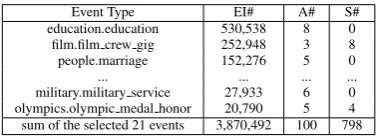
instance are usually mentioned in multiple sen-tences. Simply employing all arguments in the knowledge base to label back in sentences will generate few sentences as training samples. As
shown in Table1, only0.02%of instances can find
all argument mentions in one sentence.
Event Type EI# A# S#
education.education 530,538 8 0
film.film crew gig 252,948 3 8
people.marriage 152,276 5 0
... ... ... ...
military.military service 27,933 6 0
olympics.olympic medal honor 20,790 5 4
sum of the selected 21 events 3,870,492 100 798
Table 1: Statistics of events in Freebase. EI# de-notes number of event instances in Freebase. A# denotes number of arguments for each event type-s, and S# indicates number of sentences contain all arguments of each event type in Wikipedia.
[image:2.595.75.288.62.160.2] [image:2.595.321.512.543.612.2]arguments and select key or representative
argu-ments (see details in Section 3.1) for each event
type by using Freebase; Secondly, we merely use key arguments to label events and figure out trig-ger words; Thirdly, an external linguistic knowl-edge resource, FrameNet, is employed to filter noisy trigger words and expand more triggers; Af-ter that, we propose a Soft Distant Supervision (SDS) for EE to automatically label training da-ta, which assumes that any sentence containing al-l key arguments in Freebase and a corresponding trigger word is likely to express that event in some way, and arguments occurring in that sentence are likely to play the corresponding roles in that event. Finally, we evaluate the quality of the automatical-ly labeled training data by both manual and auto-matic evaluations. In addition, we employ a CNN-based EE approach with multi-instance learning for the automatically labeled data as a baseline for further research on this data. In summary, the con-tributions of this paper are as follows:
• To our knowledge, it is the first work to
au-tomatically label data for large scale EE via world knowledge and linguistic knowledge. All the labeled data in this paper have been
released and can be downloaded freely2.
• We propose an approach to figure out key
ar-guments of an event by using Freebase, and use them to automatically detect events and corresponding trigger words. Moreover, we employ FrameNet to filter noisy triggers and expand more triggers.
• The experimental results show that the
qual-ity of our large scale automatically labeled data is competitive with elaborately human-annotated data. Also, our automatically la-beled data can augment traditional human-annotated data, which could significantly im-prove the extraction performance.
2 Background
In this paper, we respectively use Freebase as our world knowledge containing event instance and FrameNet as the linguistic knowledge containing trigger information. The articles in Wikipedia are used as unstructured texts to be labeled. To under-stand our method easily, we first introduce them as follows:
2https://github.com/acl2017submission/event-data
Freebase is a semantic knowledge base
(Bol-lacker et al., 2008), which makes use of
medi-ators (also called compound value types, CVT-s) to merge multiple values into a single value.
As shown in Figure 3, people.marriage is one
type of CVTs. There are many instances of
peo-ple.marriage and the marriage ofBarack Obama
and Michelle Obama is numbered as m.02nqglv.
Spouse, from, to and location of ceremony are
roles of thepeople.marriageCVTs. Barack
Oba-ma, Michelle Obama, 10/3/1992 and Trinity U-nited Church of Christ are the values of the in-stances. In this paper, we regard these CVTs as events, type of CVTs as event type, CVT instances as event instances, values in CVTs as arguments in events and roles of CVTs as the roles of ar-guments play in the event, respectively. Accord-ing to the statistics of the Freebase released on
23thApril,2015, there are around1885CVTs and
around14million CVTs instances. After filtering
out useless and meaningless CVTs, such as CVT-s about uCVT-ser profileCVT-s and webCVT-site information, we
select 21types of CVTs with around 3.8 million
instances for experiments, which mainly involves
events abouteducation,military,sportsand so on.
FrameNet3 is a linguistic resource storing
in-formation about lexical and predicate argument
se-mantics (Baker et al., 1998). FrameNet contains
more than1,000frames and10,000Lexical
Unit-s (LUUnit-s). Each frame of FrameNet can be taken aUnit-s a semantic frame of a type of events (Liu et al., 2016). Each frame has a set of lemmas with part of speech tags that can evoke the frame, which are
called LUs. For example,appoint.vis a LU of
Ap-pointingframe in FrameNet, which can be mapped topeople.appointmentevents in Freebase. And a LUs of the frame plays a similar role as the trig-ger of an event. Thus we use FrameNet to detect triggers in our automatically data labeling process. Wikipedia4 that we used was released on
Jan-uary,2016. All6.3million articles in it are used in
our experiments. We use Wikipedia because it is relatively up-to-date, and much of the information in Freebase is derived from Wikipedia.
3 Method of Generating Training Data
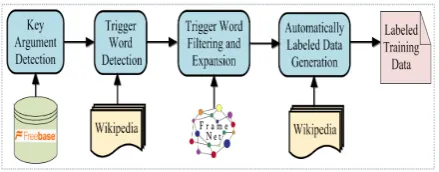
Figure 4 describes the architecture of
automati-cally labeling data, which primarily involves the following four components: (i) Key argument
Wikipedia
Training
[image:4.595.72.292.62.148.2]DS
Figure 4: The architecture of automatically label-ing trainlabel-ing data for large scale event extraction.
tection, which prioritizes arguments of each even-t even-type and seleceven-ts key argumeneven-ts for each even-type of event; (ii) Trigger word detection, which uses key arguments to label sentences that may express events preliminarily, and then detect triggers; (iii) Trigger word filtering and expansion, which uses FrameNet to filter noisy triggers and expand trig-gers; (iv) Automatically labeled data generation, which uses a SDS to label events in sentences.
3.1 Key Argument Detection
This section illustrates how to detect key argu-ments for each event type via Freebase. Intuitively, arguments of a type of event play different roles. Some arguments play indispensable roles in an event, and serve as vital clues when distinguishing different events. For example, compared with
ar-guments liketime,locationand so on,spousesare
key arguments in amarriageevent. We call these
arguments as key arguments. We propose to use
Key Rate (KR) to estimate the importance of an argument to a type of event, which is decided by
two factors:Role SaliencyandEvent Relevance.
Role Saliency (RS) reflects the saliency of an argument to represent a specific event instance of a given event type. If we tend to use an argumen-t argumen-to disargumen-tinguish one evenargumen-t insargumen-tance form oargumen-ther in-stances of a given event type, this argument will play a salient role in the given event type. We de-fine RS as follows:
RSij =
Count(Ai, ETj)
Count(ETj) (1)
where RSij is the role saliency ofi-th argument
toj-th event type, Count(Ai , ETj) is the
num-ber of Arguemnti occurring in all instances of
eventT ypej in Freebase andCount(ETj)is the
number of instances ofeventT ypej in Freebase.
Event Relevance (ER) reflects the ability in which an argument can be used to discriminate
d-ifferent event types. If an argument occurs in ev-ery event type, the argument will have a low event relevance. We propose to compute ER as follows:
ERi = log
Sum(ET)
1 +Count(ET Ci) (2)
whereERiis the event relevance ofi-th
argumen-t,Sum(ET) is the number of all event types in
knowledge base andCount(ET Ci)is the number
of event types containing i-th argument. Finally,
KR is computed as follows:
KRij =RSij∗ERi (3)
We compute KR for all arguments of each even-t even-type, and soreven-t even-them according even-to KR. Then we
choose topK arguments as key arguments.
3.2 Trigger Word Detection
After detecting key arguments for every even-t even-types, we use even-these key argumeneven-ts even-to label sen-tences that may express events in Wikipedia. At
first, we use Standford CoreNLP tool5to converts
the raw Wikipedia texts into a sequence of sen-tences, attaches NLP annotations (POS tag, NER tag). Finally, we select sentences that contains all key arguments of an event instance in Freebase as sentences expressing corresponding events. Then we use these labeled sentences to detect triggers.
In a sentence, a verb tend to express an occur-rence of an event. For example, in ACE 2005
En-glish data, there are 60% of events triggered by
verbs. As shown in Figure 1, threw is a trigger
ofAttack event. Intuitively, if a verb occurs more times than other verbs in the labeled sentences of one event type , the verb tends to trigger this type of event; and if a verb occurs in sentences of
ev-ery event types, like is, the verb will have a low
probability to trigger events. Thus we propose
Trigger Candidate Frequency (TCF) and Trigger Event Type Frequency(TETF) to evaluate above
t-wo aspects. Finally we employTrigger Rate(TR),
which is the product of TCF and TETF to estimate the probability of a verb to be a trigger, which is formulated as follows:
T Rij =T CFij ∗T ET Fi (4)
T CFij = Count(Vi, ET Sj)
Count(ET Sj) (5)
T ET Fi = log
Sum(ET)
1 +Count(ET Ii) (6)
where T Rij is the trigger rate of i-th verb to j
-th event type, Count(Vi, ET Sj) is the number
of sentences, which express j-th type of
even-t and coneven-tain i-th verb, Count(ET Sj) is the
number of sentences expressing j-th event type,
Count(ET Ii)is the number of event types, which
have the labeled sentences containing i-th verb.
Finally, we choose verbs with highT Rvalues as
the trigger words for each event type.
3.3 Trigger Word Filtering and Expansion We can obtain an initial verbal trigger lexicon by above trigger word detection. However, this initial trigger lexicon is noisy and merely contains verbal
triggers. The nominal triggers like marriageare
missing. Because the number of nouns in one sen-tence is usually larger than that of verbs, it is hard to use TR to find nominal triggers. Thus, we pro-pose to use linguistic resource FrameNet to filter noisy verbal triggers and expand nominal triggers. As the success of word embedding in capturing
se-mantics of words (Turian et al.,2010), we employ
word embedding to map the events in Freebase to frames in FrameNet. Specifically, we use the
aver-age word embedding of all words ini-th Freebase
event type name ei and word embedding ofk-th
lexical units ofj-th frameej,k to compute the
se-mantic similarity. Finally, we select the frame
con-tains max similarity ofei andej,k as the mapped
frame, which can be formulated as follows: f rame(i) = arg max
j (similarity(ei, ej,k)) (7)
Then, we filter the verb, which is in initial ver-bal trigger word lexicon and not in the mapping frame. And we use nouns with high confidence in the mapped frame to expand trigger lexicon. 3.4 Automatically labeled data generation Finally, we propose a Soft Distant Supervision and use it to automatically generate training da-ta, which assumes that any sentence containing al-l key arguments in Freebase and a corresponding trigger word is likely to express that event in some way, and arguments occurring in that sentence are likely to play the corresponding roles in that event.
4 Method of Event Extraction
In this paper, event extraction is formulated as a two-stage, multi-class classification task. The
first stage is called Event Classification, which
aims to predict whether the key argument can-didates participate in a Freebase event. If the key arguments participate a Freebase event, the second stage is conducted, which aims to assign arguments to the event and identify their
corre-sponding roles. We call this stage as
argumen-t classificaargumen-tion. We employ two similar Dynam-ic Multi-pooling Convolutional Neural Network-s with Multi-inNetwork-stance Learning (DMCNNNetwork-s-MIL) for above two stages. The Dynamic Multi-pooling Convolutional Neural Networks (DMCNNs) is the best reported CNN-based model for event
extrac-tion (Chen et al.,2015) by using human-annotated
training data. However, our automatically labeled data face a noise problem, which is a intrinsic problem of using DS to construct training data
(Hoffmann et al.,2011;Surdeanu et al.,2012). In
order to alleviate the wrong label problem, we use Multi-instance Learning (MIL) for two DMCNNs. Because the second stage is more complicated and limited in space, we take the MIL used in argu-ments classification as an example and describes as follows:
We define all of the parameters for the stage of argument classification to be trained in
DM-CNNs as θ. Suppose that there are T bags
{M1, M2, ..., MT} and that the i-th bag contains
qiinstances (sentences)Mi =mi1, m2i, ..., mqii ,
the objective of multi-instance learning is to pre-dict the labels of the unseen bags. In stage of ar-gument classification, we take sentences contain-ing the same argument candidate and triggers with a same event type as a bag and all instances in a bag are considered independently. Given an
in-put instance mji, the network with the parameter
θ outputs a vector O, where the r-th component
Or corresponds to the score associated with
argu-ment roler. To obtain the conditional probability
p(r|mji, θ), we apply a softmax operation over all
argument role types:
p(r|mji, θ) = e
or
n
P
k=1
eok
(8)
where,nis the number of roles. And the objective
of multi-instance learning is to discriminate bags rather than instances. Thus, we define the
objec-tive function on the bags. Given all (T) training
Event Type FreebaseSize Sentences(KA) Sentences(KA+T) Examples of argument roles sorted by KR Examples of triggers
people.marriage 152,276 56,837 26,349 spouse, spouse, from, to, location marriage, marry, wed, wedding, couple,..., wife
music.group membership 239,813 90,617 20,742 group, member, start, role, end musician, singer, sing, sang, sung, concert,..., play
education.education 530,538 26,966 11,849 student, institution, degree,..., minor educate, education, graduate, learn, study,..., student
organization.leadership 43,610 5,429 3,416 organization, person, title,..., to CEO, charge, administer, govern, rule, boss,..., chair
olympics.olympic medal honor 20,790 4,056 2,605 medalist, olympics, event,..., country win, winner, tie, victor, gold, silver,..., bronze
... ... ... ... ... ...
[image:6.595.74.527.62.129.2]sum of 21 selected events 3,870,492 421,602 72,611 argument1, argument2 ,..., argumentN trigger1, trigger2, trigger3, ... , triggerN
Table 2: The statistics of five largest automatically labeled events in selected 21 Freebase events, with their size of instances in Freebase, sentences labeled with key argument (KA) and KA + Triggers(T), examples of arguments roles sorted by KR and examples of triggers.
using cross-entropy at the bag level as follows:
J(θ) =
T
X
i=1
logp(yi|mji, θ) (9)
wherejis constrained as follows:
j∗ = arg max
j p(r|m j
i, θ) 1≤j≤qi (10)
To compute the network parameter θ, we
max-imize the log likelihood J(θ) through
stochas-tic gradient descent over mini-batches with the
Adadelta (Zeiler,2012) update rule.
5 Experiments
In this section, we first manually evaluate our auto-matically labeled data. Then, we conduct automat-ic evaluations for our labeled data based on ACE corpus and analyze effects of different approach-es to automatically label training data. Finally, we shows the performance of DMCNNs-MIL on our automatically labeled data.
5.1 Our Automatically Labeled Data
By using the proposed methods, a large set of la-beled data could be generated automatically.
Ta-ble2 shows the statistics of the five largest
auto-matically labeled events among selected21
Free-base events. Two hyper parameters, the number of key arguments and the value of TR in our au-tomatically data labeling, are set as 2 and 0.8, by grid search respectively. When we merely use t-wo key arguments to label data, we will obtain
421,602labeled sentences. However, these
sen-tences miss labeling triggers. Thus, we leverage these rough labeled data and FrameNet to find trig-gers and use SDS to generate labeled data. Finally,
72,611labeled sentences are generated
automat-ically. Compared with nearly 6,000 human
an-notated labeled sentence in ACE, our method can automatically generate large scale labeled training data.
5.2 Manual Evaluations of Labeled Data
##001 He is the uncle of [Amal Clooney], [wife] of the actor [George Clooney].
Trigger: wife Event Type: Marriage MannalAnotate[Y/N]: Argument: Amal Clooney Role:Spouse MannalAnotate[Y/N]:
Argument: George Clooney Role:Spouse MannalAnotate[Y/N]:
##002 She was [married] to the cinematographer [Theo Nischwitz] and was sometimes credited as [Gertrud Hinz-Nischwitz].
Trigger: married Event Type: Marriage MannalAnotate[Y/N]:
Argument: Theo Nischwitz Role:Spouse MannalAnotate[Y/N]:
Argument: Gertrud Hinz-Nischwitz Role:Spouse MannalAnotate[Y/N]:
Figure 5: Examples of manual evaluations.
We firstly manually evaluate the precision of our automatically generated labeled data. We ran-domly select 500 samples from our automatically labeled data. Each selected sample is a sentence with a highlighted trigger, labeled arguments and corresponding event type and argument roles.
Fig-ure5 gives some samples. Annotators are asked
to assign one of two labels to each sample. “Y”: the word highlighted in the given sentence indeed triggers an event of the corresponding type or the word indeed plays the corresponding role in that event. Otherwise “N” is labeled. It is very easy to annotate a sample for annotators, thus the annotat-ed results are expectannotat-ed to be of high quality. Each sample is independently annotated by three
anno-tators6 (including one of the authors and two of
our colleagues who are familiar with event extrac-tion task) and the final decision is made by voting.
[image:6.595.334.495.615.651.2]Stage Average Precision Trigger Labeling 88.9 Argument Labeling 85.4
Table 3: Manual Evaluation Results
We repeat above evaluation process on the final
72,611labeled data three times and the average
precision is shown in Table3. Our automatically
generated data can achieve a precision of88.9and
85.4for trigger labeling and argument labeling
Methods Identification(%)Trigger Trigger Identification+ Classification(%) Identification(%)Argument ArgumentRole(%)
P R F P R F P R F P R F
[image:7.595.77.524.62.148.2]Li’s structure trained with ACE 76.9 65.0 70.4 73.7 62.3 67.5 69.8 47.9 56.8 64.7 44.4 52.7 Chen’s DMCNN trained with ACE 80.4 67.7 73.5 75.6 63.6 69.1 68.8 51.9 59.1 62.2 46.9 53.5 Nguyen’s JRNN trained with ACE 68.5 75.7 71.9 66.0 73.0 69.3 61.4 64.2 62.8 54.2 56.7 55.4 DMCNN trained with ED Only 77.6 67.7 72.3 72.9 63.7 68.0 64.9 51.7 57.6 58.7 46.7 52.0 DMCNN trained with ACE+ED 79.7 69.6 74.3 75.7 66.0 70.5 71.4 56.9 63.3 62.8 50.1 55.7
Table 4: Overall performance on ACE blind test data
spectively, which demonstrates that our automati-cally labeled data is of high quality.
5.3 Automatic Evaluations of Labeled Data To prove the effectiveness of the proposed ap-proach automatically, we add automatically gen-erated labeled data into ACE dataset to expand the training sets and see whether the performance of the event extractor trained on such expanded training sets is improved. In our automatically labeled data, there are some event types that can correspond to those in ACE dataset. For
exam-ple, our people.marriage events can be mapped
to life.marry events in ACE2005 dataset. We mapped these types of events manually and we add them into ACE training corpus in two ways. (1) we delete the human annotated ACE data for these mapped event types in ACE dataset and add our automatically labeled data to remainder ACE training data. We call this Expanded Data (ED) as
ED Only. (2) We directly add our automatically la-beled data of mapped event types to ACE training
data and we call this training data as ACE+ED.
Then we use such data to train the same even-t exeven-traceven-tion model (DMCNN) and evaluaeven-te even-them on the ACE testing data set. Following (Nguyen et al.,2016;Chen et al.,2015;Li et al.,2013), we used the same test set with 40 newswire articles and the same development set with 30 documents and the rest 529 documents are used for ACE train-ing set. And we use the same evaluation metric P, R, F as ACE task defined. We select three
base-lines trained with ACE data. (1) Li’s structure,
which is the best reported structured-based system
(Li et al., 2013). (2) Chen’s DMCNN, which is
the best reported CNN-based system (Chen et al., 2015). (3)Nguyen’s JRNN, which is the
state-of-the-arts system (Nguyen et al.,2016).
The results are shown in Table 4. Compared
with all models, DMCNN trained with ACE+ED
achieves the highest performance. This demon-strates that our automatically generated labeled
data could expand human annotated training data
effectively. Moreover, compared withChen’s
DM-CNN trained with ACE,DMCNN trained with ED
Only achieves a competitive performance. This
demonstrates that our large scale automatically la-beled data is competitive with elaborately human-annotated data.
5.4 Discussion Impact of Key Rate
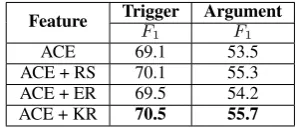
In this section, we prove the effectiveness of KR to find key arguments and explore the impact of dif-ferent numbers of key arguments to automatically generate data. We specifically select two methods as baselines for comparison with our KR method: ER and RS, which use the event relevance and role salience to sort arguments of each type of events respectively. Then we choose the same number of key arguments in all methods and use these key arguments to label data. After that we evaluate these methods by using above automatic evalua-tions based on ACE data. Results are shown in Ta-ble5. ACE+KR achieve the best performance in both stages. This demonstrates the effectiveness of our KR methods.
Feature TriggerF Argument
1 F1
ACE 69.1 53.5
ACE + RS 70.1 55.3 ACE + ER 69.5 54.2 ACE + KR 70.5 55.7
Table 5: Effects of ER, RS and KR
To explore the impact of different numbers of key arguments, we sort all arguments of each type
of events according to KR value and select topk
arguments as the key arguments. Examples are
shown in Table 2. Then we automatically
eval-uate the performance by using automatic
evalua-tions proposed above. Figure6shows the results,
[image:7.595.341.490.552.617.2]Figure 6: Effects of the number of key arguments
performance in both stages. Then, the F1 value
re-duces askgrows. The reason is that the heuristics
for data labeling are stricter askgrows. As a
re-sult, less training data is generated. For example,
if k = 2, we will get 25,797sentences labeled
aspeople.marriageevents and we will get534
la-beled sentences, ifk = 3. However, when we set
k = 1, although more labeled data are generated,
the precision could not be guaranteed.
Impact of Trigger Rate and FrameNet
In this section, we prove the effectiveness of TR and FrameNet to find triggers. We specifically s-elect two methods as baselines: TCF and TETF. TCF, TETF and TR respectively use the trigger candidate frequency, trigger event type frequen-cy and trigger rate to sort trigger candidates of each type of events. Then we generate initial trig-ger lexicon by using all trigtrig-ger candidates with high TCF value, TETF value or TR value. We
set these hyper parameters as0.8,0.9and0.8,
re-spectively, which are determined by grid search
from (0.5,0.6,0.7,0.8,0.9,1.0). FrameNet was
used to filter noisy verbal triggers and expand nominal triggers. Trigger examples generated by
TR+Framenet are shown in Table 2. Then we evaluate the performance of these methods by using above automatic evaluations. Results are
shown in Table6, Compared withACE+TCF and
ACE+TETF,ACE+TRgains a higher performance in both stages. It demonstrates the effectiveness of our TR methods. When we use FrameNet to
gen-erate triggers, compared with ACE+TR, we get a
1.0improvement on trigger classification and a1.7
improvement on argument classification. Such im-provements are higher than imim-provements gained by other methods (TCF, IEF, TR), which demon-strates the effectiveness of the usage of FrameNet.
Feature TriggerF Argument
1 F1
ACE 69.1 53.5
ACE + TCF 69.3 53.8
ACE + TETF 69.2 53.7
ACE + TR 69.5 54.0
[image:8.595.320.512.61.136.2]ACE + TR + FrameNet 70.5 55.7
Table 6: Effects of TCF, TETF,TR and FrameNet
5.5 Performance of DMCNN-MIL
Following previous work (Mintz et al., 2009) in
distant supervised RE, we evaluate our method in two ways: held-out and manual evaluation.
Held-out Evaluation
In the held-out evaluation, we hold out part of the Freebase event data during training, and compare newly discovered event instances against this held-out data. We use the following criteria to judge the correctness of each predicted event automati-cally: (1) An event is correct if its key arguments and event type match those of an event instance in Freebase; (2) An argument is correctly classified if its event type and argument role match those of any of the argument instance in the corresponding
Freebase event. Figure7 and Figure 8 show the
precision-recall (P-R) curves for each method in the two stages of event extraction respectively. We can see that multi-instance learning is effective to alleviate the noise problem in our distant super-vised event extraction.
Figure 7: P-R curves for
event classification. Figure 8: P-R curves forargument classification.
Human Evaluation
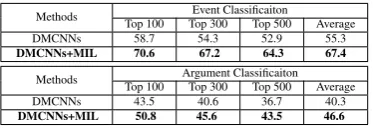
[image:8.595.307.525.490.581.2]Instead, we calculate the precision of the top n ex-tracted event instances. The human evaluation
re-sults are presented in Table 7. We can see that
DMCNNs-MIL achieves the best performance.
Methods Top 100 Top 300Event ClassificaitonTop 500 Average
DMCNNs 58.7 54.3 52.9 55.3
DMCNNs+MIL 70.6 67.2 64.3 67.4
Methods Top 100 Argument ClassificaitonTop 300 Top 500 Average
DMCNNs 43.5 40.6 36.7 40.3
[image:9.595.88.275.128.192.2]DMCNNs+MIL 50.8 45.6 43.5 46.6
Table 7: Precision for top 100, 300, and 500 events
6 Related Work
Most of previous event extraction work focused on supervised learning paradigm and trained even-t exeven-traceven-tors on human-annoeven-taeven-ted daeven-ta which yield
relatively high performance. (Ahn, 2006; Ji and
Grishman, 2008; Hong et al., 2011; McClosky
et al., 2011; Li et al., 2013, 2014; Chen et al.,
2015;Nguyen and Grishman,2015;Nguyen et al.,
2016). However, these supervised methods de-pend on the quality of the training data and la-beled training data is expensive to produce. Un-supervised methods can extract large numbers of events without using labeled data (Chambers and Jurafsky,2011;Cheung et al.,2013;Huang et al., 2016). But extracted events may not be easy to be mapped to events for a particular knowledge base. Distant supervision have been used in relation extraction for automatically labeling training
da-ta (Mintz et al.,2009;Hinton et al.,2012;Krause
et al., 2012; Krishnamurthy and Mitchell, 2012;
Berant et al., 2013; Surdeanu et al., 2012; Zeng
et al., 2015). But DS for RE cannot directly use
for EE. For the reasons that an event is more com-plicated than a relation and the task of EE is more difficult than RE. The best reported supervised RE
and EE system got a F1-score of 88.0% (Wang
et al.,2016) and55.4%(Nguyen et al.,2016)
re-spectively. Reschke et al. (2014) extended the
distant supervision approach to fill slots in plane crash. However, the method can only extract ar-guments of one plane crash type and need flight number strings as input. In other words, the ap-proach cannot extract whole event with different types automatically.
7 Conclusion and Future Work
In this paper, we present an approach to automati-cally label training data for EE. The experimental
results show the quality of our large scale auto-matically labeled data is competitive with elabo-rately human-annotated data. Also, we provide a DMCNN-MIL model for this data as a baseline for further research. In the future, we will use the proposed automatically data labeling method to more event types and explore more models to extract events by using automatically labeled data.
Acknowledgments
This work was supported by the Natural Science Foundation of China (No. 61533018) and the National Basic Research Program of China (No. 2014CB340503). And this research work was al-so supported by Google through focused research awards program.
References
David Ahn. 2006. The stages of event extraction. In Proceedings of the Workshop on Annotating and Reasoning About Time and Events. pages 1–8. http://dl.acm.org/citation.cfm?id=1629235.1629236.
Collin F Baker, Charles J Fillmore, and John B Lowe. 1998. The berkeley framenet project. In Proceed-ings of the 36th Annual Meeting of the Association for Computational Linguistics and 17th Internation-al Conference on ComputationInternation-al Linguistics. Asso-ciation for Computational Linguistics, pages 86–90. http://aclweb.org/anthology/C98-1013.
Jonathan Berant, Andrew Chou, Roy Frostig, and Percy Liang. 2013. Semantic parsing on free-base from question-answer pairs. In Proceed-ings of the 2013 Conference on Empirical Meth-ods in Natural Language Processing. Association for Computational Linguistics, pages 1533–1544. http://aclweb.org/anthology/D13-1160.
Kurt Bollacker, Colin Evans, Praveen Paritosh, Tim Sturge, and Jamie Taylor. 2008. Freebase: a collaboratively created graph database for struc-turing human knowledge. In Proceedings of the 2008 ACM SIGMOD international confer-ence on Management of data. pages 1247–1250. http://doi.acm.org/10.1145/1376616.1376746.
Nathanael Chambers and Dan Jurafsky. 2011. Template-based information extraction without the templates. In Proceedings of the 49th Annual Meeting of the Association for Computational Linguistics: Human Language Technologies. As-sociation for Computational Linguistics, pages 976–986. http://aclweb.org/anthology/P11-1098. Yubo Chen, Liheng Xu, Kang Liu, Daojian Zeng,
Meet-ing of the Association for Computational Lin-guistics and the 7th International Joint Confer-ence on Natural Language Processing. Associa-tion for ComputaAssocia-tional Linguistics, pages 167–176. https://doi.org/10.3115/v1/P15-1017.
Kit Jackie Chi Cheung, Hoifung Poon, and Lucy Van-derwende. 2013. Probabilistic frame induction. In Proceedings of the 2013 Conference of the North American Chapter of the Association for Computa-tional Linguistics: Human Language Technologies. Association for Computational Linguistics, pages 837–846. http://aclweb.org/anthology/N13-1104.
Geoffrey E Hinton, Nitish Srivastava, Alex Krizhevsky, Ilya Sutskever, and Ruslan R Salakhutdinov. 2012. Improving neural networks by preventing co-adaptation of feature detectors. arXiv preprint arX-iv:1207.0580https://arxiv.org/pdf/1207.0580.
Raphael Hoffmann, Congle Zhang, Xiao Ling, Luke Zettlemoyer, and S. Daniel Weld. 2011. Knowledge-based weak supervision for information extraction of overlapping relations. InProceedings of the 49th Annual Meeting of the Association for Computational Linguistics: Human Language Tech-nologies. Association for Computational Linguistic-s, pages 541–550. http://aclweb.org/anthology/P11-1055.
Yu Hong, Jianfeng Zhang, Bin Ma, Jianmin Yao, Guodong Zhou, and Qiaoming Zhu. 2011. Us-ing cross-entity inference to improve event extrac-tion. In Proceedings of the 49th Annual Meet-ing of the Association for Computational LMeet-inguis- Linguis-tics: Human Language Technologies. Association for Computational Linguistics, pages 1127–1136. http://aclweb.org/anthology/P11-1113.
Lifu Huang, Taylor Cassidy, Xiaocheng Feng, Heng Ji, Clare R. Voss, Jiawei Han, and Avirup Sil. 2016. Liberal event extraction and event schema induction. In Proceedings of the 54th Annual Meeting of the Association for Computational Linguistics. Associ-ation for ComputAssoci-ational Linguistics, pages 258–268. http://www.aclweb.org/anthology/P16-1025.
Heng Ji and Ralph Grishman. 2008. Refining event extraction through cross-document inference. In Proceedings of ACL-08: HLT. Association for Computational Linguistics, pages 254–262. http://aclweb.org/anthology/P08-1030.
Sebastian Krause, Hong Li, Hans Uszkoreit, and Feiyu Xu. 2012. Large-scale learning of relation-extraction rules with distant supervision from the web. In Proceedings of International Se-mantic Web Conference, Springer, pages 263– 278. http://link.springer.com/chapter/10.1007/978-3-642-35176-1 17.
Jayant Krishnamurthy and Tom Mitchell. 2012. Weak-ly supervised training of semantic parsers. In Pro-ceedings of the 2012 Joint Conference on Empiri-cal Methods in Natural Language Processing and
Computational Natural Language Learning. Associ-ation for ComputAssoci-ational Linguistics, pages 754–765. http://aclweb.org/anthology/D12-1069.
Qi Li, Heng Ji, Yu Hong, and Sujian Li. 2014. Con-structing information networks using one single model. In Proceedings of the 2014 Conference on Empirical Methods in Natural Language Pro-cessing. Association for Computational Linguistics, pages 1846–1851. https://doi.org/10.3115/v1/D14-1198.
Qi Li, Heng Ji, and Liang Huang. 2013. Joint event extraction via structured prediction with global fea-tures. InProceedings of the 51st Annual Meeting of the Association for Computational Linguistics. As-sociation for Computational Linguistics, pages 73– 82.http://aclweb.org/anthology/P13-1008.
Shulin Liu, Yubo Chen, Shizhu He, Kang Liu, and Jun Zhao. 2016. Leveraging framenet to im-prove automatic event detection. In Proceed-ings of the 54th Annual Meeting of the Associ-ation for ComputAssoci-ational Linguistics. Association for Computational Linguistics, pages 2134–2143. http://www.aclweb.org/anthology/P16-1201.
David McClosky, Mihai Surdeanu, and Christopher Manning. 2011. Event extraction as dependency parsing. InProceedings of the 49th Annual Meet-ing of the Association for Computational LMeet-inguis- Linguis-tics: Human Language Technologies. Association for Computational Linguistics, pages 1626–1635. http://aclweb.org/anthology/P11-1163.
Mike Mintz, Steven Bills, Rion Snow, and Daniel Ju-rafsky. 2009. Distant supervision for relation ex-traction without labeled data. InProceedings of the Joint Conference of the 47th Annual Meeting of the ACL and the 4th International Joint Conference on Natural Language Processing of the AFNLP. Asso-ciation for Computational Linguistics, pages 1003– 1011.http://aclweb.org/anthology/P09-1113.
Huu Thien Nguyen and Ralph Grishman. 2015. Event detection and domain adaptation with convolution-al neurconvolution-al networks. InProceedings of the 53rd An-nual Meeting of the Association for Computation-al Linguistics and the 7th InternationComputation-al Joint Con-ference on Natural Language Processing. Associa-tion for ComputaAssocia-tional Linguistics, pages 365–371. https://doi.org/10.3115/v1/P15-2060.
Thien Huu Nguyen, Kyunghyun Cho, and Ralph Grishman. 2016. Joint event extraction via re-current neural networks. In Proceedings of the 2016 Conference of the North American Chap-ter of the Association for Computational Linguis-tics: Human Language Technologies. Associa-tion for ComputaAssocia-tional Linguistics, pages 300–309. http://www.aclweb.org/anthology/N16-1034.
2014. Event extraction using distant supervi-sion. In Proceedings of the Ninth Internation-al Conference on Language Resources and E-valuation. pages 4527–4531. http://www.lrec-conf.org/proceedings/lrec2014/pdf/1127 Paper.pdf. Mihai Surdeanu, Julie Tibshirani, Ramesh Nallapati,
and D. Christopher Manning. 2012. Multi-instance multi-label learning for relation extraction. In Pro-ceedings of the 2012 Joint Conference on Empiri-cal Methods in Natural Language Processing and Computational Natural Language Learning. Associ-ation for ComputAssoci-ational Linguistics, pages 455–465. http://aclweb.org/anthology/D12-1042.
Joseph Turian, Lev-Arie Ratinov, and Yoshua Bengio. 2010. Word representations: A simple and gen-eral method for semi-supervised learning. In Pro-ceedings of the 48th Annual Meeting of the As-sociation for Computational Linguistics. Associa-tion for ComputaAssocia-tional Linguistics, pages 384–394. http://aclweb.org/anthology/P10-1040.
Linlin Wang, Zhu Cao, Gerard de Melo, and Zhiyuan Liu. 2016. Relation classification vi-a multi-level vi-attention cnns. In Proceedings of the 54th Annual Meeting of the Associa-tion for ComputaAssocia-tional Linguistics. Association for Computational Linguistics, pages 1298–1307. http://www.aclweb.org/anthology/P16-1123. Matthew D Zeiler. 2012. Adadelta: An adaptive
learn-ing rate method. arXiv preprint arXiv:1212.5701 https://arxiv.org/pdf/1212.5701.