Munich Personal RePEc Archive
Foreign currency lending
Delis, Manthos and Politsidis, Panagiotis and Sarno, Lucio
Montpellier Business School, University of Sydney, Cass Business
School
26 July 2018
Foreign currency lending
Manthos D. Delis
Montpellier Business School
Panagiotis N. Politsidis
University of Sydney
Lucio Sarno
Cass Business School and CEPR
Foreign currency lending
Abstract
Lending to corporates in foreign currencies can expose banks to substantial currency risk. Using global syndicated loan data, we find that a one-standard-deviation increase in exchange rate volatility increases loan spreads by approximately 20 basis points for loans made in a currency different from the lenders’. This implies excess interest of approximately USD 2.55 million for loans of average size and duration. We show that our finding is mostly attributed to credit constraints and deviations from perfect competition in international lending markets. Borrowers can lower the extra cost by forming strong lending relationships with their banks.
Keywords: Global syndicated loans; Foreign currency lending; Exchange rate risk; Bank market power; Relationship lending.
3
1. Introduction
Banks’ cross-border claims toward the nonbanking sector have expanded considerably in
recent decades, amounting to USD 13.1 trillion as of September 2017 (BIS, 2018). About 20%
(USD 2.6 trillion) of these claims are in foreign currencies, and the market is expanding
substantially toward emerging market economies. These facts naturally raise questions about
the role that exchange rate risk plays in international bank lending and, specifically, on the
pricing of loans in foreign currency. How important is the exchange rate risk banks bear when
lending in a different currency? Do banks pass this risk to their borrowers in the form of higher
cost of loans, and is this cost economically important? How different is this cost across
borrowing firms with different firm characteristics, riskiness, and lending relationships with
the banks? These are the questions addressed in this paper.
There are two sides to exchange rate risk in cross-border lending: foreign firms
borrowing in the lender’s currency - henceforth foreign-currency borrowing - which implies
exchange rate risk for the borrower (demand-side risk), and lending to foreign firms in the
borrower’s currency - henceforth foreign-currency lending - which implies exchange rate risk
for the lender (supply-side risk). Such foreign-currency lending has significantly increased over
the last three decades, despite the credit market freeze during the global financial crisis.
Syndicated foreign-currency lending reported in Dealscan reached about USD one trillion in
2015 and has surpassed syndicated foreign-currency borrowing since 2000 (Figure 1). In this
paper, we examine whether and how banks price exchange rate risk in foreign-currency
lending. Despite the existence of a substantial literature on cross-border lending
foreign-currency borrowing (e.g., Francis and Hunter, 2012; Brown, Kirschenmann, and Ongena, 2014;
Niepmann and Schmidt-Eisenlohr, 2017), the effect of exchange rate risk on foreign-currency
lending has not received much attention.
4 Exchange rate risk is costly for lenders, implying a higher lending rate or higher loan
fees. Higher lending costs create a competitive disadvantage for affected borrowers compared
to firms that can access the domestic credit market and thus face no exchange rate risk on their
loans. The higher cost of credit can have significant implications for the profitability and
international competitiveness of borrowers engaging in foreign currency lending, especially
given that in our data these firms appear on average to be less risky (i.e., they are more
profitable and have less leverage) than firms borrowing in the bank’s currency.
Our empirical analysis focuses on the causal effect of exchange rate risk on the cost of
credit and other corporate loan characteristics. We use data from the global syndicated loan
market. These data are ideal for our setting because they are at the loan level, which is helpful
to achieve adequate identification of causal effects, and they include bank loans to several
countries, provide information about several loan characteristics, and can be matched with the
exchange-rate conditions prior to loan origination.
The dataset covers the period 1984-2016, although most loans originate from 1994
onward, and includes more than 100,000 loan deals. Our main outcome variable is the
all-in-drawn spread (AISD), which includes the loan spread over LIBOR plus any facility fee. The
main explanatory variable is a measure of exchange rate risk based on the realized volatility of
the bilateral exchange rate between the borrower’s and the lender’s (i.e., the lead lenders of the
syndicate) countries over a one-month, three-month, or six-month period. Alternatively, we
use forward-looking measures of exchange rate risk (i.e., measures based on forward, rather
than spot, rates).
We draw causal inferences from an approach that has two important characteristics.
First, we compare the differential effect of exchange rate risk on the cost of credit between
loans denominated in a currency different from the lender’s currency (the treatment group) and
5 should have a strong effect only on the treatment group, and any effect on the control group
should reflect macroeconomic risk and ideally be captured by relevant macroeconomic control
variables. This approach is very similar to the differences-in-differences (DiD) approach by
Rajan and Zingales (1998), who identify the effect of financial development on growth, and of
many other studies from that point onward.
Second, the multiple loan facilities per firm every year allow the fielding of “firm times
year” fixed effects, which allows us to control for time-varying demand-side (firm-year) forces
that might affect the relation between exchange rate risk and loan spreads. Intuitively, these
forces include any exchange rate risk borrowers face - that is, the demand-side exchange rate
risk in foreign-currency borrowing documented in the previous literature (Francis and Hunter,
2012; Bergbrant, Francis, and Hunter, 2016; Niepmann and Schmidt-Eisenlohr, 2017).
We find that the effect of exchange rate risk on AISD is both statistically and
economically significant. For example, a one-standard-deviation increase in our measure of
exchange rate risk based on the three-month volatility of the exchange rate yields an AISD that
is approximately 20 basis points higher for loans made in a currency different from the lender’s
compared to those made in the lender's currency. Economically, this is a large effect, equal to
a 7% higher AISD compared to the average in our sample, highlighting a substantial cost to
borrowing firms vis-à-vis international competitors that (can) borrow in their bank’s currency.
We further show the importance of this cost by calculating the extra interest payments
for these firms. For the average loan size and maturity, an AISD that is 20 basis points higher
corresponds to approximately USD 2.55 million in higher interest expense over the loan’s
duration. Thus, we can infer that foreign exchange risk implies substantially higher cost of
credit for firms borrowing in a currency different than their lenders’ compared to firms
6 Several sensitivity tests show that these baseline findings are robust. The most
important of these tests are the following five. First, we use different sets of fixed effects (e.g.,
Jimenez et al., 2014). These include “bank times year” fixed effects that saturate the model
from time-varying bank-side explanations of the findings, as well as “country-per-year” fixed
effects that saturate the model from the effects of country-pair characteristics that might be
otherwise captured by our measures of exchange rate risk (e.g., Jimenez et al., 2014). Second,
we use specifications with different control variables to show that the results are not driven by
a “bad controls problem”. Third, given that the number of loans differs by country or
country-pair, we use a weighted-least-squares approach (e.g., Delis, Hasan, and Ongena, 2017). Fourth,
the results are robust when using a Heckman-type model, which considers the probability of a
firm borrowing in a currency different than the lenders’ currency to account for endogeneity
(Dass and Massa, 2011). Fifth, we show that our specifications are robust to the exclusion of
fixed effects and the inclusion of more than 30 control variables characterizing the within-year
monetary environment as well as institutional and economic differences between the lenders’
and borrowers’ countries.
We conduct additional analysis to understand the reasons behind our main finding on
the pricing of exchange rate risk in foreign-currency lending, especially given that banks can
hedge against this risk. First, we consider variation in liquidity of hedging instruments in the
foreign exchange market, measured using bid-ask data for forward rates across currencies and
time. Even though we find evidence that our liquidity measures directly affect the cost of credit,
the relation between exchange rate risk and the cost of credit remains intact whereas liquidity
does not cause heterogeneity in that relation, being unable to explain the differences in loan
pricing observed in the data across firms. Next, we turn to measures of credit constraints and
bank market power. We find that in countries with higher credit to the private sector as a share
7 Similarly, our main finding is significantly stronger as bank market power (measured by the
Lerner index) increases. Thus, we identify domestic credit constraints and market power of
lenders as the most significant factors causing heterogeneous effects in the nexus between
exchange rate risk and the cost of credit.
Overall, these findings yield the natural question of whether the affected firms can do
anything to remedy this competitive disadvantage. We consider two potential strategies. The
first involves firms formulating repeated lending relationships with their lead lender(s). We
provide evidence that firms with at least one more loan with the same lead arranger in the last
two years prior to the current loan are exposed to significantly lower cost of credit compared
to firms for which the current loan is the first with the specific lead lender. We thus contend
that establishing a long-term relationship with the lender is key to mitigate the increased cost
of credit due to exchange rate risk. The second strategy is to enhance the loan contract with
more covenants (or with specific covenants) and to change the structure of the syndicate by
including more banks in the loan syndicate or by changing the share of the lead lender.
However, we find that such practices do not mitigate the impact of exchange rate risk in loan
pricing equations, and that therefore cross-sectional variation in these aspects of the loan does
not affect the loan spreads.
The rest of the paper proceeds as follows. Section 2 highlights the reasons for
foreign-currency lending. It also relates our study to the existing literature and further highlights the
novelty of our work relative to that literature.Section 3 discusses the data set and the empirical
specification. Section 4 presents and discusses our main empirical results, showing the impact
of exchange rate risk on the cost of credit. Section 5 shows the importance of bank-firm
relationships as a remedy for the increased cost of credit. Section 6 concludes the paper. An
8
2. Motivation for foreign-currency lending and related literature
Banks lend to foreign firms in the firms’ currencies for two interrelated reasons. First, they
finance projects with positive net present values, and banks aim to overcome credit constraints
for the relevant firms. This is evident in the fact that most foreign-currency lending occurs from
banks in larger and more developed financial markets to firms in smaller and less developed
ones. 1 Second, foreign-currency loans might be more profitable than alternative lending
opportunities in the domestic market. Perhaps unsurprisingly, there is self-selection: firms
involved in foreign-currency lending are large, well-established, and profitable, with an
international focus for their operations (Allayannis et al., 2003; Brown and De Haas, 2012).
The three most closely related studies to ours are Francis and Hunter (2012), Bergbrant,
Francis, and Hunter (2016), and Niepmann and Schmidt-Eisenlohr (2017). The first two use
data on syndicated loans to analyze how firms’ general exposure to exchange rate risk (i.e.,
because of their foreign operations) affects the cost of credit. Firms’ exposure is measured by
the residual from a regression of firm returns on an exchange rate index and stock market
returns. The difference in the scope of these two papers compared to our study is the focus on
exchange rate risk of firms in general and not of foreign-currency lending, and the associated
implications for firms borrowing in a currency different than the lenders’ currency. In fact, in
our study we aim to control for such firm exchange rate risk (demand-side) and identify the
bank’s (supply-side) pricing of exchange rate risk.
Niepmann and Schmidt-Eisenlohr (2017) use loan-level data from U.S. banks’
regulatory filings and find that a firm with debt denominated in foreign currency is more likely
to become past due on its loans than a firm with local currency debt. This study is different
from ours because it focuses on what we define as foreign-currency borrowing (foreign firms
9 borrowing in the lender’s currency), and on the probability of loan non-repayment (i.e., credit
risk). Therefore, we address a different question in that we focus on the implications for the
cost of credit in foreign-currency lending.2
Several other studies relate to our research, with most of them analyzing the reasons for
cross-border lending. Brown, Kirschenmann, and Ongena (2014), for example, use unique data
on loans from a Bulgarian bank and show how the currency of the loan is determined. Brown
and De Haas (2012) show that foreign banks lend more in foreign currency to corporate clients,
but this is not because of better access to wholesale funding. Bacchetta and Merrouche (2016)
identify the reasons behind the increase in foreign-currency borrowing by European firms and
suggest that this occurs when European lending standards tighten and Euribor spreads increase.
Brown, Ongena, and Yeşin (2011) show that exchange rate volatility is not a key driver of
foreign currency borrowing, but what matters is weak corporate governance and the absence
of capital controls.
Further, there is a large literature on how exchange rate risk in general (not via lending)
affects firm performance. For example, Francis, Hasan, and Hunter (2008) show the
importance of exchange rate movements for returns across virtually all U.S. industries, by
separating the currency risk premium on industry stock returns into the component stemming
from industrialized countries and the component stemming from other important trading
partners from the emerging economies. Other relevant studies include Aghion et al. (2004), Kamil (2012), and Kim, Tesar, and Zhang (2015), among others. Finally, several other papers
look into the role of foreign bank presence (e.g., Bonin, Hasan, and Wachtel, 2005; Haselmann
and Wachtel, 2011; Bräuning, and Ivashina, 2017).
10 Overall, therefore, while we build on prior literature on cross-border bank lending, this
paper is the first to examine specifically foreign-currency lending and its implications for the
cost of credit and pricing of currency risk.
3. Data and empirical model
This main data source is Dealscan, which includes the most comprehensive loan-deal
information available on global syndicated loan markets. Our data set covers the period
1984-2016 but loan coverage for most countries starts in 1993-1994. We drop all loans for which
there is no conventional pricing (i.e., there is no spread) and this eliminates all types of Islamic
finance and very specialized credit lines. Dealscan includes loan facilities for multiple
participant banks, and we use the information at the loan facility level (the unit of our analysis).
The number of loan facilities for our baseline specifications ranges from 107,100 to 110,574,
depending on the controls used. These loans are drawn from firms operating in 87 countries.
We match the loans with bank-specific information from Bankscope; however, in most
of the analysis we use bank × year fixed effects that render bank-year characteristics redundant.
Similarly, by using firm × year fixed effects, we do not require any firm × year control
variables. In a third round of data collection, we match the resulting dataset with
macroeconomic (country-year) variables from several freely available sources. We provide
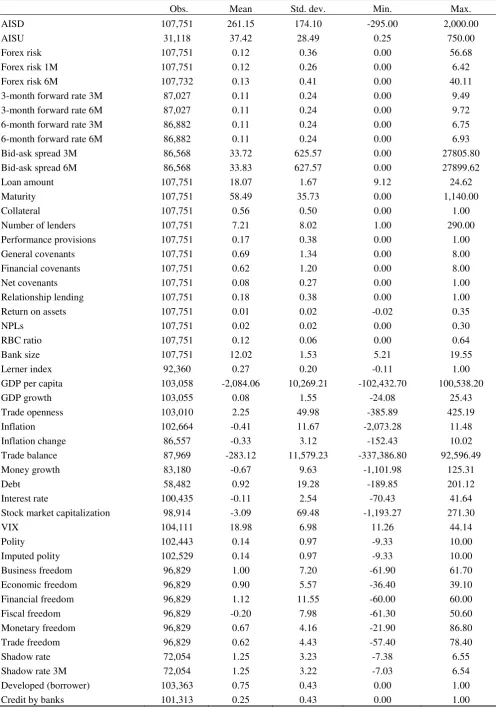
variable definitions and sources in Table A1 of the Internet Appendix and basic summary
statistics in Table 1. We provide additional summary statistics in Tables A2 and A3
(country-year averages and country-specific averages, respectively).
[Insert Table 1 about here]
In Table A4 of the Internet Appendix, we report the number of foreign-currency loans
(loans denominated in a currency different from the lender’s currency). Banks giving these
11 and constitute approximately 14.6% of the full sample (equal to 107,751 loans in our preferred
empirical specification). The relevant number of countries is 44. Essentially, our identification
method aims at comparing the different (high) Forex risk of foreign-currency lending (i.e., the treatment group) with the (low) Forex risk of the rest of the loans, where the lender’s currency is the same as the loan currency (i.e., the control group). The control group of loans faces Forex risk only to the extent that this risk affects the macroeconomic environment.
Empirical specification. Specifically, we use the following empirical model:
𝐶𝑜𝑠𝑡 𝑜𝑓 𝑐𝑟𝑒𝑑𝑖𝑡𝑙𝑡 = 𝑎0+ 𝑎1𝐹𝑜𝑟𝑒𝑥 𝑟𝑖𝑠𝑘𝑙𝑡+ 𝑎2𝐷𝑖𝑓𝑓𝑒𝑟𝑒𝑛𝑡 𝑐𝑢𝑟𝑟𝑒𝑛𝑐𝑦𝑙𝑡+ 𝑎3𝐹𝑜𝑟𝑒𝑥 𝑟𝑖𝑠𝑘𝑙𝑡×
𝐷𝑖𝑓𝑓𝑒𝑟𝑒𝑛𝑡 𝑐𝑢𝑟𝑟𝑒𝑛𝑐𝑦𝑙𝑡+ 𝑎4𝐶𝑜𝑛𝑡𝑟𝑜𝑙𝑠𝑘𝑡 + 𝑢𝑙𝑡 (1)
The outcome variable Cost of credit measures the cost of loan facility l originated at time t. The most widely used measure is the all-in-drawn spread (AISD), denoting the spread over LIBOR, although some recent literature (e.g., Berg, Saunders, Steffen, and Streitz, 2017) also
highlights the importance of fees and the all-in-spread undrawn (AISU). We define precisely these variables in Table A1.
Forex risk for each loan facility is the realized volatility of the bilateral exchange rate
between the borrower’s and the lender’s countries over an N-day period, or:
𝐹𝑜𝑟𝑒𝑥 𝑟𝑖𝑠𝑘𝑙𝑡 = √𝑁 ∑(𝐸𝑥𝑐ℎ𝑎𝑛𝑔𝑒 𝑟𝑎𝑡𝑒1 𝑎𝑏𝑖− 𝜇)2 𝑖𝑁
(2)
Essentially, equation (2) is the daily (percentage) change in the bilateral exchange rate between
one-12 month, three-month, and six-month periods preceding the origination date of the loan. For most
of our analysis, we use three-month Forex risk, assuming that banks look at the volatility of exchange rates over three months prior to the loan origination date.
In turn, Different currency equals 1 if the loan facility is originated in a currency
different from the lender’s currency, and zero otherwise. The vector 𝑎0 denotes different types
of fixed effects, described later. Controls is a vector of control variables of different dimension k. Finally, u is a stochastic disturbance. For detailed definitions, see Table A1.
The main coefficient of interest is 𝑎3, which shows the differential effect of Forex risk on the cost of credit between loans granted in the same and different currencies than the
currency of the lender. Differently phrased, we obtain identification from the fact that foreign
exchange risk affects the cost of loans made in a currency different from the lender’s currency
(the treatment group) compared to loans made in the lender’s currency (the control group). We
expect that 𝑎3 is positive if foreign exchange risk matters in foreign-currency lending and thus
increases the cost of credit for borrowing firms.
Moreover, the coefficient 𝑎1 shows how a one-point increase in Forex risk affects the cost of credit for all loans in the sample. If the model is well-identified, the interaction term
and the control variables should explain (most of) the effect of Forex risk on the cost of credit (i.e., 𝑎1 should be statistically insignificant). This is because the effect of foreign exchange risk
on the cost of loans made in the lender’s currency should be minimal or zero, especially when
controlling for macroeconomic risk.
Controls and fixed effects. We include several control variables and, perhaps most important, fixed effects. Following the relevant literature (e.g., Ivashina, 2009; Delis, Hasan,
and Ongena, 2017), we control for loan characteristics such as the log of the loan amount, loan
13 provisions and/or collateral, and the total number of covenants.3 For exact definitions of these
variables, see Table A1; for summary statistics, see Table 1.
Importantly, we use firm × year and bank × year fixed effects. The former allow us to
control for any time-varying demand (firm)-side explanations of our findings. These alternative
explanations include the firms’ (demand-side) exposure to exchange rate risk (as opposed to
the loan’s exposure that we examine in this study). The regression still yields results on the
main coefficients of interest because there are multiple loan facilities to the same firm within
years and Forex risk is identified within years.
In most of our specifications, we include the controls and fixed effects. We should note,
however, that if our DiD method approximates a randomized experiment, then the different
mix of fixed effects and control variables should not have a large effect on 𝑎3. We show that
this holds in numerous sensitivity tests. We also conduct sensitivity tests without sets of control
variables (especially the loan controls) to show that a “bad controls” problem does not affect
the results.
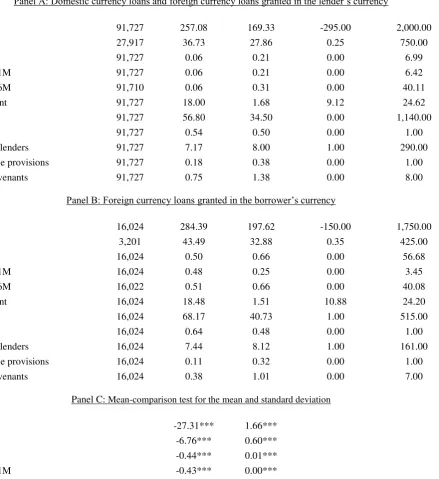
Key summary statistics. In Panels A and B of Table 2 we report summary statistics for key loan features and foreign exchange risk measures for the control and treatment groups,
respectively; Panel C reports their differences. We find that, on average, AISD is 27 basis points higher for firms receiving loans in their own currency compared to firms receiving loans in the
lead bank’s currency. This difference is statistically significant at the 1% level, and a similar
picture extends to AISU. In addition, loans in the borrower’s currency are more likely to be secured and have a higher number of lenders. In contrast, lenders attach fewer provisions and
covenants on these loans.
[Insert Table 2 about here]
14
4. The effect of exchange rate risk on the cost of credit
4.1. Baseline results
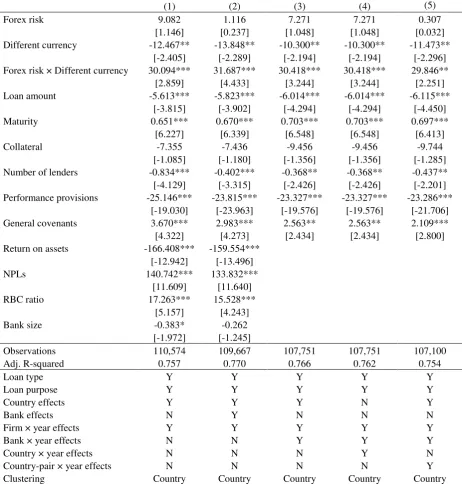
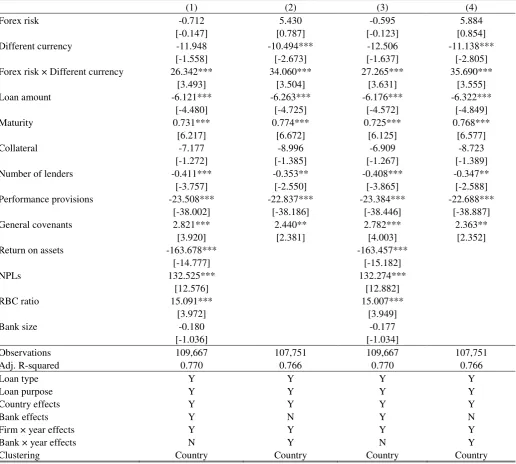
Table 3 reports our baseline results. The different specifications include different types of fixed
effects, with the more stringent one being that in column (5), which includes loan type, loan
purpose, country-pair × year, firm × year, and bank × year fixed effects. 4
[Insert Table 3 about here]
The coefficient on Forex risk is statistically insignificant, which is intuitive as foreign exchange risk should not affect AISD unless the loan is in another currency and bears some exchange rate risk. Also, the coefficient on Different currency is negative and statistically significant at conventional levels (equal to approximately 11.5 basis points, according to
specification 5). This is an interesting finding in itself, suggesting that when there is no foreign
exchange risk, foreign loans go to firms with a lower average AISD (i.e., less risky firms compared to domestic ones).
The main coefficient of interest 𝑎3 shows that a one-standard-deviation increase in
Forex risk increases AISD by an average of 20 basis points for loans made in a currency
different from the lender’s, compared to those made in the lender's domestic currency.
Economically, this is a large effect, equal to a 7% increase for the average loan in our sample.
Given that the average loan size is $259 million, firms facing exchange rate risk in their loans
thus pay, on average, approximately USD 0.52 million (=$259,000,000 ×20 basis points) per
year in excess interest in foreign currency lending operations. Considering that the average
time to maturity is 4.9 years, this represents approximately USD 2.55 million in extra interest
4 The use of different fixed effects does not qualitatively affect the coefficient on the interaction term between
15
expenses over the loan’s duration.5 Therefore, we can infer that foreign exchange risk
substantially raises the cost of loans for firms borrowing in their domestic currencies compared
to firms borrowing in the lead banks’ currency.
Let us illustrate the implication of this estimate for a country. Take, for example,
Australia. The average Forex risk for loans denominated in Australian dollars is 0.62 (i.e., approximately three times the average Forex risk for all loans to Australian firms regardless of their currency denomination; see Tables A3 and A4 of the Internet Appendix). When Forex risk is above its mean value, the average AISD on Australian dollar-denominated loans is 169.10 basis points. This is 18% higher compared to an average AISD of 143.33 basis points when Forex risk is below its mean.6 Looking at specific subperiods, the average Forex risk for loans where an Australian firm is the borrower was 0.50 in 2014, and the average AISD on loans to Australian firms denominated in Australian dollars was 199.06 basis points. However,
during 2015-2016, a period marked by a rise in the volatility of the Australian dollar, the
corresponding mean value for Forex risk was 0.68, while the average AISD surged to 267.19 basis points. Similar examples exist for other countries, among them countries with historically
high currency volatility, such as emerging market countries.
To illustrate the relative importance of exchange rate risk vis-à-vis the rest of the
explanatory variables, we also report standardized coefficients in Table A5 of the Internet
Appendix. The coefficient on the DiD is higher than any of the other loan and bank
characteristics, second only to the fixed effects. The effect of the control variables is generally
in line with our expectations and the recent literature on the determinants of loan spreads (e.g.,
Ferreira and Matos, 2012; Delis, Hasan, and Mylonidis 2017). Specifically, a higher loan
5 Assuming five annual payments and LIBOR as the discount rate, the increase in interest expense equals USD 2.3 million for an average 12-month LIBOR rate of 4.2% during our sample period (for similar calculations, see Ivashina and Sun, 2011).
16 amount and more syndicate members go hand-in-hand with the formation of the syndicate
(Ivashina, 2009), together implying lower spreads. Loans with longer maturities impose a
lengthier commitment for the syndicate members and thus carry a higher spread.
Performance-pricing provisions tie the spread to the firm’s financial condition, and thus their strong negative
effect on AISD is intuitive. The role of covenants is different and their effect is positive, as using such instruments implies riskier loans (Demiroglu and James, 2010).
Given that results from all specifications are consistent, we select specification in
column (3) of Table 3 as our baseline, so as to draw inferences from specifications including
both firm × year and bank × year fixed effects. However, for comparison, we also report in
most of the following tables the results from a specification without bank × year fixed effects,
as in column (2).
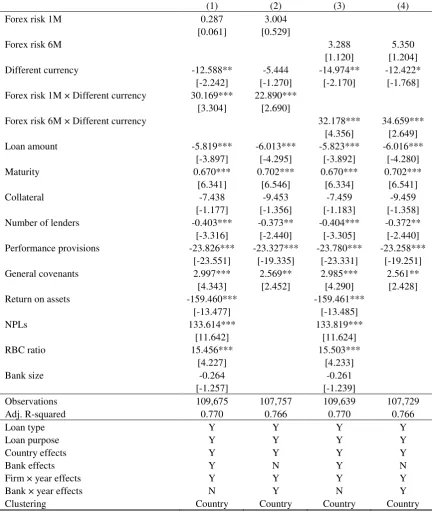
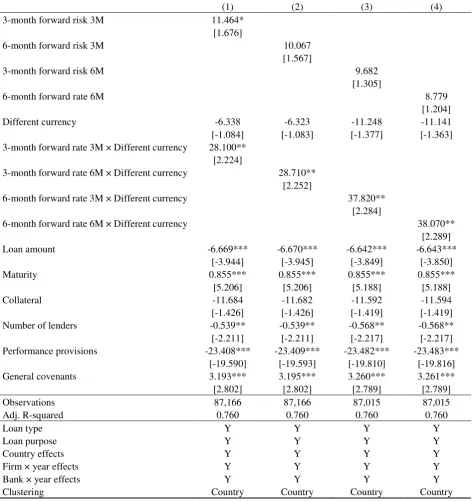
In Tables 4 and 5, we consider alternative foreign exchange risk measures. In columns
(1) and (2) of Table 4 we use the one-month version of our foreign exchange risk measure, and
in columns (3) and (4) we use the six-month version. Both measures provide similar results to
the baseline. Based on the similarity of the results, we conduct the rest of the analysis by
employing the three-month Forex measure, but all results carry through (and are sometimes slightly stronger) when using the other measures of foreign exchange risk.
Thus far, our findings are based on the assumption that volatility in spot exchange rates
provides accurate information about exchange rate risk as viewed by lenders. By nature, the
pricing of loan contracts is forward looking. Therefore, following the same methodology as for
the calculation of our baseline exchange rate risk measure, we construct forward-looking
exchange rate risk measures based on 3- and 6-month forward rates. We report results for these
measures in Table 5.7 In all specifications and regardless of the foreign exchange risk measure
17 employed, the DiD term has a positive and sizable effect on AISD, which increases with the maturity of the forward contract.
[Insert Tables 4 & 5 about here]
Subsequently, we sequentially exclude loan-level control variables from our
specifications. These tests address whether (i) these variables yield a “bad controls” problem
and (ii) any subgroup of variables exerts a disproportionate impact on our results.8 In the first
two specifications of Table 6, we omit all loan-level variables; and in (3) and (4), we only
include variables of a quantitative nature, namely Loan amount and Maturity. In the subsequent specifications, we exclude variables with qualitative information on the loan. This information
pertains to the existence of collateral and the number of lenders (columns 5 and 6), or the
existence of performance-pricing provisions and the number of general covenants attached to
the loan (columns 7 and 8).9
The coefficient on Forex risk × Different currency assumes values within the 25-31 basis points range, confirming the higher cost of credit for international loans when these loans
are denominated in the firm’s rather than the bank’s currency, ceteris paribus. Further, the
coefficient on Different currency is consistently negative, although not always significant at conventional significance levels, revealing that in the absence of foreign exchange risk, loans
carry a lower spread when made in the borrower’s currency.10
[Insert Table 6 about here]
Tables 3-6 reveal that the effect of control variables is generally in line with
expectations and with previous work by Ivashina (2009), Bae and Goyal (2009), Delis, Hasan,
and Ongena (2017), and Cai, Saunders, and Steffen (2018). In particular, loan spreads decrease
8The “bad controls” problem might arise due to differences in the composition of loans to a particular firm. 9 The replacement (or addition) of General covenants with Financial covenants or Net covenants leaves our results unchanged.
18 when loan amounts are lower and maturities increase. In addition, loans are more competitively
priced when more members participate in the syndicate or when there are more performance
provisions. Adding covenants, however, increases loan spreads. The behavior of the bank-level
variables (in the models without bank × year fixed effects), defined in Table A1, is also
intuitive: a higher return on bank assets is associated with a lower AISD, and higher nonperforming loans and risk-based capital ratios are associated with higher loan spreads. Last,
bank size does not appear to matter for syndicated loan pricing.
4.2. Weighted least squares
So far, we assume that all loans enter the model with equal weights. However, the majority of
loans denominated in foreign currency in the sample are to borrowers headquartered in
developing countries. U.S. borrowers are approximately 46% of total observations (see Table
A4 in the Internet Appendix). Normally, including country fixed effects in our baseline
specification (or the country × year and country-pair × year in alternative specifications)
provides a safeguard against cross-country variation. We nevertheless acknowledge that the
empirical specification might leave the analysis open to the critique that countries receiving
fewer loans might affect our results disproportionately. To this end, we re-estimate our
preferred model specification using weighted least squares.
We report the results in Table 7, from specifications that include weights by lender’s
country (columns 1 and 2) and by country-pair (columns 3 and 4).11 We find qualitatively
identical results to the baseline results, and indeed stronger results for the importance of foreign
exchange risk in loan pricing. The effect of Forex risk × Different currency on AISD is increased by 0.9-1.3 percentage points compared to the baseline results in Table 3, with spreads
11 We calculate weights by lender country as the number of loans from a given country in a given year to the total number of loans in that year. Weights by country-pair are the number of loans between a given country-pair (the
19 of 7.9% and 8.3% (columns 2 and 4). Concerning the coefficients on Forex risk, Different
currency, and the set of loan- and bank-level variables, their sign and level of statistical significance are generally the same as those found in the OLS specifications. We thus conclude
that, if anything, the baseline results are conservative.
[Insert Table 7 about here]
4.3. Results using AISU
Another extension of our analysis relates to the role of loan fees. Berg, Saunders, and Steffen
(2016) show that commitment plus facility fees, defined as the all-in-spread-undrawn (AISU), are larger for high-volatility firms. Thus, we might expect that higher volatility in bilateral
exchange rates raises the cost of foreign currency-denominated loans through higher fees.
Unfortunately, data on fees is generally not available or very limited in the global DealScan
data.
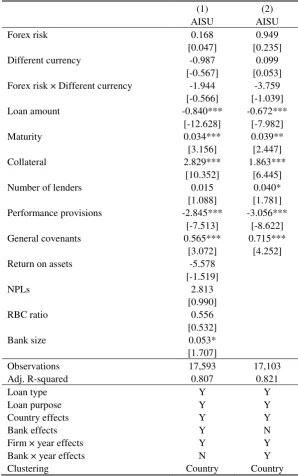
Nonetheless, in Table 8 we examine the baseline specification with AISU as the dependent variable. We do not detect a statistically significant effect of either Forex risk × Different currency or Different currency on AISU. Thus, it seems that the interaction of foreign exchange risk with the choice of currency denomination is only priced in spreads.
[Insert Table 8 about here]
4.4. Selection issues in foreign-currency lending
An endogeneity problem different from the ones discussed so far arises due to possible
selection in the firms’ decision to apply for foreign-currency lending. We do not expect this
problem to be severe in our context, as presumably if firms had a better financing alternative
they would use it. Nonetheless, to remedy a similar selection problem when using syndicated
20 using the syndicated loan market in the first stage of their model. Our approach here follows
this method. In the first stage, we use a probit model for the entire sample of loan facilities to
estimate the determinants of the firm’s decision to use foreign-currency lending. Subsequently,
in the second stage, we run the regression on the subsample of foreign-currency loan facilities.
Following Dass and Massa (2011), we assume that the firm’s decision to borrow from
foreign banks in domestic currency is a function of the main determinants of the decision to
borrow in general. These determinants include a set of loan-level characteristics; a set of
weights for the number, origin, and direction of loans made in a given year; and loan type, loan
purpose, year, bank, firm, and country dummies. We also include a number of firm-level
characteristics, namely return on assets (Firm return on assets), size (Firm size), the ratio of the market value of assets to the book value of assets (Tobin’s Q), the ratio of tangible assets
to total assets (Tangibility), and the ratio of total debt to total assets (Leverage). Finally, we include the number of loans a given bank makes in a given year (Lender loans), the number of loans for a given pair of lender and borrower countries in a given year (Country-pair loans), and the total number of loans granted in a given year (Total loans).
We report first- and second-stage results in Table A7 of the Internet Appendix (Panels
A and B, respectively). Focusing on probit estimates (Panel A), we observe that the higher the
return on assets and the size of the firm, the less likely foreign-currency lending is.
Unsurprisingly, firms decide to use this market if they require large loans; however, these loans
increasingly require collateral and performance-pricing provisions. The second-stage estimates
show that the effect of Forex risk on AISD is even more potent compared to our baseline estimates: spreads now rise by 10.9% to 14% in response to a one-standard-deviation increase
21 4.5. Differences between U.S. and European lenders
In this section, we examine potential differences in the effect of Forex risk on loans granted by U.S. and European Union (EU) lenders. Average spreads for syndicated loans are
approximately 30 basis points smaller in Europe (see Carey and Nini, 2007). However, this
difference in pricing is not confirmed when considering AISU (Berg, Saunders, Steffen, and Streitz, 2017). In Table A8, we interact our DiD term with USA (columns 1 and 2) and EU (columns 3 and 4). These are two binary variables representing loans granted by U.S. lenders
and EU lenders, respectively. Our double interaction term is statistically significant at
conventional levels across all four specifications, and its magnitude lies within the range
suggested by the baseline estimates. In contrast, triple interactions, albeit positive, are not
statistically significant, suggesting no differential effect for U.S. versus EU lenders. Hence,
when adding the coefficient on the triple interaction term to that on Forex risk × Different currency, the overall effect of exchange rate risk on loan spreads becomes even more pronounced.
4.6. Control for monetary policy
So far, our analysis uses bank × year and firm × year fixed effects to control for time-varying
country determinants of the cost of credit. An important determinant of exchange rates
within-year is the stance of monetary policy (e.g., Eichenbaum and Evans, 1995) and in this section
we consider controlling for monetary policy in equation (1). We do so for two interrelated
reasons. First, exchange rate volatility might capture changes in monetary policy, i.e. reflecting
omitted variable bias. Second, the risk-taking channel of monetary policy predicts a positive
relation between expansionary monetary policy and bank risk-taking.12 If low interest rates
22 entice banks to take more risk and there are systematic risk differences in international vs.
domestic lending unrelated to exchange rate risk, the interaction term Forex risk × Different currency might simply capture such risk differences induced by monetary shocks.
We examine the role of monetary policy using a subsample consisting of the U.S., the
Eurozone, Japan, and the UK. In these countries, we can better identify the stance of monetary
policy, especially using measures encompassing non-standard monetary policy post crisis.13
We use the shadow short rate (one- and three-month averages), which provides a more accurate
description of monetary policy stance when interest rates are near the zero lower bound,
compared to the actual short rate (Krippner, 2016; Von Borstel, Eickmeier, and Krippner,
2016). Following the risk-taking channel literature, we lag all measures of monetary policy by
one period.
The results in Table A9 show that our DiD term does not lose in explanatory power:
the magnitude is in fact stronger than in Table 3. The coefficients on each of the monetary
policy measures are negative and statistically significant, supporting the positive relation
between expansionary monetary policy and bank loan rates (i.e., a risk-taking channel). These
results are in line with Delis, Hasan, and Mylonidis (2017) and Paligorova and Santos (2017),
who use syndicated loans to identify the risk-taking channel in the United States. 14
4.7. Additional sensitivity tests
In columns (1) and (2) of Table A10, we control for the introduction of the euro by attaching
the same country number to each Eurozone country following the replacement of its national
13 The adoption of a single monetary policy in the Eurozone occurred concurrently with the initiation of the third stage of the Economic and Monetary Union (EMU) on January 1, 1999. Therefore, we conduct this exercise for 1999-2017. However, the results hold even when extending the subsample to the pre-1999 period (available on request).
23 currency. This change concerns our list of borrower countries, and thus the relevant fixed
effects or the clustering of standard errors should capture any related impact on our estimates.
Indeed, we document minimal changes in the results vis-à-vis the baseline.
Subsequently, we refine the loan facilities included in the sample according to their
type and purpose. In columns (3) and (4) we exclude all loans other than term and revolver
loans, which are the most conventional corporate loan deals. In columns (5) and (6) we exclude
loans for leveraged buyouts (LBOs) or mergers and acquisitions (M&As) because these can
lower the cost of credit by reducing the asymmetric information between the bank and the
borrowing firm (Ivashina and Kovner, 2011).15 In principle, the loan-type and loan-purpose
fixed effects used in the previous analysis should capture such discrepancies in loan pricing.
Again, the results from these exercises are similar to the baseline.
The remaining sensitivity tests represent alternative specifications for the ones reported
earlier. First, we control for differences in the macroeconomic, financial, and institutional
environment between the lenders’ and borrowers’ countries. These variables (defined in Table
A1) should correlate strongly with the country-pair × year fixed effects in column (5) of Table
3. However, using too many fixed effects might cloud inferences so that we should at least
verify that our results hold when using country-pair controls (differences in country-year
variables between the lenders’ and borrowers’ countries) instead. We do not use all indicators
at once, because they tend to have high pairwise correlations. For definitions of these variables,
see Table A1.
In Table A11, we use macroeconomic and financial market country-pair controls. We
initially consider GDP per capita and GDP growth and sequentially add different controls. The
results (columns 1 to 4) confirm the sign and size of the coefficient on Forex risk × Different
24 currency. When we consider a reduced sample due to data availability (columns 5 to 8), the interaction effect is even stronger. The estimates of these controls are intuitive. For example,
the larger the difference in GDP per capita between the country of the lender and the country
of the borrower, the larger the loan spread.
Next, we control for differences in institutional quality characteristics. These
characteristics matter for the functioning of financial markets in general (e.g., Acemoglu and
Johnson, 2005) and the pricing of loans in particular (Delis, Hasan, and Ongena, 2017). We
consequently expect borrower countries that lag behind lender countries in institutional
development to experience higher loan spreads for their firms.
Again, due to collinearity of our indicators of institutional democracy with the rest of
institutional variables, we adopt Imputed polity as the benchmark institutional control and consider additional controls henceforth. Being a dichotomous indicator, Imputed polity is ideal for identification purposes, as a change from 0 to 1 sends a strong signal to banks and thus
alters the information content used to price risk. The results in columns (1) to (8) of Table A12
confirm our expectations, because a one-point difference in Imputed polity between the country of the lender and the country of the borrower raises spreads by approximately 40 basis points.
For all specifications, the coefficient on Forex risk × Different currency is statistically significant at conventional levels and takes values within the 33-38 basis points range.
Further, to make sure that our inferences are not sensitive to the type of clustering (also
given the multilevel nature of our data), we also cluster standard errors by loan facility, bank,
firm, and by bank and firm and year (see Table A13). We note that the results are also robust
to the clustering of standard error by lender country or by lender country and borrower country
(results available on request).
Last, acknowledging the arguments on the link between exchange rates and
25 and Schmeling, 2014), we test whether various macro fundamentals drive our results. To this
end, we estimate specifications without bank × year fixed effects and include combinations of
specific macro variables that matter most for exchange rates, such as GDP growth, money
growth, the inflation rate (level and change), and the real interest rate. Columns (1) to (4) of
Table A14 show that although including these variables reduces the number of observations,
the coefficient on Forex risk × Different currency is still significant at the 1% level and within the range suggested by the previous estimations.
5. Understanding our results
The results in Section 4 provide evidence of differential loan pricing between firms borrowing
in their bank’s currency and firms borrowing in their own domestic currency. This differential
pricing should in theory be eliminated in the presence of uncovered interest rate parity, i.e., if
agents are risk neutral and form rational expectations, implying that they are indifferent with
respect to the currency of denomination, in which case interest rate differentials across
countries are exactly offset by expected future changes in exchange rates. If agents are risk
averse and thus uncovered interest rate parity does not hold, however, banks should be able to
hedge foreign exchange risk. In this case, the extra margin imposed in foreign currency lending
should, in a competitive market for lending, be equal to the cost of hedging. Our results show
that currency denomination constitutes an important determinant of foreign-currency loan
pricing. Having established that, in this section we perform a number of tests to better
understand the reasons behind our findings and, more generally, the heterogeneity of loan
pricing differentials across countries and currencies.16
26 5.1. Currency hedging
To examine this possibility, we consider that the cost of hedging should be related to the cost
of trading in a suitable currency derivative contract. Therefore, differentials in loan prices
should be higher for currencies that have higher trading costs, i.e. lower liquidity. We consider
the bid-ask spread on forward contracts as a proxy of the trading cost of such hedging of
currency risk.17 Specifically, we control in equation (1) for the bid-ask spread, using either the
bilateral 3- or 6-month forward exchange rate, and also interact it with Different currency. In essence, we assume that the cost of hedging a currency is proportional to its liquidity, as
measured by the bid-ask spread.
Results for the 3-month measure (column 1 of Table 9) show that the coefficient on the
bid-ask spread is positive and statistically significant, implying a higher cost of credit for all
loans when foreign exchange markets are less liquid. However, the estimate on the interaction
term Bid-ask spread × Different currency is statistically insignificant, failing to reveal an heterogeneous effect when the loan facility is granted in the currency of the borrower's country.
Using the triple interaction Forex risk × Bid-ask spread × Different currency (along with all the relevant main and double interactions) or measures based on the quoted spread (as in e.g.,
Goyenko and Ukhov, 2009) and the volatility of the bid-ask spread, again yields insignificant
coefficient estimates. We conclude that differences in liquidity across currencies in the foreign
exchange market, which usually translates into higher hedging costs, is associated with higher
cost of credit but this is irrespective of the loan currency denomination or the effect of exchange
rate risk on the cost of credit.
[Insert Table 9 about here]
27 5.2. Level of economic development
Our next step is to identify the set of countries in which our results prevail. We do so by
examining the heterogeneity of our main finding due to specific country characteristics that
potentially play an important role in determining the effect of exchange rate risk on the cost of
credit. In column (2) of Table 9, we introduce the triple interaction term Forex risk × Different currency × Developed (along with all the relevant main and double interactions). The variable Developed is binary, taking the value one if GDP per capita is above our sample’s mean and the value zero below the mean.18
The coefficients on the triple interaction and the double interaction are statistically
insignificant, but adding them in the regression produces a statistically significant estimate
(marginal effect) that is approximately equal to our baseline estimate. Importantly, the
coefficient on the triple interaction shows that most of the effect comes from developed
countries. Thus, these results imply that our finding is not related to country risk (already
captured by other macroeconomic indicators) but should be related to other structural
characteristics of the borrowers’ financial sector.
5.3. Credit constraints and market competition
Third, we consider the possibility that the firms’ decision to resort to international financing is
related to credit constraints in the domestic loan market and related deviations from
competition in the international lending market. If this is the case, we expect that the effect of
exchange rate risk is higher when borrowers face higher domestic credit constraints. To test
this hypothesis we introduce the triple interaction term between measures of credit constraints
and Forex risk × Different currency (again along with all the relevant main and double
28 interactions). Following a vast literature, we measure credit constraints using the ratio of credit
provided by banks over GDP (e.g., Beck, Demirgüç-Kunt, and Levine, 2010; Manova, 2012).
Similar to the analysis of developed vs. developing countries, we generate a dummy equal to
one if credit by banks over GDP is above our sample mean and the value zero if it is below that
mean (we name this variable Credit by banks). The results in column (3) of Table 9 suggest that the effect of exchange rate risk is less strong when Credit by banks equals one (lower credit constraints).
Naturally, this finding points to low banking market competition in lending as a
candidate to affect the relation between exchange rate risk and the cost of credit. To examine
the role of competition in more depth, we generate a bank-year measure of market power using
the approach of Delis, Kokas, and Ongena (2017). The merit of this approach (thoroughly
discussed in the Internet Appendix) is that it provides a Lerner index for each bank-year via
the estimation of a non-parametric (fully flexible) functional form of the cost function. Then,
similar to the rest of the specifications in Table 9, we use a triple interaction term including the
Lerner index. The results (column 4) show that a one standard deviation increase in the Lerner
index (equal to 0.2) implies an 8.6 basis points further increase in the cost of credit. Thus, the
effect of exchange rate risk on the cost of credit is indeed stronger when lenders possess higher
market power. 19
29 5.4. Relationship lending and loan structure
Our results thus far highlight an important competitive disadvantage of firms borrowing in a
currency different than their lender’s currency, which persists in a number of sensitivity tests
and is stronger for firms in developed countries but with relatively low levels of credit provided
by banks, as well as when lenders have higher market power. Naturally, these findings raise
the question of whether the affected borrowers can do something to lower the extra cost of
credit (that is besides being sound firms with profitable projects). In what follows, we focus on
two potential strategies: the first considers forming ties between firms and banks via repeated
lending (relationship lending); and the second considers the conditions of the particular loan
contract and the loan syndicate’s structure.
Previous lending between the lead bank and the firm implies that the bank gains
important information about the specific borrowing firm (e.g., its ability to repay and its
business model) as well as about the impact the exchange rate had on the value of the loan
repayments in the lender’s currency. This, ceteris paribus, lowers the respective informational asymmetry, and one may expect that the bank is more willing to share some of the exchange
rate risk with a borrowing firm that is a “repeat borrower” rather than transfer all of the
exchange rate risk. To test this hypothesis, we introduce a triple interaction between
Relationship lending (i.e., a dummy equal to one if the lead bank and the firm have at least one other loan in the last two years, see e.g., Bharath, Dahiya, Saunders, and Srinivasan, 2009) and
Forex risk × Different currency.
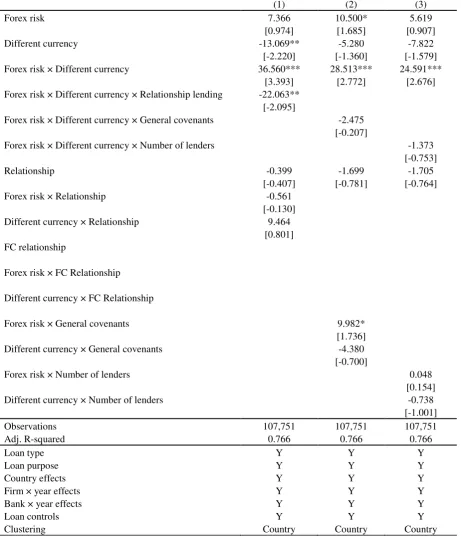
We report the results in the first column of Table 10. The coefficient on Forex risk ×
Different currency × Relationship lending shows that the borrower recovers approximately 60% of the higher cost due to exchange rate risk. In economic terms this is translated into
30
million over the loan’s duration. Thus, the presence of a prior lending relationship results in
the sharing of exchange rate risk between the lender and the borrower.
[Insert Table 10 about here]
The second strategy aiming to mitigate the effect of exchange rate risk on the cost of
credit concerns the structure of the loan. Two ways to achieve this objective are the inclusion
of tighter covenants to lower exchange rate risk and the addition of more syndicate members
to spread the risk across more banks.
Dealscan does not include information on covenants specific to exchange rate risk
because, most probably, such covenants do not exist (for a full review of covenant categories,
see Demiroglu and James, 2010; and Hasan, Hoi, Wu, and Zhang, 2014). However, it seems
plausible that lending in a different currency might imply higher covenant intensity. Following
Hasan, Hoi, Wu, and Zhang (2014), we measure total covenant intensity using the total number
of covenants (financial and general covenants) and introduce a triple interaction term between
this measure, Forex risk, and Different currency (as we did for Relationship lending in equation 3). The results in column (3) of Table 10 show that the triple interaction is statistically
insignificant. Repeating this analysis using specific loan covenants (e.g., the minimum current
ratio covenant and the maximum debt to earnings covenant as in Demiroglu and James, 2010)
does not affect the results.
We conduct a similar analysis with the Number of lenders in a triple interaction term and report the results in column (4) of Table 10. As in the previous column, we document a
statistically insignificant triple interaction. We additionally experiment with other variables on
the setup of the loan contract and the structure of the syndicate (e.g., using performance pricing
provisions and collateral, different loan size and maturity, different loan shares by the lead bank
vis-à-vis participant banks), but we fail to find results indicative of a reduced impact of
31 5.5. Summing up
Overall, the results in this section suggest that the international lending market is not a perfectly
competitive market. It is rather characterized by heterogeneous loan spreads depending on the
loan currency denomination and borrower credit constraints, even after controlling for loan
contract terms and the operation of the loan supply and loan demand channels. Aggravated by
price segmentation documented in the foreign exchange market (see Hau, Hoffmann,
Langfield, and Timmer, 2017), imperfect competition in international lending markets results
in divergent syndicated loan spreads when lenders are exposed to exchange rate risk.
6. Conclusions
The market for international lending in the borrower’s currency is large and growing. These
cross-border loans imply considerable exchange rate risk for banks lending in a currency that
is not their own. This study is the first to measure how this bank-side risk affects lending terms,
and particularly the cost of credit, in a broad cross-section of firms.
Using global loan-level data from the syndicated loan market, we show that lenders
place a significant cost on borrowers in foreign-currency lending. Our baseline specification
suggests that a one-standard-deviation increase in exchange rate risk increases loan spreads by
approximately 20 basis points for loans made in a currency different from the lenders’
compared to those made in the lenders’ currency. These results are robust to several changes
in the baseline specification and alternative estimation methods.
The data also show that firms borrowing from foreign banks in their domestic currency
are, on average, less risky than those borrowing in the banks’ domestic currency. Apart from
implying that our baseline results are rather conservative, this reflects a cost of first-order
importance for healthy firms facing credit constraints in their domestic banking markets. We
32 0.52 million per year or USD 2.55 million when considering the average loan maturity. Thus,
firms with no better financing alternatives have a significant competitive disadvantage
compared to firms borrowing in their banks’ currency due to foreign exchange risk.
With the aim to identify the factors affecting the relation between exchange rate risk
and the cost of credit, we show the key role played by credit constraints and bank market power.
Specifically, in countries with a high ratio of domestic credit provided by banks over GDP, the
effect of exchange rate risk on the cost of credit is significantly weaker. In contrast, the same
effect is significantly stronger as the market power of the bank lending in foreign currency
increases. Is there a remedy against this excessive cost of credit and the associated competitive
disadvantage of the affected firms? Among the remedies considered here, repeated lending
with the same bank (formation of relationship lending) is the only one yielding significantly
lower cost of credit and some degree of risk sharing between lending banks and borrowing
firms.
References
Aghion, P., Bacchetta, P., Banerjee, A., 2004. A corporate balance-sheet approach to currency
crises. Journal of Economic Theory 119, 6-30.
Allayannis, G., Brown, G.W., Klapper, L.F., 2003. Capital structure and financial risk:
Evidence from foreign debt use in East Asia. Journal of Finance 58, 2667-2710.
Altunbas, Y., Gambacorta, L., Marquéz-Ibáñez, D., 2014. Does monetary policy affect bank
risk taking? International Journal of Central Banking 10, 95-135.
Bacchetta, P., Merrouche, O., 2016.Countercyclical foreign currency borrowing: Eurozone
firms in 2007-2009. Swiss Finance Institute Research Paper No. 15-63.
Bae, K.H., Goyal, V.K., 2009. Creditor rights, enforcement, and bank loans. Journal of Finance
33 Beck, T., Demirgüç-Kunt, A., Levine, R., 2010. Financial institutions and markets across
countries and over time: The updated financial development and structure database. The
World Bank Economic Review, 24(1), 77-92.
Berg, T., Saunders, A., Steffen, S., 2016. The total cost of corporate borrowing in the loan
market: Don't ignore the fees. Journal of Finance 71, 1357-1392.
Berg, T., Saunders, A., Steffen, S., Streitz, D., 2017. Mind the gap: The difference between US
and European loan rates. Review of Financial Studies 30, 948-987.
Bergbrant, M.C., Francis, B.B., Hunter, D.M., 2016. Bank loan contracting and firms’
unhedged currency risk. Available at: http://www.fmaconferences.org/Lisbon/Papers/
FX_exposure& loan_cost_12_01_2016.pdf.
Bharath, S.T., Dahiya, S., Saunders, A., Srinivasan, A., 2009. Lending relationships and loan
contract terms. Review of Financial Studies 24, 1141-1203.
Bonin. J.P., Hasan, I., Wachtel, P., 2005. Bank performance, efficiency and ownership in
transition countries. Journal of Banking and Finance 29, 31-53.
Bräuning, F., Ivashina, V., 2017. Monetary policy and global banking. National Bureau of
Economic Research Working Paper No. w23316.
Brown, M., De Haas, R., 2012. Foreign banks and foreign currency lending in emerging
Europe. Economic Policy 27, 57-98.
Brown, M., Kirschenmann, K., Ongena, S., 2014. Bank funding, securitization, and loan terms:
Evidence from foreign currency lending. Journal of Money, Credit and Banking 46,
1506-1534.
Brown, M., Ongena, S., Yeşin, P., 2011. Foreign currency borrowing by small firms in the
transition economies. Journal of Financial Intermediation 20, 285-302.
Cai, J., Saunders, A., Steffen, S., 2018. Syndication, interconnectedness, and systemic risk.
34 Carey, M., Nini, G., 2007. Is the corporate loan market globally integrated? A pricing puzzle.
Journal of Finance 62, 2969-3007.
Dass, N., Massa, M., 2011. The impact of a strong bank-firm relationship on the borrowing
firm. The Review of Financial Studies, 24(4), 1204-1260.
Delis, M.D., Hasan, I., Mylonidis, N., 2017. The risk‐taking channel of monetary policy in the
U.S.: Evidence from corporate loan data. Journal of Money, Credit and Banking 49,
187-213.
Delis, M.D., Hasan, I., Ongena, S., 2017. Democracy and credit: 'Democracy doesn't come
cheap' but at least credit to its corporations will be. CEPR Discussion Paper No. DP11840.
Delis, M. D., Kokas, S., Ongena, S., 2017. Bank market power and firm performance. Review
of Finance, 21(1), 299-326.
Dell'Ariccia, G., Laeven, L., Suarez, G.A., 2017. Bank leverage and monetary policy's risk‐
taking channel: Evidence from the United States. Journal of Finance 72, 613-654.
Demiroglu, C., James, C.M., 2010. The information content of bank loan covenants. Review
of Financial Studies 23, 3700-3737.
Eichenbaum, M., Evans, C.L., 1995. Some empirical evidence on the effects of shocks to
monetary policy on exchange rates. Quarterly Journal of Economics 110, 975-1009.
Francis, B.B., Hasan, I., Hunter, D.M., 2008. Can hedging tell the full story? Reconciling
differences in United States aggregate-and industry-level exchange rate risk premium.
Journal of Financial Economics 90, 169-196.
Francis, B.B., Hunter, D.M., 2012. Exchange rate exposure and the cost of debt: Evidence from
bank loans. Available at: http://www.bcb.gov.br/pec/depep/Seminarios/2012_VIISem
RiscosBCB/Arquivos/2012_VIISemRiscosBCB_Bill_Francis.pdf.
Goyenko, R. Y., Ukhov, A. D., 2009. Stock and bond market liquidity: A long-run empirical
35 Hadenius, A., Teorell, J., 2007. Pathways from authoritarianism. Journal of Democracy 18,
143-157.
Hasan, I., Hoi, C.K., Wu, Q., Zhang, H., 2014. Beauty is in the eye of the beholder: The effect
of corporate tax avoidance on the cost of bank loans. Journal of Financial Economics 113,
109-130.
Haselmann, R., Wachtel, P., 2011. Foreign banks in syndicated loan markets. Journal of
Banking and Finance 35, 2679-2689.
Hau, H., Hoffmann, P., Langfield, S., Timmer, Y., 2017. Discriminatory Pricing of
Over-the-Counter Derivatives.
Ilzetzki, E., Reinhart, C.M., Rogoff, K.S., 2017. Exchange arrangements entering the 21st
century: Which anchor will hold? National Bureau of Economic Research Working paper
No. w23134.
Ivashina, V., 2009. Asymmetric information effects on loan spreads. Journal of Financial
Economics 92, 300-319.
Ivashina, V., Sun, Z., 2011. Institutional stock trading on loan market information. Journal of
Financial Economics 100, 284-303.
Jiménez, G., Ongena, S., Peydró, J. L., Saurina, J., 2014. Hazardous Times for Monetary
Policy: What Do Twenty‐Three Million Bank Loans Say About the Effects of Monetary
Policy on Credit Risk‐Taking?. Econometrica, 82(2), 463-505.
Kamil, H., 2012. How do exchange rate regimes affect firms’ incentives to hedge currency
risk? Micro evidence for Latin America. IMF Working Papers 12/69, International
Monetary Fund.
Kim, Y.J., Tesar, L.L., Zhang, J., 2015. The impact of foreign liabilities on small firms:
36 Krippner, L., 2016. Documentation for measures of monetary policy. Reserve Bank of New
Zealand. Wellington, New Zealand.
Manova, K., 2012. Credit constraints, heterogeneous firms, and international trade. Review of
Economic Studies, 80(2), 711-744.
Niepmann, F., Schmidt-Eisenlohr, T., 2017. Foreign currency loans and credit risk: Evidence
from U.S. banks. Available at SSRN: https://ssrn.com/abstract=3032520.
Paligorova, T., Santos, J.A., 2017. Monetary policy and bank risk-taking: Evidence from the
corporate loan market. Journal of Financial Intermediation 30, 35-49.
Teorell, J., Dahlberg, S., Holmberg, S., Rothstein, B., Khomenko, A., Svensson, R., 2017. The
quality of government standard dataset, version Jan. 17. University of Gothenburg: The
Quality of Government Institute.
Sarno, L., Schmeling, M., 2014. Which fundamentals drive exchange rates? A cross‐sectional
perspective. Journal of Money, Credit and Banking 46, 267-292.
Von Borstel, J., Eickmeier, S., Krippner, L., 2016. The interest rate pass-through in the euro
area during the sovereign debt crisis. Journal of International Money and Finance 68,