Simplifying Lexical Simplification:
Do We Need Simplified Corpora?
Goran GlavaˇsUniversity of Zagreb Faculty of Electrical Engineering
and Computing [email protected]
Sanja ˇStajner
University of Wolverhampton Research Group in Computational Linguistics [email protected]
Abstract
Simplification of lexically complex texts, by replacing complex words with their simpler synonyms, helps non-native speakers, children, and language-impaired people understand text better. Recent lexical simplification methods rely on manually simplified corpora, which are expensive and time-consuming to build. We present an unsupervised approach to lexical simplification that makes use of the most recent word vector representations and requires only regular corpora. Results of both automated and human evaluation show that our simple method is as ef-fective as systems that rely on simplified corpora.
1 Introduction
Lexical complexity makes text difficult to under-stand for various groups of people: non-native speakers (Petersen and Ostendorf, 2007), chil-dren (De Belder and Moens, 2010), people with intellectual disabilities (Feng, 2009; Saggion et al., 2015), and language-impaired people such as autistic (Martos et al., 2012), aphasic (Car-roll et al., 1998), and dyslexic (Rello, 2012) peo-ple. Automatic simplification that replaces com-plex words with their simpler synonyms is thus needed to make texts more understandable for ev-eryone.
Lexical simplification systems still predomi-nantly use a set of rules for substituting long and infrequent words with their shorter and more fre-quent synonyms (Devlin and Tait, 1998; De Belder and Moens, 2010). In generating the substitution rules (i.e., finding simple synonyms of a complex word), most systems refer to lexico-semantic re-sources like WordNet (Fellbaum, 1998). The non-existence of lexicons like WordNet for a vast
num-ber of languages diminishes the impact of these simplification methods.
The emergence of the Simple Wikipedia1 shifted the focus towards the data-driven ap-proaches to lexical simplification, ranging from unsupervised methods leveraging either the meta-data (Yatskar et al., 2010) or co-occurrence statis-tics of the simplified corpora (Biran et al., 2011) to supervised methods learning substitutions from the sentence-aligned corpora (Horn et al., 2014). Using simplified corpora improves the simplifica-tion performance, but reduces method applicabil-ity to the few languages for which such corpora exist.
The research question motivating this work re-lates to achieving comparable simplification per-formance without resorting to simplified corpora or lexicons like WordNet. Observing that “sim-ple” words appear in regular (i.e., “complex”, not simplified) text as well, we exploit recent ad-vances in word vector representations (Penning-ton et al., 2014) to find suitable simplifications for complex words. We evaluate the performance of our resource-light approach (1) automatically, on two existing lexical simplification datasets and (2) manually, via human judgements of grammatical-ity, simplicgrammatical-ity, and meaning preservation. The ob-tained results support the claim that effective lex-ical simplification can be achieved without using simplified corpora.
2 Related Work
Systems for lexical simplification are still domi-nantly rule-based, i.e., they rely on a set of sub-stitutions, each consisting of a complex word and its simpler synonym, which are in most cases ap-plied regardless of the context in which the com-plex word appears. Constructing substitution rules involves identifying synonyms, usually in
Word-1https://simple.wikipedia.org
Net, for a predefined set of complex words (Car-roll et al., 1998; Bautista et al., 2009), and then choosing the “simplest” of these synonyms, typ-ically using some frequency-based (Devlin and Tait, 1998; De Belder and Moens, 2010) or length-based heuristics (Bautista et al., 2009). The main shortcomings of the rule-based systems include low recall (De Belder and Moens, 2010) and mis-classification of simple words as complex (and vice versa) (Shardlow, 2014).
The paradigm shift from knowledge-based to data-driven simplification came with the creation of Simple Wikipedia, which, aligned with the “original” Wikipedia, constitutes a large compara-ble corpus to learn from. Yatskar et al. (2010) used the edit history of Simple Wikipedia to recognize lexical simplifications. They employed a proba-bilistic model to discern simplification edits from other types of content changes. Biran et al. (2011) presented an unsupervised method for learning substitution pairs from a corpus of comparable texts from Wikipedia and Simple Wikipedia, al-though they exploited the (co-)occurrence statis-tics of the simplified corpora rather than its meta-data. Horn et al. (2014) proposed a supervised framework for learning simplification rules. Using a sentence-aligned simplified corpus, they gener-ated the candidate rules for lexical simplification. A context-aware binary classifier, trained and eval-uated on 500 Wikipedia sentences (annotated via crowdsourcing), then decides whether a candidate rule should be applied or not in a certain context.
The main limitation of the aforementioned methods is the dependence on simplified corpora and WordNet. In contrast, we propose a resource-light approach to lexical simplification that re-quires only a sufficiently large corpus of regular text, making it applicable to the many languages lacking these resources.
3 Resource-Light Lexical Simplification
At the core of our lexical simplification method, which we name LIGHT-LS, is the observation that
“simple” words, besides being frequent in simpli-fied text, are also present in abundance in regu-lar text. This would mean that we can find sim-pler synonyms of complex words in regular cor-pora, provided that reliable methods for measuring (1) the “complexity” of the word and (2) semantic similarity of words are available. LIGHT-LS
sim-plifies only single words, but we fully account for
this in the evaluation, i.e., LIGHT-LS is penalised
for not simplifying multi-word expressions. In this work, we associate word complexity with the com-monness of the word in the corpus, and not with the length of the word.
3.1 Simplification Candidate Selection We employ GloVe (Pennington et al., 2014), a state-of-the-art model of distributional lexical se-mantics to obtain vector representations for all corpus words. The semantic similarity of two words is computed as the cosine of the angle be-tween their corresponding GloVe vectors. For each content word (noun, verb, adjective, or ad-verb)w, we select as simplification candidates the topn words whose GloVe vectors are most sim-ilar to that of word w. In all experiments, we used 200-dimensional GloVe vectors pretrained on the merge of the English Wikipedia and Gigaword 5 corpus.2 For each content word w, we select n = 10most similar candidate words, excluding the morphological derivations ofw.
3.2 Goodness-of-Simplification Features We rank the simplification candidates according to several features. Each of the features captures one aspect of the suitability of the candidate word to replace the original word. The following are the descriptions for each of the features.
Semantic similarity. This feature is computed as the cosine of the angle between the GloVe vector of the original word and the GloVe vector of the simplification candidate.
Context similarity. Since type-based distri-butional lexico-semantic models do not discern senses of polysemous words, considering only se-mantic similarity between the original and can-didate word may lead to choosing a synonym of the wrong sense as simplification of the complex word. The simplification candidates that are syn-onyms of the correct sense of the original word should be more semantically similar to the context of the original word. Therefore, we compute this feature by averaging the semantic similarities of the simplification candidate and each content word from the context of the original word:
csim(w, c) = |C(1w)| X
w0∈C(w)
cos(vw,vw0)
2http://www-nlp.stanford.edu/data/
whereC(w)is the set of context words of the orig-inal word w and vw is the GloVe vector of the word w. We use as context a symmetric window of size three around the content word.
Difference of information contents.The primary purpose of this feature is to determine whether the simplification candidate is more informative than the original word. Under the hypothesis that the word’s informativeness correlates with its com-plexity (Devlin and Unthank, 2006), we choose the candidate which is less informative than the original word. The complexity of the word is es-timated by its information content (ic), computed as follows:
ic(w) =−logP freq(w) + 1
w0∈Cfreq(w0) + 1 wherefreq(w)is the frequency of the wordwin a large corpusC, which, in our case, was the Google Book Ngrams corpus (Michel et al., 2011). The final feature value is the difference between the information contents of the original word and the simplification candidate, approximating the com-plexity reduction (or gain) that would be intro-duced should the simplification candidate replace the original word.
Language model features.The rationale for hav-ing language model features is obvious – a sim-plification candidate is more likely to be a com-patible substitute if it fits into the sequence of words preceding and following the original word. Letw−2w−1ww1w2 be the context of the original
word w. We consider a simplification candidate cto be a good substitute forwifw−2w−1cw1w2
is a likely sequence according to the language model. We employed the Berkeley language model (Pauls and Klein, 2011) to compute the likelihoods. Since Berkeley LM contains only bi-grams and tribi-grams, we retrieve the likelihoods for ngrams w−1c, cw1, w−2w−1c, cw1w2, and
w−1cw1, for each simplification candidatec.
3.3 Simplification Algorithm
The overall simplification algorithm is given in Al-gorithm 1. Upon retrieving the simplification can-didates for each content word (line 4), we compute each of the features for each of the simplification candidates (lines 5–8) and rank the candidates ac-cording to feature scores (line 9). We choose as the best candidate the one with the highest aver-age rank over all features (line 12). One impor-tant thing to notice is, that even though LIGHT-LS
Algorithm 1:Simplify(tt)
1: subst ←∅
2: for eachcontent tokent∈tt do 3: all ranks ←∅
4: scs ←most similar(t)
5: for eachfeaturef do 6: scores ←∅
7: for eachsc∈scsdo 8: scores ←scores∪f(sc) 9: rank ←rank numbers(scores) 10: all ranks ←all ranks∪rank
11: avg rank ←average(all ranks) 12: best ←argmaxsc(avg rank) 13: ific(best)<ic(tt)do
14: bpos ←in pos(best,pos(tt)) 15: subst ←subst ∪(tt, bpos) 16: returnsubst
has no dedicated component for deciding whether simplifying a word is necessary, it accounts for this implicitly by performing the simplification only if the best candidate has lower information content than the original word (lines 13–15). Since simplification candidates need not have the same POS tag as the original word, to preserve gram-maticality, we transform the chosen candidate into the morphological form that matches the POS-tag of the original word (line 14) using the NodeBox Linguistics tool.3
4 Evaluation
We evaluate the effectiveness of LIGHT-LS
auto-matically on two different datasets but we also let humans judge the quality of LIGHT-LS’s
simplifi-cations.
4.1 Replacement Task
We first evaluated LIGHT-LS on the dataset
crowdsourced by Horn et al. (2014) where manual simplifications for each target word were collected from 50 people. We used the same three evalua-tion metrics as Horn et al. (2014): (1)precisionis the percentage of correct simplifications (i.e., the system simplification was found in the list of man-ual simplifications) out of all the simplifications made by the system; (2)changedis the percentage of target words changed by the system; and (3)
ac-curacyis the percentage of correct simplifications
Table 1: Performance on the replacement task
Model Precision Accuracy Changed Biran et al. (2011) 71.4 3.4 5.2 Horn et al. (2014) 76.1 66.3 86.3
LIGHT-LS 71.0 68.2 96.0
LIGHT-LS’s performance on this dataset is
shown in Table 1 along with the performance of the supervised system by Horn et al. (2014) and the unsupervised system by Biran et al. (2011), which both used simplified corpora. The results show that LIGHT-LS significantly outperforms the
unsupervised system of Biran et al. (2011) and performs comparably to the supervised system of Horn et al. (2014), which requires sentence-aligned simplified corpora. The unsupervised sys-tem of Biran et al. (2011) achieves precision sim-ilar to that of LIGHT-LS but at the cost of
chang-ing only about 5% of complex words, which re-sults in very low accuracy. Our method numeri-cally outperforms the supervised method of Horn et al. (2014), but the difference is not statistically significant.
4.2 Ranking Task
We next evaluated LIGHT-LS on the
SemEval-2012 lexical simplification task for English (Spe-cia et al., 2012), which focused on ranking a target word (in a context) and three candidate replace-ments, from the simplest to the most complex. To account for the peculiarity of the task where the target word is also one of the simplification can-didates, we modified the features as follows (oth-erwise, an unfair advantage would be given to the target word): (1) we excluded the semantic
sim-ilarity feature, and (2) we used the information
content of the candidate instead of the difference of information contents.
We used the official SemEval task evaluation script to compute the Cohen’s kappa index for the agreement on the ordering for each pair of can-didates. The performance of LIGHT-LS together
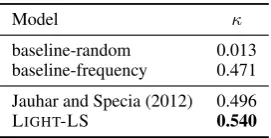
with results of the best-performing system (Jauhar and Specia, 2012) from the SemEval-2012 task and two baselines (random and frequency-based) is given in Table 2. LIGHT-LS significantly
[image:4.595.349.485.87.156.2]out-performs the supervised model by Jauhar and Spe-cia (2012) with p < 0.05, according to the non-parametric stratified shuffling test (Yeh, 2000). An interesting observation is that the competitive frequency-based baseline highly correlates with
Table 2: SemEval-2012 Task 1 performance
Model κ
baseline-random 0.013 baseline-frequency 0.471 Jauhar and Specia (2012) 0.496
LIGHT-LS 0.540
our information content-based feature (the higher the frequency, the lower the information content). 4.3 Human Evaluation
Although automated task-specific evaluations pro-vide useful indications of a method’s performance, they are not as reliable as human assessment of simplification quality. In line with previous work (Woodsend and Lapata, 2011; Wubben et al., 2012), we let human evaluators judge the gram-maticality, simplicity, and meaning preservation of the simplified text. We compiled a dataset of 80 sentence-aligned pairs from Wikipedia and Simple Wikipedia and simplified the original sentences with LIGHT-LS and the publicly available system
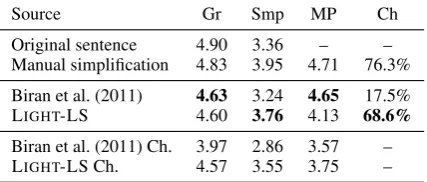
of Biran et al. (2011). We then let two annota-tors (with prior experience in simplification an-notations) grade grammaticality and simplicity for the manual simplification from Simple Wikipedia and simplifications produced by each of the two systems (total of 320 annotations per annotator). We also paired the original sentence with each of the three simplifications (manual and two sys-tems’) and let annotators grade how well the sim-plification preserves the meaning of the original sentence (total of 240 annotations per annotator). We averaged the grades of the two annotators for the final evaluation. All grades were assigned on a Likert (1–5) scale, with 5 being the highest grade, i.e., all fives indicate a very simple and completely grammatical sentence which fully preserves the meaning of the original text. The inter-annotator agreement, measured by Pearson correlation coef-ficient, was the highest for grammaticality (0.71), followed by meaning preservation (0.62) and sim-plicity (0.57), which we consider to be a fair agree-ment, especially for inherently subjective notions of simplicity and meaning preservation.
-Table 4: Example simplifications
Source Sentence
Original sentence The contrast between a high level of education and a low level of political rights was particularly great in Aarau, and the city refused to send troops to defend the Bernese border.
Biran et al. (2011) simpl. Theseparatebetween a high level of education and a low level of political rights was particularly great in Aarau , and the city refused to send troops to defend the Bernese border.
LIGHT-LS simpl. The contrast between a high level of education and a low level of political rights was
[image:5.595.81.512.88.202.2]especiallygreat in Aarau, and the cityaskedto send troops to protectthe Bernese border.
Table 3: Human evaluation results
Source Gr Smp MP Ch
Original sentence 4.90 3.36 – – Manual simplification 4.83 3.95 4.71 76.3% Biran et al. (2011) 4.63 3.24 4.65 17.5%
LIGHT-LS 4.60 3.76 4.13 68.6%
Biran et al. (2011) Ch. 3.97 2.86 3.57 – LIGHT-LS Ch. 4.57 3.55 3.75 –
LS are significantly simpler (p < 0.01; paired Student’s t-test) than both the original sentences and sentences produced by the system of Biran et al. (2011). The system of Biran et al. (2011) produces sentences which preserve meaning bet-ter than the sentences produced by LIGHT-LS, but
this is merely because their system performs no simplifications in over 80% of sentences, which is something that we have already observed on the replacement task evaluation. Furthermore, annota-tors found the sentences produced by this system to be more complex than the original sentences. On the contrary, LIGHT-LS simplifies almost 70%
of sentences, producing significantly simpler text while preserving grammaticality and, to a large ex-tent, the original meaning.
In order to allow for a more revealing com-parison of the two systems, we additionally eval-uated each of the systems only on sentences on which they proposed at least one simplification (in 70% of sentences for LIGHT-LS and in only
17.5% of sentences for the system of Biran et al. (2011)). These results, shown in the last two rows of Table 3, demonstrate that, besides simplicity and grammaticality, LIGHT-LS also performs
bet-ter in bet-terms of meaning preservation. In Table 4 we show the output of both systems for one of the few example sentences in which both systems made at least one change.
Since LIGHT-LS obtained the lowest average
grade for meaning preservation, we looked deeper
into the causes of changes in meaning introduced by LIGHT-LS. Most changes in meaning stem
from the inability to discern synonymy from relat-edness (or even antonymy) using GloVe vectors. For example, the word “cool” was the best simpli-fication candidate found by LIGHT-LS for the
tar-get word“warm”in the sentence“Water
temper-atures remained warm enough for development”.
5 Conclusion
We presented LIGHT-LS, a novel unsupervised
approach to lexical simplification that, unlike ex-isting methods, does not rely on Simple Wikipedia and lexicons like WordNet, which makes it ap-plicable in settings where such resources are not available. With the state-of-the-art word vec-tor representations at its core, LIGHT-LS requires
nothing but a large regular corpus to perform lexi-cal simplifications.
Three different evaluation settings have shown that LIGHT-LS’s simplifications based on multiple
features (e.g., information content reduction, con-textual similarity) computed on regular corpora lead to performance comparable to that of systems using lexicons and simplified corpora.
At the moment, LIGHT-LS supports only
single-word simplifications but we plan to extend it to support multi-word expressions. Other lines of future research will focus on binding LIGHT-LS
with methods for syntax-based (Zhu et al., 2010) and content-based (Glavaˇs and ˇStajner, 2013) text simplification.
Acknowledgements
[image:5.595.75.289.239.330.2]References
Susana Bautista, Pablo Gerv´as, and R. Ignacio Madrid. 2009. Feasibility analysis for semi-automatic con-version of text to improve readability. In Proceed-ings of the Second International Conference on In-formation and Communication Technology and Ac-cessibility (ICTA), pages 33–40.
Or Biran, Samuel Brody, and No´emie Elhadad. 2011. Putting it simply: A context-aware approach to lex-ical simplification. InProceedings of the ACL-HLT 2011, pages 496–501. ACL.
John Carroll, Guido Minnen, Yvonne Canning, Siob-han Devlin, and John Tait. 1998. Practical sim-plification of english newspaper text to assist apha-sic readers. In Proceedings of AAAI-98 Workshop on Integrating Artificial Intelligence and Assistive Technology, pages 7–10.
Jan De Belder and Marie-Francine Moens. 2010. Text simplification for children. InProceedings of the SI-GIR Workshop on Accessible Search Systems, pages 19–26.
Siobhan Devlin and John Tait. 1998. The use of a psy-cholinguistic database in the simplification of text for aphasic readers. Linguistic Databases, pages 161–173.
Siobhan Devlin and Gary Unthank. 2006. Help-ing aphasic people process online information. In Proceedings of the 8th International ACM SIGAC-CESS Conference on Computers and Accessibility (ASSETS), pages 225–226. ACM.
Christiane Fellbaum. 1998. WordNet. Wiley Online Library.
Lijun Feng. 2009. Automatic readability assessment for people with intellectual disabilities. In ACM SIGACCESS Accessibility and Computing, num-ber 93, pages 84–91. ACM.
Goran Glavaˇs and Sanja ˇStajner. 2013. Event-centered simplification of news stories. InProceedings of the Student Workshop held in conjunction with RANLP, pages 71–78.
Colby Horn, Cathryn Manduca, and David Kauchak. 2014. Learning a lexical simplifier using wikipedia. In Proceedings of ACL 2014 (Short Papers), pages 458–463.
Sujay Kumar Jauhar and Lucia Specia. 2012. UOW-SHEF: SimpLex – lexical simplicity ranking based on contextual and psycholinguistic features. In Proceedings of the SemEval-2012, pages 477–481. ACL.
Juan Martos, Sandra Freire, Ana Gonz´alez, David Gil, and Maria Sebastian. 2012. D2.1: Functional re-quirements specifications and user preference sur-vey. Technical report, FIRST project.
Jean-Baptiste Michel, Yuan Kui Shen, Aviva Presser Aiden, Adrian Veres, Matthew K. Gray, Joseph P. Pickett, Dale Hoiberg, Dan Clancy, Peter Norvig, and Jon Orwant. 2011. Quantitative analysis of culture using millions of digitized books. Science, 331(6014):176–182.
Adam Pauls and Dan Klein. 2011. Faster and smaller n-gram language models. InProceedings of ACL-HLT 2011, pages 258–267. ACL.
Jeffrey Pennington, Richard Socher, and Christopher D Manning. 2014. GloVe: Global vectors for word representation. In Proceedings of EMNLP 2014, pages 1532–1543.
Sarah E. Petersen and Mari Ostendorf. 2007. Text simplification for language learners: A corpus anal-ysis. In Proceedings of Workshop on Speech and Language Technology for Education (SLaTE). Luz Rello. 2012. DysWebxia: A Model to Improve
Accessibility of the Textual Web for Dyslexic Users. InACM SIGACCESS Accessibility and Computing., number 102, pages 41–44. ACM, New York, NY, USA, January.
Horacio Saggion, Sanja ˇStajner, Stefan Bott, Simon Mille, Luz Rello, and Biljana Drndarevic. 2015. Making it simplext: Implementation and evaluation of a text simplification system for spanish. ACM Transactions on Accessible Computing, 6(4):14. Matthew Shardlow. 2014. Out in the open:
Find-ing and categorisFind-ing errors in the lexical simplifica-tion pipeline. InProceedings of LREC 2014, pages 1583–1590.
Lucia Specia, Sujay Kumar Jauhar, and Rada Mihal-cea. 2012. SemEval-2012 Task 1: English lexical simplification. InProceedings of the SemEval 2012, pages 347–355. ACL.
Kristian Woodsend and Mirella Lapata. 2011. Learn-ing to simplify sentences with quasi-synchronous grammar and integer programming. InProceedings of EMNLP 2011, pages 409–420. ACL.
Sander Wubben, Antal Van Den Bosch, and Emiel Krahmer. 2012. Sentence simplification by mono-lingual machine translation. InProceedings of ACL 2012 (Long Papers), pages 1015–1024. ACL. Mark Yatskar, Bo Pang, Cristian
Danescu-Niculescu-Mizil, and Lillian Lee. 2010. For the sake of sim-plicity: unsupervised extraction of lexical simplifi-cations from Wikipedia. InProceedings of NAACL 2010, pages 365–368. ACL.
Alexander Yeh. 2000. More accurate tests for the statistical significance of result differences. In Pro-ceedings of COLING 2000, pages 947–953. ACL. Zhemin Zhu, Delphine Bernhard, and Iryna Gurevych.