Proceedings of the 55th Annual Meeting of the Association for Computational Linguistics- Student Research Workshop, pages 120–127 Vancouver, Canada, July 30 - August 4, 2017. c2017 Association for Computational Linguistics
Proceedings of the 55th Annual Meeting of the Association for Computational Linguistics- Student Research Workshop, pages 120–127 Vancouver, Canada, July 30 - August 4, 2017. c2017 Association for Computational Linguistics
Modeling Situations in Neural Chat Bots
Shoetsu Sato
The University of Tokyo
Naoki Yoshinaga
Institute of Industrial Science, the University of Tokyo
Masashi Toyoda
Institute of Industrial Science, the University of Tokyo
Masaru Kitsuregawa
Institute of Industrial Science, the University of Tokyo National Institute of Informatics [email protected]
Abstract
Social media accumulates vast amounts of online conversations that enable data-driven modeling of chat dialogues. It is, however, still hard to utilize the neural network-based SEQ2SEQ model for dia-logue modeling in spite of its acknowl-edged success in machine translation. The main challenge comes from the high de-grees of freedom of outputs (responses). This paper presents neural conversational models that have general mechanisms for handling a variety of situations that affect our responses. Response selection tests on massive dialogue data we have collected from Twitter confirmed the effectiveness of the proposed models with situations de-rived from utterances, users or time.
1 Introduction
The increasing amount of dialogue data in social media has opened the door to data-driven model-ing of non-task-oriented, or chat, dialogues ( Rit-ter et al.,2011). The data-driven models assume a response generation as a sequence to sequence mapping task, and recent ones are based on neural SEQ2SEQ models (Vinyals and Le, 2015;Shang
et al.,2015;Li et al.,2016a,b;Xing et al.,2017). However, the adequacy of responses generated by these neural models is somewhat insufficient, in contrast to the acknowledged success of the neural SEQ2SEQmodels in machine translation (Johnson
et al.,2016).
[image:1.595.309.520.283.355.2]The contrasting outcomes in machine transla-tion and chat dialogue modeling can be explained
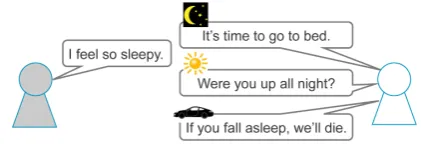
Figure 1: Conversational situations and responses.
by the difference in the degrees of freedom on out-put for a given inout-put. An appropriate response to a given utterance is not monolithic in chat di-alogue. Nevertheless, since only one ground truth response is provided in the actual dialogue data, the supervised systems will hesitate when choos-ing from the vast range of possible responses.
So, how do humans decide how to respond? We converse with others while (implicitly) consider-ing not only the utterance but also other various conversational situations (§2) such as time, place, and the current context of conversation and even our relationship with the addressee. For example, when a friend says “I feel so sleepy.” in the morn-ing, a probable response could be “Were you up all night?” (Figure1). If the friend says the same thing at midnight, you might say “It’s time to go to bed.” Or if the friend is driving a car with you, you might answer “If you fall asleep, we’ll die.”
Modeling situations behind conversations has been an open problem in chat dialogue modeling, and this difficulty has partly forced us to focus on task-oriented dialogue systems (Williams and Young,2007), the response of which has a low de-gree of freedom thanks to domain and goal speci-ficity. Although a few studies have tried to exploit conversational situations such as speakers’
tions (Hasegawa et al.,2013) or personal charac-teristics (Li et al.,2016b) and topics (Xing et al.,
2017), the methods are specially designed for and evaluated using specific types of situations.
In this study, we explore neural conversational models that have general mechanisms to incorpo-rate various types of situations behind chat con-versations (§3.2). These models take into account situations on the speaker’s side and the addressee’s side (or those who respond) when encoding ut-terances and decoding its responses, respectively. To capture the conversational situations, we design two mechanisms that differ in how strong of an ef-fect a given situation has on generating responses. In experiments, we examined the proposed con-versational models by incorporating three types of concrete conversational situations (§2): utter-ance, speaker/addressee (profiles), and time (sea-son), respectively. Although the models are capa-ble of generating responses, we evaluate the mod-els with a response selection test to avoid known issues in automatic evaluation metrics of gener-ated responses (Liu et al., 2016a). Experimental results obtained using massive dialogue data from Twitter showed that modeling conversational situ-ations improved the relevance of responses (§4).
2 Conversational situations
Various types of conversational situations could affect our response (or initial utterance) to the ad-dressee. Since neural conversational models need massive data to train a reliable model, our study investigates conversational situations that are nat-urally given or can be identified in an unsupervised manner to make the experimental settings feasible. In this study, we represent conversational situ-ations as discrete variables. That allows models to handle unseen situations in testing by classify-ing them into appropriate situation types via dis-tributed representations or the like as described be-low, and helps to analyze the outputs. We consider the following conversational situations to each ut-terance and response in our dialogue dataset (§4), and cluster the situations to assign specific situa-tion types to the utterances and responses in the training data of our conversational models. Utterance The input utterance (to be responded to by the system) is a primary conversational sit-uation and is already modeled by the encoder in the neural SEQ2SEQmodel. However, we may be able to induce a different aspect of situations that
are represented in the utterance but are not cap-tured by the SEQ2SEQ sequential encoder (Sato
et al.,2016). We first represent each utterance of utterance-response pairs in our dialogue dataset by a distributed representation obtained by averaging word2vec1vectors (pre-trained from our dialogue
datasets (§ 4.1)) for words in the utterances. The
utterances are then classified byk-means cluster-ing to identify utterance types.2
User (profiles) User characteristics should af-fect his/her responses asLi et al.(2016b) have al-ready discussed. We classify profiles provided by each user in our dialogue dataset (§4.1) to acquire
conversational situations specific to the speakers and addressees. The same as with the input utter-ance, we first construct a distributed representation of each user’s profile by averaging the pre-trained word2vec vectors for verbs, nouns and adjectives in the user profiles. The users are then classified byk-means clustering to identify user types.3 Time (season) Our utterances can be affected by when we speak as illustrated in§1, so we adopted
time as one conversational situation. On the ba-sis of timestamp of the utterance and the response in our dataset, we split the conversation data into four season types: namely, spring (Mar. – May.), summer (Jun. – Aug), autumn (Sep. – Nov.), and winter (Dec. – Feb.). This splitting reflects the cli-mate in Japan since our data are in Japanese whose speakers mostly live in Japan.
In training our neural conversational models, we use each of the above conversational situation types for the speaker side and addressee (who re-spond) side, respectively. Note that the utterance situation is only considered for the speaker side since its response is unseen in response genera-tion. In testing, the conversational situation types for input utterances (or speaker and addressee’s profiles) are identified by finding the closest cen-troid obtained by thek-means clustering of the ut-terances (profiles) in the training data.
3 Method
Our neural conversational models are based on the SEQ2SEQmodel (Sutskever et al.,2014) and inte-grate mechanisms to incorporate various
conversa-1https://code.google.com/p/word2vec/ 2We setkto10. Although the space limitations preclude results when varyingk, this does not affect our conclusions.
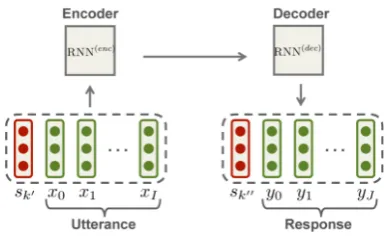
Figure 2: Local-global SEQ2SEQ.
tional situations (§2) at speaker side and addressee side. In the following, we briefly introduce the SEQ2SEQ conversational model (Vinyals and Le,
2015) and then describe two mechanisms for in-corporating conversational situations.
3.1 SEQ2SEQconversational model
The SEQ2SEQconversational model (Vinyals and
Le, 2015) consists of two recurrent neural net-works (RNNs) called an encoder and a decoder. The encoder takes each word of an utterance as input and encodes the input sequence to a real-valued vector representing the utterance. The de-coder then takes the encoded vector as its initial state and continues to generate the most probable next word and to input the word to itself until it finally outputs EOS.
3.2 Situation-aware conversational models The challenge in designing situation-aware neu-ral conversational models is how to inject given conversational situations intoRNNencoders or de-coders. In this paper, we present two situation-aware neural conversational models that differ in how strong of an effect a given situation has. 3.2.1 Local-global SEQ2SEQ
Motivated by a recent success in multi-task learn-ing for a deep neural network (Liu et al.,2016c,b;
Gupta et al.,2016;Luong et al.,2016), our local-global SEQ2SEQtrains two types ofRNNencoder and decoder for modeling situation-specific dia-logues and universal diadia-logues jointly (Figure2).
[image:3.595.75.290.59.227.2]Local-RNNs are meant to model dialogues in individual conversational situations at both the speaker and addressee sides. Each local-RNN is trained (i.e., its parameters are updated) only on
Figure 3: SEQ2SEQwith situation embeddings.
dialogues under the corresponding situation. A salient disadvantage of this modeling is that the size of training data given to each local-RNN de-creases as the number of situation types inde-creases. To address this problem, we combine another global-RNNencoder and decoder trained on all the dialogue data and take the weighted sum of the hidden stateshs of the twoRNNs for both the en-coder and deen-coder to obtain the output as:
hi(enc)=WG(enc)RNNG(enc)(h(i−enc1), xi)+
WL(enc)RNN(Lenc) k0 (h
(enc)
i−1 , xi), (1)
h(jdec)=WG(dec)RNNG(dec)(h(jdec−1), yj−1)+
WL(dec)RNN(Ldec) k00 (h
(dec)
j−1 , yj−1), (2)
whereRNN(G·)(·)andRNN(L·)(·)denote global-RNN and local-RNN, respectively, and theWs are
train-able matrices for the weighted sum. The embed-ding and softmax layers of theRNNs are shared. 3.2.2 SEQ2SEQwith situation embeddings
The local-global SEQ2SEQ(§3.2.1) assumes that dialogues with different situations involve differ-ent domains (or tasks) that are independdiffer-ent of each other. However, this assumption could be too strong in some cases and thus we devise another weakly situation-aware conversational model.
We represent the given situations at speaker and addressee sides,sk0 andsk00, as situation
embed-dings and then feed them to the encoder and de-coder prior to processing sequences (Figure3) as:
h(0enc)=RNN(hinit, sk0), (3)
hi(enc)=RNN(h(ienc−1), xi−1), (4)
h0(dec)=RNN(hI(enc+1), sk00), (5) hj(dec)=RNN(h(jdec−1), yj−1), (6)
wherehinitis a vector filled with zeros andh(Ienc+1)
Average length in words (utterances) 15.7 Average length in words (responses) 10.1 Average length in words (user profiles) 37.4
[image:4.595.322.514.60.134.2]Number of users 386,078
Table 1: Statistics of our dialogue datasets (train-ing, validation, and test portions are merged here).
This encoding was inspired by a neural machine translation system (Johnson et al., 2016) that en-ables multilingual translation with a single model. Whereas it inputs the target language embedding only to the encoder to control the target language, we input the speaker-side situation to the encoder and the addressee-side one to the decoder.
4 Evaluation
In this section, we evaluate our situation-aware neural conversational models on massive dialogue data obtained from Twitter. We compare our mod-els (§3.2) with SEQ2SEQbaseline (§3.1) using a response selection test instead of evaluating gen-erated responses, sinceLiu et al.(2016a) recently pointed out several problems of existing metrics such as BLEU(Papineni et al., 2002) for evaluat-ing generated responses.
4.1 Settings
Data We built massive dialogue datasets from our Twitter archive that have been compiled since March, 2011. In this archive, timelines of about 1.5 million users4 have been continuously
col-lected with the official API. It is therefore suitable for extracting users’ conversations in timelines.
On Twitter, a post (tweet) and a mention to it can be considered as an utterance-response pair. We randomly extracted 23,563,865 and 1,200,000 pairs from dialogues in 2014 as training and vali-dation datasets, and extracted 6000 pairs in 2015 as a test dataset in accordance with the follow-ing procedure. Because we want to exclude ut-terances that need contexts in past dialogue ex-changes to respond from our evaluation dataset, we restrict ourselves to only tweets that are not mentions to other tweets (in other words, utter-ances without past dialogue exchanges are chosen for evaluation). For each utterance-response pair in the test dataset, we randomly chose four (in to-tal, 24,000) responses in 2015 as false response
4Our collection started from 26 popular Japanese users in March 2011, and the user set has iteratively expanded to those who are mentioned or retweeted by already targeted users.
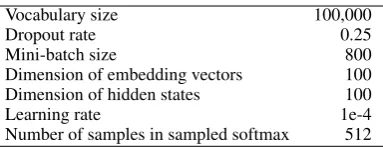
Vocabulary size 100,000
Dropout rate 0.25
Mini-batch size 800
Dimension of embedding vectors 100 Dimension of hidden states 100
Learning rate 1e-4
Number of samples in sampled softmax 512 Table 2: Hyperparameters for training.
candidates which together constitute five response candidates for the response selection test. Each utterance and response (candidate) is tokenized by MeCab5with NEologd6dictionary to feed the
se-quence to the word-based encoder decoder.7
Ta-ble1shows statistics on our dialogue datasets. Models In our experiments, we compare our situation-aware neural conversational models (we refer to the model in § 3.2.1 as L/G SEQ2SEQ
and the model in§3.2.2asSEQ2SEQemb) with
situation-unawarebaseline(§3.1) for taking each
type of conversational situations (§ 2) into con-sideration. We also evaluate the model in§ 3.2.1
without global-RNNs (referred to asL SEQ2SEQ)
to observe the impact of global-RNNs.
We used a long-short term memory (LSTM) (Zaremba et al., 2014) as the RNN encoder and decoder, sampled softmax (Jean et al., 2015) to accelerate the training, and TensorFlow8to
imple-ment the models. OurLSTMs have three layers and are optimized by Adam (Kingma and Ba,2015). The hyperparameters are fixed as in Table2. Evaluation procedure We use the above mod-els to rank response candidates for a given utter-ance in the test set. We compute the averaged cross-entropy loss for words in each response didate (namely, its perplexity) by giving the can-didate following the input utterance to each con-versational model, and used the resulting values for ranking candidates to choose top-k plausible ones. We adopt1 in t P@k(Wu et al.,2016) as the evaluation metric, which indicates the ratio of utterances that are provided the single ground truth in topkresponses chosen fromtcandidates. Here we use1 in 2 P@1,91 in 5 P@1, and1 in 5 P@2.
5http://taku910.github.io/mecab/ 6https://github.com/neologd/ mecab-ipadic-neologd
7The number of words in the utterances and the response candidates in the test set is limited to equal or less than 20, since very long posts do not constitute usual conversation.
8https://www.tensorflow.org/
Model 1 in 2 P@1 1 in 5 P@1 1 in 5 P@2 Baseline 64.5% 33.9% 56.6% Situation: utterance
L SEQ2SEQ 67.2% 37.2% 60.6%
L/G SEQ2SEQ 68.5% 38.2% 62.1% SEQ2SEQemb 65.6% 35.4% 58.2% Situation: speaker/addressee (profiles)
L SEQ2SEQ 67.3% 38.0% 60.9%
L/G SEQ2SEQ 66.4% 36.4% 59.2%
SEQ2SEQemb 67.8% 37.5% 61.1%
Situation: time (season)
L SEQ2SEQ 62.0% 30.8% 54.8%
L/G SEQ2SEQ 65.9% 35.8% 58.1%
[image:5.595.72.293.62.207.2]SEQ2SEQemb 67.3% 37.6% 60.7%
Table 3: Results of the response selection test.
4.2 Results
Table 3lists the results of the response selection test. The proposed conversational models success-fully improved the relevance of selected responses by incorporating conversational situations.
The proposed model that performed best is dif-ferent depending on the situation type. We found from the dataset that many of the conversations did not seem to be affected by the seasons, that is, time (season) situation is less influential than other sit-uations. This explains the poor performance ofL SEQ2SEQwith time (season) situations due to the data sparseness in training local-RNNs, although the sparseness is mostly addressed by globalRNNs inL/G SEQ2SEQ.
As stated in § 3.2.2, L/G SEQ2SEQ is ex-pected to capture situations more strongly than SEQ2SEQemb. To confirm this, we plotted
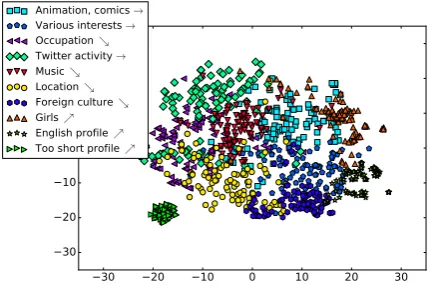
scat-tergrams of the utterance vectors (Figure 4) and the user profile vectors (Figure5) in the training data by using t-SNE (Maaten and Hinton,2008). We provide cluster descriptions by manually look-ing into the content of the utterances and user pro-files in each cluster. The descriptions are followed by % if L/G SEQ2SEQ performed better than SEQ2SEQ emb in terms of 1 in 5 P@1 for test
utterances with the corresponding situation type, by&if the opposite and by→if comparable (dif-ferences are within±1.0%). Elements of clusters were randomly sampled.
L/G SEQ2SEQtends to perform better for
ut-terances with densely concentrated (or coherent) speaker profile clusters (Figure5). This is because utterances given by the speakers in these coherent clusters (and the associate responses) have similar conversations, situations of which are captured by local-RNNs in the local-global SEQ2SEQ.
−30 −20 −10 0 10 20 30
−30 −20 −10 0 10 20 30 Diverse topics ր Opinions, q estions ր Food, sightseeing ր Emotional ց Self-explos re ր Good morning ր Desires ր Coming home ր Good night ր Reporting ret rn ր
Figure 4: The scattergram of sampled utterance vectors visualized using t-SNE.
−30 −20 −10 0 10 20 30
−30 −20 −10 0 10 20 30
Animation, comics → Various interests → Occupation ց T itter activity → Music ց Location ց Foreign culture ց Girls ր English profile ր Too short profile ր
Figure 5: The scattergram of sampled user profile vectors visualized using t-SNE.
This explains the reason why L/G SEQ2SEQ
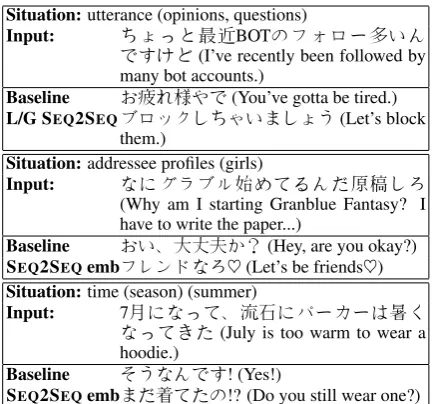
[image:5.595.309.525.65.207.2] [image:5.595.309.526.267.413.2]Situation:utterance (opinions, questions)
Input: ちょっと最近BOTのフォロー多いん ですけど(I’ve recently been followed by many bot accounts.)
Baseline お疲れ様やで(You’ve gotta be tired.)
L/G SEQ2SEQブロックしちゃいましょう(Let’s block them.)
Situation:addressee profiles (girls)
Input: なにグラブル始めてるんだ原稿しろ (Why am I starting Granblue Fantasy? I have to write the paper...)
Baseline おい、大丈夫か?(Hey, are you okay?)
SEQ2SEQembフレンドなろ♥(Let’s be friends♥)
Situation:time (season) (summer)
Input: 7月になって、流石にパーカーは暑く なってきた(July is too warm to wear a hoodie.)
Baseline そうなんです! (Yes!)
[image:6.595.73.291.60.262.2]SEQ2SEQembまだ着てたの!? (Do you still wear one?) Table 4: Responses selected by the systems.
Examples Table 4 lists the response candidate selected by the baseline and our models. As we had expected, the situation-aware conversational models are better at selecting ground-truth re-sponses for situation-specific conversations.
5 Related Work
Conversational situations have been implicitly ad-dressed by preparing datasets specific to the target situations and by solving the problem as a task-oriented conversation task (Williams and Young,
2007); examples include troubleshooting (Vinyals and Le, 2015), navigation (Wen et al.,2015), in-terviewing (Kobori et al., 2016), and restaurant search (Wen et al.,2017). In what follows, we in-troduce non-task-oriented conversational models that explicitly consider conversational situations.
Hasegawa et al. (2013) presented a conversa-tional model that generates a response so that it elicits a certain emotion (e.g., joy) in the addressee mind. Their model is based on statistical ma-chine translation and linearly interpolates two con-versational models that are trained from a small emotion-labeled dialogue corpus and a large non-labeled dialogue corpus, respectively. This model is similar to our local-global SEQ2SEQbut differs in that it has hyperparameters for the interpolation, whereas our local-global SEQ2SEQautomatically learnsWGandWLfrom the training data.
Li et al. (2016b) proposed a neural conversa-tional model that generates responses taking into consideration speakers’ personalities such as gen-der or living place. Because they fed a specific
speaker ID to their model and represent individual (known) speakers with embeddings, Their model cannot handle unknown speakers. In contrast, our model can consider any speakers with profiles be-cause we represent each cluster of profiles with an embedding and find an appropriate profile type for the given profile by nearest-neighbor search.
Sordoni et al. (2015) encoded a given utter-ance and the past dialogue exchanges, and com-bined the resulting representations forRNNto de-code a response. Zhao et al.(2017) used a condi-tional variacondi-tional autoencoder and automatically-induced dialogue acts to handle discourse-level di-versity in the encoder. While these sophisticated architectures are designed to take dialogue histo-ries into consideration, our simple models can eas-ily exploit various situations.
Recently,Xing et al.(2017) proposed to explic-itly consider topics of utterances to generate topic-coherent responses. Although they used latent Dirichlet allocation while we use k-means clus-tering, both methods confirmed the importance of utterance situations. The way to obtain specific situations is still an open research problem. As demonstrated in this study, our primary contribu-tion is the invencontribu-tion of neural mechanisms that can consider various conversational situations.
Our local-global SEQ2SEQmodel is closely re-lated to a many-to-many multi-task SEQ2SEQ pro-posed by Luong et al. (2016). The critical dif-ference is in that their model assumes only lo-cal tasks, while our model assumes many lolo-cal tasks (situation-specific dialogue modeling) and one global task (general dialogue modeling).
6 Conclusion
We proposed two situation-aware neural conver-sational models that have general mechanisms for handling various conversational situations rep-resented by discrete variables: (1) local-global SEQ2SEQ that combines two SEQ2SEQ models (§3.2.1) to handle situation-specific dialogues and
universal dialogues jointly, and (2) SEQ2SEQwith situation embeddings (§3.2.2) that feeds the situa-tions directly to a SEQ2SEQmodel. The response selection tests on massive Twitter datasets con-firmed the effectiveness of using situations such as utterances, user (profiles), or time.
References
Pankaj Gupta, Hinrich Sch¨utze, and Bernt Andrassy. 2016. Table filling multi-task recurrent neural net-work for joint entity and relation extraction. In Proceedings of the 26th International Conference on Computational Linguistics (COLING-16). pages 2537–2547.
Takayuki Hasegawa, Nobuhiro Kaji, Naoki Yoshinaga, and Masashi Toyoda. 2013. Predicting and elicit-ing addressee’s emotion in online dialogue. In Pro-ceedings of the 51st Annual Meeting of the Asso-ciation for Computational Linguistics (ACL). pages 964–972.
S´ebastien Jean, Kyunghyun Cho, Roland Memisevic, and Yoshua Bengio. 2015. On using very large target vocabulary for neural machine translation. In Proceedings of the 53rd Annual Meeting of the Association for Computational Linguistics and the 7th International Joint Conference on Natural Lan-guage Processing (ACL-IJCNLP-16). pages 1–10. Melvin Johnson, Mike Schuster, Quoc V Le, Maxim
Krikun, Yonghui Wu, Zhifeng Chen, Nikhil Thorat, Fernanda Vi´egas, Martin Wattenberg, Greg Corrado, et al. 2016. Google’s multilingual neural machine translation system: Enabling zero-shot translation. arXiv preprint arXiv:1611.04558.
Diederik Kingma and Jimmy Ba. 2015. Adam: A method for stochastic optimization. InProceedings of the third International Conference on Learning Representations (ICLR-15).
Takahiro Kobori, Mikio Nakano, and Tomoaki Naka-mura. 2016. Small talk improves user impressions of interview dialogue systems. InProceedings of the 17th Annual Meeting of the Special Interest Group on Discourse and Dialogue (SIGDIAL-16). pages 370–380.
Jiwei Li, Michel Galley, Chris Brockett, Jianfeng Gao, and Bill Dolan. 2016a. A diversity-promoting ob-jective function for neural conversation models. In Proceedings of the 2016 Conference of the North American Chapter of the Association for Computa-tional Linguistics: Human Language Technologies (NAACL-HLT-16). pages 110–119.
Jiwei Li, Michel Galley, Chris Brockett, Georgios P Spithourakis, Jianfeng Gao, and Bill Dolan. 2016b. A persona-based neural conversation model. In Pro-ceedings of the 54th Annual Meeting of the Associa-tion for ComputaAssocia-tional Linguistics (ACL-16). pages 994–1003.
Chia-Wei Liu, Ryan Lowe, Iulian Serban, Mike Nose-worthy, Laurent Charlin, and Joelle Pineau. 2016a. How not to evaluate your dialogue system: An em-pirical study of unsupervised evaluation metrics for dialogue response generation. In Proceedings of the 2016 Conference on Empirical Methods in Natu-ral Language Processing (EMNLP-16). pages 2122– 2132.
Pengfei Liu, Xipeng Qiu, and Xuanjing Huang. 2016b. Deep multi-task learning with shared memory for text classification. InProceedings of the 2016 Con-ference on Empirical Methods in Natural Language Processing (EMNLP-16). pages 118–127.
Pengfei Liu, Xipeng Qiu, and Xuanjing Huang. 2016c. Recurrent neural network for text classification with multi-task learning. InProceedings of the Twenty-Fifth International Joint Conference on Artificial In-telligence (IJCAI-16). pages 2873–2879.
Minh-Thang Luong, Quoc V. Le, Ilya Sutskever, Oriol Vinyals, and Lukasz Kaiser. 2016. Multi-task se-quence to sese-quence learning. InProceedings of the fifth International Conference on Learning Repre-sentations (ICLR-16).
Laurens van der Maaten and Geoffrey Hinton. 2008. Visualizing data using t-sne. Journal of Machine Learning Research9(Nov):2579–2605.
Kishore Papineni, Salim Roukos, Todd Ward, and Wei-Jing Zhu. 2002. Bleu: a method for automatic eval-uation of machine translation. In Proceedings of 40th Annual Meeting of the Association for Compu-tational Linguistics (ACL-02). pages 311–318.
Alan Ritter, Colin Cherry, and William B Dolan. 2011. Data-driven response generation in social media. In Proceedings of the 2011 Conference on Empirical Methods in Natural Language Processing (EMNLP-11). pages 583–593.
Shoetsu Sato, Naoki Yoshinaga Shonosuke Ishiwatari, Masashi Toyoda, and Masaru Kitsuregawa. 2016. UT dialogue system at NTCIR-12 STC. In Proceed-ings of the 12th NTCIR Conference on Evaluation of Information Access Technologies. pages 518–522.
Lifeng Shang, Zhengdong Lu, and Hang Li. 2015. Neural responding machine for short-text conver-sation. In Proceedings of the 53rd Annual Meet-ing of the Association for Computational LMeet-inguistics and the 7th International Joint Conference on Natu-ral Language Processing (ACL-IJCNLP-15). pages 1577–1586.
Alessandro Sordoni, Michel Galley, Michael Auli, Chris Brockett, Yangfeng Ji, Margaret Mitchell, Jian-Yun Nie, Jianfeng Gao, and Bill Dolan. 2015. A neural network approach to context-sensitive gen-eration of conversational responses. In Proceed-ings of the 2015 Conference of the North American Chapter of the Association for Computational Lin-guistics: Human Language Technologies (NAACL-HLT-15). pages 196–205.
Oriol Vinyals and Quoc V. Le. 2015. A neural conver-sational model. In Proceedings of Deep Learning Workshop held at the 31st International Conference on Machine Learning (ICML-15).
Tsung-Hsien Wen, Milica Gasic, Nikola Mrkˇsi´c, Pei-Hao Su, David Vandyke, and Steve Young. 2015. Semantically conditioned lstm-based natural lan-guage generation for spoken dialogue systems. In Proceedings of the 2015 Conference on Empirical Methods in Natural Language Processing (EMNLP-15). pages 1711–1721.
Tsung-Hsien Wen, David Vandyke, Nikola Mrkˇsi´c, Milica Gasic, Lina M. Rojas Barahona, Pei-Hao Su, Stefan Ultes, and Steve Young. 2017. A network-based end-to-end trainable task-oriented dialogue system. In Proceedings of the 15th Conference of the European Chapter of the Association for Com-putational Linguistics (EACL-17). pages 438–449.
Jason D. Williams and Steve Young. 2007. Partially observable markov decision processes for spoken dialog systems. Computer Speech and Language 21(2):393–422.
Bowen Wu, Baoxun Wang, and Hui Xue. 2016. Rank-ing responses oriented to conversational relevance in chat-bots. In Proceedings of the 26th Inter-national Conference on Computational Linguistics (COLING-16). pages 652–662.
Chen Xing, Wei Wu, Yu Wu, Jie Liu, Yalou Huang, Ming Zhou, and Wei-Ying Ma. 2017. Topic aware neural response generation. In Proceedings of the 31st AAAI Conference on Artificial Intelligence (AAAI-17). pages 3351–3357.
Wojciech Zaremba, Ilya Sutskever, and Oriol Vinyals. 2014. Recurrent neural network regularization. In Proceedings of the third International Conference on Learning Representations (ICLR-14).