Learning the Curriculum with Bayesian Optimization
for Task-Specific Word Representation Learning
Yulia Tsvetkov♠ Manaal Faruqui♠ Wang Ling♣ Brian MacWhinney♠ Chris Dyer♣♠ ♠Carnegie Mellon University ♣Google DeepMind
{ytsvetko,mfaruqui,cdyer}@cs.cmu.edu,
[email protected], [email protected]
Abstract
We use Bayesian optimization to learn curricula for word representation learning, optimizing performance on downstream tasks that depend on the learned represen-tations as features. The curricula are mod-eled by a linear ranking function which is the scalar product of a learned weight vec-tor and an engineered feature vecvec-tor that characterizes the different aspects of the complexity of each instance in the training corpus. We show that learning the curricu-lum improves performance on a variety of downstream tasks over random orders and in comparison to the natural corpus order.
1 Introduction
It is well established that in language acquisition, there are robust patterns in the order by which phenomena are acquired. For example, prototypi-cal concepts are acquired earlier; concrete words tend to be learned before abstract ones (Rosch, 1978). The acquisition of lexical knowledge in artificial systems proceeds differently. In gen-eral, models will improve during the course of pa-rameter learning, but the time course of acquisi-tion is not generally studied beyond generaliza-tion error as a funcgeneraliza-tion of training time or data size. We revisit this issue of choosing the order of learning—curriculum learning—framing it as an optimization problem so that a rich array of factors—including nuanced measures of difficulty, as well as prototypicality and diversity—can be exploited.
Prior research focusing on curriculum strate-gies in NLP is scarce, and has conventionally been following a paradigm of “starting small” (Elman, 1993), i.e., initializing the learner with “simple” examples first, and then gradually increasing data
complexity (Bengio et al., 2009; Spitkovsky et al., 2010). In language modeling, this prefer-ence for increasing complexity has been realized by curricula that increase the entropy of training data by growing the size of the training vocabu-lary from frequent to less frequent words (Ben-gio et al., 2009). In unsupervised grammar duction, an effective curriculum comes from in-creasing length of training sentences as training progresses (Spitkovsky et al., 2010). These case studies have demonstrated that carefully designed curricula can lead to better results. However, they have relied on heuristics in selecting curricula or have followed the intuitions of human and animal learning (Kail, 1990; Skinner, 1938). Had differ-ent heuristics been chosen, the results would have been different. In this paper, we use curriculum learning to create improved word representations. However, rather than testing a small number of curricula, we search for an optimal curriculum us-ing Bayesian optimization. A curriculum is de-fined to be the ordering of the training instances, in our case it is the ordering of paragraphs in which the representation learning model reads the cor-pus. We use a linear ranking function to conduct a systematic exploration of interacting factors that affect curricula of representation learning models. We then analyze our findings, and compare them to human intuitions and learning principles.
We treat curriculum learning as an outer loop in the process of learning and evaluation of vector-space representations of words; the iterative pro-cedure is (1) predict a curriculum; (2) train word embeddings; (3) evaluate the embeddings on tasks that use word embeddings as the sole features. Through this model we analyze the impact of cur-riculum on word representation models and on ex-trinsic tasks. To quantify curriculum properties, we define three groups of features aimed at analyz-ing statistical and lanalyz-inguistic content and structure
of training data: (1) diversity, (2) simplicity, and (3) prototypicality. A function of these features is computed to score each paragraph in the training data, and the curriculum is determined by sorting corpus paragraphs by the paragraph scores. We detail the model in §2. Word vectors are learned from the sorted corpus, and then evaluated on part-of-speech tagging, parsing, named entity recog-nition, and sentiment analysis (§3). Our exper-iments confirm that training data curriculum af-fects model performance, and that models with op-timized curriculum consistently outperform base-lines trained on shuffled corpora (§4). We analyze our findings in §5.
The contributions of this work are twofold. First, this is the first framework that formulates curriculum learning as an optimization problem, rather then shuffling data or relying on human in-tuitions. We experiment with optimizing the cur-riculum of word embeddings, but in principle the curriculum of other models can be optimized in a similar way. Second, to the best of our knowledge, this study is the first to analyze the impact of distri-butional and linguistic properties of training texts on the quality of task-specific word embeddings.
2 Curriculum Learning Model
We are considering the problem of maximizing a performance of an NLP task through sequentially optimizing the curriculum of training data of word vector representations that are used as features in the task.
LetX = {x1, x2, . . . , xn}be the training cor-pus with nlines (sentences or paragraphs). The curriculum of word representations is quantified by scoring each of the paragraphs according to the linear functionw|φ(X), whereφ(X)∈R`×1is a real-valued vector containing`linguistic features extracted for each paragraph, and w ∈ R`×1 de-note the weights learned for these features. The feature values φ(X) are z-normalized across all paragraphs. These scores are used to specify the order of the paragraphs in the corpus—the curricu-lum: we sort the paragraphs by their scores.
After the paragraphs are curriculum-ordered, the reordered training corpus is used to generate word representations. These word representations are then used as features in a subsequent NLP task. We define the objective functioneval : X → R, which is the quality estimation metric for this NLP task performed on a held-out dataset (e.g.,
corre-lation, accuracy,F1 score, BLEU). Our goal is to define the features φ(X) and to find the optimal weightswthat maximizeeval.
We optimize the feature weights using Bayesian optimization; we detail the model in §2.1. Distri-butional and linguistic features inspired by prior research in language acquisition and second lan-guage learning are described in §2.2. Figure 1 shows the computation flow diagram.
Bayesian optimization
Feature extraction
Paragraph scoring & sorting
Extrinsic task training & eval
Representation learning
Figure 1: Curriculum optimization framework.
2.1 Bayesian Optimization for Curriculum Learning
As no assumptions are made regarding the form ofeval(w), gradient-based methods cannot be ap-plied, and performing a grid search over param-eterizations of w would require a exponentially growing number of parameterizations to be tra-versed. Thus, we propose to use Bayesian Op-timization (BayesOpt) as the means to maximize eval(w). BayesOpt is a methodology to globally optimize expensive, multimodal black-box func-tions (Shahriari et al., 2016; Bergstra et al., 2011; Snoek et al., 2012). It can be viewed as a se-quential approach to performing a regression from high-level model parameters (e.g., learning rate, number of layers in a neural network, and in our model–curriculum weightsw) to the loss function or the performance measure (eval).
of parameters to explore given the current beliefs aboutevalis called theacquisition function. The surrogate model and the acquisition function are the two key components in the BayesOpt frame-work; their interaction is shown in Algorithm 1.
The surrogate model allows us to cheaply ap-proximate the quality of a set of parameters w without running eval(w), and the acquisition function uses this surrogate to choose a new value ofw. However, a trade-off must be made: should the acquisition function move w into a region where the surrogate believes an optimal value will be found, or should it explore regions of the space that reveal more about how eval behaves, per-haps discovering even better values? That is, acquisition functions balance a tradeoff between exploration—by selectingwin the regions where the uncertainty of the surrogate model is high, and exploitation—by querying the regions where the model prediction is high.
Popular choices for the surrogate model are Gaussian Processes (Rasmussen, 2006; Snoek et al., 2012, GP), providing convenient and powerful prior distribution on functions, and tree-structured Parzen estimators (Bergstra et al., 2011, TPE), tailored to handle conditional spaces. Choices of the acquisition functions include probability of improvement (Kushner, 1964), expected improve-ment (EI) (Moˇckus et al., 1978; Jones, 2001), GP upper confidence bound (Srinivas et al., 2010), Thompson sampling (Thompson, 1933), entropy search (Hennig and Schuler, 2012), and dynamic combinations of the above functions (Hoffman et al., 2011); see Shahriari et al. (2016) for an ex-tensive comparison. Yogatama et al. (2015) found that the combination of EI as the acquisition func-tion and TPE as the surrogate model performed favorably in Bayesian optimization of text repre-sentations; we follow this choice in our model.
2.2 Distributional and Linguistic Features To characterize and quantify a curriculum, we de-fine three categories of features, focusing on vari-ous distributional, syntactic, and semantic aspects of training data. We now detail the feature cate-gories along with motivations for feature selection.
DIVERSITY. Diversity measures capture the
dis-tributions of types in data. Entropy is the best-known measure of diversity in statistical research, but there are many others (Tang et al., 2006; Gim-pel et al., 2013). Common measures of diversity
Algorithm 1Bayesian optimization
1: H ← ∅ .Initialize observation history 2: A ←EI .Initialize acquisition function 3: S0←T P E .Initialize surrogate model 4: fort←1 toT do
5: wt ← argmaxwA(w;St−1,H).Predict wtby optimizing acquisition function 6: eval(wt) .Evaluatewton extrinsic task 7: H ← H∪(wt, eval(wt)).Update
obser-vation history
8: EstimateStgivenH 9: end for
10: returnH
are used in many contrasting fields, from ecol-ogy and biolecol-ogy (Rosenzweig, 1995; Magurran, 2013), to economics and social studies (Stirling, 2007). Diversity has been shown effective in re-lated research on curriculum learning in language modeling, vision, and multimedia analysis (Ben-gio et al., 2009; Jiang et al., 2014).
Letpi andpj correspond to empirical frequen-cies of word typestiandtjin the training data. Let
dij correspond to their semantic similarity, calcu-lated as the cosine similarity between embeddings oftiandtj learned from the training data. We an-notate each paragraph with the following diversity features:
• Number of word types:#types • Type-token ratio: ##tokenstypes
• Entropy:−Pipiln(pi)
• Simpson’s index (Simpson, 1949):Pipi2
• Quadratic entropy (Rao, 1982):1 P
i,jdijpipj
SIMPLICITY. Spitkovsky et al. (2010) have
Meurers, 2012). We use an off-the-shelf syntac-tic parser2 (Zhang and Clark, 2011) to parse our training corpus. Then, the following features are used to measure phonological, lexical, and syntac-tic complexity of training paragraphs:
• Language model score
• Character language model score
• Average sentence length
• Verb-token ratio
• Noun-token ratio
• Parse tree depth
• Number of noun phrases:#NP s • Number of verb phrases:#V Bs
• Number of prepositional phrases:#P P s
PROTOTYPICALITY. This is a group of
seman-tic features that use insights from cognitive lin-guistics and child language acquisition. The goal is to characterize the curriculum of representation learning in terms of the curriculum of human lan-guage learning. We resort to the Prototype the-ory (Rosch, 1978), which posits that semantic cat-egories include more central (or prototypical) as well as less prototypical words. For example, in the ANIMAL category, dog is more prototypical than sloth (because dog is more frequent); dog is more prototypical thancanine (becausedog is more concrete); anddogis more prototypical than bull terrier(becausedogis less specific). Accord-ing to the theory, more prototypical words are ac-quired earlier. We use lexical semantic databases to operationalize insights from the prototype the-ory in the following semantic features; the features are computed on token level and averaged over paragraphs:
• Age of acquisition (AoA) of words was ex-tracted from the crowd-sourced database, con-taining over 50 thousand English words (Kuper-man et al., 2012). For example, the AoA ofrun is 4.47 (years), offleeis 8.33, and ofabscondis 13.36. If a word was not found in the database it was assigned the maximal age of 25.
• Concreteness ratings on the scale of 1–5 (1 is most abstract) for 40 thousand English lemmas (Brysbaert et al., 2014). For example,cookieis rated as 5, andspiritualityas 1.07.
2http://http://people.sutd.edu.sg/ ~yue_zhang/doc
• Imageability ratings are taken from the MRC psycholinguistic database (Wilson, 1988). Fol-lowing Tsvetkov et al. (2014), we used the MRC annotations as seed, and propagated the ratings to all vocabulary words using the word embed-dings as features in an`2-regularized logistic re-gression classifier.
• Conventionalization features count the num-ber of “conventional” words and phrases in a paragraph. Assuming that a Wikipedia title is a proxy to a conventionalized concept, we counted the number of existing titles (from a database of over 4.5 million titles) in the para-graph.
• Number of syllables scores are also extracted from the AoA database; out-of-database words were annotated as 5-syllable words.
• Relative frequency in a supersense was com-puted by marginalizing the word frequencies in the training corpus over coarse semantic cate-gories defined in the WordNet (Fellbaum, 1998; Ciaramita and Altun, 2006). There are 41 super-sense types: 26 for nouns and 15 for verbs, e.g., NOUN.ANIMALandVERB.MOTION. For exam-ple, inNOUN.ANIMALthe relative frequency of humanis 0.06, ofdogis 0.01, ofbirdis 0.01, of cattleis 0.009, and ofbumblebeeis 0.0002.
• Relative frequency in a synset was calculated similarly to the previous feature category, but word frequencies were marginalized over Word-Net synsets (more fine-grained synonym sets). For example, in the synset {vet, warhorse, vet-eran, oldtimer, seasoned stager},veteranis the most prototypical word, scoring 0.87.
3 Evaluation Benchmarks
et al., 2016). The `2-regularized logistic regres-sion classifier is tuned on the development set and accuracy is reported on the test set.
Named Entity Recognition (NER). Named en-tity recognition is the task of identifying proper names in a sentence, such as names of persons, lo-cations etc. We use the recently proposed LSTM-CRF NER model (Lample et al., 2016) which trains a forward-backward LSTM on a given se-quence of words (represented as word vectors), the hidden units of which are then used as (the only) features in a CRF model (Lafferty et al., 2001) to predict the output label sequence. We use the CoNLL 2003 English NER dataset (Tjong Kim Sang and De Meulder, 2003) to train our models and present results on the test set.
Part of Speech Tagging (POS). For POS tag-ging, we again use the LSTM-CRF model (Lam-ple et al., 2016), but instead of predicting the named entity tag for every word in a sentence, we train the tagger to predict the POS tag of the word. The tagger is trained and evaluated with the standard Penn TreeBank (PTB) (Marcus et al., 1993) training, development and test set splits as described in Collins (2002).
Dependency Parsing (Parse). Dependency parsing is the task of identifying syntactic re-lations between the words of a sentence. For dependency parsing, we train the stack-LSTM parser of Dyer et al. (2015) for English on the universal dependencies v1.1 treebank (Agi´c et al., 2015) with the standard development and test splits, reporting unlabeled attachment scores (UAS) on the test data. We remove all part-of-speech and morphology features from the data, and prevent the model from optimizing the word embeddings used to represent each word in the corpus, thereby forcing the parser to rely completely on the pretrained embeddings.
4 Experiments
Data. All models were trained on Wikipedia ar-ticles, split to paragraph-per-line. Texts were cleaned, tokenized, numbers were normalized by replacing each digit with “DG”, all types that oc-cur less than 10 times were replaces by the “UNK” token, the data was not lowercased. We list data sizes in table 1.
# paragraphs # tokens # types 2,532,361 100,872,713 156,663
Table 1: Training data sizes.
Setup. 100-dimensional word embeddings were trained using thecbowmodel implemented in the word2vec toolkit (Mikolov et al., 2013).3 All training data was used, either shuffled or ordered by a curriculum. As described in §3, we modified the extrinsic tasks to learn solely from word em-beddings, without additional features. All models were learned under same conditions, across cur-ricula: in Parse, NER, and POS we limited the number of training iterations to 3, 3, and 1, re-spectively. This setup allowed us to evaluate the effect of curriculum without additional interacting factors.
Experiments. In all the experiments we first train word embedding models, then the word em-beddings are used as features in four extrinsic tasks (§3). We tune the tasks on development data, and report results on the test data. The only com-ponent that varies across the experiments is order of paragraphs in the training corpus—the curricu-lum. We compare the following experimental se-tups:
• Shuffledbaselines: the curriculum is defined by random shuffling the training data. We shuffled the data 10 times, and trained 10 word embed-dings models, each model was then evaluated on downstream tasks. Following Bengio et al. (2009), we report test results for the system that is closest to the median in dev scores. To evalu-ate variability and a range of scores that can be obtained from shuffling the data, we also report test results for systems that obtained the highest dev scores.
• Sorted baselines: the curriculum is defined by sorting the training data by sentence length in increasing/decreasing order, similarly to (Spitkovsky et al., 2010).
Our intuition is that a coherent curriculum can improve models, since words with simi-lar meanings and simisimi-lar contexts are grouped when presented to the learner.
• Optimized curriculummodels: the curriculum is optimized using the BayesOpt. We evaluate and compare models optimized using features from one of the three feature groups (§2.2). As in the shuffled baselines, we fix the number of trials (here, BayesOpt iterations) to 10, and we report test results of systems that obtained best dev scores.
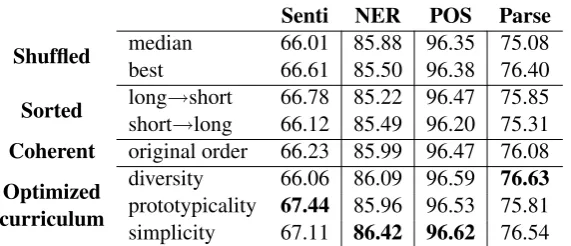
Results. Experimental results are listed in ta-ble 2. Most systems trained with curriculum sub-stantially outperform the strongest of all baselines. These results are encouraging, given that all word embedding models were trained on the same set of examples, only in different order, and display the indirect influence of the data curriculum on downstream tasks. These results support our as-sumption that curriculum matters. Albeit not as pronounced as with optimized curriculum, sorting paragraphs by length can also lead to substantial improvements over random baselines, but there is no clear recipe on whether the models prefer cur-ricula sorted in an increasing or decreasing order. These results also support the advantage of a task-specific optimization framework over a general, intuition-guided recipe. An interesting result, also, that shuffling is not essential: systems trained on coherent data are on par (or better) than the shuf-fled systems.4 In the next section, we analyze these results qualitatively.
5 Analysis
What are task-specific curriculum prefer-ences? We manually inspect learned features and curriculum-sorted corpora, and find that best systems are obtained when their embeddings are 4Note that in the shuffled NER baselines, best dev re-sults yield lower performance on the test data. This implies that in the standard development/test splits the development and test sets are not fully compatible or not large enough. We also observe this problem in the curriculum-optimized Parse-prototypicality and Senti-diversity systems. The dev scores for the Parse systems are 76.99, 76.47, 76.47 for di-versity, prototypicality, and simplicity, respectively, but the prototypicality-sorted parser performs poorly on test data. Similarly in the sentiment analysis task, the dev scores are 69.15, 69.04, 69.49 for diversity, prototypicality, and sim-plicity feature groups. Senti-diversity scores, however, are lower on the test data, although the dev results are better than in Senti-simplicity. This limitation of the standard dev/test splits is beyond the scope of this paper.
learned from curricula appropriate to the down-stream tasks. We discuss below several examples. POS and Parse systems converge to the same set of weights, when trained on features that provide various measures of syntactic simplicity. The fea-tures with highest coefficients (and thus the most important features in sorting) are #NP s, Parse tree depth,#V P s, and#P P s(in this order). The sign in the#NP sfeature weight, however, is the opposite from the other three feature weights (i.e., sorted in different order). #NP sis sorted in the increasing order of the number of noun phrases in a paragraph, and the other features are sorted in the decreasing order. Since Wikipedia corpus con-tains a lot of partial phrases (titles and headings), such curriculum promotes more complex, full sen-tences, and demotes partial sentences.
Best Senti system is sorted by prototypicality features. Most important features (with the highest coefficients) are Concreteness, Relative frequency in a supersense, and the Number of syllables. First two are sorted in decreasing order (i.e. paragraphs are sorted from more to less concrete, and from more to less prototypical words), and the Num-ber of syllables is sorted in increasing order (this also promotes simpler, shorter words which are more prototypical). We hypothesize that this sor-ing reflects the type of data that Sentiment analysis task is trained on: it is trained on movie reviews, that are usually written in a simple, colloquial lan-guage.
Unlike POS, Parse, and Senti systems, all NER systems prefer curricula in which texts are sorted from short to long paragraphs. The most impor-tant features in the best (simplicity-sorted) system are#P P sand Verb-token ratio, both sorted from less to more occurrences of prepositional and verb phrases. Interestingly, most of the top lines in the NER system curricula contain named entities, al-though none of our features mark named entities explicitly. We show top lines in the simplicity-optimized system in figure 2.
Finally, in all systems sorted by prototypical-ity, the last line is indeed not a prototypical word Donaudampfschiffahrtselektrizitätenhaupt-betriebswerkbauunterbeamtengesellschaft, which is an actual word in German, frequently used as an example of compounding in synthetic languages, but rarely (or never?) used by German speakers.
em-Senti NER POS Parse Shuffled medianbest 66.01 85.88 96.35 75.0866.61 85.50 96.38 76.40
Sorted longshort→→shortlong 66.78 85.22 96.47 75.8566.12 85.49 96.20 75.31 Coherent original order 66.23 85.99 96.47 76.08 Optimized
curriculum
[image:7.595.161.447.61.184.2]diversity 66.06 86.09 96.59 76.63 prototypicality 67.44 85.96 96.53 75.81 simplicity 67.11 86.42 96.62 76.54
Table 2: Evaluation of the impact of the curriculum of word embeddings on the downstream tasks.
Trimingham “ Golf ” ball .
Adélie penguin
“ Atriplex ” leaf UNK UNK
Hồng Lĩnh mountain
Anneli Jäätteenmäki UNK cabinet
Gävle goat
Early telescope observations . Scioptric ball
Matryoshka doll
Luxembourgian passport
Australian Cashmere goat Plumbeous water redstart
Dagebüll lighthouse
Vecom FollowUs . tv
Syracuse Junction railroad .
San Clemente Island goat
[image:7.595.308.523.459.498.2]Tychonoff plank
Figure 2: Most of the top lines in best-scoring NER system contain named entities, although our features do not annotate named entities explicitly.
bedding training is to weight training examples according to curriculum during word represen-tation training. We modify the cbow objective
PT
t=1logp(wt|wt−c..wt+c)as follows:5
T
X
t=1
( 1
1 +e−weight(wt) +λ) logp(wt|wt−c..wt+c)
Here, weight(wt) denotes the score attributed to the tokenwt, which is thez-normalized score of the paragraph; λ=0.5 is determined empirically.
logp(wt)|wt−c..wt+c)computes the probability of predicting wordwt, using the context ofc words to the left and right of wt. Notice that this quan-tity is no longer a proper probability, as we are not 5The modified word2vec tool is located at https:// github.com/wlin12/wang2vec.
normalizing over the weightsweight(wt)over all tokens. However, the optimization in word2vec is performed using stochastic gradient descent, op-timizing for a single token at each iteration. This yields a normalizer of 1 for each iteration, yielding the same gradient as the originalcbowmodel.
We retrain our best curriculum-sorted systems with the modified objective, also controlling for curriculum. The results are shown in table 3. We find that the benefit of integrating curricu-lum in training objective of word representations is not evident across tasks: Senti and NER systems trained on vectors with the modified objective sub-stantially outperform best results in table 2; POS and Parse perform better than the baselines but worse than the systems with the original objective.
Senti NER POS Parse
curriculum 67.44 86.42 96.62 76.63 cbow+curric 68.26 86.49 96.48 76.54 Table 3: Evaluation of the impact of curriculum integrated in thecbowobjective.
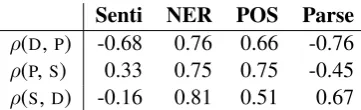
the training corpora. Correlation results across tasks and across feature sets are shown in table 4.
The general pattern of results is that if two sys-tems score higher than baselines, training sen-tences of their feature embeddings have similar curricula (i.e., the Spearman’sρis positive), and if two systems disagree (one is above and one is be-low the baseline), then their curricula also disagree (i.e., the Spearman’sρis negative or close to zero). NER systems all outperform the baselines and their curricula have high correlations. Moreover, NER sorted by diversity and simplicity have bet-ter scores than NER sorted by prototypicality, and in line with these resultsρ(S,D)NER > ρ(P,S)NER andρ(S,D)NER > ρ(D,P)NER. Similar pattern of results is in POS correlations. In Parse systems, also, diversity and simplicity features yielded best parsing results, andρ(S,D)P arse has high positive correlation. The prototypicality-optimized parser performed poorly, and its correlations with better systems are negative. The best parser was trained using the diversity-optimized curriculum, and thus ρ(D,P)P arseis the lowest. Senti results follow sim-ilar pattern of curricula correlations.
Senti NER POS Parse ρ(D,P) -0.68 0.76 0.66 -0.76 ρ(P,S) 0.33 0.75 0.75 -0.45 ρ(S,D) -0.16 0.81 0.51 0.67 Table 4: Curricula correlations across feature groups.
Curriculum learning vs. data selection. We compare the task of curriculum learning to the task of data selection (reducing the set of training in-stances to more important or cleaner examples). We reduce the training data to the subset of 10% of tokens, and train downstream tasks on the reduced training sets. We compare system performance trained using the top 10% of tokens in the best curriculum-sorted systems (Senti-prototypicality, NER-implicity, POS-simplicity, Parse-diversity) to the systems trained using the top 10% of tokens in a corpus with randomly shuffled paragraphs.6 The results are listed in table 5.
The curriculum-based systems are better in POS 6Topn% tokens are used rather than topn% paragraphs because in all tasks except NER curriculum-sorted corpora begin with longer paragraphs. Thus, with topn% paragraphs our systems would have an advantage over random systems due to larger vocabulary sizes and not necessarily due to a better subset of data.
Senti NER POS Parse
[image:8.595.313.521.63.105.2]random 63.97 82.35 96.22 69.11 curriculum 64.47 76.96 96.55 72.93
Table 5: Data selection results.
and in Parse systems, mainly because these tasks prefer vectors trained on curricula that promote well-formed sentences (as discussed above). Con-versely, NER prefers vectors trained on corpora that begin with named entities, so most of the to-kens in the reduced training data are constituents in short noun phrases. These results suggest that the tasks of data selection and curriculum learning are different. Curriculum is about strong initializa-tion of the models and time-course learning, which is not necessarily sufficient for data reduction.
6 Related Work
Two prior studies on curriculum learning in NLP are discussed in the paper (Bengio et al., 2009; Spitkovsky et al., 2010). Curriculum learning and related research on self-paced learning has been explored more deeply in computer vision (Bengio et al., 2009; Kumar et al., 2010; Lee and Grauman, 2011) and in multimedia analysis (Jiang et al., 2015). Bayesian optimization has also received little attention in NLP. GPs were used in the task of machine translation quality estimation (Cohn and Specia, 2013) and in temporal analysis of so-cial media texts (Preotiuc-Pietro and Cohn, 2013); TPEs were used by Yogatama et al. (2015) for optimizing choices of feature representations—n -gram size, regularization choice, etc.—in super-vised classifiers.
7 Conclusion
[image:8.595.90.271.399.454.2]Acknowledgments
This work was supported by the National Science Foundation through award IIS-1526745. We are grateful to Nathan Schneider, Guillaume Lample, Waleed Ammar, Austin Matthews, and the anony-mous reviewers for their insightful comments.
References
Željko Agi´c, Maria Jesus Aranzabe, Aitziber Atutxa, Cristina Bosco, Jinho Choi, Marie-Catherine de Marneffe, Timothy Dozat, Richárd Farkas, Jennifer Foster, Filip Ginter, Iakes Goenaga, Koldo Gojenola, Yoav Goldberg, Jan Hajiˇc, An-ders Trærup Johannsen, Jenna Kanerva, Juha Kuokkala, Veronika Laippala, Alessandro Lenci, Krister Lindén, Nikola Ljubeši´c, Teresa Lynn, Christopher Manning, Héctor Alonso Martínez, Ryan McDonald, Anna Missilä, Simonetta Monte-magni, Joakim Nivre, Hanna Nurmi, Petya Osen-ova, Slav Petrov, Jussi Piitulainen, Barbara Plank, Prokopis Prokopidis, Sampo Pyysalo, Wolfgang Seeker, Mojgan Seraji, Natalia Silveira, Maria Simi, Kiril Simov, Aaron Smith, Reut Tsarfaty, Veronika Vincze, and Daniel Zeman. 2015. Universal de-pendencies 1.1. LINDAT/CLARIN digital library at Institute of Formal and Applied Linguistics, Charles University in Prague.
Yoshua Bengio, Jérôme Louradour, Ronan Collobert, and Jason Weston. 2009. Curriculum learning. In
Proc. ICML, pages 41–48.
James S Bergstra, Rémi Bardenet, Yoshua Bengio, and Balázs Kégl. 2011. Algorithms for hyper-parameter optimization. InProc. NIPS, pages 2546–2554.
Marc Brysbaert, Amy Beth Warriner, and Victor Ku-perman. 2014. Concreteness ratings for 40 thou-sand generally known english word lemmas. Behav-ior research methods, 46(3):904–911.
Massimiliano Ciaramita and Yasemin Altun. 2006. Broad-coverage sense disambiguation and informa-tion extracinforma-tion with a supersense sequence tagger. In
Proc. EMNLP, pages 594–602.
Trevor Cohn and Lucia Specia. 2013. Modelling an-notator bias with multi-task Gaussian processes: An application to machine translation quality estima-tion. InProc. ACL, pages 32–42.
Michael Collins. 2002. Discriminative training meth-ods for hidden markov models: Theory and experi-ments with perceptron algorithms. InProc. EMNLP, pages 1–8.
Chris Dyer, Miguel Ballesteros, Wang Ling, Austin Matthews, and Noah A. Smith. 2015. Transition-based dependency parsing with stack long short-term memory. InProc. ACL.
Jeffrey L Elman. 1993. Learning and development in neural networks: The importance of starting small.
Cognition, 48(1):71–99.
Manaal Faruqui, Jesse Dodge, Sujay K. Jauhar, Chris Dyer, Eduard Hovy, and Noah A. Smith. 2015. Retrofitting word vectors to semantic lexicons. In
Proc. NAACL.
Christiane Fellbaum, editor. 1998. WordNet: an elec-tronic lexical database. MIT Press.
Kevin Gimpel, Dhruv Batra, Chris Dyer, and Gregory Shakhnarovich. 2013. A systematic exploration of diversity in machine translation. InProc. EMNLP, pages 1100–1111.
Michael J. Heilman, Kevyn Collins-Thompson, Jamie Callan, and Maxine Eskenazi. 2007. Combining lexical and grammatical features to improve read-ability measures for first and second language texts. InProc. NAACL, pages 460–467.
Philipp Hennig and Christian J Schuler. 2012. En-tropy search for information-efficient global opti-mization. The Journal of Machine Learning Re-search, 13(1):1809–1837.
Matthew D Hoffman, Eric Brochu, and Nando de Fre-itas. 2011. Portfolio allocation for Bayesian opti-mization. InProc. UAI, pages 327–336.
Lu Jiang, Deyu Meng, Shoou-I Yu, Zhenzhong Lan, Shiguang Shan, and Alexander Hauptmann. 2014. Self-paced learning with diversity. In Proc. NIPS, pages 2078–2086.
Lu Jiang, Deyu Meng, Qian Zhao, Shiguang Shan, and Alexander G Hauptmann. 2015. Self-paced curricu-lum learning. InProc. AAAI, volume 2, page 6. Donald R Jones. 2001. A taxonomy of global
opti-mization methods based on response surfaces. Jour-nal of global optimization, 21(4):345–383.
Robert Kail. 1990. The development of memory in children. W. H. Freeman and Company, 3rd edition. M. P. Kumar, Benjamin Packer, and Daphne Koller. 2010. Self-paced learning for latent variable mod-els. InProc. NIPS, pages 1189–1197.
Victor Kuperman, Hans Stadthagen-Gonzalez, and Marc Brysbaert. 2012. Age-of-acquisition ratings for 30,000 english words. Behavior Research Meth-ods, 44(4):978–990.
Harold J Kushner. 1964. A new method of locating the maximum point of an arbitrary multipeak curve in the presence of noise.Journal of Basic Engineering, 86(1):97–106.
Guillaume Lample, Miguel Ballesteros, Sandeep Sub-ramanian, Kazuya Kawakami, and Chris Dyer. 2016. Neural architectures for named entity recog-nition. InProc. NAACL.
Yong Jae Lee and Kristen Grauman. 2011. Learning the easy things first: Self-paced visual category dis-covery. InProc. CVPR, pages 1721–1728.
Anne E Magurran. 2013. Measuring biological diver-sity. John Wiley & Sons.
Mitchell P Marcus, Mary Ann Marcinkiewicz, and Beatrice Santorini. 1993. Building a large anno-tated corpus of english: The penn treebank. Compu-tational linguistics, 19(2):313–330.
Tomas Mikolov, Kai Chen, Greg Corrado, and Jeffrey Dean. 2013. Efficient estimation of word represen-tations in vector space. InProc. ICLR.
Jonas Moˇckus, Vytautas Tiesis, and Antanas Žilin-skas. 1978. On Bayesian methods for seeking the extremum. Towards global optimization, 2(117-129):2.
Emily Pitler and Ani Nenkova. 2008. Revisiting readability: A unified framework for predicting text quality. InProc. EMNLP, pages 186–195.
Daniel Preotiuc-Pietro and Trevor Cohn. 2013. A tem-poral model of text periodicities using gaussian pro-cesses. InProc. EMNLP, pages 977–988.
C Radhakrishna Rao. 1982. Diversity and dissimilarity coefficients: a unified approach. Theoretical popu-lation biology, 21(1):24–43.
Carl Edward Rasmussen. 2006. Gaussian Processes for machine learning.
Eleanor Rosch. 1978. Principles of categorization. In Eleanor Rosch and Barbara B. Lloyd, editors, Cog-nition and categorization, pages 28–71.
Michael L Rosenzweig. 1995. Species diversity in space and time. Cambridge University Press. Sarah E. Schwarm and Mari Ostendorf. 2005.
Read-ing level assessment usRead-ing support vector machines and statistical language models. InProc. ACL, pages 523–530.
João Sedoc, Jean Gallier, Lyle Ungar, and Dean Foster. 2016. Semantic word clusters using signed normal-ized graph cuts. arXiv preprint arXiv:1601.05403. Bobak Shahriari, Kevin Swersky, Ziyu Wang, Ryan P
Adams, and Nando de Freitas. 2016. Taking the human out of the loop: A review of Bayesian opti-mization. Proc. IEEE, 104(1):148–175.
Edward H Simpson. 1949. Measurement of diversity.
Nature.
Burrhus Frederic Skinner. 1938. The behavior of or-ganisms: an experimental analysis. An Experimen-tal Analysis.
Jasper Snoek, Hugo Larochelle, and Ryan P Adams. 2012. Practical Bayesian optimization of machine learning algorithms. In Proc. NIPS, pages 2951– 2959.
Richard Socher, Alex Perelygin, Jean Wu, Jason Chuang, Christopher D. Manning, Andrew Y. Ng, and Christopher Potts. 2013. Recursive deep mod-els for semantic compositionality over a sentiment treebank. InProc. EMNLP.
Valentin I Spitkovsky, Hiyan Alshawi, and Dan Juraf-sky. 2010. From baby steps to leapfrog: How less is more in unsupervised dependency parsing. InProc. NAACL, pages 751–759.
Niranjan Srinivas, Andreas Krause, Sham M Kakade, and Matthias Seeger. 2010. Gaussian process opti-mization in the bandit setting: No regret and experi-mental design. InProc. ICML, pages 1015–1022. Andy Stirling. 2007. A general framework for
analysing diversity in science, technology and so-ciety. Journal of the Royal Society Interface, 4(15):707–719.
E Ke Tang, Ponnuthurai N Suganthan, and Xin Yao. 2006. An analysis of diversity measures. Machine Learning, 65(1):247–271.
William R Thompson. 1933. On the likelihood that one unknown probability exceeds another in view of the evidence of two samples. Biometrika, 25(3/4):285–294.
Erik F Tjong Kim Sang and Fien De Meulder. 2003. Introduction to the conll-2003 shared task: Language-independent named entity recognition. In
Proc. CoNLL.
Yulia Tsvetkov, Leonid Boytsov, Anatole Gershman, Eric Nyberg, and Chris Dyer. 2014. Metaphor de-tection with cross-lingual model transfer. InProc. ACL.
Sowmya Vajjala and Detmar Meurers. 2012. On im-proving the accuracy of readability classification us-ing insights from second language acquisition. In
Proc. BEA, pages 163–173.
Michael Wilson. 1988. MRC psycholinguistic
database: Machine-usable dictionary, version 2.00.
Behavior Research Methods, Instruments, & Com-puters, 20(1):6–10.
Dani Yogatama, Lingpeng Kong, and Noah A Smith. 2015. Bayesian optimization of text representations. InProc. EMNLP, pages 2100–2105.