Proceedings of the 55th Annual Meeting of the Association for Computational Linguistics, pages 1925–1935 Vancouver, Canada, July 30 - August 4, 2017. c2017 Association for Computational Linguistics Proceedings of the 55th Annual Meeting of the Association for Computational Linguistics, pages 1925–1935
Vancouver, Canada, July 30 - August 4, 2017. c2017 Association for Computational Linguistics
A Teacher-Student Framework for
Zero-Resource Neural Machine Translation
Yun Chen†, Yang Liu‡∗, Yong Cheng+, Victor O.K. Li††Department of Electrical and Electronic Engineering, The University of Hong Kong ‡State Key Laboratory of Intelligent Technology and Systems
Tsinghua National Laboratory for Information Science and Technology
Department of Computer Science and Technology, Tsinghua University, Beijing, China Jiangsu Collaborative Innovation Center for Language Competence, Jiangsu, China +Institute for Interdisciplinary Information Sciences, Tsinghua University, Beijing, China
[email protected]; [email protected]; [email protected]; [email protected]
Abstract
While end-to-end neural machine transla-tion (NMT) has made remarkable progress recently, it still suffers from the data scarcity problem for low-resource lan-guage pairs and domains. In this paper, we propose a method for zero-resource NMT by assuming that parallel sentences have close probabilities of generating a sentence in a third language. Based on the assumption, our method is able to train a source-to-target NMT model (“stu-dent”) without parallel corpora available guided by an existing pivot-to-target NMT model (“teacher”) on a source-pivot par-allel corpus. Experimental results show that the proposed method significantly im-proves over a baseline pivot-based model by +3.0 BLEU points across various lan-guage pairs.
1 Introduction
Neural machine translation (NMT) ( Kalchbren-ner and Blunsom, 2013; Sutskever et al., 2014; Bahdanau et al., 2015), which directly models the translation process in an end-to-end way, has attracted intensive attention from the commu-nity. Although NMT has achieved state-of-the-art translation performance on resource-rich language pairs such as English-French and German-English (Luong et al., 2015;Jean et al., 2015;Wu et al., 2016; Johnson et al., 2016), it still suffers from the unavailability of large-scale parallel corpora for translating low-resource languages. Due to the large parameter space, neural models usually learn poorly from low-count events, resulting in a poor choice for low-resource language pairs. Zoph et
∗Corresponding author: Yang Liu.
al. (2016) indicate that NMT obtains much worse translation quality than a statistical machine trans-lation (SMT) system on low-resource languages.
As a result, a number of authors have endeav-ored to explore methods for translating language pairs without parallel corpora available. These methods can be roughly divided into two broad categories: multilingual and pivot-based. Firat et al. (2016b) present a multi-way, multilin-gual model with shared attention to achieve zero-resource translation. They fine-tune the attention part using pseudo bilingual sentences for the zero-resource language pair. Another direction is to develop a universal NMT model in multilingual scenarios (Johnson et al.,2016;Ha et al., 2016). They use parallel corpora of multiple languages to train one single model, which is then able to translate a language pair without parallel corpora available. Although these approaches prove to be effective, the combination of multiple languages in modeling and training leads to increased com-plexity compared with standard NMT.
Another direction is to achieve source-to-target NMT without parallel data via a pivot, which is either text (Cheng et al., 2016a) or image (Nakayama and Nishida, 2016). Cheng et al. (2016a) propose a pivot-based method for zero-resource NMT: it first translates the source lan-guage to a pivot lanlan-guage, which is then translated to the target language. Nakayama and Nishida (2016) show that using multimedia information as pivot also benefits zero-resource translation. How-ever, pivot-based approaches usually need to di-vide the decoding process into two steps, which is not only more computationally expensive, but also potentially suffers from the error propagation problem (Zhu et al.,2013).
In this paper, we propose a new method for zero-resource neural machine translation. Our
(a)
(b)
X
Z
Y
Z
X
Y
P(z|x;✓x!z) P(y|z;✓z!y)
P(y|z;✓z!y)
P(y|x;✓x!y)
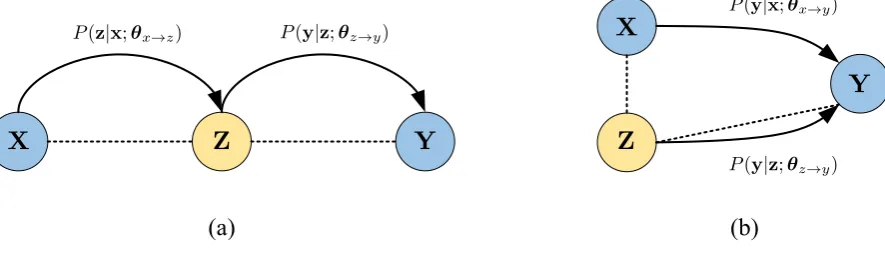
Figure 1: (a) The pivot-based approach and (b) the teacher-student approach to zero-resource neural machine translation. X, Y, and Zdenote source, target, and pivot languages, respectively. We use a
dashed line to denote that there is a parallel corpus available for the connected language pair. Solid lines with arrows represent translation directions. The pivot-based approach leverages a pivot to achieve indirect source-to-target translation: it first translates x into z, which is then translated into y. Our training algorithm is based on the translation equivalence assumption: ifx is a translation of z, then P(y|x;θx→y) should be close toP(y|z;θz→y). Our approach directly trains the intended source-to-target modelP(y|x;θx→y)(“student”) on a source-pivot parallel corpus, with the guidance of an existing pivot-to-target modelP(y|z; ˆθz→y)(“teacher”).
method assumes that parallel sentences should have close probabilities of generating a sentence in a third language. To train a source-to-target NMT model without parallel corpora (“student”), we leverage an existing pivot-to-target NMT model (“teacher”) to guide the learning process of the student model on a source-pivot parallel corpus. Compared with pivot-based approaches (Cheng et al., 2016a), our method allows direct parame-ter estimation of the intended NMT model, with-out the need to divide decoding into two steps. This strategy not only improves efficiency but also avoids error propagation in decoding. Experi-ments on the Europarl and WMT datasets show that our approach achieves significant improve-ments in terms of both translation quality and de-coding efficiency over a baseline pivot-based ap-proach to zero-resource NMT on Spanish-French and German-French translation tasks.
2 Background
Neural machine translation (Sutskever et al.,2014; Bahdanau et al.,2015) advocates the use of neu-ral networks to model the translation process in an end-to-end manner. As a data-driven approach, NMT treats parallel corpora as the major source for acquiring translation knowledge.
Letxbe a source-language sentence andybe a
target-language sentence. We useP(y|x;θx→y)
to denote a source-to-target neural translation model, where θx→y is a set of model parame-ters. Given a source-target parallel corpus Dx,y, which is a set of parallel source-target sentences, the model parameters can be learned by maximiz-ing the log-likelihood of the parallel corpus:
ˆ
θx→y = argmax θx→y
( X
hx,yi∈Dx,y
logP(y|x;θx→y) )
.
Given learned model parametersθˆx
→y, the de-cision rule for finding the translation with the highest probability for a source sentencexis given
by
ˆ
y= argmax
y
(
P(y|x; ˆθx→y) )
. (1)
As a data-driven approach, NMT heavily relies on the availability of large-scale parallel corpora to deliver state-of-the-art translation performance (Wu et al., 2016;Johnson et al., 2016). Zoph et al. (2016) report that NMT obtains much lower BLEU scores than SMT if only small-scale par-allel corpora are available. Therefore, the heavy dependence on the quantity of training data poses a severe challenge for NMT to translate zero-resource language pairs.
[image:2.595.79.522.67.198.2]translating zero-resource language pairs (de Gis-pert and Mari˜no, 2006; Cohn and Lapata, 2007; Utiyama and Isahara,2007;Wu and Wang,2007; Bertoldi et al., 2008; Wu and Wang, 2009; Za-habi et al., 2013;Kholy et al., 2013). As pivot-based methods are agnostic to model structures, they have been adapted to NMT recently (Cheng et al.,2016a;Johnson et al.,2016).
Figure 1(a) illustrates the basic idea of pivot-based approaches to zero-resource NMT (Cheng et al.,2016a). LetX,Y, andZdenote source,
tar-get, and pivot languages. We use dashed lines to denote language pairs with parallel corpora avail-able and solid lines with arrows to denote transla-tion directransla-tions.
Intuitively, the source-to-target translation can be indirectly modeled by bridging two NMT mod-els via a pivot:
P(y|x;θx→z,θz→y)
= X
z
P(z|x;θx→z)P(y|z;θz→y). (2)
As shown in Figure 1(a), pivot-based ap-proaches assume that the source-pivot parallel cor-pusDx,zand the pivot-target parallel corpusDz,y are available. As it is impractical to enumerate all possible pivot sentences, the two NMT models are trained separately in practice:
ˆ
θx→z = argmax
θx→z
( X
hx,zi∈Dx,z
logP(z|x;θx→z) )
,
ˆ
θz→y = argmax
θz→y
( X
hz,yi∈Dz,y
logP(y|z;θz→y) )
.
Due to the exponential search space of pivot sentences, the decoding process of translating an unseen source sentence x has to be divided into two steps:
ˆ
z= argmax
z
n
P(z|x; ˆθx→z) o
, (3)
ˆ
y= argmax
y
n
P(y|ˆz; ˆθz→y) o
. (4)
The above two-step decoding process potentially suffers from the error propagation problem (Zhu et al., 2013): the translation errors made in the first step (i.e., source-to-pivot translation) will af-fect the second step (i.e., pivot-to-target transla-tion).
Therefore, it is necessary to explore methods to directly model source-to-target translation without parallel corpora available.
3 Approach 3.1 Assumptions
In this work, we propose to directly model the in-tended source-to-target neural translation based on a teacher-student framework. The basic idea is to use a pre-trained pivot-to-target model (“teacher”) to guide the learning process of a source-to-target model (“student”) without training data available on a source-pivot parallel corpus. One advantage of our approach is that Equation (1) can be used as the decision rule for decoding, which avoids the error propagation problem faced by two-step de-coding in pivot-based approaches.
As shown in Figure 1(b), we still assume that a source-pivot parallel corpus Dx,z and a pivot-target parallel corpus Dz,y are avail-able. Unlike pivot-based approaches, we first use the pivot-target parallel corpus Dz,y to ob-tain ateacher modelP(y|z; ˆθz→y), where θˆz→y is a set of learned model parameters. Then, the teacher model “teaches” the student model P(y|x;θx→y)on the source-pivot parallel corpus
Dx,zbased on the following assumptions.
Assumption 1 If a source sentencexis a transla-tion of a pivot sentencez, then the probability of generating a target sentence yfrom x should be close to that from its counterpartz.
We can further introduce a word-level assump-tion:
Assumption 2 If a source sentencexis a transla-tion of a pivot sentencez, then the probability of generating a target wordyfromxshould be close to that from its counterpart z, given the already obtained partial translationy<j.
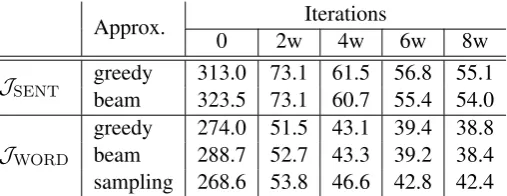
The two assumptions are empirically verified in our experiments (see Table 2). In the following subsections, we will introduce two approaches to zero-resource neural machine translation based on the two assumptions.
3.2 Sentence-Level Teaching
Given a source-pivot parallel corpus Dx,z, our training objective based on Assumption 1 is de-fined as follows:
JSENT(θx→y)
= X
hx,zi∈Dx,z
KLP(y|z; ˆθz→y)
P(y|x;θx→y)
where the KL divergence sums over all possible target sentences:
KLP(y|z; ˆθz→y)
P(y|x;θx→y)
= X
y
P(y|z; ˆθz→y) log
P(y|z; ˆθz→y)
P(y|x;θx→y)
.(6)
As the teacher model parameters are fixed, the training objective can be equivalently written as
JSENT(θx→y)
=− X
hx,zi∈Dx,z
Ey|z; ˆθz→y h
logP(y|x;θx→y) i
. (7)
In training, our goal is to find a set of source-to-target model parameters that minimizes the train-ing objective:
ˆ
θx→y = argmin θx→y
n
JSENT(θx→y) o
. (8)
With learned source-to-target model parameters ˆ
θx→y, we use the standard decision rule as shown in Equation (1) to find the translation yˆ for a source sentencex.
However, a major difficulty faced by our ap-proach is the intractability in calculating the gra-dients because of the exponential search space of target sentences. To address this problem, it is pos-sible to construct a sub-space by either sampling (Shen et al.,2016), generating ak-best list (Cheng
et al., 2016b) or mode approximation (Kim and Rush, 2016). Then, standard stochastic gradient descent algorithms can be used to optimize model parameters.
3.3 Word-Level Teaching
Instead of minimizing the KL divergence between the teacher and student models at the sentence level, we further define a training objective at the word level based on Assumption2:
JWORD(θx→y)
= X
hx,zi∈Dx,z
Ey|z; ˆθz→y h
J(x,y,z,θˆz→y,θx→y) i
, (9)
where
J(x,y,z,θˆz→y,θx→y)
= |y| X
j=1
KLP(y|z,y<j; ˆθz→y)
P(y|x,y<j;θx→y)
. (10)
Equation (9) suggests that the teacher model
P(y|z,y<j; ˆθz→y) “teaches” the student model
P(y|x,y<j;θx→y)in a word-by-word way. Note
that the KL-divergence between two models is de-fined at the word level:
KLP(y|z,y<j; ˆθz→y)
P(y|x,y<j;θx→y)
= X
y∈Vy
P(y|z,y<j; ˆθz→y) log P(y|z,y<j; ˆθz→y)
P(y|x,y<j;θx→y)
,
whereVy is the target vocabulary. As the param-eters of the teacher model are fixed, the training objective can be equivalently written as:
JWORD(θx→y)
=− X
hx,zi∈Dx,z
Ey|z; ˆθz→y h
S(x,y,z,θˆz→y,θx→y) i
,(11)
where
S(x,y,z,θˆz→y,θx→y)
= |y| X
j=1
X
y∈Vy
P(y|z,y<j; ˆθz→y)×
logP(y|x,y<j;θx→y). (12)
Therefore, our goal is to find a set of source-to-target model parameters that minimizes the train-ing objective:
ˆ
θx→y = argmin θx→y
n
JWORD(θx→y) o
. (13)
We use similar approaches as described in Sec-tion 3.2 for approximating the full search space with sentence-level teaching. After obtaining
ˆ
θx→y, the same decision rule as shown in Equa-tion (1) can be utilized to find the most probable target sentenceyˆ for a source sentencex.
4 Experiments 4.1 Setup
We evaluate our approach on the Europarl (Koehn, 2005) and WMT corpora. To compare with pivot-based methods, we use the same dataset as (Cheng et al.,2016a). All the sentences are tokenized by thetokenize.perlscript. All the experiments treat English as the pivot language and French as the target language.
Corpus Direction Train Dev. Test
Europarl
Es→En 850K 2,000 2,000
De→En 840K 2,000 2,000
En→Fr 900K 2,000 2,000
WMT EsEn→En 6.78M 3,003 3,003
[image:5.595.76.291.63.148.2]→Fr 9.29M 3,003 3,003
Table 1: Data statistics. For the Europarl corpus, we evaluate our approach on Spanish-French (Es-Fr) and German-French (De-(Es-Fr) translation tasks. For the WMT corpus, we evaluate approach on the Spanish-French (Es-Fr) translation task. English is used as a pivot language in all experiments.
zero-resource scenario. To avoid the trilingual corpus constituted by the source-pivot and pivot-target corpora, we split the overlapping pivot sen-tences of the original source-pivot and pivot-target corpora into two equal parts and merge them sepa-rately with the non-overlapping parts for each lan-guage pair. The development and test sets are from WMT 2006 shared task.1 The evaluation metric is case-insensitive BLEU (Papineni et al., 2002) as calculated by themulti-bleu.perlscript. To deal with out-of-vocabulary words, we adopt byte pair encoding (BPE) (Sennrich et al.,2016) to split words into sub-words. The size of sub-words is set to 30K for each language.
For the WMT corpus, we evaluate our approach on a Spanish-French (Es-Fr) translation task with a zero-resource setting. We combine the follow-ing corpora to form the Es-En and En-Fr paral-lel corpora: Common Crawl, News Commentary, Europarl v7 and UN. All the sentences are tok-enized by the tokenize.perl script. stest2011 serves as the development set and New-stest2012 and Newstest2013 serve as test sets. We use case-sensitive BLEU to evaluate translation re-sults. BPE is also used to reduce the vocabulary size. The size of sub-words is set to 43K, 33K, 43K for Spanish, English and French, respectively. See Table1for detailed statistics for the Europarl and WMT corpora.
We leverage an open-source NMT toolkitdl4mt
implemented by Theano2for all the experiments and compare our approach with state-of-the-art multilingual methods (Firat et al., 2016b) and pivot-based methods (Cheng et al.,2016a). Two variations of our framework are used in the
exper-1http://www.statmt.org/wmt07/shared-task.html 2dl4mt-tutorial: https://github.com/nyu-dl
iments:
1. Sentence-Level Teaching: for simplicity, we use the mode as suggested in (Kim and Rush, 2016) to approximate the target sentence space in calculating the expected gradients with respect to the expectation in Equation (7). We run beam search on the pivot sen-tence with the teacher model and choose the highest-scoring target sentence as the mode. Beam size withk= 1(greedy decoding) and
k = 5 are investigated in our experiments, denoted as sent-greedy and sent-beam, re-spectively.3
2. Word-Level Teaching: we use the same mode approximation approach as in sentence-level teaching to approximate the expectation in Equation12, denoted as word-greedy(beam search with k = 1) and word-beam (beam
search with k = 5) respectively. Besides, Monte Carlo estimation by sampling from the teacher model is also investigated since it in-troduces more diverse data, denoted as word-sampling.
4.2 Assumptions Verification
To verify the assumptions in Section 3.1, we train a source-to-target translation model
P(y|x;θx→y) and a pivot-to-target translation modelP(y|z;θz→y)using the trilingual Europarl corpus. Then, we measure the sentence-level and word-level KL divergence from the source-to-target model P(y|x;θx→y) at different iterations to the trained pivot-to-target modelP(y|z; ˆθz→y) by caculatingJSENT (Equation (5)) andJWORD
3We can also adopt sampling andk-best list for
approxi-mation. Random sampling brings a large variance (Sutskever et al., 2014; Ranzato et al., 2015; He et al., 2016) for sentence-level teaching. Fork-best list, we renormalize the probabilities
P(y|z; ˆθz→y)∼
P(y|z; ˆθz→y)α
P
y∈YkP(y|z; ˆθz→y)
α,
whereYkis thek-best list from beam search of the teacher model and αis a hyperparameter controling the sharpness
Approx. Iterations
0 2w 4w 6w 8w
JSENT greedybeam 313.0 73.1 61.5 56.8 55.1323.5 73.1 60.7 55.4 54.0
JWORD
greedy 274.0 51.5 43.1 39.4 38.8
beam 288.7 52.7 43.3 39.2 38.4
[image:6.595.174.428.62.160.2]sampling 268.6 53.8 46.6 42.8 42.4
Table 2: Verification of sentence-level and word-level assumptions by evaluating approximated KL di-vergence from the source-to-target model to the pivot-to-target model over training iterations of the source-to-target model. The pivot-to-target model is trained and kept fixed.
Method Es→Fr De→Fr
Cheng et al. (2016a)
pivot 29.79 23.70
hard 29.93 23.88
soft 30.57 23.79
likelihood 32.59 25.93
Ours sent-beam 31.64 24.39
[image:6.595.164.435.219.318.2]word-sampling 33.86 27.03
Table 3: Comparison with previous work on Spanish-French and German-French translation tasks from the Europarl corpus. English is treated as the pivot language. The likelihood method uses 100K parallel source-target sentences, which are not available for other methods.
(Equation (9)) on 2,000 parallel source-pivot sen-tences from the development set of WMT 2006 shared task.
Table2shows the results. The source-to-target model is randomly initialized at iteration 0. We find thatJSENT andJWORDdecrease over time,
suggesting that the source-to-target and pivot-to-target models do have small KL divergence at both sentence and word levels.
4.3 Results on the Europarl Corpus
Table 3 gives BLEU scores on the Europarl corpus of our best performing sentence-level method (sent-beam) and word-level method (word-sampling) compared with pivot-based methods (Cheng et al., 2016a). We use the same data preprocessing as (Cheng et al.,2016a). We find that both the sent-beam and word-sampling methods outperform the pivot-based approaches in a zero-resource scenario across language pairs. Our word-sampling method improves over the best performing zero-resource pivot-based method (soft) on Spanish-French translation by +3.29 BLEU points and German-French translation by +3.24 BLEU points. In addition, the word-sampling mothod surprisingly obtains improvement over the likelihood method, which leverages a source-target parallel corpus. The
Method devEs→Frtest devDe→Frtest
sent-greedy 31.00 31.05 22.34 21.88
sent-beam 31.57 31.64 24.95 24.39
word-greedy 31.37 31.92 24.72 25.15
word-beam 30.81 31.21 24.64 24.19
word-sampling 33.65 33.86 26.99 27.03
Table 4: Comparison of our proposed methods on Spanish-French and German-French transla-tion tasks from the Europarl corpus. English is treated as the pivot language.
significant improvements can be explained by the error propagation problem of pivot-based methods that translation error of the source-to-pivot trans-lation process is propagated to the pivot-to-target translation process.
[image:6.595.308.532.385.483.2]0 3 6 9 1 2 1 5 3 0
6 0 9 0 1 2 0 1 5 0 1 8 0 2 1 0
0 3 6 9 1 2 1 5
0
5
1 0 1 5 2 0 2 5 3 0
V
a
li
d
L
o
s
s
I t e r a t i o n s
s e n t - g r e e d y s e n t - b e a m w o r d - g r e e d y w o r d - b e a m w o r d - s a m p l i n g
×1 0 4 ×1 0 4
B
L
E
U
I t e r a t i o n s
s e n t - g r e e d y s e n t - b e a m w o r d - g r e e d y w o r d - b e a m w o r d - s a m p l i n g
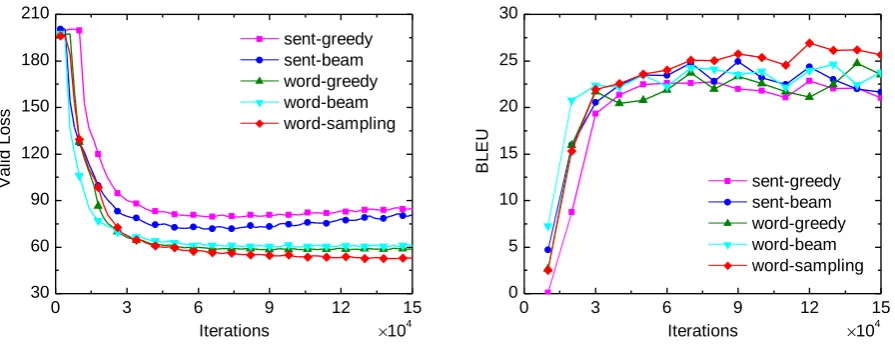
Figure 2: Validation loss and BLEU across iterations of our proposed methods.
Method Es Training BLEU
→En En→Fr Es→Fr Newstest2012 Newstest2013 Existing zero-resource NMT systems
Cheng et al. (2016a)† pivot 6.78M 9.29M - 24.60
-Cheng et al. (2016a)† likelihood 6.78M 9.29M 100K 25.78
-Firat et al. (2016b) one-to-one 34.71M 65.77M - 17.59 17.61
Firat et al. (2016b)† many-to-one 34.71M 65.77M - 21.33 21.19
Our zero-resource NMT system
[image:7.595.78.526.63.237.2]word-sampling 6.78M 9.29M - 28.06 27.03
Table 5: Comparison with previous work on Spanish-French translation in a zero-resource scenario over the WMT corpus. The BLEU scores are case sensitive.†: the method depends on two-step decoding.
time complexity grows linearly with the number of beamsk, the better performance is achieved at
the expense of search time.
For word-level experiments, we observe that the word-sampling method performs much bet-ter than the other two methods: +1.94 BLEU points on Spanish-French translation and +1.88 BLEU points on German-French translation over the word-greedy method; +2.65 BLEU points on Spanish-French translation and +2.84 BLEU points on German-French translation over the word-beam method. Although Table2shows that word-level KL divergence approximated by pling is larger than that by greedy or beam, sam-pling approximation introduces more data diver-sity for training, which dominates the effect of KL divergence difference.
We plot validation loss4and BLEU scores over iterations on the German-French translation task in Figure 2. We observe that word-level models
4Validation loss: the average negative log-likelihood of
sentence pairs on the validation set.
tend to have lower validation loss compared with sentence-level methods. Generally, models with lower validation loss tend to have higher BLEU. Our results indicate that this is not necessarily the case: the sent-beam method converges to +0.31 BLEU points on the validation set with +13 vali-dation loss compared with the word-beam method. Kim and Rush (2016) claim a similar observation in data distillation for NMT and provide an expla-nation that student distributions are more peaked for sentence-level methods. This is indeed the case in our result: on German-French translation task the argmax for the sent-beam student model (on average) approximately accounts for 3.49% of the total probability mass, while the correspond-ing number is 1.25% for the word-beam student model and 2.60% for the teacher model.
4.4 Results on the WMT Corpus
ex-groundtruth
source Os sent´ais al volante en la costa oeste , en San Francisco , y vuestra misi´on es llegar losprimeros a Nueva York . pivot You get in the car on the west coast , in San Francisco , and your task is to be the first oneto reach New York . target Vous vous asseyez derri`ere le volant sur la cˆote ouest `a San Francisco et votre mission estd' arriver le premier `a New York .
pivot pivot
You 'll feel atthe west coast in San Francisco , and yourmissionis togetthe firstto
New York .[BLEU: 33.93]
target Vous vousle premier `a New York .sentirez comme chez vous[BLEU: 44.52]`a San Francisco,et votre mission est d'obtenir
likelihood pivot
You feel atthe west coast , in San Francisco , and yourmissionis toreachthe firsttoNew York .[BLEU: 47.22]
[image:8.595.77.533.61.225.2]target Vous vousle premier `a New York .sentez `ala cˆote ouest[BLEU: 49.44],`a San Francisco,et votre mission est d'atteindre word-sampling target Vous vousarriver le premier `a New York .sentez auvolant sur la cˆote ouest[BLEU: 78.78],`a San Francisco et votre mission est d'
Table 6: Examples and corresponding sentence BLEU scores of translations using the pivot and likeli-hood methods in (Cheng et al., 2016a) and the proposed word-sampling method. We observe that our approach generates better translations than the methods in (Cheng et al., 2016a). We italicize correct translation segmentswhich are no short than 2-grams.
periments on the large scale WMT corpus for Spanish-French translation. Table5shows the re-sults of our word-sampling method in compari-son with other state-of-the-art baselines. Cheng et al. (2016a) use the same datasets and the same preprocessing as ours. Firat et al. (2016b) uti-lize a much larger training set.5 Our method ob-tains significant improvement over the pivot base-line by +3.46 BLEU points on Newstest2012 and over many-to-one by +5.84 BLEU points on New-stest2013. Note that both methods depend on a source-pivot-target decoding path. Table6shows translation examples of the pivot and likelihood methods proposed in (Cheng et al.,2016a) and our proposed word-sampling method. For the pivot and likelihood methods, the Spainish sentence segment ’sent´ais al volante’ is lost when translated to English. Therefore, both methods miss this in-formation in the translated French sentence. How-ever, the word-sampling method generates ’volant sur’, which partially translates ’sent´ais al volante’, resulting in improved translation quality of target-language sentence.
4.5 Results with Small Source-Pivot Data
The word-sampling method can also be applied to zero-resource NMT with a small source-pivot corpus. Specifically, the size of the source-pivot corpus is orders of magnitude smaller than that of the pivot-target corpus. This setting makes sense in applications. For example, there are signifi-cantly fewer Urdu-English corpora available than 5Their training set does not include the Common Crawl
corpus.
Method De-En De-Fr En-FrCorpus BLEU
MLE × √ × 19.30
transfer × √ √ 22.39
pivot √ × √ 17.32
Ours √ × √ 22.95
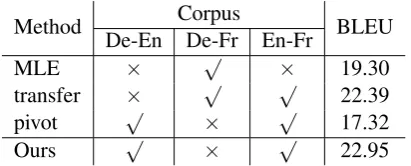
Table 7: Comparison on German-French trans-lation task from the Europarl corpus with 100K German-English sentences. English is regarded as the pivot language. Transfer represents the trans-fer learning method in (Zoph et al.,2016). 100K parallel German-French sentences are used for the MLE and transfer methods.
English-French corpora.
To fulfill this task, we combine our best per-forming word-sampling method with the initial-ization and parameter freezing strategy proposed in (Zoph et al.,2016). The Europarl corpus is used in the experiments. We set the size of German-English training data to 100K and use the same teacher model trained with 900K English-French sentences.
[image:8.595.313.519.305.388.2]5 Related Work
Training NMT models in a zero-resource scenario by leveraging other languages has attracted inten-sive attention in recent years. Firat et al. (2016b) propose an approach which delivers the multi-way, multilingual NMT model proposed by (Firat et al., 2016a) to zero-resource translation. They use the multi-way NMT model trained by other language pairs to generate a pseudo parallel corpus and fine-tune the attention mechanism of the multi-way NMT model to enable zero-resource transla-tion. Several authors propose a universal encoder-decoder network in multilingual scenarios to per-form zero-shot learning (Johnson et al.,2016;Ha et al.,2016). This universal model extracts transla-tion knowledge from multiple different languages, making zero-resource translation feasible without direct training.
Besides multilingual NMT, another important line of research is bridging source and target lan-guages via a pivot language. This idea is widely used in SMT (de Gispert and Mari˜no,2006;Cohn and Lapata,2007;Utiyama and Isahara,2007;Wu and Wang, 2007; Bertoldi et al., 2008; Wu and Wang, 2009; Zahabi et al., 2013; Kholy et al., 2013). Cheng et al. (2016a) propose pivot-based NMT by simultaneously improving source-to-pivot and pivot-to-target translation quality in order to improve source-to-target translation qual-ity. Nakayama and Nishida (2016) achieve zero-resource machine translation by utilizing image as a pivot and training multimodal encoders to share common semantic representation.
Our work is also related to knowledge distilla-tion, which trains a compact model to approximate the function learned by a larger, more complex model or an ensemble of models (Bucila et al., 2006;Ba and Caurana,2014;Li et al.,2014; Hin-ton et al., 2015). Kim and Rush (2016) first in-troduce knowledge distillation in neural machine translation. They suggest to generate a pseudo cor-pus to train the student network. Compared with their work, we focus on zero-resource learning in-stead of model compression.
6 Conclusion
In this paper, we propose a novel framework to train the student model without parallel cor-pora under the guidance of the pre-trained teacher model on a source-pivot parallel corpus. We in-troduce sentence-level and word-level teaching to
guide the learning process of the student model. Experiments on the Europarl and WMT corpora across languages show that our proposed word-level sampling method can significantly outper-forms the state-of-the-art pivot-based methods and multilingual methods in terms of translation qual-ity and decoding efficiency.
We also analyze zero-resource translation with small source-pivot data, and combine our word-level sampling method with initialization and pa-rameter freezing suggested by (Zoph et al.,2016). The experiments on the Europarl corpus show that our approach obtains an significant improvement over the pivot-based baseline.
In the future, we plan to test our approach on more diverse language pairs, e.g., zero-resource Uyghur-English translation using Chinese as a pivot. It is also interesting to extend the teacher-student framework to other cross-lingual NLP ap-plications as our method is transparent to architec-tures.
Acknowledgments
This work was done while Yun Chen is visiting Tsinghua University. This work is partially sup-ported by the National Natural Science Founda-tion of China (No.61522204, No. 61331013) and the 863 Program (2015AA015407).
References
Jimmy Ba and Rich Caurana. 2014. Do deep nets really need to be deep? InNIPS.
Dzmitry Bahdanau, Kyunghyun Cho, and Yoshua Ben-gio. 2015. Neural machine translation by jointly learning to align and translate. In Proceedings of ICLR.
Nicola Bertoldi, Madalina Barbaiani, Marcello Fed-erico, and Roldano Cattoni. 2008. Phrase-based sta-tistical machine translation with pivot languages. In IWSLT.
Cristian Bucila, Rich Caruana, and Alexandru Niculescu-Mizil. 2006. Model compression. In KDD.
Yong Cheng, Yang Liu, Qian Yang, Maosong Sun, and Wei Xu. 2016a. Neural machine translation with pivot languages. CoRRabs/1611.04928.
Trevor Cohn and Mirella Lapata. 2007. Machine trans-lation by triangutrans-lation: Making effective use of multi-parallel corpora. InACL.
Adri`a de Gispert and Jos´e B. Mari˜no. 2006. Catalan-english statistical machine translation without paral-lel corpus: bridging through spanish. In Proceed-ings of 5th International Conference on Language Resources and Evaluation (LREC). Citeseer, pages 65–68.
Orhan Firat, Kyunghyun Cho, and Yoshua Bengio. 2016a. Multi-way, multilingual neural machine translation with a shared attention mechanism. In HLT-NAACL.
Orhan Firat, Baskaran Sankaran, Yaser Al-Onaizan, Fatos T. Yarman-Vural, and Kyunghyun Cho. 2016b. Zero-resource translation with multi-lingual neural machine translation. InEMNLP.
Thanh-Le Ha, Jan Niehues, and Alexander H. Waibel. 2016. Toward multilingual neural machine trans-lation with universal encoder and decoder. CoRR abs/1611.04798.
Di He, Yingce Xia, Tao Qin, Liwei Wang, Nenghai Yu, Tie-Yan Liu, and Wei-Ying Ma. 2016. Dual learning for machine translation. InNIPS.
Geoffrey E. Hinton, Oriol Vinyals, and Jeffrey Dean. 2015. Distilling the knowledge in a neural network. CoRRabs/1503.02531.
S´ebastien Jean, Kyunghyun Cho, Roland Memisevic, and Yoshua Bengio. 2015. On using very large tar-get vocabulary for neural machine translation. In ACL.
Melvin Johnson, Mike Schuster, Quoc V. Le, Maxim Krikun, Yonghui Wu, Zhifeng Chen, Nikhil Tho-rat, Fernanda B. Vi´egas, Martin Wattenberg, Gre-gory S. Corrado, Macduff Hughes, and Jeffrey Dean. 2016. Google’s multilingual neural machine trans-lation system: Enabling zero-shot transtrans-lation. CoRR abs/1611.04558.
Nal Kalchbrenner and Phil Blunsom. 2013. Recurrent continuous translation models. InEMNLP.
Ahmed El Kholy, Nizar Habash, Gregor Leusch, Evgeny Matusov, and Hassan Sawaf. 2013. Lan-guage independent connectivity strength features for phrase pivot statistical machine translation.
Yoon Kim and Alexander M. Rush. 2016. Sequence-level knowledge distillation. InEMNLP.
Philipp Koehn. 2005. Europarl: a parallel corpus for statistical machine translation.
Jinyu Li, Rui Zhao, Jui-Ting Huang, and Yifan Gong. 2014. Learning small-size dnn with output-distribution-based criteria. InINTERSPEECH.
Thang Luong, Ilya Sutskever, Quoc V. Le, Oriol Vinyals, and Wojciech Zaremba. 2015. Addressing the rare word problem in neural machine translation. InACL.
Hideki Nakayama and Noriki Nishida. 2016. Zero-resource machine translation by multimodal encoder-decoder network with multimedia pivot. CoRRabs/1611.04503.
Franz Josef Och. 2003. Minimum error rate training in statistical machine translation. InACL.
Kishore Papineni, Salim Roukos, Todd Ward, and Wei-Jing Zhu. 2002. Bleu: a method for automatic eval-uation of machine translation. InACL.
Marc’Aurelio Ranzato, Sumit Chopra, Michael Auli, and Wojciech Zaremba. 2015. Sequence level training with recurrent neural networks. CoRR abs/1511.06732.
Rico Sennrich, Barry Haddow, and Alexandra Birch. 2016. Neural machine translation of rare words with subword units .
Shiqi Shen, Yong Cheng, Zhongjun He, Wei He, Hua Wu, Maosong Sun, and Yang Liu. 2016. Minimum risk training for neural machine translation .
Ilya Sutskever, Oriol Vinyals, and Quoc V. Le. 2014. Sequence to sequence learning with neural networks .
Masao Utiyama and Hitoshi Isahara. 2007. A compari-son of pivot methods for phrase-based statistical ma-chine translation. InHLT-NAACL.
Hua Wu and Haifeng Wang. 2007. Pivot language ap-proach for phrase-based statistical machine transla-tion. Machine Translation21:165–181.
Hua Wu and Haifeng Wang. 2009. Revisiting pivot language approach for machine translation. In ACL/IJCNLP.
Yonghui Wu, Mike Schuster, Zhifeng Chen, Quoc V. Le, Mohammad Norouzi, Wolfgang Macherey, Maxim Krikun, Yuan Cao, Qin Gao, Klaus Macherey, Jeff Klingner, Apurva Shah, Melvin Johnson, Xiaobing Liu, Lukasz Kaiser, Stephan Gouws, Yoshikiyo Kato, Taku Kudo, Hideto Kazawa, Keith Stevens, George Kurian, Nishant Patil, Wei Wang, Cliff Young, Jason Smith, Jason Riesa, Alex Rudnick, Oriol Vinyals, Gregory S. Corrado, Macduff Hughes, and Jeffrey Dean. 2016. Google’s neural machine translation system: Bridg-ing the gap between human and machine translation. CoRRabs/1609.08144.
Xiaoning Zhu, Zhongjun He, Hua Wu, Haifeng Wang, Conghui Zhu, and Tiejun Zhao. 2013. Improving pivot-based statistical machine translation using ran-dom walk. InEMNLP.