Proceedings of the 55th Annual Meeting of the Association for Computational Linguistics- Student Research Workshop, pages 56–61 Vancouver, Canada, July 30 - August 4, 2017. c2017 Association for Computational Linguistics
Proceedings of the 55th Annual Meeting of the Association for Computational Linguistics- Student Research Workshop, pages 56–61 Vancouver, Canada, July 30 - August 4, 2017. c2017 Association for Computational Linguistics
Variation Autoencoder Based Network Representation Learning
for Classification
Hang Li#1, Haozheng Wang#2, Zhenglu Yang#3 Masato Odagaki†4
#College of Computer and Control Engineering, Nankai University, Tianjin, China †Maebashi Institute of Technology, Japan
1 2{hangl,hzwang}@mail.nankai.edu.cn 3[email protected] 4[email protected]
Abstract
Network representation is the basis of many applications and of extensive in-terest in various fields, such as infor-mation retrieval, social network analy-sis, and recommendation systems. Most previous methods for network represen-tation only consider the incomplete as-pects of a problem, including link struc-ture, node information, and partial integra-tion. The present study introduces a deep network representation model that seam-lessly integrates the text information and structure of a network. The model cap-tures highly non-linear relationships be-tween nodes and complex features of a network by exploiting the variational au-toencoder (VAE), which is a deep unsu-pervised generation algorithm. The repre-sentation learned with a paragraph vector model is merged with that learned with the VAE to obtain the network representation, which preserves both structure and text in-formation. Comprehensive experiments is conducted on benchmark datasets and find that the introduced model performs better than state-of-the-art techniques.
1 Introduction
Information network representation is an impor-tant research issue because it is the basis of many applications, such as document classification in citation networks, functional label prediction in protein-protein interaction networks, and potential friend recommendations in social networks. Al-though there are not a few recent work proposed to study the issue (Belkin and Niyogi,2003; Tenen-baum et al., 2001; Cao et al., 2015; Tian et al.,
2014;Cao, 2016), it is still far from satisfactory
because of the intrinsic difficulty. In essence, the rich and complex information (i.e., link structure and node contents) embedded in information net-works poses a significant challenge in the effective representation of networks.
Network-distributed representation learning can be viewed as a problem using low-dimensional vectors to represent nodes in a network. Most work representation methods are based on a net-work structure. The traditional representation is based on matrix decomposition and uses eigenvec-tors as representation (Belkin and Niyogi, 2003;
Roweis and Saul,2000;Tenenbaum et al.,2001). Furthermore, they extend to high-order informa-tion (Cao et al., 2015). However, these meth-ods are not applicable to large-scale networks, and although many approximate approaches have been developed to solve this problem, they are not effective enough. Some methods are based on optimization objective functions (Tang et al.,
2015; Pan et al., 2016; Yang et al., 2015). Al-though they are suitable for large-scale network data, they adopt shallow models that are limited in terms of performance and are difficult to use to obtain highly non-linear relationships that are vital to the preservation of network structure. In-spired by deep learning techniques in natural lan-guage processing, (Perozzi et al., 2014; Grover and Leskovec,2016) adopted several stunted ran-dom walks in networks to generate node se-quences serving as sentence corpus and then ap-plied the skip-gram model to these sequences to learn node representation. However, they cannot easily handle additional information during ran-dom walks in a network.
To capture highly non-linear structures for large-scale networks, (Tian et al., 2014; Cao,
2016) introduced an autoencoder to model train-ing instead of ustrain-ing a sampltrain-ing based method to generate linear sequences. Motivated by this
model, we develop the variational autoencoder (VAE) (Kingma and Welling, 2014), which is a deep generation model, instead of a basic autoen-coder. Most previous studies utilized only one type of information in networks. The work in (Le and Mikolov,2014) focused on node content, and others (Grover and Leskovec,2016;Perozzi et al.,
2014) explored link structure. Although a few previous models (Pan et al., 2016; Yang et al.,
2015) combined both text information and net-work structure, they did not preserve the complete network structure and only partially utilized node content. A straightforward method is to learn rep-resentations from text features and network struc-ture independently, and then concatenate the two separate representations.
To address the above issues, we introduce a deep generative model to learn network represen-tation by modeling both node content information and network structure comprehensively. First, the representation based on node content through the paragraph vector model is obtained. Then, we feed the network adjacency matrix and representation obtained into a deep generative model, the build-ing block of which is the VAE. After stackbuild-ing sev-eral layers of the VAE, the result of the first layer is chosen before decoding as the final representation. Intuitively, we can obtain the representation con-taining both content information and structure in a d-dimensional feature space. The experimental
evaluation demonstrates the superior performance of the model on the benchmark datasets.
2 Preliminary
Notation: LetG= (V, E, C)denote a given
net-work, whereV = {vi}i=1...N is the node set and
E = {eij} is the edge set that indicates the
re-lation of nodes. If a direct link exists betweenvi
and vj then eij = 1; otherwise, eij = 0 when
network is unweighted. C = {ci} is the set of
content information. letA denote the adjacency matrix for a network, and letx = {ei,k, ..., en,k}
be an adjacency vector. Our goal is to seek a low-dimensional vector~yj for each nodevi of a given
network.
Autoencoder:We first provide a brief description of a basic autoencoder and the VAE. The basic au-toencoder first compresses the input into a small form and then transforms it back into an approx-imation of the input. The encoding part aims to find the compression representation z of a given
datax, and the decoding part is a reflection of the encoder used to reconstruct the original input x.
The VAE (Kingma and Welling, 2014) imposes a prior distribution on the hidden layer vector of the autoencoder and re-parameterizes the network according to the parameters of the prior distribu-tion. Through the parameterization process, the means and variance values of the input data can be learned. We extended VAE to generate two means and variances of input data, which can be considered correspond to the content and structure respectively.
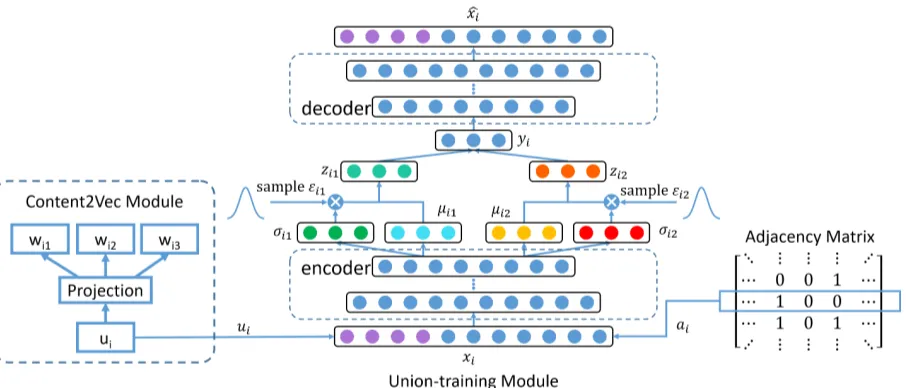
3 Model Description
The architecture of the proposed model is shown in Fig.1. The whole architecture consists of two main modules, namely, the content2vec module and the union training module. For an informa-tion network, such as a paper citainforma-tion network, we can obtain the node link and content information (e.g., paper abstract). We learn an effective feature representation vector that preserves both structure information and node content information and can thus be applied to many tasks (e.g., paper classifi-cation).
3.1 Content2vec Module
We employ the state-of-the-art approach called doc2vec (Le and Mikolov, 2014), which uti-lizes text to learn vector representations of docu-ments, as our content2vec module. Specifically, if one node contains other information (e.g., author name), we treat it as a word and merge it into the comprehensive text information (e.g., the abstract of the paper in the citation network) as the con-tent of the node. A representationuithat includes
the node content information is obtained from this module.
3.2 Union-training Module
The union training module is the core part of our model, in which content information and structure information are integrated. The details are shown in Fig1. The VAE is adopted as the main block. Given a network, the adjacency matrixA can be
obtained. A can describe the relationship among
the nodes and reflect the overall structure of the network. We extract each adjacency vectoraiand
concatenate it with the correspondinguias the
Figure 1: Architecture of our model. wi can be seen as a word of the content information, ui is a node
in the network,ui is a representation vector learned by the Content2Vec Module,xi is a vector of the
adjacency matrix. The input of the union-training module is combination of xi and ui, the encoder
and decoder are stack full-connected layer,σi1,σi2,µi1,µi2 can be seen the mean and variance of the
distribution of the content and structure data, respectively. εi1 andεi2 are the sample data from two
Gaussian distributions.
structure information is able to be learned simul-taneously.
During the encoding phase, we adapt several fully connected layers composed of multiple non-linear mapping functions to map the input data to a highly nonlinear latent space. Therefore, given the inputxi, the outputhk for thekth layer is shown
as follow:
h1=π(W1xi+b1)
hk=π(Wkhk−1+bk), k= 1,2...K (1)
where π is the nonlinear activation function of
each layer. The value ofK varies with the data. In the last layer of encoder, we obtain four out-put: µi1, σi1 µi2 and σi2. They can be treated
as the means and variances of the distribution of content information and structure information re-spectively. Furthermore, we sample two values
εi1 andεi2 from two previous distributions (e.g.,
Gaussian distribution). Then we can obtain the re-parameterizedzi1andz21. Through concatenate
zi1andz21, content and structure information can
be integrated together, yi is the representation of
the network. Nonlinear operations are not per-formed in this phase. Thus, the gradient descent method can be safely applied in optimization. The operations can be expressed as follows:
zik=f(µik,σik,εi), k= 1,2
yi=M erge[zi1,zi2]
(2)
where f is a linear function that can
re-parameterizeyi,M ergeconcatenate the two
vec-tors together directly.
The decoding phase is a reflection of the en-coder; its output xˆi should be close to the input
xi. The loss function of this module that should
be minimized is as follows:
L(xi) =−
2 X
k=1
KL(q(zik|xi)||p(zik))+H(xi,xˆi)
(3) where KL is the KL divergence which is always used as a measure of the difference between two distributions,His a cross-entropy function that is used to measure the difference betweenxiandxˆi.
Finally, We choose the output of the layeryi as
the final representation of each node.
4 Experiments 4.1 Experimental setup
Table 1: Macro-F1 score on Citeseer-M10 Network
%p One-Hot Deepwalk Node2vec Doc2vec DW+D2V TADW TriDNR Ours
10% 0.254 0.297 0.314 0.503 0.526 0.475 0.683 0.889
30% 0.321 0.334 0.331 0.536 0.615 0.488 0.744 0.913
50% 0.352 0.346 0.346 0.547 0.633 0.495 0.760 0.924
70% 0.363 0.344 0.339 0.534 0.630 0.495 0.773 0.940
Table 2: Macro-F1 score on DBLP Network
%p One-Hot Deepwalk Node2vec Doc2vec DW+D2V TADW TriDNR Ours
10% 0.328 0.379 0.448 0.574 0.495 0.660 0.724 0.751
30% 0.362 0.454 0.473 0.598 0.586 0.687 0.742 0.753
50% 0.371 0.459 0.475 0.604 0.614 0.697 0.747 0.762
70% 0.372 0.461 0.476 0.605 0.628 0.699 0.748 0.763
CiteSeerM101. It contains 10 distinct categories
with 10,310 papers and 77,218 citations. Titles are treated as the text information because no more text information is available; and (2) DBLP dataset2. We treat abstracts as text information
and choose 4 research areas with the same setting as that of (Pan et al., 2016), which are database (SIGMOD, ICDE, VLDB, EDBT, PODS, ICDT, DASFAA, SSDBM, CIKM), data mining (KDD, ICDM, SDM, PKDD, PAKDD), artificial intelli-gent (IJCAI, AAAI, NIPS, ICML, ECML, ACML, IJCNN, UAI, ECAI, COLT, ACL, KR), computer vision (CVPR, ICCV, ECCV, ACCV, MM, ICPR, ICIP, ICME). Therefore we get a network contains 30,422 nodes and 41,206 edges.
We compare our approach with the following methods:
• One-Hotuses adjacency matrix, which car-ries the structure information as the high-dimension representation, and directly feed into the classifier.
• DeepWalk(Perozzi et al.,2014) is exploited by statistical models, which employs trun-cated random walks to learns nodes embed-ding by treating walk as the equivalent of sen-tences.
• Node2vec (Grover and Leskovec, 2016) learns the network representation by design-ing a biased random walk procedure which efficiently explores diverse neighborhoods.
• Doc2vec(Le and Mikolov,2014) is the Para-graph Vector model that learns document
rep-1http://citeseerx.ist.psu.edu/
2http://arnetminer.org/citation (V4 version is used)
resentation by predicting the words appeared.
• DW+D2Vis simply to concatenate the rep-resentation result learned by DeepWalk and Doc2vec.
• TADW (Yang et al., 2015) is text-based DeepWalk, which incorporates text informa-tion into network structure by matrix factor-ization.
• TriDNR(Pan et al.,2016) uses node text, la-bel, and structure to jointly learn node repre-sentation.
4.2 Performance on Node Classification
We conduct the paper classification task on two benchmark citation networks to evaluate the per-formance of our method. To reduce the impact of sophisticated classifiers on the performance, we employ a linear SVM, which is a common tech-nique used by the exiting work (Pan et al.,2016). The results are shown in Table1and Table2, re-spectively. The reported parameters for our model are set: dimension d=100 on CiteseerM10 and d=300 on DBLP. The dimension for other
algo-rithms is the same as ours, and the other parame-ters are set as their papers report, i.e., window size
b=10 in DeepWalk and Node2vec, in-out
parame-terq=2 in Node2vec, text weight∂=0.8 in TADW
and TriDNR. We use Macro-F1 which is the same as that adopted by other algorithms to measure the classification performance. The experiments are independently conducted 10 times for each setting, and the average values are reported. The propor-tion of training data with labels is range from10%
[image:4.595.110.489.185.246.2](a) (b) (c) (d)
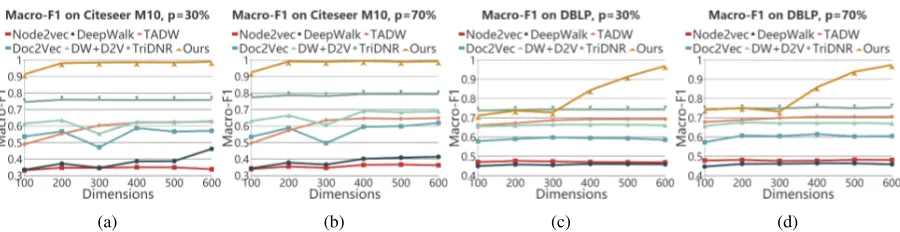
Figure 2: Performance of each strategy on different training proportionp
Our model is evaluated by comparing it with seven approaches. One-Hot uses the original structure data, and its performance is poor because it is discrete and the context relation of nodes can not be captured. DeepWalk and Node2vec are structure-based methods that exhibit inferior per-formance mainly because they only use the shal-low structure information and the network is rather sparse, while the information of the complex non-linear structure cannot be employed. The perfor-mance of Doc2vec is not as good as ours which demonstrates the effectiveness of our proposed model. TADW and TriDNR are inferior to our approach, although these two methods also con-sider the text and structure. Nevertheless, they cannot capture the complex non-linear structure. The reason for the superior of our method is that our model can effectively capture the inter-relationship between node content and link struc-ture, and the intro-relationship among nodes and links, which are essential to learn the represen-tation of networks. Furthermore, our model can capture the information of highly non-linear struc-ture instead of the shallow strucstruc-ture (e.g., Deep-Walk) by exploiting VAE. Moreover, our approach does not require heavy text information which is utilized by the other state-of-the-art strategies (e.g.,TriDNR). Our model exhibits consistent su-perior performance, and is up to 16% better than the state-of-the-art methods (i.e., the Macro-F1 score of our model is 94% when the proportion of training data with labels is 70% conducted on the Citeseer-M10 Network dataset).
4.3 Parameter Setting
A significant hyperparameter in our model is the dimensiond. The performance of different
meth-ods with varying dimensions has been evaluated. The result is illustrated in Fig.2. We obtain very good performance on the CiteSeer-M10 dataset,
i.e., the Macro-F1 score is 94% and the perfor-mance tends to be stable as b becomes larger. It
validates the effectiveness of our algorithm and the reason is due to the ability of our model that can capture the complex network structure and the text information. From Fig.2, we can see that the per-formance gets better whendincreases from 100 to
600. We think the main reason is because more in-formation can be preserved in higher dimensional space of the datasets.
5 Conclusions
In this paper, we have introduced an effective network representation model, which comprehen-sively integrates the text information and the net-work structure. We introduced Paragraph Model as a preliminary module. And we have exploited Variational Autoencoder as the main block of our model, that could capture highly non-linear struc-ture of the network. The comprehensive experi-mental evaluation on two benchmark datasets has demonstrated the effectiveness of the model.
Acknowledgement
This research is supported by the National Nat-ural Science Foundation of China: U1636116, 11431006, Research Fund for International Young Scientists: 61650110510, Ministry of Education of Humanities and Social Science: 16YJC790123.
References
Mikhail Belkin and Partha Niyogi. 2003. Laplacian eigenmaps for dimensionality reduction and data representation. Neural Computation 15(6):1373– 1396.
Shaosheng Cao, Wei Lu, and Qiongkai Xu. 2015. Grarep:learning graph representations with global structural information. pages 891–900.
A Grover and J Leskovec. 2016. node2vec: Scalable feature learning for networks. InSIGKDD.
Diederik P Kingma and Max Welling. 2014. Auto-encoding variational bayes .
Quoc V Le and Tomas Mikolov. 2014. Distributed rep-resentations of sentences and documents. InICML.
Shirui Pan, Jia Wu, Xingquan Zhu, Chengqi Zhang, and Yang Wang. 2016. Tri-party deep network rep-resentation. InIJCAI.
Bryan Perozzi, Rami Al-Rfou, and Steven Skiena. 2014. Deepwalk: Online learning of social repre-sentations. InSIGKDD.
Sam T. Roweis and Lawrence K. Saul. 2000. Nonlin-ear dimensionality reduction by locally linNonlin-ear em-bedding. Science290(5500):2323–2326.
Jian Tang, Meng Qu, Mingzhe Wang, Ming Zhang, Jun Yan, and Qiaozhu Mei. 2015. Line: Large-scale in-formation network embedding. InWWW.
Joshua B. Tenenbaum, Vin De Silva, and John C. Langford. 2001. A global geometric framework for nonlinear dimensionality reduction. Science
290(5500):2319–2323.
F. Tian, B. Gao, Q. Cui, E. Chen, and T. Y. Liu. 2014. Learning deep representations for graph clustering.
Inproceedings.