Munich Personal RePEc Archive
Analyzing Wage Differentials by Fields of
Study: Evidence from Turkey
Di Paolo, Antonio and Tansel, Aysit
University of Barcelona, Middle East Technical University, IZA and
ERF
20 July 2017
Online at
https://mpra.ub.uni-muenchen.de/80299/
Analyzing Wage Differentials by Fields of Study: Evidence from Turkey*
Antonio Di Paolo** and Aysit Tansel***
*AQR-IREA, University of Barcelona; **Middle East Technical University, ERF & IZA July 2017
Abstract
This paper analyzes the drivers of wage differences among college graduates who hold a degree in a different field of study. We focus on Turkey, an emerging country that is characterized by a sustained expansion of higher education. We estimate conditional wage gaps by field of study using OLS regressions. Average differentials are subsequently decomposed into the contribution of observable characteristics (endowment) and unobservable characteristics (returns). To shed light on distributional wage disparities by field of study, we provide estimates along the unconditional wage distribution by means of RIF-Regressions. Finally, we also decompose the contribution of explained and unexplained factors in accounting for wage gaps along the whole distribution. As such, this is the first work providing evidence on distributional wage differences by college major for a developing country. The results indicate the existence of important wage differences by field of study, which are partly accounted by differences in observable characteristics (especially occupation and, to a lesser extent, employment sector). These pay gaps are also heterogeneous over the unconditional distribution of wages, as is the share of wage differentials that can be attributed to differences in observable characteristics across workers with degrees in different fields of study.
JEL Classifications: J31, J24, I23, I26
Keywords: Fields of Study, Wage Differentials, Decomposition, Unconditional Wage
Distribution, Turkey
* Funding from the MEC grant ECO2016-75805-R is gratefully acknowledged. This paper benefited from comments
received in seminars at the Atilim University (Ankara, Turkey), the Selcuk University (Konya, Turkey), the Piri Reis University (Istanbul, Turkey), as well as at the 28th EALE Conference (Ghent, Belgium), 2nd Workshop on Human
Capital (Istanbul, Turkey), 37th MEEA Annual Meeting (Chicago, US) and the 4thWorkshop on the Economics,
Statistics and Econometrics of Education. We also thank the suggestions received by Asena Caner. We are grateful to Murat Karakas (TURKSTAT) for his help in questions related to the data. The usual disclaimers apply.
***Aysit Tansel (corresponding author), e-mail: [email protected]. Address: Department of Economics Middle East
Technical University, 06800 Ankara (Turkey), telephone: +903122102073, fax: +903122107964; Institute for the Study of Labor (IZA), Bonn, Germany; Economic Research Forum (ERF) Cairo, Egypt.
**Antonio Di Paolo, e-mail: [email protected]. Address: Department of Econometrics, University of Barcelona,
1) Introduction
What drives wage disparities among university graduates who studied different
fields? There is an extensive amount of evidence documenting the general payoff to
obtaining a university degree (relative to lower education levels), but also a growing
number of papers highlighting the existing heterogeneity in the return to tertiary education
according to the field of study (see Altonji et al., 2012 and Altonji et al., 2015 for recent
overviews). However, the forces that drive wage gaps by field of study among university
graduates have not been widely explored so far and the literature focused on this specific
issue is still scarce.
Indeed, analyzing the factors that account for wage differences by field of study is
becoming an attractive area of research, since there are several policy-relevant issues that
motivate such interest. First, relative wage differences across fields of tertiary education
are likely to affect the choice of university major (see Berge, 1988, Montmarquette et al.,
2002, Bhattacharya, 2005, Beffy et al., 2012, Long et al., 2015, among others). Therefore,
providing evidence about earnings gaps across fields and, more importantly, about the
drivers of such disparities would be extremely valuable for future university students (and
their parents) when deciding about their college major. Second, insights about
determinants of earnings disparities across fields of study would be useful for academic
policies aimed at efficiently allocating economic resources across universities and
academic areas, setting tuition fees for different university programs, as well as
determining the course composition of different fields of study that will prepare students
for the labor market. This would be especially important in the context of a sustained
expansion of tertiary education, as is occurring in many developed and emerging
countries, since the supply of university graduates from different fields of study
constitutes an important input into the skill composition of the future workforce (Altonji
et al., 2015). Its efficient allocation in the economy represents a fundamental aspect for
guaranteeing a sustainable pattern of economic growth and development.
We consider the case of Turkey, a developing country that has been characterized by
a huge expansion of tertiary education over the last decades. The high and increasing
demand for university education in Turkey is mainly due to the substantially high returns
to tertiary education, compared to lower levels of schooling (see Tansel, 1994, 2001, and
2010). Indeed, during the period 2014-2016, the numbers of male (female) students
representing substantial increases in recent years. Moreover, the Turkish case is
especially relevant, since access to university is determined by a highly selective
centralized university entrance examination. Its results determine the final placement of
applicants across different fields, degrees, and universities (for additional details, see
Caner and Okten, 2010 and Frisancho et al., 2016). Therefore, having a clear picture about
the relative monetary rewards of holding a degree in different fields of study would be
beneficial for prospective students, when carrying out the necessary investment to prepare
for the university entrance examination. Moreover, the evidence we report in this paper
could be useful for administrators, since it can serve as a basis to optimally set the
university entrance examination cut-off points associated with different disciplines. More
generally, our work represents the first contribution about the monetary value attached to
different fields of tertiary education in developing countries, since to the best of our
knowledge the existing literature is exclusively focused on developed countries.1
Our empirical analysis proceeds as follows: First, we run simple OLS regressions for
(log) real hourly wages with a set of field of study indicators. The wage equations are
estimated for male wage-earners, in order to minimize issues due to possible self-selection
into labor market participation and employment. The model is initially based on a
parsimonious specification that includes only controls for survey wave, current job
tenure, and potential experience (previous to current employment). Next, we
progressively augment the wage equation by including additional controls for family
characteristics (marital status and the number of children), job characteristics
(employment sector, a quadratic function of firm size and occupation), and regional fixed
effects (dummies for the 26 NUTS2 regions). These estimates reveal that ceteris paribus
differences in wages across fields of study are, to a certain extent, mediated by the
conditional association between wages and other observed characteristics. Third, we
investigate the factors that account for the raw wage gaps across college majors by
performing the Oaxaca-Blinder decomposition for average outcomes. This methodology
disentangles the observed average differences in hourly wages into the contribution of
observable characteristics (endowments or explained component) and the corresponding
coefficients (prices or unexplained component). A similar decomposition approach has
1 See Arcidiacono (2004), Hamermesh and Donald (2008), Altonji et al. (2012), Altonji et al. (2014), and Webber
only been applied by Grave and Goerlitz (2012) to analyze wage differences by field of
study among university graduates in Germany. However, no other paper relies on
decomposition analysis to examine the role of observed and unobserved factors in
explaining wage gaps between fields of study for university graduates2. This means that
we provide additional evidence about the drivers of average wage differences by field of
study.
The simple regressions and the corresponding decomposition provide evidence only
on the average of the wage distribution, which might hide important differentials that take
place at other points of the wage distribution than the mean. Therefore, we go a step
further by providing distributional wage gaps. There are a few papers that investigate
wage differences by field of study along the conditional wage distribution using classical
Quantile Regressions (see Hamermesh and Donald, 2008, Kelly et al., 2010, Chevalier,
2011 and Livanos and Pouliakas, 2011). In this paper, rather than considering the effect
of fields of study at different points of the conditional wage distribution, we adopt the
Unconditional Quantile Regression (UQR) approach proposed by Firpo et al. (2009). This
approach provides the wage differential of a given field relative to the chosen base
category at different points of the unconditional wage distribution. This is indeed an
important piece of evidence, since not only policy-makers but also students and parents
are more likely to be interested in the relative returns to different college majors on the
unconditional wage distribution. Such estimates can be obtained through the Recentered
Influence Function (RIF) Regression. It yields estimates of Unconditional Quantile
Partial Effects of holding a degree in a given field. This novel approach has never been
applied in the literature on fields of study, and thus represents an important contribution
of this paper. Therefore, in a subsequent step, we decompose the gaps observed at
different points of the unconditional wage distribution using the decomposition method
based on Regressions (Firpo et al., 2007). The decomposition based on
RIF-Regressions extends the classical Oaxaca-Blinder decomposition3 by disentangling the
explained and unexplained components of the wage gap by field of study at different
points of the unconditional wage distribution. The evidence from this distributional
decomposition is informative, since the relative role of returns and endowments in
explaining wage differences across fields of study is likely to depend on the point of the
2 It seems also worth mentioning that Lemieux (2014) decomposed the wage gap between high school graduates and
university graduates in a given field, focusing on the role of occupation and its relationship to the field of study.
3 Moreover, the RIF-based decomposition is not path-dependent and allows for a detailed analysis of the contribution
wage distribution at which they are evaluated. As such, our RIF-based decomposition
analysis of wage gaps by field of study constitutes the last remarkable value-added of our
work with respect to the existing research.
Although informative about the role of explained and unexplained factors in
accounting for the wage gaps across different disciplines, it seems worth recognizing that
our approach remains subject to one of the main challenges in the estimation of the wage
effect of holding a degree in a given subject: the issue of self-selection into different
disciplines based on unobservable characteristics. There are very few papers that
explicitly deal with this issue. The endogeneity of the choice of field of study has been
approached by means of structural economic models by Arcidiacono (2004) and more
recently, by Kinsler and Pavan (2015). An alternative and promising approach is based
on exploiting discontinuities induced by test-score based university admission,4 which
generates a random variation in the choice of university-subject combinations. Variants
of this general strategy have been developed by Hastings et al. (2013) for Chile and by
Kirkebøen et al. (2016) for Norway. In both countries, university entrance is ruled by a
centralized admission process and, more importantly, it is possible to link administrative
information about exam performance, college choice, and preferences with future
earnings. This enables estimating the causal effect of completing the degree in a given
subject, net of the effect of selection into fields and into next-best alternatives (Kirkebøen
et al., 2016). Although university entrance in Turkey is managed in a similar way,
combining college application data with information on post-graduate labor market
outcomes is unfortunately still unfeasible for this country. Consequently, we are forced
to rely on conditional correlations (as is done in the majority of related works) and to
interpret the unexplained component of wage differentials across fields as the composite
impact of returns to observable characteristics and selection-on-unobservable
characteristics. In our view, although clearly representing a second-best solution, the
results from our approach are still informative about the drivers of wage differences by
the field of study, and will highlight the factors that should be better investigated in causal
terms when more detailed data become available.
The rest of the paper proceeds as follows: in Section 2 we describe the data and
present some descriptive statistics, in Section 3 we explain the empirical methodology
4 Additionally, Ketel et al. (2016) analyzed the return to being admitted to a medical school in the Netherlands, which
that is applied in the empirical analysis, in Section 4 we present and discuss the results
for average wage differentials (4.1) and distributional wage differentials (4.2) and finally
we conclude in Section 5.
2) Data Description
The empirical analysis is based on annual repeated cross-sections of data from the
Turkish Household Labor Force Survey (HLFS), covering the period 2009-2015.
Although the HLFS database is also available for previous years, 2009 is the first wave
in which a question about the individual’s field of study is included. The survey originally
considers 20 different categories for fields of study (plus one category for military/police
career studies5). We regrouped them into 15 categories due to small sample sizes in some
fields in the original classification. We select only tertiary educated males who are
regularly employed as wage-earners at the time of the survey.6 We retain only individuals
employed full-time who work no less than 30 hours and no more than 72 hours per week.
Individuals who are either older than 65 or younger than 23 are excluded from the final
sample, as well as those who are enrolled in education at the time of the survey.
Observations with real monthly wages (in 2010 prices) lower than 600 Turkish Liras (TL)
are discarded, which implies eliminating individuals who earn a salary lower than the
minimum wage set in 2010. Migrants and Turkish returning emigrants who returned after
completing tertiary education are also excluded from the analysis. After cleaning for
missing values in relevant variables, we end up with a pooled sample of 77,154
observations.
Our dependent variable is the log of hourly real wages from the main job in terms of
2010 prices. The database contains information on monthly wages, which are net of taxes
and include extra compensations such as bonuses and premiums in addition to salary. In
order to construct hourly wages, we exploit the information on “typical” hours of work
per week, which are converted into monthly hours of work by applying a factor of 4.3.
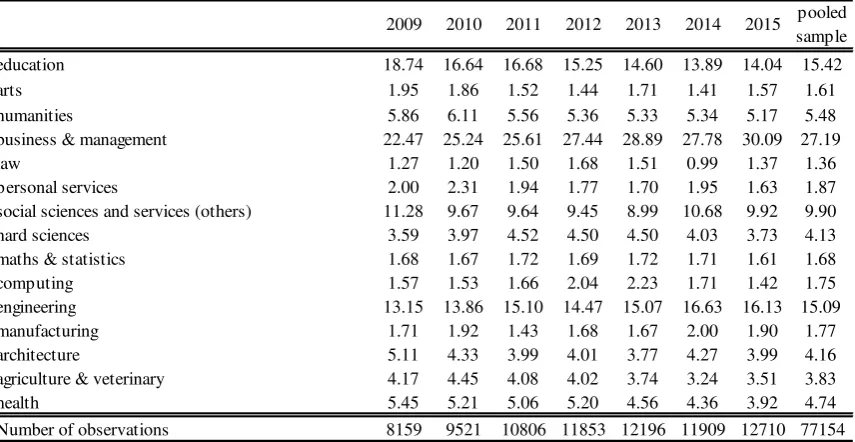
Table A1 in the Appendix displays the distribution of college major across survey waves,
5 We excluded individuals who graduated in this field, since they are mostly in the army or police forces and their labor
market outcomes are hardly comparable with the results of their counterparts in other fields of study.
6 This restriction implies that we aim at obtaining evidence for the (male) working population, which should not be
as well as for the pooled sample (2009-2015).7 The raw data indicate that business and
management is the most common field of study (27%), followed by education and
engineering each accounting for about 15% of the pooled sample. Further, the fields of
education, arts, humanities, personal services, architecture, agriculture & veterinary, and
health have all lost importance over the period 2009-2015, while the share of observations
in business & management, engineering, and (to a lesser extent) manufacturing increased
over time during the same period.
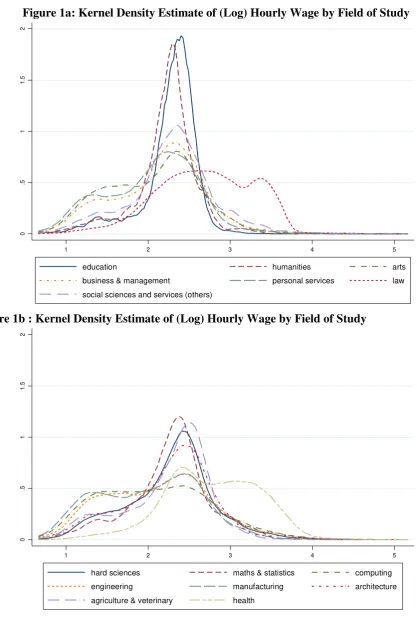
Kernel density estimates of the (log) hourly real wage by fields of study are reported
in Figure 1. In order to facilitate the visualization of distributional wage differences across
different fields of study, we present two graphs. Figure 1a presents the results for the
broad areas of humanities and social sciences. Figure 1b presents the results for hard
sciences, technical disciplines, and health-related fields. The former figure shows that the
wage distribution in the fields of education and humanities are very concentrated around
the mean (log) hourly wage of about 2.3 (which corresponds to an average real hourly
wage of about 10 TL). Graduates in arts and, to a lesser extent, in personal services and
business & management are the least paid, since they are mostly represented in the lowest
tail of the hourly wage distribution. Graduates in (other) social sciences and services fall
in an intermediate position, whereas graduates in law display a wage distribution that is
significantly shifted towards the right tail indicating that law is a highly rewarded field
(at least without conditioning for individual characteristics). Figure 1b indicates that
graduates in computing, manufacturing, and engineering are more represented in the
lower part of the unconditional hourly wage distribution. In contrast, those who studied
for a degree in hard sciences, mathematics & statistics, architecture, and agriculture &
veterinary are placed in an intermediate position and their wages are mostly concentrated
around the mean. Similar to the case of law, the hourly wage distribution of graduates in
health disciplines is significantly shifted towards the right, with an important proportion
of observations concentrated at the top of the overall unconditional hourly wage
distribution. The analysis of the unconditional wage distribution by field of study reveals
that different degrees are unevenly rewarded in the labor market. Moreover, wage
differences across fields operate not only on the average, but also along the wage
distribution. In the next section we investigate the drivers of such average and
7 Descriptive statistics for the variables used in the empirical analysis are reported in Table A2 in the Appendix. Notice
distributional wage differentials by fields of study using regression and decomposition
tools.
3) Empirical Methodology
3.1) Average Wage Differentials
The starting point of our analysis of wage differentials by fields of study consists of a
simple OLS regression that explains (logged) real hourly wages (ln(wi)) as a function of
a vector of control variables (Xi) and a set of dummies for each field of study (FSi):
ln(𝑤𝑤𝑖𝑖) =𝛼𝛼+𝛽𝛽′𝑋𝑋𝑖𝑖+∑ 𝛿𝛿𝑗𝑗 𝑗𝑗𝐼𝐼(𝐹𝐹𝐹𝐹𝑖𝑖 =𝑗𝑗) +𝜀𝜀𝑖𝑖 𝑗𝑗 = 1 …𝐽𝐽 −1. (1)
Here δj represent the coefficients of interest, which measure the percentage wage
difference of holding a degree in field “j” relative to the reference category (in our case,
the field of “business and management”). We first present the estimates of δj without
conditioning for any observable characteristics, which yield unconditional wage
differences across different fields of study. Second, we progressively expand the vector
of covariates, moving from a regression that contains only the basic set of controls
(current job tenure and previous potential experience, both in quadratic form, plus survey
wave dummies), which is subsequently augmented by family characteristics, sector
dummies and firm size (in quadratic form), occupation dummies and NUTS2 region
dummies. This stepwise inclusion of control variables yields different estimates of the
“ceteris paribus” wage differentials by college major, and allows to assess whether the
raw wage differences observed across different fields of study are, to some extent,
mediated by other observable characteristics of the individual, his job, and his region of
residence, which might co-vary with both fields of study and salaries.
In order to better appreciate the contribution of observable characteristics on the
observed wage disparities between individuals who graduated from different fields, we
apply the Oaxaca-Blinder (OB) decomposition for average wage gaps (Oaxaca, 1973,
Blinder, 1973). This well-known decomposition method disentangles average outcome
differentials into the contribution of the (average) endowment of observable
unexplained factors (i.e. the so-called wage structure component, which is captured by
differences in the estimated coefficients). To avoid choosing an arbitrary reference field,
we decompose the gap between the average wages of individuals graduated in field j and
the average wages in all other fields of study different from j (-j) of their counterparts.
Moreover, as suggested by Fortin (2008) and Fortin et al. (2011), we estimate the
nondiscriminatory reference wage structure from a pooled regression with all the fields
together,8 imposing an identification restriction that ensures that the wage advantage of
one field equals the disadvantage suffered by other fields, that is:
ln(𝑤𝑤𝑖𝑖) =𝛼𝛼+𝛽𝛽′𝑋𝑋𝑖𝑖+𝛾𝛾𝑗𝑗𝐼𝐼(𝐹𝐹𝐹𝐹𝑖𝑖 =𝑗𝑗) +𝛾𝛾−𝑗𝑗𝐼𝐼(𝐹𝐹𝐹𝐹𝑖𝑖 ≠ 𝑗𝑗) +𝑢𝑢𝑖𝑖 𝑗𝑗 = 1 …𝐽𝐽 (2)
𝑠𝑠𝑢𝑢𝑠𝑠𝑗𝑗𝑠𝑠𝑠𝑠𝑠𝑠𝑠𝑠𝑡𝑡 𝛾𝛾𝑗𝑗+𝛾𝛾−𝑗𝑗 = 0
Equation (2) is estimated for each different field of study (j) using the pooled sample, and
contains indicators for being graduated in field “j” (𝐹𝐹𝐹𝐹𝑖𝑖 = 𝑗𝑗) and for being graduated in
any of the fields that is different from “j” (𝐹𝐹𝐹𝐹𝑖𝑖 ≠ 𝑗𝑗). The estimated β coefficient thus
represents the nondiscriminatory wage structure that is used in the decomposition. From
the estimates of equation (2) it is possible to decompose the raw percentage wage
differentials between graduates in field “j” and their counterparts who obtained a degree
in a different field (-j) into different components as follows:
ln�𝑤𝑤𝚥𝚥�
�������� −ln�����������𝑤𝑤−𝚥𝚥�=�𝑋𝑋�𝑗𝑗− 𝑋𝑋�−𝑗𝑗�𝛽𝛽̂+�𝛾𝛾�𝑗𝑗− 𝛾𝛾�−𝑗𝑗�+𝐸𝐸[𝑢𝑢𝑖𝑖|𝐹𝐹𝐹𝐹𝑖𝑖 =𝑗𝑗]− 𝐸𝐸[𝑢𝑢𝑖𝑖|𝐹𝐹𝐹𝐹𝑖𝑖 ≠ 𝑗𝑗] =�𝑋𝑋�𝑗𝑗 − 𝑋𝑋�−𝑗𝑗�𝛽𝛽̂+ [������������������𝑋𝑋�𝑗𝑗�𝛽𝛽̂𝑗𝑗− 𝛽𝛽̂�+�𝛼𝛼�𝑗𝑗− 𝛼𝛼���
𝛾𝛾�𝑗𝑗
− �𝑋𝑋��������������������−𝑗𝑗�𝛽𝛽̂−𝑗𝑗 − 𝛽𝛽̂�+�𝛼𝛼�−𝑗𝑗− 𝛼𝛼���] 𝛾𝛾�−𝑗𝑗
(3)
The term �𝑋𝑋�𝑗𝑗− 𝑋𝑋�−𝑗𝑗�𝛽𝛽̂ represents the composition effect (i.e. average wage differences
due to differences in observable characteristics), whereas the term �𝛾𝛾�𝑗𝑗− 𝛾𝛾�−𝑗𝑗�=
�𝑋𝑋�𝑗𝑗�𝛽𝛽̂𝑗𝑗− 𝛽𝛽̂�+�𝛼𝛼�𝑗𝑗− 𝛼𝛼��� − �𝑋𝑋�−𝑗𝑗�𝛽𝛽̂−𝑗𝑗− 𝛽𝛽̂�+�𝛼𝛼�−𝑗𝑗− 𝛼𝛼��� corresponds to the part of the
mean differential that can be attributed to different remuneration of observable
characteristics across fields of study.9
8 Notice that the OB decomposition (as well as the distributional analysis that follows) is carried out using the full set
of control variables included in the vector X.
9 Notice that the term 𝐸𝐸[𝑢𝑢
3.2) Distributional Wage Differentials
It seems worth noting that both the regression analysis and the OB decomposition
provide evidence about average wage differences across college majors. However, as
commented in the introduction (and confirmed by the graphical analysis of the wage
distribution by field of study), focusing on average gaps could hide important disparities
that could occur in other parts of the wage distribution than the mean. To evaluate
distributional wage disparities across fields of study, we estimate the Unconditional
Quantile Regression (UQR) proposed by Firpo et al. (2009). The UQR method is based
on the statistical concept of Influence Function (IF), which represents the influence of an
individual observation on a distributional statistic of interest (e.g. the quantile). By adding
back the statistic to the corresponding IF, it is possible to obtain the Recentered Influence
Function (RIF) for each quantile of the outcome. Specifically, the RIF for the τth quantile
(𝑞𝑞𝜏𝜏) of logged hourly wages corresponds to,
𝑅𝑅𝐼𝐼𝐹𝐹(ln(𝑤𝑤𝑖𝑖) ,𝑞𝑞𝜏𝜏) =𝑞𝑞𝜏𝜏 +𝐼𝐼𝐹𝐹(ln(𝑤𝑤𝑖𝑖) ,𝑞𝑞𝜏𝜏) =𝑞𝑞𝜏𝜏 +𝜏𝜏−𝐼𝐼(ln(𝑤𝑤𝑖𝑖)≤𝑞𝑞𝜏𝜏)
𝑓𝑓ln(𝑤𝑤)(𝑞𝑞𝜏𝜏) (4)
where I(·) is an indicator function and 𝑓𝑓ln(𝑤𝑤)(𝑞𝑞𝜏𝜏) is the density of the marginal
(unconditional) distribution of the outcome (ln(𝑤𝑤)) evaluated at 𝑞𝑞𝜏𝜏. The estimated
counterpart of the RIF is simply obtained by replacing the unknown components by their
sample estimators, such as,
𝑅𝑅𝐼𝐼𝐹𝐹� (ln(𝑤𝑤𝑖𝑖) ,𝑞𝑞�𝜏𝜏) =𝑞𝑞�𝜏𝜏 +𝐼𝐼𝐹𝐹�(ln(𝑤𝑤𝑖𝑖) ,𝑞𝑞�𝜏𝜏) =𝑞𝑞�𝜏𝜏 +𝜏𝜏−𝐼𝐼(ln(𝑤𝑤𝑖𝑖)≤𝑞𝑞�𝜏𝜏)
𝑓𝑓̂ln(𝑤𝑤)(𝑞𝑞�𝜏𝜏) (5)
Where 𝑓𝑓̂ln(𝑤𝑤)(𝑞𝑞�𝜏𝜏) corresponds to a kernel density estimator of the unconditional density
function of the outcome. The RIF for a given quantile can be taken as a linear
approximation of the nonlinear function of the quantile, and captures the change of the
(unconditional) quantile of the outcome in response to a change in the underlying
distribution of the covariates (Firpo et al., 2009). In fact, it can be shown that the expected
value of the RIF can be modelled to be a linear function of explanatory variables, as in a
study along the (unconditional) wage distribution by specifying the following linear UQR
for selected quantiles of the unconditional distribution of real hourly wages (𝑞𝑞�𝜏𝜏):
𝐸𝐸[𝑅𝑅𝐼𝐼𝐹𝐹� (ln(𝑤𝑤𝑖𝑖) ,𝑞𝑞�𝜏𝜏)|𝑋𝑋𝑖𝑖,𝐹𝐹𝐹𝐹𝑖𝑖] =𝛼𝛼�𝜏𝜏 +𝛽𝛽̂𝜏𝜏′𝑋𝑋𝑖𝑖 +∑ 𝛿𝛿̂𝑗𝑗 𝑗𝑗𝜏𝜏𝐼𝐼(𝐹𝐹𝐹𝐹𝑖𝑖 = 𝑗𝑗) 𝑗𝑗 = 1 …𝐽𝐽 −1. (6)
The estimates of 𝛿𝛿̂𝑗𝑗𝜏𝜏 from equation (6) represents the marginal impact of a small change
in the probability of holding a degree in field “j” (relative to the reference field) on the
unconditional τ-quantile of logged hourly wages.
Given the linear approximation of the conditional expectation of the RIF and the
theoretical property stating that the average 𝑅𝑅𝐼𝐼𝐹𝐹������ln�𝑤𝑤𝑗𝑗�,𝑞𝑞�𝜏𝜏� is equal to the
corresponding marginal quantile of the distribution of the outcome (𝑞𝑞�𝑗𝑗𝜏𝜏), it is possible to
generalize the standard OB decomposition of average outcomes to a distributional
decomposition applied to the unconditional distribution of the outcome (see Firpo et al.,
2007 and Fortin et al., 2011 for technical details). Put in other words, it is possible to
examine the contribution of the endowment of observable characteristics and the returns
to these characteristics in explaining the estimated unconditional wage gap across fields
of study, applying the outcome decomposition for average outcomes described by
equation (3) to the RIF, that is:
𝑞𝑞�𝑗𝑗𝜏𝜏− 𝑞𝑞�−𝑗𝑗𝜏𝜏 =𝑅𝑅𝐼𝐼𝐹𝐹������ln�𝑤𝑤𝑗𝑗�,𝑞𝑞�𝜏𝜏� − 𝑅𝑅𝐼𝐼𝐹𝐹������ln�𝑤𝑤−𝑗𝑗�,𝑞𝑞�𝜏𝜏� =
�𝑋𝑋�𝑗𝑗− 𝑋𝑋�−𝑗𝑗�𝛽𝛽̂𝜏𝜏+��𝑋𝑋�𝑗𝑗�𝛽𝛽̂𝑗𝑗𝜏𝜏− 𝛽𝛽̂𝜏𝜏�+�𝛼𝛼�𝑗𝑗𝜏𝜏− 𝛼𝛼�𝜏𝜏�� − �𝑋𝑋�−𝑗𝑗�𝛽𝛽̂−𝑗𝑗𝜏𝜏− 𝛽𝛽̂𝜏𝜏�+�𝛼𝛼�−𝑗𝑗𝜏𝜏− 𝛼𝛼�𝜏𝜏��� (7)
Here 𝛽𝛽̂𝜏𝜏 corresponds to the nondiscriminatory wage structure (estimated from a pooled
RIF regression) at quantile τ estimated in a similar fashion as equation (2) using the
estimated RIF for individuals graduated in field “j” and in fields different than “j” as
dependent variable. Similar to equation (3), the term �𝑋𝑋�𝑗𝑗− 𝑋𝑋�−𝑗𝑗�𝛽𝛽̂𝜏𝜏 represents the
composition effect and the term �𝑋𝑋�𝑗𝑗�𝛽𝛽̂𝑗𝑗𝜏𝜏− 𝛽𝛽̂𝜏𝜏�+�𝛼𝛼�𝑗𝑗𝜏𝜏− 𝛼𝛼�𝜏𝜏�� − �𝑋𝑋�−𝑗𝑗�𝛽𝛽̂−𝑗𝑗𝜏𝜏− 𝛽𝛽̂𝜏𝜏�+
�𝛼𝛼�−𝑗𝑗𝜏𝜏− 𝛼𝛼�𝜏𝜏�� captures the unexplained component of the percentage wage differential
4) Estimation Results
4.1) Average Wage Differentials
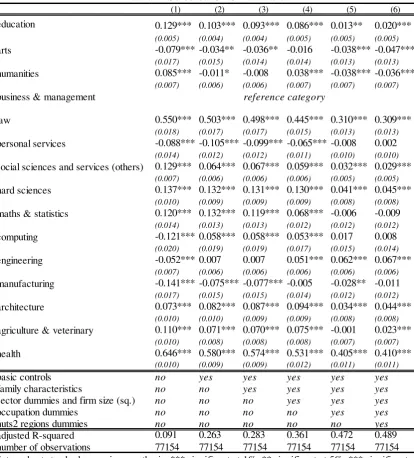
The main results from the OLS estimation of equation (1) are reported in Table 2
(complete results are displayed in Table A3 in the Appendix). The estimates in column
(1) are obtained without conditioning on observable characteristics and express
percentage differences in real hourly wages relative to graduates in business &
management,10 which is the reference and the most common field of study. Graduates in
manufacturing (-14.1%), computing (-12.1%) and, to a lesser extent, in personal services
(-8.8%), arts (-7.9%), and engineering (-5.2%) obtain a lower average remuneration than
graduates in business and management. All the other fields are better paid than the
reference group. The unconditional wage differential is especially pronounced for health
(+64.6%) and law (+55%), which are followed by hard sciences (+13.7%), social sciences
and education (+12.9%), mathematics & statistics (+12%), agriculture & veterinary
(+11%), humanities (+8.5%), and architecture (+7.3%). Thus, manufacturing is the
lowest and health is the highest paid field of study compared to business & management.
In Column (2) we control for the survey wave, current job tenure, and previous
potential experience, where the latter two variables enter in a quadratic form. In this way
we account for the fact that graduates in different fields of study may have different career
profiles in terms of tenure and work experience, as well as for the changing distribution
of university graduates across fields of study over time. Indeed, some of the negative
differentials relative to graduates in business & management either change sign (i.e.
computing), disappear (i.e. engineering), or are mitigated (as for manufacturing and arts).
The positive differential observed in favor of graduates in education, law, social sciences,
agriculture & veterinary, and health is lower when controlling for the basic set of
covariates, and reverts sign for the field of humanities.
Accounting for family characteristics, namely marital status and the number of
children, has virtually no effect on the coefficients associated with different fields of study
(see in Column (3)). This suggests that family structure and cohabitation do not drive
wage disparities between individuals graduated in different disciplines. The results
indicate that graduates in education, law, social sciences & services, mathematics &
10 The average of (log) real hourly wages for graduates in business & management is equal to 2.15 (i.e. hourly wage in
statistics, computing, architecture, agriculture & veterinary, and health all earn more than
graduates in business & management with the same amount of work experience and
similar family characteristics. The field of personal services gets the lowest remuneration
(-10% compared to the reference group). Graduates in arts, personal services, and
manufacturing earn less than the reference group. Surprisingly, having a degree in the
field of engineering is not associated with higher wages relative to business &
management. Health and law appear to be, by far, the college majors that are better
rewarded in the Turkish labor market, even controlling for several individual and family
characteristics.
Column (4) displays the wage differentials also conditioning on two important
features of the job, namely employment sector (grouped into 10 categories) and firm size
(in quadratic form). Wage differentials are generally reduced after controlling for sector
and firm size. More remarkably, graduates in arts do not earn significantly less than
graduates in business & management who work in the same sector and in firms of similar
size. Graduates from the fields of humanities and engineering are slightly better
remunerated than the reference group when sector and firm size are controlled for (+3.8%
and +5.1%, respectively). Moreover, the negative differential experienced by graduates
in manufacturing disappears when compared to the reference group with similar personal
characteristics, who work in the same sector and in firms of the same size. The premium
for the fields of architecture, and agriculture & veterinary is somewhat higher when
employment sector and the firm size are included as regressors. The high differential in
favor of law and health disciplines is only marginally reduced after controlling for sector
and firm size.
Conditioning on occupation in Column (5) generally compresses wage differentials
across fields of study by a substantial amount, as is usually reported in the literature
(Altonji et al., 2015, p. 35). The sign and the significance of the wage differentials
generally remain stable after accounting for occupation dummies, with some exceptions.
The negative gap suffered by graduates in arts (relative to business & management)
emerges again when comparing individuals who also hold similar occupations. Graduates
in humanities and manufacturing are instead penalized when occupation is controlled for,
whereas the wage differential for the fields of personal services (negative), mathematics
& statistics, computing, and agriculture & veterinary (all positive) vanish when they are
estimated conditional on occupational categories. Notably, graduates in law and health
31% and 40.5% than the reference category even controlling for occupation. The
estimates are mostly unaffected by the further inclusion of fixed effects for 26 NUTS2
regions of Turkey as shown in Column (6). This suggests that local differences in the
labor market do not significantly affect wage disparities between tertiary educated
workers with different college majors. The exceptions are manufacturing, for which the
negative differential disappears after conditioning on regions, and agriculture &
veterinary, which is slightly more rewarded than business & management.
We also repeated the OLS estimation for the full specification of the wage equation
splitting the sample into three age groups namely 23-30, 31-40, and 41-65. These results
are reported in Table A3 in the Appendix. This exercise provides a picture of the relative
pay differentials across disciplines at different stages of the career. There are remarkable
differences over the life-cycle for humanistic disciplines. Namely, the premium
associated with education is mostly captured by young workers, who earn 13.2% more
than their counterparts of the same age cohort who graduated in business & management,
while the oldest group of workers in this field suffers an earnings penalty. A similar
pattern is observed for arts, since young graduates in this field are better paid than the
reference field, while the opposite is true for the older cohorts. The premium for graduates
in social sciences and architecture vanishes in advanced stages of the working career. On
the contrary, the premium for the fields of law, computing, manufacturing, health, and to
a lesser extent, hard sciences is higher for the more senior groups of workers.
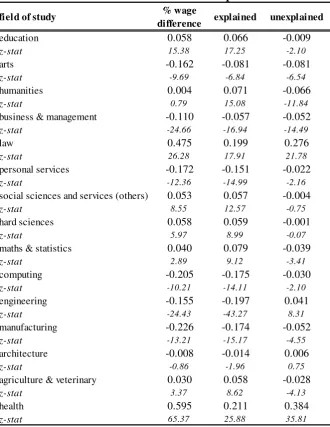
In order to better appreciate the role of observable characteristics and the associated
coefficients in accounting for the observed average wage gaps, we report the results from
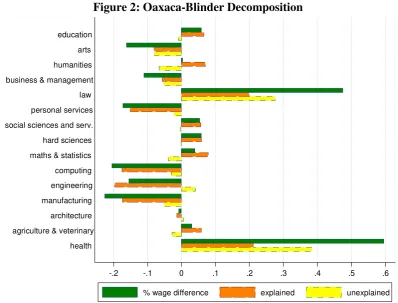
the Oaxaca-Blinder decomposition shown in Equation (3). The basic results are displayed
in Table 2 and graphically illustrated in Figure 2. The detailed results that report the
contribution of each block of variables (and their returns) are shown in Table A4 in the
Appendix. It can be appreciated that the average wage gap in favor of graduates in
education (relative to other disciplines) is entirely explained by the endowment of
observable characteristics — mostly occupation. The lower average wages observed for
graduates in arts are similarly explained by the contribution of observed characteristics
and their return (both with a negative sign). Wages of graduates in humanities are around
the overall average and, for this field, the modest contribution of explained and
unexplained factors operate in opposite directions. The field of business & management
is less rewarded than others, which is almost equally explained by a less favorable
a highly paid field) the unobservable components are slightly more relevant than the
observables in explaining the higher average hourly wage. For this field, the higher
coefficients associated with sector and occupation, and to a lesser extent their more
favorable composition in terms of these features of the job, represent the main driver of
the high and positive wage gap relative to other fields. The lower average remuneration
of graduates in personal services is almost entirely explained by observable
characteristics, whereby the effect of occupation prevails over the other covariates.
Observables are also responsible for the higher average wages in both social sciences and
hard sciences. For mathematics and statistics, the distribution of endowments positively
affects average hourly wages, but the returns to endowments operate in the opposite
direction. Average hourly pay is lower for graduates in computing, engineering, or
manufacturing than for graduates of other fields, and the observable characteristics seem
to account for almost their entire wage gaps. More specifically, for computing lower work
experience/job tenure are the main conditioning factors behind the negative wage
differential they suffer. For engineering, occupation is the most important observed factor
that accounts for the negative gap, followed by sector/firm size and work experience.
These three sets of observable characteristics are also the main driver of the wage penalty
experienced by graduates in manufacturing, with a similar weight. The wage rate for
graduates in architecture does not significantly differ from those in other fields, and the
slightly higher wages for agriculture & veterinary are driven by the net effect of a better
distribution of observed characteristics and lower associated returns. Finally, the field of
health is clearly better rewarded, whereby the unexplained factors are more important
than the explained. As in the case of law, the higher return to occupation (but not to
employment sector and firm size) is the main factor behind the premium for graduates in
health disciplines.
4.2) Differences along the Wage Distribution
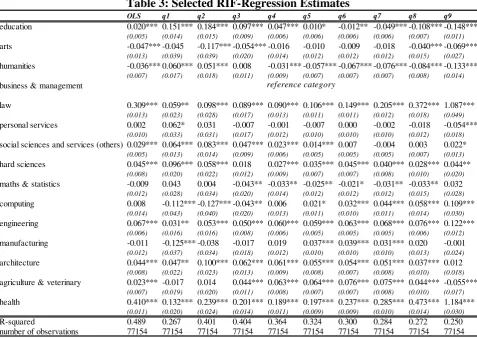
Selected coefficients from RIF-Regressions estimated at different deciles of the
unconditional wage distribution are displayed in Table 3 (complete results are not shown
but are available upon request). These represent the estimates of equation (6), which are
obtained using the full set of control variables. We also report the result from the OLS
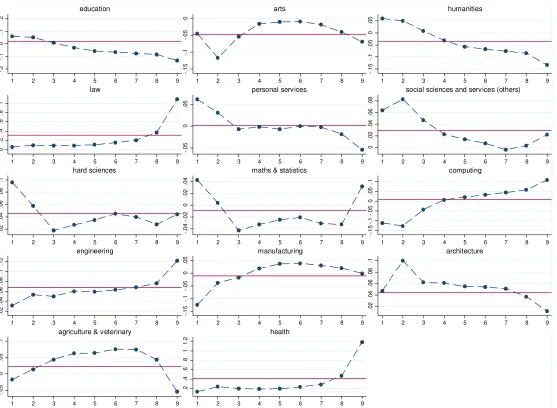
regression to allow for comparison. The same evidence can be graphically appreciated in
field of study along the distribution of real hourly wages. Relative to business &
management, graduates in education are better remunerated at the bottom of the
unconditional wage distribution, but the effect decreases monotonically with the quantiles
and becomes negative after the median. A similar pattern is observed for humanities. In
contrast, the high average reward to a degree in law that is detected by OLS is mostly
operating in the upper part of the wage distribution, since for lower deciles the positive
gap relative to the reference field is significantly less pronounced (but still positive).
Social science degrees yield a payoff relative to business & management only at the
bottom of the wage distribution, while no important differences are detected above the
median.
Interestingly, the wage premium in hard sciences is higher at lower quantiles, but
remains significant over the whole distribution. Graduates in mathematics & statistics are
instead slightly less rewarded than those in business & management only in the middle
of the distribution. As for graduates in computing, we observe lower wages at the left tail
of the distribution, but the sign of the gap is reversed above the median. Indeed, this
substantial heterogeneity was not captured by the average differential estimated by OLS,
which is virtually zero. Similarly, also for the field of manufacturing there is a negative
gap relative to business & management in the lower decile of the wage distribution, which
reverts to positive around the center. However, no significant differences are detected at
higher deciles. The returns to engineering increase along the unconditional wage
distribution, while the estimated differential decreases slightly for architecture. In any
case, both fields are better remunerated than business & management along the whole
unconditional distribution of hourly wages. Hourly pay gaps between agriculture &
veterinary and the reference field follow an inverted U-shaped pattern (being negative at
the lowest and highest deciles, respectively). Finally, similar to the case of law, the
positive wage gap in favor of health is especially high at the top of the unconditional wage
distribution, but is also relevant even at its left cue.
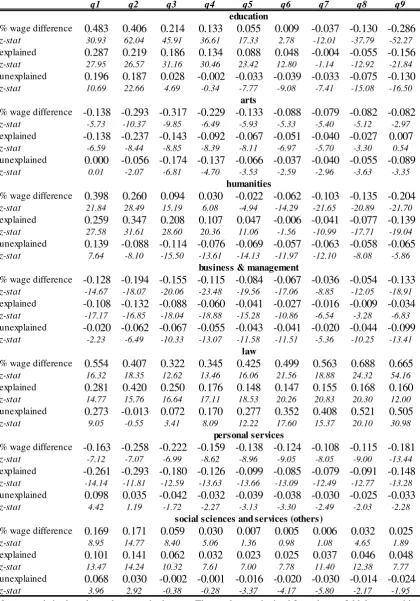
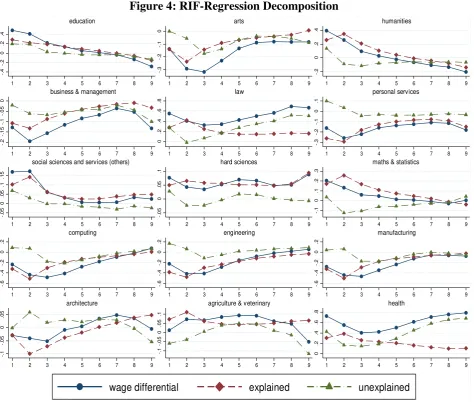
The decomposition results of wage gaps at different deciles of the unconditional
wage distribution are reported in Table 4 and graphically displayed in Figure 4. Detailed
RIF-decomposition results are shown in Table A6 in the Appendix. It appears that
observable and unobservable components have a similar weight in explaining wage
differences for the field of education at different points of the wage distribution and
follow the overall decreasing tendency of the wage gap relative to other fields. The
driven by occupation, which exerts a positive effect over the entire distribution, but is
indeed compensated by the negative impact of sector and firm size above the median. The
lower returns to work experience and occupation appear to be the main drivers of the
decreasing contribution of unexplained factors, which is especially pronounced at the
bottom of the wage distribution. For the field of arts, the endowment of observable
characteristics plays an important role in accounting for the negative wage gap detected
at the bottom of the distribution, but tends to decrease along it. The negative contribution
of the estimated coefficients is also very pronounced at the second and third quantile,
being mostly driven by the return to family characteristics (which is also relevant at the
top of the distribution). Observable characteristics account for most of the positive wage
gap observed for humanities at the bottom of the wage distribution, but their relevance
declines and even becomes negative at top quantiles (where graduates in this field earn
less than their counterparts). Similar to the case of education, although occupational
selection represents a favorable endowment for graduates in humanities, differences in
employment sector and firm size penalize them at the top of the distribution. Also, the
lower returns to work experience and occupation substantially contribute to the sharp
decrease of the role of unobservables in accounting for the wage gap at bottom deciles.
In the case of business & management, the negative wage gap that graduates in this
field experience relative to their counterparts generally tends to vanish along the
unconditional wage distribution (with the exception of the last quantile) and seems to be
mostly driven by the unfavorable distribution of endowments at lower deciles. More
specifically, occupational selection tends to penalize low-paid graduates in this field.
Occupation seems to exert a negative effect on wages of graduates in business &
management also at the top of the distribution, but its effect is compensated by the
positive impact of sector and firm size. For law, returns and endowments operate in
opposite directions at different points of the wage distribution, since the effect of
explained factors decreases along the quantiles and the contribution of unexplained
elements increases and accounts for most of the remarkably positive wage gap graduates
in this field enjoy at the top of the wage distribution. Among the observables, employment
sector and firm size are especially beneficial for bottom deciles, while occupation shows
a relatively stable positive contribution over the entire wage distribution. Regarding the
unexplained factors, it seems worth highlighting the changing contribution of the return
to work experience, which exerts a negative impact at the bottom of the distribution and
impact at the center of the unconditional distribution and contributes to the high wage gap
experienced by graduates in law. The negative wage gap for personal service is largely
explained by the unfavorable endowment of observable characteristics, with the
exception of the left tail of the wage distribution where the contribution of unexplained
factors slightly mitigates the distribution of observables. Detailed decomposition results
show that occupational choices are the most important drivers of the negative effect of
endowments for personal services, being the contribution of this element that is especially
relevant at the bottom and the top of the unconditional distribution of wages. Graduates
in social sciences experience a positive wage gap at the bottom of the wage distribution,
which is mostly accounted by the positive contribution of observable characteristics (i.e.
work experience and sector/firm size). The importance of observables for this field
decreases along the wage distribution and is somewhat compensated by the slightly
negative impact of the estimated coefficients that is detected after the median.
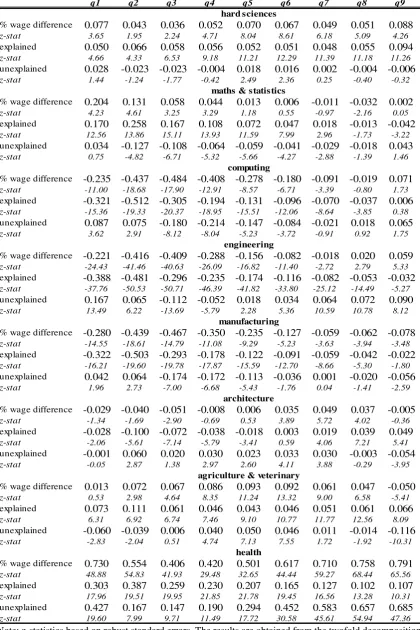
The modest wage disparities between hard sciences and other fields, which tend to
be relatively constant over the entire distribution, seem to be mostly explained by the
effect of covariates, among which occupational selection plays the most important role.
Graduates in mathematics & statistics are better paid than their counterparts at the bottom
of the wage distribution, but this positive differential vanishes at its median. However, it
seems interesting to highlight that the positive (but decreasing) contribution of
observables is somewhat compensated by the estimated return, which tends to be lower
for graduates in this field. More specifically, occupation appears to be the most important
factor behind explained differences, whereas the returns to family characteristics and
sector/firm size display the most relevant contribution in accounting for the unexplained
wage gap. Graduates in computing are instead penalized with respect to graduates in other
fields, especially below the median of the unconditional wage distribution. The negative
differential detected at lower quantiles is mainly driven by observable factors, whereas
the corresponding coefficients play a most important role at the center of the distribution.
A similar pattern is detected for the fields of engineering and manufacturing, which are
less rewarded than other fields at the bottom of the distribution, but this negative wage
gap disappears when moving to higher quantiles (and even reverts sign in the case of
engineering). Indeed, for both fields the important negative differential detected in the
first half of the wage distribution is mostly explained by differences in observable
characteristics, being employment sector/firm size and, to a lesser extent, work
Graduates in engineering and manufacturing obtain higher rewards to observable
characteristics at the bottom of the wage distribution, but the estimated coefficients tend
to penalize them around the central quantiles. Unexplained components have a positive
contribution for graduates in the former field above the median. Moreover, it seems
interesting to highlight the negative contribution of the coefficients associated to work
experience for the first two quantiles, which then reverts sign and tends to compensate
the lower returns to observables for these two technical fields of study. The field of
architecture is slightly less paid than others at the bottom of the distribution, while this
wage gap tends to revert above the median. In this case, explained and unexplained
components tend to operate in opposite directions along the unconditional wage
distribution, since the endowment of observable characteristics (mainly sector/firm size)
tend to penalize graduates in this field until the median, this differential being somewhat
compensated by slightly higher returns to characteristics (mostly sector/firm size and
occupation). For agriculture & veterinary, the inverted U-shaped contribution of
unexplained characteristics is what drives the same pattern observed for the overall wage
gap. Indeed, they tend to be better paid than other fields around the center of the wage
distribution and the endowment of observable characteristics is generally favorable for
them but the contribution of the estimated coefficients tend to be negative at the two
extremes of the distribution and positive in the middle. We detected a positive impact of
the coefficients associated with family characteristics along the whole distribution, as
well as of sector/firm size until the median, but these are compensated by the lower return
to work experience for graduates in agriculture & veterinary relative to their counterparts
from other fields. Finally, the positive wage gap in health disciplines is the result of the
net effect of the contrasting contribution of characteristics (with a decreasing weight
along the wage distribution) and coefficients (with an increasing weight at higher
quantiles), which is indeed a similar pattern observed for the case of law. Moreover,
among the observable characteristics, selection into occupation and employment sector
and, to a lesser extent, differences in work experience represent the main factors behind
5) Conclusions
This paper reports evidence on the pay disparities among tertiary educated workers
who hold a degree in different fields of study. We focus our analysis on Turkey, a
developing country that has been characterized by a sustained expansion of higher
education during the last decades. We detected significant heterogeneity in wage rates
across college majors, which are especially pronounced for the fields of law and health.
Indeed, graduates in these two disciplines are by far the better paid tertiary educated
(male) workers in the Turkish labor market. Observable characteristics matter in
explaining wage differences by field of study, since conditioning for characteristics alters
the magnitude and in some case also the sign of the estimated differentials. Consistent
with previous evidence in the literature, occupational selection represents the most
important driver of pay gaps, but also employment sector, firm size and work experience
operate as conditioning factors of the wages of Turkish university graduates. On the
contrary, other observable factors appear to be less relevant, such as family characteristics
(possibly because we focused on males) or geographical location (with the exception of
the field of agriculture & veterinary).
With the aim of appreciating the extent to which the observed wage gaps are driven
by differences in observable characteristics and/or by differences in the return associated
to those characteristics, we performed the Oaxaca-Blinder decomposition for average
wage differentials. The results indicate that differences in the endowments (i.e. the
explained component) account for a substantial share of the wage gaps, and even explain
almost the entire wage gap in some cases. Indeed, the overall effect of the return to
characteristics (i.e. the unexplained component) is negligible and even not significant for
several fields of study, such as social science and services, hard sciences and architecture
(while marginally significant for education and personal services). It seems also worth
noting that, in some cases, explained and unexplained components contribute to the wage
gaps in opposite directions. Finally, the contribution of unexplained elements turns out to
be especially high and actually higher than the contribution of observables for the two top
paid fields of study, law, and health. This finding is possibly due to the importance of
self-selection of high wage potential individuals into these two fields, which are among
the ones with the highest cut-off score requirements for the university admission test, but
also to labor market regulations that cover most of the jobs/sectors where graduates in
As long as important wage disparities between individuals who obtained a degree in
a different field of study could occur at other points of the distribution than the mean, we
investigated distributional wage gaps along the unconditional distribution of hourly
wages. Recentered Influence Function (RIF) Regressions estimates indicate that wage
disparities by college major generally vary over the wage distribution, making the
distributional analysis particularly relevant to analyze pay gaps by field of study. Indeed,
wage differences (relative to the reference category) display a decreasing pattern for the
fields of education, humanities, personal services, social services, mathematics &
statistics and architecture (except for the last quantile), moving from positive to negative
differentials. In contrast, pay disparities tend to increase along the wage distribution for
law, health, computing, and engineering (moving from negative to positive for the latter
two), and display an inverted U-shaped pattern for graduates in arts, manufacturing, and
agriculture & veterinary.
We finally decomposed distributional wage differentials, in order to understand
whether the contributions of explained and unexplained factors also change at different
points of the unconditional distribution of hourly wages. The distributional
decomposition confirms that the endowment of observable characteristics represents the
main driver of wage differentials, but their contribution to the observed wage gaps tends
to decrease when moving to the upper part of the unconditional wage distribution and
even changes sign after the median (changing from positive to negative for education,
humanities, and mathematics & statistics, and from negative to positive for architecture).
Unexplained elements instead appear very relevant for the fields of law and health, the
top paid college majors, and actually account for an increasingly important part of the
positive wage gap experienced by graduates in these two fields in the upper part of the
unconditional wage distribution.
Overall, the results point out that selection into occupation and, to a lesser extent,
into economic sectors represents the main mechanism behind observed wage differences
between individuals who obtained a university degree in a different field of study. As
long as these two selection mechanisms are likely to be determined by both observable
and unobservable individual characteristics (possibly correlated with wage potential), and
in this work we are unable to disentangle between the two, additional research is needed
to better understand the real contribution of occupation and employment sector to the
wage return attributed to different fields of study. Related to this, although the
observables, understanding the extent to which endogenous self-selection of individuals
into different fields of study represents the main driver of wage differences represents a
challenge for future research, which will be possible when more detailed (administrative)
data also becomes available in the case of Turkey. Indeed, it is quite likely that selection
into the fields of law and health, based on unobserved traits that correlate with earnings
potential, would account for most of the high wage premium attached to these fields at
the top of the distribution (which is mostly left unexplained).
References
Arcidiacono, P. (2004). Ability sorting and the returns to college major. Journal of Econometrics, 121(1), 343-375.
Altonji, J. G., Blom, E., and Meghir, C. (2012). Heterogeneity in human capital investments: High school curriculum, college major, and careers. Annual Review of Economics, 4(1), 185-223.
Altonji, J. G., Kahn, L. B., and Speer, J. D. (2014). Trends in Earnings Differentials across College Majors and the Changing Task Composition of Jobs. The American Economic Review, 104(5), 387-393.
Altonji, J. G., Arcidiacono, P. and Maurel, A. (2016). “The Analysis of Field Choice in College and Graduate School: Determinants and Wage Effects”. In Handbook of the Economics of Education, Vol. 5 (pages 305-396), ed. By E. A. Hanushek, S. Machin and L. Woessmann. Amsterdam: Elsevier.
Ballarino, G., and Bratti, M. (2009). Field of study and university graduates' early employment outcomes in Italy during 1995–2004. Labour, 23(3), 421-457.
Beffy, M., Fougere, D., and Maurel, A. (2012). Choosing the field of study in postsecondary education: Do expected earnings matter? Review of Economics and Statistics, 94(1), 334-347.
Berger, M. (1988). Predicted future earnings and choice of college major. Industrial and Labor Relations Review, 41, 418-429.
Bhattacharya, J. (2005). Specialty selection and lifetime returns to specialization. Journal of Human Resources, 40(1), 115-143.
Buonanno, P., and Pozzoli, D. (2009). Early labour market returns to college subject. Labour, 23(4), 559-588.
Caner, A., and Okten, C. (2010). Risk and career choice: Evidence from Turkey. Economics of Education Review, 29(6), 1060-1075.
Chevalier, A. (2011). Subject choice and earnings of UK graduates. Economics of Education Review, 30(6), 1187-1201.
Finnie, R., and Frenette, M. (2003). Earning differences by major field of study: evidence from three cohorts of recent Canadian graduates. Economics of Education Review, 22(2), 179-192.
Firpo, S., Fortin, N., and Lemieux, T. (2007). Decomposing wage distributions using recentered influence function regressions. University of British Columbia Working Paper (June).
Firpo, S., Fortin, N. M. and Lemieux, T. (2009). Unconditional Quantile Regressions. Econometrica, 77(3), 953-973.
Fortin, N., Lemieux, T., and Firpo, S. (2011). “Decomposition methods in economics”. In Handbook of Labor Economics, Vol. 4A (pages 1-102), ed. by O. Ashenfelter and D. Card. Amsterdam: Elsevier.
Frisancho, V., Krishna, K., Lychagin, S., and Yavas, C. (2016). Better luck next time: Learning through retaking. Journal of Economic Behavior and Organization, 125, 120-135.
Grave, B. S., and Goerlitz, K. (2012). Wage differentials by field of study–the case of German university graduates. Education Economics, 20(3), 284-302.
Hamermesh, D. S., and Donald, S. G. (2008). The effect of college curriculum on earnings: An affinity identifier for non-ignorable non-response bias. Journal of Econometrics, 144(2), 479-491.
Hastings, J. S., Neilson, C. A., and Zimmerman, S. D. (2013). Are some degrees worth more than others? Evidence from college admission cutoffs in Chile. National Bureau of Economic Research (NBER) Working Paper No. w19241.
Kelly, E., O’Connell, P. J., and Smyth, E. (2010). The economic returns to field of study and competencies among higher education graduates in Ireland. Economics of Education Review, 29(4), 650-657.
Ketel, N., Leuven, E., Oosterbeek, H., & van der Klaauw, B. (2016). The Returns to Medical School: Evidence from Admission Lotters. American Economic Journal: Applied Economics, 8(2), 225-254.
Kirkeboen, L., Leuven, E., and Mogstad, M. (2016). Field of Study, Earnings, and Self-Selection. The Quarterly Journal of Economics, 131(3), 1057-1111.
Lemieux, T. (2014). Occupations, fields of study and returns to education. Canadian Journal of Economics/Revue Canadienne d'économique, 47(4), 1047–1077.
Livanos, I., and Pouliakas, K. (2011). Wage returns to university disciplines in Greece: are Greek higher education degrees Trojan Horses? Education Economics, 19(4), 411-445.
Long, M. C., Goldhaber, D., and Huntington-Klein, N. (2015). Do completed college majors respond to changes in wages? Economics of Education Review, 49, 1-14.
Montmarquette, C., Cannings, K., and Mahseredjian, S. (2002). How do young people choose college majors? Economics of Education Review, 21(6), 543-556.
Stinebrickner, R., and Stinebrickner, T. (2014). A major in science? Initial beliefs and
final outcomes for college major and dropout. The Review of Economic Studies, 81,
426–72.
Tansel, A. (1994). Wage Employment, Earnings and Returns to Schooling for Men and Women in Turkey. Economics of Education Review, 13 (4): 305-320.
Tansel, A. (2001). “Self-Employment, Wage-Employment, and Returns to Schooling by Gender in Turkey”. In Labor and Human Capital in the Middle East: Studies of Markets and Household Behavior (pages 637-667), ed. by D. Salehi-Isfahani. Reading, UK: Ithaca Press.
Tansel, A. (2010). Changing Returns to Education for Men and Women in a Developing Country: Turkey, 1994-2005. Paper presented at the ESPE conference, June 18-21, 2008, London UK, ECOMOD conference, July 2-4, 2008, Berlin Germany, MEEA conference, March 20-23, 2009, Nice, France and ICE-TEA conference, September 1-3, 2010 Girne, Republic of Northern Cyprus.
United Nations Educational Scientific and Cultural Organization (UNESCO) (2016) The International Standard Classification of Education (ISCED) Fields of Education and Training 2013, Paris: UNESCO, Institute for Statistics.
Walker, I., and Zhu, Y. (2011). Differences by degree: Evidence of the net financial rates of return to undergraduate study for England and Wales. Economics of Education Review, 30(6), 1177-1186.
Tables and Figures
Figure 1a: Kernel Density Estimate of (Log) Hourly Wage by Field of Study
Figure 1b : Kernel Density Estimate of (Log) Hourly Wage by Field of Study
0
.5
1
1
.5
2
1 2 3 4 5
education humanities arts
business & management personal services law
social sciences and services (others)
0
.5
1
1
.5
2
1 2 3 4 5
hard sciences maths & statistics computing
engineering manufacturing architecture
Table 1: Selected OLS Estimates
Note: robust standard errors in parenthesis, *** significant at 1%, ** significant at 5%, *** significant at 10%. Regression in column (2) contains controls for wave dummies, previous potential experience (quadratic) and current job tenure (quadratic). Regression in column (3) includes dummies for marital status and the number of children as additional controls. Regression in column (4) includes dummies for sector and quadratic firm size. Regression in column (5) includes dummies for occupation. Regression in column (6) includes dummies for nuts2 regions. Complete estimates are reported in Table A2 in the Appendix.
(1) (2) (3) (4) (5) (6)
education 0.129*** 0.103*** 0.093*** 0.086*** 0.013** 0.020***
(0.005) (0.004) (0.004) (0.005) (0.005) (0.005)
arts -0.079*** -0.034** -0.036** -0.016 -0.038*** -0.047***
(0.017) (0.015) (0.014) (0.014) (0.013) (0.013)
humanities 0.085*** -0.011* -0.008 0.038*** -0.038*** -0.036***
(0.007) (0.006) (0.006) (0.007) (0.007) (0.007)
business & management
law 0.550*** 0.503*** 0.498*** 0.445*** 0.310*** 0.309***
(0.018) (0.017) (0.017) (0.015) (0.013) (0.013)
personal services -0.088*** -0.105*** -0.099*** -0.065*** -0.008 0.002
(0.014) (0.012) (0.012) (0.011) (0.010) (0.010)
social sciences and services (others) 0.129*** 0.064*** 0.067*** 0.059*** 0.032*** 0.029***
(0.007) (0.006) (0.006) (0.006) (0.005) (0.005)
hard sciences 0.137*** 0.132*** 0.131*** 0.130*** 0.041*** 0.045***
(0.010) (0.009) (0.009) (0.009) (0.008) (0.008)
maths & statistics 0.120*** 0.132*** 0.119*** 0.068*** -0.006 -0.009
(0.014) (0.013) (0.013) (0.012) (0.012) (0.012)
computing -0.121*** 0.058*** 0.058*** 0.053*** 0.017 0.008
(0.020) (0.019) (0.019) (0.017) (0.015) (0.014)
engineering -0.052*** 0.007 0.007 0.051*** 0.062*** 0.067***
(0.007) (0.006) (0.006) (0.006) (0.006) (0.006)
manufacturing -0.141*** -0.075*** -0.077*** -0.005 -0.028** -0.011
(0.017) (0.015) (0.015) (0.014) (0.012) (0.012)
architecture 0.073*** 0.082*** 0.087*** 0.094*** 0.034*** 0.044***
(0.010) (0.010) (0.009) (0.009) (0.008) (0.008)
agriculture & veterinary 0.110*** 0.071*** 0.070*** 0.075*** -0.001 0.023***
(0.010) (0.008) (0.008) (0.008) (0.007) (0.007)
health 0.646*** 0.580*** 0.574*** 0.531*** 0.405*** 0.410***
(0.010) (0.009) (0.009) (0.012) (0.011) (0.011)
basic controls no yes yes yes yes yes
family characteristics no no yes yes yes yes
sector dummies and firm size (sq.) no no no yes yes yes
occupation dummies no no no no yes yes
nuts2 regions dummies no no no no no yes
adjusted R-squared 0.091 0.263 0.283 0.361 0.472 0.489 number of observations 77154 77154 77154 77154 77154 77154