Proceedings of the 55th Annual Meeting of the Association for Computational Linguistics (Short Papers), pages 399–403 Vancouver, Canada, July 30 - August 4, 2017. c2017 Association for Computational Linguistics
Proceedings of the 55th Annual Meeting of the Association for Computational Linguistics (Short Papers), pages 399–403 Vancouver, Canada, July 30 - August 4, 2017. c2017 Association for Computational Linguistics
Feature Hashing for Language and Dialect Identification
Shervin Malmasi
Harvard Medical School, Boston, MA Macquarie University, Australia
Mark Dras
Macquarie University Sydney, Australia
Abstract
We evaluate feature hashing for language identification (LID), a method not previ-ously used for this task. Using a standard dataset, we first show that while feature performance is high, LID data is highly dimensional and mostly sparse (>99.5%) as it includes large vocabularies for many languages; memory requirements grow as languages are added. Next we apply hash-ing ushash-ing various hash sizes, demonstrat-ing that there is no performance loss with dimensionality reductions of up to 86%. We also show that using an ensemble of low-dimension hash-based classifiers fur-ther boosts performance. Feature hashing is highly useful for LID and holds great promise for future work in this area.
1 Introduction
Language Identification (LID) is the task of deter-mining the language of a text, at the document, sub-document or even sentence level. LID is a fundamental preprocessing task in NLP and is also used in lexicography, machine translation and in-formation retrieval. It is widely used for filtering to select documents in a specific language; e.g.
LID can filter webpages or tweets by language. Although LID has been widely studied, several open issues remain (Hughes et al.,2006). Current goals include developing models that can iden-tify thousands of languages; extending the task to more fine-grained dialect identification; and mak-ing LID functionality more readily available to users/developers. A common challenge among these goals is dealing with high dimensional fea-ture spaces. LID differs from traditional text cate-gorization tasks in some important aspects. Stan-dard tasks, such as topic classification, are usually
performed within a single language, and the max-imum feature space size is a function of the single language’s vocabulary. However, LID must deal with vocabulary from many languages and the fea-ture space grows prodigiously.
This raises immediate concerns about memory requirements for such systems and portends im-plementation issues for applying the systems to dozens, hundreds or even thousands of languages. Recent LID work has reported results on datasets including over1,300languages (Brown,2014), al-beit using small samples. Such models are going to include an extraordinarily large feature space, and individual vectors for each sample are going to be extremely sparse. LID is usually done using
n-grams and as the number of languages and/or
ngets larger, the feature space will become
pro-hibitively large or impractical for real-world use. For high dimensional input, traditional dimen-sionality reduction methods (e.g.PCA, LDA) can be computationally expensive. Feature selection methods,e.g.those using entropy, are simpler but still expensive. Recently, feature hashing has been shown to be a very effective dimensionality re-duction method (Weinberger et al.,2009). It has proven to be useful in numerous machine learning applications, particularly for handling extremely high dimensional data. It also provides numerous other benefits, which we describe in§2.1.
Although hashing could be tremendously use-ful for LID, to our knowledge no such experiments have been reported to date. It is unclear how colli-sions of features from different languages would affect its application for LID. Accordingly, the aims of the present work are to: (1) evaluate the effectiveness of hashing for LID; (2) compare its performance to the standardn-gram approach; (3)
assess the role of hash size (and collision rate) on accuracy for different feature types; and (4) deter-mine if ensemble methods can boost performance.
2 Related Work
2.1 Language and Dialect Identification Work in language identification (LID) dates back to the seminal work of Beesley(1988),Dunning
(1994) andCavnar and Trenkle(1994). Automatic LID methods have since been widely used in NLP research and applications. Recently, attention has turned to discriminating between close languages, such as Malay-Indonesian and Croatian-Serbian (Ljubeˇsi´c et al.,2007), or even dialects/varieties of one language,e.g.Arabic dialects (Malmasi et al.,
2015). This has been the focus of the “Discrim-inating Similar Language” (DSL) shared task se-ries in recent years. In this work we use data from the 2016 task (Malmasi et al.,2016).
The 2016 task used data from 12different lan-guages/dialects. A training and development set consisting of 20,000 sentences from each lan-guage and an unlabelled test set of1,000sentences per language was used for evaluation. Most par-ticipants relied on multi-class discriminative clas-sifiers trained with word unigrams and character
n-grams (Malmasi et al.,2016).
2.2 Feature Hashing
Feature hashing is a method for mapping a high-dimensional input to a low-high-dimensional space us-ing hashus-ing (Weinberger et al.,2009). Hashing has proven to be simple, efficient and effective. It has been applied to various tasks including protein se-quence classification (Caragea et al.,2012), senti-ment analysis (Da Silva et al.,2014), and malware detection (Jang et al.,2011).
This method uses a hash functionh(x)to arbi-trarily map input to a hash key of a specified size. The hash size,e.g.218, determines the size of the mapped feature space. Hash functions are many-to-one mappings. Collision occur when distinct inputs yield the same output,i.e.h(a) =h(b). The collision rate is affected by the hash size. From a learning perspective, collisions cause random clustering of features and introduce noise; unre-lated features map to the same vector index and may degrade the learner’s accuracy. However, it has been shown that “the interference between in-dependently hashed subspaces is negligible with high probability” (Weinberger et al.,2009).
A positive by-product of hashing is that it elim-inates the need for a feature dictionary. In NLP, bag-of-words models require a full pass over the data to identify the vocabulary for each feature type (e.g. n-grams) and build a feature index.
Eliminating this has many benefits: it simpli-fies implementation of feature extraction meth-ods, reduces memory overhead, and facilitates dis-tributed computing. Global statistics, e.g. totals and per-class feature counts, are usually required for feature selection and dimensionality reduction methods. Feature hashing may eliminate the need for full processing of the data to calculate these. 3 Data and Experimental Setup
Our methodology is based on the results of 2016 DSL Shared Task (Malmasi et al., 2016) and we use their dataset. The DSL task is performed at the sentence level, making it more challenging.
3.1 Data
A key shortcoming in LID research has been the absence of a common dataset for evaluation (Hughes et al., 2006), a need that has been met by the corpora released as part of the DSL shared task series. We use the DSLCC 3.0 corpus from the 2016 DSL task.1 This allows us to compare our findings to that of the17participants. Using a standard, publicly available dataset also facilitates replicability of our results. The 2016 task used data from 12 different languages and varieties,2 including training/development sets composed of 20,000sentences per language. An unlabelled test set of1,000sentences per language was used for evaluation. The total sentences for training and testing are240k and12k, respectively. We report our results on the standard test set.
3.2 Classifier and Evaluation
Participants applied various methods, but the task organizers note that linear classifiers, particularly SVMs, were the most successful (Malmasi et al.,
2016). This is unsurprising as SVMs have been very successful for text classification and we adopt this method. The data is balanced across classes, so accuracy is used as the evaluation metric.
3.3 Features
Most DSL entries use surface features, with words and high-order character n-grams being
particu-larly successful. We apply character n-grams of
order1–6(CH1-6) and word unigrams (WD1).
1http://ttg.uni-saarland.de/resources/DSLCC/
2Bosnian (BS), Argentine Spanish (ES AR), Peninsular
4 Feature Performance & Dimensionality In our first experiment we examine the feature space in our dataset and establish the memory re-quirements and accuracy of the feature types we use (character1–6n-grams and word unigrams).
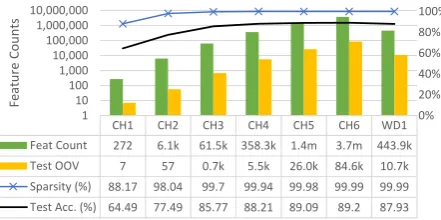
For each feature type we extract the training vectors and use it to train a linear SVM model which is used to classify the standard test set. We report the feature’s accuracy on the test set along with some statistics about the data: the number of features in the training data, the number of out-of-vocabulary (OOV) features3 in the test data, and the sparsity4of the training data matrix. These re-sults are shown in Figure1.
CH1 CH2 CH3 CH4 CH5 CH6 WD1 Feat Count 272 6.1k 61.5k 358.3k 1.4m 3.7m 443.9k Test OOV 7 57 0.7k 5.5k 26.0k 84.6k 10.7k Sparsity (%) 88.17 98.04 99.7 99.94 99.98 99.99 99.99 Test Acc. (%) 64.49 77.49 85.77 88.21 89.09 89.2 87.93
0% 20% 40% 60% 80% 100%
1 10 100 1,000 10,000 100,000 1,000,000 10,000,000
Fea
tu
re
C
o
unt
[image:3.595.308.537.104.238.2]s
Figure 1: Details of our feature spaces. Train-ing set feature counts and test set OOV counts are shown as bars (left axis, logarithmic scale). Train-ing data sparsity and test set accuracy are shown as lines (in %, right axis).
These results reveal a number of interesting patterns. Character n-grams perform better than word unigrams. The winner of the 2016 DSL task combined various charactern-grams into an SVM
model to obtain 89.4% accuracy on the test set. We obtain the best result of89.2% using charac-ter 6-grams alone. The character n-gram feature
grow rapidly, from61k trigrams to3.7m6-grams. While accuracy plateaus at6-grams, there is only a1% improvement from4- to6-grams, but a huge feature space increase. The number of OOV test features also increases, but is relatively small.
The sparsity analysis is also revealing, showing that for many features only around 0.1% of the training matrix contains non-zero values. We can expect that this sparsity will rapidly grow with the addition of more classes to the dataset. This poses a huge problem for practical applications of LID for discriminating large number of languages.
In this regard, we can also assess how the di-mensionality cumulatively increases as languages
3i.e.features present in the test set but not the training set. 4Matrix sparsity is the proportion of zero-valued elements.
are added, shown in Figure 2. Features increase even as similar languages are added; we expect this trend to continue if more classes are added.
0 0.5 1 1.5 2 2.5 3 3.5 4
0 100000 200000 300000 400000 500000
BS
ES_AR ES_ES ES_MX FR_CA FR_FR
HR ID MY
PT
_B
R
PT_
PT SR Char
n
‐
gr
ams
(in
millions)
Word
Unig
ram
Count
[image:3.595.75.296.262.372.2]WORD1 CHAR4 CHAR5 CHAR6
Figure 2: Feature growth rate as classes are added. Words (bars, left axis) and character n-grams
(lines, right axis) grow as languages are added. 5 Feature Hashing Performance
Having established baseline performance for our features using the standard approach, we now experiment with applying feature hashing to the same data in order to evaluate its effectiveness for this task and compare it to the standard approach.
We also assess the effect of hash size on the fea-ture collision rate, and in turn, on classification accuracy. To do this we test each feature5 using hash sizes in the range 210 (1024) to 222 (2.1m) features, which covers most of our feature types. Our hash function is implemented using the signed 32-bit version of MurmurHash3.6
We report each feature’s accuracy at every hash size, with the smallest hash that yields maximal accuracy considered to be the best result. Each feature is compared against its performance using the full feature space (baseline). These results, along with the reduction in the feature space for the best results, are listed in Table1.
Our first observation is that every feature matches baseline performance at a hash size smaller than its full feature space. This demon-strates that feature hashing is useful for LID.
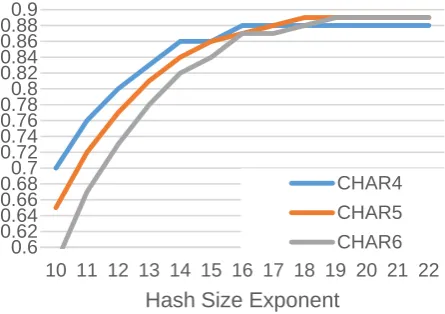
We can also assess the effect of feature colli-sions using the results, which we plot in Figure3. We note that at the same hash size, features with a larger space perform worse. That is, with a 212 hash size, CHAR4 outperforms 5- and 6-grams. This is evidence of performance degradation due to hash collision. However, we see that when us-ing an appropriately sized hash, feature collisions between languages do not degrade performance.
Hash Size
Feature Baseline 210 211 212 213 214 215 216 217 218 219 220 221 222 ∆feats
CHAR2 0.77 0.74 0.76 0.77 0.77 0.77 0.77 0.77 0.77 0.77 0.77 0.77 0.77 0.77 -33%
CHAR3 0.86 0.74 0.79 0.82 0.84 0.85 0.86 0.86 0.86 0.86 0.86 0.86 0.86 0.86 -47%
CHAR4 0.88 0.70 0.76 0.80 0.83 0.86 0.86 0.88 0.88 0.88 0.88 0.88 0.88 0.88 -82%
CHAR5 0.89 0.65 0.72 0.77 0.81 0.84 0.86 0.87 0.88 0.89 0.89 0.89 0.89 0.89 -81%
CHAR6 0.89 0.58 0.67 0.73 0.78 0.82 0.84 0.87 0.87 0.88 0.89 0.89 0.89 0.89 -86%
[image:4.595.73.539.61.194.2]WORD1 0.88 0.70 0.74 0.78 0.81 0.83 0.85 0.86 0.87 0.88 0.88 0.88 0.88 0.88 -41%
Table 1: Test set accuracy for hashed features at each hash size. Baseline is accuracy without hashing. Best result (w/ smallest hash) per row in bold. Last column is the best result’s reduction in dimensionality. We observe that every feature matches its baseline at a hash size smaller than its full feature space.
0.6 0.62 0.64 0.66 0.680.7 0.72 0.74 0.76 0.780.8 0.82 0.84 0.86 0.880.9
10 11 12 13 14 15 16 17 18 19 20 21 22
Hash Size Exponent CHAR4
CHAR5
CHAR6
Figure 3: Performance (left axis) of 3 features at different hash sizes. Higher order n-grams
per-form worse at lower hash sizes due to collisions.
We also analyze the memory reduction achieved via hashing by calculating the relative difference in dimensionality between the best result and the full feature set, listed in the last column of Table1. We see very significant reductions of up to86% in dimensionality without any performance loss. Character4-grams yield very competitive results (0.88) with a large feature space reduction of82% using a hash size of216.
6 Hashing-based Ensemble Classifier Ensemble classifiers combine multiple learners with the aim of improving accuracy through en-hanced decision making. They have been ap-plied to many tasks and shown to achieve bet-ter results compared to single-classifier methods (Oza and Tumer,2008). By aggregating the out-puts of multiple classifiers their outout-puts are gen-erally considered to be more robust. Ensembles have been successfully used for LID,e.g.winning
the 2015 task (Malmasi and Dras, 2015a). They also achieve state-of-the-art performance for Na-tive Language Identification (Malmasi and Dras,
2017). Could an ensemble composed of low-dimension hash-based classifiers achieve compet-itive performance?
In order to assess this we created an ensemble of our features with a hash size of 216. Eval-uating against the test set, a hard voting ensem-ble achieved88.7%accuracy while a probability-based combination obtained89.2%. Comparing to the winning shared task accuracy of89.4%, this is an excellent result given that only65,536features were used by our system. Ensemble combination boosted our best single-model216hash size result by 1.1%. This highlights the utility of ensemble methods for hashing-based feature spaces. It also shows that model combination can compensate for small performance losses caused by hashing.
7 Discussion and Conclusion
We presented the first application of feature hash-ing for language identification. Results show that hashing is highly effective for LID and can amelio-rate the dimensionality issues that can impose pro-hibitive memory requirements for some LID tasks. We further showed that reduced feature spaces with as few as65k features can be combined in en-semble classifiers to boost performance. We also demonstrated the effect of hash collision on accu-racy, and outlined the type of analysis needed to choose the correct hash size for a given feature.
[image:4.595.74.297.264.421.2]effi-cient. This reduction facilitates model loading and training as we also showed that LID data is ex-tremely sparse, with over99%of our training ma-trix cells containing zeros. This is particularly use-ful for limited memory scenarios (e.g.handheld or embedded devices). It may also enable the use of methods requiring dense data representations, something often infeasible for large datasets.
Another key advantage of hashing is that it eliminates the need for maintaining a feature dic-tionary, making it easy to develop feature extrac-tion modules. This greatly simplifies paralleliza-tion, lending itself to online learning and dis-tributed systems, which are important issues for LID systems in our experience.
Hashing also holds promise for facilitating the use of deep learning methods for LID. In the 2016 DSL task, such systems performed “poorly com-pared to traditional classifiers”; participants cited “memory requirements and long training times” spanning several days (Malmasi et al.,2016). Fea-ture hashing has recently been used to compress neural networks (Chen et al.,2015) and its appli-cation for deep learning-based text classifiappli-cation may provide insightful results.
There are also downsides to hashing, including the inability to interpret feature weights and model parameters, and some minor performance loss.
Future work in this area includes evaluation on larger datasets, as well as cross-corpus experi-ments, which may also be insightful. The ap-plication of these methods to other text classifi-cation tasks, particularly those dealing with lan-guage varieties such as Native Lanlan-guage Identifi-cation (Malmasi and Dras,2015b), could also pro-vide a deeper understanding about how they work.
References
Kenneth R Beesley. 1988. Language identifier: A com-puter program for automatic natural-language
iden-tification of on-line text. InProceedings of the 29th
Annual Conference of the American Translators As-sociation. page 54.
Ralf D Brown. 2014. Non-linear Mapping for
Im-proved Identification of 1300+ Languages. In
EMNLP.
Cornelia Caragea, Adrian Silvescu, and Prasenjit Mi-tra. 2012. Protein sequence classification using
fea-ture hashing. Proteome science10(1):S14.
William B. Cavnar and John M. Trenkle. 1994.
N-Gram-Based Text Categorization. InProceedings of
SDAIR-94. Las Vegas, US, pages 161–175.
Wenlin Chen, James T Wilson, Stephen Tyree, Kilian Q Weinberger, and Yixin Chen. 2015. Compressing
neural networks with the hashing trick. In ICML.
pages 2285–2294.
Nadia FF Da Silva, Eduardo R Hruschka, and Este-vam R Hruschka. 2014. Tweet sentiment analysis
with classifier ensembles. Decision Support Systems
66:170–179.
Ted Dunning. 1994. Statistical identification of
lan-guage. Computing Research Laboratory, New Mex-ico State University.
Baden Hughes, Timothy Baldwin, Steven Bird, Jeremy Nicholson, and Andrew MacKinlay. 2006. Recon-sidering language identification for written language resources .
Jiyong Jang, David Brumley, and Shobha Venkatara-man. 2011. Bitshred: feature hashing malware for
scalable triage and semantic analysis. In
Proceed-ings of the 18th ACM conference on Computer and communications security. ACM, pages 309–320. Nikola Ljubeˇsi´c, Nives Mikeli´c, and Damir Boras.
2007. Language indentification: How to distinguish
similar languages? InInformation Technology
In-terfaces. pages 541–546.
Shervin Malmasi and Mark Dras. 2015a. Language
Identification using Classifier Ensembles. In
Pro-ceedings of LT4VarDial 2015.
Shervin Malmasi and Mark Dras. 2015b. Multilingual
Native Language Identification. In Natural
Lan-guage Engineering.
Shervin Malmasi and Mark Dras. 2017. Native Lan-guage Identification using Stacked Generalization.
arXiv preprint arXiv:1703.06541.
Shervin Malmasi, Eshrag Refaee, and Mark Dras. 2015. Arabic Dialect Identification using a Parallel
Multidialectal Corpus. InProceedings of PACLING
2015. pages 209–217.
Shervin Malmasi, Marcos Zampieri, Nikola Ljubeˇsi´c, Preslav Nakov, Ahmed Ali, and J¨org Tiedemann. 2016. Discriminating between Similar Languages and Arabic Dialect Identification: A Report on the
Third DSL Shared Task. InProceedings of the 3rd
Workshop on Language Technology for Closely Re-lated Languages, Varieties and Dialects (VarDial). Osaka, Japan, pages 1–14.
Nikunj C Oza and Kagan Tumer. 2008. Classifier
en-sembles: Select real-world applications.
Informa-tion Fusion9(1):4–20.
Kilian Weinberger, Anirban Dasgupta, John Langford, Alex Smola, and Josh Attenberg. 2009. Feature
hashing for large scale multitask learning. In