5472
Dual Supervised Learning for
Natural Language Understanding and Generation
Shang-Yu Su Chao-Wei Huang Yun-Nung Chen Department of Computer Science and Information Engineering
National Taiwan University
{f05921117,r07922069}@ntu.edu.tw [email protected]
Abstract
Natural language understanding (NLU) and natural language generation (NLG) are both critical research topics in the NLP and dia-logue fields. Natural language understanding is to extract the core semantic meaning from the given utterances, while natural language generation is opposite, of which the goal is to construct corresponding sentences based on the given semantics. However, such dual re-lationship has not been investigated in liter-ature. This paper proposes a novel learning framework for natural language understand-ing and generation on top of dual supervised learning, providing a way to exploit the dual-ity. The preliminary experiments show that the proposed approach boosts the performance for both tasks, demonstrating the effectiveness of the dual relationship.1
1 Introduction
Spoken dialogue systems that can help users solve complex tasks such as booking a movie ticket have become an emerging research topic in artificial in-telligence and natural language processing areas. With a well-designed dialogue system as an in-telligent personal assistant, people can accomplish certain tasks more easily via natural language in-teractions. The recent advance of deep learning has inspired many applications of neural dialogue systems (Wen et al., 2017; Bordes et al., 2017;
Dhingra et al., 2017; Li et al., 2017). A typical dialogue system pipeline can be divided into sev-eral parts: 1) a speech recognizer that transcribes a user’s speech input into texts, 2) a natural lan-guage understanding module (NLU) that classifies the domain and associated intents and fills slots to form a semantic frame (Chi et al.,2017;Chen et al., 2017;Zhang et al.,2018;Su et al.,2018c,
1https://github.com/MiuLab/DualSL
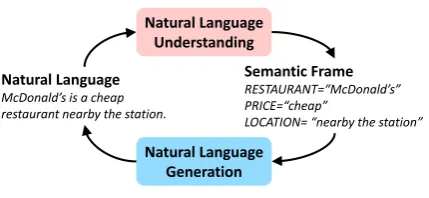
Natural Language Understanding
Natural Language Generation Natural Language
McDonald’s is a cheap
restaurant nearby the station.
Semantic Frame
RESTAURANT=“McDonald’s” PRICE=“cheap”
[image:1.595.309.524.220.319.2]LOCATION=“nearby the station”
Figure 1: NLU and NLG emerge as a dual form.
2019), 3) a dialogue state tracker (DST) that pre-dicts the current dialogue state in the multi-turn conversations, 4) a dialogue policy that determines the system action for the next step given the cur-rent state (Peng et al.,2018;Su et al.,2018a), and 5) a natural language generator (NLG) that outputs a response given the action semantic frame (Wen et al.,2015;Su et al.,2018b;Su and Chen,2018). Many artificial intelligence tasks come with a
dualform; that is, we could directly swap the in-put and the target of a task to formulate another task. Machine translation is a classic example (Wu et al., 2016); for example, translating from En-glish to Chinese has a dual task of translating from Chinese to English; automatic speech recognition (ASR) and text-to-speech (TTS) also have struc-tural duality (Tjandra et al.,2017). Previous work first exploited the duality of the task pairs and pro-posed supervised (Xia et al.,2017) and unsuper-vised (reinforcement learning) (He et al., 2016) training schemes. The recent studies magnified the importance of the duality by boosting the perfor-mance of both tasks with the exploitation of the duality.
train-ing framework for NLU and NLG based ondual supervised learning(Xia et al.,2017), which is the first attempt at exploiting the duality of NLU and NLG. The experiments show that the proposed ap-proach improves the performance for both tasks.
2 Proposed Framework
This section first describes the problem formula-tion, and then introduces the core training algo-rithm along with the proposed methods of estimat-ing data distribution.
Assuming that we have two spaces, the seman-tics space X and the natural language space Y, givenndata pairs{(xi, yi)}ni=1, the goal of NLG is to generate corresponding utterances based on given semantics. In other words, the task is to learn a mapping function f(x;θx→y) to
trans-form semantic representations into natural lan-guage. On the other hand, NLU is to capture the core meaning of utterances, finding a func-tion g(y;θy→x) to predict semantic
representa-tions given natural language. A typical strategy of these optimization problems is based on maximum likelihood estimation (MLE) of the parameterized conditional distribution by the learnable parame-tersθx→y andθy→x.
2.1 Dual Supervised Learning
Considering the duality between two tasks in the dual problems, it is intuitive to bridge the bidi-rectional relationship from a probabilistic perspec-tive. If the models of two tasks are optimal, we haveprobabilistic duality:
P(x)P(y|x;θx→y) =P(y)P(x|y;θy→x)
=P(x, y)∀x, y,
where P(x) andP(y) are marginal distributions of data. The condition reflects parallel, bidirec-tional relationship between two tasks in the dual problem. Although standard supervised learning with respect to a given loss function is a straight-forward approach to address MLE, it does not con-sider the relationship between two tasks.
Xia et al. (2017) exploited the duality of the dual problems to introduce a new learning scheme, which explicitly imposed the empirical probabil-ity dualprobabil-ity on the objective function. The training strategy is based on the standard supervised learn-ing and incorporates the probability duality con-straint, so-calleddual supervised learning.
There-fore the training objective is extended to a multi-objective optimization problem:
minθx→y(E[l1(f(x;θx→y), y)]),
minθy→x(E[l2(g(y;θy→x), x)]),
s.t.P(x)P(y|x;θx→y) =P(y)P(x|y;θy→x),
wherel1,2 are the given loss functions. Such con-straint optimization problem could be solved by introducing Lagrange multiplier to incorporate the constraint:
(
minθx→y(E[l1(f(x;θx→y), y)] +λx→ylduality),
minθy→x(E[l1(g(y;θy→x), x)] +λy→xlduality),
whereλx→y andλy→x are the Lagrange
parame-ters and the constraint is formulated as follows:
lduality= (log ˆP(x) + logP(y|x;θx→y)
−log ˆP(y)−logP(x|y;θy→x))2.
Now the entire objective could be viewed as the standard supervised learning with an addi-tional regularization term considering the duality between tasks. Therefore, the learning scheme is to learn the models by minimizing the weighted combination of an original loss term and a regu-larization term. Note that the true marginal distri-bution of dataP(x)andP(y)are often intractable, so here we replace them with the approximated empirical marginal distributionPˆ(x)andPˆ(y).
2.2 Distribution Estimation as Autoregression
With the above formulation, the current problem is how to estimate the empirical marginal distri-bution Pˆ(·). To accurately estimate data distri-bution, the data properties should be considered, because different data types have different struc-tural natures. For example, nastruc-tural language has sequential structures and temporal dependencies, while other types of data may not. Therefore, we design a specific method of estimating distribution for each data type based on the expert knowledge. From the probabilistic perspective, we can de-compose any data distributionp(x)into the prod-uct of its nested conditional probability,
p(x) =
D
Y
d
p(xd|x1, ..., xd−1), (1)
2.2.1 Language Modeling
Natural language has an intrinsic sequential na-ture; therefore it is intuitive to leverage the autore-gressive property to learn a language model. In this work, we learn the language model based on recurrent neural networks (Mikolov et al., 2010;
Sundermeyer et al.,2012) by the cross entropy ob-jective in an unsupervised manner.
p(y) =
L
Y
i
p(yi |y1, ..., yi−1;θy), (2)
wherey(·)are words in the sentencey, andLis the sentence length.
2.2.2 Masked Autoencoder
The semantic representation x in our work is discrete semantic frames containing specific slots and corresponding values. Each semantic frame contains the core concept of a certain sentence, for example, the slot-value pairs “name[Bibimbap House], food[English],
priceRange[moderate], area [riverside], near[Clare Hall]” corresponds to the target sentence “Bibimbap House is a moderately priced restaurant who’s main cuisine is English food. You will find this local gem near Clare Hall in the Riverside area.”. Even though the product rule in (1) enables us to decompose any probability distribution into a product of a sequence of conditional probability, how we decompose the distribution reflects a specific physical meaning. For example, language modeling outputs the probability distribution over vocabulary space of i-th word yi by only
taking the preceding word sequencey<i. Natural
language has the intrinsic sequential structure and temporal dependency, so modeling the joint distribution of words in a sequence by such autoregressive property is logically reasonable. However, slot-value pairs in semantic frames do not have a single directional relationship between them, while they parallel describe the same sen-tence, so treating a semantic frame as a sequence of slot-value pairs is not suitable. Furthermore, slot-value pairs are not independent, because the pairs in a semantic frame correspond to the same individual utterance. For example, French food would probably cost more. Therefore, the correlation should be taken into account when estimating the joint distribution.
2
1
3
1
2
2
1
[image:3.595.320.507.63.218.2]2
1
3
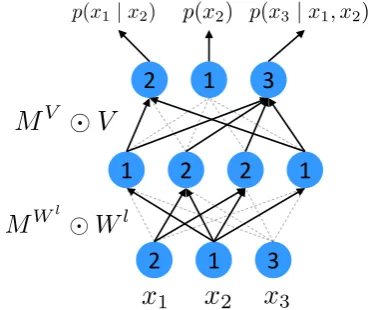
Figure 2: The illustration of the masked autoencoder for distribution estimation (MADE).
Considering the above issues, to model the joint distribution of flat semantic frames, various de-pendencies between slot-value semantics should be leveraged. In this work, we propose to uti-lize a masked autoencoder for distribution estima-tion (MADE) (Germain et al.,2015). By zeroing certain connections, we could enforce the variable unitxdto only depend on any specific set of
vari-ables, not necessary onx<d; eventually we could
still have the marginal distribution by the product rule:
p(x) =
D
Y
d
p(xd|Sd), (3)
whereSdis a specific set of variable units.
In practice, we elementwise-multiply each weight matrix by a binary mask matrixMto inter-rupt some connections, as illustrated in Figure2. To impose the autoregressive property, we first as-sign each hidden unitk an integer m(k) ranging from 1 to the dimension of dataD−1inclusively; for the input and output layers, we assign each unit a number ranging from 1 toDexclusively. Then binary mask matrices can be built as follows:
M =
1 ifml(k0)≥ml−1(k),
1 ifmL(d)> mL−1(k),
0 otherwise.
Herelindicates the index of the hidden layer, and
Learning Scheme NLU NLG
F1 BLEU ROUGE-1 ROUGE-2 ROUGE-L
[image:4.595.82.517.61.161.2](a) Baseline: Iterative training 71.14 55.05 55.37 27.95 39.90 (b) Dual supervised learning,λ= 0.1 72.32 57.16 56.37 29.19 40.44 (c) Dual supervised learning,λ= 0.01 72.08 55.07 55.56 28.42 40.04 (d) Dual supervised learning,λ= 0.001 71.71 56.17 55.90 28.44 40.08 (e) Dual supervised learning w/o MADE 70.97 55.96 55.99 28.74 39.98
Table 1: The NLU performance reported on micro-F1 and the NLG performance reported on BLEU, ROUGE-1, ROUGE-2, and ROUGE-L of models (%).
3 Experiments
To evaluate the effectiveness of the proposed framework, we conduct the experiments, the set-tings and analysis of the results are described as follows.
3.1 Settings
The experiments are conducted in the benchmark E2E NLG challenge dataset (Novikova et al.,
2017), which is a crowd-sourced dataset of 50k instances in the restaurant domain. Our models are trained on the official training set and veri-fied on the official testing set. Each instance is a pair of a semantic frame containing specific slots and corresponding values and an associated nat-ural language utterance with the given semantics. The data preprocessing includes trimming punctu-ation marks, lemmatizpunctu-ation, and turning all words into lowercase.
Although the original dataset is for NLG, of which the goal is to generate sentences based on the given slot-value pairs, we further formulate a NLU task as predicting slot-value pairs based on the utterances, which is a multi-label classification problem. Each possible slot-value pair is treated as an individual label, and the total number of la-bels is 79. To evaluate the quality of the generated sequences regarding both precision and recall, for NLG, the evaluation metrics include BLEU and ROUGE (1, 2, L) scores with multiple references, while F1 score is measured for the NLU results.
3.2 Model Details
The model architectures for NLG and NLU are a gated recurrent unit (GRU) (Cho et al., 2014) with two identical fully-connected layers at the two ends of GRU. Thus the model is symmetri-cal and may have semantic frame representation as initial and final hidden states and sentences as the sequential input.
In all experiments, we use mini-batch Adam
as the optimizer with each batch of 64 examples, 10 training epochs were performed without early stop, the hidden size of network layers is 200, and word embedding is of size 50 and trained in an end-to-end fashion.
3.3 Results and Analysis
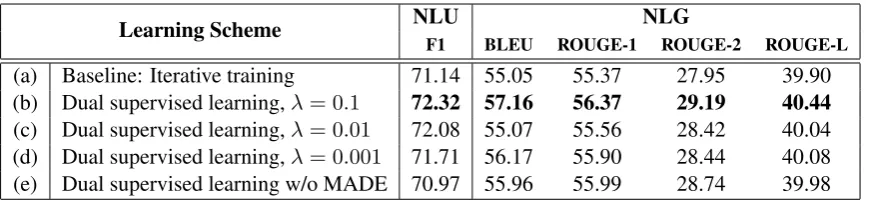
The experimental results are shown in Table 1, where each reported number is averaged over three runs. The row (a) is the baseline that trains NLU and NLG separately and independently, and the rows (b)-(d) are the results from the proposed ap-proach with different Lagrange parameters.
The proposed approach incorporates probabil-ity dualprobabil-ity into the objective as the regulariza-tion term. To examine its effectiveness, we con-trol the intensity of regularization by adjusting the Lagrange parameters. The results (rows (b)-(d)) show that the proposed method outperforms the baseline on all automatic evaluation metrics. Fur-thermore, the performance improves more with stronger regularization (row (b)), demonstrating the importance of leveraging duality.
computed from the training set. The performance is worse than the ones that model the dependen-cies, demonstrating the importance of considering the nature of input data and modeling data distri-bution via the masked autoencoder.
We further analyze understanding and genera-tion results compared with the baseline model. In some cases, it is found that our NLU model can extract the semantics of utterances better and our NLU model can generate sentences with richer in-formation based on the proposed learning scheme. In sum, the proposed approach is capable of im-proving the performance of both NLU and NLG in the benchmark data, where the exploitation of duality and the way of estimating distribution are demonstrated to be important.
4 Conclusion
This paper proposes a novel training framework for natural language understanding and generation based on dual supervised learning, which first ex-ploits the duality between NLU and NLG and in-troduces it into the learning objective as the reg-ularization term. Moreover, expert knowledge is incorporated to design suitable approaches for es-timating data distribution. The proposed methods demonstrate effectiveness by boosting the perfor-mance of both tasks simultaneously in the bench-mark experiments.
Acknowledgements
We thank the anonymous reviewers for their in-sightful feedback on this work. This work was fi-nancially supported from the Young Scholar Fel-lowship Program by Ministry of Science and Technology (MOST) in Taiwan, under Grant 108-2636-E-002-003 and 108-2634-F-002-019.
References
Antoine Bordes, Y-Lan Boureau, and Jason Weston. 2017. Learning end-to-end goal-oriented dialog. In Proceedings of ICLR.
Po-Chun Chen, Ta-Chung Chi, Shang-Yu Su, and Yun-Nung Chen. 2017. Dynamic time-aware attention to speaker roles and contexts for spoken language understanding. InProceedings of ASRU.
Ta-Chung Chi, Po-Chun Chen, Shang-Yu Su, and Yun-Nung Chen. 2017. Speaker role contextual model-ing for language understandmodel-ing and dialogue policy learning. InProceedings of IJCNLP.
Kyunghyun Cho, Bart Van Merri¨enboer, Caglar Gul-cehre, Dzmitry Bahdanau, Fethi Bougares, Holger Schwenk, and Yoshua Bengio. 2014. Learning phrase representations using RNN encoder-decoder for statistical machine translation. InProceedings of EMNLP, pages 1724–1734.
Bhuwan Dhingra, Lihong Li, Xiujun Li, Jianfeng Gao, Yun-Nung Chen, Faisal Ahmed, and Li Deng. 2017. Towards end-to-end reinforcement learning of dia-logue agents for information access. InProceedings of ACL, pages 484–495.
Mathieu Germain, Karol Gregor, Iain Murray, and Hugo Larochelle. 2015. Made: Masked autoen-coder for distribution estimation. In International Conference on Machine Learning, pages 881–889.
Di He, Yingce Xia, Tao Qin, Liwei Wang, Nenghai Yu, Tie-Yan Liu, and Wei-Ying Ma. 2016. Dual learn-ing for machine translation. InAdvances in Neural Information Processing Systems, pages 820–828.
Xiujun Li, Yun-Nung Chen, Lihong Li, Jianfeng Gao, and Asli Celikyilmaz. 2017. End-to-end task-completion neural dialogue systems. InProceedings of The 8th International Joint Conference on Natu-ral Language Processing.
Tom´aˇs Mikolov, Martin Karafi´at, Luk´aˇs Burget, Jan ˇ
Cernock`y, and Sanjeev Khudanpur. 2010. Recurrent neural network based language model. InEleventh annual conference of the international speech com-munication association.
Jekaterina Novikova, Ondrej Duˇsek, and Verena Rieser. 2017. The E2E dataset: New challenges for end-to-end generation. InProceedings of SIGDIAL, pages 201–206.
Baolin Peng, Xiujun Li, Jianfeng Gao, Jingjing Liu, Kam-Fai Wong, and Shang-Yu Su. 2018. Deep dyna-q: Integrating planning for task-completion dialogue policy learning. arXiv preprint arXiv:1801.06176.
Shang-Yu Su and Yun-Nung Chen. 2018. Investigat-ing lInvestigat-inguistic pattern orderInvestigat-ing in hierarchical natural language generation. In Proceedings of 7th IEEE Workshop on Spoken Language Technology.
Shang-Yu Su, Xiujun Li, Jianfeng Gao, Jingjing Liu, and Yun-Nung Chen. 2018a. Discriminative deep dyna-q: Robust planning for dialogue policy learn-ing. InProceedings of the 2018 Conference on Em-pirical Methods in Natural Language Processing.
Shang-Yu Su, Pei-Chieh Yuan, and Yun-Nung Chen. 2018c. How time matters: Learning time-decay at-tention for contextual spoken language understand-ing in dialogues. InProceedings of the 2018 Con-ference of the North American Chapter of the Asso-ciation for Computational Linguistics: Human Lan-guage Technologies, Volume 1 (Long Papers), pages 2133–2142.
Shang-Yu Su, Pei-Chieh Yuan, and Yun-Nung Chen. 2019. Dynamically context-sensitive time-decay at-tention for dialogue modeling. In ICASSP 2019-2019 IEEE International Conference on Acous-tics, Speech and Signal Processing (ICASSP), pages 7200–7204. IEEE.
Martin Sundermeyer, Ralf Schl¨uter, and Hermann Ney. 2012. Lstm neural networks for language modeling. InThirteenth annual conference of the international speech communication association.
Andros Tjandra, Sakriani Sakti, and Satoshi Naka-mura. 2017. Listening while speaking: Speech chain by deep learning. In 2017 IEEE Automatic Speech Recognition and Understanding Workshop (ASRU), pages 301–308. IEEE.
Tsung-Hsien Wen, Milica Gasic, Nikola Mrksic, Lina M Rojas-Barahona, Pei-Hao Su, Stefan Ultes, David Vandyke, and Steve Young. 2017. A network-based end-to-end trainable task-oriented dialogue system. InProceedings of EACL, pages 438–449.
Tsung-Hsien Wen, Milica Gasic, Nikola Mrkˇsi´c, Pei-Hao Su, David Vandyke, and Steve Young. 2015. Semantically conditioned lstm-based natural lan-guage generation for spoken dialogue systems. In Proceedings of the 2015 Conference on Empirical Methods in Natural Language Processing, pages 1711–1721.
Yonghui Wu, Mike Schuster, Zhifeng Chen, Quoc V Le, Mohammad Norouzi, Wolfgang Macherey, Maxim Krikun, Yuan Cao, Qin Gao, Klaus Macherey, et al. 2016. Google’s neural ma-chine translation system: Bridging the gap between human and machine translation. arXiv preprint arXiv:1609.08144.
Yingce Xia, Tao Qin, Wei Chen, Jiang Bian, Neng-hai Yu, and Tie-Yan Liu. 2017. Dual supervised learning. In Proceedings of the 34th International Conference on Machine Learning-Volume 70, pages 3789–3798. JMLR. org.