sciences
Article
A Connected and Autonomous Vehicle Reference
Architecture for Attack Surface Analysis
Carsten Maple * , Matthew Bradbury , Anh Tuan Le and Kevin Ghirardello
Warwick Manufacturing Group, University of Warwick, Coventry CV4 7AL, UK;
[email protected] (M.B.); [email protected] (A.T.L.); [email protected] (K.G.) * Correspondence: [email protected]
Received: 28 August 2019; Accepted: 14 November 2019; Published: 25 November 2019
Featured Application: The reference architecture presented is to be instantiated with different components which is then used to analyse the attack surface of those components.
Abstract: Connected autonomous vehicles (CAVs) will be deployed over the next decade
with autonomous functionalities supported by new sensing and communication capabilities. Such functionality exposes CAVs to new attacks that current vehicles will not face. To ensure the safety and security of CAVs, it is important to be able to identify the ways in which the system could be attacked and to build defences against these attacks. One possible approach is to use reference architectures to perform an attack surface analysis. Existing research has developed a variety of reference architectures but none for the specific purpose of attack surface analysis. Existing approaches are either too simple for sufficiently detailed modelling or require too many details to be specified to easily analyse a CAV’s attack surface. Therefore, we propose a reference architecture using a hybrid Functional-Communication viewpoint for attack surface analysis of CAVs, including the Devices, Edge and Cloud systems CAVs interact with. Using two case studies, we demonstrate how attack trees can be used to understand the attack surface of CAV systems.
Keywords:connected autonomous vehicles; reference architecture; attack surface analysis
1. Introduction
In recent years, interest in deploying connected autonomous vehicles (CAVs) on real road networks has been increasing [1]. In order to enable the applications that depend on connectivity [2] and autonomy [3], vehicle computer systems are becoming more complex and the number of ways in which the vehicles can communicate with other devices, each other, nearby Edge infrastructure, and the Cloud, is increasing. Such changes in complexity [4], connectivity and levels of autonomy means that there are more ways in which a CAV can be attacked [5] and a successful breach carries greater impact.
Due to the safety ramifications, it is important to protect the security of vehicles and the systems they rely on. Security breaches could lead to vehicle theft, privacy leakage or in the worst case lead to injury or death of occupants. Analysing these security threats in isolation is insufficient since vulnerabilities could be, and often are, exploited in combination to lead to escalated threats with the potential for greater harm.
Reference architectures can be used to help understand and analyse complex systems, specifying the entire system and any interactions. In addition to being a useful tool for analysis, a reference architecture can be used to assist in performing attack surface analysis, for example, as part of the system level analysis and design in SAE J3061 (Figure 7) [6]. By using output from a threat modelling, the identified goals, resources, capabilities, motivations and presence of an attacker
can be used with a reference architecture to help understand how an attack could be executed. However, a problem with using existing reference architectures for attack surface identification and analysis is that they are often either lack important details [7] in order to derive certain categories of attacks, or too complex [8] for vehicle manufacturers and CAV system designers to feasibly use (which will be elaborated on in Sections2.1and2.2). This paper addresses these issues by proposing a hybrid Functional-Communication viewpoint reference architecture for attack surface analysis. This reference architecture aims to balance the complexity-completeness trade-off, such that the model is sufficient complex to model a wide range of interactions but remains easy enough to practically use.
While many of the attacks against traditional vehicles could be modelled using this reference architecture, we target L3–L5 autonomous vehicles (which are described in Table1). These are the new and emerging autonomous vehicles that are beginning to be deployed, and which will encounter new threats compared to L0–L2 vehicles [9]. These new threats may try to manipulate input sensor data [10] in order to affect how and where an autonomous vehicle drives, or may simply try to remotely take control of the vehicle’s functions [11]. There is the potential for these attacks (and others [12]) to have a large impact due to the potential of leading to unsafe conditions for vehicle occupants and pedestrians [13]. As the way in which vehicles are designed and operated is changing at a rapid pace, this reference architecture aims to focus on the next 10 years [14] of autonomous vehicles and be flexible to facilitate future changes.
[image:2.595.86.515.510.671.2]To demonstrate the effectiveness of using this reference architecture to perform attack surface analysis, we instantiate it with two different case studies. Using the interactions of components in the reference architecture and goals identified from a threat modelling, attack surfaces are derived. Performing the threat modelling to identify attacker goals, motivations, capabilities and resources is out of the scope of this paper as the attack surface defines how these goals can be reached but does not aim to specify what these goals are. There exist many threat modelling approaches [6,15–18] that can be used as input to the reference architecture. In the first example of valet parking, the attacks against a vehicle parking itself in an autonomous car park are investigated. In the second example, a real world attack against Tesla vehicles is used to highlight the need to consider the Edge infrastructure in the security of CAVs.
Table 1.Levels of Vehicular Autonomy [19] from no autonomy (where the driver is in full control of the vehicle) at level 0 to level 5 where the vehicle is in full control.
Level Name Description Example
0 None The human driver is in full control. Anti-lock Braking System
1 Driver Assistance
The human driver is assisted by a driver assistance system of steering or acceleration/deceleration using information about the driving environment. The human performs all other tasks.
Cruise Control
2 Partial
The human driver is assisted by one or more driver assistance systems of both steering and acceleration/deceleration using information about the driving environment. The human performs all other tasks.
Lane Centring
3 Conditional
The autonomous vehicle controls all aspects of driving, with the expectation that the human driver will respond appropriately to a request to intervene.
Traffic Jam Chauffeur [20]
4 High The autonomous vehicle controls all aspects of driving, even if a human
driver does not respond appropriately to a request to intervene. Driverless Valet Parking [20]
5 Full The autonomous vehicle is in full control and no human input related to
driving is expected. Driverless Cars
We make the following contributions in this paper:
1. A reference architecture made up of 4 sub-architectures: CAVs, Devices & Peripherals, the Edge and the Cloud formed of a hybrid Functional and Communication viewpoint.
3. Two case studies to demonstrate the applications of attack surface and attack tree analysis in deepening the security knowledge of the system.
The remainder of this paper is organised as follows. In Section2we present relevant related work, including examining existing vehicular reference architectures. Section 3 describes our proposed reference architecture, its components and relevant attack surfaces and Section4describes the methodology for using the attack surface; including using attack trees as a method to perform the analysis. In Section5two case studies of example applications are presented as instantiations of our reference architecture. The implications of the reference architecture is discussed in Section6; and future work is presented in Section7, before the paper concludes with Section8.
2. Related Work
There has been much work conducted on analysing the threats that an autonomous vehicle will face [7,11,21–23]. The issue with existing work on threat analysis is that they did not consider a comprehensive ranges of components (i.e., CAV, devices, Edge, Cloud) that form the potential CAV operational contexts. This means that threats which use a combination of attacks against different components in specific orders can be missed. Reference architectures have been developed to aid in the design of products and services for autonomous vehicles but have seldom been used to provide a wider view of composite threats. Those reference architectures that do exist, can suffer from being too broad, or are insufficiently detailed, for attack surface analysis. When too broad, they require specifying less pertinent details as part of the model, which detracts from performing the attack surface analysis. When insufficiently detailed, there are threats that cannot be analysed using the reference architecture. The remainder of this section will present related work on reference architectures used to model autonomous vehicle systems.
2.1. Reference Architectures
In order to better analyse how a system is structuredreference architecturesare used as an abstract way of specifying a system. A reference architecture is an approach to model a system and provide a consistent and standardised way to describe that system. This common model should be created such that it is able to describe a broad range of scenarios that the system can be used in. Reference architectures allow modularisation of a system into components and interfaces between these components to be defined. These features can be used to assist with system development in a scalable way (e.g., by multiple organisations [24]) and also facilitate testing of the system.
This paper will develop a reference architecture specifically for assisting in the attack surface identification and analysis in CAVs. We will present our reference architecture in the next section but provide here an overview of existing reference architectures. This related work guides our own development and assists us in identifying the shortcomings of existing schemes that are discussed in the next section.
A common feature of reference architectures is to decompose the system they are modelling into multiple viewpoints and then specify those viewpoints in detail. There are several different viewpoints that reference architectures can present, including:
• Functional: how the components work and what their tasks are • Communication: how the components interact
• Implementation: how the components are implemented • Enterprise: the relation between organisations and users • Usage: concerns of expected usage of the system
• Information: the types of information handled by the system [25] • Physical: the physical objects in the system and their connections.
systems. When developing a reference architecture, it is important to develop only the viewpoints necessary to describe the system to prevent a user of the reference architecture needing to provide additional unnecessary information.
2.1.1. Non-CAV Reference Architectures
Before exploring the existing CAV reference architecture it is useful to examine reference architectures for different fields. In doing so they raise interesting ideas for ways in which CAV reference architectures can be improved.
A common architectural framework for the development of interoperable industrial internet systems was presented in Reference [26]. The Industrial Internet Reference Architecture (IIRA) is divided into four viewpoints, namely Business, Usage, Functional and Implementation. While and last two viewpoints are of utmost importance in the identification of a system’s threats and vulnerabilities, as they are concerned with a system’s functional requirements, interdependencies and technological implementations. The IIRA also describes a system’s business objectives and expected usage, both of which go beyond the scope of a reference architecture for attack surface analysis.
A Smart Grid Reference Architecture was developed in Reference [27] which uses Business, Functional, Information and Communication viewpoints. Explicit considerations ofinformation security, are included (i.e., confidentiality, privilege escalation), however, the methodology of how to perform a security analysis of the system is not described. The systems described are complex and include many implementation details, including the scenario a component is operating in and what actions the component is involved with. From a security analysis perspective the reference architecture could be simplified (e.g., by removing business cases) to reduce the scope for which cyber security needs to be considered. This means that while the reference architecture states that it is useful for a cyber security analysis, due to it describing aspects of a Smart Grid which do not have cyber security considerations, performing a cyber security analysis is difficult. The conclusions from this are that reference architectures for cyber security analysis, should focus on the aspects of the system for which cyber security is relevant.
2.1.2. CAV and ITS Reference Architectures
A functional reference architecture for autonomous driving was introduced in Reference [28], which provided a foundation for considering the functionality of an autonomous vehicle irrespective of its implementation. There are close relations between functional safety and security analysis in the automotive domain. The functional safety analysis relies on information taken from hazard identification, which can be influenced by security aspects such as the communication between the components or access to assets. On the other hand, the implemented countermeasures to address functional safety can determine the security level of the system. As a result, there are certain attempts to integrate security into (functional) safety analysis in CAV, such as SAE J3061 [6]. However, there is insufficient focus on CAV interactions to support using this model for an attack surface analysis. This is because the approach focuses on the vehicle only and does not consider interactions with RSUs, other vehicles, the Internet and other devices.
In Reference [7] a security-focused risk assessment was performed for autonomous driving (AD). To achieve this the authors defined a reference architecture by synthesising from multiple academic and industrial AD sources to model select AD applications. The model was instantiated for different selected applications of interest and a risk assessment of the identified threats was performed. The authors note that their work does not attempt to perform an exhaustive specification of threats but to provide ways to specify the system to aid in deriving the threats. The reference architecture and analysis of it performed in our work is similar to this paper, however, we argue that certain details are lacking from this model which prevents a sufficiently in-depth analysis of the attack surface.
considerations of an ITS system, the organisational aspects highlight certain areas of interaction which are of interest from a security perspective. One issue that was highlighted was that heterogeneous systems had trouble interacting due to different implementations by different suppliers. An adaptor was required to allow these systems to interact, which would be a component of the attack surface. The reference architecture raises the importance of service collaboration, for example, parking and guidance services will need to collaborate to ensure a car is not directed to a full car park. The interactions between these services will also form part of the attack surface.
A detailed and comprehensive reference architecture for cooperative and intelligent transport was developed in Reference [8]. There are three components to this architecture, (i) Architecture Reference for Cooperative and Intelligent Transportation (ARC-IT), (ii) Regional Architecture Development for Intelligent Transportation (RAD-IT) and (iii) Systems Engineering Tool for Intelligent Transportation (SET-IT). RAD-IT focuses on tools for regional ITS architectures and SET-IT focuses on assisting with developing “architectures for pilots, test beds and early deployments”. They key component is ARC-IT when it is used to specify a Functional viewpoint [30] and Communication viewpoint [31]. The architecture is designed to be comprehensive, which is a benefit as the architecture can be used to specify interactions in detail. However, the additional detail adds additional complexity that makes the tool harder to use. There is need for a simpler model that can be easily analysed.
The CARMA project [32], which aims to investigate the distribution of the autonomous control functions throughout an ITS defines a three tiered architecture in terms of the CARMA CORE, CARMA EDGE and VEHICLE. The CARMA CORE layer acts as in a supervisory role of the distributed vehicle control functions (such as mission planning of the end-to-end vehicle trip). The majority of mid-level controls, such as improving the calculation of reference signals for vehicle control, are implemented in the CARMA EDGE. However, some of these mid-level controls are implemented in the VEHICLE layer. The CARMA system presents a model of a complex autonomous system that introduce a number of security concerns and challenges [33]. A reference architecture could be used to achieve an understanding of the attack surface thereby allowing a more holistic threat assessment.
ITS reference architectures have also been developed for other regions, such as Holland [34], the USA [35] and Europe [36]. However, these architectures suffer from the same problem that ARC-IT does, that they are intended to be very general and cover a wide range of considerations of intelligent transport systems. This lack of focus reduces their usability to undertake an attack surface analysis.
2.2. Requirements for Attack Surface Analysis
attack surface analysis, the Functional viewpoint is sufficient. Other viewpoints (e.g., Enterprise and Usage) are useful in considering different types of security such as security management. Therefore, the Functional and Communications viewpoint can be focused on when performing a cyber security attack surface analysis.
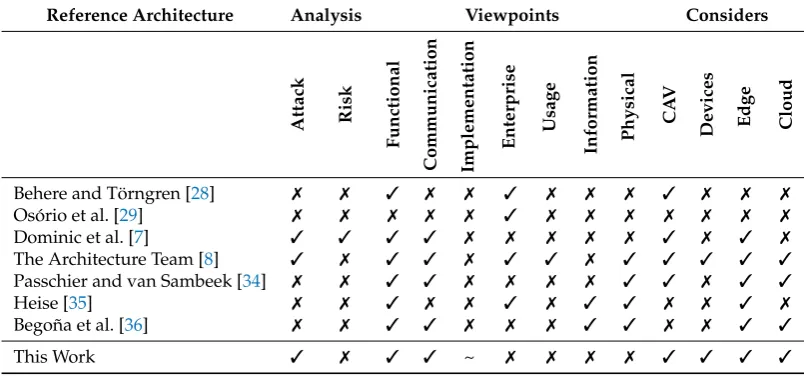
[image:6.595.96.502.348.537.2]A comparison of the existing and proposed reference architectures is provided in Table 2. Features that the reference architecture includes is indicated with a3and features that are not included are indicated with a7, the following features are shown: (i) purpose of the reference architecture (Analysis), (ii) the viewpoints used (Viewpoints) and (iii) the areas the reference architectures consider (Considers). Our work partially considers the Implementation viewpoint as it can be implemented as avirtualcomponent and is thus marked with a ~. Some of the existing reference architectures fail to focus on the wide range of interactions that a CAV could be involved with. Most reference architectures include Edge devices such as RSUs but do not considering the wider range of interactions between CAVs, Devices & Peripherals, the Edge and the Cloud. Without considering all of these interactions, it will be impossible to analyse many current and emerging attacks, so a new reference architecture needs to specify these interactions.
Table 2. Summary of connected and autonomous vehicle (CAV) Reference Architectures where the purpose, viewpoints used and the components are identified with a3if included or an7if not included.
Reference Architecture Analysis Viewpoints Considers
Attack Risk
Functional
Communication Implementation
Enterprise Usage Information Physical
CA
V
Devices Edge Cloud
Behere and Törngren [28] 7 7 3 7 7 3 7 7 7 3 7 7 7
Osório et al. [29] 7 7 7 7 7 3 7 7 7 7 7 7 7
Dominic et al. [7] 3 3 3 3 7 7 7 7 7 3 7 3 7
The Architecture Team [8] 3 7 3 3 7 3 3 7 3 3 3 3 3
Passchier and van Sambeek [34] 7 7 3 3 7 7 7 7 3 3 7 3 3
Heise [35] 7 7 3 7 7 3 7 3 3 7 7 3 7
Begoña et al. [36] 7 7 3 3 7 7 7 3 3 7 7 3 3
This Work 3 7 3 3 ~ 7 7 7 7 3 3 3 3
2.3. Summary
There are many threats that have been identified for CAVs and there have been several reference architectures developed to analyse the attack surface of CAVs. However, the reference architectures tend to either be too broad and consider aspects of an ITS that do not need to be specified when considering the attack surface of CAVs or lack sufficient detail to analyse certain types of threats. In the next section we will present a reference architecture formed of a hybrid functional-communication viewpoint to address the lack of reference architectures that balance ease of use with being sufficiently detailed.
3. A CAV Reference Architecture: Components and Related Attack Surfaces
as part of a functional component or as a virtual functional component that exists and interacts with all components. Important virtual components that might exist include the Operating System and the hardware that the software is executing on (e.g., Electronic Control Units (ECUs)). The users of the system are considered when identifying the scenarios of interest in which the reference architecture will be instantiated with concrete components. Finally, how users and organisations interact may lead to security issues (e.g., resetting a password) but as these threats do not specifically relate to CAVs they are out of the scope of this paper.
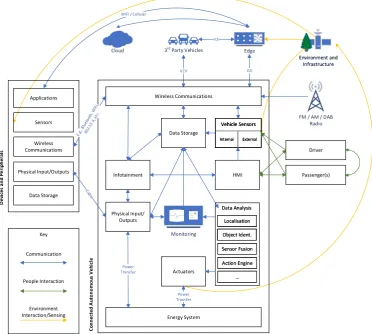
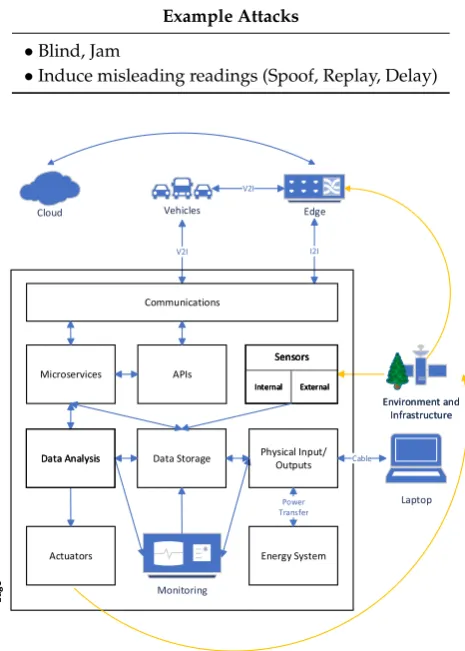
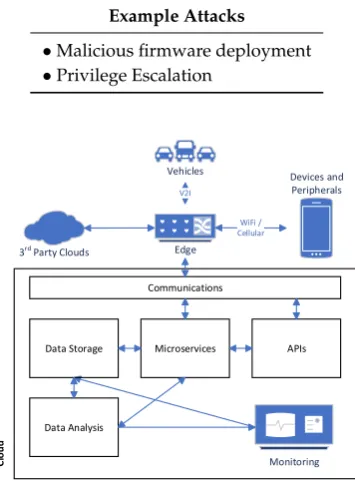
The four sub-architectures that are presented were designed by identifying key components within CAVs and the ways it which they will interact. The sub-architectures for CAVs and Devices & Peripherals are presented in Figure 1. The two sub-architectures for the Edge and the Cloud are shown in Figures2and3respectively. These architectures are composed of various abstract components which need to be instantiated with concrete implementations to undertake an analysis of the architecture. For example, the Sensors component could be instantiated with GPS, LIDAR, tire pressure and temperature sensors. These components should be instantiated with the desired concrete implementations that are required for a specific application. When analysing different applications, the reference architecture will be instantiated with a different set of components.
Monitoring 3rd Party Vehicles Cloud V2I Wireless Communications Energy System Data Storage Actuators Physical Input/ Outputs Infotainment Environment and Infrastructure Environment and Infrastructure
[image:7.595.112.485.321.655.2]FM / AM / DAB Radio Edge Power Transfer D e vi ce s an d P e ri p h e ra ls Wireless Communications Applications Sensors Physical Input/Outputs Driver Passenger(s) HMI C o n n e cted A u to n o m o u s V e h ic le Data Analysis Localisation Sensor Fusion Action Engine ... Object Ident. Data Analysis Localisation Sensor Fusion Action Engine ... Object Ident. External Internal External Internal Vehicle Sensors Vehicle Sensors External Internal Vehicle Sensors Key Communication People Interaction Environment Interaction/Sensing Data Storage
Figure 1.CAV and Devices & Peripherals Reference Architectures (Hybrid Functional-Interaction viewpoint).
3.1. CAV Reference Architecture
to consider when analysing attacks but they do not form the high level functionality of the system. For example, the telematics control unit subject to research in Reference [22] contains multiple functional components in a single physical component. The remainder of this section will describe the components present in the architecture.
3.1.1. Wireless Communications
Vehicles are currently or expected to be equipped with multiple antennas in order to communicate over different wireless protocols. This includes antennas for (i) receiving audio over AM, FM or DAB radio, (ii) receiving and transmitting IEEE 802.11 WiFi, (iii) bidirectional V2X communications over IEEE 802.11p and (iv) bidirectional cellular antennas (such as 4G). It may also be the case that Internet of Things (IoT) technologies such as IEEE 802.15.4 or ZigBee are included to facilitate interoperability with IoT networks. Many of the systems in the CAV will interact with the communications due to the need to coordinate with nearby vehicles or to provide services to the vehicle’s users. As communications are the primary way in which vehicles will exchange information, they will be the avenue through which most attacks are launched. These attacks may try to compromise or interfere the way in which packets are communicated or compromise the components to which the packets are forwarded.
Example Attacks
•DoS V2X communications [37] •Eavesdrop
•Replay
•MiTM Intercept
•Incorrect handling of malicious packets (e.g., DAB [38]) leading to RCE •Context information leakage (e.g., location, identity [39])
•Sybil Attacks [40]
•Colluding to defeat agreement protocols [41] •Wormhole (Relay) Attack [42]
3.1.2. Physical Inputs and Output
Physical inputs and outputs that are contained within a vehicle include ports such as USB, OBD-II, audio connections and others. Exploiting these ports is typically harder for an attacker as they would usually require physical access to the vehicle, however, due to the presence of additional devices that connect to these ports there are ways in which attacks can be performed via a remote connection.
With the presence of a USB port (depending on the protocol with which the hardware interprets the data), there is the possibility for an adversary to gain access to the vehicle’s internal network [43]. Malicious USB sticks could be given out to people loaded with music or videos for free, with the intent of being plugged into the vehicle. When plugged in, malware could attempt to access the internal vehicle’s CAN bus. Another approach is to fool users into connecting a device that resembles a USB stick but can repeatedly deliver a high voltage discharge that would destroy a vehicle’s internal electronics [44].
Example Attacks
•Cause electrical damage [44]
•Install malicious software (e.g., by firmware updates on CDs or USB sticks) [11]
3.1.3. Internal Communications (Virtual)
as it is implicit due to the components interacting. Vehicles may also use a different internal interaction (such as Ethernet) in the future and by under-specifying this implementation detail, the reference architecture is more generic.
Example Attacks
•Send crafted packets [11,43,45,46] •DoS [45]
•Eavesdrop [45]
Attacking this internal communication network can be performed by a direct connection to it, for example, via an OBD-II port. Alternatively, an attacker can gain access to this internal network via vulnerabilities in the components that connect to it. Once these components are compromised an attacker will have access to eavesdrop on messages sent [45] or the ability to inject malicious messages [43,45,46]. With access to the internal network of a vehicle many functional aspects of the vehicle can be controlled, including: the radio, instrument panel, the vehicle’s body, engine, brakes, HVAC and others [21]. A solution to these issues is to use encryption and authentication of messages [47], however, vehicles currently on the road act as if the CAN bus is a walled garden and do not attempt to encrypt or authenticate messages sent on the bus.
3.1.4. Sensors (Internal and External)
Sensors are a key component of CAV systems. The vehicles will rely on their input to build a model of the world. Example sensors include: (i) Global Navigation Satellite System (GNSS) to be aware of a vehicle’s position, (ii) wheel rotation senors to be aware of velocity, (iii) LIDAR to be aware of the relative position of other vehicles, (iv) parking cameras to assist drivers and a variety of other sensors such as temperature, humidity and light. Sensors may also observe information passivelyabout the occupants in the vehicle. As sensors are a way for the vehicle to obtain the state of the environment around it, if that data can be maliciously manipulated, then the vehicle may make incorrect decisions based on the manipulated data. Alternately, an adversary may attempt to eliminate the vehicle being able to use certain sensors, such as by jamming GNSS signals or producing too much LIDAR interference for the data to be useful [10]. Another approach may be for an adversary to place additional sensors on the vehicle exterior or to subject the sensors to physical manipulation.
In certain systems, the vehicle’s sensors may wirelessly communicate their data to the car (such as when monitoring tire pressure [48]). Most sensors are expected to be hardwired to the system due to high reliability requirements. Wireless sensors pose a greater security threat as there is a larger attack surface for an adversary to take advantage of. For example, the Tire Pressure Monitoring System (TPMS) leaks identity information about the vehicle by including unencrypted identifiers in the packets it sends. Due to the lack of authentication and validation, the system also is vulnerable to spoofing and replay attacks, where the vehicle could easily be fooled into believing the tire is flat even if it was not.
Example Attacks
•Induce misleading readings (Spoof, Replay, Delay) [10] •Blind, Jam [10]
•Tamper (Disable, Replace)
3.1.5. Data Storage
the purpose for the data. For example, music and video should not be stored in the same location as the vehicle’s software but implementation details may mean that this is not the case. Not all data will be stored locally, some will be present in the Cloud and only requested when required. Other data may be stored in the Edge or even in other vehicles on the road.
Example Attacks
•Violate Integrity (manipulate data) •Violate Confidentiality (extract data) •Violate Availability (delete data) •Violate Non-repudiation (delete logs) •Remote firmware update [22]
3.1.6. Data Analysis
To make sense of the data obtained from external sources (such as the sensors) and the data stored locally in the vehicle, some sort of analysis will need to be performed on it. This analysis may use simple conditions to trigger actuators (e.g., if temperate rises above a threshold, then turn on the air conditioning) but more complicated techniques, such as machine learning models, will also be used. These machine learning models will be prevalent in CAVs due to the need for autonomy.
Example Attacks
•Induce bad analysis (e.g., adversarial ML [49]) •Obtain analysis
•Malicious input to put analysis into infinite loop (DoS)
Localisation
One of the key pieces of knowledge for an autonomous vehicle is its location. Information such as from GNSS can be used to provide a fairly accurate location [50] as long as the vehicle is in an open area with few buildings blocking satellite signals. Other approaches such as dead reckoning are used to calculate the vehicle’s current position based on a previously known position, the vehicle’s speed, heading and the travel time.
Object Identification
As part of autonomous driving it will be necessary for the CAV to be able to identify objects. These objects will include people, obstacles, road signs and many other objects. Machine learning based algorithms will be used to perform visual identification. However, using machine learning can open the vehicle up to being attacked in new ways. One example is adversarial machine learning, where input manipulation can lead to unexpected results. For example, in Reference [51] 3D printed objects were crafted to be misclassified by an object detection model. In one case a turtle was detected as a gun, such a detection could lead to unexpected behaviour in the vehicle. Alternate issues might include the vehicle failing to recognise another vehicle, such as when a Tesla was involved with a fatal accident when it attempted to drive under a truck [52]. An adversary manipulating the data provided to sensors, may affect the actions vehicles take.
Sensor Fusion
fusion technique needs to be aware of how to handle data provided by an attacker, such that it does not lead to incorrect actuations.
Action Engine
Once an autonomous vehicle has both determined its location and the road objects surrounding it, it may call on the Action Engine sub-module to decide what it must do next. Possible actions to be taken include interactions with other connected vehicles on the road and both short and long term driving decisions. RSUs or the Cloud, on the other hand, make use of the Action Engine to ensure that the vehicle control and planning systems are correct and safe and to ensure that multiple vehicles on the road at the same time coordinate and are managed to move people and packages to their destinations in the most effective way.
3.1.7. Energy System
The energy system both supplies energy (in the form of electricity) to the systems within a CAV and is also capable of being supplied with energy. Energy can be supplied back to the batteries through the use of regenerative breaking, solar panels, recharging cables and other sources. The energy system is also tasked with maintaining the vehicle’s batteries to ensure power is safely drawn from them. If the energy system is compromised then unsafe usages of electricity may follow which could lead to damage to the vehicle.
Example Attacks
•Overcharge battery to damage it •Drain power
3.1.8. Actuation
This module contains any components that can perform an action with an impact on the physical world. This may include, applying the brakes, changing wheel speed, changing the angle the wheel is pointed in, operating the air conditioning, lowering or raising windows, locking and unlocking car doors and others. If an adversary is not attempting to gain information about the vehicle or passengers, then actuating components are likely to be the key target. For example, an attacker may attempt to compromise a large number of vehicles in order to provide Theft as a Service (TaaS) [56]. Rather than steal cars, the thief will install malware on as many vehicles as possible. Then, when there is demand for a particular car the malware can give the thief access to the vehicle. The adversary who installed the malware may not even need to active the malware themselves, as they could provide a crafted key to the intended buyer.
Example Attacks
•Disable
3.1.9. Monitoring and Logging
Monitoring and logging are important aspects for CAVs in a number of scenarios, including: verifying that vehicles are functioning correctly, analysing past decisions made and will be used to manage maintenance schedules. For example, if a CAV is in an collision the vehicle will need the ability to explain why it made the decisions before the collision. If an adversary is capable of accessing the diagnostics unit then it may rewrite decision making history, preventing reliable auditing.
Example Attacks
3.1.10. Infotainment
The infotainment system is used to manage the entertainment system within a vehicle (such as audio/video systems) and information systems (such as maps and navigation, phone and car status). Infotainment systems are also likely to contain a web browser to facilitate access to the internet for both entertainment and information. An issue with infotainment systems is that they may process data from untrusted sources. If the data is maliciously crafted to take advantage of vulnerabilities in the system, then an attacker may be able to remotely execute arbitrary code.
Example Attacks
•Arbitrary code execution (via browser) [45]
•Arbitrary code execution (via crafted audio/video files)
3.1.11. Human-Machine Interface
A Human-Machine Interface (HMI) is any device or software which allows a person toactively interact with a machine. A passive observation of the occupants would be performed by the Sensors component. In vehicles HMI includes critical systems such as the steering wheel, accelerator pedal, break pedal and gear controls. Less critical system include the controls on the dashboard and feedback mechanisms. An attacker may attempt to intercept the signals from the HMI to prevent the vehicle doing something other than requested. Alternatively, the attacker might use the HMIs to report statuses that are incorrect to attempt to get the driver or passengers to perform certain actions. For example, the adversary may turn on engine safety warnings (when there is no problem) to cause the driver to stop the car. The attacker could then use this opportunity to steal the vehicle or perform other attacks, such as attaching a tracking sensor.
Note that HMI does not communicate directly with the actuators. There will need to be some data analysis performed that potentially adjusts the action performed. For example, an anti-lock breaking system would not always actuate the brakes in the way the driver requests.
Example Attacks
•Spoofing vehicle status •Intercept commands
3.2. Devices and Peripherals Reference Architecture
Vehicles may have a number of peripherals that interact with each other. Some examples of the kinds of devices and peripherals that may be present and in use are: (i) Car Keys, (ii) Smart phones, (iii) MP3 players, (iv) Bluetooth devices, (v) 3rd Party Navigation Systems, (vi) Dashcams, (vii) Portable games consoles and others. These devices could either interact with the vehicle or simply be present within the vehicle. Some of these interactions may be relatively simple, such as accessing the vehicle’s WiFi in order to connect to the internet via a cellular connection. Others may involve accessing the vehicle’s storage, actuating the infotainment system or controlling other aspects of the vehicle. These peripherals are additional vectors that attackers can take advantage of to attack the system. This may be by loading the device with malware to gain control [57] or interacting with the context of the inter-device communication [58].
3.2.1. Applications
One of the key features of certain devices (such as smartphone) are the ability to run applications on it. Some vehicle manufacturers (such as Volkswagen [59]) are creating mobile apps that obtain information from the car or allow the app to control certain features (such as the infotainment system). If the phone is compromised then that malware may be able to affect the vehicle’s systems via the app. The attacker may be able to leak data about the car, gain an internal vector to the vehicle’s systems or use the phone’s connection to the cloud to attack the vehicle.
Example Attacks
•Location tracking via sensor data (e.g., magnetometer [60]) •Data harvesting
•Become internal attack vector for remote adversary •Malicious smartphone app interfering with CAN bus [57]
3.2.2. Sensors
The devices within a vehicle may have their own sensors that reveal information about the state of the environment inside the vehicle or about the vehicle itself. An adversary may wish to take advantage of these sensors to gain knowledge about the vehicle, which could be potentially useful in escalating the severity of other attacks.
Example Attacks
•Blind, Jam
•Induce misleading readings (Spoof, Replay, Delay)
Monitoring Vehicles Cloud
Communications
Edge
Ed
ge
V2I
Data Storage
External Internal External Internal
Sensors Sensors
External Internal
Sensors
Physical Input/ Outputs
Actuators Energy System
Power Transfer
Environment and Infrastructure Environment and
Infrastructure
Cable
Laptop
Microservices APIs
[image:13.595.182.415.361.687.2]Data Analysis Data Analysis
Figure 2.Edge Reference Architecture (Hybrid Functional-Interaction viewpoint).
3.2.3. Wireless Communications
For example, WiFi devices will broadcast their MAC addresses periodically when looking for a device to connect to [61]. Bluetooth devices will also beacon their MAC address in order to find devices to connect to [58]. Both reveal identity information that could be used to track people in vehicles.
Example Attacks
•Relay Attack (Car Key Signal [42])
•Replay attack (e.g., unlock car using recorded signal)
•Wireless protocols leak identity information about owner [61] •Facilitates tracking of person and vehicle [58]
3.3. Edge Reference Architecture
The Edge reference architecture specifies the interactions of components that occur between operations of the vehicle and the operations of the Cloud. This may include devices used to access a WAN (such as cellular base stations or WiFi hotspots). Edge devices must include some functionality that does not occur remotely but occurs close to where the vehicle is operating or at the boundary between the vehicle and the cloud. There is a wide range of scenarios that could be considered in the Edge reference architecture. The main example are Road-Side Units (RSUs) which are computing devices placed along road networks to support CAVs travelling along the roads. These devices will communicate with autonomous vehicles to assist their autonomous activities. Alternate pieces of infrastructure could also be considered as part of the Edge. For example, internet connected traffic lights, smart parking garages and others, may need to interact with autonomous vehicles and actuate components to facilitate autonomous driving.
Certain components have been previously described (e.g., Sensors, Data Analysis) and will not be repeated as part of the Edge sub-architecture. Some components previously described will be repeated due to differences with the previous sub-architectures.
Example Attacks
•Modify hardware (Tamper) •Disable hardware
3.3.1. Communication
Communication on the Edge has additional capabilities compared with CAVs and the Devices & Peripherals within them, as the Edge can be physically connected to a wide area network (WAN) rather than just wirelessly connected. Such physical connections might be provided by high bandwidth fibre, Ethernet and other communication approaches that require a physical medium. However, Edge nodes will still need to have wireless communication in order to facilitate V2I communication. This communication will include the technologies specified in vehicles to facilitate Dedicated Short-Range Communications (DSRC) (e.g., IEEE 802.11p and/or C-V2X). Other technologies might include non-vehicular specific cellular communications, WiFi and protocols to interact with IoT systems (e.g., IEEE 802.15.4).
Example Attacks
•Edge Emulation [62] •DoS
3.3.2. Data Storage
Example Attacks
•Violate Integrity (manipulate data) •Violate Confidentiality (extract data) •Violate Availability (delete data)
3.3.3. Actuators
Edge systems may potentially have the ability to actuate key pieces of infrastructure which can influence the environment (such as traffic lights or barriers). Depending on what the actuator is, the Edge device(s) may be capable of having a large impact on the behaviour and security of vehicles. For example, a compromised Edge might claim a certain actuation state that is not true, such as claiming a traffic light is green when it is red.
Example Attacks
•Disable
3.3.4. Energy System
The energy system being used to power the Edge system is important to consider as different kinds could be used. Typically Edge systems will be powered using mains power and the attacks on this system relate to removing access to this power. However, alternate power systems (such as via batteries and renewable energy like solar) may be used in areas where providing mains power is infeasible or too costly.
Example Attacks
•Disconnect power supply
The Edge will have Physical IO ports that allow technicians to connect directly to the Edge infrastructure. These ports should be protected using physical security mechanisms (such as locks) to protect against attacks. From a cyber security perspective the ports need to defend against attacks that occur once physical security is bypassed. This means that any user connecting via these ports should be correctly authenticated and forensic logs made about these connection attempts.
Example Attacks
•Privilege Escalation
3.3.5. Monitoring and Logging
Records of actions taken by both the Edge and Cloud will need to be kept. This is to allow investigators to understand why a specific sequence of action occurred. They will also be needed to understand performance characteristics of the system.
Example Attacks
•Delete/Modify logs
3.3.6. Microservices
Any services that are used internally do not need to be exposed to the wider internet, which reduces the attack surface compared to a monolithic application. However, while each individual microservice has a smaller attack surface, the inter-microservices communications become a possible avenues of attack.
Example Attacks
•Malicious firmware deployment •Privilege Escalation
Communications
Data Storage
Vehicles
3rd
Party Clouds Edge
Microservices APIs
Data Analysis
Monitoring
C
lo
u
d
[image:16.595.209.387.151.393.2]Devices and Peripherals
Figure 3.Cloud Reference Architecture (Hybrid Functional-Interaction viewpoint)
3.3.7. Application Programming Interface (APIs)
The APIs exposed by a service hosted on the Edge are used to access that service. APIs can be exposed in a number of ways, however, a common technique is to use RESTful APIs [63] that represent a request and response in JSON which is typically sent over HTTP(S). As APIs often involve user provided data, it is important to ensure that it is sanitised before being manipulated or used for a task. A lack of sanitation or vulnerabilities in the parsing code of the request can lead to confidentiality or integrity violations. A common example of this kind of attack are SQL injections.
Example Attacks
•Lack of user data validation (e.g., SQL injection) •Incorrect data disclosure
3.4. Cloud Reference Architecture
The interactions with CAVs and the Cloud and the operation of the Cloud are important to consider with respect to the attack surface of autonomous vehicles. Much of the information that CAVs request will be provided by Cloud services and specific applications will require interaction with Cloud APIs for services to function. The Cloud reference architecture is intended to be a simplified representation of the key components that are important for CAVs. It is sufficiently detailed for an analysis of how attacks on the Cloud will impact a CAV, however, more detailed reference architectures and threat models should be used to analyse the Cloud in greater depth (such as References [64–66]).
3.4.1. Communication
The communication patterns that occur in the Cloud will be more complex due to the Cloud’s need for scalability, high performance and high reliability. Rather than having a single connection to the wider networking infrastructure, the Cloud will have multiple gateways which utilise load balancing to improve performance. As the Cloud is internet connected, large services will be under attack from DDoS packet spam [67]. This means that firewalls and DDoS protection is an important part of the Cloud’s communication infrastructure.
Example Attacks
•Jam or disconnect link •MiTM
•DDoS
3.4.2. Data Storage
Cloud data storage will be different to both vehicular and RSU data storage, as it will be physically distributed across many different data centres. The data will also be replicated to ensure integrity and availability under hardware failures. This replication and distribution increases the attack surface of the data storage, as there are multiple sites to consider exploiting and the communication between sites to perform the replication could also be vulnerable to exploitation.
Example Attacks
•Insider attacks against data centre [68] •Hardware failures limiting availability •Unintended remote access
3.4.3. Data Analysis
The data analysis performed by the Cloud is going to be different from that performed by the vehicle, as the Cloud will have access to much more data over a longer time period. Therefore, the Cloud will have different objectives in terms of the analysis it produces from the data. For example, it may analyse historical data to better predict traffic patterns, which could be used to load balance road networks when a vehicle requests a route from its origin to its destination. An attacker may wish to gain this analysis (as it is likely to be very valuable) or impact the analysis so it outputs poor results (e.g., such that all vehicles are directed into a lower capacity road, leaving higher capacity roads free).
Example Attacks
•Privacy leakage of user information (Privacy Preserving Data Mining to protect it [69])
4. Methodology
4.1. Instantiating the Reference Architecture
Thus far the abstract reference architecture has been presented, with abstract components such as Sensors. To use the reference architecture the abstract components needs to be instantiated with concrete components as required by the specific scenario of interest (as will be shown in Section 5). For example, the Sensors component could be instantiated with multiple sensors such as LIDAR, odeometry and temperature when an application needs the output from these sensors to perform its function. Not all components need to be instantiated, as the scenario may not involve certain systems within the vehicle. Only once the reference architecture has been instantiated with components the threats against those components can be identified. Using the reference architecture the threats posed by compromised components can be identified by the links specifying how the components interact.
4.2. Synthesis of Attack Surface
Once the system has been instantiated for a use case, attack surface analysis is used to identify a comprehensive set of feasible methods for adversaries to achieve their goals. Attackers can use or combine different attack paths to reach their desired goals. Where mitigations should be implemented can be identified by focusing on reducing the ability for an adversary to exploit critical attack surfaces. Attack goals can be obtained by systematically performing a threat modelling on the critical components or functionality of a system. There are a number of approaches to perform threat modelling [6], of which Microsoft’s STRIDE is commonly used in the automotive security domain. A reference architecture is useful in conjunction with threat modelling, as it provides a methodology to identify the attack routes to achieve a goal that may not have been previously considered in the threat modelling. However, performing a threat modelling is out-of-scope for this work to ensure generalisation to arbitrary threat modelling techniques.
One effective method to describe attack surfaces areattack trees, which were first introduced in Reference [15] to manage the large number of threats derived from comprehensive threat modelling in general security. Attack tress have since been employed in automotive security in a number of scenarios [70–72]. To create attack trees potential threat agents and their goals in compromising the system first need to be identified. For each attack goal, the relevant attack surfaces need to be specified that define possible paths to reach this goal. These paths can then be represented as an attack tree. At the end of this procedure, a list of attack trees which cover known goals, sub-goals and attack methods of potential threat agents are produced.
In this paper, we also employ attack trees to synthesise, manage and control the attack surface. The process to perform the attack tree analysis is illustrated in Figure4and described below:
1. The goal(s) of the threat actor needs to be specified.
2. Using these goals, identify the component in the reference architecture that ultimately needs to be compromised for these goals to be achieved.
3. Identify the possible entry points to the system the threat actor could exploit.
4. Using the entry point(s) calculate the path(s) that an threat actor could take to reach the target component from an external interaction.
[image:18.595.80.522.691.751.2]5. Considering a threat actor’s capabilities, resources and presence, prune paths that the threat actor cannot exploit.
Evaluation of threat agents appear at both ends of an attack tree. At the beginning, goals are derived from threat agents’ motivations. It is assumed that threat agents will only consider goals that follow from their motivations. For example, a thief has a motivation to increase their wealth, so a goal is to steal physical assets rather than cause damage. Each threat will require a specific capability to be carried out, such as: technique, skills, knowledge, equipment, presence and others. Therefore, at the end of the procedure, the capability of threat agents also needs to be evaluated to check if achieving the goal is feasible. If achieving the goal is not feasible, then the attack tree needs to be pruned from the set of attack trees generated.
Existing work has been performed on identifying threat actors and their capabilities, goals, resources and motivations which should be used as input to this attack surface analysis. For example, a comprehensive library of threat agents for general information systems was provided by Intel [73] in their Threat Agent Risk Analysis (TARA) model. This library contains information of 22 threat agents and their 9 common attributes. However, many of the agents are inapplicable in to CAV security. For example, the TARA list was reduced to the seven most relevant agents in Reference [7], which included thief, owner, organised crime, mechanic, hacktivist, terrorist and foreign government.
4.3. Identify Attack Entry Points at the Boundary and Internal Interaction Points
Attacks against a single component can have limited impact. Therefore, is it often the case that compromised components are used to aid in attacking another component or multiple components are attacked simultaneously. These attacks are more complicated and take longer to perform but can have a greater impact on the CAV. The motivations for an attacker to attack a component via another compromised component can be divided into two categories: (i) escalating attacker capability and (ii) creating greater impacts. Achieving one of these categories (or both) can be obtained by sequential manipulation (attacking a component from another already compromised component), concurrent manipulation (attacking two components simultaneously) or a mixture of the two manipulations.
4.4. Summary
This section described the procedure to synthesis the attack surface of a system described using a reference architecture. To provide an insight into how to apply this technique, two case studies using it are explored in the next section.
5. Case Studies
In this section we present two different case studies to demonstrate how to use the proposed reference architecture for attack surface analysis. The procedure for creating these case studies is as follows:
1. Identify a scenario where cyber security is important.
2. Instantiate the reference architecture with concrete instances of components that are present in the scenario.
3. Use input from threat modelling to identify the goals, motivations, capabilities and resources of an adversary.
4. Use the instantiated reference architecture to build attack trees. This facilitate the cyber security analysis of the scenario by identifying how an adversary will perform attacks.
5. Finally, identify the ways in which the system can be changed to mitigate the attacks.
5.1. Driverless Valet Parking
its allocated space. When the driver wishes to retrieve the vehicle, a signal can be sent from a smart phone to request the vehicle autonomously drives back to its owner. Figures5and6show how certain components were instantiated with concrete components. In this example the Edge resources form the smart parking garage.
As this case study was also examined in Reference [7], by implementing this application we will demonstrate the differences between using our reference architecture and the one proposed in Reference [7]. This comparison will demonstrate that our architecture allows a more detailed analysis of the attack surface due to the consideration of interactions between the vehicle and the devices & peripherals, the Edge and the Cloud. Some different components are included that are not referenced in the example in Reference [7]. These new components are in boxes with dashed lines. They indicate certain functionality that could be involved with a valet parking system and highlight different ways in which the system could be attacked that are not covered in the previous work.
Monitoring 3rd Party Vehicles V2I Wireless Communications Energy System Physical Input/ Outputs Environment and Infrastructure Environment and Infrastructure
[image:20.595.98.497.266.647.2]FM / AM / DAB Radio Edge Power Transfer D e vi ce s an d P e ri p h e ra ls Wireless Communications Sensors Physical Input/Outputs Driver Passenger(s) C o n n e cted A u to n o m o u s V e h ic le Data Analysis Localisation Sensor Fusion Action Engine Object Ident. Data Analysis Localisation Sensor Fusion Action Engine Object Ident. Vehicle Sensors GNSS Range Inertial Odometry Data Storage Maps Wheels Breaks Actuators Environment Applications Req. Park Req. Retrieval Req. Park Infotainment HMI Dashboard Touch Screen Data Storage Key Communication People Interaction Environment Interaction/Sensing Cloud
Figure 5.Valet Parking: Vehicle and Devices Instantiation.
5.1.1. Threat Identification
A number of threats were identified in the original example in Reference [7] that can also identified using the reference architecture proposed.
• Spoof GNSS on Vehicle: GNSS signals could be spoofed to assist a thief stealing a vehicle. • Modify Map via Update onCloud: A map update is used to force the vehicle along a route to
an arbitrary destination.
• Blind Range Sensor on Vehicle: An adversary seeking to cause a crash could blind the range sensor to prevent a vehicle from knowing its distance from obstacles.
• DoS Parking Allocator on Cloud: An adversary seeking to induce a traffic jam or freeze the parking garage could DoS the allocator, preventing vehicles from requesting new spaces.
Vehicles Communications Edge E d ge V2I
Data Storage Physical Input/ Outputs Environment and Infrastructure Environment and Infrastructure Laptop Actuators Barrier Actuators Barrier Energy System Mains Power Energy System Mains Power Monitoring APIs Microservices Positioning Microservices Positioning Sensors Range Empty Space Sensors Range Empty Space Sensor Fusion Action Engine Data Analysis Sensor Fusion Action Engine Data Analysis Cloud
(a)
Communications
Data Storage APIs
Monitoring C lo u d Microservices Map Server Parking Alloc. Data Analysis Historical Prediction Vehicles 3rd
Party Clouds Edge
Devices and Peripherals
[image:21.595.78.510.154.436.2](b)
Figure 6.Valet Parking: Edge and Cloud Instantiation. (a)Edge; (b) Cloud.
Using our reference architecture (see Figures5and6), the following additional threats have been identified:
• DoS Parking Sensor on Edge: Cover sensor that detects a vehicle in a parking space to reduce the availability of the parking garage.
• Information Disclosure via Vulnerable APIs on Cloud: Vulnerable APIs can potentially execute arbitrary code (such as via SQL injection attacks), allowing an adversary to remotely obtain sensitive data about the parking garage system.
• MiTM on Edge: A device could be placed in the parking garage that mimics roadside infrastructure. If it has a high signal strength vehicles would prefer connecting to that overt V2I rather than the Edge infrastructure of the parking garage, allowing a MiTM attack between the vehicle and the cloud services. This attack could reveal sensitive information about the user (such as financial details). It could also be used to over allocate vehicles causing a large traffic jam in the parking garage (denying vehicle availability).
This work does not perform the threat modelling in step 3, as it is expected to input this information from one of the many different threat modelling techniques.
Considering the additional components contained within the dashed lines, the following additional threats have been identified:
• Incorrect Indoors Positioning on Edge: If the Edge assists the vehicle perform indoors positioning, then spoofed and jammed signals could be used to decrease the vehicle’s certainty of its position.
By including the additional interactions with the Edge and Cloud, as well as a better structuring of components and their interactions, our reference architecture has allowed more threats to be identified. The identification process does not require specifying a large amount of details compared to more comprehensive reference architectures such as in Reference [8].
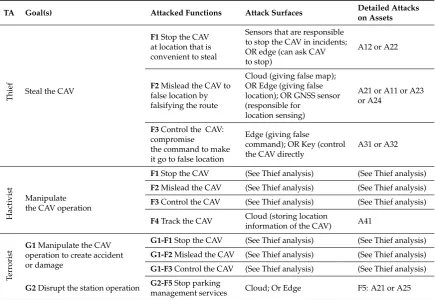
[image:22.595.82.518.288.588.2]Attack trees were built from these specified potential threats by first selecting the most relevant threat agents; which are the thief, hacktivist and terrorist.For each threat agent the most important goals were identified. The attack trees were then analysed for each of these goals, which is summarised in Table3. Finally, each tree was combined into a single tree (Figure7) to illustrate the security analysis of the use case with respect to the threats, threat agents and their goals.
Table 3. Attack Tree Analysis for Driverless Valet Parking Use Case with example threat actors and their goals.
TA Goal(s) Attacked Functions Attack Surfaces Detailed Attacks
on Assets
Thief Steal the CAV
F1Stop the CAV
at location that is convenient to steal
Sensors that are responsible to stop the CAV in incidents; OR edge (can ask CAV to stop)
A12 or A22
F2Mislead the CAV to
false location by falsifying the route
Cloud (giving false map); OR Edge (giving false location); OR GNSS sensor (responsible for
location sensing)
A21 or A11 or A23 or A24
F3Control the CAV:
compromise
the command to make it go to false location
Edge (giving false
command); OR Key (control the CAV directly
A31 or A32
Hactivist
Manipulate the CAV operation
F1Stop the CAV (See Thief analysis) (See Thief analysis)
F2Mislead the CAV (See Thief analysis) (See Thief analysis)
F3Control the CAV (See Thief analysis) (See Thief analysis)
F4Track the CAV Cloud (storing location
information of the CAV) A41
T
err
orist
G1Manipulate the CAV
operation to create accident or damage
G1-F1Stop the CAV (See Thief analysis) (See Thief analysis)
G1-F2Mislead the CAV (See Thief analysis) (See Thief analysis)
G1-F3Control the CAV (See Thief analysis) (See Thief analysis)
G2Disrupt the station operation G2-F5Stop parking
management services Cloud; Or Edge F5: A21 or A25
5.1.2. Discussion
Attack goal: exploiting driver valet parking
vulnerabilities
Attack surfaces Attacks on assets Attacker capability Attacked functions
Falsify or interrupt internal functions
Falsify or interrupt external support functions
Compromising communication functions
Thief Spoof GNSS – A11
Hacktivist Blind range sensor on
vehicle – A12
Hacktivist
Modify map update on Cloud – A23
Terrorist DoS parking allocator on
Cloud – A21
Hacktivist DoS parking sensor on
edge – A22
Terrorist Cut main power on Edge –
A25
Thief Incorrect indoor
positioning on Edge – A24 GNSS sensor Range sensors Cloud map Cloud database Parking sensor Indoor sensor Cloud services Cloud API AND/OR Compromising privacy Thief Replay retrieval on Device
– A32
Thief MitM on Edge – A31
Edge communication
Key control communication
Hacktivist
[image:23.595.78.522.85.354.2]Information Disclosure via vulnerable API on Cloud – A41
Figure 7.Attack Tree for Valet Parking Example that highlights multiple ways in which an attacker can reach its goal.
Table 4.Attack Tree Analysis for Tesla Use Case with example threat actors and their goals.
TA Goal(s) Attacked Functions Attack Surfaces Detailed Attacks on Assets
Hacktivist
HG: to control the CAV components (e.g., IC, Parrot, Gateway) remotely
HF1get shell access AS-HF1:IC, Parrot, Gateway
A-HF1:A43 or A42 or A41
HF1.1:overwrite firmware AS-HF1.1:Linux
Kernel, Browser A-HF1.1:A22
HF1.1.1:get firmware address AS-HF1.1.1:
Browser A-HF1.1.1:A21
HF1.1.2:redirect browser to fake domain
AS-HF1.1.2:
Browser, WIFI
A-HF1.1.2:A11 or A12 or A13
HF2:get root privileges AS-HF2: Linux
Kernel A-HF2: A31
HF2.1:disable the security app AS-HF2.1: Linux
Kernel A-HF2.1: A32
T
err
orist
TG:to create high safety impact attack by autonomous vehicle
TG1:to control the CAV remotely
TG2:to monitor the CAV to find environment where it can create high safety impact (e.g., involves many people)
TG1:See attacked function analysis for HG
See attack surfaces
for HG See attacks for HG
TG2: TF-TG2: to track the CAV and its operating environment
AS-TF2: See similar analysis in valet driving example
TG2: See similar analysis in valet driving example
[image:23.595.86.515.414.662.2]5.2. Tesla Exploitation
An example of an attack that needed to compromise multiple components to gain further control of the vehicle was presented in Reference [45]. The default behaviour of the vehicle was to connect to an unprotected WiFi hotspot and opening a website in the infotainment. By setting up an alternate WiFi hotspot with the same SSID but broadcasting at a higher power, the vehicle instead connected to the alternate hotspot, which allowed traffic to be redirected to a custom server. This means an attacker with semi-local presence could perform this attack. To perform the initial attack the adversary needed to identify a vulnerability in the web browser running in the infotainment system. By chaining together multiple browser vulnerabilities the adversary could execute arbitrary code through the compromised browser. Privilege escalation was then required to affect the system in substantial ways. Without gaining the privilege escalation the adversary would have little ability to affect the internal systems. However, read access to memory storage was provided through the browser exploit, which revealed debug information that included procedures for upgrading firmware. This allowed a custom firmware to be flashed to certain components, which is capable of performing arbitrary tasks.
So the summarised steps are as follows, withFUNCTIONALcomponents andimplementationsof those components formatted differently (see more details of reference model in Figures8and9):
1. EXTERNALCOMMUNICATIONSconnects to popularWiFihotspot 2. A maliciousWiFihotspot spoofs the SSID with a greater signal strength 3. Compromisebrowserin INFOTAINMENT
4. Privilege escalation inOperating System
5. STORAGEaccess
6. Flashfirmware(change STORAGE)
7. Custom firmware eavesdrops/transmits/blocks messages on the CAN bus (INTERNAL COMMUNICATIONS)
Even with access to the CAN bus safety features limited the adversary’s ability to perform certain actions. For example, the authors attempted to open the trunk while the vehicle was in motion but this was prevented. However, the authors found a way to block certain CAN message which allowed them to open the trunk or to disable automatic locking of doors when the vehicle was moving.
In response to this vulnerability several controls were added to reinforce the security of Tesla vehicles, including (see Figure10):
• C1: Greater isolation of the Infotainment web browser from being able to interact with other parts of the system
• C2: Page Table Isolation (which prevents the kernel from accessing user mode memory and thus preventing the adversary from executing code in user space)
• C3: Code Signing (to prevent untrusted code execution)
Monitoring 3rd Party Vehicles V2I Energy System Physical Input/ Outputs Environment and Infrastructure Environment and Infrastructure
FM / AM / DAB Radio Edge Power Transfer D e vi ce s an d P e ri p h e ra ls Wireless Communications Applications Sensors Physical Input/Outputs Driver Passenger(s) C o n n e cted A u to n o m o u s V e h ic le Data Analysis Localisation Sensor Fusion Action Engine Object Ident. Data Analysis Localisation Sensor Fusion Action Engine Object Ident. Vehicle Sensors Data Storage Debug Info Wheels Breaks Actuators Firmware Upd. Web Browser Infotainment HMI Dashboard Touch Screen Wireless Communications WiFi Open Trunk
Auto Lock Doors
[image:25.595.97.498.87.473.2]GNSS Speed Spoofed Edge Firmware Data Storage Key Communication People Interaction Environment Interaction/Sensing Cloud
Figure 8.Tesla Exploit: Vehicle and Devices Instantiation.
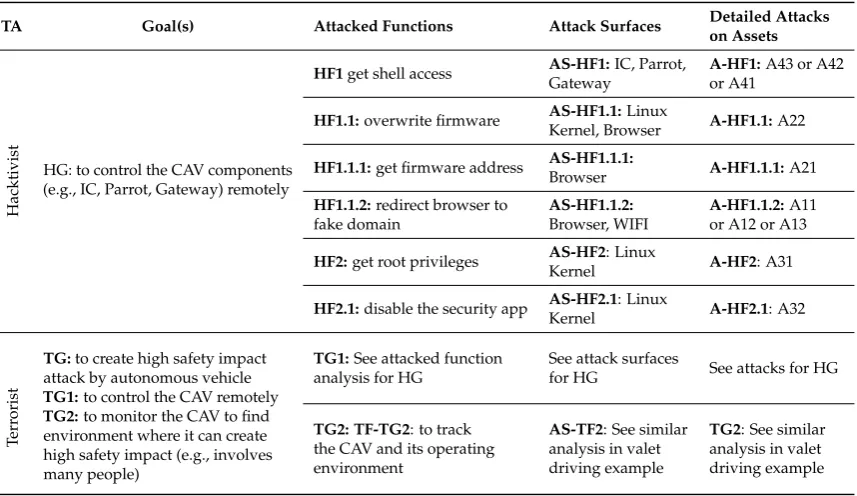
The security analysis from Reference [45] is extended by our attack tree analysis in Table4
and Figure10, with alternatives to browser attacks being identified as part of the attack surface. The goals of the hacktivists (i.e., Tencent researchers) can be extended to a higher-impact goal of a terrorist, for example, to control the CAV to create accidents when it is operating in a crowded environment. Relations between the threats, goals and agents are illustrated in Figure10. When applying the Tesla controls, it can be seen that the detailed attacks are eliminated, the relevant attack surfaces are significantly reduced, while the connections between the surfaces are removed.
Vehicles
Communications
Edge
Ed
g
e
(W
iF
i H
o
tsp
o
t)
V2I
Data Storage
Sensors
Data Analysis Physical Input/
Outputs
Actuators
Environment and Infrastructure Environment and
Infrastructure
Cable
Laptop
WiFi Hotspot
Microservices
Monitoring
APIs
Energy System
Mains Power Energy System
Mains Power
Cloud
(a)
Communications
Data Storage APIs
Data Analysis
Monitoring
C
lo
u
d
Microservices
Firmware Upd.
Dashboard
Vehicles
3rd
Party Clouds Edge
Devices and Peripherals
[image:26.595.85.512.90.361.2](b)
Figure 9.Tesla Exploit: Edge and Cloud Instantiation. (a)Edge; (b) Cloud.
[image:26.595.77.521.376.734.2]![Table 1. Levels of Vehicular Autonomy [19] from no autonomy (where the driver is in full control ofthe vehicle) at level 0 to level 5 where the vehicle is in full control.](https://thumb-us.123doks.com/thumbv2/123dok_us/9424843.446315/2.595.86.515.510.671/levels-vehicular-autonomy-autonomy-control-vehicle-vehicle-control.webp)