Original citation:
Gerrard, Bill and Lockett, Andy. (2016) Team-specific human capital and performance. British Journal of Management.
Permanent WRAP URL:
http://wrap.warwick.ac.uk/77078
Copyright and reuse:
The Warwick Research Archive Portal (WRAP) makes this work by researchers of the University of Warwick available open access under the following conditions. Copyright © and all moral rights to the version of the paper presented here belong to the individual author(s) and/or other copyright owners. To the extent reasonable and practicable the material made available in WRAP has been checked for eligibility before being made available.
Copies of full items can be used for personal research or study, educational, or not-for profit purposes without prior permission or charge. Provided that the authors, title and full bibliographic details are credited, a hyperlink and/or URL is given for the original metadata page and the content is not changed in any way.
Publisher’s statement:
"This is the peer reviewed version of the following articleGerrard, Bill and Lockett, Andy. (2016) Team-specific human capital and performance. British Journal of Management., which has been published in final form at http://dx.doi.org/10.1111/1467-8551.12173 This article may be used for non-commercial purposes in accordance with Wiley Terms and Conditions for Self-Archiving."
A note on versions:
The version presented here may differ from the published version or, version of record, if you wish to cite this item you are advised to consult the publisher’s version. Please see the ‘permanent WRAP URL’ above for details on accessing the published version and note that access may require a subscription.
TEAM SPECIFIC HUMAN CAPITAL AND PERFORMANCE
Bill Gerrard
Leeds University Business School University of Leeds
Leeds LS2 9JT, UK
&
Andy Lockett Warwick Business School
TEAM SPECIFIC HUMAN CAPITAL AND PERFORMANCE
Over the last 15 years, scholars of resource-based view (RBV) have highlighted the role of
human capital (HC) as a key factor explaining why some firms outperform others (Acedo,
Barroso, & Galan, 2006; Barney, 1991; Barney, Wright, & Ketchen, 2001; Coff, 1999). HC
resources, however, raise a number of challenges for firms wishing to create a position of
sustainable competitive advantage. First, HC resources may be difficult to protect, as
individuals have relative freedom to move between rivals (Hatch & Dyer, 2004). Second, for
HC to lead to sustainable performance differences for teams requires the presence of
isolating mechanisms (Rumelt, 1984), which may include specificity, causal ambiguity, social
complexity and path dependency (see: Ambrosini & Bowman, 2010; Dierickx & Cool, 1989;
Lippman & Rumelt, 1982; Reed & DeFillipi, 1990). By definition, such isolating mechanisms
protect HC resources from appropriation or imitation, making empirical assessment of their
importance problematic (Ambrosini & Bowman, 2001; Godfrey & Hill, 1995; Lockett &
Thompson, 2001; Rouse & Dellenbach, 1999).
Perhaps unsurprisingly, given the issues raised above, recent meta-analyses indicate that
evidence of the resource-performance relationship is less than conclusive (Barney & Arikan,
2001; Crook, Ketchen, Combs & Todd, 2008; Newbert, 2007) with Newbert’s (2007)
meta-analysis providing specific evidence of the relationship between HC and performance being
equivocal in nature. We suggest that such equivocality may arise from extant studies
employing variables that are analytically convenient but are not the most salient ones from a
HC perspective (See: Lockett, Thompson & Morgensen, 2009, for a RBV perspective), and the
dominance of cross-sectional study designs that do not allow for resource-accumulation
concerns by focus on the isolating mechanism of the specificity of HC, employing Becker’s
(1962) distinction between general and specific HC, and utilizing a panel data design.
Following the lead of Chellemi and Gui (1997) and Huckman and Pisano (2006), we focus
on the role of team specific HC (henceforth TSHC) in shaping team performance. TSHC
constitutes the skills and knowledge that individuals develop through interacting with one
another, and is most valuable when employed in the team context in which it was developed
(Blair, 1999). As such, TSHC is a particularly interesting resource for RBV scholars because it
is path dependent in nature, being a unique and valuable skill that is developed over time
(Coff, 1999; Grant, 1996; Penrose, 1959). Furthermore, in contrast to general human capital,
TSHC is tied semi-permanently to a team and is thus very difficult to trade or exchange
without loss of value (Chi, 1994).
Drawing on the work of Berman et al. (2002) and Huckman, Staats and Upton (2009), who
differentiate between the different roles individuals may perform in a team, we contribute
to RBV and HC theory by conceptualizing TSHC as a multi-dimensional concept. Specifically,
we delineate two dimensions of TSHC, Team Member TSHC and Team Manager TSHC, and
then develop the following arguments about their interrelationships with team
performance. First, team members develop Team Member TSHC through their tenure with a
team, which we argue has a positive effect on team performance. Second, managers
develop Team Manager TSHC through their tenure with a team, which we suggest positively
moderates the relationship between Team Member TSHC and team performance. By
separating out the effects of Team Member TSHC and Team Manager TSHC we are able to
explore how managerial tenure influences team performance, and how changes in managers
may reduce the positive performance effects of Team Member TSHC. In doing so, we are
important firm-specific resources are developed, and with what performance effects.
Furthermore, we are also able to advance prior research on the relationship between
managerial tenure and performance that does not account for the quality of HC (see:
Hughes, Hughes, Mellahi & Guermat, 2010).
We test our model using a ten-year panel of football organizations competing in the
English Premier League (EPL). Adopting a panel data approach, we are able to overcome the
limitations of cross- sectional studies that do not capture the lagged effects of investments
in HC, or changes in performance over time from a build-up of superior HC. Our approach
enables us to capture the effects of TSHC as it is developed over time, and/or destroyed,
through changes to team members and the team manager over time.
TEAM SPECIFIC HUMAN CAPITAL AND PERFORMANCE
A central quest for scholars of the RBV has been to link sustainable performance differences
to resource endowments (Hatch & Dyer, 2004). A key resource of any organization is HC,
which we conceptualize employing Becker’s theory of HC (Becker, 1962 & 1975). The HC of
an individual is determined by their knowledge, skills, and abilities (Schultz, 1961), and may
be accumulated via work, education and other activities and habits (Becker, 1962; 1975). HC
may be viewed as consisting of a hierarchy of skills and knowledge with varying degrees of
transferability across contexts (Castanias & Helfat, 1991). Becker (1993) argues that the most
influential theoretical concept in HC analysis is the distinction between general and specific
HC. General HC is independent of any context, and can be transferred effectively across
organizations or teams. Specific HC relates to skills and knowledge that are less transferable
between contexts, and have a much narrower scope of applicability (Gimeno, Folta, Cooper
The notion of specific HC has traditionally been related to the firm, and employed by
economists to examine the remuneration implications of individuals developing either
general and/or firm specific HC (Addison & Siebert, 1979). Following the lead of Chillemi and
Gui (1997), who developed the notion of TSHC as a non-material asset derived from customs
developed by the individuals in a team, we focus on TSHC and examine its performance
effects. In doing so we acknowledge that individuals in a team may perform different roles
(Berman et al., 2002; Huckman et al., 2009) and delineate two different dimensions of TSHC:
Team Member TSHC and Team Manager TSHC. We expand on these ideas below.
Team Member TSHC
Team Member TSHC is developed through the tenure of a team member with a team,
which may arise in three main ways. First, over time specific training can be implemented
that will hone the skills of the individual so that they are better suited to their organization.
Team-specific training will lead to the development of Team Member TSHC, which are the
skills and knowledge that will have the highest value within their current team (Klein,
Crawford & Alchian, 1978; Mahoney & Pandian, 1992). Second, over time team members
will become better able to understand how the organization functions, their role within the
team, and how to achieve their performance objectives accordingly. Accordingly, team
member tenure will enhance their Team Member TSHC, enabling team members to act in a
more coordinated manner (Moreland, Argote & Krishnan, 1998). Third, team member
tenure will increase their interactions with the “network of workers” in the team (Mailath &
Postlewaite, 1990). Over time, through shared learning within the team, team members will
be able to share knowledge about “whom to contact about particular problems that may
arise and they know the strengths and weaknesses of their co-workers” (Mailath &
team members will enhance the levels of trust in team (see: Granovetter 1985; Uzzi 1997;
McEvily, Perrone & Zaheer, 2003), which will facilitate knowledge flows across team
members.
Drawing on Berman et al. (2002), we suggest that an important component of Team
Member TSHC will be tacit knowledge, which may play an important role in sustaining
performance advantages for a firm because it is socially complex, and by definition, difficult
to imitate (Reed & DeFellippi, 1990; Barney, 1991; Nonaka, 1991; Grant, 1996). Hence, Team
Member TSHC is particularly relevant from a RBV perspective because it is a resource that
can only be developed over time within a specific team context, which prevents rivals from
being able to imitate this team-specific resource in the short run (Cappelli & Singh, 1992;
Mahoney & Pandian, 1992; Mahoney, 1995; Penrose, 1959; Prescott & Visscher, 1980;
Teece, Pisano, & Shuen, 1997). In addition, Team Member TSHC cannot be transferred
across teams because it is specific to the team context in which it was developed
(Williamson, 1979; Mahoney & Pandian, 1992). We suggest, therefore, that the Team
Member TSHC holds the potential for teams to generate sustainable performance
advantages, and will have a positive effect on team performance. Hence:
H1: Team Member TSHC will be positively related to team performance.
Team Manager TSHC
A number of key authors in the field argue that codified and tacit knowledge are not, and
should not, be treated as separate entities (see: Polanyi, 1966; Ravetz, 1971; Collins, 1974;
Gelwick, 1977). Nonaka attests to the close link between both types of knowledge arguing
that organizational knowledge is created through a continuous dialogue between codified
knowledge, therefore, may be problematic sinceit is rare that a body of knowledge can be
completely transformed into a codified form without losing something. As such, most forms
of knowledge are by definition, a mixture of codified and tacit (Johnson, Lorenz and Lundvall,
2002).
We argue that team managers play a key role in imparting codified knowledge to team
members, and also shaping the way in which team members develop tacit knowledge, in a
number of different ways. The notion that managers play a key role in shaping the
resource-base of the firm, through the accumulation and deployment firm resources, is central to
much RBV scholarship (Amit & Schoemaker, 1993; Augier & Teece, 2008; 2009; Collis &
Montgomery, 1995; Teece, 2007). A manager’s ability to shape the firm’s resource base to
enhance performance, however, will depend on their HC. We suggest that as a team
manager’s tenure increases they will be better able to learn about their organizations, and
to refine their strategic approach so that it better aligns with their environment (Hambrick &
Fukutomi, 1991; Henderson et al., 2006; Miller & Shamsie, 2001). An important element of
learning requires team managers to make effective assessments of team members, and their
suitability for enacting the team’s desired strategy, which will be revised over time. As a
consequence, Team Manager TSHC will enhance a team manager’s ability shape the HC of
their teams, with associated performance benefits, through the accumulation and
deployment Team Member TSHC.
In terms of the accumulation of resources, as Team Manager TSHC increases, a team
manager will be better able to determine the types of individuals they wish to attract, which
will enable them to better align their organizations to their environment (Hambrick &
Fukutomi, 1991; Henderson et al., 2006; Miller & Shamsie, 2001). Drawing on the
as Team Manager TSHC increases they will be better able to shape their team’s HC profile,
through the mechanisms of “attraction-selection-attrition”, to fit with their strategy for the
firm.
In addition to “attraction-selection-attrition”, managers can help develop team members
TSHC through shaping the training of team members (Chellemi & Gui, 1997; Mailath &
Postlewaite, 1993; Huckman & Pisano, 2006). Team managers play a key role in fostering a
learning environment, with high performing teams commonly being explicitly managed to
promote learning Edmonson, Bohmer and Pisano (2001) of codified and tacit knowledge. As
a manager’s tenure increases they will be better able to align their organizations to their
environment (Hambrick & Fukutomi, 1991; Henderson et al., 2006; Miller & Shamsie, 2001),
of which developing and tailoring training programmes for team members to develop Team
Member TSHC will be a key component of executing strategy.
Turning now to the deployment of resources, managers’ deployment of HC may have
important performance effects, even controlling for the quality of HC involved. We suggest
that the better informed a manager is about the HC resources at their disposal, the more
able they will be to deploy the HC resources in an effective manner. As Team Manager TSHC
increases with tenure, managers will be more informed about the HC resources at their
disposal, which will enhance their ability to deploy them effectively (Cool & Dierkix, 1989;
Dierickx & Cool, 1989; Reed & DeFillippi, 1990).
Based on the accumulation and deployment mechanisms of the RBV outlined above (Amit
& Schoemaker, 1993; Augier & Teece, 2008; 2009; Collis & Montgomery, 1995; Teece, 2007),
we argue that Team Manager TSHC will positively moderate the relationship between Team
H2: The relationship between Team Member TSHC and team performance will be positively moderated by Team Manager TSHC.
DATA AND METHOD
The professional team sports industry provides an excellent research site for investigating
managerial phenomena (see: Kiedel, 1984; 1987; Pfeffer & Davis-Blake, 1986; Staw & Hoang,
1995; Wright, Smart & McMahan, 1995), and specifically RBV and the various components of
knowledge-based competitive advantage (Berman et al., 2002). The data-rich nature of the
professional team sports industry enables researchers to easily identify and measure
organizational performance, and the stock of experience of senior managers (i.e. head
coaches) and other key employees (i.e. players) (Kahn, 2000). The extreme intensity and
directness of competition in both the production and market processes suggests that
competitive advantage may be difficult to create and sustain in professional team sports.
Therefore, professional team sports provide a very rigorous context for testing our
hypotheses on the crucial role of TSHC in driving organizational performance.
Empirical context
Our empirical context, the EPL, is the top professional football league in England, and
arguably globally, as measured in terms of revenues, which stood at £3.26bn for the
2013-2014 season, up from 29% during 2012/2013.1 The EPL is also an interesting context due to
the highly flexible labour market for football players. The system of free agency, introduced
following the landmark Bosman ruling by the European Court of Justice in 1995, has led to all
players having unrestricted mobility between teams when their current contract expires. The
increased fluidity of the labour market, post Bosman, has contributed to a rapid rise in the
1 See:
http://www2.deloitte.com/uk/en/pages/press-releases/articles/annual-review-of-football-finance-2015.html). Also, The recent television deal will increase EPL revenues from £3.08 for 2013/2014 to for £5.136bn for live Premier League TV rights for 2016-17
wages as players are now better able to appropriate the full economic value associated with
their HC. In effect, the players with more valuable stocks of HC command higher wages and
so only the richest teams can afford to employ the best players. As a result, although large
sums of money have been attracted to the EPL through media rights deals principally with
satellite TV company, BSkyB, the money flows straight through the game to the players
(Conn, 2005).2
If professional sports leagues were characterised by financial determinism, with sporting
outcomes entirely dictated by who paid the highest wages and attracted the players with the
most valuable HC, then leagues would become totally predictable and lose the uncertainty
of outcome that is such a crucial value driver (Rottenberg, 1956). Both anecdotal and
statistical evidence suggests that the wage bill is not the only determinant of sporting
success (Gerrard, 2006). In England, and also across the world, football is replete with
examples of clubs that have become very successful with modest wage bills (e.g. Wimbledon
FC; see: Crabtree, 1997) as well as clubs that have been spectacularly unsuccessful with very
large wage bills (e.g. Leeds United FC; see: Rostron, 2004).
Given the rapid rise in wages, it is becoming increasingly important that football
organizations look for new ways to generate performance advantages as opposed to merely
buying success. Interesting parallels have occurred in other sporting contexts, for example,
the concept of sabermetrics (i.e. the application of data analytics to baseball) through
“Moneyball: The art of winning an unfair game” (Lewis, 2004). Citing how management used
new performance metrics to seek out previously undervalued players and then shaped them
2 Alan Sugar (Tottenham's chairman from 1991-99) said many years ago at a Premier League
meeting, “Gentlemen, it doesn't matter whether the television company gives us £3m or £33m, we'll piss it up the wall on wages.”
into a team, Lewis argues that although team success can be bought it can also be made.
Wolfe, Wright and Smart (2006) suggest that Moneyball holds potentially interesting insights
for scholars with an interest in competitive advantage.
Sample and Data
Our data consists of a panel of ten seasons, 1996/97 - 2005/06, of the EPL. Since 1995 the
EPL has consisted of 20 teams each season, therefore, our sample comprises 200
observations. Each team plays every other team home and away during the season to give a
380-game total league schedule with each team playing 38 games. Teams are awarded 3
points for a win, 1 point for a tied game and no points for a loss. The championship is
awarded to the team with most points with goal difference and goals scored used if two or
more teams are tied with the same points. Unlike the North American major leagues, there
are no post-season domestic playoffs in the EPL although the final standings do determine
entry to European tournaments in the following season. The bottom three teams are
relegated to the Football League, the next tier in the pyramid structure, at the end of each
season and replaced by three promoted teams. Over the sample period, 35 different teams
played in the EPL. We contend that a merit-hierarchy sports league with promotion and
relegation such as the EPL maximises innovation and effort incentives for both strong and
weak teams and hence provides a better research site for investigating the impact of HC
effects on team performance rather than leagues in which membership is fixed between
seasons with no promotion-relegation system.
All of our data is archival and is compiled from published sources (i.e. various editions of
the Sky Sports Football Yearbook). Consistent with the practical criteria outlined by Godfrey
and Hill (1995) and Berman et al. (2002) for a useful data set, we contend that our data
measure of the performance of a team. Second, data is provided on all of the players in a
team, and also the larger squad. The squad sizes in our sample varied from 35-55. For every
team and year data are available for every player. Third, the measures are consistent across
all the time periods in our sample. Finally, the use of survey-based methods is infeasible for a
data set that incorporates individual level data every year for nearly one thousand
individuals, both players and managers, over a ten-year period.
Dependent Variable
Team Performance. Our measure of team performance is defined as the total number of
points gained by the team during the season divided by the maximum attainable points. In
the case of the EPL, the maximum attainable points per season during the sample period is
114. In Guest’s (1997) terms, our measure is a “hard performance” measure, based on
operational performance. We employ such a measure because it best reflects Coff’s (1999)
notion of value creation, and is not subject to the problems of value appropriation that
affect financial measures of performance.
Model variables
Both of our model variables are team-level constructs, which measure the extent to
which team members and the team manager have developed human capital that is specific
to the team. Consistent with Becker’s (1962 & 1975) definition, we follow the lead of
Berman et al. (2002) and Huckman and Pisano (2006) in employing individual’s experience
with a team as a means of constructing our measures of TSHC.
Team Member TSHC. Following Berman et al. (2002) we measure Team Member TSHC as
the weighted average of players' total number of career league experiences for their current
team at the start of the season. We have weighted by current league starting appearances
game. We use the log transformation in order to improve the diagnostic properties of the
estimated models.
Team Manager TSHC. We measure Team Manager TSHC as the head coach's total number
of games in charge at his current team (including previous spells) at the start of the current
season using 1992, the year in which the EPL was formed, as the base year. Again we use the
log transformation to yield the best diagnostic statistical estimates, specifically Ln(1 + Team
Manager TSHC) to avoid the problem of Team Manager TSHC having a zero value when a
new head coach has been appointed prior to the start of the new season.
Team Member TSHC * Team Manager TSHC. In modelling the cross product we allow for
the interaction between Team Member TSHC and Team Manager TSHC. The inclusion of the
cross product, along with the separate linear effects of Team Member TSHC and Team
Manager TSHC, allows us to examine the possible performance effects of previously
accumulated Team Member TSHC when a new team manager is appointed with zero
previous experience with the team. We define the cross product as Team Member TSHC * [1
+ Team Manager TSHC] using log transformations of the two components.
Control variables
General HC. The principal measure of General HC used in this study is defined as a club’s
total annual wage costs divided by the annual league average to remove inflation effects.
There are no reliable publicly available data on player wage costs in European professional
team sports. A club’s total wage costs can be sourced from its audited company accounts
and, given that player wages are the dominant component of total wage costs, it has
generally been accepted that total wage costs provide a good proxy for player wage costs.
performance and player quality in English professional football by, for example, Szymanski
and Smith (1997) and Szymanski and Kuypers (1999).
Age. In addition to total wage costs, we also include the weighted average of player age
at the start of the season, weighted by current league starting appearances, as an additional
measure of general HC. We also include the squared term, AgeSq, to allow for any quadratic
effects, particularly the possibility that veteran players may receive a higher proportion of
their remuneration for their off-the-field activities such as image rights which would imply
that total wage costs may be less reliable as a proxy for the stock of general HC related to
on-the-field sporting performance.
Experience. We have also included an experience variable to further control for general
HC. Experience is defined as the weighted average of the players’ total career league
appearances for all professional football clubs, weighted by current league starting
appearances. We use the log transformation to ensure the best diagnostic properties for the
estimated models. As with the age variable and for similar reasons, we also allow for a
quadratic effect by the inclusion of the squared term, ExperienceSq. The quadratic effects for
both age and experience are found to be statistically significant in the final estimated
models. There was no evidence of a statistically significant quadratic effect for total wage
costs and so no squared term for this variable is included in the reported estimates. We also
investigated the inclusion of various measures of the general HC of the head coach but all
were found to be very highly insignificant statistically and were excluded from the final
reported estimates.
Dynamics. When undertaking sensitivity analysis on the robustness of the reported
estimates, we consider the effects of using a dynamic specification to capture the time
include two dynamic variables, Past Performance, defined as team performance in the
previous season and Promoted, which is a binary variable taking the value of unity when a
team is newly promoted from the lower division, and zero if the team played in the EPL in
the previous season.
Diversity. In our sensitivity analysis we also include two additional control variables, Age
Diversity and Experience Diversity to capture the possible effects on team performance
arising from the heterogeneity of the general HC across team members. Both variables are
measured by the respective standard deviation of player age and experience at the start of
the current season weighted by current league starting appearances.
Model Specification and Estimation
In order to test our hypotheses we estimated four models starting with the linear and
quadratic general HC and control variables in model 1, introducing Team Member TSHC in
model 2, and the moderating effect of Team Manager TSHC on the relationship between
Team Member TSHC and Team Performance in model 3. Finally, in model 4 we present a
team-specific fixed effects analysis, utilizing the panel structure of our data set, to deal with
the potential problems of residual autocorrelation and the mis-attribution of organizational
capital effects to the shared experience of team members and the team manager. We
employed model 4, our preferred model, to test our theoretical model.
Residual autocorrelation can be the result of a dynamic mis-specification problem. In
essence, we need to disentangle the causal relationship between the shared experience
(which is the result of team stability) and performance. Simply stated, shared experience
may lead to enhanced team performance which, in turn, may lead to greater shared
experience as the management try to keep together a successful team. Interestingly,
estimation problem requiring the use of a different estimation method. An alternative
interpretation of residual autocorrelation is as evidence of a dynamic mis-specification
problem requiring a change in the model specification such as the inclusion of lagged effects
(Hendry, 1980). We investigate the possibility of dynamic mis-specification, as detailed
below, given that there are good theoretical grounds for expecting a feedback effect from
team performance on shared experience.
In addition to addressing the issue of residual autocorrelation, any model of team
performance needs to acknowledge that knowledge does not only reside at the level of the
individual, but may also be embedded in an organization. We suggest that such knowledge
constitutes organizational capital, which is the knowledge that is preserved within
organizations as individuals “come and go” (Daft & Weick, 1984: 285). Organizational capital
includes codified experience residing within and utilized through databases, patents,
manuals, structures, systems, and processes (Youndt, Subramaniam & Snell, 2004).
Interestingly, issues of dynamic mis-specification and organizational capital effects are
potentially related as organizational capital effects can create a dynamic interdependency in
team performance across time periods. Specifically, if organizational capital changes slowly
over time its impact on performance will be relatively constant over the short and medium
term, thereby creating a tendency towards organizations replicating performance in the
future periods. Hence, residual autocorrelation may be the consequence of a failure to
include organizational capital as an explanatory variable. Utilizing the panel nature of our
data set in model 4, estimating a fixed effects model, we can address the issues of dynamic
mis-specification and organizational capital simultaneously. The fixed effects coefficients are
a proxy for a team’s organizational capital, which vary between teams but are assumed to be
yielded the better goodness-of-fit and diagnostic properties for our panel data as compared
to a lagged variables approach.
In order to establish the robustness of our fixed effects results in our preferred model 4,
we also report four additional estimated models. Models 5 and 6 report the results when the
time dependency of team performance is modelled using a dynamic specification. In model 5
the two dynamic variables, Past Performance and Promoted, are included with no fixed
effects. Model 6 includes both team-specific fixed effects and team-specific past
performance effects using generalized method of moments (GMM) estimation. Model 7
extends model 6 by including two additional controls, Age Diversity and Experience Diversity,
to allow for the possible performance effects of the heterogeneity of general HC across team
members. Finally model 8 considers the possibility that our TSHC variables are partially
endogenously determined to the extent that members and managers of successful teams
are more likely to be retained, creating the possibility of a feedback effect from team
performance to TSHC. We report the instrumental-variable (IV) estimates for model 7 with
general HC (i.e. wages) and the TSHC variables treated as endogenous.
Four diagnostic tests are quoted for all of the estimated models – a normality test which
can be indicative of outliers and general model miss-specification, White's test for
heteroscedasticity, the Ramsey RESET test for general model mis-specification, and the AR(1)
test for first-order residual autocorrelation (adjusted for the panel structure of the data).
RESULTS
Table 1 provides the descriptive statistics and correlation matrix for selected variables. The
descriptive statistics for the experience and TSHC variables are reported without the log
transformation. The simple correlation coefficients show that general HC measured by
reflecting the strength of financial determinism in English professional football. This
reinforces the belief that the players’ labour market is highly efficient in reflecting general
HC in player wage valuations and, as a consequence, validates the use of relative wage costs
as the principal means of controlling for general HC effects. Both team member TSHC and
manager TSHC are positively related correlated with team performance, at .43 and .39
respectively. It should be noted that the correlation coefficient indicates a potential
multicollinearity problem with high correlation between the age and experience variables.
However, this multicollinearity has limited impact on our results since age and experience
are control variables and not a central focus of this study. In any case the estimated
coefficients for these variables show a reasonable degree of stability and are statistically
significant in most of the estimated models. The data set includes a well-known “outlier”, Sir
Alex Ferguson, the long-serving head coach of Manchester United, the most successful team
in the EPL. The empirical results change little, however, when Sir Alex Ferguson is excluded
from the sample. Indeed the impact of both Team Manager TSHC and the cross product
increases slightly in absolute terms. If anything Ferguson’s managerial longevity and success
masks the impact on performance of managers with much shorter periods of tenure.
INSERT TABLE 1 ABOUT HERE
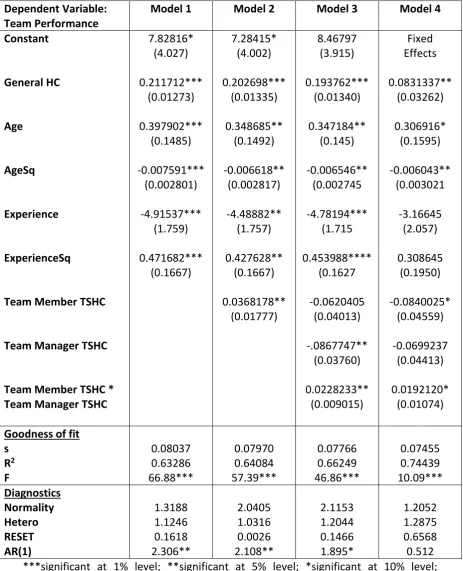
--OLS regression results are reported in Table 2 – models 1 to 3. Model 1 shows that all the
General HC variables are statistically significant at the 1% level and jointly explain 63.3% of
the variation in Team Performance. The quadratic effects for both Age and Experience are
statistically significant. Age is found to have an inverted U-shaped relationship with Team
Performance with the marginal effect of an increased average age in the team diminishing
may be less reflective of on-the-field sporting ability for older players. The Experience effect
exhibits a U-shaped relationship with Team Performance.
-- INSERT TABLE 2 ABOUT HERE --
Model 2 introduces Team Member TSHC, which has a significant positive impact on Team
Performance, supporting H1. In addition, and for the purpose of robustness, we modelled
Team Member TSHC in quadratic form to test for the potential that its performance benefits
would diminish with cumulative experience (Wright 1936; Dutton & Thomas 1984; Adler,
1990; Argote et al. 1990). We found no evidence that this was the case, the Team Member
TSHC quadratic term being highly insignificant.
In model 3 we include the moderating effect of Team Manager TSHC on the relationship
between Team Member TSHC and Team Performance. The inclusion of the cross product
term renders the effects of Team Member TSHC and Team Manager TSHC negative, and the
cross product term is positive and statistically significant at the 5% level, supporting H2.
Interestingly, the inclusion of the interaction term allows for the possibility of the negative
effects on Team Performance caused by manager/employee succession that reduces Team
Member TSHC and/or Team Manager TSHC to low levels. In all three estimated models the
AR(1) diagnostic test statistic is statistically significant indicating the presence of residual
autocorrelation.
Model 4, our preferred model, employs team-specific fixed effects to deal with the
related problems of residual autocorrelation and the potential effect of organizational
capital (which may consist of practices such as talent management programmes), which is
accomplished as the AR(1) diagnostic test statistic becomes statistically insignificant. The
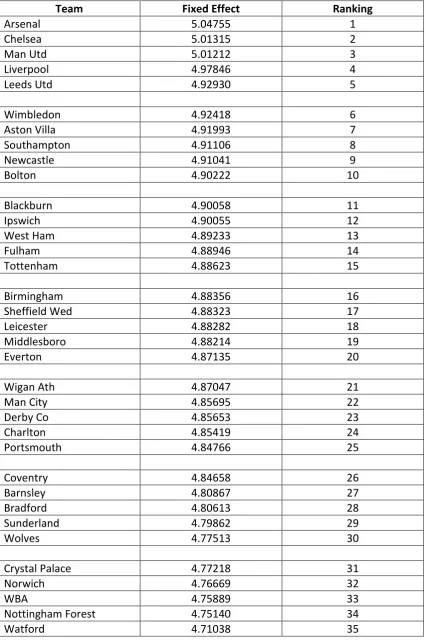
estimated fixed effects are reported in Table 3. In model 4, team member TSHC and
dominant. At mean values of Team Member TSHC and Team Manager TSHC the marginal
impacts are both positive. Team Member TSHC and Team Manager TSHC only have negative
impacts overall (including the cross product effect) when their values are low. Specifically
Team Member TSHC has a negative effect overall only when Team Manager TSHC is less than
79.2 (around two playing seasons); Team Manager TSHC only has a negative impact overall
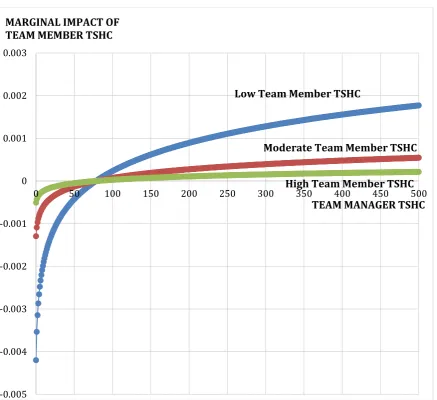
when Team Member TSHC is less than 38.1. For analytical clarity we graphically represent
the moderating relationship in Figure 1, showing the effect of Team Manager TSHC on the
overall marginal impact of Team Member TSHC (i.e. both the linear and cross-product
effects) at three different levels of Team Member TSHC: low (= 20), moderate (= 65), and
high (= 165). Figure 1 shows that the moderating effect of Team Manager TSHC is greatest at
low levels of Team Member TSHC. At high levels of Team Member TSHC there is little
variation on the marginal impact of Team Member TSHC from the moderating effect of Team
Manager TSHC.
-- INSERT TABLE 3 ABOUT HERE --
-- INSERT FIGURE 1 ABOUT HERE --
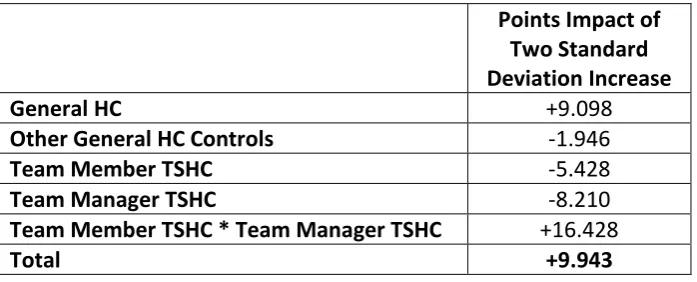
In Table 4 we report the impact on league points of a two standard deviation increase in
all of the general and team-specific HC variables as presented in model 4. The impact of a
two standard deviation increase in wage costs is 9.1 points, the equivalent of three
additional wins. The result slightly exaggerates the impact of General HC on (sporting)
performance given that, as discussed above, wage costs include remuneration for image
rights (i.e. non-sporting performance) and hence are likely to overstate the sporting
contribution of older, more experienced and better known players. After correcting for the
effects of age and experience the overall impact of the increase in general HC is 7.2 points
points (28.1%) to the total impact but this is a net contribution. The positive impact of the
cross product is 16.4 points, more than twice the impact of general HC.
-- INSERT TABLE 4 ABOUT HERE --
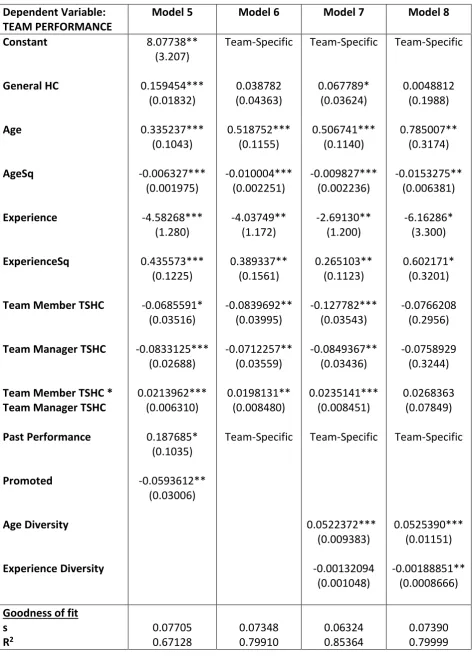
In Table 5 we report the results of the sensitivity analysis of our basic TSHC model of team
performance. In model 5 fixed effects are replaced by the two dynamic variables, which are
both statistically significant and also resolve the residual autocorrelation problem.
Importantly, there is very little impact on the estimated coefficients for the TSHC variables
when switching from a fixed-effects specification in model 4 to the dynamic specification in
model 5. In model 6 we allow for team-specific dynamics as well as team-specific fixed
effects. In this specification there is no need to separately allow for promotion effects, which
are now highly insignificant and fully captured by the team-specific dynamics. Again using a
dynamic specification resolves the residual autocorrelation problem and, crucially, has very
little impact on the magnitude of the TSHC effects. Model 7 extends model 6 by including
two additional diversity variables as controls. Age Diversity has a positive and significant
effect on Team Performance whereas Experience Diversity has a negative but insignificant
effect. Controlling for diversity effects leads to a greater absolute effect on Team
Performance from both General HC and TSHC compared to model 6 while reducing the
absolute linear and quadratic effects of average experience. In addition, the two diversity
variables jointly resolve the residual non-normality problem that arose in model 6 from the
use of team-specific dynamics. This specification provides some insight into the trade-off
faced when new team members are introduced whose General HC is towards the extremes
in the team particularly as regards age. New team members, either young players or
veterans, may compensate for the negative performance effects of lowering Team Member
-- INSERT TABLE 5 ABOUT HERE --
Model 8 reports the results from using IV estimation to control for the possible
endogeneity of the TSHC effects, with instruments constructed that include the remaining
data collected on teams but not otherwise used in the reported models (specifically player
career scoring rates and national team appearances, both levels and heterogeneity,
supplemented by playing-season binary variables). Two key results emerge from model 8.
First, the estimated effect of the control variable, general HC as measured by wage costs, is
substantially reduced by more than tenfold after allowing for endogeneity. Second, and
crucially, allowing for endogeneity using IV estimation leads to only small absolute effects on
all three TSHC variables. Although we recognise the limitations of our IV estimates due to
data constraints, they do nevertheless provide a clear indication that the direct effects of
TSHC on team performance remain largely unaffected after eliminating any bias in the OLS
estimates arising from dampening feedback effects. In contrast, the magnitude of the direct
effect of team expenditure on General HC is progressively reduced, ultimately being
rendered statistically insignificant in model 8 when allowing for dynamic interdependencies
and possible endogeneity effects. The finding suggests that there is a strong feedback from
team performance to wage expenditure via performance-sensitive revenues, such that
high-spending teams that perform well are able to generate high revenues to maintain their high
wage expenditures. However, this feedback process does not necessarily have the same
impact on TSHC since high wage budgets allow teams to have a choice between retaining the
General HC of their existing team or acquiring additional new General HC in the marketplace,
with very different implications for the team’s stock of TSHC.
In sum, the sensitivity analysis reported in Table 5 provides reassurance that the
the time dependency of performance; (ii) the possible impact of General HC heterogeneity
within teams; and (iii) the potential endogeneity of TSHC due to current team performance
impacting on future retention and recruitment decisions for both team members and
managers.
DISCUSSION AND CONCLUSION
In this paper we have developed and tested a model of two different dimensions of TSHC:
team member and team manager. Drawing on data from a professional team sport, our
findings indicate that Team manager TSHC positively moderates the relationship between
Team Member TSHC and Team Performance. We believe that our work has important
implications for scholars of the RBV and HC in terms of the potential sources of firm-specific
competitive advantage.
Our findings attest to the importance of managerial tenure in both shaping and deploying
the HC at their disposal. Employing the cross product we are able to demonstrate that the
performance advantages that that stem from Team Member TSHC are contingent on the
presence of Team Manager TSHC, which has important implications for managerial tenure.
Specifically, our findings highlight that low levels of managerial tenure, which are associated
with high managerial turnover, will have a negative effect on the relationship between Team
Member TSHC and Team Performance. Hence, there is a real and significant performance
implication to changing a manager, as reflected by the negative direct effects for Team
Member TSHC and Team Manager TSHC when the cross product term is included. The
negative effects arguably capture the impact of the disruption associated with changing a
manager and/or high team member turnover.
Our findings have important implications for our understanding of how resources are
relationship has occupied a central position in RBV research (Hoskisson, Hitt, Wan & Yiu,
1999). However, recent meta-analyses of empirical studies indicate that evidence for this
relationship is less than conclusive (Barney & Arikan, 2001; Crook, Ketchen, Combs & Todd,
2008; Newbert, 2007). We suggest that the equivocal nature of results may be due to
previous studies not identifying the key resources that drive performance, i.e. the variables
employed are analytically convenient but are not the most salient ones (Lockett et al., 2009).
Consistent with RBV scholars, who have focused on capability development, we contend
that managers play a key role in the process of capability development and deployment
(Augier & Teece, 2008, 2009; Sirmonet al., 2007; Teece, 2007). As such, managers should be
viewed as a key resource of the firm, and one that may enable the firm to develop
performance advantages.
In addition, our findings have important implications for the management of teams and
the development of HC that may lead to sustainable competitive advantage. In the
professional sports industries, as well as commerce in general, organizations compete for
the best talent. Where flexible labour markets exist, organizations will merely compete with
one another and drive up the wages for workers, particularly when workers’ skills are largely
non-firm specific. In Coff’s (1999) terms, the value created by workers through their general
HC is likely to be appropriated by workers through wage bargaining over time. TSHC, in
contrast, is more amenable to being appropriated by the firm, and may be viewed as an
important source of sustainable competitive advantage because workers find it difficult to
appropriate the returns to their TSHC (Coff, 1999; Mortensen, 1988a & 1988b; Rosen, 1988).
As highlighted in the results section, we find that the performance impact from a two
standard deviation shift in TSHC is greater, than that of General HC, where an organization
may be an important concept for scholars of the RBV, as it may hold the promise for
organizations to create sustainable performance differences, which they may appropriate to
enhance their financial performance.
From a practitioner perspective, our work suggests that managers need considerable time
before they can become effective in their new role; the positive effect of Team Manager
TSHC on the relationship between Team Member TSHC and Team Performance occurring, on
average, after two years of managerial tenure. Paradoxically, many EPL football
organizations are not prepared to wait that long, with the average tenure of managers
falling below 18 months in recent seasons (League Managers Association, 2010).
Furthermore, the benefits of managerial tenure may be more limited when they join a team
with high levels of Team Member TSHC, see Figure 1. We suggest that high levels of Team
Member TSHC developed under a previous manager may lead to team members being more
resistant to the adoption of new practices introduced by the new manager.
In addition to managerial tenure, our work raises important practitioner issues in relation
to the turnover of personnel in a team. Replacing some team members and/or the manager
may be one component of a strategy to improve performance in a failing work group, but it
is no guarantee of future success. Any gain through new recruitment in terms of the stock of
General HC within the work group will be, at least in part, offset by the reduction in the stock
of TSHC and the inevitably difficulties in assimilating new members into the work group.
Team turnover, therefore, should be viewed as a double-edged sword, particularly for high
performing teams.
In terms of future research, we feel that there is a need for more work to examine the
functioning of teams may influence the performance effects of the TSHC accumulated over
which will shape the context in which the team members interact with one another through
different forms of conflict (affective and cognitive), may affect the relationship between
TSHC and performance. Our results are indicative of a complex trade-off between General
HC and TSHC, particularly when considering replacing team members (which reduces Team
Member TSHC) and bringing in either young or veteran players who significantly increase the
overall heterogeneity of the team’s General HC, which can be performance-enhancing.
Second, in considering how teams function, we suggest that team sports offers an
interesting window into the use of HRM practices (such as talent management systems) and
how they may influence the accumulation and deployment of HC. Building on the work of
Wright et al. (1995), scholars may wish to examine how different configurations of HRM
practices may lead to the creation of team-specific HC, and its effects on performance.
Third, we feel that more work needs to be done to consider what may be an “optimal”
level of team turnover, and how this may be influenced by the dynamics of a competitive
environment. Given the highly fluid labour market (managers and players), and extreme
competitive nature of the EPL, we wonder whether or not sufficient team stability can be
REFERENCES
Addison, J.T. & Siebert, W.S. 1979. The Market for Labor: An Analytical Treatment, Goodyear Publishing, Santa Monica, Ca., 1979.
Adler, P.S. 1990. Shared learning. Management Science, 36(8): 938-957.
Alvarez, S. & Busenitz, L. 2001. The entrepreneurship of resource-based theory. Journal of Management, 27: 755-775.
Ambrosini, V. & Bowman, C. 2001. Tacit knowledge: Some suggestions for operationalization. Journal of Management Studies. 38(6): 811-829.
Ambrosini, V. & Bowman, C. 2010. The impact of causal ambiguity on competitive advantage and rent appropriation. British Journal of Management, 21(4), 939-953.
Amit, R. & Schoemaker, P.J.H. 1993. Strategic assets and organizational rent. Strategic Management Journal. 14(1): 33-46.
Argote, L., Beckman, S.L. & Epple, D. 1990. The persistence and transfer of learning in industrial settings. Management Science, 36(2): 140-154.
Augier, M. & Teece D.J. 2008. Strategy as evolution with design: The foundations of dynamic capabilities and the role of managers in the economic system. Organization Studies 29(8-9): 1187-1208
Augier, M. & Teece D.J. 2009. Dynamic capabilities and the role of managers in business strategy and economic performance. Organization Science 20(2): 410-421
Barney, J.B. 1991. Firm resources and sustained competitive advantage. Journal of Management, 17: 99-120.
Barney, J. & Arikan A.M. 2001. The resource-based view: Origins and implications. In MA Hitt, RE Freeman, JS Harrison (Eds.), Handbook of Strategic Management: 124-188. Blackwell: Oxford
Becker, G.S. 1962. Investment in human capital: A theoretical analysis. Journal of Political Economy. 70(5): 9-49.
Becker, G.S. 1975. Human Capital. New York: National Bureau of Economic Research. Becker, G.S. 1993. Nobel lecture: The economic way of looking at behaviour. Journal of
Political Economy. 101 (3): 385-409.
Berman, S L., Down, J. & Hill, C.W. 2002. Tacit knowledge as a source of competitive advantage in the National Basketball Association. Academy of Management Journal. 45(1): 13-31.
Boxall, P. 1996. The strategic HRM debate and the resource-based view of the firm. Human
Resource Management Journal. 6(3): 59–75.
Blair, M.M. 1999. Firm specific human capital and theories of the firm. In (Eds.) Blair, M.M. and Roe, M.J. Employees and Corporate Governance: 58-90. The Brookings Institution. Cappelli, P. & Singh, H. 1992. Integrating strategic human resources and strategic
management. In Lewin, D., Mitchell, O.S. & Sherer, P.D. (Eds.), Research frontiers in industrial relations and human resources (pp.165–192). Madison, WI: IRRA.
Castanias, R.P. & Helfat, C.E. 1991. Managerial resources and rents. Journal of Management, 17(1): 155-171.
Chillemi, O. & Gui, B. 1997. Team human capital and worker mobility. Journal of Labor Economics. 15(4): 567-585.
Collins, H. M. 1974. The TEA set: Tacitknowledgeand scientific networks. Science Studies, 4: 165-86.
Conn, D. 2005. The Beautiful Game? Searching for the Soul of Football. Yellow Jersey Press. Crabtree, S. J. 1997. Amazing Journey: Wimbledon Football Club 1982-1987.
Crook, T.R., Ketchen, D.J., Combs, J.G. & Todd, S. Y. 2008. Strategic resources and performance: A meta-analysis. Strategic Management Journal 29(11): 1141-1154
Daft, R.L. & Weick, K. E. 1984. Toward a model of organizations as interpretation systems. Academy of Management Review, 9: 284-295.
Dierickx, I. & Cool, K. 1989. Asset stock accumulation and the sustainability of competitive advantage. Management Science. 35(12): 1504-1511.
Edmondson, A.C., Bohmer, R.M. & Pisano, G.P. 2001. Disrupted routines: Team learning and new technology implementation in hospitals. Administrative Science Quarterly, 46(4): 685-716.
Flamholtz, E. & Lacey, J. 1981. Personnel Management: Human Capital Theory and Human Resource Accounting. Los Angeles: Institute of Industrial Relations, UCLA
Gelwick, R. 1977. The Way of Discovery. Oxford: Oxford University Press.
Gerrard, B. 2006. Analysing the win-wage relationship in pro sports leagues: Evidence from the FA Premier League, 1997/98 – 2001/02. In P. Rodriguez, S. Kesenne and J. Garcia (Eds), Sports economics after fifty years: Essays in honour of Simon Rottenberg. Oviedo, Spain: Universidad de Oviedo.
Gimeno, J., Folta, T. B., Cooper, A. C., and Woo, C. Y. 1997. Survival of the fittest? Entrepreneurial human capital and the persistence of underperforming firms, Administrative Science Quarterly, 42: 750-783.
Godfrey, P.C. & Hill, C.W.L. 1995. The problem of unobservables in strategic management research. Strategic Management Journal. 16: 519-533.
Grant, R.M. 1996. Toward a knowledge-based theory of the firm. Strategic Management Journal 17: 109–122.
Hatch, N.W. & Dyer, J.H. 2004. Human capital and learning as a source of sustainable competitive advantage. Strategic Management Journal. 25: 115-1178.
Hendry, D.F. 1980. Econometrics: alchemy or science? Economica, 47: 387-406.
Hitt, M.A., Bierman, L., Shimizu, K. & Kochhar, R. 2001. Direct and moderating effects of human capital on strategy and performance in professional service firms: A resource-based perspective. Academy of Management Review. 44(1):13-28.
Hoskisson, R.E. ,Hitt, M.A., Wan, W.P. & Yiu, D. 1999. Theory and research in strategic management: Swings of a pendulum. Journal of Management. 25(3): 417-456.
Huckman, R.S. & Pisano, G. P. 2006. The firm specificity of individual performance: Evidence from cardiac surgery. Management Science, 52(4): 473-488.
Huckman, R.S., Staats, B.R. & Upton, D.M. 2009. Team familiarity, role experience, and performance: Evidence from Indian software services. Management Science. 55(1): 85-100.
Hughes, M., Hughes, P., Mellahi, K. & Guermat, C. 2010. Short‐term versus Long‐term Impact of Managers: Evidence from the Football Industry. British Journal of Management, 21(2), 571-589.
Kahn, L. M. 2000. The sports business as a labor market laboratory. Journal of Economic Perspectives. 14(3): 75-94.
Kiedel, R. W. 1987. Team sports models as a generic organizational framework. Human Relations. 40: 591-612.
Klein, B., Crawford, R. G., & Alchian, A. A. 1978. Vertical integration, appropriable rents, and the competitive contracting process. Journal of law and economics, 297-326.
League Managers Association, 2010. LMA End of Season Statistics – May 2010. League Managers Association: Leamington Spa.
Lepak, D. P., & Snell, S. A. 2002. Examining the human resource architecture: The
relationships among human capital, employment, and human resource configurations.
Journal of Management, 28(4), 517-543.
Lewis, M. 2002. Moneyball: The Art of Winning an Unfair Game. Norton: New York.
Lippman, S & Rumelt R. 1982. Uncertain imitability: an analysis of interfirm differences in efficiency under competition. Bell Journal of Economics. 13: 418-438.
Lockett, A. & Thompson, S. 2001. The resource-based view and economics. Journal of Management. 27: 723-754.
Lockett, A., Thompson, S. & Morgenstern, U. 2009. The Development of the Resource Based View. of the firm: A Critical Appraisal. International Journal of Management Reviews. 11(1): 9-28.
Mahoney, J.T. 1995. The management of resources and the resource of management. Journal of Business Research, 33, 91–101.
Mahoney, J.T. & Panadian, J.1992. The resource-based view within the conversation of strategic management. Strategic Management Journal, 13: 363–380.
Mailath, G.J. & Postlewaite, A. 1993. Workers versus firms: Bargaining over a firm’s value. Review of Economic Studies. 57: 369-380.
McEvily, B., Perrone, V. & Zaheer, A 2003. Trust as an organizing principle. Organization Science, 14(1): 91-103.
Moreland, R. L., Argote, L. & Krishnan, R. 1998. Training people to work in groups. In Tindale, R.S. Heath, L., Edwards, J., Posavac, E.J., Bryant, F.B., Suarez-Balcazar, Y., Henderson-King, E. & Myers, J. (Eds), Theory and Research on Small Groups, Plenum, New York.
Mortensen, D. T. 1988a. Matching: Finding a partner for life or otherwise. American Journal of Sociology. 94: 215-240.
Mortensen, D.T. 1988b. Wages, separations and job tenure: On-the-job specific training or matching. Journal of Labor Economics. 6: 445-471.
Newbert, S.L. 2007. Empirical research on the resource-based view of the firm: An assessment and suggestions for future research. Strategic Management Journal 28(2): 121-146
Nonaka, I. 1994. A dynamic theory of organizational knowledge. Organization Science. 5(1): 14-37.
Penrose, E.T. 1959. The Theory of Growth of the Firm, Blackwell: Oxford.
Pfeffer, J. and Davis-Blake, A. 1986. Administrative success and organizational performance: How administrative experience mediates the succession effect. Academy of Management Journal. 29: 72-83.
Polyani, M. 1966. The Tacit Dimension. London: Routledge & Kegan Paul.
Prescott, E.C. & Visscher, M. 1980. Organization capital, Journal of Political Economy, 88: 446-461.
Ravetz. J. R. 1971. Scientific Knowledge and its Social Problems. Oxford: Clarendon Press. Reed, R. and DeFillippi, R. J. 1990. Causal ambiguity, barriers to imitation, and sustainable
Reagans, R., Argote, L. & Brooks, D. 2005. Individual experience and experience working together: Predicting learning rates from knowing who knows what and knowing how to work together. Management Science, 51(6): 869-881.
Rouse, M. J. & Daellenbach, U. S. 1999. Rethinking research methods for the resource-based perspective: Isolating sources of sustainable competitive advantage. Strategic
Management Journal. 20: 487-494.
Rosen, S. 1988. Transaction costs and internal labor markets. Journal of Law, Economics and Organization. 4: 49-64.
Rostron, P. 2004. Leeds United: Trials and Tribulations. Mainstream Publishing.
Rottenberg, S. 1956. The baseball players’ labor market. Journal of Political Economy. 64: 242-258.
Rumelt R. 1984. Towards a strategy theory of the firm. In R. Lamb (ed.) Competitive Strategic Management. Prentice Hall: Englewood Cliffs, NJ.
Schultz, T. W. 1961. Investment in human capital. American Economic Review, 51: 1-17. Schneider, B. 1987. The people make the place. Personnel Psychology, 40: 437–453.
Schneider, B., Goldstein, H.W. & Smith D.B. 1995. The ASA framework: An update. Personnel Psychology, 48: 747–773.
Sirmon, D.G., Hitt, M. A. & Ireland, R. D. 2007. Managing firm resources in dynamic environments to create value: Looking inside the black box. Academy of Management Review. 32(1): 273-292
Staw, B. & Hoang, H. 1995. Sunk costs in the NBA: Why draft order affects playing time and survival in professional basketball. Administrative Science Quarterly. 40: 474-494.
Szymanski, S. & Kuypers, T. 1999. Winners and Losers: The Business Strategy of Football. Viking.
Szymanski, S. & Smith, R. 1997. The English football industry: profit, performance and industrial structure. International Review of Applied Economics. 11: 135-153.
Teece, D.J., Pisano G., & Shuen A. 1997. Dynamic capabilities and strategic management. Strategic Management Journal, 18: 509–533.
Teece D.J. 2007. Explicating dynamic capabilities: The nature and microfoundations of (sustainable) enterprise performance. Strategic Management Journal 28(13): 1319-1350. Williamson, O.E. 1979. Transaction cost economics: The governance of contractual relations,
Journal of Law and Economics, 22: 233–261.
Wolfe, R., Wright, P.M. & Smart, D.L. 2006. Radical HRM innovation and competitive advantage: The Moneyball story. Human Resource Management Journal. 45(1): 111-145. Wright, T.P. 1936. Factors affecting the cost of airplanes. Journal of Aeronautical Science, 3:
122-128.
Wright, P.M., Dunford, B., & Snell, S. 2001. Human resources and the resource based view of the firm. Journal of Management. 27(6), 701–721.
Wright, P.M., Smart, D.L. & McMahan, G. C. 1995. Matches between human resources and strategy among NCAA basketball teams. Academy of Management Journal. 38:1052-1074. Youndt, M.A., Subramaniam, M. & Snell, S.A. 2004. Intellectual capital profiles: An
TABLE 1
Descriptive statistics and correlation matrix
Note: Descriptive statistics and correlation matrix calculated before log transformation applied to experience and TSHC variables.
Variable Max
Value
Min Value
Mean S.D. Coefficient of Variation
Correlation Coefficient
(1) (2) (3) (4) (5) (6)
Team Performance (1) 0.83 0.13 0.46 0.13 0.29 1.00
General HC(2) 2.83 0.29 1.00 0.48 0.48 0.78 1.00
Age (3) 30.87 22.67 26.97 1.24 0.05 -0.15 -0.23 1.00
TABLE 2
OLS regression analysis of Team member TSHC, Team Manager TSHC and Team Performance
Dependent Variable: Team Performance
Model 1 Model 2 Model 3 Model 4
Constant General HC Age AgeSq Experience ExperienceSq
Team Member TSHC
Team Manager TSHC
Team Member TSHC * Team Manager TSHC
7.82816* (4.027) 0.211712*** (0.01273) 0.397902*** (0.1485) -0.007591*** (0.002801) -4.91537*** (1.759) 0.471682*** (0.1667) 7.28415* (4.002) 0.202698*** (0.01335) 0.348685** (0.1492) -0.006618** (0.002817) -4.48882** (1.757) 0.427628** (0.1667) 0.0368178** (0.01777) 8.46797 (3.915) 0.193762*** (0.01340) 0.347184** (0.145) -0.006546** (0.002745 -4.78194*** (1.715 0.453988**** (0.1627 -0.0620405 (0.04013) -.0867747** (0.03760) 0.0228233** (0.009015) Fixed Effects 0.0831337** (0.03262) 0.306916* (0.1595) -0.006043** (0.003021 -3.16645 (2.057) 0.308645 (0.1950) -0.0840025* (0.04559) -0.0699237 (0.04413) 0.0192120* (0.01074)
TABLE 3
Estimated Fixed Effects (Model 4)
Team Fixed Effect Ranking
Arsenal 5.04755 1
Chelsea 5.01315 2
Man Utd 5.01212 3
Liverpool 4.97846 4
Leeds Utd 4.92930 5
Wimbledon 4.92418 6
Aston Villa 4.91993 7
Southampton 4.91106 8
Newcastle 4.91041 9
Bolton 4.90222 10
Blackburn 4.90058 11
Ipswich 4.90055 12
West Ham 4.89233 13
Fulham 4.88946 14
Tottenham 4.88623 15
Birmingham 4.88356 16
Sheffield Wed 4.88323 17
Leicester 4.88282 18
Middlesboro 4.88214 19
Everton 4.87135 20
Wigan Ath 4.87047 21
Man City 4.85695 22
Derby Co 4.85653 23
Charlton 4.85419 24
Portsmouth 4.84766 25
Coventry 4.84658 26
Barnsley 4.80867 27
Bradford 4.80613 28
Sunderland 4.79862 29
Wolves 4.77513 30
Crystal Palace 4.77218 31
Norwich 4.76669 32
WBA 4.75889 33
Nottingham Forest 4.75140 34
FIGURE 1
The moderating effect of Manager TSHC on the relationship between Team Member TSHC and team performance
-0.005 -0.004 -0.003 -0.002 -0.001 0 0.001 0.002 0.003
0 50 100 150 200 250 300 350 400 450 500
MARGINAL IMPACT OF TEAM MEMBER TSHC
TEAM MANAGER TSHC Low Team Member TSHC
TABLE 4
Estimated Points Impact of a Two Standard Deviation in the Determinants of Team Performance
Points Impact of Two Standard Deviation Increase
General HC +9.098
Other General HC Controls -1.946
Team Member TSHC -5.428
Team Manager TSHC -8.210
Team Member TSHC * Team Manager TSHC +16.428