£11~6
V) 3S0r NVS
L9Z1N*
OONVN~3~NVS
~ 13~~VW~010
!
J J r : W 7 1
~
·o.
1.1. £,07 T')~
SlV)
100
Hl3d
VV
CD
Time Sharing in Action
October, 1967
-because The Kelly-Springfield Tire Company gets the right tire to the right place at the right time, with a modern communications and datE processing system, that's why not And they sell over 2600 differen· sizes and types of tires in the U.S. Canada and 66 other countries.
Here's how the system works:
a
each warehouse Bell System Tele typeCR' machines use master tape!
to enter standard information or customers and their purchases while the variable sale informatior is typed in manually. The machine! make printed orders and by-produc
r
• 65
)m each of the 26 warehouses lared for factory production
ling.
resu It: I nformation flow is more accurate. Customers best possible service, every-in the Kelly-Sprevery-ingfield mar-world.
nore information, call your lephone Business Office and a talk with one of our Com-Itions Consultants. And don't e to call us early-because 'y we can serve you best.
1 you work with data commu-lS, work with the Bell System.
t
t
..
SAN
PUBLIC
J09~
LISRAllv
ONE
S'GM~
ClJf\t\PUTeR
lS
<90'
Ne
To
HANOL-.E
A~L..
THE TEl--1:Me-rRY
fRoM
POS6\lX'N
f~'6HTS.
Poseidon will be one of the most advanced strategic
mis-siles in our inventory. Lockheed is developing it.
Telemetry from Poseidon test flights will be recorded
by three stations along the range at up to a 100-kc word
rate (1 million bits per second). The tapes will then be
processed in real time by a Sigma 7 computer system
located at Sunnyvale, California.
In the foreground the Sigma 7 computer will have
adaptive control of the telemetry front end. In the
back-ground it will perform mathematical analyses and
com-parisons of the refined data.
The front end will decommutate the incoming streams,
minimize the noise, edit and compress the data, merge the
three tapes into one optimized record, and sort the
infor-mation into measurement strings with time correlation.
Concurrently, Lockheed engineers will be able to type
questions into the computer and obtain immediate
answers. They will have their test results 10 to 25 times
faster than they could get them from a conventional
telemetry system.
Sigma is the only system that can do decommutation,
data compression and merging all at once in real time.
Other systems can barely perform one of these functions
at a 100-kc word rate.
Sigma can do it because of the high-performance
tele-metry front end, the computer's enormous throughput
rate, and the specialized telemetry software.
Like all Sigma telemetry systems, this one is composed
of standard modules. Even the software is modular. Thus,
although the system is custom-tailored for Poseidon, there
are no subsystem interface problems, and virtually no
special programming will be required.
All the operating software is provided, so that the
telemetry engineers can operate the system, using
FOR-TRAN statements and the SDS Telemetry Compiler.
We are currently putting together five Sigma 7
telem-etry systems for major missile and space programs, and
each one is custom-engineered through the use of
stand-ard hstand-ardware and software modules.
We developed the modular con-
5 C 5
cept from experience in producing
more than 500 special-purpose data
systems. All we needed to make it
work was a computer that could
manage the whole job.
Scientific Data Systems,Sigma makes it possible.
Santa Monica, CaliforniaThe new, small DECdisk provides 32K words extra memory for the PDp·8 for $6,000. Additional 32K DECdisk units cost $3,000 each. Since a basic $18,000 PDP·8 computer has 4096 words in core, with four DECdisk units, that could give you a high speed computer with 135,16812 bit words for $33,0001
DECdisk is compatible with the $10,000 PDP·8/S, too. Adding four DECdisk units gives you a slightly slower computer with 135,16812 bit words.
More memory for less cost than any other computer.
At last count, more than 700 PDP·8 computers have been sold to scientists and equipment manufacturers. The PDp·8 is, by far, the most successful and proven on·line, real time,
small computer in the world. And that was before DECdisk.
DECdisk was developed, like all DIGITAL peripheralsl to
customize a basically inexpensive computer to special appli· cations. Yours. DECtape was developed the same way. The unique 3
X"
reels of magnetic tape not only provide low cost storage, but permit you to carry your program library in your pocket. And displays - did you know that DIGITAL was the first computer manufacturer to put a CRT on a computer?Computer manufacturers who worry about what the cus· tomer needs, worry a great deal about peripherals. DIGITAL has one of the largest lines of peripherals in the industry. Write, and we'll send you a free "Small Computer Handbook" and tell you all about our peripherals.
New, low cost, small computer disk.
Thanks for the memory, PDP·S.
DIGITAL EQUIPMENT CORPORATION, Maynard, Massachusetts 01754. Telephone: (617) 897·8821 • Cambridge, Mass .• New Haven. Washington, D.C .• Parsippany, N.J .• Rocnester, N.Y .• Philadelphia. Huntsville. Pittsburgh. Chicago. Denver. Ann Arbor. Houston. Los Angeles. Palo Alto. Seattle. Carleton Place and Tororto,
Oil]. • Reading, England • Paris, France • Munich and Cologne, Germany • Sydney and West Perth, Australia • Modules distributed also through Allied Radio
OCTOBER, 1967 Vol. 16, No. 10
52 Across the Editor's Desk
Computing and Data Process-ing Newsletter
70 AdtJertiJing Index
66 Books and Other Publications 68 Calendar of Coming Events 68 C&A Problem Corner
by Walter Penney, COP
64 Computer Census 62 New Contracts
63 New Installations 69 New Patents
by Raymond R. Skolnick
Editor and Publisher
Edmund C. Berkeley
Assistant Editors
Moses M. Berlin, Charlene J. Hofer, Linda Ladd Lovett, Neil D. MacDonald
Contributing Editors
John Bennett, Andrew D. Booth, Dick H. Brandon, John W. Carr, III, Ned Chapin, Alston S. Householder, Peter Kugel, Rod E. Packer
Advisory Committee
T. E. Cheatham, Jr., James J. Cryan, Richard W. Hamming, Alston S. Householder, Victor 'Paschkis
Art Director
Ray W. Hass
Fulfilment Manager
William J. McMillan, 815 Washington St., Newtonville, Mass. 02160, 617 DE 2-5453
Advertising Representative f
NEW YORK 10018, Bernard
Lane-37 West 39 St., 212-279-7281
CHICAGO 60611, Cole, Mason, and Deming
737 N. Michigan Ave., 312-787-6558
LOS ANGELES 90005, Wentworth F. Green
300 S. Kenmore Ave., 213-387-8135
SAN FRANCISCO 94123, Richard C. Alcorn
2152 Union St., 415-897-1620
ELSEWHERE, The Publisher
815 Washington St., 617-332-5453
Newtonville, Mass. 02160
Special Feature:
The front cover shows three "time sharers" using what is believed to be the first, fully general-purpose, time-sharing system designed, developed and implemented by an industrial company for its own use. For more information, see page 70.
Titne-Shared CUlltputer Systems
16 AN EVOLVING SPECIAl·PUkPOSE TIME-SHARING SYSTEM, by Paul A. Castleman
A discussion of the problems of de)igning, constructing, and operating an evolving, special. purpose, time-sharillg ~ysh:m . . . and a description of one system for which the evolutionary period Was not a brief initial phase, but a process which took place over a period of several years.
20 THE ROCHESTER DIRECT-ACCESS TIME-SHARED SYSTEM, by Kurt Enslein, Anthony G. Lauck, Robert M<;tclntyre, and Robert E. Hopkins
The evolution and present status of a direct access terminal in Rochester, New York, linked to a Control Data Corporation computer in Cambridge, Mass . . . . including users' needs, pre-vious solutions, and a description of facilities now being used.
23 COMPUTER TIME SHARING: ITS ORIGINS AND DEVELOPMENT, by T. James Glauthier Where the general purpose time-sharing systems came from and who developed them and an outline of the general-purpose systems that are operating today.
30 PROGRAMMING SELF-TAUGHT, by Hal B. Becker
An exploration of a self-teaching system for programming . . . demonstrated in a series of lessons in the fundamentals of programming in BASIC.
38 COMPUTER TIME SHARING - A REVIEW, by Nicole Pointel and Daniel Cohen
A review of the essential and complementary features of a time sharing system . . . and how these featu~es improve man-machine relations by permitting undelayed conversation between man and machine.
48 THE MANY NEW USES OF TIME SHARING, by Thomas J. O'Rourke
How the president of a time-shoring facility with over a thousand subscribers evaluates: the impact of time shat ing; the question of time shoring vs. direct access; and the economics of time sharing.
7
Editorial,
by Edmund C. Berkeley In the Beginning - and in the Future47
lVorld Report -
Grt:at Britain,
by Ted Sc.hoetersGE launches time sharing in UK; IBM foresees gold mine in communications; the first CDC 6600 is placed in Britain.
Multi-Access Forum
10 The Computing Sciences Are the Tools Which Bring Organization and Understanding to Exploding Knowledge, by Senator Howard H. Baker, Jr.
A look at the relationship between scientists and politicians, with emphasis on eliminating the information gap which presently exists between these two professions.
11 The Intellectual Implications of Technological Change, by Dr. Emmanuel G. Mesthene
12 Human Protests and Objections to the Computer, and the Philosophical Sources of Them, by Peter Warburton
13 Powerful Ideas: Responsibility for Truthful Input, by Neil Macdonald 13 Tiny Flaws in Medical Design Can Kill
14 Applications for 1968 Examina!ion for DPMA'S Certificate in Data Processing Due Nov. 1, 1967 14 ACM to Hold Professional Development Seminars on Computer Graphics
14 Indexing of Data Processing Literature: An International Effort 15 Index of Government-Sponsored Computer Projects is Completed 15 Annual Computer Art Issue - Comments
15 The Paid Circulation Policy of "Computers and Automation" 67 GE Time Sharing Services - Correction
67 Artist in Computer Art - Correction
:~c-"'o COMPUTERS AND AUTOMATION IS PUBLISHED MONTHLY AT 815 WASHINGTON ST" NEWTONVILLE, MASS. 02160, BY BERKELEY ENTERPRISES, INC. PRINTED IN U.S.A. SUBSCRIPTION RATES: UNITED
:~. STATES, $15.00 FOR 1 YEAR, $29.00 FOR 2 YEARS, INCLUDING THE JUNE DIRECTORY ISSUE; CANADA, ADD SOc A YEAR FOR POSTAGE; FOREIGN, ADD $3.50 A YEAR FOR POSTAGE. ADDRESS ALL
"" .,.0 EDITORIAL AND SUBSCRIPTION MAIL TO BERKELEY ENTERPRISES, INC., 815 WASHINGTON ST., NEWTONVILLE, MASS., 02160. SECOND CLASS POSTAGE PAID AT BOSTON, MASS.
POSTMASTER: PLEASE SEND ALL FORMS 3579 TO BERKELEY ENTERPRISES, INC., 815 WASHINGTON ST., NEWTONVILLE, MASS. 02160. © COPYRIGHT, 1967, BY BERKELEY ENTERPRISES, INC. CHANGE OF ADDRESS: IF YOUR ADDRESS CHANGES, PLEASE SEND US BOTH YOUR NEW ADDRESS AND YOUR OLD ADDRESS (AS IT APPEARS ON THE MAGAZINE ADDRESS IMPRINT). AND ALLOW THREE WEEKS
FOR THE CHANGE TO BE MADE.
C&A
EDITORIAL
In The Beginning - and in the Future
In Washington in August, the Association for Computing Machinery held its 20th anniversary meeting.
The ACM began in the summer of 1947. A temporary organizing committee called the first meeting that September at Columbia University, New York; 75 people were present, and T. Kite Sharpless, then of the Moore School of Elec-trical Engineering, read a paper on "The Pilot Model of EDVAC" (Electronic Discrete Variable Computer). At that meeting, as temporary secretary of the organization, I signed up 58 people who desired to become members of what was then called the "Eastern Association for Comput-ing Machinery." And I continued as secretary of the Asso-ciation for Computing Machinery until 1953.
Kite Sharpless was not at the August 1967 ACM meeting. He died a few weeks before.
The 20th anniversary was celebrated in a long afternoon meeting on Wednesday, August 30, devoted to the theme "In the Beginning." Some two thousand people were present in the audience; and some twenty "computer pioneers" spoke of the early developments they had participated in or witnessed.
Sam Alexander of the Bureau of Standards was released from the hospital for the afternoon, and was presented with the Harry H. Goode Memorial medal. Thin and pale, he gave a moving report of the "fear-induced inspiration" and hard work connected with making the first Bureau of Stan-dards computer, SEAC, saying it "stood on the shoulders" of many, many contributors, and "had more intellectual parents than any other device."
Herman Goldstine, then of the Ballistic Research Labo-ratories at Aberdeen, told a number of stories about the dis-tinguished mathematician Dr. John Von Neumann, who initiated several early computers, and who died some years ago. Goldstine spoke of the great interest in computers among mathematicians and scientists studying the atomic nucleus, who were:
"interested in solving by calculation what they could not solve by experimentation."
Grace Hopper of Remington-Rand Univac and the U. S. Navy, made some friendly and touching remarks about the early days of computing and programming, and the im-portance of teaching, and the entire audience gave her a standing ovation.
Maurice Wilkes, of the Mathematical Laboratory at Cambridge University, England, talked of the computer EDSAC built there, and laid claim to an "unanticipated dis-covery," which he made in 1949:
"I discovered debugging."
Not all the remarks dealt with the past. One was: "The ACM now has twenty thousand members. The time will come when it will have two hundred thou-sand members."
The reporter Lincoln Steffens' famous remark, made in the 1920's in another connection, was quoted as applying to computers:
COMPUTERS and AUTOMATION for October, 1967
"We have seen the future and it works."
For a while the flavor of the old days in computing was recaptured, the days when we first tread on the new and fascinating territory of the computer field. The ACM, with help from Ampex and other organizations, recorded the whole session, in video and sound. Some of the flavor of those days will in this way hopefully spread to those who come after.
What was this flavor? There were several strong factors. In the first place, there were only a few hundred people in the computer field, and almost everybody knew, and could talk to, almost everybody else. This tradition is partly pre-served in the annual cocktail party and reception of the ACM - but in the old days at every meeting you spoke to everybody and assumed you knew him even if you didn't, and you compared ideas quickly and found congeniality quickly.
Second, the field was so much smaller that you could un-derstand and even be interested in a great many of the papers and reports. Now the field is so sophisticated, and so much of the language is so specialized, that many of the papers are hard to understand, and have a narrow audience: Third, almost the only computer makers were staffs of scientists - either at universities or in small groups who had just left universities and were trying to start making computers on their own. The big manufacturers of office and business machines had almost no idea of and no in-terest in the "computer revolution," but were content with punch card machines, desk calculators,· and cash registers. There was not even a glimmering of the present vast commer-cialism. Instead, the emphasis everywhere wall on discovery, on doing things for the first time.
Can we get back any of this flavor in the future? I think so.
One possibility I see would be to make a new social invention whereby relative strangers could communicate well in the first two minutes. For example, a punch card with holes showing your interests, activities, and background -which you could overlap with the similar punch card of a new acquaintance - could be a big stride forward. Another possibility is a sensible and vigorous attack on the problem of making papers explanatory, understandable, and inter-esting to a wider audience. Still another possibility is a practice which the English already use - limited attendance, so that only some persons can go to certain meetings -although this would certainly go against the grain of many Americans.
Certainly we should start preparing now for the time when the ACM will have 50,000 members.
Editor
Guns, courtesy of Abercrombie & F.itch. For quality reproductions of this photograph, WrIte us at Memorex.
LIKE THE TWO GREAT SHOTGUNS, ARE NOT IDENTICAL.
When you buy a Purdey or a Holland, you buy the finest in guns. They cost about forty-five hundred dollars each. They last for generations.
When you buy the two great tapes-ours or the one the computer company makes - you buy the most durable, most reliable computer tape around. Naturally, they cost more. It's not surprising, therefore, that they make pass after pass after pass without a drop-out.
The two great guns are pretty much alike in total performance. But although each is exquisitely crafted
to perform unerringly, they are not identical. You'd have to use them both to know exactly what each can do.
lt's the same with the two great tapes: they aren't exactly alike, either. In fact, some tape-users insist that our great tape out-performs the other.
Could be.
C&A
MULTI-ACCESS FORUM
THE COMPUTING SCIENCES ARE THE TOOLS WHICH BRING
ORGANIZATION AND UNDERSTANDING TO EXPLODING KNOWLEDGE
Senato.r Howard H. Baker, Jr.
U.S. Senate
Washington, D.C.
(Based on an Address to the Members of the
Associa-tion for Computing Machinery, meeting at Washington,
D.C., August 30, 1967)
Your field of interest is as broad as the entire scope of the activities and the environm~nt of mankind. The com-puting sciences provide the tools and techniques which per-mit us to bring coherence and organization to the exploding body of knowledge, which will directly affect every life and all our governmental institutions now and in the future.
In the social sciences, as distinguished from the physical sciences, your industry, talents, and imagination will permit us for the first time to engage in systematic and profound scientific inquiries. For the first time theoretical science, applied science, engineering, economics, and government are discernibly interacting.
It is imperative that we begin now to plan for the great technological revolution which is almost upon us. We must make the necessary adjustments and preparations to assure that this revolution works for our benefit, that it makes us freer, and that it does not destroy the basic values upon which our nation was founded.
You are well aware of the fears expressed of the "big brotherism" aspects of the computerized society. And you've heard the humorously told accounts of people fighting frus-trating battles against an immutable computer which insists on sending a bill which for some reason or other is erroneous. These stories and jokes are funny today. But tomorrow when our society becomes completely dependent on, com-puterization, they could become nightmares, unless we plan for the new age computers are bringing us.
To attack the problems of revolutionary technology we need a coherent and coordinated approach to the socio-technological and political implications.
Some of us are not scientists or technicians, but politicians, whose roots are in experience of people, their idiosyncrasies, their prejudices and vagaries. The future lying ahead con-sists of automated machines, the cybernetic revolution, manip-lated genetic structures, self-contained cities recycling their own wastes, giant supersonic airplanes with thousands of passengers, nuclear devices that will produce costless energy. This kind of future gives substantial concern to us on Capitol Hill.
We lack in the Senate, in Congress, in the Executive Branch, and among our State and local governments, a
mechanism for inquiring into and reporting on the broad impact of science and technology - on man's thinking, his health, work, living habits,and individual security over the next fifty years.
There is a tremendous information gap between the poli-tician and scientist.
We really don't know where we are heading - where the benefits of technology can be best applied, and what hazards and problems may flow from any technological application.
In an attempt to meet this information gap, Senator Muskie has proposed legislation which would establish in the U.S. Senate, the Select Committee on Technology and Hu-man Environment, composed of members from each of the standing committees most involved with legislation affecting human needs. This committee would provide an excellent forum where scientists and legislators could face each other and discuss the critical environmental problems ahead, and what science and technology can do to solve them. It would provide a central source of information and analysis, cutting across the technological spectrum, which the standing com-mittees and members of the Senate would use in developing their legislative policies.
This Select Committee would have no jurisdiction over legislation or powers of legislative oversight; but its reports and recommendations could well become a cornerstone for the development of national goals and planning involving science and technology.
In the military and defense sectors, and in our efforts to put a man on the moon, we are well along with our scientific and technological planning and programming, our systems management, our cybernetic progress. It is true there have been problems in these sectors, but extraordinary minds and machines have worked to solve them.
and scientific effort that IS going forward so energetically
in the space and defense fields?
And supposing we do bring in to consultation the scien-tists and the technologists, and their 21st Century equipment and ideas, do we have the type of governmental structure and administrative processes to implement effectively the re-building process? How much of our concepts of free enter-prise, of individual freedom and initiative, and of democratic decision-making will have to be forfeited or modified in order to build a new American society along scientific lines? These are hard questions requiring some hard decisions and hard answers. But the internal conditions of many areas, urban and rural, in this country are becoming so serious that we are being forced to make decisions.
Could it be that we as legislators representing a hundred and ninety miIlion people are locked into a technological system which in the long run we are powerless to control? Atomic power and computerization will be at the head of the operations of a city of the future. The computer complex would be the city's largest decision-making body. What kind of a government would such a city have? What kind of political decisions would be needed? What kind of competition would there be? How much private owner-ship? How much individual freedom would 'a person have?
Never before in our Nation's history has it been quite so critical that we shorten the ten to twenty year gap between basic research discoveries and their practical applications. Never before has it been quite so critical that Congress legislate intelligently so that taxpayers, impatient to achieve
effective solutions to a myriad of social problems, get their money's worth from each dollar spent.
In summing up, the first proposition that I want to leave in your minds is this: that all of us - you in the computer field, we in the Congress - have got to do a great deal more thinking about where science and technology is lead-ing us. We have to think about what kind of mechanism we can devise for coordinating information about what is happening, and what benefits and hazards are developing as a result of the technological revolution.
Second, the time is long overdue for the development of national goals and planning with respect to the relationship between our scientific and technological achievements and the improvement of our human environment. We can no longer rely on Federal grants in aid and State and local administrators to solve the problems of our cities. Science and industry have got to be brought into the discussion.
Third, we have to think very seriously about the kind of creative Federal system of government that will best serve our needs in the 21st Century, that will preserve to the greatest extent possible individual freedom, and the demo-cratic process of decision-making.
And finally, we must develop a national purpose, to which everyone will become dedicated - to rebuild,' re-furbish, rejuvenate this nation at every level of human ac-tivity, and in this way reduce the widening gap between affluence and despair that is threatening the strength of this nation.
THE INTELLECTUAL IMPLICATIONS OF TECHNOLOGICAL CHANGE
Dr. Emmanuel G. Mesthene Harvard University
Cambridge, Mass. 02138
(A Summary of an Address at the Meeting of the
As·
sociation for Computing Machinery, Washington, D.C.
August, 1967; limited according to permission to IIless
than 400 words")
The intellectual effects of technological change may well be crucial to understanding all the other effects - military, economic, social, political, etc.
It is through enhancing the status and importance of knowledge in general, that science and technology may affect society most significantly.
Technology denotes not only physical tools and machines but also intellectual tools - from language, ideas, and sci-ence, all the way to computer programs, systems analysis, and program planning and budgeting systems.
So the relation of technology to society must be redefined as the relation of knowledge to society.
Why?
Because contemporary society is marked by change more fundamentally than any previous society. Change comes from: economic pressures for greater efficiency; weapons technology; the "Everest complex" - which spurs action because new technology makes something newly possible; the "Apollo syndrome" - where powerful interests engaged in new technology successfully urge its adoption and use.
New technology: generates change; presses innovation for-ward; induces changes in human values; calls forth new forms of social organization; causes new objectives to be discerned. So the world that we know becomes one in which change is all-pervasive in which our lives, concepts, ideas, the ways we think, all change.
COMPUTERS and AUTOMATION for October, 1967
Change in society is no longer a temporary perturbation of a steady state, or a short transition to a new stable state. Change is continual and increasingly rapid.
A society full of change: requires more knowledge of the social sciences; poses new questions; probes at technological and intellectual frontiers; searches out new implications of science and technology; explores the intersections of dis-ciplines.
In these unusually difficult and important enterprises the computer will be a most helpful intellectual tool.
We are led to renewed commitments to the beliefs: • There is nothing in nature or existence that is
in-herently unknowable.
• Rationality is the most important instrument for so-cial control.
We are abandoning the traditional American suspicion of planning.
The experimental domain of science increasingly requires the whole world as a laboratory; and science must change its traditional ground-rules for experiment to prevent permanent damage to the world it explores.
Social responsibility. consists of more than good will or an annual panel discussion - it requires a deep understanding of the social meaning of technical activity.
HUMAN PROTESTS AND OBJECTIONS TO THE COMPUTER,
AND THE PHILOSOPHICAL SOURCES OF THEM
Peter Warburton
Chevy Chase, Md. 20015
There are, it seems to me; two quite different kinds of objections to computers by human beings.
First, some people see computers as another tool created by man that leads to human detriment because we are not able (either we lack the intelligence, or more often, the social and political "will" or control) to establish an adequate social context. Thus, computers could result, primarily be-cause of anarchy resulting from a lack of system control and each computer user going off in his own direction, in a mess analogous to our congested automobile traffic. All of us frequently get into traffic jams; and all that our highway engineers can nowadays suggest is that we tear down people's houses to build more freeways and parking lots.
This sort of objection to computers, it seems to me, comes from the point of view that sees no particular good or evil inherent in technology, but at the same time realizes that :>ften we handle technology piece-meal, without imple-menting a system for good use. The result is better than before we had the tool (nobody in his right mind proposes that we go back to horse and buggy or bicycles - people who feel that way move out of the United States), but by no means without inconvenience, and things are nowhere nearly as good as they could be. But the social system for tool-use is man-made, and presumably can be remade by men, if they care enough.
The second kind of objection is, I believe, quite different. Critics· stating this kind of objection do not see computers as. a system problem, but as a moral problem. Somehow computers are a threat to human dignity, and we ought to go back to farming before man is thoroughly corrupted. Or computers are not just another machine, but part of a technology which is taking over with a life of its own, and this technology is oblivious to human values and will crush us all.
I propose that these two kinds of objections stem from two, rather incompatible, points of view which are part of our cultural heritage, but which we rarely if ever are aware of.
One point of view is that of traditional Christianity, that man is a two-part combination of a body (nature) and a soul (god-like). This point of view has been threatened by Copernicus, Darwin, and Freud, and the viewpoint of science and technology which sees man as a one-part animal that has evolved body, mind, and culture out of lower forms of life. Most thinkers nowadays accept Copernicus and Darwin, accept that man's body evolved, but not everyone accepts the view that man's mind and culture evolved. This point is made by Robert Ardry in The Territorial Imperative: that while cultural anthropologists have ac-cepted man's body evolution, they have not acac-cepted his cultural evolution from animals. I personally did not realize how strongly pervasive this attitude was until I talked with people about Ardry's book and read the reviews of it. Then I came to realize that Ardry is striking a very sensitive point. Apparently, many people feel that if there is nothing unique about man, nothing that has not evolved from animals, then man has neither dignity nor meaning for his life.
It is apparent therefore why people holding this view feel very distrustful of computers. To these people it is not just a technological impossibility for machines to think, it is a logical impossibility, because ~hatever a machine is, it is not like a human soul and therefore cannot possibly think. From the two-part point of view, machines are bodies, not
12
souls; but from the one-part point of view, machines, like man, are a product of nature, and there is no fundamental logical reason why a machine cannot think. Men think, so why can't a machine?
I do not claim that this distinction is obvious. I think it is anything but obvious. It has taken many years for me to trace it down and uncover it. Let me give some examples. John Wilkerson of the Center for Study of Democratic Institutions, Santa Barbara, Calif., has popularized and ex-tended Jacques Ellul's attack on technology. Wilkerson thinks it is impossible for computers to have values, except as a programmer puts his values into the criteria by which a program decides in one way rather than another. Why does Wilkerson feel this way? After all, if man is a data processing machine and if man has values, in what way is a machine logically different? I think the answer is that Wilkerson sees man as a two-part combination of body (chemical and data processing) and of soul (values), and a machine as a one-part body. But the machines have great energy and power, over man and other things, and since the machine has no values innately, it will be a force for man's detriment. In fact, Ellul sees technology as possessing a Hegelian "will" and "rationality" all its own.
An intellectual does not have to be a Christian to hold the two-part view. Jean Paul Sartre, who is an atheist, does not believe machines can think. For the same reason he does not accept the theory of evolution as anything more than an interesting speculation. Sartre is concerned with man's consciousness, which he believes is quite non-body. He does not know where it came from, but he is quite certain consciousness is so different from body that it could not possibly have evolved from material beings. Sartre's belief is, of course, grounded in systems of thought he acquired from Descartes, Hegel, and Husser!'
What has all this to do with the original problem? Just this: If you start with the two-part view of man, then any indication that machines have human-like qualities is a threat to your sense of man's dignity, - just as Copernicus's moving man out of the center of the universe was a threat to man's concept of himself as something special in the universe, just as Darwin's theory of evolution was a threat to man's concept of himself as something special, just as Freud's theory of man's irrationality was a threat to those who saw man as a special rational something in the uni-verse, just as Ardry's theory that man's culture evolves from animal behavior is a threat to man's uniqueness. And so computers are a threat to the concept of "man which gives man a special place in the universe.
But none of these concepts is a threat to the holder of the view that man is a one-part animal product of evolution. Rather, all these theories are welcome as evidence that man is part and parcel of nature, and there is nothing non-natural
Still, the idea that man's mind and consciousness is not a part of Nature, but a part of Nature's creator is a very old idea. It was even an old idea in Plato's time. It is an idea that is not going to die easily, even in 20th Century
America, the technological society. And it will always create tension in the "conceptual framework" of a person who holds it and who also is told that machmes can be mind-like and that man and machine are both products of nature.
POWERFUL IDEAS: RESPONSIBILITY FOR TRUTHFUL INPUT
Neil Macdonald
Associate Publisher
Computers and Automation
A basic function of Multi-Access Forum in this magazine is
to stir up ideas, to broaden the horizons of computer people with powerful ideas, to help them see all the panorama of ideas in the computer and information sciences.
This raises some interesting questions. Among them are: • What is an idea?
• How do you measure the power of an idea? • Where do good ideas come from?
• What are the ten (or hundred, or thousand) most important ideas in the computer field?
We can't of course answer all these questions here and now; but in Multi-Access Forum we hope to cover such questions as these from time to time.
An example of a really important idea in the computer field was the idea of the stored program, which the com-puter itself could modify by its computations. This idea was not present in the Harvard IBM Automatic Sequence Controlled Calculator, which started running in 1944, nor in the ENIAC, -.vhich started running in 1946. But today it is a common idea, yet still profoundly important.
Another important idea which is at present enjoying much fashionableness is the idea of the time-shared multi-access computer. This issue of Computers and Automation con-tains many articles relating to time-shared computing sys-tems. The editors of Computers and Automation think that there is currently an overemphasis on time-sharing, that much emphasis should remain on batch processing, and that much emphasis should be placed on direct access to
TINY FLAWS IN MEDICAL DESIGN CAN KILL
(Based on a report in the September, 1967 edition of
ELECTRONIC DESIGN,
published by Hayden Publishing
Co., Inc., 850 3rd Ave., New York, N.Y.)
A seemingly harmless current of 20 millivolts can kill a hospital patient under certain conditions - and there are reports that errant currents from faulty electronic equipment have imperiled patients in certaih cases. In light of the fact that there are today no Federal, state or local standards to regulate the design, construction and electrical safety of equipment used in a hospital room or doctor's office, the potential for continuing this tragedy exists.
This is the picture p'ainted by medical and engineering critics of some of today's electronic equipment. Two major flaws in equipment are turning up, according to these critics, as the field of medical electronics reaches out toward grow-ing markets: . ( 1) faulty components in instrumentation and monitoring devices; and (2) wiring systems that do not provide maximum protection for a patient.
A leading critic, Dr. Paul Stanley, Professor of Aeronautics, Astronautics and Engineering Sciences at Purdue University, Lafayette, Indiana, says that doctors are well aware that small electric currents applied to the body can be fatal, but that they are not fully aware that malfunctioning hospital
COMPUTERS and AUTOMATION for October, 1967
computers - whereby a small computer (or even a large one) is used essentially by one person at a time who has intimate interaction with every part of the computer when-ever he chooses to.
A third important idea that we want to nail down in these current remarks is this one:
1. Correct handling of information depends on correct data drawn from the world of physical facts and also the world of human facts, - of organizations, people, societies, newspapers, etc.
2. Therefore, computer people as information engi-neers have a responsibility for obtaining correct and truthful facts to put into computers.
Take, for example, the Arab-Israeli War of June 1967. When the Arabs were tl'toroughly defeated in four days, the Arab governments attributed their defeat to overwhelming aerial intervention by American and British planes helping Israel. This was a lie. This was a lie of enormous dimen-sions, for no American and British planes at all helped Israel. The lie was told to millions of Arabs; the lie was assiduously spread; the fantasy was cultivated; and today millions of Arabs have been convinced that their defeat did not occur from the Israelis but from an alliance of Israelis, Americans, and British.
Computers and Automation will take its stand resolutely against the telling of lies. Information processing cannot work correctly when lies are poured into the input.
instruments can produce these currents. It is bad enough when ~ healthy person is subjected to such shocks, Dr. Stanley says, but the problem is drastically compounded when a hospital p<ttient, especially one suffering from a heart prob-lem, receives the shock from an electrical device attached to his body.
Efforts to set safety design standards are being pressed by such professional groups as the Safety Committee of the Instrument Society of America, the Corresponding Commit-tee of the IEEE, and the Standards CommitCommit-tee of the Association for the Advancement of Medical Instrumentation. However, th~y report little headway toward achieving their goals.
To help fill the void, some manufacturers have begun to set their own standards. And in Congress a bill has been introduced in the House of Representatives to create a na-tional commission that would study the quality controls and manufacturing procedures of companies that make medical instrumentation equipment. The bill, HR 6165, introduced last February by Rep. Ed Reinecke (R-Calif.), is still under study.
APPLICATIONS FOR 1968 EXAMINATION FOR DPMA'S
CERTIFICATE IN DATA PROCESSING DUE NOV. 1, 1967
R. Calvin Elliott, Exec~ Director Data Processing Management Assoc.
505
Busse Hwy. Park Ridge, III. 60068The seventh annual examination for the "Certificate in
Data Processing" (CDP) will be given February 24, 1968, at 100 test centers in the United States and Canada.
The three-hour examination is given at accredited colleges and universities, and is designed to test a wide area of data processing knowledge considered necessary for professional competence in the field. Any individual meeting the applica-tion requirement~ is eligible to sit for the examination; DPMA membership is not required.
Certification is granted to candidates who pass the ex-amination, meet a three-year experience requirement in data processing, and fulfill the academic requirements which
in-clude a number of college level courses encompassing the fields of business and mathematics.
The examination consists of 220 multiple choice questions covering: automatic data processing techniques and equip-ment; computer programming and software systems; data processing systems concepts, design and implementation; and quantitative methods in data processing including accounting, mathematics and statistics.
A list of examination sites, study guides, and application forms for the 1968 examination are available free from the above address. The deadline for filing applications is No-vember 1, 1967. All applications must be submitted to DPMA headquarters.
ACM TO HOLD PROFESSIONAL DEVELOPMENT SEMINARS
ON COMPUTER GRAPHICS
James M. Adams, Jr. Director of Education
Association for Computing Machinery
211 E. 43rd St.
New York, N.Y. 10017
A series of half-day seminars for programmers and analysts on "Computer Graphics" has been scheduled for five cities by the Professional Development Committee of the Associa-tion for Computing Machinery in cooperaAssocia-tion with the Special Interest Committee on Graphics.
These introductory sessions will be held 1-6 P.M. in the following cities:
October 26
October 27
October 30
October .31 November 1
Denver, Colorado San Francisco, California Albuquerque, New Mexico St. Louis, Missouri New Orleans, Louisiana
The seminar is intended as a comprehensive overview of the role of computers in graphical data processing, particu-larly displays. Topics will include basic concepts and ter-minology, display hardware and software, data structures and applications.
Instructors will be Dr. Andries Van Dam, Assistant Pro-fessor, Brown University, and Samuel M. Matsa, Manager, New York Scientific Center, IBM Corp., New York, N. Y. Requests for additional information and enrollment forms should be sent to me at the above address.
INDEXING OF DATA PROCESSING LITERATURE: AN INTERNATIONAL EFFORT
S. D. Duyverman
Chrmn. of ad-hoc Bd. of Directors
IFIP Administrative Data Processing Group
6, Stadhouderskade
Amsterdam W. 1, Netherlands
In response to the letter of Philip' R. Bagley and your invitation on page 12 of the July issue of Computers and Automation, I am writing to draw the attention of your readers to the fact that there is a monthly abstracting and indexing periodical which goes a very long way toward meeting the requirements specified by Mr. Bagley and your-self.
This periodical, "Literature on Automation," has been published for over six years by the Netherlands Automatic Information Processing Research Centre and has recently
14
been taken under the banner of the new IFIP Administra-tive Data Processing Group.
In a few months time, the Group has received support in twenty countries. It will be developed in the United States by a special committee of AFIPS under the chairman-ship of Mr. R. C. Cheek, Director of the 'Pele-Computer Centre of the Westinghouse Electric Corp., Pittsburgh, Pa. We hope that this periodical will meet a long felt need for the exchange of information and experience on an in-terna tional basis.
INDEX OF GOVERNMENT-SPONSORED COMPUTER PROJECTS IS COMPLETED
National Bureau of Standards
Office of Tech. Inform. & Publications
U.S. Dept. of Commerce Washington, D.C. 20234
The National Bureau of Standards Center for Computer Sciences and Technology has completed the compilation of an automated index of government-sponsored research and development projects in the, computer sciences. The index, which covers almost 2500 projects, was prepared with the assistance of the Defense Documentation Center.
The index is stored on computer tape; it will be available for such machine searches as the listing of all projects for which a particular investigator has responsibility, or the
determination of the amount of money spent by a certain agency on all projects in the computer sciences.
The index is available for study in the form of a computer printout at the Computer Center's Technical Information Exchange at the Gaithersburg, Maryland, laboratories of the National Bureau of Standards. The printout consists of two different listings. One is sequenced by 20 subject categories in the field of computer sciences and technology; the other is by sponsoring organization, and is further arranged by performing organization.
ANNUAL COMPUTER ART ISSUE - COMMENTS
I. From William H. Harkins, Director Automation Institute
Boston, Mass. 02116
Your. August issue with its annual computer art display is excellent. The creativity and diversity of output from a sophisticated plotter program should be of great interest to professionals and laymen alike.
As a new organization in Boston for EDP Training, we find that while interest in computers and systems is high, many young people still have fears about the entire idea of the computer field. In order to help eliminate these un-certainties about going into a new career, we spend con-siderable time ~ith prospective students showing them our school and giving machine demonstrations.
It has occurred to me that an excellent example of the need for intelligent human minds behind every computer is the computer art material such as you have published in
your current and earlier issues. Would you permit us to photostatically reproduce this material for display use within our school? Full credits to C&A plus the individuals, would be given.
II. From the Editor
Thank you for your kind remarks about our computer art issue.
We are glad to give you permission to reproduce for dis-play within your school computer art that wt! have published, with due acknowledgement to the individuals producing it and to Computers and Automation.
THE PAID CIRCULATION POLICY OF "COMPUTERS AND AUTOMATION"
I. From Mary T. Berran Technical Librarian
The Dikewood Corporation Albuquerque, N. Mex. 87106
We have a request from several members of the staff for issues of Computers and Automation, which we understand are free. Would you please place us on your distribution list as soon as possible?
Thank you for your kind and prompt attention.
II. From Carl Heyel Management Counsel Manhasset, L.I., N.Y. 11030
As a management consultant and currently special con-sultant to BEMA, am I qualified to get on your controlled circulation list? I am currently heavily concerned with BEMA in its presentation to the Federal Communications Commission relative to the latter's investigation of the com-puter industry, and receiving your publication here would be especially helpful over the ensuing months.
COMPUTERS and AUTOMATION for October, 1967
III. From: the Editor
We have your letters asking us to send our magazine free.
Computers and Automation is a paid circulation magazine, and we do not regularly have free or complimentary or con-trolled subscriptions.
Furthermore, we believe that a magazine should be sup-ported chiefly by its readers, and not entirely· by its adver-tisers, in order that the editorial information printed in its pages shall be less subject to control in the interests of advertisers. Such control can be direct in the form of suasion,
Of indirect in the form of fear of loss of 'advertising revenue,
or in the form of· restriction of the audience to whom the magazine may be sent, etc. He who pays the piper calls the tune.
We shall be glad to welcome anyone as a regular paid subscriber to our magazine if he so wishes.
(Please turn to page
67 )
AN EVOLVING SPECIAL- PURPOSE
TIME-SHARING SYSTE'M
Paul A. Castleman
Bolt Beranek and Newman Inc.
Cambridge~
Mass. 02138
"The biggest operational problem in an evolving special-purpose
time-sharing system is reliability. Because the data attached to the system
are important and also must be maintained for a long time, reliability
is doubly crucial. Errors affecting the data base cannot only interrupt
users' current procedures, but also jeopardize past work."
Like Caesar's Gaul, the class of time-sharing systems can be divided in three parts: special-purpose, general-purpose, and evolving special-purpose. The special-purpose systems perform many application functions, but no programming functions. Airline reservation systems and banking systems are representative
of
this class. To achieve the impression of many terminals using the computer at the same time, some special-purpose systems employ multiprogram time-sharing, that is, allowing each terminal to run a separate program that is swapped in and out of the computer periodically. Al-ternatively, these systems may use one program that resides in the computer but handles many transactions at the same time.General. time-sharing systems, like MIT's Project MAC, employ multiprogramming, are programmable from the ter-minals, but provide few if any application functions. Where-as users of special-purpose systems share application func-tions (e.g., checking a schedule), users of general systems share a computer (e.g., debugging a program) .
Some of the more sophisticated applicatiDn systems have incorporated capabilities of bDth special-purpose and gen-eral time-sharing systems. These evolving special-purpose systems perform specific applicatiDn jobs for a real-life ac-tivity, but must also have the prDgramming capability of general time-sharing systems to allow the system itself to.
be modified. There are three principal reasons why such systems need to evolve:
• It is difficult to. specify in advance what the characteris-tics Df a complex information system should be. • Once an initial versiDn Df the system is running,
auto-mation can alter the way users perform their Driginal jDbs and thus precipitate secondary changes upon the system.
• Once a system is running, its users conceive Df new applicatiDns.
Management informatiDn systems, hospital information sys-tems, and administrative educational systems are examples of applications requiring the evolving special-purpose ap-prDach.
An eVDlving hospital time-sharing sys'tem was designed and implemented as part of the Hospital Computer Project,
Note: Work reported here was performed under contractPH43-62-850 with' the National Institutes of Health, Public Health Service, U.S. De-partment of Heatlh,Education, and Welfare.
16
a joint research program Df Bolt Beranek and Newman, Inc. and the Massachusetts General Hospital. The experi-ence of the Project has been that the eVDlutionary period for the system is not a brief initial phase but rather a pro-longed process on the order of several years. On the basis of this experience, this paper discusses the problems of de-signing, constructing, and operating an evolving special-purpose time-sharing system. One solutiDn to some of the problems is also proposed.
Problems of Design and Construction
Building one system that is both general and special-pur-pose is much more than twice as difficult as building both types separately. The Operating System must have general and special-purpose portions. (In the Hospital CDmputer System, these two parts of the Operating System are about the same size.) The problem of such an ambivalent Op-erating System is not just separating the two. parts, but al-lowing each to work effectively in the presence of the other.
Including the general time-sharing portiDn of the Operating System, which handles the program swapping, tends to IDwer the efficiency of the special-purpose application programs. Because the design must include this general multiprogram-ming, the system contains the inefficiency Df swapping over-head CDmmon to all general time-sharing systems. Thus two users perfDrming similar functions may have to share time for multiple copies of the same application program. If the system design did not have to include the general time-sharing facility, resident application programs could probably be built to share time more effectively.
To combat this inefficiency, the HDspital Computer System upgraded some functions which were common to many ap-plication prDgrams into. resident system routines. These com-mon routines constitute the special-purpose portion of the Operating System. They reside in the computer memDry
and function as an extension of the application prDgrams, so that at least these common routines are not swapped and do not contribute to the system overhead. Examples of these special-purpose system functions are:
• a question-answer interpreter for maintaining inter-active dialogues;
• routines for handling the special hospital file struc-ture, which automatically update data indices and create special patient data items.
However, once these portions of application software are embedded in the special-purpose part of the Operating Sys-tem, they become frozen to change and can thereafter evolve only at great cost, effort, and risk.
Distinguishing Between Fundion Capability and Computer Capability
The general time-sharing portion of the Operating System must be built to share function capability as well as computer capability, and further must distinguish the difference. The system cannot just run programming functions and applica-tion funcapplica-tions under time-sharing, but must handle them dif-ferently. For example, when an application program is run-ning and is interrupted from the terminal, the Operating System transfers control to the interrupt-handling routine of the application program. However, if the same application program is interrupted while running under the debugging monitor program, the Operating System stops the program and restores control to the debugging monitor. Employing the debugging monitor, the user can then examine his core image and files to find out what is happening. In this case the user receives the use of the computer for programming purposes; in the former he receives the use oJ a specific func-tion for applicafunc-tion purposes.
A similar design consideration applies to the handling of program failures. When an application program crashes while being run by a hospital user, the Operating System must halt the program and release any I/O devices and files which the program had held. When a program run by a programmer under the debugging monitor crashes, the Operating System merely returns control to the debugging monitor.
How to Share Time
Another problem in designing the general part of the Op-erating System is how to share time. In the Hospital Com-puter System, the time-sharing queueing algorithm assigns time under the assumption that all programs are equal. The frequency with which a program is run is based only on that program's behavior. (Specifically, a program that com-municates often with its terminal runs more often, but usually for a short time; a program that computes rather than com-municates runs less often, but usually for a longer time.) Absent from this scheme is any "sense" of what the system's real priorities should be. There is no obvious way for a special-purpose program that is performing some critical service to supersede other programs for running time. There-fore a special priority system had to be designed, whereby external priorities could be superimposed over the queueing process. A high priority can then be assigned to a program to reflect its importance} and the program will run for a longer time within the queueing scheme, regardless of whether it computes or communicates.
Reliability
The primary objective of an evolving special-purpose time-sharing system is to provide a real service for people who are generally not computer programmers and furthermore depend on the system to perform their duties. Therefore the biggest operational problem is reliability. Because the data attached to special-purpose system are important and also must be maintained for a long time, reliability is doubly crucial, since errors affecting the data base cannot only in-terrupt users' current procedures but also jeopardize past work.
COMPUTERS and AUTOMATION for October, 1967
If the system is designed to handle both special-purpose functions and programming development, then why is re-liability a problem? It is a problem because in a real op-erating environment some new "dangerous" programs cannot ,be tested on the system at the same time that service is in . effect. As a result, new software must be checked out during off-hours, with two consequences. First, the system is not subjected to its usual daytime load during checkout time. I t is a characteristic of time-shared programs that different "bugs" may appear depending on the conditions of the over-all system activity. For example, the "time-sharing bug" of a program manipulating data incorrectly because another program processes the same data at virtually the same time would be unlikely on a lightly loaded system. Second, pro-grammers must simulate at night their counterparts of lay-men users. Unfortunately, these two types of people tend to use application programs differently and to make different types of errors; so program debugging is again limited. Therefore, because the same system is used for both service and development, programs checked as rigorously as possible can still cause system failures when they are installed during actual service hours.
Pressure for Smooth Service
Just as the evolution of the system can impair its reliability, the pressure for smooth service can also dampen the evolu-tion of the system. Becat!se of both risk and inconvenience, many developments are not attempted. While much creative programming has been done at night, it is difficult to revise whole systems, or even make seemingly simple additions of new hardware, on the night shift. For example the hospital system has been using the same patient-record file structure for over three years, even though significant improvements have been designed, because the logistics of installing a new structure are very complex and the risk to the reliability of affected application and system programs is very great.
System Loading
A third operational problem is system loading. Because development occurs concurrently with service, it degrades both the efficiency and predictability of response time for special-purpose functions. The scheme of program priorities attacks this problem, but does not solve it completely. The external priority assignments are essentially manual tinkering, and can only optimize the performance of the most important application programs.
The Dual Processor System
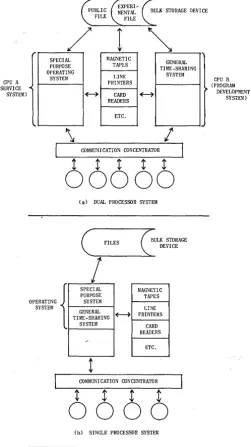
One type of evolving special-purpose time-sharing system which would solve many of the problems outlined above is the dual processor system. This system would have two dis-tinct central processor units, CPU A and CPU
B.
The gen-eral and special-purpose portions of the single Operating System would be separated into two Operating Systems, one for CPU A and one for CPUB.
With the special-purpose Operating System, CPU A would perform all the service functions, but not programming functions. CPU B, with a general time-sharing system, would handle developmental programming. The two processors and Operating Systems would share common peripherals.To insure reliability, CPU B would have read-only access to the public file used by the special-purpose system, but would also have its own experimental files insulated from the service system. The two processors might also share a common communication concentrator for further efficiency. Figure 1 (a) illustrates the configuration of a dual processor evolving special-purpose time-sharing system. Figure 1 (b) shows the single processor system.