warwick.ac.uk/lib-publications
Original citation:Ozkat, Erkan Caner, Franciosa, Pasquale and Ceglarek, Dariusz . (2017) Laser dimpling process parameters selection and optimization using surrogate-driven process capability space. Optics & Laser Technology, 93. pp. 149-164.
Permanent WRAP URL:
http://wrap.warwick.ac.uk/87875
Copyright and reuse:
The Warwick Research Archive Portal (WRAP) makes this work by researchers of the University of Warwick available open access under the following conditions. Copyright © and all moral rights to the version of the paper presented here belong to the individual author(s) and/or other copyright owners. To the extent reasonable and practicable the material made available in WRAP has been checked for eligibility before being made available.
Copies of full items can be used for personal research or study, educational, or not-for-profit purposes without prior permission or charge. Provided that the authors, title and full bibliographic details are credited, a hyperlink and/or URL is given for the original metadata page and the content is not changed in any way.
Publisher’s statement:
© 2017, Elsevier. Licensed under the Creative Commons Attribution-NonCommercial-NoDerivatives 4.0 International http://creativecommons.org/licenses/by-nc-nd/4.0/ A note on versions:
The version presented here may differ from the published version or, version of record, if you wish to cite this item you are advised to consult the publisher’s version. Please see the ‘permanent WRAP URL’ above for details on accessing the published version and note that access may require a subscription.
Laser dimpling process parameters selection and optimization using
surrogate-driven process capability space
Erkan Caner Ozkat* (a), Pasquale Franciosa(a), Dariusz Ceglarek(a)
(a) Warwick Manufacturing Group, University of Warwick, Gibbet Hill Rd., Coventry CV4 7AL, UK
E – mail: [email protected], [email protected], [email protected]
Abstract
Remote laser welding technology offers opportunities for high production throughput at a
competitive cost. However, the remote laser welding process of zinc-coated sheet metal parts
in lap joint configuration poses a challenge due to the difference between the melting
temperature of the steel (∼1500 C) and the vaporizing temperature of the zinc (~907 C). In fact, the zinc layer at the faying surface is vaporized and the vapour might be trapped within
the melting pool leading to weld defects. Various solutions have been proposed to overcome
this problem over the years. Among them, laser dimpling has been adopted by manufacturers
because of its flexibility and effectiveness along with its cost advantages. In essence, the dimple works as a spacer between the two sheets in lap joint and allows the zinc vapour escape during
welding process, thereby preventing weld defects. However, there is a lack of comprehensive
characterization of dimpling process for effective implementation in real manufacturing system
taking into consideration inherent changes in variability of process parameters. This paper
introduces a methodology to develop (i) surrogate model for dimpling process characterization
considering multiple–inputs (i.e. key control characteristics) and multiple–outputs (i.e. key
performance indicators) system by conducting physical experimentation and using multivariate
adaptive regression splines; (ii) process capability space (Cp–Space) based on the developed
surrogate model that allows the estimation of a desired process fallout rate in the case of
violation of process requirements in the presence of stochastic variation; and, (iii) selection and
optimization of the process parameters based on the process capability space. The proposed
methodology provides a unique capability to: (i) simulate the effect of process variation as
generated by manufacturing process; (ii) model quality requirements with multiple and coupled
quality requirements; and (iii) optimize process parameters under competing quality
requirements such as maximizing the dimple height while minimizing the dimple lower surface
area.
Keywords Laser dimpling · Zinc coated steel · Surrogate modelling · Design of experiment ·
Nomenclature
𝐷𝐻 Dimple height
𝐷𝑈 Dimple upper surface area 𝐷𝐿 Dimple lower surface area
𝑆𝑠 Scanning speed
𝛼 Incidence angle
𝐹𝑂 Focal offset
𝐿𝑇 Laser track
𝐾𝐶𝐶𝑠 Key Control Characteristics 𝐾𝑃𝐼𝑠 Key Performance Indicators
𝑁𝑖 Number of KCCs
𝑁𝑗 Number of KPIs
𝑁𝑘 Number of experimental configurations 𝑁𝑙 Number of experiment replications
𝑑 Number of dependent KPIs
𝑁𝑠(𝑘) Number of KPIs in the 𝑘𝑡ℎ experimental configuration 𝐾𝐶𝐶𝑖(𝑘) 𝑖𝑡ℎ KCC value in the 𝑘𝑡ℎ experimental configuration
𝐾𝑃𝐼𝑗(𝑘,𝑙) 𝑗𝑡ℎ KPI value in the 𝑘𝑡ℎ experimental configuration at the 𝑙𝑡ℎ replication 𝜇𝐾𝑃𝐼
𝑗(𝑘) Mean value of the 𝑗
𝑡ℎ KPI in the 𝑘𝑡ℎ experimental configuration
𝜎𝐾𝑃𝐼
𝑗(𝑘) Standard deviation of the 𝑗
𝑡ℎ KPI in the 𝑘𝑡ℎ experimental configuration
𝜇̂𝐾𝑃𝐼𝑗 Estimated mean value of the 𝑗𝑡ℎ KPI
𝐾𝑃𝐼
𝑗(𝑘) Success rate of the 𝑗
𝑡ℎ KPI in the 𝑘𝑡ℎ experimental configuration
𝐾𝑃𝐼
1(𝑘)⋯𝐾𝑃𝐼𝑑(𝑘) Success rate of the dependent KPIs in the 𝑘
𝑡ℎ experimental configuration
̂
𝐾𝑃𝐼𝑗 Estimated success rate of the 𝑗
𝑡ℎ KPI
̂
𝐾𝑃𝐼1⋯𝐾𝑃𝐼𝑑 Estimated success rate of dependent KPIs
𝐹𝜇𝐾𝑃𝐼𝑗 Deterministic surrogate model of the 𝑗𝑡ℎ KPI 𝐹
𝐾𝑃𝐼𝑗 Stochastic surrogate model of the 𝑗
𝑡ℎ KPI 𝐹
𝐾𝑃𝐼1⋯𝐾𝑃𝐼𝑑 Stochastic surrogate model of dependent KPIs
𝑃𝐷𝐹 Probability density function
𝑆𝑅 Success rate
𝛽 Minimal desirable success rate
𝐿𝐿 Lower limit
𝑈𝐿 Upper limit
KCC − space Process parameter space 𝐂𝐩− 𝐬𝐩𝐚𝐜𝐞 Process capability space
𝐃𝐂𝐩𝐣 – 𝐒𝐩𝐚𝐜𝐞 Deterministic process capability space of 𝑗𝑡ℎ KPI
𝐒𝐂𝐩𝐣 – 𝐒𝐩𝐚𝐜𝐞 Stochastic process capability space of 𝑗𝑡ℎ KPI 𝐃𝐂𝐩 – 𝐒𝐩𝐚𝐜𝐞 Deterministic process capability space
1
1. Introduction
Thin zinc coated steel sheets are widely used in the automotive industry due to its high
corrosion resistance, especially in body-in-white and closure panels [1,2]. With the
advancement of the laser technology, laser welding has been gradually replacing traditional
5
welding methods since it offers cheaper and faster manufacturing process as well as better
mechanical and aesthetic joint quality [3–5]. Despite such benefits, it is nonetheless challenging
to achieve high quality joint in lap joint configuration of zinc coated steel since the boiling point
of zinc (~907 C) is significantly lower than the melting point of steel (~1500 C), resulting in
highly pressurized zinc vapour on the faying surfaces during the welding process. Left
10
unaddressed, such zinc vapour can easily be trapped inside the molten pool which can lead to
welding defects such as porosity, spatter, burn-through, and severe undercuts [6,7].
Over the past few years, significant amount of researches have been conducted to prevent the molten pool from being destroyed by the zinc vapour and several solutions have been proposed which can be classified as:
15
Ventilation – This method is based on degasification of zinc vapour from the medium without
causing any weld defects either by enlarging molten pool [8,9]; stabilizing the keyhole by
employing shielding gas [10,11]; creating pre-drilled ventilation channels [12]; applying
appropriate spacers at the faying surfaces [13–15]; or adopting a suction method to remove
20
the vapour [16];
Inserting a thin metal foil – This involves adding another material (e.g. Al & Cu) into the
faying surface which absorbs zinc vapour or reacts with zinc vapour in such a way that a
liquid alloy with a high boiling point is formed [17,18];
Tandem beams – This approach employs a dual laser beam or a secondary heat source. The
25
first beam applies pre-heating which vaporizes zinc coating and second beam performs actual
welding [19–21];
Controlling keyhole oscillation – The molten pool shape can be controlled based on the pulsed wave mode of laser beam so that more stable keyhole oscillation can be achieved,
allowing the zinc vapour to escape during the keyhole closure [22,23]
30
Surf-sculpt – This method creates surface features from the base metal by repeated movement
of the low power on-focus laser beam in a short distance. These features increase surface
area of the material and can be utilized as a spacer between the faying surface in lap joint
2
All of the above solutions have been shown to produce satisfactory welds in lap joint
35
configuration. However, they do have number of disadvantages due to: (i) challenges in
development of system automation for robotic joining process (see inserting a thin metal foil
solution); (ii) increased system complexity (see ventilation and tandem beam solutions) due to
the need for installation of additional equipment which increases processing cost as well; and,
(iii) increased cycle time (see tandem beam, controlling keyhole oscillation and surf-sculpt
40
solutions) due to lower processing speed.
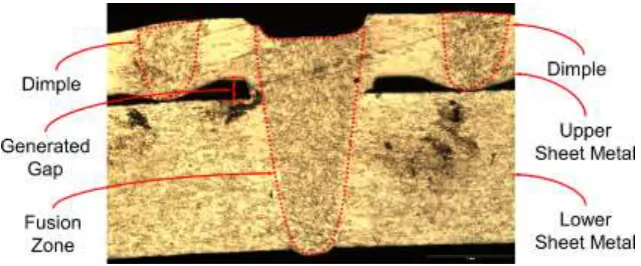
A promising technique for mitigation of zinc vapour is “laser dimpling” which makes a
dimple on the faying surface of the upper sheet metal by rapid and single movement of the laser beam. Hence, the zinc vapour is vented out through the generated gap between the faying
surfaces which is illustrated in Fig. 1. The laser dimpling process has been used by the
45
automotive industry as it does not require any additional equipment and can be performed using
the same laser source and fixture adopted for welding [26,27]. Furthermore, it is not restricted
by the shape and curvature of the workpiece and weld location.
[image:6.595.138.459.373.506.2]50
Fig. 1. Micro-section of laser welded joint with laser dimpling technique
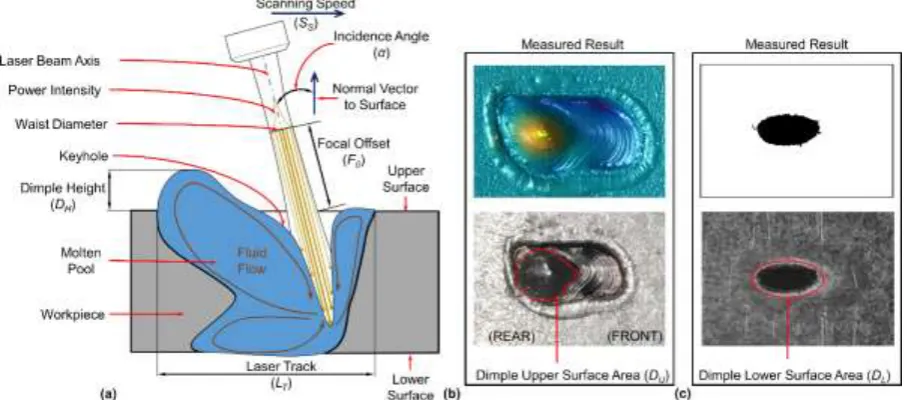
The physical principle behind laser dimpling process can be explained by the “humping
effect” which is influenced by the heat and mass transfer in the molten pool. In general, humps
occur periodically along the weld bead which deteriorate the homogeneity of molten pool. In
55
laser welding process, when the beam hits the workpiece, it creates a deep narrow cavity, known
as keyhole. While laser beam is moving, the liquid material at the bottom of the keyhole flows
upwards to the rear of the molten pool and generates a backward trail of a thin jet due to the
surface tension on the keyhole walls. The solidification of this jet on the surface forms the hump
at the rear and leading to a valley of cavity at the front which is given in Fig. 2. There has been
60
significant research which look at the humping effect as a negative phenomenon during joining
3
the hump [28–32]. However, the “humping effect” can be beneficially utilized by laser dimpling
process to create the required gap in lap welding of zinc coated steels.
65
Fig. 2. (a) Illustration of humping effect during a dimpling process (b) dimple upper surface (c) dimple
lower surface
According to Gu [26,27], humping effect was used to generate dimple for laser welding
70
process first, by studying the influence of a single parameter, focal offset, on the dimple height.
Then, they used this information to generate dimples at different scanning speed and incidence
angle, while other parameters such as focal offset were kept constant. Results indicated that
dimple height monotonically decreased with increasing both scanning speed and incidence
angle; whereas, the dimple height firstly, increased and then decreased whilst increasing the
75
focal offset. In a more recent study conducted by Colombo and Previtali [33] applied univariate
linear regression model to determine influence of scanning speed on the dimple height keeping
constant laser power, focal offset, and laser track. They found that linear energy, which is the
amount of the energy supplied per unit time, was the primary factor affecting the dimple height.
However, this study has limitation as authors considered only the influence of a single process
80
parameter without exploring other important process parameters and their interactions.
The existing literature has focussed mainly on single–input (i.e. scanning speed) and single–
output (i.e. dimple height) scenario which is necessary but not sufficient to give a complete
characterisation of the dimpling process. Furthermore, the laser material processes are
characterized as multiple–inputs and multiple–outputs (MIMO) system with non-linear
85
functional relationship [34–36].
Thus, it is important to take into consideration MIMO–based scenario for dimpling process.
[image:7.595.72.526.127.327.2]4
parameters for a dimpling process: scanning speed (SS), focal offset (FO), incidence angle (𝛼);
and, laser track (LT) as well as the following three key performance indicators (KPIs) to be 90
addressed as multiple–outputs parameters: dimple height (DH), dimple upper surface area (DU);
and, dimple lower surface area (DL).
Another limitation associated with the current literature is the lack of modelling variation in
the dimpling process. The current models are developed under the assumption of ideal process
performance neglecting process variation. As a result of lack of understanding process
95
variation, the measurement of selected KPI (e.g. dimple height) for given process parameters
might violate the given allowance limits and it will lead to erroneous process parameters
selection. However, no comprehensive research work has been reported in the laser dimpling
process that considers MIMO–based scenario with process variation.
This study is, therefore, focused on development of: (i) surrogate model for dimpling
100
process characterization considering multiple–inputs and multiple–outputs (MIMO) system by
conducting physical experimentation and using multivariate adaptive regression splines; (ii)
process capability space (Cp–space) for deterministic and stochastic cases based on the
developed surrogate models; and (iii) optimization of the process parameters based on the
process capability space.
105
The methodology is developed by introducing the concepts of deterministic and stochastic
process capability spaces. The deterministic Cp–space is a measure of the dimpling process
capability to satisfy simultaneously all the KPIs allowance limits requirements. Whereas, the
stochastic Cp–space is the estimation of process fallout rate which is the probability of making
a dimple which satisfies simultaneously all the KPIs limits requirements. The stochastic Cp–
110
space is then used to develop robust dimpling process by identifying process parameters which
are less sensitive to the variation in process.
2. Problem Formulation 115
2.1. Definition of key control characteristics (KCCs) and key performance indicators (KPIs)
The quality performance of a dimple is evaluated by multiple–outputs called in this paper
as Key Performance Indicators (KPIs), which are delivered by process parameters (multiple–
inputs), named in this paper as Key Control Characteristics (KCCs). As shown in Fig. 2, the
120
5 Scanning speed (SS) – The travelling speed of the laser beam along the upper surface of the
workpiece;
Focal offset (FO) – The distance along the beam axis between the focal point and the 125
interaction of beam and upper surface of the workpiece;
Incidence angle (α) – The angle along the beam movement between the beam axis and the
normal vector to the upper surface of the workpiece;
Laser track (LT) – The linear distance of the beam movement to make a dimple which is
parallel to the upper surface of the workpiece.
130
We observe that the aforementioned KCCs affect not only the selected dimpling process
KPIs, but also KPIs of other downstream processes. For example, scanning speed and laser track
can affect process cycle time and fixture clamp layout design [37]. Moreover, focal offset and
incidence angle can be related to not only dimple height or dimple upper surface area but also
135
they can affect detailed 3D fixture design includes the beam visibility, accessibility and offline
programming of the robotic scanner head. This is caused by the fact that the robotic system used
to make dimples needs to gain access to the workpiece with no collision between the
workpiece/fixture and the laser beam. These examples illustrate the importance analysing
dimpling process as MIMO–based system and also to develop methodology which can be
140
expanded to include additional KPIs as required by downstream processes.
Let us define that four KCCs (SS, FO, α, LT) are gathered as in Eq. (1), where 𝑖 and 𝑘 represent
index of KCC and experimental configuration
k
iKCC ; whereas, 𝑁𝑖 and 𝑁𝑘 are the total
number of KCCs and experimental configurations, respectively.
145
1 1
1
1
i
k k
i N
k i
N N
N
KCC KCC
KCC
KCC KCC
KCCs (1)
The following KPIs are proposed to measure the functionality, strength and aesthetic quality
requirements of the dimple which are illustrated in Fig. 2.
150
Dimple Height (DH) – This KPI is needed to evaluate the required and predetermined gap
between over lapped sheet metal parts which is the main functional objective of a dimple. It
is reported in the literature that to make joints with satisfactory quality in laser lap welding
6 Dimple upper surface area (DU) – This KPI assesses (i) strength of the dimple to prevent 155
excessive deformation of the dimple height under compression of clamping force applied during welding process; and, (ii) uncertainty as measured by difference between dimple
height and the required gap between the faying surfaces during consecutive welding process
and caused by geometric surface defects such as roughness, scratches, lines and etc. In
essence, the larger dimple upper surface area generates stronger and higher dimples but it
160
creates unwanted surface feature such as dark spots in the lower surface of the workpiece.
According to initial screening experiments, we propose dimple upper surface area should
be in the range of [1.0, 5.0] mm2 in order to generate sufficient gap between faying surfaces
to achieve satisfactory joint in laser lap welding.
Dimple lower surface area (DL) – The dark spot appeared in the dimple lower surface is an 165
aesthetic quality requirement which is an unwanted feature in Class-A surfaces in the
automotive industry [38]. Thus, the objective is to determine dimple lower surface area
which minimizes dimple height variation under compression clamping force in lap joint.
According to initial screening experiments, we propose dimple lower surface area should
be in the range of [0, 1.5] mm2.
170
Let us define three KPIs (DH, DUand DL), as shown in Eq. (2), where 𝑗, 𝑘 and 𝑙 represent
index of KPI, experimental configuration number and its replication
k l,
jKPI ; whereas, 𝑁𝑗, 𝑁𝑘
and 𝑁𝑙 are the total number of KPIs, experimental configurations and replicates, respectively.
175
1, 1,1 , ,1 , j=1, , lk k l
j
N
j j
k l j
N N N
j j N KPI KPI KPI KPI KPI j j KPIs KPI KPI (2)
The aforementioned three KPIs are selected as the primary indicators used in this paper to
evaluated dimpling process. Additionally, the paper defines lower limits (LL) and upper limits
(UL) for each KCC and KPI, which are given in Tables 1 and 2, respectively.
[image:10.595.74.525.681.758.2]180
Table 1 KCCs and their corresponding allowance limits
KCC Unit KCCLL KCCUL
Scanning speed m/min 2 4
Incidence angle 0 20
Laser track mm 2 4
7
The lower and upper limits of all KCCs have been defined by taking into account
technological constraints such as maximum scanning speed of the laser beam, minimum laser
power intensity on the upper surface of the workpiece to create a dimple. These limits were
185
determined by conducting initial dimpling and welding experiments, results of which are not
reported in the paper. The set of all possible KCCs within the allowance limits defines the
process parameters space (KCC–space). On the other hand, the lower and upper allowance
limits of all KPIs are determined based on aforementioned quality requirements.
190
Table 2 KPIs and their corresponding allowance limits
KPI Unit KPILL KPIUL
Dimple height mm 0.1 0.3
Dimple upper surface area mm2 1.0 5.0
Dimple lower surface area mm2 0.0 1.5
2.2. Formulation of surrogate modelling for the dimpling process characterization
The proposed modelling approach addresses two key limitations of the currently available
195
models for dimpling process characterization as discussed in the introduction section by taking
into consideration; (i) approximation of a comprehensive multivariate relations between
multiple– inputs (KCCs) and multiple–outputs (KPIs) of the dimpling process, and (ii) process
variation over the KCC–space which can be either homoscedasticity (all KPIs across the KCC–
space have the same variance) or heteroscedasticity (variability of a KPI is unequal across the
200
KCC–space). The process capability space (Cp–space) is presented to address both limitations
by defining a set of KPIs comprehensively evaluate dimpling process and identifying process
parameters inside the KCC–space that satisfy the given quality requirements.
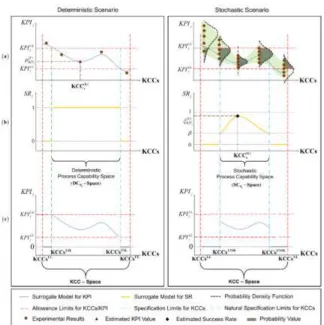
Two different scenarios are considered: deterministic and stochastic. In the deterministic
scenario, one or many measurements of the KPIs are conducted. Then, the mean values are
205
calculated to compute deterministic surrogate model which estimates the KPI values over the
KCC–space. A success rate (binary function) is therefore calculated which determines whether
the estimated value is within its lower and upper allowance limits for a given KPI. In case of
success, the given process parameters (KCCs) are said to be feasible. However, this modelling
approach has its own limitations. Indeed, due the stochastic nature of the KPI measurements,
210
some individual measurements might violate the limits contrary to its estimated value which
does not and vice-versa as highlighted in Fig. 3a.
Thus, stochastic scenario is proposed to take into account the mean and variance to calculate
8
variation can be represented as in the form of the success rate function. Initially, the probability
215
density function is developed either normal or non-normal distribution, using the measured
KPI values. Afterwards, the SR value is calculated which is the probability value of satisfying
the allowance limits as illustrated shaded regions in Fig. 3a. Finally, stochastic surrogate model
(non-binary function) is developed to calculate the SR values over the KCC–space to determine
the feasible KCCs for achieving given success rate () as highlighted in Fig. 3b
220
Furthermore, the success rate is also referred as (1 – process fallout rate) in the
manufacturing terminology and note is made that the higher success rate is the lower the process fallout rate. Moreover, the allowance limits for KCCs are determined by the equipment
capability; whereas, the specification limits for KCCs are determined to satisfy the allowance
limits for KPIs and the natural specification limits are determined to satisfy desirable success
225
[image:12.595.136.461.331.657.2]rate, which are illustrated in Fig. 3c.
Fig. 3. Conceptual representation deterministic and stochastic scenarios; (a)Experimental results (b)
Success rate models (c) Tolerance limits 230
The observed KPIs might not be independent each other and their joint relationship becomes
important to define the PDF function. Therefore, the Pearson correlation coefficient test has
9 235
cov ,
, 1, ,
mn m n Nj
m n m n KPI KPI KPI KPI (3)
The correlation result
ij indicates the linear relationship among KPIs which takes a valuebetween -1 and +1. Even though correlation and dependency are statistically different terms, if
KPIs are linearly correlated, it can be deduced that they are dependent each other. As a result,
240
the dependence among KPIs changes the form of the PDF function. The mean value of the 𝑘𝑡ℎ
experimental configuration of the jth KPI is defined in Eq. (4), where k s
N is the sample size in
the 𝑘𝑡ℎ experimental configuration.
1
, 1 T 1 , , , , k s k j k Nk
j j j
N k l j k KPI l s
KPI KPI KPI
KPI N
j KPI μ (4) 245The PDF function that describes the simultaneous behaviour of the dependent KPIs which
is called as “joint probability density function” is given in Eq. (5).
1 1 1 2 1 2 T k k k d
KPI KPI d k
PDF e
d k d k
KPId KPId
KPI μ KPI μ
(5)
250
where d is the number of the dependent KPIs and it will equal to the number of KPIs (𝑁𝑗),
if all KPIs are dependent to each other. The symmetric covariance matrix in the 𝑘𝑡ℎ
experimental configuration is given as k
. On the other hand, The PDF function is represented
as function of mean value
k jKPI
and standard deviation
k jKPI
for univariate independent
255
KPI, which is given in Eq. (6).
2 1 2 1 2 j k KPI j k KPI j k j k j KPI KPI KPI PDF e
(6)
The Shapiro–Wilk normality test, which provides better results that other normality tests for
260
small sample size [39], is applied to assess the normality assumption for each experimental
10
number of replication is quite small to directly calculate the standard deviation. Therefore, it is
formulated using the range statistics and corrective coefficient (d2) constant.
The success rate is calculated as a probabilistic approach that is the area under the PDF
265
function. The probability is determined by the integral of the PDF over the given allowance
limits, and it is formulated in Eq. (7) for dependent KPIs; whereas, in Eq. (8) for each
independent KPI.
1 1 1 11 , , 1 1, ,
UL UL
d
k k
k k d
KPI KPId LL LL
d
KPI KPI
k k k k
d d K
KPI KPI KPI KPI
PDF KPI KPI dKPI dKPI k N
(7)270
1, , , 1, , UL j
k LL k
j j j
KPI k k
j j J K
KPI KPI PDFKPI KPI dKPI j d N k N
(8)The general forms of deterministic and stochastic surrogate models for estimating KPI value
and the success rate for dependent and independent KPIs are given in Eqs. (9) to (11),
respectively.
275
1
ˆ , , 1, ,
j i
KPI KCC KCCN j Nj
KPIj μ
F (9)
1 1
ˆ , ,
d i
KPI KPI KCC KCCN
KPI1 KPId ξ
F (10)
1
ˆ , , 1, ,
j i
KPI KCC KCCN j d Nj
KPIj
ξ
F (11)
280
2.3. Formulation of deterministic and stochastic process capability space
A sub-set of KCC–space is the process capability space (Cp–space), which envelops all the
feasible KCCs satisfying the KPIs allowance limits. For the 𝑗𝑡ℎ KPI, deterministic process
capability space
jp
DC - Space is expressed in Eq. (12).
285
1
1
, , 1
, , 1, ,
0
i i
LL UL
j N j
N j
if KPI KCC KCC KPI
KCC KCC j N
otherwise KPIj j μ p F
DC - Space (12)
The stochastic process capability spaces are defined in Eqs. (13) & (14) for dependent and
independent KPIs, respectively.
290
1
1
1
ˆ , , 1
, , 0 i d i N KPI KPI N
if KCC KCC
KCC KCC otherwise
KPI1 KPId KPI1 KPId
ξ p
F
SC - Space (13)
1
1
ˆ , , 1
, , 1, ,
0 i j i N KPI N J
if KCC KCC
KCC KCC j d N
otherwise KPIj j ξ p F
11
where 𝛽 is the minimal desirable success rate. The identification of the final deterministic
295
and stochastic process capability spaces is done by aggregation individual deterministic and
stochastic process capability spaces and obtained from Eq. (15) and Eq. (16), respectively.
1 J j N j p p
DC - Space DC - Space (15)
1
J
j
N
j d
KPI1 KPId
p p p
SC - Space = SC - Space SC - Space. (16)
300
It is noteworthy that 𝑑 is the number of the dependent KPIs which is determined according to the Pearson correlation coefficient test. The final stochastic process capability space is
obtained by the probability theory which is a product of the independent and dependent
stochastic process capability spaces. If the all KPIs are dependent, final stochastic process
305
capability is only computed from the dependent stochastic process capability space.
2.4. Process parameter optimization using calculated surrogate models
The aim of this study is to identify optimum KCCs which maximize KPI (evaluated by
310
deterministic surrogate model) and the probability of satisfying the allowance limits of that KPI
(evaluated by stochastic surrogate model) at the same time. Therefore, the multi–objective
optimization problem can be formally stated in Eq. (17).
1
1 1 1
maximize F , , , F , , , F , ,
1, , subject to
ˆ 1, ,
KPIj i KPIj i KPI KPId i
j
N N N
LL UL
i i i i
LL UL
j KPI j j
KCC KCC KCC KCC KCC KCC KCC KCC KCC i N
KPI KPI j N
(17) 315
3. Generation of the deterministic and the stochastic surrogate models
3.1 Materials
320
The material used in this study was DX54D hot dip galvanized (GI) steels with nominal zinc
coating thicknesses of 20 μm. The chemical composition and mechanical properties of this
steel are given in Tables 3 and 4, respectively.
Table 3 Chemical composition DX54D steel (wt %)
325
Material Elements (wt %)
C Si Mn P S Ti
12
Two series of experiments were carried out. The first series served to characterise the
dimpling process and develop the deterministic and stochastic process capability spaces;
dimples were generated on the top surface of zinc coated sheet metal with a thickness of 0.75
mm. The second series was used to validate the calculated optimum KCCs based on the process
330
capability spaces by confirmation experiments which were carried out on coupon experiments.
Table 4 Mechanical properties of steel DX54D
Material Yield Strength (MPa) Tensile Strength
(MPa) Total Elongation (%)
DX54D 120 – 220 260 – 350 38
335
3.2 Experimental setup
Dimpling experiments were carried out using IPG Photonics YLR-4000 laser source with a
nominal power of 3 kW at a wavelength of 1064 nm. The laser beam was delivered using an optical fiber of core diameter of 50 μm, projecting the laser beam to a spot of 900 μm diameter.
340
The laser source generates a multi-mode beam with an M2 of 31.4 (measured by Primes Focus
meter) at a central wavelength of 1064 nm. Neither shielding nor backing gases were used
[image:16.595.84.525.202.249.2]during the experiments.
Figure 4 shows the experimental setup for beam quality measurement, laser dimpling and
remote welding systems. The laser beam is delivered by COMAU SmartLaser robotic system
345
which is a dedicated system for remote laser welding/dimpling and consists of 4 axes with
dynamics and kinematics of a standard industrial robot with an optical system able to deflect
the focused beam with high dynamics. The system specifications are given in Table 5.
350
Fig. 4. Overview of the experimental setup (a) Beam quality measurement (b) Laser Dimpling setup
[image:16.595.80.524.538.719.2]13
Table 5 Laser focusing and repositioning module (SmartLaser)
Characteristic Feature Unit Specification
Collimating length mm 50
Max focal length mm ~1200
Measured spot size m 900
Working area mm 700 × 450 × 400 Working distance mm 𝑚𝑖𝑛 894 𝑚𝑎𝑥 1216
355
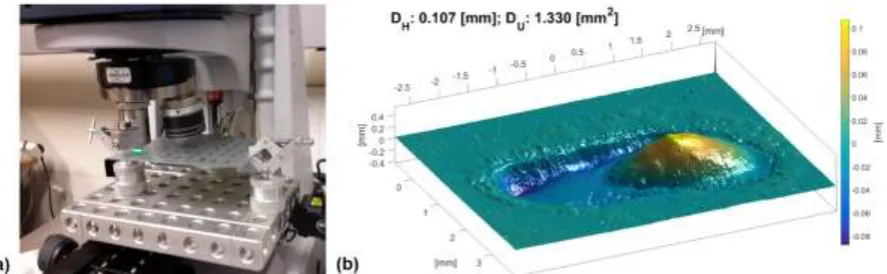
3D optical surface profilometer (Bruker, Contour GT) was used to measure dimple height
(DH) and dimple upper spot area (DU). The top surface of the zinc coated steel was scanned at
speed 5m/s with a vertical resolution of ~10 nm on a rectangle region 4.5 x 6.5 mm. Thus,
there are some gaps in the obtained data. The raw data obtained from the optical profilometer
was filtered and then reconstructed in 3D which was meshing of the scanned surface area using
360
“Laplacian smoothing filter”. The experimental setup for profilometer and an example of
scanning result with corresponding process parametersare shown in Fig. 5.
Fig. 5. (a) Experimental setup for profilometer (b) An example of 3D reconstruction. Process
365
parameters: SS: 2 m/min, FO: 35 mm, : 20, LT: 4 mm
On the other hand, dimple lower surface area (DL) was computed by image segmentation
method using MatLab®. Each image is captured with high resolution camera (3264×2448
pixels), with focal axis perpendicular to the surface of the workpiece to avoid image distortion.
370
Initially, the number of pixel is calculated in 10 mm straight line to obtain scale from pixel
length to millimetre; and then, the image was converted into 256 grey levels. After removing
the background from the original image, it was binarized (black and white image). The number
of black pixels inside the binarized image gives the area in pixel unit. This is converted into
millimetre square using the obtain scale to get the corresponding lower surface area (DL). As 375
[image:17.595.79.523.348.485.2]14
Fig. 6. Measurement of the dimple lower surface area (a) Grabbed image with scale bar. (b) Dimple
lower surface area (DL) for experiment configuration 19 with 5 replications. Process parameters: SS: 2 380
m/min, FO: 25 mm, : 10, LT: 4 mm
3.3 Design of Experiments
Several methods are available for the design of experiments to establish the relationship
385
between input and output variables, which include, among others, single-factor by single-factor
approach, factorial or fractional factorial approaches, Box-Behnken, Doehlet or Taguchi
experimental designs. Even though the full factorial design requires larger number of
experimental configurations than others alternative techniques, it allows to spread out design
point uniformly to obtain complete information on an unknown design function with a limited
390
sample size for capturing both main factors and interactions. Therefore, we adopted a full
factorial design approach with 4 – factor and 3 – level requires 81 experimental configurations
(Nk) with five replicates resulting 405 experimental runs. The design of experiment table was
created in randomize order and it was distributed into 9 batches of sheet metal plates (130 ×
110 mm). Thus, each plate had equal number of dimples and dimpling experiments were
395
conducted according to the created DoE table. However, this equal division did not guarantee
that each replicate was conducted in different metal plates. Due to the expected non-linear and
stochastic nature of the dimpling process, we selected 3 levels for each KCC and the selected
experimental levels were shown in Table 6.
400
Table 6 Key control characteristics and corresponding levels
KCC Unit Level [1] Level [2] Level [3]
Scanning Speed m/min 2.0 3.0 4.0
Incidence Angle 0.0 10.0 20.0
Focal Offset mm 25.0 35.0 55.0
[image:18.595.72.524.679.755.2]15
Replication is conducted to detect the variation of system. Note is made that the more
number of replications is the more accurate estimation of variation within the system. We
selected 5 replications because they represent the right balance between expected model
405
accuracy and time needed to perform experiments and collect data (one single dimple
experiment, including laser processing, measurement and data collection, took about 2 hours).
The paper is intended to provide a general methodological approach, whose accuracy may be
enhanced whenever more replications are made available.
410
3.4 Developing of Surrogate Models
The first objective of this work is to compute a surrogate model capable of analytically
formulate relationships between multiple–inputs (KCCs) and multiple–outputs (KPI values and
success rates). This study applied multivariable adaptive regression spline (MARS) method
415
developed by Friedman [40]. The MARS method is a non-linear and non-parametric regression
that is able to model complex non-linear relationship among input variables by developing
regression models locally rather than globally by the dividing the parameter space into several
pieces and then performing piecewise fitting in each piece. Furthermore, it does not require
larger number of training data sets and long training process compared to other methods such
420
as neural networks, support vector machines [41].
The piecewise fitting is more appropriate for obtained data in dimpling experiments which
are actual measurements and calculated success rates. The behaviour of the obtained data in
one region inside the KCC–space cannot be easily correlated to its behaviour in other region
caused by a sudden change which reduces the goodness of the regression. For instance, high
425
success rate can be achieved in one experimental configuration but low success rate might be
obtained in the next experimental configuration. This sudden change can be handle by using
piecewise fitting methods.
The MARS models was developed using ARESLab© [42], a dedicated MatLab toolbox. The
parameters used for developing the surrogate models were; (i) the maximum number of basis
430
functions that included the intercept terms was set as 101. These functions were necessary to
build the model in the forward building phase; (ii) the maximum degree of interactions between
KCCs was set as 4; (iii) piecewise cubic type was chosen; (iv) the least important basis
functions and high-order interactions were eliminated by feature selection and Generalized
Cross-Validation (GCV) score in the backward elimination phase and set as 3; and, (v) k-fold
435
16
4. Development of the deterministic and the stochastic process capability spaces
The second objective of this work is to develop deterministic and stochastic process
capability spaces. A probabilistic approach was used to developed the stochastic capability
440
space. In some problems, the measured KPIs might be dependent each other and their
simultaneous behaviour defines the probability space. Therefore, the Pearson correlation
coefficient test was initially conducted to determine the number of the dependent KPIs (d). As
a consequence, a stochastic surrogate model and a stochastic process capability space were
computed for the dependent KPIs; whereas, different stochastic surrogate models and
445
stochastics process capability spaces were computed for each independent KPIs.
The Dixon’s Q test was employed for identification of outliers for each experimental
configuration and KPIs since it was designed for small sample size and assumed normal
distribution [43]. When an outlier detected in one of the dependent KPI, the corresponding
values in other KPIs were also considered as outlier even if the passed were not identified as
450
outliers. The procedure flow for computing final deterministic and stochastic process capability
[image:20.595.68.527.393.731.2]spaces are summarized in Table 7.
Table 7 The procedure flow for computing process capability spaces
Step The methodology for computing final process capability spaces 1 Gather measurements for each KPI using Eq. (2)
2 Define number of dependent KPIs using Eq. (3)
3.1 Calculate outliers for each experimental configuration of each KPI using The Dixon’s Q test 3.2 Update the number of sample size for each experimental configuration
4.1 Calculate mean for each experimental configuration for each KPI using Eq. (4) 4.2 Calculate standard deviation for each experimental configuration for each KPI
1
. .
2
T
max min
, , , , 1, ,
k j
k Nk
j j j
k l k l
j j
KPI
j KPI KPI KPI
KPI KPI d j N j KPI
5.1 Calculate PDF for each experimental configuration for dependent KPIs using Eq. (5) 5.2 Calculate PDF for each experimental configuration for each independent KPI using Eq. (6) 6.1 Calculate SR for each experimental configuration for dependent KPIs using Eq. (7)
6.2 Calculate SR for each experimental configuration for each independent KPI using Eq. (8) 7.1 Calculate deterministic surrogate model for each KPI using Eq. (9)
7.2 Calculate stochastic surrogate model for dependent KPIs using Eq. (10) 7.3 Calculate stochastic surrogate model for each independent KPI using Eq. (11) 8.1 Calculate deterministic process capability space for each KPI using Eq. (12) 8.2 Calculate stochastic process capability space for dependent KPIs using Eq. (13) 8.3 Calculate stochastic process capability space for each independent KPI using Eq. (14) 9.1 Calculate final deterministic process capability over KCC–space using Eq. (15) 9.2 Calculate final stochastic process capability over KCC–space using Eq. (16) 455
17
The last objective of this work is optimization of the process parameters based on the
deterministic and stochastic process capability spaces. Both deterministic and stochastic Cp–
spaces provide necessary models for selection KCCs to optimize the KPIs using various
strategies reflecting the engineering needs of the dimpling process. In general, the optimisation
460
entails two competing objectives; (i) to obtain maximum KPI value; and, (ii) to maximize the
probability of satisfying the allowance limits of selected KPI. It is important to note that the
requirements for dimpling process are determined by downstream processes such as assembly
fixture design and optimization [37]. For example, assembly fixture design for welding which
is a downstream process might require a specific KCCs/KPIs configuration which will impose
465
the dimpling process to achieve the best success rate in satisfying the requirements of achieving
lower allowance limits of KPIs. Therefore, the proposed optimization strategy is based on
-constraint method rather than solving Pareto Frontier. This involves optimization of success
rate in achieving pre–selected KPIs configuration and using the other functions as constraints.
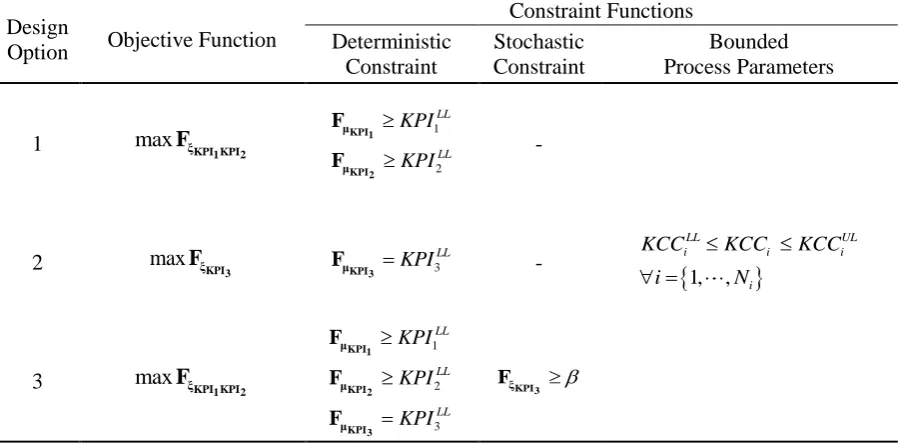
In this paper, three design options are defined to optimize all KPIs. The first design option
470
maximizes success rate of the dependent KPIs which addresses the functional and strength
requirement of a dimple (i.e. DH, DU) to control simultaneously minimum gap requirement and
strength of dimple. Similarly, the second design option evaluates the success rate of the
independent KPI which focuses on aesthetic requirements of a dimple (i.e. DL) that is important
for Class–A surfaces. The other design options are combination of these options and handled
475
as multi–objective optimization. Table 8 describes the proposed optimization strategies for
[image:21.595.74.527.536.758.2]various pre–defined KCCs/KPIs configurations.
Table 8 Proposed options for process parameters selection
Design
Option Objective Function
Constraint Functions Deterministic Constraint Stochastic Constraint Bounded Process Parameters
1 maxFξKPI KPI1 2
1 2 LL LL KPI KPI KPI1 KPI2 μ μ F F -
1, ,
LL UL
i i i
i
KCC KCC KCC
i N
2 maxFξKPI3 3
LL KPI KPI3 μ F -
3 maxFξKPI KPI1 2
18
6. Results and discussions 480
6.1 Statistical data analysis
The total number of KCCs, KPIs, experimental configurations, replication and dependent
KPIs are determined as Ni, Nj, Nk, Nl and d, respectively. The dependency among KPIs are 485
evaluated using the Pearson product-moment correlation coefficient test and its result () takes a value between +1 and −1, where 1 is total positive linear correlation, 0 is no linear correlation, and −1 is total negative linear correlation. The result of the Pearson test is given in Eq. (18).
According to results, dimple height (DH) and dimple upper surface area (DU) are chosen as
dependent KPIs and dimple lower surface area (DL) is independent from other KPIs. 490
cov ,
, 1, ,3
1 0.7852 0.2409
0.7852 1 0.5515
0.2409 0.5515 1
mn m n
m n
m n
KPI KPI
KPI KPI
(18)
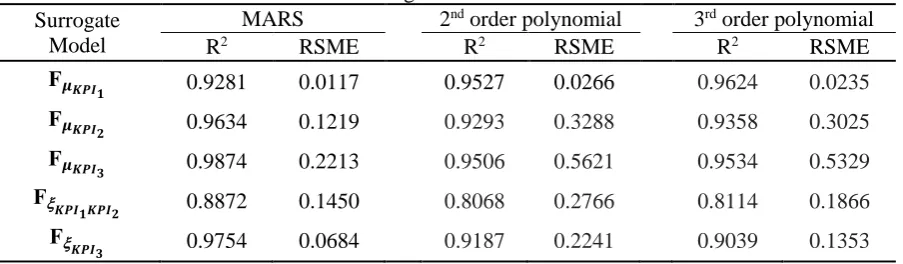
The goodness of surrogate models is assessed by computing the determination of coefficient
(R2) and root mean square error (RMSE) and the MARS models are compared with second and
495
third order polynomial regressions which are reported in
Table 9. The success rate in the stochastic case is not a binary value and it gets any value
between zero and one. However, its behaviour in one region inside the KCC–space cannot be
easily correlated to its behaviour in other region. This change can be handle by using piecewise
500
fitting methods and better R2 and RMSE are obtained in MARS model. The obtained MARS
[image:22.595.75.527.586.718.2]models and the measured KPIs are given in the in the Appendix.
Table 9 R2 & RSME values for different surrogate models
Surrogate Model
MARS 2nd order polynomial 3rd order polynomial
R2 RSME R2 RSME R2 RSME
F𝝁𝑲𝑷𝑰𝟏 0.9281 0.0117 0.9527 0.0266 0.9624 0.0235
F𝝁𝑲𝑷𝑰𝟐 0.9634 0.1219 0.9293 0.3288 0.9358 0.3025
F𝝁
𝑲𝑷𝑰𝟑 0.9874 0.2213 0.9506 0.5621 0.9534 0.5329
F
𝑲𝑷𝑰𝟏𝑲𝑷𝑰𝟐 0.8872 0.1450 0.8068 0.2766 0.8114 0.1866
F
𝑲𝑷𝑰𝟑 0.9754 0.0684 0.9187 0.2241 0.9039 0.1353
19
6.2Deterministic Surrogate Models
510
In the deterministic scenario, the mean values are calculated to compute surrogate model
which estimates the KPI values over the KCC–space. The results of these deterministic
surrogate models are illustrated in Figs. 7 to 9 for varying scanning speed (SS) and incidence
angle () for constant laser track (LT) and focal offset (FO) values. These figures provide two
types of information; (i) the effect of the process parameters on KPIs which can be directly
515
used by the automotive industry; and, (ii) individual deterministic process capability spaces
DC - Spacepj
which lead to final deterministic process capability space
DC - Spacep
. It isinteresting to note that dimple is formed in the same direction with laser track movement for
higher defocus (~5 mm) whereas dimple is formed in the opposite direction of the laser
movement for lower focal offset (~25mm). This behaviour is one of the findings of this study
520
and is shown in Fig. 10. It can be explained by the fact that larger defocusing generates bigger
laser beam spot size which leads to a drop in power intensity. In this case the molten material
is moved forward by the movement of the laser beam. The dimples obtained in this condition
are characterized by a cavity in the rear and higher dimple in front, which is highlighted in Fig.
2.
525
6.2.1 Characterization of dimple height (DH)
According to the literature, dimple height decreases with scanning speed. However, as
predicted in Fig. 7, this can only be obtained for high focal offset (~55 mm) and constant
530
incidence angle. For low focal offset (~25 mm), the laser track clearly affects the dimple height,
whilst a bipolarized pattern can be observed because of the mutual interaction between speed
and incidence angle. At medium focal offset (~35), scanning speed slightly affects dimple
height, whilst the interaction between laser track and incidence angle generates a unipolar
pattern. The highest dimple height is observed around 5 – 10 degrees. The reason for this could
535
be the amount of energy absorbed by the material and tilted keyhole that pushes the melting
upwards. It can be deduced that the dimple height increases while increasing laser track as also
20 540
Fig. 7.The estimated dimple height value (DH) over KCC–space in the deterministic scenario
6.2.2. Characterization of dimple upper surface area (DU)
Dimple upper surface area (DU) decreases with increasing scanning speed whist other
545
parameters are kept constant. However, it increases with increasing both scanning speed and
laser track but decreases with increasing both scanning speed and focal offset. It is evident that
increasing laser track results in higher and larger dimple since the longer displacement creates
longer trailing jet on the surface as also indicated in the literature [24]. The correlation patterns
exhibit a unipolar shape, which tends to be elongated moving toward higher laser track and
550
[image:24.595.136.465.457.630.2]focal offset.
Fig. 8.The estimated dimple upper surface value (DU) over KCC–space in the deterministic scenario
555
6.2.3. Characterization of dimple lower surface area (DL)
It is interesting to note that the main and interaction effects of incidence angle into dimple
lower surface area (DL) can be negligible and it can be seen in Fig. 9 that the correlation pattern
21
correlated with focal offset and scanning speed. The minimum DL is observable for medium
[image:25.595.139.463.125.296.2] [image:25.595.69.543.323.678.2](~35 mm) and high (~55 mm) focal offset and lower laser track (~ 2 mm).
Fig. 9.The estimated dimple lower surface value (DL) over KCC–space in the deterministic scenario
565
Fig. 10. Effect of focal offset on three KPIs when process parameters are constant at SS: 3 m/min, :
22
6.3 Deterministic Process Capability Space (DCP – Space)
The deterministic process capability space (DCp – Space) is illustrated in Fig. 11. The
575
shaded area represents the feasible region and any value inside corresponds to feasible process
parameters (KCCs) which simultaneously satisfy all quality requirements defined in Table 2.
According to the DCp – Space result, feasible process parameters cannot be achieved for lower
focal offset (~25 mm) since dimple lower surface area (DL) is more likely to exceed its
allowance limits that is highlighted in Fig. 9. The reason might be lower focal offset creates
580
higher power intensity and thus more amount of material is molten which results in wider and
deeper molten pool. The rate of change of the laser intensity determines the physical
phenomena between material and laser beam. For instance, slow speed, short laser track and
low focal offset result higher energy intensity rate and thus, higher dimple but larger dimple
lower surface area is occurred. Therefore, feasible regions are gathered in the medium level of
585
[image:26.595.74.525.357.650.2]the process parameters.
Fig. 11. Deterministic Process Capability Space (DCP – Space) for laser dimpling process
590
6.4 Stochastic Process Capability Space (SCP – Space)
The calculated stochastic process capability space (SCp–Space) is presented in Fig. 12 It
represents the simultaneous product of the stochastic process capability spaces defined in Eq.
(16). The achievable success rates of the dimpling process are displayed in contour plot by
23
initially selecting minimal desirable success rate (β) at zero in Fig. 12. Therefore, it will provide
more information to select a set of KCCs. For example, point A and B are inside the feasible region in Fig. 11 which define two different sets of KCCs that simultaneously satisfy KPIs
allowance limits. On the contrary, these points represented in Fig. 12 are different success rates
since the process variation is less at the point B. Therefore, point B provide more robust process
600
parameters (KCCs) and SCp–Space can be utilized to select KCCs according to pre–defined
success rate (β). Furthermore, the deterministic process capability space and stochastic process
capability space have to follow same pattern since probability value is a function of mean and
variation.
According to results, higher success rate regions are concentrated at the medium focal offset
605
(~35 mm). The success rate is nearly zero at lower focal offset (~25 mm) thus confirming the
results obtained by the DCP–Space model. According to the results, the minimal desirable
success rate (β) was set at 0.8 and it was highlighted in shaded region in Fig. 12.
[image:27.595.73.525.355.601.2]610
Fig. 12. Stochastic Process Capability Space (SCP – Space) for laser dimpling process
6.5 Process parameters selection and optimisation
Despite the fact that evolutionary algorithms do not guarantee the global optimum, their
615
convergence speeds to the optimal results (nearly global) are better than those of the traditional
techniques. Thus, evolutionary algorithms have been used for optimization of real-world
problems in many applications instead of traditional techniques [44–47]. Therefore, genetic
24
Population size, probability of crossover and mutation numbers were selected as 500, 0.60 and
620
0.12, respectively.
In this paper, we define three design options to optimize all KPIs which are described in
Table 8 and the optimization results are given in Table 10. The results indicate that the optimum
configurations are concentrated between medium (~35 mm) and high (~55 mm) focal offset
and higher laser track (~4 mm) and medium scanning speed (~3 mm). This can be explained
625
by the amount of time spent by the laser power intensity on the workpiece. It can be deduced
that by decreasing interaction time less amount of materials was molten and molten pool
becomes shallow because less amount of laser energy was absorbed. The design option three is approximately illustrated as Point C in Figs. 11 and 12.
630
Table 10 Optimization results
Design
Option SS LT FO 𝜇̂𝐾𝑃𝐼1 𝜇̂𝐾𝑃𝐼2 𝜇̂𝐾𝑃𝐼3 ̂𝐾𝑃𝐼1⋯𝐾𝑃𝐼2 ̂𝐾𝑃𝐼3
1 2.0020 15.0069 3.9692 54.9941 0.198 2.756 4.868 1.000 0.000 2 3.3709 0.2704 3.0229 52.8982 0.092 0.710 0.000 0.283 1.000 3 3.9967 19.9778 3.4845 37.2153 0.199 1.592 0.000 1.000 0.993
In order to validate the optimization results obtained in Table 10 and estimated values from
the surrogate models defined in Eqs. (9), to (11), confirmation experiments were carried out by
coupon experiments. Five replications of each design option were performed on a 10 x 40 mm
635
sheet metal with a thickness of 0.75 mm and the results are reported in Table 11. It shows
measured 5 replications for each KPI and their mean and success rate. These values are
computed according to the methodological flow from Step 1 to Step 6.2 which are presented
in Table 7. These calculated values are compared against estimated values from the developed
surrogate models.
[image:28.595.71.530.583.752.2]640
Table 11 Validation of the optimization results for all design options
Design
Option KPI Rep. 1 Rep. 2 Rep. 3 Rep. 4 Rep. 5 KPI ˆKPI KPI ˆKPI
1
DH 0.183 0.190 0.185 0.209 0.189 0.1912 0.198 1 1
DU 2.184 2.055 2.080 2.192 2.154 2.133 2.756 1 1
DL 4.467 4.318 4.415 5.028 3.417 4.329 4.868 0 0
2
DH 0.124 0.13 0.114 0.084 0.118 0.114 0.092 0.588 0.283 DU 1.123 1.186 1.037 0.776 1.076 1.0396 0.710 0.588 0.283
DL 0.000 0.000 0.000 0.000 0.000 0.000 0.000 1 1
3
25
These design options are offered to find robust process parameters to obtain maximum
dimple height and upper surface; and, minimum dimple lower surface area. The first option
studies maximizing mean and success rate of dimple height and upper surface area without
645
considering the dimple lower surface. According to the results, the calculated and estimated
mean and success rates are quite similar. However, this similarity is not achieved for the second
design option. The second option considers only to obtain robust parameters for minimum
dimple lower surface area. The variation of the DH and DU at this point are more than measured
values and dimple upper surface might be also correlated with dimple lower surface area. These
650
reasons might cause the different in the calculated and estimated values.
The laser dimpling process is currently utilized for the laser lap welding of zinc coated steels,
especially automotive industry. The dimples generate a small gap between faying surfaces
where the zinc vapour is vented out through. However, obtaining a constant gap without having
a darker spot at the back side of the steel are the major challenges of the process. An optimum
655
set of process parameter was validated by welding experiments and results are given in Fig. 13.
The figure shows images of welded specimen before and after the optimization of laser
dimpling process. The dark spots are not visible on the lower surface and there are no spatters
around the stitch after implementing optimum laser dimpling process parameters. Likewise,
the quality of weld seam is improved, no blow holes are detected in the weld seam.
[image:29.595.77.515.458.607.2]660
Fig. 13 Remote laser welded joint. (a) – Trial and error approach before optimization. (b) –
Optimized configuration based on the proposed methodology 665
7 Conclusions and Final Remarks
This paper presents a novel methodology to select process parameters for laser dimpling
process. It is based on the process capability space which allows the estimation of a desired
process fallout rate in the case of quality failures or violation of process requirements. The
670