© 2019, IRJET | Impact Factor value: 7.211 | ISO 9001:2008 Certified Journal
| Page 2731
PERSONALIZED E-LEARNING USING LEARNER’S CAPABILITY
SCORE (LCS)
Prof. Ramya Ramprasad
1, Dharani. J
2, Gayathri. B
3, Pooja. V
41,2,3,4
Department of Information Technology, Anand Institute of Higher Technology, Tamilnadu, India
---***---ABSTRACT - The best thing in everyone’s life is the education. The blooming youngsters without any knowledge of education will really feel hard to invent newfangled technologies. “India being an emergent country and having an optimum rank in education among other countries can accomplish great heights in science and technology”. The development of electronic learning models, especially in developing countries such as India has grown well as Information Technology applications designed for learning purposes. Colleges and schools seek to complement the traditional teaching system with e-learning systems. However, we found there are differences in individual learning styles in terms of speed and learning styles. Teaching students with one mechanism will ignore individual rights while reducing the meaning of education broadly from the humanity dimension. Such situations will affect the growth of knowledge. The electronic learning model then undergoes a shift away from a mere system, now evolving into a personalized learning model, where learning processes are oriented toward the students' abilities. Under these conditions, models and other techniques are needed to help personalized adaptive learning as they need it. This paper identifies the general criteria of personalized electronic learning model to meet the needs, interests and objectives of the learner in a more personal sense in a broader sense. The goal is to calculate Learner’s Capability Score (LCS) using performance, style and time. This results in obtaining an optimal learning path, thus developing the platform for a personalized e-learning environment.
KEYWORDS: LCS, personalized E-learning, curriculum sequencing.
I. INTRODUCTION:
E-learning or "electronic learning" is an umbrella term that describes education using electronic devices and digital media. Web-based training, computer-based training or web-based learning and online learning are a few synonymous terms that have over the last few years been labeled as e-learning. The use of computers and the Internet forms the major component of E-learning. Online education is another common form of e-E-learning. . Many colleges and universities allow students to submit assignments and complete tests online. Personalization refers to instruction that is paced to learning needs designed for learning preferences designed for specific interests of different learners. After all learners are just humans, with varying tastes, styles, preferences and needs. “One size does not fit all”. Make each learner’s desire relate to the way of learning that he/she wants. Curriculum sequencing is an important research area because no particular learning part is appropriate for all learners. It provides an optimal learning path to individual learners since every learner has different prior background knowledge, preferences, and often various learning goals. . In order to find an appropriate learning sequence with N learning concepts, one should explore a large number of possible solutions (N!).
II. RELATED WORKS
Oluwatoyin et al [5] developed a Genetic algorithm-based Curriculum Sequencing Model For Personalized E-Learning System. This paper helps learners to identify the difficulty level of each of the curriculum or course concepts and the relationship degree that exists between the course concepts in order to provide an optimal personalized learning pattern to learners based on curriculum sequencing to improve the learning performance of the learners. Random path has been chosen from the path that has been defined already.
”The paper [7] deals with the graph – a graph displaying study course topic structure and knowledge assessment and describe the concept map based knowledge evaluation system integration possibilities with personalized study planning prototype and usage in personal study planning. In order to perform the structure analysis of the concept maps authors propose to use of the methods of structure analysis to calculate the ranks for the nodes of the graphs thus detecting the most significant nodes in the graph structure. The calculation of ranks for the graph nodes allows detecting the most essential concepts in the concept map. The author describe that the integration result prove that it is an assumption.
© 2019, IRJET | Impact Factor value: 7.211 | ISO 9001:2008 Certified Journal
| Page 2732
A student model in a based course to sequence the curriculum was discussed in paper[4]. Since the teaching in a web-based course is usually non-linear, dynamic curriculum sequencing is important as there is not a linear path that will be appropriate for all students. Thus a student model needs to be constructed which can guide students through the non-linear curriculum. This student model is built on the student’s quiz performance and on how well he studies the material. The student model is used to judge how well a topic has been “learned”, which can then be used to determine which other topics are ready to be learned. The methods described in this paper simply rank the topics. It is not discussed how to teach a topic once it is chosen. Many of the decisions on how to teach (i.e. how to dynamically construct the content of pages) can be made based on the three individual topic scores.III. PROPOSED MODEL
In this model we design an application for the learners in colleges/universities. In this we create GUI for learner and all the information’s are stored in the backend using the MySQL which provide high security and privacy for the data’s. Using this application we can analyze their capability. First step is to register the application using the unique Email ID. After registration, the learner will choose their desired course. The first course concept is given as a medium level of difficulty. Once the course concept is learned, a test has been conducted to analyze the performance. The test scores are updated in the database. Using the learner’s performance, time and style their LCS is calculated and the desired path is provided. Iterations will continue until the completion of the course. Thus the personalized e-learning environment has been developed. To achieve personalized E-learning path, analyzing learner’s capability score (LCS). The tools used here are,
Xampp software
moodle framework
mysql database using php language.
Notepad ++
LCS PARAMETERS
To achieve personalized E-learning path, analyzing learner’s capability score (LCS) plays a vital role. LCS can be calculated by using the following parameters,
i. TIME (ⱦ): The total duration for entire course is obtained from the learners, so that the time span throughout the course period can be fixed and they can verify whether the time span meets the constraint or not.
ii. PERFORMANCE (₽): The learner’s performance can be evaluated by conducting a test for every course concepts and by validating the test results.
iii. STYLE (₰): Various types of course concepts are provided and learners can select their desired ease of learning style. iv. OBJECTIVE (Ø): The learner’s satisfactory level can be analyzed by getting the feedback from the learners. By this
parameter, we can identify whether the course concept was useful or not.
v. DIFFICULTY (DT): Every course concept’s level of difficulty will be evaluated by the experts.
vi. LEVEL OF QUESTIONS (ℚ):The difficulty level of questions are done by analyzing each question and allocating the negative and positive mark. This parameter is useful to analyze the performance
A. SYSTEM ARCHITECTURE
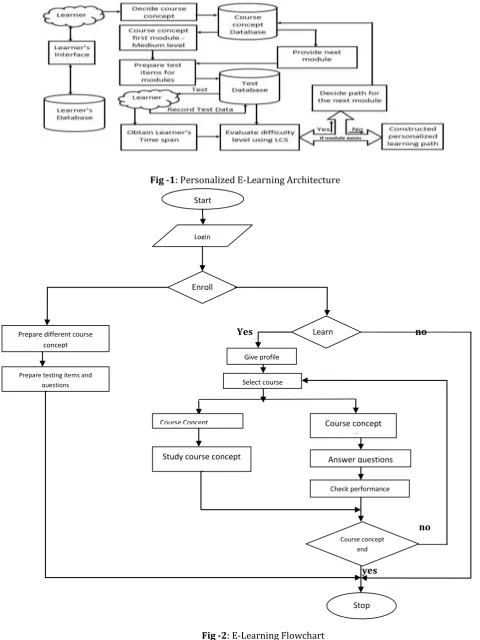
The system architecture of personalized E-learning system using LCS is shown in the fig (a).Learners will register with their unique Email ID and the details about the learner’s are stored in a database Learners decide the course and the first concept is given as the medium level. Once the completion of first concept, the test is taken by the learner to analyze their performance level. LCS can be calculated using performance, style and time Personalized e-Learning path has been provided to the learner.
B.LCS ALGORITHM
© 2019, IRJET | Impact Factor value: 7.211 | ISO 9001:2008 Certified Journal
| Page 2733
Fig -1: Personalized E-Learning Architecture
Yes no
no
yes
yes
Fig -2: E-Learning Flowchart Start
Login
Enroll
Prepare different course concept
Prepare testing items and questions
Learn
Give profile
Course concept questions
Study course concept Answer questions Course Concept
Check performance Select course
Course concept end
[image:3.595.94.515.77.257.2] [image:3.595.52.533.104.745.2]© 2019, IRJET | Impact Factor value: 7.211 | ISO 9001:2008 Certified Journal
| Page 2734
ALGORITHM-1 (LCS)START
PARAMETERS: Performance(₽), time(ⱦ), style(₰), objective(Ø), difficulty( ) and level of questions(ℚ). Difficulty (Number of Experts, Level of Difficulty);
Initialize the Course.
Initialize the Course Concepts. Select the learning Style (₰). Obtain the learners time span (ⱦ).
Provide medium level of difficulty for FIRST COURSE CONCEPT START Test.
Analyze Performance (₽), level of questions(ℚ). Call CalculateLCS (₽, ℚ);
FOR i=2 to N:
Provide CourseConcept[i] based on LCS. START Test.
Analyze Performance (₽), level of questions(ℚ). Call CalculateLCS (₽, ℚ);
Optimal Personalized Learning path provided. STOP
In the algorithm-2, we study about how we analyze and evaluate the difficulty of the course concepts. Here we have five level of difficulty of concepts and the experts will study and analyze the difficulty of course concept and rate the difficulty level of course concept . Finally the sum of expert rating and the difficulty of course is multiplied and the average is taken
ALGORITHM-2 (Difficulty (Number of Experts, Level of Difficulty):
START
PARAMETER : Number of Experts, CourseConcept.
INITIALIZE Count, Count1, Count 2, Count 3, Count4, Count5 as 0. FOR each Course Concept i = 1 to m:
FOR each Experts j = 1 to n: IF (a[i][j] == 1)
Count 1 += 1 ; IF (a[i][j] == 2)
Count 2 += 2 ; IF (a[i][j] == 3)
Count 3 += 3 ; IF (a[i][j] == 4)
Count 4 += 4 ; IF (a[i][j] == 5)
Count 5 += 5 ; FOR k = 1 to n:
Count=Count+Count[k] DT = Count/k
IF (DT == 1 || DT == 2)
DT = Easy level; else IF (DT == 3)
DT = Medium level; Else
DT = Difficult level; STOP
© 2019, IRJET | Impact Factor value: 7.211 | ISO 9001:2008 Certified Journal
| Page 2735
ALGORITHM - 3 Calculate LCS (Performance (₽), level of questions(ℚ)):START
PARAMETER : Performance (₽), level of questions(ℚ). Initialize tperformance(tp) and fperformance(fp) as 0. FOR i = 1 to 10:
Initialize ₽ as 1
IF(result == true && ℚ== difficulty) ₽ = ₽ + ₽*(ℚ/ no of ques); tp = tp + ₽;
IF(result == true && ℚ== easy) ₽ =₽+ ₽*(ℚ/ no of ques); tp =tp +₽;
IF(result == false && ℚ == difficulty) ₽ = ₽ - ₽*((2-ℚ(easy) )/no of ques); fp = fp + ₽;
IF(result == false && ℚ == easy)
₽ =₽- ₽*((2-ℚ(difficult) )/no of ques); fp = fp + ₽;
₽ = tp - ₽; IF (₽ > 7)
Difficult path; else IF (4 < ₽ < 7)
Medium path; Else
Easy path; STOP
IV. EXPERIMENTAL ANALYSIS
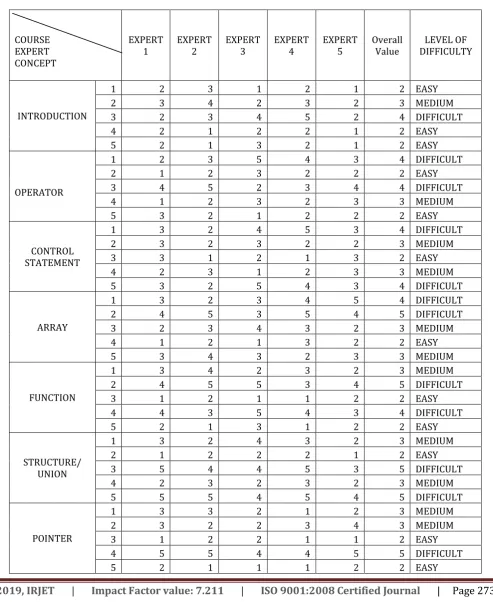
Collect various course concepts and evaluate its difficulty level by getting feedback from the experts. Analyze their feedback using COURSE CONCEPT FORMULA,
m
𝐷𝑇 = ∑ 𝑑𝑙𝑖 ∗𝑒𝑛
i=1
N
//where, dli=difficulty level score (dl1, dl2, dl3, dl4, dl5), en=Total number of experts, m=number of difficulty levels. The level of difficulty is specified as,1 indicates VERY EASY course concept, 2 indicates EASY course concept,3 indicates MEDIUM level ,4 indicates DIFFICULT and 5 indicates VERY DIFFICULT course concept. the data is provided in table 1
Count i =Level of difficulty * Number of experts
There are 5 experts to evaluate a course concepts from that expert 1 & expert 4 gives 3 has level of difficulty, where as expert 2 gives 4,expert 3 and expert 5 gives 1 has level of difficulty.
DT = (1*1+2*3 + 1*4) /5 2.2
Where 2.2 denotes EASY as level of difficulty
© 2019, IRJET | Impact Factor value: 7.211 | ISO 9001:2008 Certified Journal
| Page 2736
Table -2: Level of question difficultyLevel of Question Correct Answer Wrong Answer
Easy 2 -1.8
[image:6.595.52.546.195.798.2]Difficult 3 -0.8
Table -1: expert analysis of course concept
COURSE EXPERT
CONCEPT
EXPERT
1 EXPERT 2 EXPERT 3 EXPERT 4 EXPERT 5 Overall Value DIFFICULTY LEVEL OF
INTRODUCTION
1 2 3 1 2 1 2 EASY
2 3 4 2 3 2 3 MEDIUM
3 2 3 4 5 2 4 DIFFICULT
4 2 1 2 2 1 2 EASY
5 2 1 3 2 1 2 EASY
OPERATOR
1 2 3 5 4 3 4 DIFFICULT
2 1 2 3 2 2 2 EASY
3 4 5 2 3 4 4 DIFFICULT
4 1 2 3 2 3 3 MEDIUM
5 3 2 1 2 2 2 EASY
CONTROL STATEMENT
1 3 2 4 5 3 4 DIFFICULT
2 3 2 3 2 2 3 MEDIUM
3 3 1 2 1 3 2 EASY
4 2 3 1 2 3 3 MEDIUM
5 3 2 5 4 3 4 DIFFICULT
ARRAY
1 3 2 3 4 5 4 DIFFICULT
2 4 5 3 5 4 5 DIFFICULT
3 2 3 4 3 2 3 MEDIUM
4 1 2 1 3 2 2 EASY
5 3 4 3 2 3 3 MEDIUM
FUNCTION
1 3 4 2 3 2 3 MEDIUM
2 4 5 5 3 4 5 DIFFICULT
3 1 2 1 1 2 2 EASY
4 4 3 5 4 3 4 DIFFICULT
5 2 1 3 1 2 2 EASY
STRUCTURE/ UNION
1 3 2 4 3 2 3 MEDIUM
2 1 2 2 2 1 2 EASY
3 5 4 4 5 3 5 DIFFICULT
4 2 3 2 3 2 3 MEDIUM
5 5 5 4 5 4 5 DIFFICULT
POINTER
1 3 3 2 1 2 3 MEDIUM
2 3 2 2 3 4 3 MEDIUM
3 1 2 2 1 1 2 EASY
4 5 5 4 4 5 5 DIFFICULT
© 2019, IRJET | Impact Factor value: 7.211 | ISO 9001:2008 Certified Journal
| Page 2737
FILECONCEPTS
1 2 1 2 2 3 2 EASY
2 3 2 2 3 2 3 MEDIUM
3 2 5 4 3 5 4 DIFFICULT
4 3 2 3 4 5 4 DIFFICULT
5 3 5 4 2 1 3 MEDIUM
Chart -1: Learner’s Flowchart Activity
V. CONCLUSION AND FUTURE WORK
For the further enhancement of the project different kinds of course concepts has to be collected for various courses and to be stored in the course concept database.
To increase the number of learners capacity in learner’s database. At the completion of each course the graph has been drawn and it helps us to find the learner’s capability. To make many number of learners to get benefited through this and to improve their skills analyse it . Thus the personalized E-learning path has been provided. The learner’s can analyze their capability using the graphical representation of their performance.
REFERENCES
[1] A. A. Elusoji,”Development of Web-based Adaptive Learning Resources Sequencing Model,” unpublished PhD thesis submitted to the Department of Computer Science, Federal University of Technology, Akure, Nigeria. 2015.
[2] N. Jyothi, K. Bhan, U. Mothukuri, S. Jain, and D. Jain, “A recommender system assisting instructor in building learning path for personalized learning system,” Proc. - 2012 IEEE 4th Int. Conf. Technol. Educ. T4E 2012, pp. 228–230, 2012.
[3] G. Albano, M. Gaeta, and P. Ritrovato. IWT: an innovative solution for ags e-learning model. Int. J. Knowledge Learning, Vol. 3, 2007, pp. 209–224.
[4] Personalized curriculum sequencing utilizing modified Item Response Theory(IRT) for web based instruction-2005.
© 2019, IRJET | Impact Factor value: 7.211 | ISO 9001:2008 Certified Journal
| Page 2738
[6] Mohamed E.B menal | Hamed alhunitah | Hussein Al-Salman “Swarm intelligence to solve the curriculum sequencingproblem” Department of Computer Science, college of computer and information science, king saud university, Riyadh, Saudi Arabia-2018.
[7] Raite Rollande, Janis Grundspenkis, “Personalised planning of study course using concept maps and their analysis. Procedia Computer Science 104 ( 2017 ) 152 – 159.
[8] Emanuel Jando, Meyliana, Achmad Nizar Hidayanto, Sasmoko, “Personalized E-learning Model: A Systematic Literature Review”.
[9] Matteo Baldoni1, Cristina Baroglio1, Ingo Brunkhorst2,Elisa Marengo1, and Viviana Patti1,” Reasoning-Based Curriculum Sequencing andValidation: Integration in a Service-Oriented Architecture”.
[10] Baldoni, M., Baroglio, C., Patti, V., Torasso, L.: Reasoning about learning object metadata for adapting SCORM courseware. In: Proc. of EAW’04, pp. 4–13 (2004).
[11] Baldoni, M., Marengo, E.: Curricula model checking: declarative representation and verification of properties. In: Proc. of EC-TEL’07. LNCS, Springer, Heidelberg (2007)
[12] Baumgartner, R., Flesca, S., Gottlob, G.: Visual web information extraction with Lixto. In:VLDB, pp. 119–128. Morgan Kaufmann, San Francisco (2001)
[13] Brusilovsky, P., Vassileva, J.: Course sequencing techniques for large-scale web-based education.Int. J. Cont. Engineering Education and Lifelong learning 13(1/2), 75–94 (2003)
[14] Clarke, O.E.M., Peled, D.: Model checking. MIT Press, Cambridge, MA, USA (2001)
[15] De Coi, J.L., Herder, E., Koesling, A., Lofi, C., Olmedilla, D., Papapetrou, O., Sibershi, W.:A model for competence gap analysis. In: Proc. of WEBIST 2007 .
BIOGRAPHIES
Mrs.Ramya RamPrasad
, M.E, pursuing Ph.D in WEB SERVICES AND SWARM INTELLIGENCE.
ASSISTANT PROFESSOR, B.Tech/INFORMATION TECHNOLOGY, ANAND INSTITUTE OF HIGHER TECHNOLOGYDharani.J
, Final semester,B.Tech/Information Technology, ANAND INSTITUTE OF HIGHER TECHNOLOGY
Gayathri.B
, Final semester,© 2019, IRJET | Impact Factor value: 7.211 | ISO 9001:2008 Certified Journal
| Page 2739
Pooja.V
,Final semester ,