© 2019, IRJET | Impact Factor value: 7.211 | ISO 9001:2008 Certified Journal
| Page 564
OPTIMIZATION OF STEEL PORTAL FRAMES USING PYTHON
PROGRAMMING
Pramod T.K
1, Kiran K.K
2,
1
P.G. Student, Civil Engineering Department, S J B Institute of Technology, Bengaluru-560060, Karnataka, India
2Assistant Professor, Civil Engineering Department, S J B Institute of Technology, Bengaluru-560060,
Karnataka, India
---***---Abstract -The composition of any structure, be it is a bridgeor building will be ample if it possible to construct with the needed economy and if throughout its useful life carries its intended loads and performs for intended function. Minimum weight design is design of frame which weight compatible mechanism can be formulated and a corresponding safe and statically admissible distribution of bending moment throughout the frame can be found. In this study an attempt is made to develop a software for minimum weight design of steel structures by using python programming. Plastic analysis is carried out for portal frames. Using the principle of kinematic theorem minimum weight design of portal fames carried out and graphical method of linear programming is used for optimization of weight. For testing the software performance, a single frame is considered and compared with manual calculations. It is clearly shows that there will be an accurate result in software compare to manual calculation and also it is a time constrained compare to manual calculation. Error percentage is also calculated and compared, it is having a thin difference in manual calculations.
Key Words: Optimisation, Plastic analysis, Linear programming, minimum weight, Portal frame
1. INTRODUCTION
The composition of any structure, be it is a bridge or building will be ample if it possible to construct with the needed economy and if throughout its useful life carries its intended loads and performs for intended function. Steel structures standout as more economical structure when compared with other sort of material structure. It has been realized that whenever members are rigidly connected, the structure has a much greater load carrying capacity than indicated by the elastic stress concept. Continuous or rigid frames are able to carry increased loads above first yield because structural steel has the capacity to yield in a ductile manner with no loss in strength. Thus, plastic design is a first design on the basis of the maximum load that structure can carry.
The idea of configuration of ultimate load design as the criteria is over 40 years of age. In the plastic analysis relative values that is minimum weight and minimum cost are not preassigned hence it is easy to adopt optimization. Optimization is the act of obtaining the best outcome under given conditions, optimization helps us to minimize the
weight of portal frames as well as cost, and in this work minimization of weight is focused.
1.1 INTRODUCTION TO PLASTIC ANALYSIS
Plastic analysis is based on the idealization of the stress strain curve as elastic perfectly plastic. The stress strain curve for a perfectly plastic material up to strain hardening is shown in the figure. Perfect plastic materials follow Hooks law up to the limit of proportionality. The stress-strain diagrams in compression and tension of the material are equal and also yield stresses in tension and compression are equal. The strains up to the strain hardening in tension and compression are equal. The stress strain curve show horizontal plateau both in tension and compression. Such materials are called perfectly plastic materials.
FIG.1.1. Stress-Strain curve for perfectly plastic materials
1.1.1 Assumptions for plastic moment sections
The material obeys Hooke's law until the stress reaches the upper yield value on further straining, the stress drops to the lower yield value and thereafter remain constant.
The yield stresses and the modulus of elasticity have the same value in compression as in tension. The material is homogeneous and isotropic in both
the elastic and plastic states.
The plane transverse sections remain plane and normal to the longitudinal axis after bending the effect of shear being neglected.
Beam does not have resultant axial force.
The cross section of the beam is symmetrical about an axis through its centroid parallel to plane of bending.
© 2019, IRJET | Impact Factor value: 7.211 | ISO 9001:2008 Certified Journal
| Page 565
1.1.2 Fundamental conditions for plastic analysis: Mechanism condition: The ultimate or collapse load is reached when a mechanism is formed. The number of plastic hinges developed should be just sufficient to form a mechanism.
Equilibrium condition: ∑Fx = 0, ∑Fy = 0, ∑Mxy = 0.
Plastic moment condition: The bending moment at any section of the structure should not be more than the fully plastic moment of the section.
1.1.3 Theorems for plastic collapse:
Lower bound theorem: A load factor computed on the basis of an arbitrary assumed bending moment diagram which is in equilibrium with the applied loads and where the fully plastic moment of resistance is nowhere exceeded will always be less than or at best equal to the load factor at rigid plastic collapse.
Upper bound theorem: A load factor computed on the basis of an arbitrarily assumed mechanism will always be a greater than or at best equal to the load factor at rigid plastic collapse.
Uniqueness theorem: If both the above criteria are satisfied then the resulting load factor corresponds to its value at rigid plastic collapse.
1.2 PLASTIC HINGES
Plastic hinges are formed when beam becomes fully plastic. At the plastic hinge an infinitely large rotation can occur under a constant moment equal to the plastic moment of the section. Plastic hinge is defined as a yielded zone due to bending in a structural member at which an infinite rotation can take place at a constant plastic moment Mp of the section. The number of hinges necessary for failure does not vary for a particular structure subject to a given loading condition although a part of a structure may fail independently by the formation of a smaller hinges. The member or structure behaves in the manner of a hinged mechanism and in doing so adjacent hinges rotate in opposite directions. Theoretically the plastic hinge is assumed to form at points at which plastic rotations occur.
1.3 OBJECTIVE FUNCTION.
The criteria with respect to which portal frames design is optimized, and it is expressed as a function of design variables is termed as Objective function. The choice of objective function is governed by nature of function. In the structural design the objective function is usually taken as minimization of cost or weight.
Mathematically objective function is defined as
f(X) = α1f1(X) + α2f2(X)
Where α1 and α2 are constants and f1(X) and f2(X) are objective function.
2. METHODOLOGY
To establish the objectives of the study three things are major for minimum weight design
Plastic analysis Minimization problem Linear programming
2.1 PLASTIC ANALYSIS
2.1.1 Methods of plastic analysis
Plastic designs are classified in to two types:
a) Equilibrium method.
b) Combining mechanisms method.
In this study combining mechanism method is performed to calculate the plastic analysis of portal frames. Combining mechanisms method is a type in which beam mechanism and sway mechanism are combined together to for a mechanism, this is shown in below figure 2.1
FIG.2.1 Portal frame mechanism
Indications of above figure
a) Dimensions and loading. Units: m, kN. Plastic moments shown
b) Beam mechanism c) Sway mechanism d) Combined mechanism
2.2 THE MINIMIZATION PROBLEM
© 2019, IRJET | Impact Factor value: 7.211 | ISO 9001:2008 Certified Journal
| Page 566
mathematically in the existence of more0unknowns.Furthermore, the distribution of moments over the structure at the ultimate load is influenced by the relative moment capacities of the various members. This fact becomes evident if the structure is observed during the last stages of loading leading to the ultimate load. As the ultimate load is approached, each succeeding hinge brings about a redistribution of moment which differs from the moment distribution that would have prevailed had the structure remained elastic.
At present this five-member frame, then, represents about the upper limit for trial procedures. The desired method should proceed from the first solution to the minimum-weight solution with the consideration of only a very small percentage of the possible solutions.
2.3 LINEAR PROGRAMMING
The general linear programming problem can be stated in the following standard form:
1. Graphical method
The minimum weight design consists of one or two design variables, all the objective and constraint functions can be visualized with a 1-D or 2-D plot. One easily identify the optimal point from the graph.
The procedure of solving an optimization problem graphically as follows;
a) Plot constraint boundaries and identify the feasible design region.
b) Plot the contours of objective function and identify the direction along which the objective function increases or decreases.
c) Identify the location of the optimal point. Usually the optimal point is located on one or more constraint boundaries. In other words, the optimal point is usually a tangent point between a contour of the objective function and some constraint boundaries.
d) Solve the tangent point if needed.
3. MINIMUM WEIGHT DESIGN CONCEPT
3.1 Theorems for minimum weight design
3.1.1 Foulkes theorem:
“If for any design of a frame a weight compatible mechanism can be formulated, and a corresponding safe and statically admissible distribution of bending moment throughout the frame can be found, the design will be of minimum weight.
3.2 ASSUMPTIONS FOR MINIMUM WEIGHT DESIGN
a) The frame is composed of uniform prismatic members.
b) The infinite range of sections is available.
c) Plastic collapse should occur under a single specified combination of factored loads.
d) The linearized weight function is to be minimized.
3.3EQUATIONS FOR MINIMUM WEIGHT DESIGN
Consider the minimum weight design of a fixed base rectangular portal frame
We have 6 equations
1. β1+ β2 = P*L/2 2. β1 = P*L/4
3. β2 = W*a/4 4. β1 + β2 = W*a/2
5. 2β2 + β1 = (P*L+W*a)/2 6. 2β1 + β2 = (P*L+W*a)/2
Minimum weight solution:
X = iLi
= Mp1L1 + Mp2L2 + Mp3L3
= β1(2L) + 2β2a
X = 2β1L + 2β2a
4. MINIMUM WEIGHT DESIGN SOFTWARE
4.1 User interface
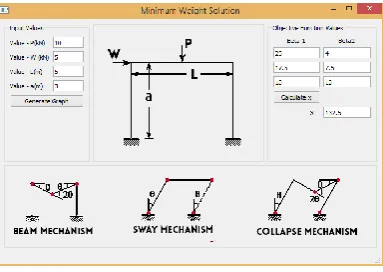
The user interface of the software is shown below. The UI consists of Input values and objective function values for calculating minimum weight function.
© 2019, IRJET | Impact Factor value: 7.211 | ISO 9001:2008 Certified Journal
| Page 567
4.2 LINEAR PROGRAMMING GRAPH:After entering the all input values we can generate the graph directly as shown in the figure below.
This graph consists of all the mechanisms equations which are already predefined in the script. From this graph we can easily get the feasible solutions and we can save the graph in many formats.
FIG.4.2. Linear programming graph of frame
4.3 MINIMUM WEIGHT SOLUTION
After plotting the LP graph we have to take all the points were lines intersect each other and calculate the objective solution “x” in the user interface box
4.4 FLOW CHART OF THE SOFTWARE
5. RESULTS AND DISCUSSION:
Computation of minimum weight solution is rendered manually as well as programmed software and results are compared. Two frames are considered for comparison each frame is having different dimensions and same assumed properties.
FRAME 1:
Data considered: Vertical Load (P): 10 KN Lateral load (W): 5 KN Span of beam: 5 m Span of column: 3m
FIG.5.1. Portal frame
Software calculation:
Step 1:
Input all the values
FIG.5.2. Input values
Step 2:
© 2019, IRJET | Impact Factor value: 7.211 | ISO 9001:2008 Certified Journal
| Page 568
FIG.5.3. LP GraphFeasible points are:
X Y 4 25 18 8 13 13 Step 3:
Plot the all points in objective function table and get the values
FIG.5.4. Minimum weight solution
Minimum weight solution (x) = 132.5
Manual calculation:
We have 6 equations 1. β1+ β2 = P*L/2 2. β1 = P*L/4 3. β2 = W*a/4 4. β1 + β2 = W*a/2
5. 2β2 + β1 = (P*L+W*a)/2 6. 2β1 + β2 = (P*L+W*a)/2
From equation 1 β1+ β2 = P*L/2
Plotting points are (25, 25) From equation 2 β1 = P*L/4
Plotting points are (0, 12.5) From equation 3 β2 = W*a/4
Plotting points are (3.75, 0) From equation 4
β1 + β2 = W*a/2
Plotting points are (7.5, 7.5) From equation 5 2β2 + β1 = (P*L+W*a)/2
Plotting points are (16.25, 32.25) From equation 6
2β1 + β2 = (P*L+W*a)/2
Plotting points are (32.25,16.25).
[image:5.595.66.258.356.492.2]Plotting a graph as shown in below:
FIG.5.5. Manual graph
From the above graph: Feasible solution points are:
1) (3.75,24.25) 2) (7.2,18) 3) (12.5 ,12.5)
Minimum weight solution:
X = iLi
= Mp1L1 + Mp2L2
Minimum weight solution (x) = 133.2
5.2 CALCULATION OF ERROR PERCENTAGE:
Table 1: Error percentage
Frame 1 Software
calculation 132.5 Manual
calculation 133.2 Error
percentage 0.07%
6. CONCLUSIONS
© 2019, IRJET | Impact Factor value: 7.211 | ISO 9001:2008 Certified Journal
| Page 569
calculate all the values which require to plot in thelinear programming graph.
2. As soon as graph is plotted we can easily get the feasible points in the software and then we can calculate the weight function respectively.
3. The software results are compared with manual calculation results by taking five portal frames with different dimensions.
4. The results which are getting from software calculation is more accurate than the manual calculation result. Linear programming graph can be plotted for any scales and any required values easily in software compared to manually plotting graph. 5. Error percentage is calculated; it is having teeth skin
difference for portal frames having less weight as weight increasing manual calculation values have large errors compared to software calculation. 6. Software takes less time compared to manual
calculation.
REFERENCES
1. J.M. Djokovic, K.M. Veljkovic and R.R Nikolic “Plastic analysis of steel frame structures using computer modelling” , Elsevier Publications, 2012, Volume 40 page no. 304 – 309.
2. Honar Kh. Issa and Fouad A. Mohammad, “Investigating the optimum design of steel portal frame using genetic algorithms”
3. Richard Hugh Bigelow and Edwin Henery Gaylord, “Minimum weight of plastically designed steel frames”, University of illinois,1966.
4. I-Chen Hung, “Plastic design of steel portal frames for minimum weight”, Missouri university,1966. 5. J Foulkes, “The minimum weight design of
structural frames”, Royal society publishing informing the science of the future, Vol. 223, No. 1155 (May 20, 1954). Pp. 485-494.
6. B.G. Neal, “The plastic methods of structural analysis”, Newyork, John wiley and sons publications,1963.
7. J. Chakrabarthy “Theory of Plasticiy”, New delhi, Third edition, British library cataloguing Publications.
8. Singiresu S. Rao, “Engineering Optimization”, Indiana, A Wiley inter science Publication.
9. Sp6(6)-1972: Application of Plastic theory in design of steel structures.
Pramod T.K., M. Tech
Department of Civil Engineering, SJB Institute of Technology Bengaluru, Karnataka, India
Kiran K.K
Assistant Professor
Department of Civil Engineering, SJB Institute of Technology, Bengaluru, Karnataka, India. Description.