Original Article
Effects of nursing with information
support and behavior intervention on lactation
and breastfeeding success rate for primiparas
Guqin Li1,3*, Jianxiang Cong2*, Li Li3, Yongmei Li3
Departments of 1Nursing, 3Dentistry, Yantai Yuhuangding Hospital, Yantai, Shandong Province, China; 2
Reproduc-tive Medicine Center, Yantai Yuhuangding Hospital, Yantai 264000, Shandong Province, China; *Equal
contribu-tors and co-first authors.
Received December 2, 2017; Accepted January 8, 2018; Epub March 15, 2018; Published March 30, 2018
Abstract: Objective: To improve the breastfeeding status of primipara, including the amount of breast milk secretion and breastfeeding rate, information support and behavior intervention were evaluated in this study. Methods: One hundred primiparas were recruited from March 2016 to March 2017. The participants were divided into interven-tion group and control group (50 cases in each group) by random number table approach. Routine treatment was employed for both groups. For the intervention group, personalized information support and behavioral intervention were used. The self-rating anxiety scale (SAS), Edinburgh postnatal depression scale (EPDS), and breastfeeding
knowledge scale were filled out by primiparas to evaluate the anxiety, depression and breastfeeding knowledge
pre- and postpartum. The amount of breast milk secretion and status of breastfeeding were also assessed. Results: After behavior intervention, the SAS score (38.8±4.9) and EPDS score (5.0±1.9) in the intervention group were
sig-nificant lower (P<0.05) than that in the control group (41.1±5.6 and 6.6±2.4, respectively). Moreover, after behavior intervention, the SAS and EPDS scores were significant lower than that before intervention (42.9±5.4 and 7.3±2.4,
respectively) in the intervention group. The scores of breastfeeding knowledge in the both groups after intervention
were significantly higher than that before intervention. After intervention, the breastfeeding knowledge (95.7±9.3) in intervention group was significantly higher (P<0.05) than that in control group (84.9±9.9). The amount of lacta
-tion in interven-tion group was significant more (P<0.05) than that in control group. The breastfeeding rate in the intervention group was significant higher (P<0.05) than that in the control group. There were 62.0% for exclusive breastfeeding, 4.0% for bottle feeding, and 34.0% for combined the two. For the exclusive breastfeeding rate, inter
-vention group (62.0%) was significantly higher (P<0.05) than that in the control group (32.0%). Conclusion: Informa -tion support and behavior interven-tion treatment could effectively improve anxiety and depression, breastfeeding knowledge, lactation, and breastfeeding rate in primipara.
Keywords: Breastfeeding, primipara, information support, behavior intervention
Introduction
Breast feeding is the safest and optimal feed-ing mode for infant growth [1]. Breast milk is the most ideal natural and nutritious food. It not only promotes the growth and development of infants, but also protects the baby from dis-eases. Also, the breast feeding can improve maternal postpartum recovery [2, 3]. Due to the lacking of breast feeding experience and knowledge of primipara, several negative emo-tions (such as anxiety, depression, lost the con-fidence of the breastfeeding) were emerged
cretion of lactation, help the mothers with nip-ple sag, and improve the confidence of breast-feeding [6, 9].
Attributed to the publicity and education of health care staff in China, and the exploration of novel improvement approaches, the breast-feeding rate was increased in recent years. However, the anxiety or depression of primipa-ra in prenatal and postnatal periods, and the low amount of lactation would affect the br- eastfeeding rate, which needs to be improved in the future. In this study, information support and behavioral intervention care were employ- ed to improve the emotion of puerpera, which would increase the amount of lactation and breastfeeding rate.
Materials and methods
Participant information
This study has got approval from local ethical committee. One hundred primiparas were re- cruited from March 2016 to March 2017 in this study. The inclusion criteria were consisted of (A) from 20 to 35 years-old, (B) birth of a single child with a gestational age of 37 weeks to 42 weeks, (C) willing to breastfeed, and under-standing and signing the informed consent, (D)
Information support: The breastfeeding knowl-edge and the request of pregnant women was evaluated after admission. According to the assessment results, the information support scheme was developed [7]. Health education for breastfeeding knowledge and information was provided, including the propaganda col-umn in ward, breastfeeding guide booklets, breastfeeding class, and one-to-one breast-feeding advice. The good relationship and effective communication with pregnant wom- en was established and maintained. The con- fidence of breastfeeding and psychological st- ate was understood timely. The health educa-tion was strengthened when less confidence of participant was appeared. The benefits and approaches of breastfeeding were explained. The mothers who owned experience of breast-feeding were invited and gave talks to improve the confidence of participants.
When anxiety, depression and other negative emotions appeared, specific help and psycho-logical counseling was performed. Psychoth- erapist was participated for intervention wh- en necessary [8]. The mobile discussion group for breastfeeding was built and maintained, which consisted of obstetrical staff and parti- cipants. After continually pushing the breast-feeding knowledge in mobile group, it
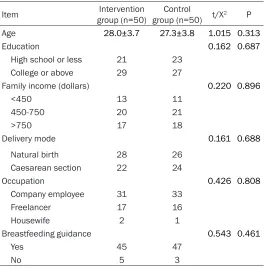
facilitat-Table 1. Participant information of two groups
Item group (n=50)Intervention group (n=50) t/XControl 2 P
Age 28.0±3.7 27.3±3.8 1.015 0.313
Education 0.162 0.687
High school or less 21 23 College or above 29 27
Family income (dollars) 0.220 0.896
<450 13 11
450-750 20 21
>750 17 18
Delivery mode 0.161 0.688
Natural birth 28 26
Caesarean section 22 24
Occupation 0.426 0.808
Company employee 31 33
Freelancer 17 16
Housewife 2 1
Breastfeeding guidance 0.543 0.461
Yes 45 47
No 5 3
education levels with junior high school or above. The exclusion cri-teria consisted of (A) persons with serious illness, (B) persons with mental illness or mental disorders, (C) not willing to join in this study. The participants were divided into the intervention group and control group (50 cases in each group). There were no significant differ-ences (all P>0.05) in age, educa-tion level, family income, delivery mode, occupation, and instructi- ons of breast-feeding between the two groups (Table 1).
Medication scheme
[image:2.612.91.355.83.351.2]Table 2. Comparison SAS scores between intervention and control group
Group Case Before intervention/routine treatment After intervention/routine treatment t P
Intervention group 50 42.9±5.4 38.8±4.9 3.952 0.000
Control group 50 43.4±5.8 41.1±5.6 1.967 0.052
t 0.447 2.219
P 0.656 0.029
Note: SAS, self-rating anxiety scale.
ed the communication, counseling and learning for participants. The problems of breastfeed- ing could be discussed and solved by certain specialists in time [7]. The public account on mobile website was built. The breastfeeding knowledge and new progress were published regularly. It provided a quality learning platform for participants.
Behavior intervention: The guidance of the breastfeeding was taught as follows. Early exposure between maternal and infant was performed after birth. Within 30 min after birth, the nurse demonstrated the correct breast-feeding method to help the infant intake the breast milk, and promote the lactation of the mother. The breastfeeding skills (such as cor-rect posture) of the mother were guided. The nurse also helped the infant to learn the correct and effective action for ingestion breast milk [8].
The guidance of getting out the bed at early stage, and moderate activity of primiparas were proceeded. To improve the postpartum recovery and gastrointestinal peristalsis, the primiparas were encouraged to get out the bed at early stage, and perform moderate acti- vity. It would improve the ingestion foods of primiparas, and promote the milk secretion [6]. To feel more joy of motherhood, and build the confidence for taking care of infant, the pri-miparas were encouraged to participate in neo-natal care [10].
The guidance of daily life for primiparas were carried out as follows. The instruction of die- tary nutrition was performed to improve the breast milk secretion. Protein-rich and easily absorbed diet (such as fish and chicken soup) was recommended. To uptake various nutri-ents, fresh fruits were also ingested in the diet [8]. Meanwhile, adequate sleep and rest was executed during the treatment.
The instruction of breast cleaning and massa- ge was guided to prepare the lactation. After hot compress of wet towel for 20 min, the lon- gitudinal massage was performed along the mammary ducts through the thumb, index and middle fingers. For the mammary areola, longer time (10 min for each massage) was recom-mended to promote mammary gland tube pa- tency, which would convenient the infant for uptake the breast milk [6]. To overcome the breastfeeding issues (including breast engorge-ment and bloating, lactiferous duct blocking, mastitis, and nipple pain), appropriate solu-tions were instructed for the primiparas. Treatment effectiveness evaluation: The self-rating anxiety scale (SAS), Edinburgh postnatal depression scale (EPDS), and breastfeeding knowledge scale were filled out by primiparas when they arrived at hospital and postpartum 42 days respectively. The lists for investigation were recovered on the spot after carefully scan-ning for the missing items.
For the list of SAS, 20 items with 4 grades were recorded [11]. It was used to evaluate the su- bjective feelings of patients for anxiety. The fre-quency of the symptoms was measured as the main evaluation item. The scoring criteria for each item was shown as follows from 1 to 4. One indicated that no or very low frequency. Two demonstrated that the low frequency. Three indicated the relative high frequency, whereas 4 demonstrated the very high frequ- ency or always anxiety. The maximal reference standardized score of SAS was 50. The high- er score indicated the worse symptoms of anxiety.
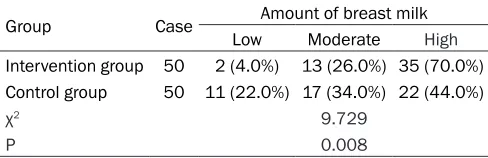
Table 5. Comparison amount of breast milk between intervention and control group
Group Case Amount of breast milk Low Moderate High Intervention group 50 2 (4.0%) 13 (26.0%) 35 (70.0%)
Control group 50 11 (22.0%) 17 (34.0%) 22 (44.0%)
χ2 9.729
[image:4.612.89.523.211.286.2]P 0.008
Table 4. Comparison breastfeeding knowledge scores between intervention and control group Group Case Before intervention/routine treatment After intervention/routine treatment t P
Intervention group 50 79.3±10.6 95.7±9.3 8.213 0.000
Control group 50 78.1±11.1 84.9±9.9 3.211 0.002
t 0.563 5.632
[image:4.612.90.334.336.415.2]P 0.575 0.000
Table 3. Comparison EPDS scores between intervention and control group
Group Case Before intervention/routine treatment After intervention/routine treatment t P
Intervention group 50 7.3±2.4 5.0±1.9 5.360 0.000
Control group 50 7.6±2.8 6.6±2.4 1.963 0.053
t 0.655 3.768
P 0.514 0.000
Note: EPDS, Edinburgh postnatal depression scale.
employed to indicate the severity from low to high: never (0), occasionally (1), often (2), and always (3). The recommended threshold score of EPDS was 9 for screening the postpartum depression of participants. More than 12 sco- res indicated the sever postpartum depre- ssion.
The breastfeeding knowledge scale included the benefits of exclusive breastfeeding, skills and attentions of breastfeeding, and storage of breast milk [13]. A total of 25 items includ- ing 5 grades were employed. The grades (from 1 to 5) indicated the recognition for the speci- fic knowledge from low to high. The total score was 125. The higher score indicated the better recognition for breastfeeding knowledge. The amount of breast milk secretion was scaled as follows [10]. The low amount of secretion: a small amount of yellow overflow emerged after milked by hand, and not enough for infant ingestion. The moderate amount of secretion:
bottle feeding or combining the two) were recorded.
Statistical analysis: SPSS 17.0 software was used for data analysis. The data was expressed by mean ± standard deviation (mean ± SD). The comparison between groups was conducted with independent sample t test. The counting data was tested by X2. P<0.05 indicated sta- tistically significant difference.
Results
Effects of information supports and behavioral intervention for anxiety
After information supports and behavioral intervention for primiparas, there was signifi-cant lower SAS score (P<0.05) in intervention group than that in control group. Compared with the SAS score before supports and inter-vention, the anxiety was significantly improv- ed (P<0.01) after the treatment (Table 2).
overflow emerged after milked by hand, and enough for infant ingestion. There was no swelling of breast between lac-tations. The high amount of secretion: a large amount of overflow emerged af- ter breastfeeding. There was swelling of breast between lactations.
Effects of information supports and behavioral intervention for depression
In this study, there was significant lower EPDS score (P<0.01) in intervention group than that in control group after the information supports and behavioral intervention. The depression was significantly improved (P<0.01) after the treatment, when compared with that before the information supports and behavioral inter-vention (Table 3).
Effects of information supports and behav-ioral intervention for breastfeeding knowledge scale
The breastfeeding knowledge scales of inter-vention and control groups were significantly improved (both P<0.05) than that before the behavior intervention or routine treatment. There was a significant higher score of breast-feeding knowledge (P<0.01) in intervention than that in control group (Table 4).
Effects of information supports and behavioral intervention for amount of breast milk secre-tion
There was significant higher amount of breast milk secretion (P<0.05) in intervention group than that in control group. The data are shown in Table 5.
Effects of information supports and behavioral intervention for breastfeeding rate of primipa-ras
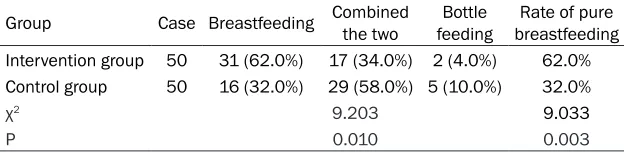
In this study, there was significant higher (P<0.05) breastfeeding rate (including breast-feeding only and combined bottle breast-feeding) in intervention group than that in control group. There were 62.0% breastfeeding, 4.0% bot- tle feeding, and 34.0% combining the two in the intervention group. Moreover, in interven-tion group, the breastfeeding only rate sho- wed significant higher (P<0.05) than that in
mote the immunity and health of infants [13, 14]. However, the situation of breastfeeding still need to be improved now. In the previous report, the breastfeeding rate was only 18.9% within six months after birth in certain areas [15]. Also, the breastfeeding knowledge scale was still low (78.1±11.1), with the rate of 32.0%. Therefore, an active intervention was needed for primiparas to improve the recogni-tion and behavior for breastfeeding, and pro-mote the exclusive breastfeeding approach, then maintain health of maternal and infant [16].
In this study, the scores of anxiety (SAS) and depression (EPDS) in intervention group were all significant lower than that in control group. After the treatment, the scores were also sig-nificant lower before medication in intervention group. The results indicated that the anxiety and depression in various levels were normally companied with the primiparas. After the infor-mation support and behavior intervention, the anxiety and depression of primiparas were improved significantly.
[image:5.612.90.402.98.174.2]According to the previous researches, the fluc-tuation of maternal mood was normally high along with the anxiety and depression. But the breastfeeding could improve the negative emo-tions [16-18]. Meanwhile, professional instruc-tion for breastfeeding and psychological sup-port were needed to promote the breastfeeding rate. Also, the previous studies showed that, several different reasons would induce the an- xiety and depression in maternal, which then cause the decreasing of breastfeeding rate. Timely guidance and intervention were needed [2, 19, 20]. In this study, good relationship and communications between nursing staff and participant was built to learn the psychological states in time. Assistance and psychological counseling for the participant were given when anxiety, depression or other negative emotion emerged. Psychological treatment was also
Table 6. Comparison breastfeeding rate between intervention and con-trol group
Group Case Breastfeeding Combined the two feedingBottle breastfeedingRate of pure Intervention group 50 31 (62.0%) 17 (34.0%) 2 (4.0%) 62.0%
Control group 50 16 (32.0%) 29 (58.0%) 5 (10.0%) 32.0%
χ2 9.203 9.033
P 0.010 0.003
control group. The data are shown in Table 6.
Discussion
pro-necessary for the primiparas with high scale negative emotion to effectively improve the mental health [8].
In this study, the scale of breastfeeding know- ledge after intervention was significantly im- proved than that before intervention. Also, the scale of breastfeeding knowledge in interven-tion group was significant higher than that in control group, which conformed with the previ-ous study [8]. Therefore, the information sup-port and behavior intervention could improve the breastfeeding knowledge of primiparas. And professional instruction and support of breastfeeding knowledge were needed for the maternal who lack of experiences to improve the breastfeeding rate [4, 13, 21, 22]. In this study, several different types of instruction and information support (such as breastfeeding class, brochures, online education, etc.) were employed to disseminate the breastfeeding knowledge. Through the combination of differ-ent approaches, the breastfeeding knowledge was studied continually to improve the scale of assessment and breastfeeding rate [23]. In this research, the amount of milk secretion in intervention group was significant higher th- an that in control group. There was significant higher breastfeeding rate in intervention group (62.0%) than that in control group (32.0%). This result was conformed with the result of Linares et al., which showed 51% for breastfeeding, 5% for bottle feeding, and 44% for combining the two [24]. The data indicated that informa-tion support and behavior interveninforma-tion could improve the secretion of breast milk, and br- eastfeeding rate. The early report showed that, cognitive behavioral interventions could suc-cessfully promote the long-term breastfeeding of primiparas [1]. Through the behavior inter-vention treatment, the proper skills for breast-feeding and breast massage were guided to promote breast milk secretion and breastfeed-ing rate. Moreover, the information support and behavior intervention could help the primipa- ras to recover health psychology. It would also improve the breast milk secretion through con-tact and sucking at early stage [6].
In conclusion, with the anxiety, depression and lack of breastfeeding knowledge in primiparas, the information support and behavior interven-tion could alleviate the negative emointerven-tions,
improve the breast milk secretion, breastfeed-ing knowledge and rate. This approach is worth a wide application in the future.
Disclosure of conflict of interest
None.
Address correspondence to: Yongmei Li, Departm- ent of Dentistry, Yantai Yuhuangding Hospital, No.20 East Road, Zhifu District, Yantai 264000, Shandong Province, China. Tel: 0535-6691999; Fax: +86-0535-6691999; E-mail: [email protected]
References
[1] Wang XL, Zhuang W, Zhao MH, Yu H, Hou YW and Wu WY. Observation of the effect of pri-mary maternal breastfeeding cognitive behav-ioral intervention. Journal of Nursing (China) 2017; 24: 64-67.
[2] Sun S, Wan HW and Zhu L. Analysis of the
sta-tus of self-efficacy and its influencing factors of
postpartum breastfeeding in primiparas. Chi-nese Journal of Modern Nursing 2015; 21: 3240-3244.
[3] Issaka AI, Agho KE and Renzaho AM. Preva-lence of key breastfeeding indicators in 29 sub-Saharan African countries: a meta-analy-sis of demographic and health surveys (2010-2015). BMJ Open 2017; 7: 141-145.
[4] Chen HJ and Yin XH. The study on the current
status of breastfeeding self-efficacy and its in
-fluencing factors in primiparas. Chinese Nurs -ing Management 2013; 13: 35-37.
[5] Yao W and Tan XX. The influence factors of breastfeeding self-efficacy and the correlation
analysis with postpartum depression in primip-aras. Chinese Nursing Management 2014; 14: 89-91.
[6] Zhang YB. Behavioral intervention and psycho-logical counseling had an effect on breastfeed-ing and depression after cesarean section. Journal of Liaoning University of Traditional Chinese Medicine 2014; 16: 220-222.
[7] Lu YY, Gao YM, Piao L, Cong YF, Cui L and Zhang C. Study on the effect of information
motivation behavior model on the self-efficacy
of breast-feeding in nipple depression. Journal of Nurses Training 2016; 31: 1166-1168. [8] Chen ZZ. The effect of information support
be-havior intervention on the self-efficacy of ma -ternal breastfeeding. Contemp Med 2016, 22: 112-113.
[10] Fang CY, Wang L and Wang LY. The effect of cognitive behavioral intervention on the suc-cessful rate of breastfeeding. China Health In-dustry 2015; 16: 147-149.
[11] Lu HY and Li GJ. The study of the influence of
the treatment mode nursing intervention on the level of prenatal anxiety. Modern Journal of Integrated Traditional Chinese and Western Medicine 2017; 26: 898-901.
[12] Li Z, Ma WJ, Li YB, Jia H and Yang X. The re-search of the status of maternity parenting and the correlation with postpartum depres-sion. Journal of Nursing Science 2017; 32: 87-89.
[13] Sun S, Wan HW and Huang R. A survey of 815 maternal for breastfeeding knowledge in Shanghai. Chinese Journal of Modern Nursing 2015; 21: 3105-3109.
[14] Wang JL. The correlation investigation between breast-feeding duration and height of infants. The Journal of Medical Theory and Practice 2015; 28: 2262-2263.
[15] Feng Y, Zhou H, Wang XL, Zhang JX and Wang Y. The situation of infant feeding and interna-tional comparative study in some parts of Chi-na. Chinese Journal of Child Health Care 2012; 20: 689-692.
[16] Hinsliff-Smith K, Spencer R and Walsh D.
Re-alities, difficulties, and outcomes for mothers
choosing to breastfeed: primigravid mothers experiences in the early postpartum period (6-8 weeks). Midwifery 2014; 30: 14-19. [17] Borra C, Iacovou M and Sevilla A. New
evi-dence on breastfeeding and postpartum de-pression: the importance of understanding women’s intentions. Matern Child Health J 2015; 19: 897-907.
[18] Sharifi F, Nouraei S and Shahverdi E. The rela -tion of pre and postnatal depression and anxi-ety with exclusive breastfeeding. Electron Phy-sician 2016; 8: 3234-3239.
[19] Lv CF. The self-efficacy of maternal breastfeed
-ing and its influenc-ing factors. Today Nurse
2012: 101-103.
[20] Yang QL, Yong XC and Yang XY. Analysis of the
influence factors on the self-efficacy of mater -nal breastfeeding. Chinese Nursing Research 2011; 25: 1926-1927.
[21] Yong JK. Important role of medical training cur-riculum to promote the rate of human milk feeding. Pediatr Gastroenterol Hepatol Nutr 2017; 20: 147-152.
[22] Trojanowska A, Brodowiczkról M and Tro-janowska P. Knowledge of young women con-cerning the impact of natural feeding on the growth and state of health of a baby. Ann Agric Environ Med 2017; 24: 484-488.
[23] Liu J, Xiong HQ and Chen Y. Study on behav-ioral interventions of maternal breastfeeding in the community. Chinese General Practice Nursing 2010; 8: 1599-1600.