Learning Fine-Grained Expressions to Solve Math Word Problems
Danqing Huang1∗, Shuming Shi2, Jian Yin1, and Chin-Yew Lin3
{huangdq2@mail2,issjyin@mail}.sysu.edu.cn
[email protected] [email protected]
1 Guangdong Key Laboratory of Big Data Analysis and Processing, Sun Yat-sen University 2Tencent AI Lab3 Microsoft Research
Abstract
This paper presents a novel template-based method to solve math word prob-lems. This method learns the mappings between math concept phrases in math word problems and their math expressions from training data. For each equation tem-plate, we automatically construct a rich template sketch by aggregating informa-tion from various problems with the same template. Our approach is implemented in a two-stage system. It first retrieves a few relevant equation system templates and aligns numbers in math word problems to those templates for candidate equation generation. It then does a fine-grained in-ference to obtain the final answer. Ex-periment results show that our method achieves an accuracy of 28.4% on the lin-ear Dolphin18K benchmark, which is 10% (54% relative) higher than previous state-of-the-art systems while achieving an ac-curacy increase of 12% (59% relative) on the TS6 benchmark subset.
1 Introduction
The research topic of automatically solving math word problems dates back to the 1960s (Bobrow,
1964a,b; Charniak, 1968). Recently many sys-tems have been proposed to these types of prob-lems (Kushman et al.,2014;Hosseini et al.,2014;
Koncel-Kedziorski et al.,2015;Zhou et al.,2015;
Roy and Roth, 2015; Shi et al.,2015;Upadhyay et al., 2016; Mitra and Baral, 2016). On a re-cent evaluation conducted by Huang et al.(2016), current state-of-the-art systems only achieved an
∗
Work done while this author was an intern at Microsoft Research.
18.3% accuracy on their published dataset Dol-phin18K. Their results indicate that math word problem solving is a very challenging task.
To solve a math word problem, a system needs to understand natural language text to extract in-formation from the problem as local context. Also, it should provide an external knowledge base, in-cluding commonsense knowledge (e.g.”a chicken has two legs”) and mathematical knowledge (e.g. ”the perimeter of a rectangle = 2 * length + 2 * width”). The system can then perform reasoning based on the above two resources to generate an answer.
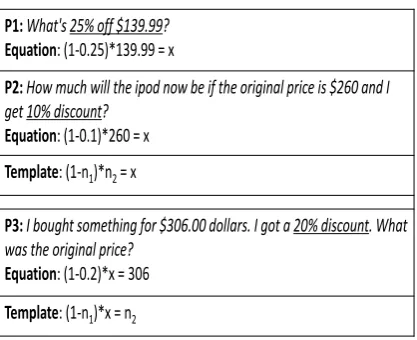
P1: What's 25% off $139.99? Equation: (1-0.25)*139.99 = x
P2: How much will the ipod now be if the original price is $260 and I
get 10% discount?
Equation: (1-0.1)*260 = x
Template: (1-n1)*n2= x
P3: I bought something for $306.00 dollars. I got a 20% discount. What
was the original price?
Equation: (1-0.2)*x = 306
[image:1.595.313.522.406.576.2]Template: (1-n1)*x = n2
Figure 1: Math Word Problem Examples.
In this paper, we focus on the acquisition of mathematical knowledge, or deriving math con-cepts from natural language. Consider the first two problemsP1andP2in Figure1. The math con-cept in the problems tells you to take away a per-centage from one and get the resulting perper-centage of a total. Using mathematical language, it can be formulated as(1−n1)∗n2, wheren1, n2are
quan-tities. In this example, we can derive the concept of subtraction from the text “[NUM] % off” and “[NUM] % discount”.
Acquisition of mathematical knowledge is non-trivial. Initial statistical approaches (Hosseini et al., 2014; Roy and Roth, 2015; Koncel-Kedziorski et al., 2015) derive math concepts based on observations from their dataset of spe-cific types of problems, e.g. problems with one single equation. For example, Hosseini et al.
(2014) assumes verbs and only verbs embed math concepts and map them to addition/subtraction.
Roy and Roth (2015); Koncel-Kedziorski et al.
(2015) assume there is only one unknown vari-able in the problem and cannot derive math con-cepts involving constants or more than one un-known variables, such as “the product of two un-known numbers”.
Template-based approaches (Kushman et al.,
2014;Zhou et al.,2015;Upadhyay et al., 2016), on the other hand, leverage the built-in composi-tion structure of equacomposi-tion system templates to for-mulate all types of math concepts seen in train-ing data, such as(1−n1)∗n2 = x in Figure1.
However, they suffer from two major shortcom-ings. First, the math concepts they learned, which is expressed as an entire template, fails to capture a lot of useful information with sparse training in-stances. We argue that it would be more expres-sive if the math concept is learned in a finer granu-larity. Second, their learning processes rely heav-ily on lexical and syntactic features, such as the dependency path between two slots in a template. When applied to a large-scale dataset, they create a huge and sparse feature space and it is unclear how these template-related features would contribute.
To alleviate the sparseness problem of math concept learning and better utilize templates, we propose a novel approach to capture rich informa-tion contained in templates, including textual ex-pressions that imply math concepts. We parse the template into a tree structure and define “template fragment” as any subtree with at least one opera-tor and two operands. We learn fine-grained map-pings between textual expressions and template fragments, based on longest common substring. For example, given the three problems in Figure1, we can map “[NUM]% off” and “[NUM]% dis-count” to1−n1, and “[NUM]% off[NUM]” to
(1−n1)∗n2 =x. In this way, we can decompose
the templates and learn math concepts in a finer grain. Furthermore, we observe that problems of the same template share some common properties. By aggregating problems of the same template and
capturing these properties, we automatically con-struct a sketch for each template in the training data.
Our approach is implemented in a two-stage system. We first retrieve a few relevant templates in the training data. This narrows our search space to focus only on those templates that are likely to be relevant. Then we align numbers in the prob-lem to those few returned templates, and do fine-grained inference to obtain the final answer. We show that the textural expressions and template sketch we propose are effective for both stages. In addition, our system significantly reduces the hy-pothesis space of candidate equations compared to previous systems, which benefits the learning pro-cess and inference at scale.
We evaluate our system on the benchmark dataset provided byHuang et al.(2016). Experi-ments show that our system outperforms two state-of-the-art baselines with a more than 10% abso-lute (54% relative) accuracy increase in the linear benchmark and a more than 20% absolute (71% relative) accuracy increase for the dataset with a template size greater than or equal to 6.
In the remaining parts of this paper, we in-troduce related work in Section 2, describe tem-plate sketch and textual expression learning in Section 3, present our two-stage system in Sec-tion4, summarize experiment setup and results in Section5, and conclude this paper in Section6.
2 Related Work
Automatic math word problem solving meth-ods (Bobrow,1964a,b;Charniak,1968,1969; Bri-ars and Larkin, 1984; Fletcher, 1985; Dellarosa,
their pre-defined semantic language. However, these methods are only effective in their desig-nated math problem categories and are not scal-able to other categories. For example, the method used by Shi et al.(2015) works extremely well for solving number word problems but not others.
In the statistical machine learning approach,
Hosseini et al.(2014) solves addition and subtrac-tion problems by extracting quantities as states and derive math concepts from verbs in the training data. Kushman et al. (2014) and Zhou et al.
(2015) generalize equations attached to problems with variable slots and number slots. They learn a probabilistic model for finding the best solution equation. Upadhyay et al.(2016) follows their approach and leverage math word problems with-out equation annotation as external resources. Seo et al. (2015) solves a set of SAT geometry ques-tions with text and diagram provided. Koncel-Kedziorski et al.(2015) and Roy and Roth(2015) target math problems that can be solved by one single linear equation. They map quantities and words to candidate equation trees and select the best tree using a statistical learning model. Mi-tra and Baral (2016) considers addition and sub-traction problems in three basic problem types: “Change”, “Part Whole” and “Comparison”. They manually design different features for each type, which is difficult to expand to more types.
In summary, previous methods can achieve high accuracy in limited math problem categories, (i.e. (Kushman et al.,2014;Shi et al.,2015)), but do not scale or perform well in datasets contain-ing various math problem types as inHuang et al.
(2016), as their designed features are becoming sparse. Their process of acquiring mathematical knowledge is either sparse or based on certain as-sumptions of specific problem types. To allevi-ate this problem, we introduce our templallevi-ate sketch construction and fine-grained expressions learning in the next section.
3 Template Sketch Construction
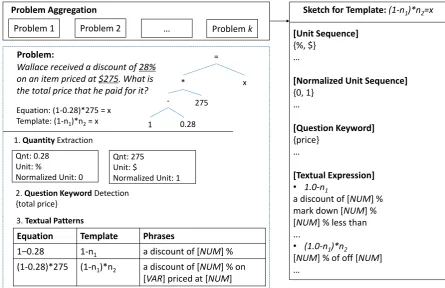
A template sketch contains template information. We define three categories of information for the sketch shown in this section. Next we describe how we construct a template sketch, via aggrega-tion of rich informaaggrega-tion from training problems. We group problems of the same template in train-ing set as one cluster and collect information. See Figure2for the outline of our template sketch
con-struction. 3.1 Definition
Template:It is first introduced in Kushman et al.
(2014). It is a unique form of an equation system. For example, given an equation system as follows:
2·x1+ 4·x2 = 34
x1+ 4 =x2
This equation system is a solution for a specific math word problem. We replace the numbers with four number slots{n1, n2, n3, n4}and generalize
the equations to the following template: n1·x1+n2·x2 =n3
x1+n4 =x2
Alignment: We align numbers in the math prob-lem with the number slots of a template. For the first math problem in Figure1with its correspond-ing template (1−n1)∗ n2 = x, there are two
numbers 0.25 and 139.99 to align with two num-ber slotsn1 andn2, which results in two different
alignments.
Kushman et al.(2014) aligns nouns to variable slots {x1, x2, ...} which leads to a huge
hypoth-esis space and does not perform as well as the number slot alignment only method proposed later by (Zhou et al., 2015). Therefore, we only con-sider number slot alignment in this paper.
3.2 Textual Expressions
For template fragments, there are usually some textual expressions. For example, “n1 % off” and
“n1 % discount” are both mapped to the template
fragment1−n1.
We employ a statistical framework to automat-ically mine textual expressions for template frag-ments from a training dataset. First we parse the equation to a hierarchical tree. In a bottom-up ap-proach, we obtain each possible subtree as a tem-plate fragment tk, which associates with at least
one number slot. For each tk, we use the
num-bers to anchor the number-related phrases in the problem, replace numbers with“[NUM]” and noun phrases with “[VAR]”, and cluster the phrases P ={p1, p2,· · · }with the sametkacross all data
given all training problems. Then we compute the longest common substring lcsk
ij between pairspi
andpj and calculate tf-idf score oflcskij. We keep
thelcsk
ij with scores above certain empirically
Sketch for Template: (1-n1)*n2=x
[Unit Sequence]
{%, $} …
[Normalized Unit Sequence]
{0, 1} …
[Question Keyword]
{price} …
[Textual Expression] • 1.0-n1
a discount of [NUM] % mark down [NUM] % [NUM] % less than ...
• (1.0-n1)*n2
[NUM] % of off [NUM] …
Problem 2
Problem 1 … Problem k
Problem Aggregation
Wallace received a discount of 28% on an item priced at $275. What is the total price that he paid for it?
=
x *
275
1
-0.28
Equation Template Phrases
1–0.28 1-n1 a discount of [NUM] %
(1-0.28)*275 (1-n1)*n2 a discount of [NUM] % on [VAR] priced at [NUM] 1. Quantity Extraction
Qnt: 0.28 Unit: %
Normalized Unit: 0
Qnt: 275 Unit: $
Normalized Unit: 1
2. Question Keyword Detection {total price}
[image:4.595.72.518.64.352.2]3. Textual Patterns Equation: (1-0.28)*275 = x Template: (1-n1)*n2= x Problem:
Figure 2: Template Sketch Construction.
3.3 Slot Type
Number slots in templates have their own type of constraints. For example, in the template(1−n1)∗
n2 = x, usuallyn1 represents a percentage
quan-tity andn2 is the quantity of an object.
We model slot types with quantity units, and find the direct governing noun phrase as its ‘owner’. For the problem in Figure 2, we ex-tract quantity unit sequence as{%, $}, normalized unit sequence as {0, 1} (because % and $ are of different quantity types), and quantity owners as
{discount, item}. The slot type information pro-vides important clues to choose the correct tem-plate and alignment.
3.4 Question Keyword
Question keyword decides which template we use. Given the following problem setting: “A rectangle has a width of 5cm and a length of 10cm.”, we can ask either Q1:“What is theareaof the rectangle?” or Q2: “What is thedifferencebetween width and length?”. The question keywordsareaand differ-encehelp our system to decide if is should apply templaten1 ∗n2 = x for Q1 and apply template
n1−n2=xfor Q2.
We first detect the question sentence (containing
keywords “what”,“how”,“figure out”...). Then we extract the question keyword on the dependency tree with simple rules that we observed in the dev set (e.g. retrieving nouns with “attr−nsubj” de-pendency relation with keyword “what”). Please note that we favor recall over precision of our de-tected question keywords since they are used as features instead of hard constrains on template de-cision. Simple rule-based extraction can already satisfy our need for detecting question keywords in math problems.
4 Two-Stage System
In this section, we describe our two-stage system for solving math problems, including template re-trieval and alignment ranking. We show how to apply textual expressions and template sketch to our system.
4.1 Template Retrieval
We use an efficient retrieval module to first narrow our search space and focus only on templates that are likely to be relevant. Let χdenote the set of test problems, andT ={t1, t2, . . . , tj}as the
tj. We define the conditional probability of
select-ing a template given a problem as follows:
p(tj|xi;νt) = P exp(νt·f(xi, tj)) t0
j∈T exp(νt·f(xi, t
0
j))
where νt is the model parameter and f(xi, tj)
is the feature vector. We apply the Ranking SVM (Herbrich et al.,2000) to minimize a regu-larized margin-based pairwise loss. We then have the following objective function:
1
2kνtk2+C
X
i
l(νT
t f(xi, tj)+−νtTf(xi, tl)−)
where superscript ”+” indicates the correct in-stance and ”-” indicates the false ones. We use the loss functionl(t) =max(0,1−t)2.
To construct the vectorf(xi, tj)for templatetj,
we use the three categories in the template sketch shown in Table1. LetQ(tj)represent the cluster
of training problems with templatetj.
Textual Features
Contains textual expressions in each template fragments?
Average Word Overlap withQ(tj)
Max Word Overlap withQ(tj)
Quantity Features Unit sequence inQ(tj)
Normalized unit sequence inQ(tj)
Question Features
[image:5.595.80.288.347.488.2]Is Question keyword inQ(tj)
Table 1: Features for template retrieval. At the phrase level, as we have mined differ-ent expressions in 3.2 for slots in templates, we can extract the phrases related to each number or number pair in a test problem and match them with expressions. For example, given a test problem to match template(1−n1)∗n2 =xin Figure2, we
have two groups of patterns to match, correspond-ing to1.0−n1and(1.0−n1)∗n2respectively.
Quantity types in a problem are important. We use the unit type sequences and normalized unit type sequence for describing number slot types in a template. In addition, if a number unit type can-not differentiate each number slot, we will make use of number “owner” as defined in subsection
3.3. For example, in the sentence ”The width is 3cm and the length is 5cm”, we extract two quanti-ties with unit type sequence{cm, cm}; and owner
{width, length}.
In addition, we consider question keywords for templates. For example, if the question keyword is ”difference”, thenx+n1 =n2will have a higher
probability of being selected thanx=n1∗n2.
We observe that in some cases, one word dif-ference can lead to two different templates. To consider cases in which some templates are very similar (e.g. x +n1 = n2 and n1 +n2 = x,
part/whole unknown), we retrieve the top ranked N (N=3) templates as candidates for alignment in the next stage.
4.2 Alignment Ranking
For each top N templates from the previous stage, we generate possible alignments A =
{a1, a2, . . . , am} as the candidate equation
sys-tem for the test problem xi. We train a ranking
model to choose the alignment with the highest probabilityp(ak|xi, tj;νa), whereνais the model
parameter vector.
p(ak) = P exp(νa·f(xi, ak)) a0
k∈Aexp(νa0·f(xi, a
0
k))
We use the same ranking model as in template se-lection stage and the objective function is changed to:
1
2kνak2+C
X
i
l(νaTf(xi, ak)+−νaTf(xi, al)−)
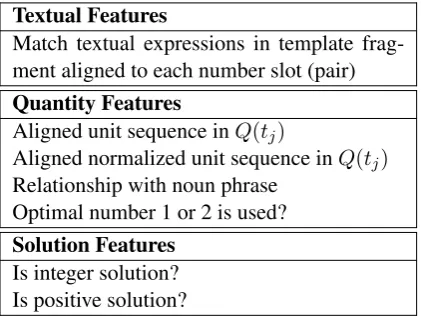
We design more fine-grained features for each number slot to formulate the alignment feature vectorf(xi, ak). It contains the following features
in Table2.
Textual Features
Match textual expressions in template frag-ment aligned to each number slot (pair) Quantity Features
Aligned unit sequence inQ(tj)
Aligned normalized unit sequence inQ(tj)
Relationship with noun phrase Optimal number 1 or 2 is used? Solution Features
Is integer solution? Is positive solution?
Table 2: Features for alignment ranking.
[image:5.595.312.523.528.686.2]mined patterns of 1−n1 in3.2, such as “a
dis-count ofn1 %”, “mark down n1 %”, etc. Given
the problem in Figure2as the test problem, align-ment(1-0.28)∗275 = xmatches textual expres-sions, while(1-275)∗0.28 =xdoes not.
For quantity features, we use the alignment-ordered unit sequence. For the problem in Figure
2 mapping to template (1−n1) ∗n2 = x, we
have two different alignments:{n1:0.28,n2:275}, {n1:275,n2:0.28}. Their aligned unit sequences
are{%, $} and{$,%} respectively. We also use the relations of quantities with noun phrases to dif-ferentiate number slot interaction with unknown variable slots and number slots, such asn1∗xand
n1∗n2.
Some templates have numerical solution prop-erties while others do not. For example, tem-plate x1 = (n1 − n2)/(n3 − n4) would be
less likely to have any strong indication of inte-ger solution properties. We count the percentage of integer/positive solutions from the correspond-ing problems as the probability that this template prefers an integer/positive solution.
4.3 Model Discussion
Our method has two main differences from pre-vious template-based methods (Kushman et al.,
2014;Zhou et al.,2015;Upadhyay et al.,2016). First, previous methods implicitly model map-ping from problem text to templates. We learn fine-grained textual expressions mapped to tem-plate fragments; and explicitly model the property of templates with template sketches. Second, pre-vious methods align numbers for all templates in a training set, while we only examine theN most probable templates. This significantly reduces the equation candidate search space. Given a prob-lem in which m numbers align with a template ofn number slots, the number of possible equa-tion candidates would be An
m. The search space
grows linearly with the number of templates in the training data. Suppose m = 5, n = 4 and we have 1000 templates, the total space would be (5∗ 4 ∗ 3 ∗ 2)∗ 1000 = 120,000 for one problem inZhou et al. (2015), and will be much larger if it considers unknown variable alignment as in (Kushman et al.,2014).
5 Experiments
Settings As demonstrated inHuang et al.(2016), previous datasets for math problems are limited in
both scale and diversity. We conduct our experi-ment on their dataset Dolphin18K. We use the lin-ear subset, containing 10,644 problems in total. We use two baseline systems for comparison: (1) ZDC (Zhou et al., 2015) is a statistical learning method that is an improved version of KAZB (Kushman et al.,2014)1. (2) SIM (Huang
et al.,2016) is a simple similarity based method. We do not compare other systems because they only solve one specific type of problem, e.g. Hos-seini et al.(2014) only handle addition/subtraction problems andKoncel-Kedziorski et al.(2015) aim to solve problems with one single linear equation. Experiments are conducted using 5-fold cross-validation with 80% problems randomly selected as training data and the remaining 20% for testing. We report the solution accuracy.
5.1 Overall Evaluation Results
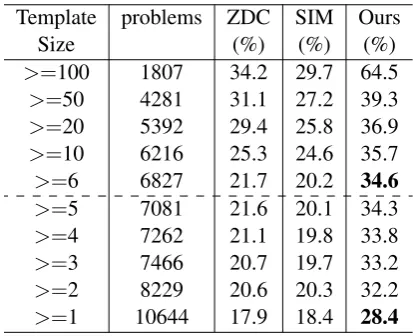
Table 3 shows the overall performance of differ-ent systems. In the table, the size of a template is the number of problems corresponding to a tem-plate. For example, for templates with a size 100 or larger, their problem counts add up to 1,807.
Template problems ZDC SIM Ours
Size (%) (%) (%)
>=100 1807 34.2 29.7 64.5
>=50 4281 31.1 27.2 39.3
>=20 5392 29.4 25.8 36.9
>=10 6216 25.3 24.6 35.7
>=6 6827 21.7 20.2 34.6
>=5 7081 21.6 20.1 34.3
>=4 7262 21.1 19.8 33.8
>=3 7466 20.7 19.7 33.2
>=2 8229 20.6 20.3 32.2
>=1 10644 17.9 18.4 28.4
Table 3: Overall evaluation results.
From the table, we observe that our model consistently achieves better performance than the baselines on all template sizes. As the template size becomes larger, all three systems achieve bet-ter performance. When template size equals 6 (TS6, as a de-facto template size constrain adopted in ZDC), our model achieve an absolute increase of over 12% (59% relative). This demonstrates the effectiveness of our proposed method.
1We ignore KAZB because it does not complete running
[image:6.595.312.519.409.577.2]When including long tail problems with a tem-plate size less than 2, performance of all three systems drop significantly. This is because the templates of these problems are not seen in the training set, and thus are difficult to solve using these template-based methods. Still, we have at least 10% absolute (54% relative) accuracy in-crease on the whole test set compared to the two baselines. Previous template-based methods re-quire templates size larger than 6 in the data as constraints. From the result, we can see that our method relaxes the template size constraint and matches more problems with less frequent tem-plates.
5.2 Accuracy per Template
Here we investigate the performance of different templates. In Table 4, we sample some domi-nant templates and report their accuracies. For our model, we report both template retrieval accuracy and final solution accuracy.
As we can see, our method performs better than the baselines for most dominant templates. Per-formance of the dominant templates can reach an accuracy level of 60%. This proves that our tem-plate sketch and textual expressions are effective in capturing rich template information.
To our surprise, some templates tend to perform better than others even with smaller template sizes. For example, x1 = n1 − n2, which represents
the subtraction problem, has 63 problems but per-forms not as well asx1 = (n1 −n2)/(n3 −n4)
which has 48 problems. We look into their corre-sponding problems and find out thatx1 =n1−n2
are applied to more themes in natural language thanx1 = (n1−n2)/(n3−n4), which are almost
about the theme of “coordinate slope”.
In our model, there is a gap between tem-plate retrieval accuracy and final solution accu-racy, which means that although we select the correct template candidates for the problem, the alignment model cannot rank the equations cor-rectly.
5.3 Two-Stage Evaluation
Next, we evaluate the performance of our two-stage system. Accuracy of template retrieval and alignment ranking is shown in Table5.
For template retrieval accuracy, Hit@N means the correct template for a problem is included in the top N list returned by our model. We es-timate the best achievable performance by using
oracle template retrieval. The result is 47.1% (Hit@ALL), which means 47.1% of the templates exist more than once in the problem set. Please note that our template retrieval evaluation may be underestimated, since in some cases, a test prob-lem can be solved by different templates.
We then use the top N templates as input for both our alignment ranking and ZDC. From the table, we have the following observations: (1) Hit@3 performs better compared to Hit@1 for both systems. This confirms our claim that some templates are similar and we need to incorporate more fine-grained features to differentiate in the alignment step; (2) It obtains the highest accu-racy when N = 3 and decreases when N gets larger. Both systems get benefits from our plate retrieval which helps retrieve relevant tem-plates and reduce the hypothesis space of equa-tions; (3) Given the sameN templates input, our alignment ranking achieves better performance than ZDC. This implies that our features are more indicative.
5.4 Feature Ablation
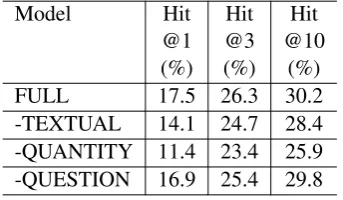
This section describes our feature ablation study. Template Retrieval In Table 6, we conduct three configurations against our model (FULL). Each ablated configuration corresponds to one category of our template sketch. From the ta-ble, we can see that all three categories of fea-tures contribute to system performance. We re-move QUANTITY results in the worse perfor-mance comparing to the FULL model.
Alignment Ranking In Table 7, N means to select the top N templates in the previous stage for alignment. The column ”Correct Template” represents how well the alignment model can per-form given the correct template input for align-ment. Our alignment model (FULL) performs the best compared to the three ablated settings, which confirms the effectiveness of template properties. 5.5 Error Analysis
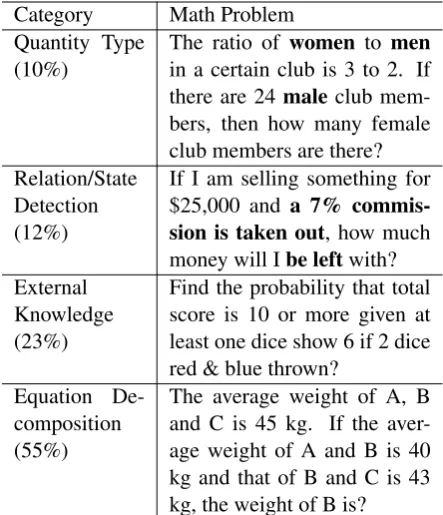
We have observed that template-based methods have difficulty solving problems with small tem-plate sizes, especially for cases that have a single problem instance (i.e. template size = 1). We sample 100 problems in which our system makes mistakes in the dev set of Dolphin18K and sum-marize them in Table8.
Ours
Template problems ZDC SIM Template retrieval Acc Final Acc
(%) (%) (%) (%)
n1∗x1 =n2 548 26.3 23.9 87.0 58.7
n1/x1=n2/n3 453 21.4 29.8 94.1 61.5
x1=n1∗n2 403 23.6 28.0 78.9 63.4
n1∗x1+n2∗x2=n3; 300 86.3 69.7 94.9 85.8
x1+x2 =n4
x1=n1∗n2∗n3 103 22.3 32.0 67.0 55.0
x1+x2 =n1 80 39.7 48.8 79.4 65.1
x1−x2 =n2
x1=n1−n2 63 11.7 15.9 50.7 23.4
[image:8.595.89.515.61.244.2]x1= (n1−n2)/(n3−n4) 48 14.9 18.8 95.7 89.4
Table 4: Accuracy Per Template. Template retrieval acc reports percent of templates appears in one of the top 3 templates returned by our method.
Hit@N 1 2 3 4 5 10 20 50 ALL
Template retrieval 17.5 22.4 26.3 27.2 28.0 30.2 32.7 35.2 47.1 Acc (%)
Final Acc (%) 24.9 27.6 28.4 27.9 27.4 25.3 22.3 22.1 20.1
[image:8.595.320.511.411.512.2]ZDC (%) 19.5 20.1 20.1 19.9 19.8 19.1 18.9 18.6 17.9
Table 5: Results of template retrieval and final accuracy with different topN templates retrieved.
Model Hit Hit Hit
@1 @3 @10
(%) (%) (%)
FULL 17.5 26.3 30.2
-TEXTUAL 14.1 24.7 28.4
-QUANTITY 11.4 23.4 25.9 -QUESTION 16.9 25.4 29.8
Table 6: Feature ablation of template retrieval.
the table, if we can detect “24 male” is the same as “men”, the problem can be solved.
Relation/State DetectionIf we can identify the changed states or mathematical relations between variables, we can solve this category of problems. In the example problem, it is important to under-stand that “commission is taken out” is my money state.
External Knowledge This requires specific mathematical models, such as permutation and combination, or commonsense knowledge, e.g. a dice has 6 sides.
Equation Decomposition The limitation of template-based approaches is that they require test problems belonging to one of the templates seen
Model Correct N= N=
Template 1 3
(%) (%) (%)
FULL 34.5 24.9 28.4
-TEXTUAL 31.9 22.2 25.1
-QUANTITY 29.2 20.9 23.3
-SOLUTION 26.3 18.7 21.2
Table 7: Feature ablation of alignment ranking.
in training. Thus, for problems corresponding to template sizes less than 2, we can decompose templates into smaller units and conduct learning more precisely. We then need to generate the equa-tions, which is also a challenge.
6 Conclusion and Future Work
[image:8.595.96.268.412.512.2]signifi-Category Math Problem Quantity Type
(10%) The ratio ofin a certain club is 3 to 2. Ifwomen to men there are 24maleclub mem-bers, then how many female club members are there? Relation/State
Detection (12%)
If I am selling something for $25,000 and a 7% commis-sion is taken out, how much money will Ibe leftwith? External
Knowledge (23%)
Find the probability that total score is 10 or more given at least one dice show 6 if 2 dice red & blue thrown?
Equation De-composition (55%)
[image:9.595.71.293.63.321.2]The average weight of A, B and C is 45 kg. If the aver-age weight of A and B is 40 kg and that of B and C is 43 kg, the weight of B is?
Table 8: Error Categorization.
cantly better than two state-of-the-art systems. Based on our error analysis, we plan to improve our model by detecting quantity types more accu-rately, learning relations and incorporating com-monsense knowledge. For long tail problems with a template size less 2, we want to utilize the fine-grained expressions we have learned and decom-pose equations for learning. Then we can reason with small equation units to generate a final equa-tion in testing. We would like to leverage seman-tic parsing and transform math problems to a more structured representation. Additionally, we plan to apply our findings to generating math problem.
7 Acknowledgments
This work is supported by the National Nat-ural Science Foundation of China (61472453, U1401256, U1501252, U1611264). Thanks to the anonymous reviewers for their helpful comments and suggestions.
References
Yefim Bakman. 2007. Robust understanding of
word problems with extraneous information. Http://arxiv.org/abs/math/0701393.
Daniel G. Bobrow. 1964a. Natural language input for a computer problem solving system. Technical report, Cambridge, MA, USA.
Daniel G. Bobrow. 1964b. Natural language input for a computer problem solving system. Ph.D. Thesis. Diane J. Briars and Jill H. Larkin. 1984. An integrated
model of skill in solving elementary word problems.
Cognition and Instruction, 1(3):245–296.
Eugene Charniak. 1968. Carps, a program which solves calculus word problems. Technical report. Eugene Charniak. 1969. Computer solution of
calcu-lus word problems. InProceedings of the 1st Inter-national Joint Conference on Artificial Intelligence, pages 303–316.
Denise Dellarosa. 1986. A computer simulation of
children’s arithmetic word-problem solving.
Behav-ior Research Methods, Instruments, & Computers, 18(2):147–154.
Charles R. Fletcher. 1985. Understanding and solving arithmetic word problems: A computer simulation.
Behavior Research Methods, Instruments, & Com-puters, 17(5):565–571.
Ralf Herbrich, Thore Graepel, and Klaus Obermayer.
2000. Large Margin Rank Boundaries for Ordinal
Regression, chapter 7.
Mohammad Javad Hosseini, Hannaneh Hajishirzi, Oren Etzioni, and Nate Kushman. 2014. Learning to solve arithmetic word problems with verb
catego-rization. InProceedings of the 2014 Conference on
Empirical Methods in Natural Language Process-ing.
Danqing Huang, Shuming Shi, Chin-Yew Lin, Jian Yin, and Wei-Ying Ma. 2016. How well do comput-ers solve math word problems? large-scale dataset
construction and evaluation. In Proceedings of the
52nd Annual Meeting of the Association for Compu-tational Linguistics.
Rik Koncel-Kedziorski, Hannaneh Hajishirzi, Ashish Sabharwal, Oren Etzioni, and Siena Dumas Ang. 2015. Parsing algebraic word problems into equa-tions. Transactions of the Association for Computa-tional Linguistics, 3:585–597.
Nate Kushman, Yoav Artzi, Luke Zettlemoyer, and Regina Barzilay. 2014. Learning to automatically
solve algebra word problems. InProceedings of the
52nd Annual Meeting of the Association for Compu-tational Linguistics.
Christian Liguda and Thies Pfeiffer. 2012. Modeling math word problems with augmented semantic
net-works. InNatural Language Processing and
Infor-mation Systems. International Conference on Appli-cations of Natural Language to Information Systems (NLDB-2012), pages 247–252.
Anirban Mukherjee and Utpal Garain. 2008. A review of methods for automatic understanding of natural language mathematical problems. Artificial Intelli-gence Review, 29(2):93–122.
Subhro Roy and Dan Roth. 2015. Solving general
arithmetic word problems. In Proceedings of the
2015 Conference on Empirical Methods in Natural Language Processing, pages 1743–1752. The Asso-ciation for Computational Linguistics.
Minjoon Seo, Hannaneh Hajishirzi, Ali Farhadi, Oren Etzioni, and Clint Malcolm. 2015. Solving geome-try problems: Combining text and diagram
interpre-tation. In Proceedings of the 2015 Conference on
Empirical Methods in Natural Language Process-ing.
Shuming Shi, Yuehui Wang, Chin-Yew Lin, Xiaojiang Liu, and Yong Rui. 2015. Automatically solving number word problems by semantic parsing and
rea-soning. InProceedings of the 2015 Conference on
Empirical Methods in Natural Language Process-ing.
Shyam Upadhyay, Ming-Wei Chang, Kai-Wei Chang, and Wen tau Yih. 2016. Learning from explicit and implicit supervision jointly for algebra word
prob-lems. In Proceedings of the 2016 Conference on
Empirical Methods in Natural Language Process-ing.
Ma Yuhui, Zhou Ying, Cui Guangzuo, Ren Yun, and Huang Ronghuai. 2010. Frame-based calculus of solving arithmetic multistep addition and
subtrac-tion word problems. Education Technology and
Computer Science, International Workshop, 2:476– 479.
Lipu Zhou, Shuaixiang Dai, and Liwei Chen. 2015. Learn to solve algebra word problems using
quadratic programming. InProceedings of the 2015