Contents
Introduction 3
Objective 3
Methodology 3
Key qualitative findings 8
Key quantitative findings 33
Recommendations for consideration 70
Conclusion 74
INTRODUCTION
The Crafts Council of Ireland (CCoI) commissioned Sia Consulting to undertake a sectoral analysis of the craft industry in the latter half of 2000. This report was submitted to CCoI in November 2000 and was subsequently published in May 2001. CCoI commissioned Sia to undertake a second benchmark of the Irish craft sector in September 2001.
The purpose of the 2001 benchmark is to track changes in the craft sector, to identify current issues and opinions and to highlight areas that require CCoI intervention. This research involved both quantitative and qualitative research. The quantitative research resulted in the development of statistically valid information on the Irish craft sector while the attitudes, opinions and expectations of the Irish craft sector were ascertained through extensive qualitative research.
This report presents the findings of the sectoral research undertaken by Sia Consulting on behalf of the Crafts Council of Ireland.
OBJECTIVE
The key objective of the assignment was as follows:
‘To provide the Crafts Council of Ireland with up to date, pertinent information on the Irish craft sector which will feed into the Craft Council of Ireland's future actions.’
The research aimed:
◆ to update the previously reported information on company size, location, staff numbers,
skill shortages, etc.
◆ to update the current reported figures in relation to annual turnover, wage levels, etc.
◆ to identify the primary obstacles to growth experienced by the craft sector
◆ to identify areas of potential market growth through qualitative interviews with a
sample of enterprises registered with the Crafts Council
◆ to assess the extent to which Irish craft meets the needs of customers
METHODOLOGY
The initial sectoral study undertaken in 2000 provided both qualitative and quantitative feedback on the Irish craft sector. It was agreed that the research methodology, incorporating a number of subtle changes, would be repeated in 2001. CCoI required quantitative data in order to develop a detailed profile of the craft sector in 2001. The qualitative aspect is designed to provide understanding as to why the picture is as it is. The quantitative data collected augments and updates the information which currently exists on the Irish craft sector.
For the purpose of the 2001 benchmark a postal survey to the entire CCoI database was identified as the optimum approach to obtaining reliable quantitative feedback from craftspeople. A number of additions were made to the structured questionnaire developed in 2000 and this was then distributed via postal survey to the full population of 1,308 craftspeople on the CCoI database, or Register of Craft Enterprise. A total of 456 questionnaires were received before the cut off date of 15th October 2001, which resulted in a response rate of 35% of the CCoI database. This compares very favourably with the percentage achieved (33%) in the 2000 study. The response rate is a reflection of the follow up reminders and the importance that the CCoI membership places on this research.
4
Structured questionnaire
The structured questionnaire included both open and closed questions. The closed questions canvassed craftspeople using ‘tick the box’ style questions, while the open questions asked the respondents to elaborate in areas of particular interest.
Qualitative research
In-depth telephone interviews were conducted by Sia consultants with 80 craftspeople from the CCoI database. The topic guide used was agreed with CCoI in advance. These qualitative interviews probed to understand the perceptions held by craftspeople on the sector’s development, the quality and variety of craft product, key barriers to growth and predictions for the future. The following table provides an outline of the breakdown of interviews carried out within each craft discipline:
CRAFT DISCIPLINE DATABASE TOTAL INTERVIEW QUOTA
Basketry 21 1
Bookbinding/Bookmaking 6 0
Candlemaking 17 1
Ceramics 265 16
Embroidery 19 0
Fly Tying 4 0
Fresco Painting 2 0
Furnituremaking 110 6
Glassmaking 91 5
Horology 3 0
Jewellerymaking 153 9
Leatherworking 17 1
Lettering 9 0
Metalworking 89 5
Mixed Media Construction 38 2
Musical Instrumentmaking 13 1
Paperworking 34 2
Printing 23 0
Silversmithing 18 0
Stoneworking 35 2
Textilemaking 280 17
Thatching 4 0
Toymaking 9 0
Woodworking 195 12
Other 13 0
Total 1,468 80
5
KEY QUALITATIVE FINDINGS
Overall findings from craftspeople
All interviewees across the range of craft disciplines gave freely of their time, views and opinions. The results of the interviews were analysed qualitatively and themes developed in terms of craftspeople's views on the Irish craft sector as a general market, perceptions towards the quality and variety of craft products, competition, key barriers to growth and future trends.
The following contains views, attitudes and concerns which were commonly held by the majority of craftspeople across all the various craft disciplines. Section 4.2 provides additional information which is specific to each craft discipline.
General market
Craftspeople were invited to outline their opinions on the status of the Irish craft sector and the causes of any growth, decline or stagnation in the sector. The majority of
interviewees suggested that the craft sector has experienced significant growth in the last five to six years. Estimations of between 10% and 25% sector growth per annum for the mid to late 1990's were put forward. Several interviewees described this period as being the most successful the craft sector has ever experienced. The favourable economic climate and greater affluence combined with significant advances made in terms of craft skills and professional business approach were identified as the primary factors contributing to this sector growth. Other factors which interviewees identified as contributing to growth in the craft sector included:
◆ greater awareness of and appreciation for Irish craft and hand made pieces among
consumers. Irish craft is increasingly viewed as an ‘art form.’ Top quality Irish craft products are now viewed by many consumers as an alternative to traditional ‘fine art’ pieces
◆ greater understanding, among the consumer base, of the skills and effort involved in
producing the various craft pieces
◆ significant improvement in the craft sector skill base and resultant enhancements in
terms of quality and variety produced. CCoI skills training received recognition for these improvements. Design and presentation skills, while still requiring further development, have also improved
◆ emergence of an increasingly discerning customer with a higher degree of visual
orientation and appreciation for design and creativity. Consumers are increasingly interested in the purchase of unique/individual pieces which the Irish craft sector is able to supply
◆ greater recognition in international markets for Irish craft
◆ greater access to the craft customer through increase in the number of retail outlets,
craft fairs and exhibition centres
◆ greater levels of disposable income and a less price sensitive customer
◆ increasing interest and investment in both home and garden improvement/decoration
7 ◆ A significant majority of interviewees, however, expressed concern over the
performance of the craft sector in the last six to twelve months. It was strongly indicated that the same level of growth was not experienced in this period. A general perception was held that the market has slowed down considerably in 2001. There was a strong consensus that the general slowdown in both the domestic and global economy, the fall off in tourism and the effects of the foot and mouth outbreak have had a very negative impact on sector growth. Craftspeople interviewed in 2001 stated that they had experienced an estimated growth of between approximately 2% and 8%. Several interviewees however did not experience any growth, while a small number experienced negative growth.
Other factors cited as contributing to this slowdown or fall off in sector growth include:
◆ conservatism on the part of buyers due to the global economic outlook. Both retailers
and agents, and to a lesser extent end consumers, were perceived to be buying lower volumes in the last six months
◆ cancellation of several trade fairs due to the foot and mouth crisis. Sales through this
very important channel have been affected as a result. Orders from retail outlets have been cancelled.Craftspeople have also noted that casual or ‘passing’ trade has suffered due to the restrictions on movement of people in the regions during the foot and mouth crisis. Interviewees also expressed concern that the crisis may affect sales in 2002 as retailers will be reluctant to place large orders with craftspeople due to the stock of craft pieces already held
◆ reduction in tourist numbers due to the combined effects of foot and mouth, the
slowdown in global markets and concerns over the Northern Ireland peace process
◆ absence of investment in innovation and research and development by the craft sector
at large. As the craft sector experienced rapid growth in the mid to late 1990's craftspeople were forced to place an emphasis on keeping pace with current demand rather than investing in design or product development. As a result a limited amount of new ranges and designs are released by the Irish craft sector each year. The Irish craft sector has thus become increasingly vulnerable to well designed international craft
◆ saturation of a limited market due to the high number of new entrants to the craft
sector in very recent years. Anecdotal evidence was given by several interviewees of recently established small craft enterprises which have been forced to cease trading. It was suggested that craft enterprises who restricted their sales to the domestic market were particularly vulnerable due to its limited size
◆ increase in the cost of materials, wage costs and other overheads throughout 2001.
Several craftspeople expressed concern that their profitability had been affected as a result
◆ inability of the market to sustain the pace of growth experienced over the last 12
months (ie, from 11/2000 to 11/2001)
◆ increasingly demanding terms and conditions imposed by intermediaries such as
8
Perceptions of quality and variety
Interviewee's opinions were sought on the performance of the Irish craft sector in meeting customer needs. Craftspeople were also asked to identify whether there are any gaps remaining in the market which could be more effectively exploited through an improvement in craft skills.
There was a strong consensus that the quality of Irish craft is excellent and would compare favourably in this respect with any international craft. The positive impact of CCoI training and an improvement in professional standards and craft skills were perceived to be the main contributory factors to achieving this high standard of quality.
The majority of interviewees, however, were concerned that Irish craft is not meeting the customer's needs in terms of either design or variety. The challenge in keeping pace with rapid sector growth and customer demand between 1995 and 2000 was suggested as the key reason for a lack of investment in design and product development during this period.
◆ Some improvements are perceived to have been made in terms of quality, design and
finish in recent years. CCoI training received praise for being largely responsible for these improvements. There was now, however, strong consensus that further development in terms of these criteria is critical for further growth to take place.
◆ Concern was raised over the scope of work produced in terms of quality. At the higher
end of the market the quality of craft produced was viewed very positively. This work compares very favourably with any work produced internationally. There was, however, a growing perception that the lower or ‘cheap and cheerful’ end of the market is gaining an increasing share. Those craftspeople who considered themselves to be operating at the higher end of the market expressed concern that such low quality products would generate a poor image for the craft sector at large.
◆ Several craftspeople were also disappointed at the increasing presence of craft pieces
which are promoted as both ‘Irish’ and ‘hand made’ when this is not entirely true. According to these interviewees the use of production techniques such as the ‘jigger jolly’ and the purchase of component pieces from international mass manufacturers should not allow the finished product to be promoted as either ‘Irish’ or ‘hand made.’These craftspeople believed that the Irish consumer is being misled in terms of what is and what is not hand made.’
◆ There is a considerable degree of opinion that gaps still exist in the Irish craft sector.
Improvements in terms of design skills were suggested as offering potential for developing new sales. Weak design skills and the lack of time to invest in product development were seen to be key challenges facing Irish craftspeople. The lack of innovation and creativity in terms of design is seen to offer potential to those
craftspeople who have strengths in this area. It is expected that a significant growth in the level of work commissioned by interested buyers such as corporations, local authorities and private investors would be possible if there were further investment in design and training in design. Other gaps in the market which were identified by craftspeople included:
– prizes/awards, etc., for example, golf, corporate awards, etc.
– garden design, sculpture and decoration
9 ◆ Consumer tastes and trends are perceived to be changing frequently. Craftspeople
believe it to be very challenging but important to keep pace with those changing trends and fashions. Colours appear to be becoming more fashion oriented and change frequently from season to season. Consumers are perceived to be growing slowly in terms of sophistication and appear to be increasingly interested in simple, low-key designs.
A small number of craftspeople indicated that they have made a conscious decision to develop at least two to three new lines each year. These craftspeople suggested that this initiative requires a ‘trade off’ between achieving efficiencies in production in the short term and securing a long term viable market. The majority of craftspeople however have found it difficult to devote the necessary amount of time and resources to design and product development in order to keep pace with consumer trends. Many of this group believed that the craft sector was falling in to the trap of producing the same lines from year to year.
◆ There was common agreement that a focus on quality in terms of production is crucial
for long term business success. The finished product will not appeal to intermediaries or end consumers if the quality is not of the expected standard.
Competition
There was a strong consensus among those being interviewed that the Irish craft sector is becoming increasingly competitive. Many craftspeople indicated that while they produce unique and individual pieces there is an acceptance that they are in fact competing directly or indirectly with other craft pieces in the same product group or price range. Several craftspeople were disappointed that they should be competing alongside low quality craft products. There is a realisation, however, that this is in fact unavoidable due to the lack of appreciation for high quality product among the customer base.
The following sources of competition were identified by craftspeople representing the majority of craft disciplines interviewed:
◆ all craftwork produced by Irish craftspeople, be it from any discipline, which sells
within the same price range. A large majority of craftspeople indicated that their product must stand out against anything else that might be on offer in the craft shop or at the trade fair
◆ several craftspeople from a number of disciplines identified international craft as an
increasingly competitive threat. The lack of innovation and creativity in terms of design in Irish craft was believed to be presenting design led international craft enterprises with a very attractive opportunity. There was also a commonly held opinion that import of very competitively priced craft from eastern Europe and the Far Eastern countries are gaining an increasing share of Irish domestic sales
◆ mass produced domestic and international products which are promoted as Irish hand
made craft are believed to be a key challenge to genuine Irish craft enterprises which concentrate on handmade craft
11 the future. Improvements in terms of design and finish were perceived to offer potential for
development of a more competitive and appealing product offering. Similarly effective presentation was viewed as a very practical means for improving the appeal of the product.
Branding and the importance of a recognisable or reputable name were considered by several craftspeople to be of growing importance. A small number of interviewees suggested that a well-developed brand offers significant potential for differentiating the product offering. A small number of craftspeople, however, were adamant that they are not in competition at all due to the very unique nature of their product.
Key barriers to growth
Craftspeople interviewed were encouraged to identify the primary barriers to development facing the Irish craft sector. A wide range of issues were raised in response to questions on this area. Some of these issues are quite specific to certain disciplines and are thus reflected in the next section which provides detail specific to each discipline. Isues which were raised consistently across all, or the majority of disciplines, are reflected below:
◆ the slowdown in both the domestic and global economy and the terrorist attacks on
the United States were identified as key areas of concern by the vast majority of craft people interviewed. There was general consensus that a slowdown in growth levels had already been experienced by the craft sector in 2001. Large-scale opinion was held that this slowdown would continue for the remainder of 2001 and would quite probably carry through to early 2002. The foot and mouth crisis and the drop off in tourism were also identified as key barriers experienced by the craft sector in terms of business development in 2001. A number of interviewees suggested that the craft sector will not be able to sustain craft enterprises who have not adopted a very professional approach to conducting business
◆ time, or the lack of, appears to be a critical barrier to growth for many craft
enterprises. Craftspeople are limited in their ability to take on certain orders due to their limited production capacity. The lack of available time also reduces their ability to invest in design and product development. Several craftspeople admitted that they would benefit from an improvement in their approach to time management and their prioritisation of tactical activities over strategic or long-term business development issues. Other internal barriers to business growth cited by craftspeople included the following:
– rising cost of staff: recruitment, training and salaries
– spiraling cost of overheads such as materials, light, heat, etc. These increasing costs are perceived to be limiting the potential for craft businesses in their efforts to expand
– the majority of craftspeople believed that an increasing emphasis on training in design, innovation and product development is required. Irish craft needs to prove itself internationally and measure up against international competition in these respects. There was a strongly held opinion that Irish craft is currently suffering from a lack of creativity and innovation which has resulted in a limited variety of craft pieces on the Irish market
12 ◆ in terms of competition many craftspeople believed that the market has now become
saturated with an increasing number of small-scale craft enterprises. Competition is now considered to be very intense in many of the craft disciplines. In addition to the large number of domestic craft businesses there is significant competition from the eastern European and Far Eastern countries. Their products are perceived to be reasonably well designed and very appealing to the consumer from a price perspective
◆ the powerful position of the intermediary is seen by many craftspeople as the most
significant barrier facing craftspeople. Retailers, trade-show hosts and gallery owners have imposed very onerous terms and conditions on craftspeople which has made it increasingly difficult to gain access to the end consumer. The margin or mark up imposed by retailers and the entry fee charged by trade show hosts has forced many craftspeople to develop alternative sales channels. In addition to these harsh terms the still limited number of channels increases the difficulty in accessing the end consumer
◆ research and development in the Irish craft sector has being very neglected in recent
years due to the demands of the day to day business operation. The lack of innovation may place Irish craft enterprises in danger of losing market share to international competition
◆ concern was raised over the lack of clear differentiation in terms of accompanying
communications between high quality and low-grade craft products. Low quality and mass manufactured craft products were seen to be ‘masquerading’ as high quality, hand made craft. A perception was commonly held by a significant number of craftspeople interviewed that customers still require further education in terms of the difference in quality of similar product types
◆ representatives of smaller craft businesses expressed concern over the growing power
of the larger craft enterprise. According to these sources it is becoming increasingly difficult to compete alongside the well-established brands and economies of scale enjoyed by larger scale companies
◆ developing international markets is perceived to be extremely challenging and in many
cases fraught with difficulties. Accessing market information, identifying suitable contacts and gaining access to appropriate trade fairs were put forward as the primary difficulties faced. The costs involved in developing these markets were seen to be a key barrier to the development of many craft businesses
◆ craftspeople have only recently developed a sense of self-confidence and self esteem.
13
Future trends
There is significant concern among craft representatives that sector growth will be limited in the next six to twelve months and possibly even beyond. The performance of the craft sector is very closely linked to the performance of the economy. The slowdown in the economy and the uncertainty in global markets caused by the recent terrorist attacks in the United States were put forward as the key reasons for this predicted slowdown. Craftspeople interviewed have already experienced declines in terms of growth levels achieved in 2001. This decline has been largely attributed to the combined effects of the restrictions caused by the foot and mouth crisis and the emergence of a more cautious and price sensitive craft buyer.
When discussing the implications of the foot and mouth crisis craftspeople were of the opinion that the effects would not be limited solely to the short term. Craftspeople commented on the high stock levels currently held by retailers due to the fall off in sales during the foot and mouth outbreak. As a result the retail sector is expected to place smaller orders with craft enterprises in the remainder of 2001 and early 2002.
The following market forecasts were generated when interviewees were asked to indicate whether the sale of Irish craft would increase or decrease. It should be noted that due to the timing of the interviews, craftspeople frequently conditioned their response by referring to the recent attacks in the United States and the threat of global conflict:
◆ uncertainty, and in many cases pessimism, exists as to whether growth in craft sector
turnover will be achieved in the next six months. Craftspeople however spoke very positively about anticipated craft sector growth subsequent to this period. The majority of craftspeople interviewed held the opinion that the sector was well enough developed to sustain this slowdown which is expected to be reasonably short lived. There was general consensus that the sector would return to positive growth at some point in 2002. A small number of craftspeople were very optimistic about both the immediate and long term future for their businesses and the craft sector at large
◆ there was a strongly held opinion that a significant number of craft enterprises may be
forced to cease trading due to a slowdown in sector growth and the advent of a more competitive market. Several craftspeople suggested that this slowdown may actually present an opportunity to craft enterprises who have adopted a very professional approach to managing their business. These craft enterprises would be in a position to secure a lot more business in a craft sector made up of a smaller number of players
◆ several craftspeople also predicted that the craft sector would experience some degree
of consolidation in that some of the larger businesses would ‘absorb’ or takeover some of the smaller craft enterprises. It was suggested that there would be a growing need to reduce overheads which would prompt craftspeople to combine resources
When asked to comment more generally on emerging market trends the craftspeople interviewed were generally quite positive. The following key issues were raised:
◆ the development of international, and in particular, European markets are identified as
providing craft enterprises with their biggest opportunity. The French, German and Dutch markets were identified as key targets by several craftspeople interviewed
◆ although some doubt was raised over the Irish consumers’ level of sophistication it
15 craft pieces. The need to develop a closer relationship with the consumer and a more
intimate understanding of their needs was put forward as being critical by a number of craftspeople
◆ improvements are expected to be made in terms of design, finish and display. This will
be largely driven by market demand and the increased level of competition from abroad
◆ a growth in the level of craftwork commissioned by public authorities, commercial
organisations and private investors is anticipated
◆ several craftspeople anticipated that there would be a fall off in the level of investment
and interest by craft enterprises in developing an internet presence. Anecdotal evidence arose of disappointment in initial attempts at exploiting this medium. A small number of craftspeople suggested that the craft sector had become disillusioned with the internet and questioned its suitability for displaying and selling craft goods
◆ several craftspeople also indicated that development of a reputable brand would
16
Craft discipline – specific findings
The previous section reflected issues which were commonly held by the representatives of the majority of craft disciplines interviewed. A number of issues were raised by
craftspeople which are specific to each craft discipline and these are categorised here.
Basketmaking
General market
◆ a marginal fall off in growth was experienced in 2001 by craftspeople interviewed from
the basketry discipline. The economic slowdown and the effects of foot and mouth were largely to blame for this slowdown. Basketmakers experienced consistent growth of between 5% and 10% throughout the latter-half of the nineties
◆ basketmakers feel that there is a greater appreciation among consumers for craft and
the value of hand made work
◆ more innovative, design led work in the basketmaking discipline is now
being produced. An emerging segment of customers are those who seek to purchase an innovative, creative product
Perceptions of quality and variety
◆ the Irish craft sector is most definitely meeting the needs of the customer. The
improvement in the quality, design and use of materials is very notable
◆ the basketmaking discipline is becoming increasingly competitive. The Irish consumer
has a lot of choice available
◆ basketmakers believe that design skills are lacking among all craftspeople and that
there is a need for continued investment in design and training in design
Competition
◆ other indigenous basketmakers are considered to be the only significant form of
competition by members of this discipline. They are competing on the same level in terms of price and high quality. The quality of imports from the Far East is inferior. Established customers are becoming increasingly aware of this difference in quality
Key barriers to growth
◆ basketmakers are finding it increasingly difficult to devote time to design and
experimentation. There is a fear among members of this discipline that craftspeople are falling into the trap of producing the ‘same old pieces’ year in year out
◆ business skills are viewed as becoming increasingly important by members of this
discipline
◆ the growing power of the retailer is now becoming an issue for many basketmakers.
Basketmakers are forced to be incredibly competitive in terms of price as a result
Future trends
◆ customers are becoming increasingly sophisticated and discerning. Unique pieces are
becoming increasingly appealing
◆ new markets will have to be developed due to the limited size of the domestic market
◆ an increasing emphasis will be required on design, creativity and innovation
◆ basketmakers were generally optimistic about the future of Irish craft. Predictions
17
Candlemaking
General market
◆ the candlemaking discipline experienced very rapid growth in the late 1990's. Sales in
2001 have not been as strong as in recent years. The combined effects of the foot and mouth crisis and the general slowdown in the economy are the primary factors causing this
◆ there is a lot more variety available to the Irish consumer in recent years. Investments
in innovation by Irish candlemakers are increasingly evident
◆ the market for Irish candles is becoming increasingly less seasonal. Both frequency
and volume of purchase of Irish candles is believed to have been increasing in recent years
◆ consumers are more interested in purchasing Irish made candles than imported
candles
Perceptions of quality and variety
◆ Irish candles compare very favourably with international produce. The buyer is offered
a very extensive range of colours, sizes and shapes
◆ candlemakers must continually invest in the development of new designs in order to
secure a viable business from year to year. Candlemakers need to make a conscious business decision to introduce a number of new ranges each year
Competition
◆ candlemaking in Ireland is becoming increasingly competitive. There are a large
quantity of excellently produced candle ranges available to the Irish consumer
◆ finish and presentation are particularly important competitive criteria in the candle
market. Candlemakers also have to be very cost efficient as the consumer is particularly price sensitive
Key barriers to growth
◆ the reluctance or inability among Irish craftspeople to develop international markets is
seen as a key barrier to growth by candlemakers interviewed in 2001. The limited size of the domestic market will determine that candlemakers and other craft disciplines look to export their product
◆ the cost involved in exhibiting and taking a stand at a trade fair is too high for many
candlemakers who are forced to develop alternative channels as a result
◆ the retailer is powerful and the terms that they impose limit access to customers
Future trends
◆ the pace of growth experienced in the craft will probably begin to stabilise in 2001 and
ensuing years. The limited size of the domestic market and the requirement for considerable investment in order to develop international markets were put forward as key reasons for this market projection
◆ craft businesses will need to constantly evolve and change their approach to business
19
Ceramics
General market
◆ growth in the ceramics sector between 1995 and 2000 was very significant. This growth
has stabilised or in some cases reversed to negative growth in the last twelve months. This is primarily due to a general slowdown in the economy and the cancellation of so many trade fairs as a result of the foot and mouth outbreak
◆ anecdotal evidence was given of a number of small scale and one-person ceramics
enterprises closing in the last twelve months. There was opinion that the overheads involved in such an enterprise are very difficult to sustain
◆ there is a significant improvement in recent years in the quality of ceramic product
produced by the Irish craft sector
◆ the ceramics customer is perceived to be becoming increasingly discerning in terms of
design and finish
◆ the craft retailer is becoming increasingly demanding in the terms they impose on
ceramists. Credit periods are being lengthened significantly
◆ sourcing skilled ceramists is no longer the challenge that it once was. The graduates
of the CCoI Skills Training course at Thomastown are very well respected
Attitudes and opinions to quality and variety
◆ ceramists were very positive in describing the craft sector's ability for meeting the
customer's needs. The quality and variety of ceramic work produced is considered to be excellent. It was suggested by a small number of interviewees that there was little difficulty in meeting current customer need as these needs are neither ‘demanding nor stretching.’ The Irish ceramics customer was described as being very insular and only affected to a slight extent by international influences
◆ batch and volume production techniques are being increasingly used in order to keep
pace with the volume of demand and the need for improved efficiencies
◆ a perception is held that there is currently a surplus of craft enterprises specialising in
ceramics. Competition is considered to be very intense. Several ceramists suggested that the dominant interest in any one craft discipline is only fleeting
◆ ceramists believed there to be significant differences in the quality of ceramic work
available on the Irish market. While the majority is considered to be excellent there is still a steady supply of low quality ceramic work
◆ consumers' tastes change from season to season. A significant number of ceramists
believe that there are gaps available to those who identify those changing trends at an early stage
◆ ceramists believe there are significant opportunities for larger scale companies to
exploit international markets. Mainland Europe was perceived to offer a lot of potential for ceramics organisations
◆ it was highlighted that there is a significant degree of scope for more outdoor sculpture
20 Competition
◆ the indigenous and international retailers are increasingly viewed as a competitor due
to their growing interest in stocking international ceramic lines
◆ the Irish ceramics market is becoming increasingly competitive. Several ceramists
believed that the sector is in fact reaching saturation point due to the large number of new business start-ups in recent years
◆ the domestic ceramics market is faced by increased competition from international
mass manufacturers offering reasonably ‘good-looking’ pieces for very competitive prices
◆ ceramists perceive branding to be of particular importance. Many suggested that a
well established brand name allows for a price premium to be charged on the product
Key barriers to growth facing the Irish craft sector
◆ research and development is very neglected in the Irish ceramics sector. Ceramists
believe this will leave them vulnerable to foreign competition in the near future
◆ strong opinion exists among practicing ceramists that a clear distinction should be
made between the work produced by professional craftspeople and that produced by amateur workers. Several craftspeople suggested that a quality mark be made available to CCoI registered ceramists
◆ continued emphasis is required on training in design, innovation and product
development
◆ the lack of easy access to market is perceived to be a key barrier to further growth.
Retailers are believed to be gaining in power and becoming increasingly demanding in their application of terms of trade. Trade fairs and exhibition centres are very limited in number and prove to be too costly for many ceramists
◆ ceramists believe that the lack of basic business skills and marketing expertise in
particular among Irish ceramists is becoming increasingly concerning
Future trends
◆ the immediate future of Irish ceramics is very uncertain due to the current economic
slowdown, the fall off in tourism and the cancellation of so many trade fairs due to the foot and mouth outbreak
◆ ceramics is not expected to maintain its position as the ‘in vogue’ craft discipline
indefnitely. Several ceramists suggested that a number of potteries will actually be forced to close down or merge with larger enterprises in the near future. Many viewed this possibility as being a positive development for the sector. The market is considered to be too small for the numbers currently involved
◆ future growth in domestic market is seen to be dependent on a greater awareness of
Irish ceramics being built among the general public
◆ ceramists were of the opinion that there is an increasing need to give equal focus to
the artistic end of the craft as well as the gift end. The development of appropriate exhibition space is critical to this
◆ the ceramics buyer is becoming more sophisticated, increasingly discerning and
21
Furnituremaking
General market
◆ growth in the Irish hand crafted furniture market has stabilised in 2001. This is largely
attributed to the general slowdown in the economy and the cancellation of so many trade fairs as a result of the foot and mouth outbreak. Retailers are judged to have purchased less and in some cases postponed or cancelled orders
◆ the rapid growth experienced in the years prior to 2001 was attributed to an increasing
awareness and appreciation for Irish craft. Furnituremakers also held the opinion that consumers placed a greater value on the craft and exhibited a far better understanding of the production skills involved
◆ there was consensus that there are more skilled furnituremakers in the Irish market in
recent years. The furniture college in Letterfrack received considerable praise for its very positive impact on improving skills in the craft sector
◆ customer expectation has become increasingly demanding in the furniture market.
This is viewed positively by the furnituremakers interviewed who suggested that the higher expectation levels had the combined effect of improving quality dramatically and eliminating unskilled craftspeople from the marketplace
Perceptions of quality and variety
◆ the quality of the furniture available in the Irish market compares very favourably with
that produced by international craft enterprises
◆ there is a concern among Irish furnituremakers that the current lack of emphasis on
innovation will leave this sector of Irish craft very vulnerable to international competition
◆ gaps are always available to furnituremakers who identify changing trends at an early
stage. The furniture buyer tends to look for specific styles from year to year
◆ furnituremakers held the opinion that there is a pressing need to improve presentation
and display skills as these are very lacking in the Irish sector
◆ an ongoing focus on the production of high quality well-finished pieces is particularly
important in the furniture market. Repeat business and referrals are vital and thus quality control assumes a high degree of importance
Competition
◆ competition from international retailers is becoming increasingly intense. There is a
perception among furnituremakers that retailers such as IKEA and Habitat are gaining an increasing share of the Irish market. The furniture stocked by these parties, while mass produced, is reasonably well designed. The Irish consumer, however, is under the impression that this stock is in some way hand made. It is also very appealing to consumers from a price perspective
Key barriers to growth
◆ furnituremakers cited an inability to devote the necessary time to innovation and design
as being a key barrier to business development. The time spent on crafting the pieces allows very little capacity for investment in design and creativity
◆ the limited number of retail outlets which have the necessary physical space to store
23 ◆ the absence of a top class gallery with suitable space to adequately exhibit furniture is
perceived by many craftspeople to be a key barrier to further development of this discipline. The retail and trade fair channels are not seen as appropriate to the needs of this discipline due to the large display space required for furniture. The current costs involved in exhibiting are also seen to be prohibitive for many furnituremakers
Future trends
◆ furnituremakers hold the opinion that consumers are becoming increasingly brand
conscious. Irish furnituremakers will be required to invest in building a brand image to compete with the larger domestic and international players
◆ an increase is expected in the level of work commissioned in the furniture discipline
Glassmaking
General market
◆ the majority of craftspeople within this discipline experienced little growth in 2001. A
small number suggested that they had actually experienced negative growth in the last twelve months. The fall off was largely attributed to the restrictions caused by the foot and mouth outbreak. The lack of investment in product development and innovation was also identified as a cause of the slowdown in market growth
◆ the late 1990's had proved to be very successful for Irish glassmakers. The growing
affluence of the Irish consumer was said to have contributed to the significant growth in this period. Other factors identified were as follows:
– a greater interest among Irish consumers in home decoration
– growing respect in both international and domestic markets for Irish craft and the quality of product produced
– a very significant improvement in the standard of craftwork produced by the entire sector through out the 1990's. The CCoI training programmes were seen to be largely instrumental in raising craft skill levels in this period
Perceptions of quality and variety
◆ the increasingly professional approach and emphasis on quality and finish adopted by
Irish craftspeople is believed to have contributed strongly to the improving performance of the glassmaking discipline in recent years
◆ the quality, design and finish of Irish glass is recognised as being excellent. Customers
continue however to be misled by mass manufacturers who promote their product as ‘hand made Irish craft’
◆ glassmakers believe that consumers are becoming more sophisticated and
knowledgeable. Consumers are very confident and knowledgeable about what they are looking for from the glassmaking discipline. There is a growing interest in the
minimalist look. Simple low key designs are now very much in fashion
Competition
◆ the challenge in identifying changing consumer trends is not believed to be too
24 Key barriers to growth
◆ the small size of the domestic market and the current lack of international market
development is believed to be a key barrier to further glassmaking sector growth
◆ the increasing cost of staff and other overheads has placed significant pressure on the
profitability of many glassmaking businesses
◆ glassmakers identified the current absence of basic business skills in many craft
enterprises as a key barrier to further development. Marketing and financial management skills were highlighted as being particularly important
◆ the growing power of the intermediary has placed pressure on craftspeople to develop
alternative channels to the customer. Several glassmakers spoke of the growing need for craftspeople to develop a retail presence
Future trends
◆ buyers of Irish glass are expected to become increasingly sophisticated, discerning and
more demanding. The craft industry will have to respond with an improvement in terms of design and an increased emphasis on quality and finish
◆ glassmakers were reasonably optimistic about the future for craft enterprises who
concentrate on developing international markets and who place an increasing emphasis on their approach to business management
Jewellerymaking
General market
◆ the majority of craftspeople from this discipline suggested that little growth was
achieved in 2001. The foot and mouth outbreak and general economic slowdown were suggested as causes for this lack of growth
◆ there was consensus that there are more skilled jewellers in the Irish market in recent
years. The CCoI Skills Training course received a lot of praise for its contribution to skills improvement in recent years
Perceptions of quality and variety
◆ jewellerymakers spoke of the lack of variety in the Irish market. The German and
Dutch markets were identified as being very progressive in terms of design and variety
◆ a perception is held among jewellerymakers that the Irish consumer is tiring of the
designs produced in Ireland. There is little evidence of creativity at the various trade fairs and jewellers expressed concern that future sales would be affected as a result
◆ international markets and in particular European markets are believed to offer
significant potential for Irish jewellers. Jewellery is seen to be very suitable for export due to the lack of heavy investment required in packaging and transportation
◆ several jewellers spoke of the need to make a conscious effort to introduce new ranges
each year. A greater emphasis will be required on design and innovation in the coming years
Key barriers to growth
◆ the lack of current international market development is seen as a key challenge to the
future development of Irish jewellery
◆ the fall in tourist numbers will force jewellers to develop new customers and markets.
25 Future trends
◆ the Irish craft sector is heavily dependent on both the domestic and global economy
according to jewellers interviewed in 2001. A slowdown in growth is anticipated by the majority of jewellers spoken to during the course of this research. This slowdown, however, is expected to be limited to the next six or twelve months
◆ jewellers believe they are particularly dependent on the tourist market and thus expect
to develop additional markets in future months
Leatherworking
General market
◆ indications from this craft discipline are that growth in the craft sector stabilised in
2001. The foot and mouth crisis was believed to have had a major impact on the sale of Irish craft in the first six months of the year
Perceptions of quality and variety
◆ customers are increasingly interested in quality and finish
Competition
◆ the competition from mass produced leather manufacturers has become particularly
intense in recent years
◆ consumers are becoming increasingly brand conscious. Manufacturers with a well
developed brand name are believed to present the most intense form of competition
Key barriers to growth
◆ the VAT imposed on craftspeople who earn over a 50,790 per annum is a key barrier to
growth. Craftspeople are forced to immediately place an additional 20% on to their selling price to compensate for this. The craftsperson’s competitive edge and incentive to grow is removed as a result
◆ the lack of available skills training in leather manufacturing is believed to be a key
barrier to future development of this discipline
◆ difficulties in managing cashflow due to the lengthy credit terms imposed by retailers
has removed the incentive for many craftspeople to establish their own business
Metalworking
General market
◆ metalworkers suggested that there was modest growth within the Irish craft sector in
2001. The trading years in both1999 and 2000 were however very good. The cause for market growth in those years was put down to the increasing interest in home improvement and decoration and the growing affluence of Irish consumers. The slowdown in 2001 was attributed largely to the effects of the foot and mouth outbreak
Perceptions of quality and variety
◆ customers are seen to be becoming more demanding and discerning. This is a very
positive trend for the quality focussed craftsperson
◆ wrought iron is particularly popular at the moment but this is expected to be
27 Competition
◆ Irish blacksmiths produce a very varied and distinctive range of products. However
metalworkers interviewed accepted that they are in fact competing alongside mass manufacturers who rely heavily on imported component pieces and those who use engineering and welding principles extensively
◆ it is becoming increasingly challenging for metalworkers to compete with imports
which are not as good quality but are priced very competitively
Key barriers to growth
◆ the demand for wrought iron product has been very high in recent years. Blacksmiths
are, however, faced with a capacity issue and an inability to complete large-scale orders due to the small staff size of their craft enterprises. The shortage of skilled staff in the Irish market was also raised in this context
◆ the slowdown in the economy and housing market in particular was viewed as a
particularly important challenge facing metalworkers in 2001
◆ the pressure in meeting current demand has led to a lack of investment in design and
innovation in metalworking
Mixed media construction
General market
◆ indications from this discipline are that growth in the craft sector has been reasonably
stable in the last two years. The limited number and size of retail outlets places constraints on potential market growth. International markets will have to be further developed in order to secure any additional sector growth
◆ the foot and mouth outbreak has affected craft sales in 2001. The cancellation of so
many trade fairs was a very significant loss to incur
◆ the County Enterprise Boards and Area Partnerships have played a key role in the
sectors development in recent years. The sector has benefited from their support in terms of training and general business advice
Competition
◆ the craft sector is becoming increasingly competitive. Imported craft presents a very
significant challenge for many of the craft disciplines. Competition within the domestic market is also intense with an increase in both available quantity and quality very noticeable in recent years
Key barriers to growth
◆ the terms and conditions imposed by retailers have limited the potential for growth
significantly
◆ the lack of presence in international markets is a cause of concern for Irish
28
Paperworking
General market
◆ craft sales were down considerably between May and July of 2001. This fall off in sales
was largely attributed to the cancellation of trade shows at Balmoral and Castlewellan where craftspeople would traditionally have taken a stand. Craftspeople have had to take more expensive stands at the Ideal Homes Exhibition in Kings Hall to compensate for these cancellations
◆ craftspeople in Northern Ireland appeared to be disappointed with the lack of
assistance provided by the Arts Council of Northern Ireland
Perceptions of quality and variety
◆ consumer tastes are changing rapidly from year to year. Craftspeople must keep pace
with this change
◆ craftspeople have found it very difficult to invest time in design and product
development due to the pace of demand in the late 1990's
Competition
◆ international competition is becoming increasingly intense
Key barriers to growth
◆ the lack of variety and investment in innovation is a cause of concern among
paperworkers. Irish craft is expected to become increasingly vulnerable to international competition as a result
Stoneworking
General market
◆ members of this discipline were reasonably positive about the performance of the craft
sector in recent years. The majority would have held the opinion that the craft sector has grown steadily between 10% and 20% per annum. The economic climate and increase in tourist numbers were suggested as key causes for this growth
◆ a slowdown was experienced this year by stoneworkers due to the foot and mouth
outbreak and the cancellation of a number of trade fairs
Competition
◆ customer loyalty is becoming increasingly difficult to secure in today's market
◆ the quality of some international craft is very good. It is most appealing to the
customer from a price perspective
Key barriers to growth
◆ the lack of business skill among craft enterprises was raised as a point of concern by
members of this discipline
◆ the lack of exposure that Irish craft receives in the national media
Future trends
◆ members of this discipline suggested that there may be less investment in internet
29
Textilemaking
General market
◆ consumers are increasingly interested in handmade pieces. Textilemakers were of the
opinion that there is a higher regard for craftwork among the general public. Consumers are increasingly interested in unique designs due to the large volume of mass produced items available on the Irish market
◆ the period between 1995 and 2000 was particularly good for textilemakers. Business in
the last 6 months of 2001 has slowed down considerably. Textilemakers blamed the slowdown in the economy and the effects of foot and mouth
◆ the market in Northern Ireland has been particularly poor in 2001. There is a lack of
interest or cautiousness among buyers due to the uncertainty in the Northern Ireland peace process
◆ several textilemakers held the opinion that the economy has been grinding to a halt for
a lot longer than most people realised. The sales generated in the most recent Showcase were down significantly on previous years according to these textilemakers
Perceptions of quality and variety
◆ the quality produced by the textile sector is viewed as being superior to that produced
in other countries
◆ the lack of innovation and the homogeneity of the current range in Irish textiles was
raised as a very significant concern by a large majority of textilemakers. There is a fear that the Irish market is becoming increasingly vulnerable to foreign competition due to this lack of emphasis on creativity
◆ opportunities still exist in the domestic market. There is an increasing need to
concentrate on design, quality and finish. Selecting the right colours is a key step in developing a new range
◆ the fashion boutiques are becoming increasingly important to the textile industry in
Ireland. The ability to charge the necessary price premium is not available in the majority of domestic craft shops
◆ Irish customers are becoming increasingly brand conscious. This applies to the
presence of a brand on the retail outlet and the craft piece itself
Competition
◆ the textiles sector is becoming increasingly competitive. Irish textilemakers are
competing with designer wear available in the high street boutiques, domestically produced craft pieces and mass produced goods from abroad
◆ textiles from China and the Far East are very price competitive. Irish textilemakers are
not in a position to compete on price alone due to the labour intensive nature of the craft
Key barriers to growth
◆ Irish textilemakers have been forced in recent years to develop new routes to the
market. The traditional craft shops no longer allow the craftsperson to charge an appropriate price. As a result textilemakers have sought to develop a closer working relationship with the high street boutique owners
◆ managing cashflow was identified as a particularly challenging task by the majority of
31 extent the terms imposed by Irish retailers appear to be becoming increasingly
demanding
◆ the high mark up percentile or margin imposed by craft retailers is particularly
challenging for makers of expensive goods such as tapestries and rugs. Textilemakers are finding it very difficult to justify the final price charged to the end consumer
Future trends
◆ buyers of Irish textiles are becoming increasingly demanding in terms of quality. A
premium is now placed on quality control and ensuring that each piece produced is in perfect condition
◆ uncertainty exists over the immediate future of the textiles market due to the recent
slowdown in the global economy and the fall off in tourist visitors to Ireland. The majority of textilemakers predicted that the long-term outlook would be positive and that any slowdown would be confined to the next six or twelve months
◆ Irish designs will become increasingly influenced by our growing multi cultural society.
The challenges involved in keeping pace with new trends and fashions as a result of this will be significant for members of the textile market
Woodworking
General market
◆ woodworkers suggested that the Irish craft sector may have slowed down in 2001.
Significant growth levels were experienced by a large majority of Northern Ireland based woodworkers after the ceasefire in the mid 1990's. The standard of work produced by the Irish craft sector also improved dramatically in this period. The increased emphasis on quality and design was identified as being a key factor in achieving sector growth
◆ the foot and mouth outbreak and the general slowdown in the economy were identified
as the main causes for this slowdown in 2001. The cancellation of a number of trade fairs had a very negative effect on woodworkers in 2001. The retailers also appeared to be more cautious than in previous years
Perceptions of quality and variety
◆ the work produced by Irish woodworkers is of an excellent standard. The quality and
finish of craft pieces is very impressive when compared with international work
◆ the lack of innovation and emphasis on design is a cause of concern for many
woodworkers. There was opinion that the Irish craft sector will become increasingly vulnerable to design led international competition if the current lack of emphasis on innovation continues
◆ woodworkers held the opinion that the market has seen a shift from the rustic look to
a more contemporary minimalist look
Competition
◆ woodworkers are increasingly competing with high quality imports from the third world
countries. Some of the work produced in these markets is of a reasonable quality and is priced very competitively
Key barriers to growth
◆ the smaller craft enterprises are finding it increasingly difficult to compete with the
larger companies and the economies of scale enjoyed by these companies
◆ managing cashflow is becoming increasingly difficult for craftspeople due to the length
of time it takes retailers to pay invoices
◆ the intermediary appears to be assuming greater power in the Irish craft sector.
Several woodworkers spoke of the need to develop alternative channels to market due to the mark up imposed by retailers and the entry fee charged by trade show hosts
◆ the lack of appropriate exhibition space outside Kilkenny was also raised as a point of
concern by several woodworkers
KEY QUANTITATIVE FINDINGS
Introduction
A total of 1,308 questionnaires were circulated by post, representing the entire Crafts Council database. 456 questionnaires were returned, representing a 35% proportion of the entire Crafts Council database, an increase on last year of 2 percentage points from 33%. In absolute terms, the number of total responses has increased by 80 (21%) from the figure of 376 in 2000. This will lend extra credence to the findings. In addition, the high level of internal correlation between the 2000 and 2001 findings in most categories also validates the sample.
The sample shows a highly representative spread of respondent businesses across the various craft disciplines, a fact which is important in ensuring the confidence with which the results can be treated. Finally, it is worth noting that in general in the 2001 survey an increased proportion of craftspeople chose to answer the various questions, with a consequent rise in response rate per question.
Profile of respondents
As with the year 2000 survey, respondents were asked a number of questions in order to provide a profile of the respondents. These questions related to the age and gender of respondents, and the length of time that they had been registered with the Crafts Council. Craftspeople were more open this year in responding to these questions, and there was no significant fall in response despite the somewhat personal nature of the questions.
Age profile
◆ In 2001 respondents were most likely to be between 35 and 44 years of age, as in the
year 2000 survey
◆ As in 2000, very few respondents (2% in 2001) were under 25 years old. The other less
common age category was that at the other end of the scale of over 55 years, a result which was also reflected in the 2000 survey
◆ The distribution of ages for respondents in both the 2001 and 2000 surveys was
approximately the same, but respondents to the 2001 survey were slightly less likely to be in the 45-54 age range than in 2000 and slightly more likely to be 25-34 years old.
33
Table 1: Number of respondents by age
AGE CATEGORIES 2001 SURVEY 2000 SURVEY
CRAFT ENTERPRISES CRAFT ENTERPRISES (BASE = 441) (BASE = 350)
Under 25 years 10 2% 5 1%
25 – 34 years 113 26% 84 24%
35 – 44 years 149 34% 116 33%
45 – 54 years 112 25% 108 31%
55+ years 57 13% 37 11%
Gender of respondents
◆ In 2001, as in the 2000 survey, respondents were slightly more likely to be female than
male.
Length of time registered with the Crafts Council
◆ As in the 2000 survey, respondents in 2001 were marginally more likely to have been
registered for over 10 years with the Crafts Council than for any shorter period of time
◆ In 2001, respondents were slightly more likely to have only registered with the Crafts
Council within the last 12 months than in 2000. However, in both years most respondents had been registered for more than one year
◆ Respondents in 2001 were slightly less likely to be registered for between 3 and 5
years. The basic distribution of responses, however, is very similar for both surveys.
Craft discipline
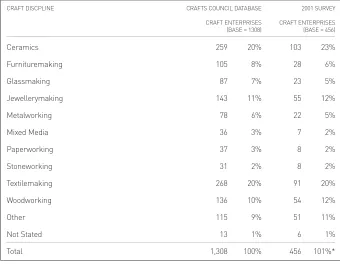
As with last year’s survey, eleven options were available for respondents to indicate their primary craft discipline. As the table below shows, the profile of the respondents was highly representative of the Crafts Council database, reflecting the validity of the sample. In line with the profile of the Crafts Council database, the most commonly represented disciplines in the sample are ceramics, jewellerymaking, textilemaking and woodworking.
34
Table 2: Number of respondents by gender
AGE CATEGORIES 2001 SURVEY 2000 SURVEY
CRAFT ENTERPRISES CRAFT ENTERPRISES (BASE = 442) (BASE = 342)
Male 211 48% 161 47%
Female 231 52% 181 53%
Total 442 100% 350 100%
Table 3: Number of respondents by length of time registered with the Crafts Council
LENGTH OF TIME REGISTERED WITH THE CRAFTS COUNCIL 2001 SURVEY 2000 SURVEY CRAFT ENTERPRISES CRAFT ENTERPRISES (BASE = 437) (BASE = 350)
Within last 12 months 39 9% 24 7%
1 – under 3 years 106 24% 81 23%
3 – under 5 years 80 18% 75 21%
5 – under 10 years 99 23% 80 23%
10+ years 113 26% 95 27%
*Note that in this and all subsequent tables some very slight rounding errors may occur
[image:35.595.184.524.139.403.2]35
Table 4: Number of respondents in comparison with the Crafts Council’s database (2001 Survey Only)
CRAFT DISCPLINE CRAFTS COUNCIL DATABASE 2001 SURVEY CRAFT ENTERPRISES CRAFT ENTERPRISES (BASE = 1308) (BASE = 456)
Ceramics 259 20% 103 23%
Furnituremaking 105 8% 28 6%
Glassmaking 87 7% 23 5%
Jewellerymaking 143 11% 55 12%
Metalworking 78 6% 22 5%
Mixed Media 36 3% 7 2%
Paperworking 37 3% 8 2%
Stoneworking 31 2% 8 2%
Textilemaking 268 20% 91 20%
Woodworking 136 10% 54 12%
Other 115 9% 51 11%
Not Stated 13 1% 6 1%
Total 1,308 100% 456 101%*
Table 5: Number of respondents by primary craft discipline
CRAFT DISCPLINE 2001 SURVEY 2000 SURVEY
CRAFT ENTERPRISES CRAFT ENTERPRISES (BASE = 450) (BASE = 350)
Ceramics 103 23% 84 22%
Furnituremaking 28 6% 72 19%
Glassmaking 23 5% 64 17%
Jewellerymaking 55 12% 42 11%
Metalworking 22 5% 32 9%
Mixed Media 7 2% 32 9%
Paperworking 8 2% 21 6%
Stoneworking 8 2% 12 3%
Textilemaking 91 20% 7 2%
Woodworking 54 12% 7 2%
Other 51 11% 3 1%
[image:35.595.186.524.431.693.2]An increased proportion of respondents selected the “Other” category in 2001 in
comparison with 2000. Among the disciplines listed in these responses were the following (in order of frequency):
◆ Candlemaking
◆ Leatherworking
◆ Basketmaking
◆ Musical instrument making
◆ Decorative painting
◆ Sculptor
◆ Silversmith
◆ Bellows making
◆ Thatching
◆ Clock making
◆ Metal spinning
◆ Street furniture
◆ Boat building
◆ Calligraphy
◆ Printmaking.
Proportion of time spent on craft business
◆ Most craftspeople (75%) work in their business on a full time basis. This has remained
the case across both surveys in 2000 and 2001
◆ This year there has been an increase in the proportion of respondents likely to be
working for less than 50% of their time on their craft business.
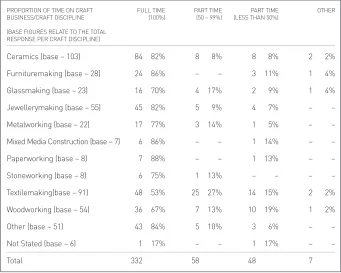
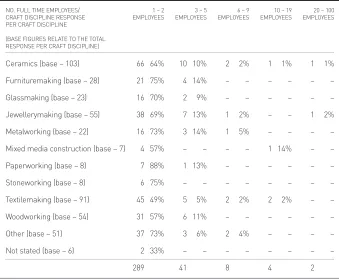
A breakdown of these figures by craft discipline shows that the 75% figure for all craftspeople conceals some significant differences between craft disciplines. Craftspeoples in the textiles discipline are the least likely to be working on a full time basis, at only 53% of all textile workers. Woodworkers are also less likely to be working full time, at only 67% of craftspeople in that discipline. Those in paperworking and furniture, at 88% and 86% respectively, are the most likely to be working on a full time basis.
36
Table 6: Proportion of time spent on craft business
PROPORTION OF TIME SPENT ON CRAFT BUSINESS 2001 SURVEY 2000 SURVEY CRAFT ENTERPRISES CRAFT ENTERPRISES (BASE = 446) (BASE = 368)
Full Time (100%) 333 75% 292 79%
Part Time (50 – 99%) 58 13% 48 13%
Part Time (less than 50%) 48 11% 20 5%
Other 7 2% 8 2%
Craftspeople who had selected “part time” or “other” elaborated on the issue of how they spent their work time. Some of the additional roles which were mentioned included:
◆ Designer
◆ Manufacturer/designer
◆ Single mother
◆ Teacher of art and design
◆ Student at Letterfrack – make pieces full time during the Summer
The nature of craftwork was illuminated by two respondents, one of whom stated that their craft work was “erratic,” while another described themselves as an “anyworker.”
For those respondents who did work part time or who chose the “other” category, the following table shows that while it is more common for them to intend to make their craft work full time, it is by no means a given, with 40% in 2001 stating that they do not intend to work at their craft on a full time basis.
37
Table 7: Breakdown of crafts disciplines by proportion of time spent on crafts business (2001 Survey Only)
PROPORTION OF TIME ON CRAFT FULL TIME PART TIME PART TIME OTHER BUSINESS/CRAFT DISCIPLINE (100%) (50 – 99%) (LESS THAN 50%)
(BASE FIGURES RELATE TO THE TOTAL RESPONSE PER CRAFT DISCIPLINE)
Ceramics (base – 103) 84 82% 8 8% 8 8% 2 2%
Furnituremaking (base – 28) 24 86% – – 3 11% 1 4%
Glassmaking (base – 23) 16 70% 4 17% 2 9% 1 4%
Jewellerymaking (base – 55) 45 82% 5 9% 4 7% – –
Metalworking (base – 22) 17 77% 3 14% 1 5% – –
Mixed Media Construction (base – 7) 6 86% – – 1 14% – –
Paperworking (base – 8) 7 88% – – 1 13% – –
Stoneworking (base – 8) 6 75% 1 13% – – – –
Textilemaking(base – 91) 48 53% 25 27% 14 15% 2 2%
Woodworking (base – 54) 36 67% 7 13% 10 19% 1 2%
Other (base – 51) 43 84% 5 10% 3 6% – –
Not Stated (base – 6) 1 17% – – 1 17% – –
[image:37.595.184.525.139.412.2]Total 332 58 48 7
Table 8: Number of respondents selecting ‘part time’ or ‘other’ by intention to become full time craftsperson
INTENTION TO BECOME FULL TIME CRAFTSPERSON? 2001 SURVEY 2000 SURVEY CRAFT ENTERPRISES CRAFT ENTERPRISES (BASE = 113) (BASE = 76)
Yes 53 47% 34 45%
No 45 40% 32 42%
No Response 15 13% 10 13%