Quantifying the Effects of Text Duplication on Semantic Models
Alexandra Schofield1 Laure Thompson1 David Mimno2
1 Department of Computer Science, Cornell University, Ithaca, NY
{xanda, laurejt}@cs.cornell.edu
2 Department of Information Science, Cornell University, Ithaca, NY [email protected]
Abstract
Duplicate documents are a pervasive prob-lem in text datasets and can have a strong effect on unsupervised models. Meth-ods to remove duplicate texts are typically heuristic or very expensive, so it is vital to know when and why they are needed. We measure the sensitivity of two latent semantic methods to the presence of dif-ferent levels of document repetition. By artificially creating different forms of du-plicate text we confirm several hypotheses about how repeated text impacts models. While a small amount of duplication is tol-erable, substantial over-representation of subsets of the text may overwhelm mean-ingful topical patterns.
1 Introduction
Different discussions of the same subject tend to use similar words. Unsupervised models such as latent semantic analysis (LSA) (Deerwester et al.,
1990) and latent Dirichlet allocation (LDA) (Blei
et al., 2003) look for these statistical signatures
of topicality in the form of repeated word co-occurrences. These methods have become increas-ingly popular because they are powerful and easy to apply to large unlabeled datasets. The appar-ent ease-of-use of LSA and LDA, however, makes it easy to overlook potential problems in text cor-pora. In this work, we focus on measuring the im-pact of one such issue: duplicate text.
Latent semantic methods look for patterns of repetition. But when text is repeated exactly, sta-tistical methods that look for patterns may be di-verted from more meaningful semantic groups: verbatim repetition looks, to the algorithm, more topical than actual topics. If not accounted for, re-peated text can change measures of fitness to
over-value fit on repeated texts, or even “leak” held out data that is duplicated in the training data. At best, duplication may cause us to overestimate the ex-pressiveness and reliability of models. At worst, models skewed by text duplication may invalidate any conclusions drawn from them, and, by exten-sion, the method itself.
Text replication is a persistent and difficult problem in natural language corpora. In social media settings, partial duplication due to quota-tion and threading is ubiquitous. Of the 20k posts in the 20 Newsgroups corpus (Lang,1995), 1151 are exact duplicates, and 25% of the remaining to-kens are quoted text from other newsgroup mes-sages.1 In literary corpora, different versions of
the same document may also conflict: text files for Hamlet may differ slightly due to publisher information, line numbers, editorial changes be-tween Shakespeare’s folios, and footnotes. Re-moving exactly identical duplicates of texts is pos-sible through direct lexicographic matching, but for lexical near-duplicates and partial textual over-lap, we may need more careful heuristics to detect duplicates, forcing researchers to make judgments about what text to remove and what to keep.
Evaluating what level of duplication is “safe” can therefore not only reduce the risk of false conclusions but also save great amounts of work spent identifying and removing duplication. In this work, we investigate the effect of text dupli-cation on LSA and LDA by experimentally am-plifying the magnitude of text duplication in a variety of corpora. We look both at how mod-els shift to over-represent repeated text and how that shift affects the model representation of doc-uments without repetition. To account for the va-riety of types of duplication, we look at exact
du-1Computed using scikit-learn’s 20 News-groups API: http://scikit-learn.org/stable/ datasets/twenty_newsgroups.html
plication of whole documents as well as repetition of a text segment across many documents. Finally, we recommend what aspects of text deduplication one should focus on to successfully reduce nega-tive effects, with different suggestions depending on the chosen model.2
2 Previous Work
Text duplication and reuse is a well-established problem in textual corpora. The web is filled with pages of near-duplicate content (Broder et al.,
1997; Manku et al., 2007), journalistic reuse
is common practice with the dissemination of information from news agencies to newspapers
(Clough et al., 2002; Smith et al., 2013), and
plagiarism is prevalent in student submissions
(Clough et al.,2003). However, past work has
fo-cused on theidentification of reuse instead of the
effectsthat duplication has on semantic models. The detection of text reuse relies on the abil-ity to measure similarabil-ity between documents or passages. In general, these techniques measure the similarity of textual content, though other sim-ilarity metrics for reuse identification have been proposed (B¨ar et al., 2012). These measures can fall into two general groups: global and local. Global techniques measure the similarities of en-tire texts. These techniques are especially used for near-duplicate detection. A common approach of this form is fingerprinting (Potthast and Stein,
2008). This method involves transforming a doc-ument into a smaller representation (e.g. a set of n-grams) to measure similarity cheaply. Local techniques measure similarity at a finer granular-ity (e.g. paragraphs or sentences). In this setting, reuse may be mixed with text derived from other sources. These techniques often involve two steps: one aligning texts with some method (Lee,2007;
Smith et al.,2013)m and one scoring similarity of
aligned sequences, e.g. based on cosine similarity of the bag-of-words vector. All of these techniques require choices of hyperparameters such as simi-larity threshold and n-gram size that affect what the technique considers duplicate text. Our work focuses on understanding what types of document deduplication are important so that practitioners can make better-informed choices about how to calibrate these models.
2Code for our experiments can be found at https://github.com/heraldicsandfox/ semantic-text-duplication.
While it is possible to evaluate semantic models as features in a downstream supervised task, they are harder to evaluate intrinsically as unsupervised models of data exploration. For LDA, it is stan-dard to consider held-out likelihood of a test set as a measure of model fit (Wallach et al.,2009b). One can also use human evaluations to judge the interpretability of topic summaries (Chang et al.,
2009), though this measure can also be approxi-mated with autoapproxi-mated evaluations based on corpus statistics (Aletras and Stevenson,2013;Lau et al.,
2014;Mimno et al.,2011). One can also evaluate
individual topics based on how much they diverge from corpus-wide distributional expectations (
Al-Sumait et al.,2009).
Because LSA does not yield semantically meaningful dimensions, intrinsic approaches to evaluation are focused on the spatial aspects of the model’s word embedding into the real do-main. Word similarity tasks are perhaps the most common evaluation, which compare human “gold standard” judgments of word pair similarity to dis-tances between the corresponding word vectors
(Finkelstein et al., 2001;Bruni et al., 2012; Hill
et al., 2016). However, the vagueness of
defi-nitions of “similarity” and the contextual depen-dency of similarity have cast doubt on these as gold standards of evaluation (Faruqui et al.,2016). Solving word analogies using vector arithmetic is also sometimes used to evaluate neural word em-beddings, but LSA does not tend to produce this structure well (Pennington et al., 2014;Mikolov
et al.,2013).
3 Theorized Impact
The fundamental problem with repeated text in a distributional semantic model is the over-representation of specific word co-occurrences to a model. To understand this, we consider the ma-trix factorization representation of these models. Borrowing notation fromArora et al. (2013), we consider a corpus withM documents and vocab-ulary size V over which we want to learn a K-dimensional representation of each document and vocabulary term. We can build anM ×V matrix Cto represent our corpus, whereCdiis a function
of the frequency of term iin document d. Both LSA and LDA represent factorizations of this ma-trix into two rank-Kmatrices,C =W AT, where
toC before producing a truncated singular value decomposition C = UΣAT, withΣ a diagonal
matrix of dimensionK×K, andUandA column-orthogonal matrices. We can reduce this to the fac-torization above by multiplyingΣ with one of the two outer matrix factors, e.g. W = UΣ. LDA performs a non-negative matrix factorization on a smoothed stochastic version ofC, producing row-stochastic matricesW andA.
Duplicate text implies that more rows inCwill contain a particular signature of word frequencies. This implies that a low-rank matrix factorization will increasingly devote representative power to this particular textual signature in order to mini-mize loss in its representation. We expect to ob-serve two principal effects:
• As text is repeated more, to optimize model fit on the data, one or more topics/dimensions will converge to model the repeated text. • Text that is not exactly or near-exactly
re-peated (orsingulartext) will be modeled less effectively both in terms of model fit and in-terpretability.
These effects are based on the incentive of the model to overfit repeated text: topics and dimen-sions modeling solely the repeated text will leave less representational power for the remaining text, and combinations of repeated and singular text will likely yield less coherent topics.
4 Evaluation Methods
We quantitatively examine several aspects of mod-els with varying forms and degrees of duplica-tion to determine the magnitude of the change produced by repeated text. It is important to note that our goal is simply to measure the dif-ference between models, and not to make norma-tive statements about thequalityof topics. Indeed, many measures of topic quality such as word intru-sion (Chang et al.,2009) and word co-occurrence
(Newman et al., 2010; Mimno et al., 2011; Lau
et al.,2014) may improve as a result of
degener-ate, single-document topics: most documents are internally coherent, so a single document’s word distribution may appear to be a sensible topic. Loss The first aspect is model loss. As stated in Section 3, as a segment of text is repeated more, we anticipate that the fit over documents containing repeated text will improve, while the
fit over documents not containing repeated text will worsen. To evaluate this for LSA, we exam-ine the Frobenius norm of the difference between the reconstructionW AT andCfor the rows
corre-sponding to documents with and without repeated text. For LDA, we estimate the perplexity of both the training data and held-out data without repeti-tions from the same corpus.
Concentration Secondly, we examine compo-nent (e.g. topic/dimension) concentration. Rep-etition of a document amplifies the co-occurrence between the terms contained in the document. As this signal grows stronger, we expect models to begin “memorizing” these words. We anticipate that affected models will develop a simpler la-tent representation for the repeated document, one concentrated over a small number of components. For example, if a model is devoting topic k to a repeated document, then instances of that docu-ment should have a high proportion of topic k. Concentration measurements relate to loss, but fo-cuses specifically on the document-component or document-topic patterns, while loss also includes information about the topic-word dynamics.
The effect of components converging to a sin-gle piece of repeated text should be easily ob-served by examining how close topics are to the unigram language model induced by the repeated text. If we repeat multiple documents indepen-dently, however, we may also expect to see dis-tinct components correlated with disjoint subsets of the repeated texts. To account for this, we eval-uate component concentration separately for docu-ments with repeated text and without repeated text. For LDA, we examine theentropyof document vectors. Information entropy represents the expec-tation of the represenexpec-tation length of a given out-come as a function of the probability distribution over outcomes:
Ed=
�
k
θdklogθdk
whereθdk is the probability of a token generated
In LSA, entropy is not as directly applicable: vectors in W = UΣ can be arbitrarily real-numbered. However, we still want to access a sim-ilar basic concept, the amount a vector representa-tion of a document is concentrated in a few dimen-sions. So, we examine theabsolute dispersionof each row vectordinW:
Dd=
�
k
|dk|
�d�1 log
|dk|
�d�1
where dk is the kth component of d.
Abso-lute dispersion measures the entropy of the L1-normalized masses of the vectors inW.
Expressivity The final aspect is expressivity of topics. If one topic converges to the unigram lan-guage model of repeated documents, the result-ing model has effectively lost one topic worth of expressive power by focusing on overly-specific themes. Someone looking to learn generalized se-mantic corpus patterns from a topic model will therefore have one fewer topic of interest avail-able. The frequency of terms in the repeated text may also overwhelm the most probable terms in many of the topics, again reducing the ability to interpret these topics or to understand their con-tent through a summarized representation. While expressivity in the form of topic summaries makes little sense for LSA, using LDA models, we may examine topic summaries, obtained as the top s most probable terms of a topic wheresis a fixed parameter. We may select the same number of termssfrom the most probable in a unigram lan-guage model of the repeated text, and determine what proportion of the tokens obtained from con-catenating topic similarities are the top terms of the repeated text language model.
5 Experimental Setup
Data We use two corpora: a sample of arti-cles from the New York Times Annotated Cor-pus (Sandhaus,2008) and a collection of Reuters newswires from the Spanish Language News Text Corpus (REUSL) (Graff,1995). We choose news corpora because they provide well-curated text with repeated subjects but few exact document-level duplicates, though quotes and templated text may still cause text duplication. We can use these as a testbed for general duplication behaviors we see across a variety of corpora. Text is lower-cased and tokenized to only include tokens of three or
more characters, allowing for contractions or hy-phenations as single tokens. New York Times arti-cles average 494.5 words in length, while Reuters newswires average 201.5 words.
To ensure our experiments are the only cause of exact duplication of text in our corpora, we use strict methods of text deduplication. When two or more documents have more than 70% uni-gram overlap, we remove all but the longest doc-ument. In addition, we delete 7-grams that ap-pear in more than 10 documents based upon ex-isting thresholds for plagiarism detection (Citron
and Ginsparg, 2015). To account for stopwords,
we remove all terms appearing in more than 80% of documents. Finally, we remove documents with fewer than 7 tokens after processing. We perform this process on a random sample of 30,000 docu-ments from each corpus to ensure we may obtain a sample of 25,000 curated documents for each of our two corpora. We also produce 10% samples of these corpora, containing 2,500 documents each, to measure the effect of corpus size.
Text Duplication Treatments We use our dedu-plicated news corpora to construct datasets with artificial text duplication. We examine two differ-ent duplication scenarios: exact documdiffer-ent dupli-cation and template string duplidupli-cation.
In exact document duplication, we randomly samplep%of the documents in the dataset and in-clude c copies of each sampled document in our final corpus along with one copy each of the re-maining documents, which we refer to as singu-lardocuments. To test the extremes of this effect, we also performsingle documenttests for largec with only one repeated document. From these syn-thetically duplicative corpora, we can determine whether effects are triggered by the sheer volume of duplicated text or if they are influenced by the diversity of the copied documents.
In template string duplication, rather than du-plicating the sampled p% of documents, we prepend a fixed string to each document in thep%
sample, producing what we refer to astemplated
� � � �
��������
���� ���� ���� ���� ����
���� ���������������������
� � � �
��������
���� ���� ���� ���� ���� ���� ����
���� �������������������
[image:5.595.76.286.65.121.2]���������� ����� ���� ���
Figure 1: Training perplexity with LDA models trained on the REUSL 25k corpus with 80 top-ics. Perplexity decreases significantly for the du-plicated documents with repetition, but the effect on singular documents is negligible with repeated proportion of the corpus smaller than0.1.
� � �� ��
��� ���� ��������� ��������
���� ���� ���� ���� ���� ���� ����
���� ����������
� � �� ��
��� ���� ��������� ��������
���� ���� ���� ���� ���� ���� ���� ����
���� �������� �
� �� �� �� �� ��� ���
Figure 2: Perplexity from duplicating a single document remains largely unaffected for singu-lar documents until the number of repetitions is c= 4096, when duplicate texts outnumber singu-lar texts. There is also a subtle inflection point for smaller numbers of topicsK atc = 256, approx-imately 1/10th of the corpus, but this effect is not visible with more topics.
the first 100 words of the classic Lorem Ipsum filler text (Lorem Template), simulating repeated text with little lexical overlap with the documents. Because we are investigating bag-of-words mod-els, we do not worry about grammatical errors in the nearly-duplicated text, so the segmentation of this repeated prefix should not be a concern. Training We analyze two types of semantic models: LSA and LDA. LSA models are trained using tf-idf weighting on word-document matri-ces using custom Python code.3 LDA models are
trained using Mallet (McCallum,2002) with fixed hyperparameters α = 50/K and β = 0.01 for ease of comparison. To compute perplexity, we use log likelihood estimates from Mallet’s built-in left-to-right estimation (Wallach et al.,2009a).
6 Results
Because of the exponential combination of differ-ent experimdiffer-ental settings available, it would be un-feasible to examine all our metrics for all data. In-stead, we focus our analysis on specific examples
3Code usesscipy,numpy, andscikit-learn.
� � � �
���� ���� ���� ���� ���� ���� ���� ����
���� ���������������������
� � � �
����� ����� ����� ����� ����� ����� ����� �����
����� �������������������
� � � �
��������
���� ���� ���� ���� ����
�������������������
� � � �
��������
����� ����� ����� ����� ����� ����� �����
����� �����������������
[image:5.595.310.521.65.189.2]���������� ����� ���� ���
Figure 3: Model loss for LSA models with 80 components. Loss for duplicated documents de-creases as the number of repetitions c increases. The frequency of replication affects loss at a much smaller scale for singular documents.
that we believe demonstrate the effects seen in the rest of the corpus. We use smaller sets of 2.5k documents for examining the effect of heavy du-plication and sets of 25k documents otherwise.
6.1 Loss
We begin with the case of exact document dupli-cation. In Figure 1, the perplexity of LDA de-creases substantially as documents are duplicated. This reduction is due to better fit to the dupli-cated documents. As fit improves in duplidupli-cated documents, however, we do not see a meaning-fully worse fit for singular documents. These doc-uments increase in perplexity, but the increase is not significant at low levels of duplication, such as whenc= 2orp= 0.001. In the single document case in Figure 2, this effect is emphasized: like-lihood on singular documents remains level even with heavy repetition in short corpora. The sheer volume of duplicated text does not by itself dam-age model fit, likely because the duplicated text can be easily modeled by a single topic.
This effect is not solely due to LDA’s spe-cific probabilistic model. We see a similar pat-tern in LSA. In Figure 3, we see that loss for duplicated documents decreases as duplication in-creases. However, the amount of decay depends on the proportion of the corpus replicated: the smaller the proportion size, the more dramatic the decay. In contrast, the loss for singular documents increases only slightly with more copies, though more for higher proportions of duplication.
[image:5.595.76.287.230.298.2]� � � � �������� ���
��� ��� ��� ��� ��� ��� ��� ���
��� �����������������
� � � �
�������� ���
��� ��� ��� ��� ���
��� ������������������
� � � �
�������� ���
��� ��� ��� ���
��� ������������������
� � � �
�������� ���
��� ��� ��� ��� ��� ��� ��� ���
��� ������������������
� � � �
�������� ���
��� ��� ��� ��� ��� ��� ���
��� ������������������
����������
[image:6.595.80.515.66.127.2]����� ���� ���
Figure 4: Held-out data perplexity (in thousands) for different the NYT 25k corpus with varying numbers of topicsK. Increasing the proportion of repetition for exact duplicate documents does not increase test perplexity. With repeated corpus proportionp = 0.001, however, repeating documents exactly 4 times (but not 2 or 8 times) significantly improves perplexity, potentially because it induces a new topic to model it. Held-out data contained no repeated documents.
� � �� ��
��� ���� ��������� ��������
��� ��� ��� ��� ��� ��� ���
��� ��������������������
� � �� ��
��� ���� ��������� ��������
���� ���� ���� ���� ����
[image:6.595.310.524.226.339.2]���� ������������������ � � �� �� �� �� ��� ���
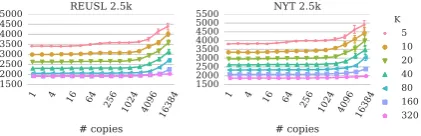
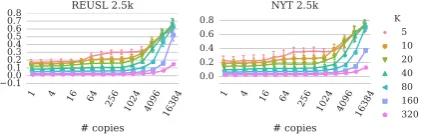
Figure 5: LSA model loss for the NYT 2.5k corpus with one duplicated document. Model loss for sin-gular documents is again unaffected by repetition, while loss for the duplicated document quickly falls to zero as repetition increases. The fall in loss signals the start of model “memorization.”
times. From Figure5, we see that the loss of sin-gular documents does not meaningfully change as the number of copies increases. We can observe the steep decline in loss for duplicated documents as the signal of when the topK components be-gin to “memorize” the duplicated document. The more components K, the fewer repetitions need for the overfitting to begin.
In the LDA case, we may also look at held out perplexity. Figure 4 shows that the fit for held-out test data is not generally significantly affected by increased repetition. There is a pattern within the data, in which repeating documents 4 times seems to produce better perplexity for singular documents than 2 or 8, significantly so for a small fraction of the corpus. A theory for this is that at a sufficient level of repetition, LDA fits the repeated text to its own topic instead of trying to conflate it with other document contents, producing better topics. However, additional repetition further sat-urates these topics and adds noise to the meaning-ful co-occurrence signal.
Figure6 demonstrates that, as before, perplex-ity is significantly higher as template repetition in-creases when there is a small number of topics K = 5. However, as the number of topics
in-� �� �� �� �� ��� ��� �
���� ���� ���� ���� �����
����� ���������������������� ����� ���� ���
� �� �� �� �� ��� ���
������������������������
� �� �� �� �� ��� ���
��������
� ���� ���� ���� ���� �����
����� �������������������������
� �� �� �� �� ��� ���
�������� ���������������������������
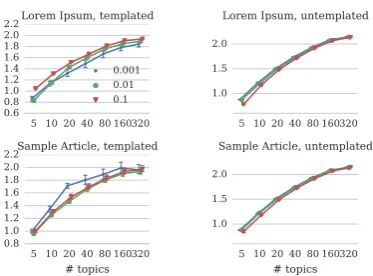
Figure 6: LDA training perplexity for REUSL 2.5k with different types of templated text repe-tition. The effect of duplication is prominent for small numbers of topics but diminishes with more topics to sufficiently model the missing text. With the fraction of the corpus that contains duplicates p = 0.1, the perplexity of template documents is below that of untemplated texts.
creases, this disparity ceases to be significant. In-terestingly, however, with high enough proportion pof documents containing templates, the perplex-ity drops below that of documents not containing the duplicates at all numbers of topics.
[image:6.595.77.287.228.295.2]� �� �� �� �� ��� ��� ��� ��� ��� ��� ��� ��� ��� ���������������������� � �� �� �� �� ��� ��� ������������������������ ������ ����� ���� ��� � �� �� �� �� ��� ��� ������������ ��� ��� ��� ��� ��� ��� ��� ������������������������� � �� �� �� �� ��� ��� ������������ ���������������������������
[image:7.595.74.288.63.179.2]Figure 7: LSA loss of templated text for the REUSL 25k corpus. Higher levels of templating presult in smaller model loss for templated texts than for untemplated texts. For p = 0.001, tem-plated loss becomes smaller than untemtem-plated loss forK = 160but more dramatically for theLorem Template. � � � � ��� ��� ��� ��� ��� ������������������������� ����� ���� ��� � � � � ���� ���� ���� ���� ���� ���� ���� ���� ���� �������������������� � � � � �������� ��� ��� ��� ��� ��� ��� ��� �������������������� � � � � �������� ���� ���� ���� ���� ���� ���� ���� ���� ���� ���� ������������������
Figure 8: Entropy for LDA with 80 topics de-creases for duplicated documents as the frequency of those documents increases, has little initial ef-fect on the entropy of the singular documents.
This may indicate that LSA is able to more ef-fectively model templated text when the templates have a distinctively different language model than the original documents.
6.2 Concentration
We expect the effect of duplication on entropy will be inversely correlated with its effect on model loss. As we increase the proportion of the cor-pus that is repeated, the model will devote more resources to duplicate text, leaving less modeling power for the remaining text. We therefore ex-pect dispersion to increase with p for duplicate documents and decrease withpfor singular docu-ments. In Figure8, the first effect clearly holds for LDA, but the second does not: there is a negligible
[image:7.595.312.522.65.216.2]� � � � ��� ��� ��� ��� ��� ���������������������� ����� ���� ��� � � � � ���� ���� ���� ���� ���� ���� ���� ���� ���� �������������������� � � � � �������� ��� ��� ��� ��� ��� ��� ��� �������������������� � � � � �������� ���� ���� ���� ���� ���� ���� ���� ���� ������������������
Figure 9: Absolute dispersion for LSA with 80 components increases slightly when first produc-ing duplicates (c = 2), but falls off for smaller proportions of repetitionp = 0.01andp = 0.001
at higher frequencies. Increasingchas a compar-atively small effect on the absolute dispersion of singular documents. � � �� �� ��� ���� ��������� �������� ��� ��� ��� ��� ��� ��� ���������� � � �� �� ��� ���� ���� ����� �������� ��� ��� ��� ��� ��� ��� �������� � � �� �� �� �� ��� ���
Figure 10: When a single document in the short corpora is repeated enough to comprise the major-ity of the corpus, the LDA entropy decreases over singular documents.
change in entropy with the number of repetitions of documents. Figure9shows a subtler version of the same effect for LSA. Notably, the decrease in absolute dispersion for repeated documents is only visible in the short corpora.
We can examine the extreme effects of the change in component concentration for singular documents by looking at its behavior in the sin-gle documenttreatment. In Figure10, we see that while entropy remains level for repetitions com-prising smaller portions of the corpus, eventually the entropy drops for both repeated and singu-lar documents. This may be because most top-ics describe the repeated document, leaving few to model the remaining singular documents.
[image:7.595.78.286.303.454.2] [image:7.595.309.521.340.407.2]� �� �� �� �� ������ ���
��� ��� ��� ��� ��� ��� ���
�������������������������
����� ���� ���
� �� �� �� �� ������ ���
��� ���
������������������������
� �� �� �� �� ������ �������� ���
��� ��� ��� ��� ��� ���
����������������������������
� �� �� �� �� ������ �������� ���
��� ���
[image:8.595.85.272.64.202.2]���������������������������
Figure 11: LDA entropy for the REUSL 25k cor-pus with Sample Template and Lorem Template
treatments. With few topics, templated documents have lower entropy than untemplated documents, but with many topics, their entropy is higher. In the mid range of topics forLorem Template, higher proportions of sampled textp produce higher en-tropy, but forSample Template, lowerpproduces higher entropy.
the prior to raise or lower entropy over topics, the components of LSA are fixed. Increasing the num-ber of components increases dimensionality, but never alters preexisting dimensions.
The effect is more subtle when templated text is repeated within documents. Figure 11 shows that with K = 20 LDA topics, if we apply the
Sample Templateto a small fraction of documents (p = 0.001), it produces a higher entropy than corpora with larger template inclusion proportion p. This is not surprising: though the template text and the original document are similar in style, with high probability they will still have different top-ics, which the model will have trouble fitting well without more observations. The Lorem Template
has the reverse effect: the language is sufficiently disjoint from the content of the documents that few topics or even a single topic can model the repeated text fully, leading to low entropy. When the language model of duplicated text is disjoint from that of the text of interest, the template can be modeled by one or a few topics or components without significantly affecting other text.
6.3 Expressivity
Quantitative analyses of model fit and topic uncer-tainty are helpful in analyzing the effect of differ-ent settings, but do not necessarily tell us whether topics from corpora with repeated documents are useful. Analysis of expressivity helps us fill in
some of the gaps in our explanations above as to what is happening at the individual topic level. In Figure12, we see that for a moderate number of topics, increased repetition of documents impacts a substantial portion of the top-ranked words, or most probable terms of topics. The saturation ef-fect has some relation to the number of repeated documents. With a single document repeated, as in Figure 13, as the number of topics increases, the ratio of top-ranked words belonging to the un-igram language model drops. We also notice that with few topics, there is a clear “saturation point” where the topic begins to be represented more, which remains level until half the short corpora are represented by the duplicate document. The pattern overwhelmingly shows that single texts are easily fit by single topics.
In the case of theLorem Templateinput, where little textual overlap exists between the template and original text, a few topics quickly fill in the repeated text, producing a limited effect on most topics. In Table1, the number of topics containing “lorem” and “ipsum” remains small as the num-ber of topics grows. Regardless of topic count of proportion, topics containing “lorem ipsum” are entirely broken Latin: the top probable terms of an example 320-topic model with p = 0.1 are
est justo donec iaculis sit ipsum quam lorem tris-tique sed amet eget pharetra curabitur fringilla non consequat mattis nec nascetur, a direct sam-ple of words from the template text.
7 Conclusion
The presence of duplicated strings, either docu-ments or duplicated text within docudocu-ments, is a se-rious but not insurmountable problem. Duplicate text can substantially alter the dimensions learned by distributional semantic models. The effect of duplication depends on several factors: the num-ber of distinct repeated strings, the similarity of repeated strings to the rest of the corpus, and the
Proportion 5 10 20 40 80 160 320
0.001 0 0 0 0 0 0.2 0.8
0.01 0 0 0.2 0.56 1 1 1
0.1 1 1 1 1 1.78 2.3 3
[image:8.595.308.523.645.687.2]� � � �
��������
���� ���� ����
���� ���������
� � � �
��������
���� ���� ���� ����
���� �������
����������
[image:9.595.76.285.65.118.2]����� ���� ���
Figure 12: With 80-topic LDA models of our larger datasets, we see that increased repetition leads to significant increases in the amount of rep-resentation of repeated text in the top keys of top-ics.
� � �� ��
��� ���� ��������� ��������
��� ��� ��� ��� ��� ��� ��� ��� ���
��� ����������
� � �� ��
��� ���� ��������� ��������
��� ��� ��� ��� ���
��������
� � �� �� �� �� ��� ���
Figure 13: Top keys of LDA topics for only a single repeated document remain concentrated in only a few topics in models withK > 5, negligi-bly impacting the top keys of remaining topics.
number of repetitions. We find that different algo-rithms are affected in different ways, but that there are methods to alleviate the effect of duplication without exhaustively removing all duplicated doc-uments. We provide the following specific conclu-sions and recommendations:
LDA accommodates low rates of document du-plication for many documents. We find that with more frequent repetition, the algorithm is able to sequester repeated text into small num-bers of topics if certain conditions hold. To handle this case, the model must have many topics avail-able relative to the number of repeated strings, and the language of the repeated text must be suffi-ciently distinct. If these conditions are met, re-peated text will affect a small number of topics that can be identified by their similarity to specific documents, or automatically based on lower than expected inter-document variability within a topic
(Mimno and Blei,2011) or distance from specific
corpus-word or document-word distributions (
Al-Sumait et al., 2009). We therefore suggest
train-ing a model first with slightly more topics than desired, then evaluating if there are any signs of repeated texts overwhelming several topics due to low coherence or corpus statistics. If no such in-dications occur, or if the duplication remains in one or two topics, then there is no need to modify the corpus or retrain the model, as the
duplicate-capturing topic may be ignored.
LSA permits high rates of document duplica-tion so long as few unique texts are repeated. Repeating one document will likely only affect one or a few components regardless of how many repetitions occur. However, if there are many dif-ferent repeated documents, more components will be used to model them, which worsens the model fit more as the number of unique repeated texts in-creases. In this case, it may be preferable to look for near-duplicate documents more aggressively and worry less about exact duplicates. Unigram-count-based deduplication may be appropriate in this case, using a simple threshold of cosine sim-ilarity between the vectors of unigram counts be-tween two documents to deduplicate.
Repeated text templates for LSA and LDA are sequestered by the model so long as they do not overlap heavily with topics of interest. In a topic model, it may be easy to identify the tem-plated text based upon it appearing in one topic. However, if there is a concern that there is sys-tematic use of text templates in documents (such as page headers or publication information) that may be too close to the language model, the n-gram removal approach inspired by Citron and
Ginsparg (2015) is an expensive but
straightfor-ward way to ensure these strings are detected and deleted. The combination of unigram dedupli-cation, n-gram deletion, and the inherent ability of semantic models to separate co-occurring text should reduce the negative effects of text duplica-tion.
Acknowledgments
[image:9.595.76.287.214.281.2]References
Nikolaos Aletras and Mark Stevenson. 2013. Evaluat-ing topic coherence usEvaluat-ing distributional semantics. InProceedings of the 10th International Conference on Computational Semantics, pages 13–22.
Loulwah AlSumait, Daniel Barbar´a, James Gentle, and Carlotta Domeniconi. 2009. Topic signifi-cance ranking of LDA generative models. InJoint European Conference on Machine Learning and Knowledge Discovery in Databases, pages 67–82. Springer.
Sanjeev Arora, Rong Ge, Yonatan Halpern, David M Mimno, Ankur Moitra, David Sontag, Yichen Wu, and Michael Zhu. 2013. A practical algorithm for topic modeling with provable guarantees. In Pro-ceedings of the 30th International Conference on Machine Learning, pages 280–288.
Daniel B¨ar, Torsten Zesch, and Irnya Gurevych. 2012. Text reuse detection using a composition of text sim-ilarity measures. InProceedings of the 24th Inter-national Conference on Computational Linguistics, volume 1, pages 167–184.
David M Blei, Andrew Y Ng, and Michael I Jordan. 2003. Latent Dirichlet allocation. The Journal of Machine Learning Research, 3:993–1022.
Andrei Z Broder, Steven C Glassman, Mark S Man-asse, and Geoffrey Zweig. 1997. Syntactic cluster-ing of the web. Computer Networks and ISDN Sys-tems, 29(8-13):1157–1166.
Elia Bruni, Gemma Boleda, Marco Baroni, and Nam-Khanh Tran. 2012. Distributional semantics in tech-nicolor. InProceedings of the 50th Annual Meeting of the Association for Computational Linguistics, volume 1, pages 136–145. Association for Compu-tational Linguistics.
Jonathan Chang, Sean Gerrish, Chong Wang, Jordan L Boyd-Graber, and David M Blei. 2009. Reading tea leaves: How humans interpret topic models. In Ad-vances in Neural Information Processing Systems, pages 288–296.
Daniel T Citron and Paul Ginsparg. 2015. Patterns of text reuse in a scientific corpus. Proceedings of the National Academy of Sciences, 112(1):25–30. Paul Clough, Robert Gaizauskas, Scott SL Piao, and
Yorick Wilks. 2002. Meter: Measuring text reuse. InProceedings of the 40th Annual Meeting of the As-sociation for Computational Linguistics, pages 152– 159.
Paul Clough et al. 2003. Old and new chal-lenges in automatic plagiarism detection. In National Plagiarism Advisory Service. Http://ir.shef.ac.uk/cloughie/index.html.
Scott Deerwester, Susan T Dumais, George W Fur-nas, Thomas K Landauer, and Richard Harshman.
1990. Indexing by latent semantic analysis. Jour-nal of the American Society for Information Science, 41(6):391.
Manaal Faruqui, Yulia Tsvetkov, Pushpendre Rastogi, and Chris Dyer. 2016. Problems with evaluation of word embeddings using word similarity tasks. Pro-ceedings of the 1st Workshop on Evaluating Vector-Space Representations for NLP, page 30.
Lev Finkelstein, Evgeniy Gabrilovich, Yossi Matias, Ehud Rivlin, Zach Solan, Gadi Wolfman, and Ey-tan Ruppin. 2001. Placing search in context: The concept revisited. InProceedings of the 10th Inter-national Conference on the World Wide Web, pages 406–414. ACM.
Gustavo Graff, David amd Gallegos. 1995. Span-ish news text. Linguistic Data Consortium, DVD: LDC95T9.
Felix Hill, Roi Reichart, and Anna Korhonen. 2016. Simlex-999: Evaluating semantic models with (gen-uine) similarity estimation. Computational Linguis-tics.
Ken Lang. 1995. Newsweeder: Learning to filter net-news. InProceedings of the 12th International Con-ference on Machine Learning, pages 331–339. Jey Han Lau, David Newman, and Timothy Baldwin.
2014. Machine reading tea leaves: Automatically evaluating topic coherence and topic model qual-ity. In Proceedings of the 52nd Annual Meeting of the Association for Computational Linguistics, pages 530–539.
John Lee. 2007. A computational model of text reuse in ancient literary texts. InProceedings of the 45th Annual Meeting of the Association for Computa-tional Linguistics, pages 472–479.
Gurmeet Singh Manku, Arvind Jain, and Anish Das Sarma. 2007. Detecting near-duplicates for web crawling. InProceedings of the 16th International Conference on the World Wide Web, pages 141–150. ACM.
Andrew K McCallum. 2002. MALLET: a ma-chine learning for language toolkit. Available at: http://mallet.cs.umass.edu.
Tomas Mikolov, Kai Chen, Greg Corrado, and Jef-frey Dean. 2013. Efficient estimation of word representations in vector space. arXiv preprint arXiv:1301.3781.
David Mimno and David Blei. 2011. Bayesian check-ing for topic models. In Proceedings of the Con-ference on Empirical Methods in Natural Language Processing, pages 227–237. Association for Com-putational Linguistics.
Proceedings of the Conference on Empirical Meth-ods in Natural Language Processing, pages 262– 272. Association for Computational Linguistics. David Newman, Jey Han Lau, Karl Grieser, and
Timo-thy Baldwin. 2010. Automatic evaluation of topic coherence. In Proceedings of the Meeting of the North American Chapter of the Association for Computational Linguistics: Human Language Tech-nologies.
Jeffrey Pennington, Richard Socher, and Christopher D Manning. 2014. GloVe: Global vectors for word representation. InProceedings of the Conference on Empirical Methods in Natural Language Processin, volume 14, pages 1532–1543.
Martin Potthast and Benno Stein. 2008. New issues in near-duplicate detection. InData Analysis, Ma-chine Learning and Applications, pages 601–609. Springer.
Evan Sandhaus. 2008. The New York Times anno-tated corpus. Linguistic Data Consortium, DVD: LDC2009T19.
David A Smith, Ryan Cordell, and Elizabeth Maddock Dillon. 2013. Infectious texts: Modeling text reuse in nineteenth-century newspapers. In Proceedings of the IEEE International Conference on Big Data, pages 86–94.
Hanna M Wallach, David Mimno, and Andrew K Mc-Callum. 2009a. Rethinking LDA: Why priors mat-ter. InAdvances in Neural Information Processing Systems, pages 1973–1981.